
Honest GIS Error and Uncertainty Blinded by Science
“Honest GIS”: Error and Uncertainty
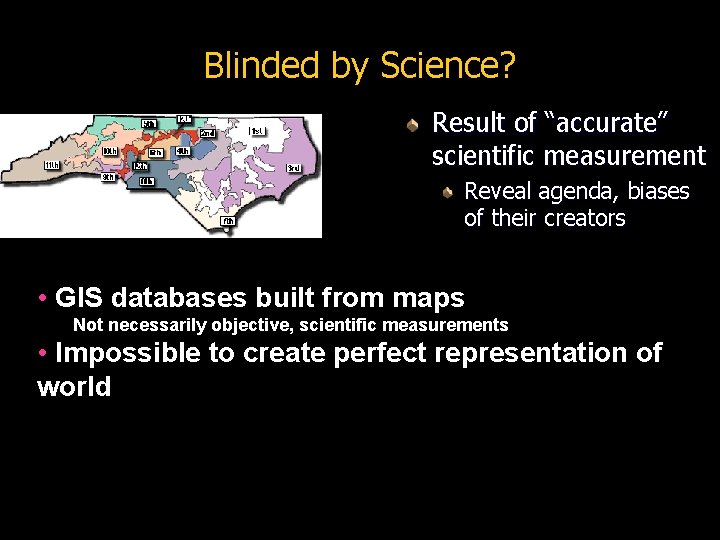
Blinded by Science? Result of “accurate” scientific measurement Reveal agenda, biases of their creators • GIS databases built from maps Not necessarily objective, scientific measurements • Impossible to create perfect representation of world
The Necessity of “Fuzziness” “It’s not easy to lie with maps, it’s essential. . . to present a useful and truthful picture, an accurate map must tell white lies. ” -- Mark Monmonier distort 3 -D world into 2 -D abstraction characterize most important aspects of spatial reality portray abstractions (e. g. , gradients, contours) as distinct spatial objects
Fuzziness (cont. ) All GIS subject to uncertainty What the data tell us about the real world Range of possible “truths” Uncertainty affects results of analysis Confidence limits - “plus or minus” Difficult to determine “If it comes from a computer it must be wright”
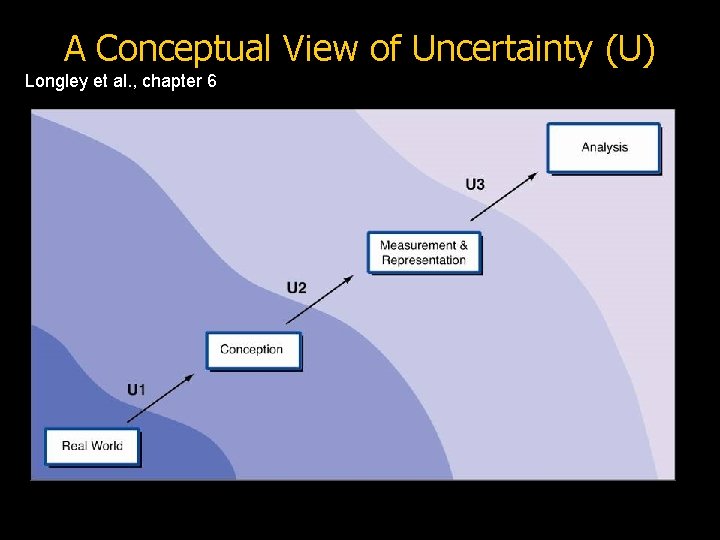
A Conceptual View of Uncertainty (U) Longley et al. , chapter 6

Digitizing Errors Longley et al. , ch. 9, p. 208
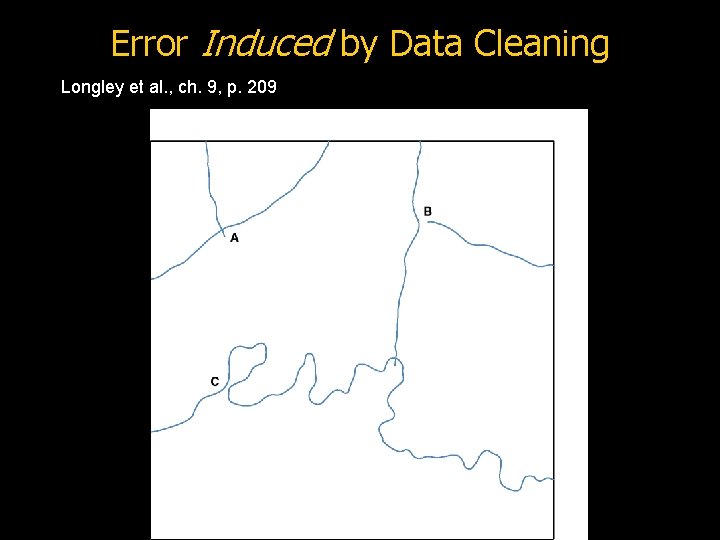
Error Induced by Data Cleaning Longley et al. , ch. 9, p. 209
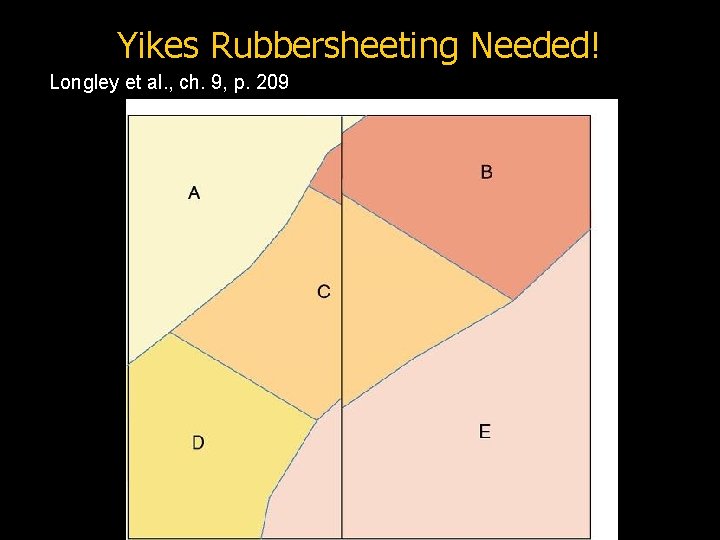
Yikes Rubbersheeting Needed! Longley et al. , ch. 9, p. 209
Uncertainty Measurements not perfectly accurate Maps distorted to make them readable Lines repositioned 5 th St. and railroad through Corvallis at scale of 1: 250, 000 At this scale both objects thinner than map symbols Map is generalized Definitions vague, ambiguous, subjective Landscape has changed over time
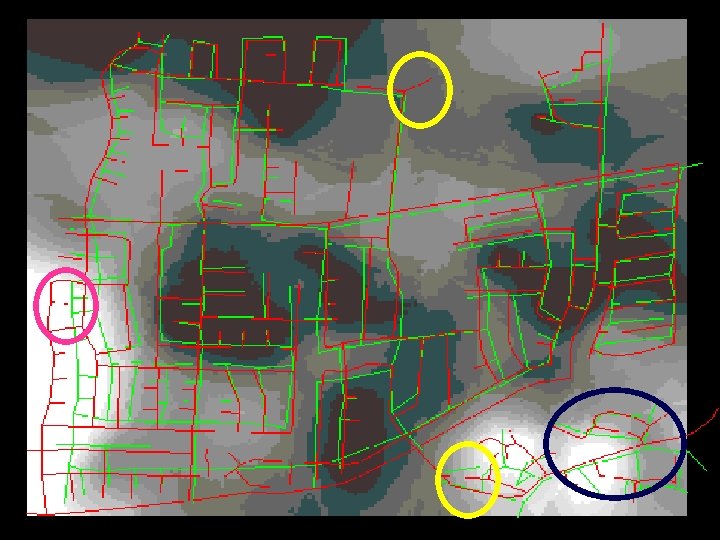
Berry “Shadow Maps of Uncertainty” http: //dusk. geo. orst. edu/buffgis/shadow. html
Towards an “Honest GIS” can map a simple feature location can also map a continuum of certainty model of the propagation of error (when maps are combined) assessing error on continuous surfaces verify performance of interpolation scheme
More Strategies Simulation strategy Complex models Describing uncertainty as “a spatially autoregressive model with parameter rho” not helpful How to get message across Many models out there Recent research on modeling uncertainty (NCGIA Intiative 1) Users can’t understand them all
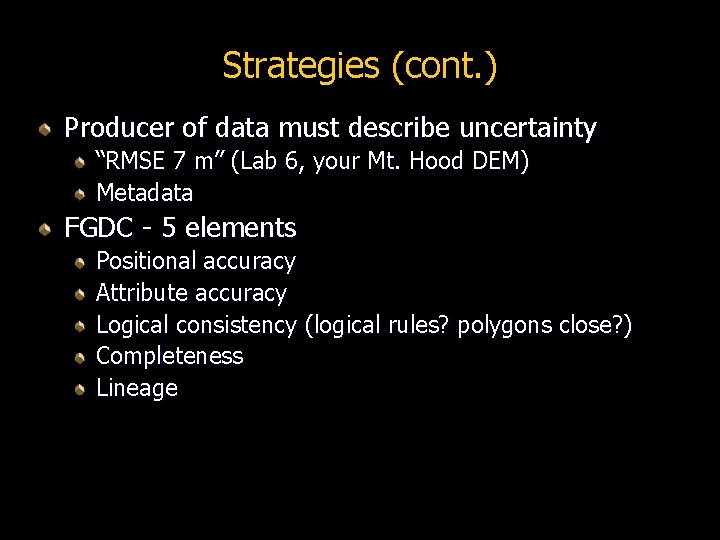
Strategies (cont. ) Producer of data must describe uncertainty “RMSE 7 m” (Lab 6, your Mt. Hood DEM) Metadata FGDC - 5 elements Positional accuracy Attribute accuracy Logical consistency (logical rules? polygons close? ) Completeness Lineage
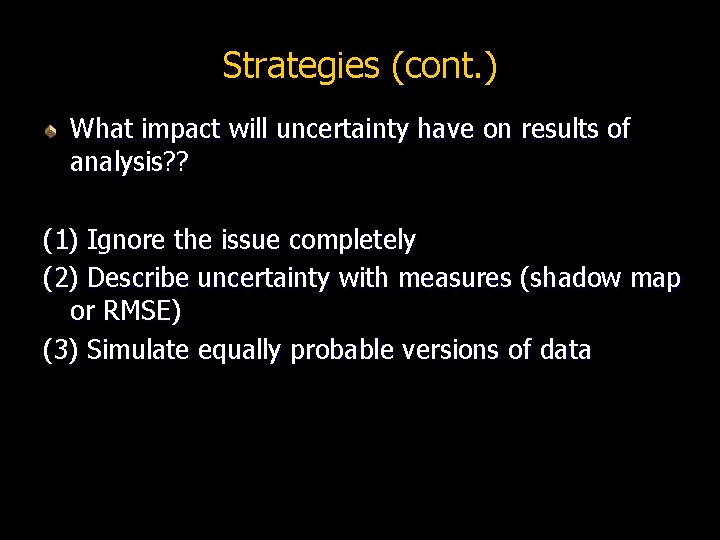
Strategies (cont. ) What impact will uncertainty have on results of analysis? ? (1) Ignore the issue completely (2) Describe uncertainty with measures (shadow map or RMSE) (3) Simulate equally probable versions of data
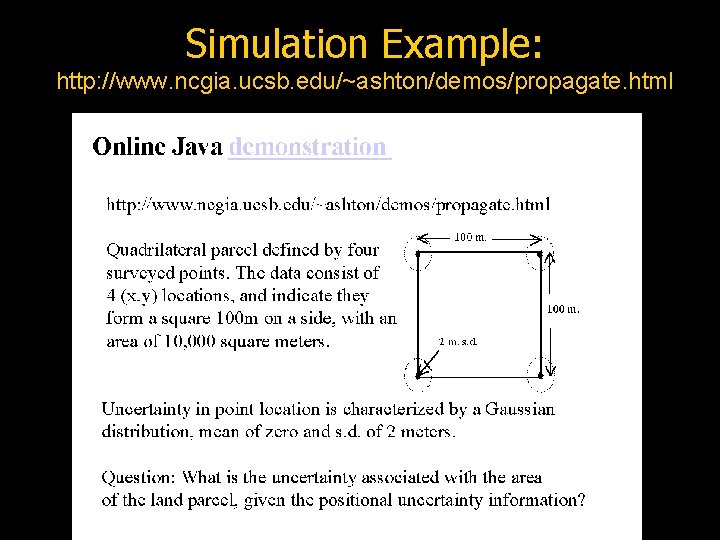
Simulation Example: http: //www. ncgia. ucsb. edu/~ashton/demos/propagate. html
Geographic Data Uncertainty and Ethics Typical users take digital data for granted, assuming their quality is high and fits the intended usage An increasing number of incidents and accidents result from the inappropriate use of geospatial data “Erroneous, inadequately documented, or inappropriate data can have grave consequences for individuals and the environment. ” (AAG Geographic Information Ethics Session Description, 2009) 19
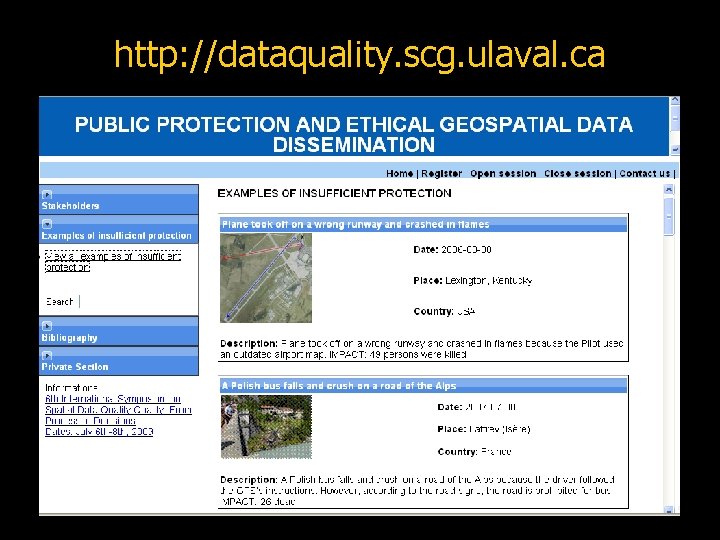
http: //dataquality. scg. ulaval. ca
Geographic Data Uncertainty and Ethics From an ethics point of view: Poor quality data should not be used for sensitive applications where it poses a risk of harm Need appropriate safeguards to avoid the harm, and to provide effective warnings Not enough just to anticipate intended uses and data quality requirements of a system. Must anticipate the possible misuses of the system as well
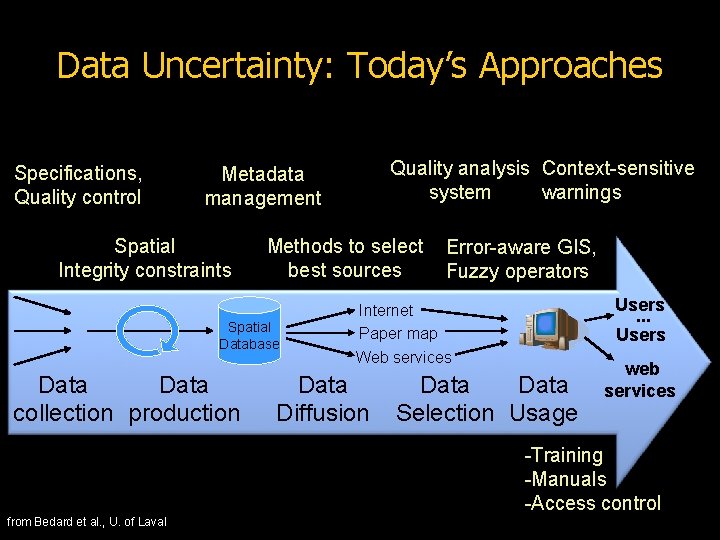
Data Uncertainty: Today’s Approaches Specifications, Quality control Quality analysis Context-sensitive system warnings Metadata management Spatial Integrity constraints Methods to select best sources Spatial Database Data collection production Error-aware GIS, Fuzzy operators Users. . . Users Internet Paper map Web services Data Diffusion Data Selection Usage web services -Training -Manuals -Access control from Bedard et al. , U. of Laval
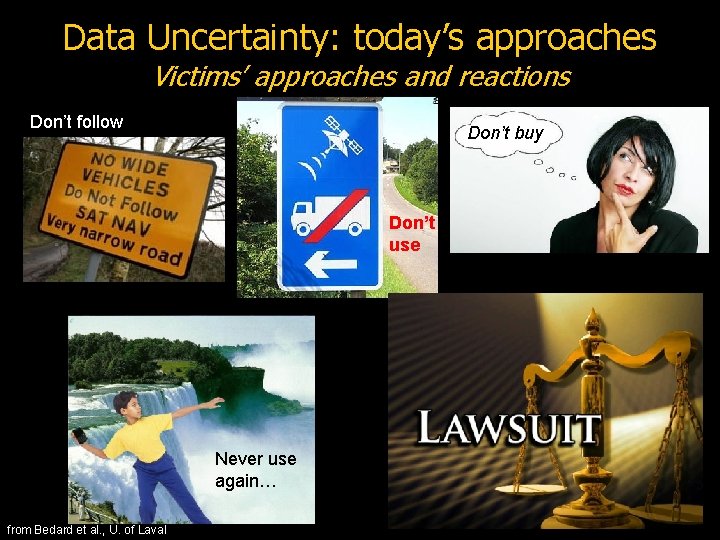
Data Uncertainty: today’s approaches Victims’ approaches and reactions Don’t follow Don’t buy Don’t use Never use again… from Bedard et al. , U. of Laval
Data Uncertainty: today’s approaches Ethics-related issue Professional self-regulatory bodies have codes of ethics contained in regulations These regulations are enacted by governments Professionals’ primary duty is to the public welfare
Data Uncertainty: today’s approaches Ethics-related issue Codes of ethics influence « Good Practices » Ex. professionals must care about individuals and environment « Professional misconduct » is typically set out in regulations Ex. Negligence, failure to report or remedy to a danger, to protect people In case of lawsuits, Codes of ethics have impacts
Data Uncertainty: today’s approaches Ethics-related issue Data uncertainty issues end up in the hands of legal systems, but they begin in the hands of systems designers Software engineering methods based on formal models are recognized as the most rigorous approaches to develop quality systems Good practices require to understand clearly data quality requirements and fitness-for-use It is a duty for the expert to care about users and to inform them about inappropriate usages of spatial data from Bedard et al. , U. of Laval
Data Uncertainty: today’s approaches Ethics-related issue Involve client in every phase of a system development method This involvement must include decisions about the risks related to spatial data definition, selection, production, dissemination and potential reuse (intended or not) Risk-related decisions must be understood and approved by the client from Bedard et al. , U. of Laval
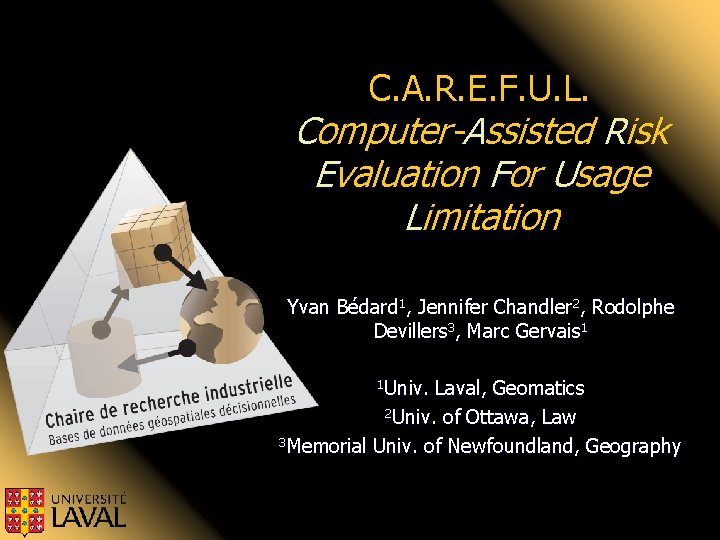
C. A. R. E. F. U. L. Computer-Assisted Risk Evaluation For Usage Limitation Yvan Bédard 1, Jennifer Chandler 2, Rodolphe Devillers 3, Marc Gervais 1 1 Univ. Laval, Geomatics 2 Univ. of Ottawa, Law 3 Memorial Univ. of Newfoundland, Geography
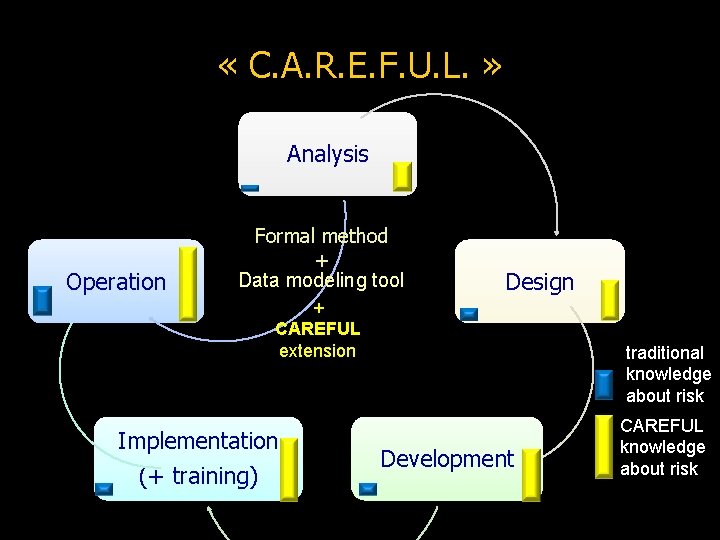
« C. A. R. E. F. U. L. » Analysis Operation Formal method + Data modeling tool Design + CAREFUL extension Implementation (+ training) traditional knowledge about risk Development CAREFUL knowledge about risk
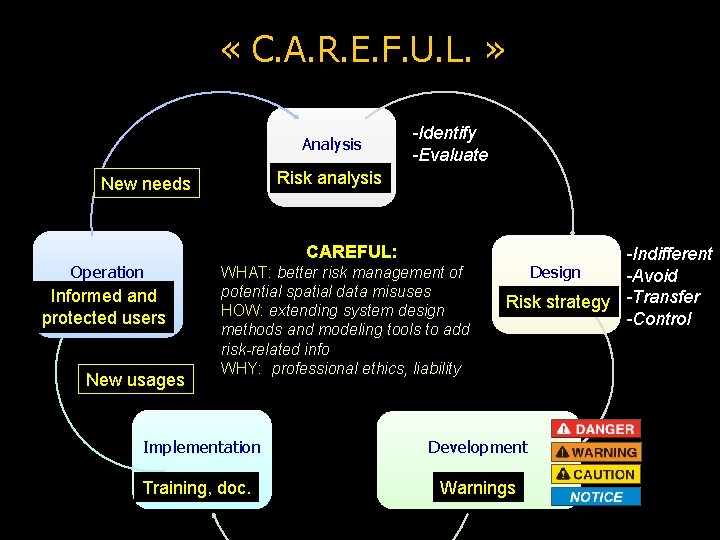
« C. A. R. E. F. U. L. » Analysis Risk analysis New needs Operation Informed and protected users New usages -Identify -Evaluate CAREFUL: WHAT: better risk management of potential spatial data misuses HOW: extending system design methods and modeling tools to add risk-related info WHY: professional ethics, liability Implementation Training, doc. -Indifferent Design -Avoid Risk strategy -Transfer -Control Development Warnings
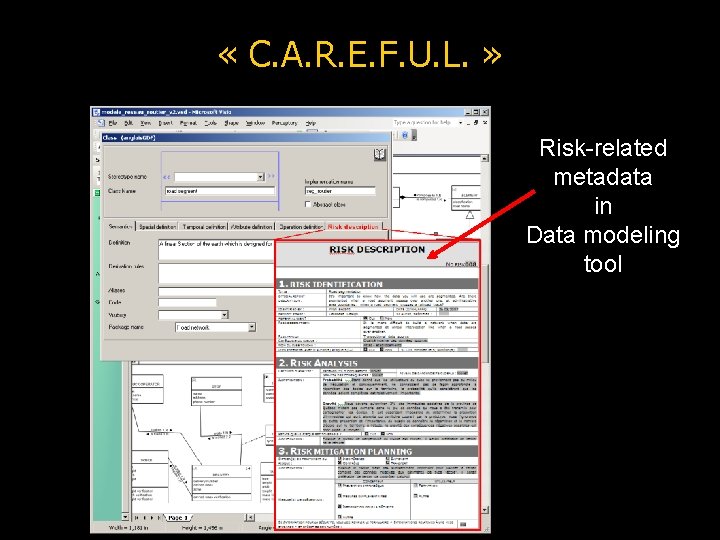
« C. A. R. E. F. U. L. » Risk-related metadata in Data modeling tool
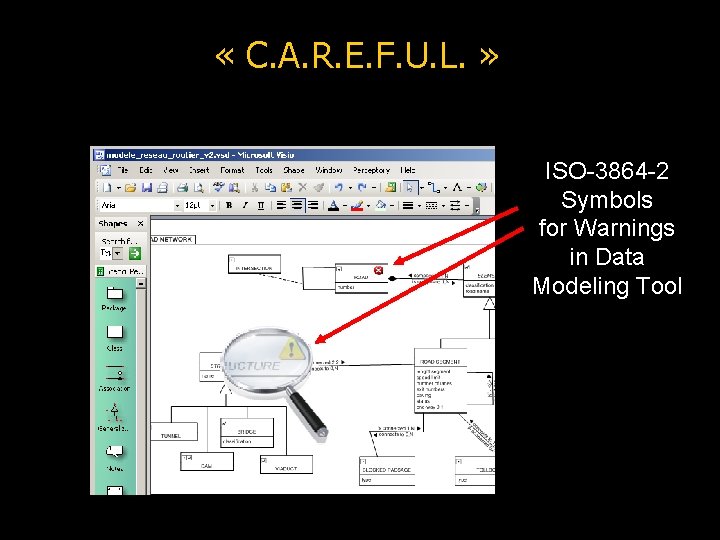
« C. A. R. E. F. U. L. » ISO-3864 -2 Symbols for Warnings in Data Modeling Tool
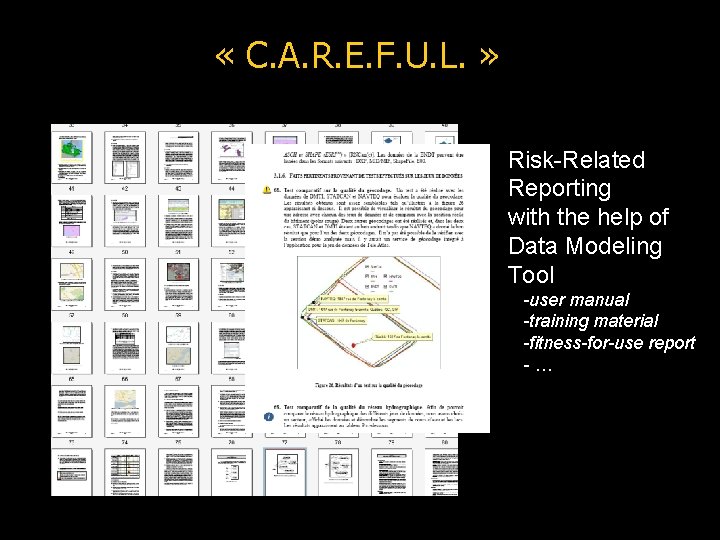
« C. A. R. E. F. U. L. » Risk-Related Reporting with the help of Data Modeling Tool -user manual -training material -fitness-for-use report -…
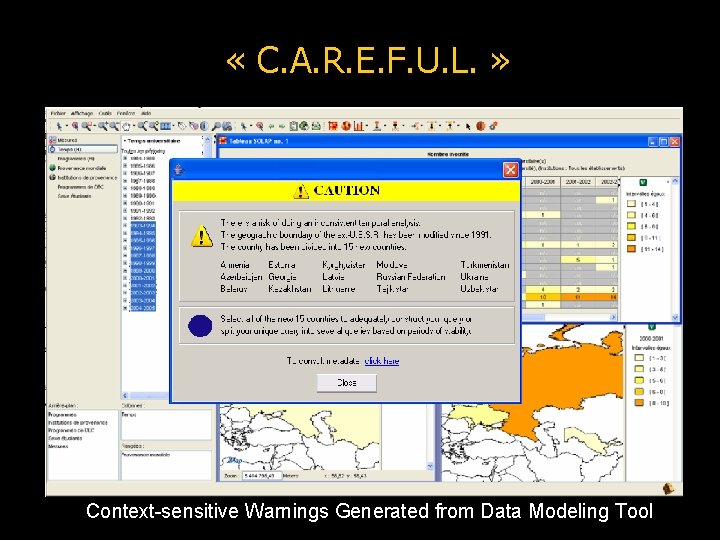
« C. A. R. E. F. U. L. » Context-sensitive Warnings Generated from Data Modeling Tool
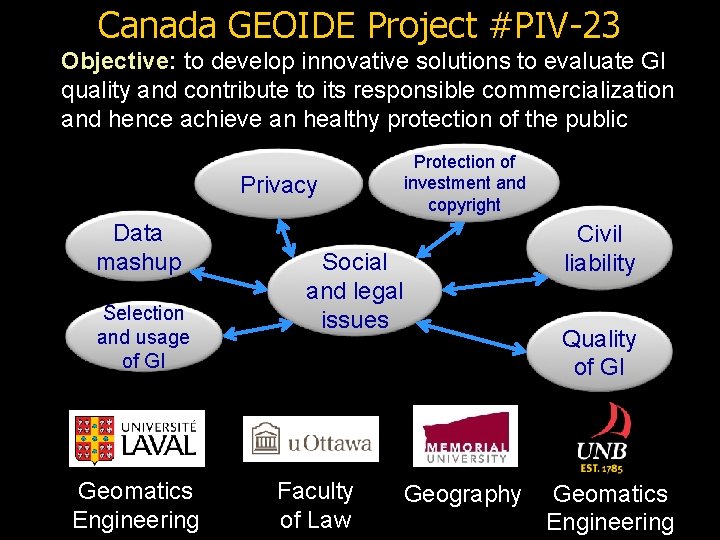
Canada GEOIDE Project #PIV-23 Objective: to develop innovative solutions to evaluate GI quality and contribute to its responsible commercialization and hence achieve an healthy protection of the public Privacy Data mashup Selection and usage of GI Geomatics Engineering Protection of investment and copyright Social and legal issues Faculty of Law Geography Civil liability Quality of GI Geomatics Engineering

On the U. S. side, NSF Ethics Education
Impacts on Professional System Designers, GIS Users Ethics leads to protecting users against harm Several approaches exist to reduce risks Ethics leads to manage the risks related to uncertain data or inappropriate uses of data including unintended uses CAREFUL is a new ethics-centered approach extending formally proven software engineering methods Gisprofessionalethics. org contain new GIS ethicscentered graduate curricula in progress
Gateway to the Literature Plewe, B. The nature of uncertainty in historical geographic information, Transactions in GIS, 6(4): 431456, 2002. UCGIS. Uncertainty in Geographic Data and GIS-Based Analyses, UCGIS Research Priority White Paper, Leesburg, VA: UCGIS, 2002. Di. Biase, D. , Harvey, F. , Wright, D. , and Goranson, C. The GIS professional ethics project: Practical ethics education for GIS professionals, in Unwin, D. , Foote, K. , Tate, N. , and Di. Biase, D. (eds. ), Teaching Geographic Information Science and Technology in Higher Education, London: Wiley and Sons, in press, 2011.
Gateway to the Literature Bater, C. W. and N. C. Coops (2009). "Evaluating error associated with LIDARderived DEM interpolation. " Comp. Geosci 35: 289 -300. Dendoncker, N. , C. Schmit, et al. (2008). "Exploring spatial data uncertainties in land-use change scenarios. " Int. J. Geog. Inf. Sci. 22(9): 1013 -1030. Xiao, N. , C. A. Calder, et al. (2007). "Assessing the effect of attribute uncertainty on the robustness of choropleth map classification. " Int. J. Geog. Inf. Sci. 21(12): 121 -144. Aguilar, F. J. , M. A. Aguilar, et al. (2007). "Accuracy assessment of digital elevation models using a non-parametric approach. " Int. J. Geog. Inf. Sci. 21(67): 667 -686. Zhou, Q. , X. Liu, et al. (2006). "Terrain complexity and uncertainties in gridbased digital terrain analysis. " Int. J. Geog. Inf. Sci. 20(10): 1137 -1148. Oksanen, J. and T. Sarjakoski (2006). "Uncovering the statistical and spatial characteristics of fine toposcale DEM error. " Int. J. Geog. Inf. Sci. 20(4): 345370.
Lindsay, J. B. (2006). "Sensitivity of channel mapping techniques to uncertainty in digital elevation data. " Int. J. Geog. Inf. Sci. 20(6): 669 -692. Henley, S. (2006). "The problem of missing data in geoscience databases. " Comp. Geosci 32: 1368 -1377. Gregory, I. N. and P. S. Ell (2006). "Error-sensitive historical GIS: Identifying areal interpolation errors in time-series data. " Int. J. Geog. Inf. Sci. 20(2): 135 -152. Bishop, T. F. A. , B. Minasny, et al. (2006). "Uncertainty analysis for soil-terrain models. " Int. J. Geog. Inf. Sci. 20(2): 117 -134. Wu, J. , T. H. Funk, et al. (2005). "Improving spatial accuracy of roadway networks and geocoded addresses. " Trans. GIS 9(4): 585 -602. Shi, W. Z. , Q. Q. Li, et al. (2005). "Estimating the propagation error of DEM from higher-order interpolation algorithms. " Int. J. Remote Sensing 26(14): 3069 -3084. Shi, W. Z. , M. Ehlers, et al. (2005). "Uncertainties in integrated remote sensing and GIS. " Int. J. Remote Sensing 26(14): 2911 -2916. Kardos, J. , G. Benwell, et al. (2005). "The visualisation of uncertainty for spatially referenced census data using hierarchical tessellations. " Trans. GIS 9(1): 19 -34.
- Slides: 38