
HOMOMORPHIC ENCRYPTION WHAT HOW AND WHY Josh Benaloh
HOMOMORPHIC ENCRYPTION: WHAT, HOW, AND WHY Josh Benaloh & Vinod Vaikuntanathan

A cryptographer’s view of the world …
In the beginning, there was symmetric encryption.

If you had the key you could encrypt …
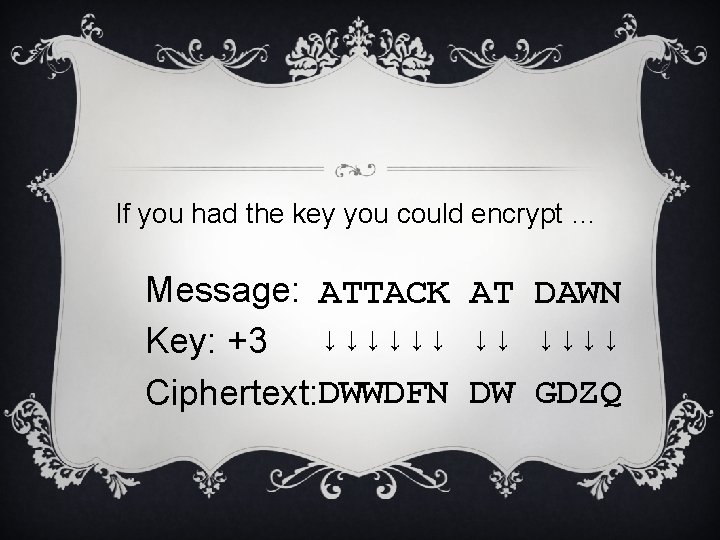
If you had the key you could encrypt … Message: ATTACK AT DAWN Key: +3 ↓↓↓↓↓↓ ↓↓ ↓↓↓↓ Ciphertext: DWWDFN DW GDZQ

If you had the key you could decrypt …
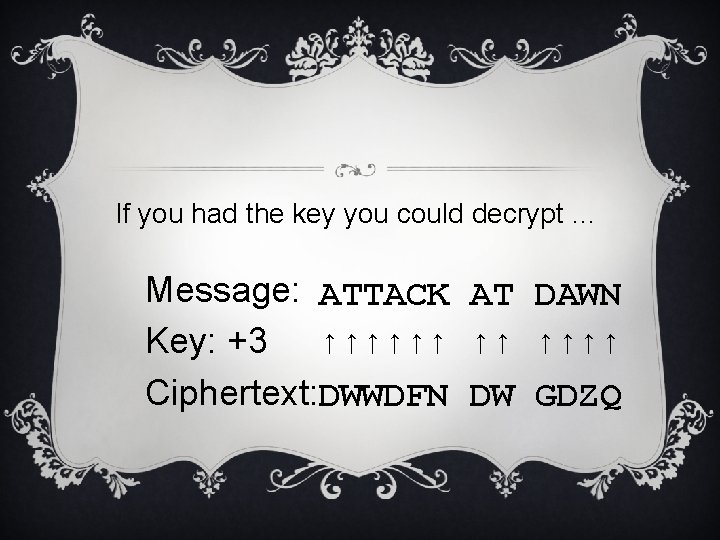
If you had the key you could decrypt … Message: ATTACK AT DAWN Key: +3 ↑↑↑↑↑↑ ↑↑ ↑↑↑↑ Ciphertext: DWWDFN DW GDZQ

… and some people were happy.
Then, there was asymmetric encryption.

Some people encrypted …

Some people encrypted … … others decrypted.

E-commerce ensued …

E-commerce ensued … … and more people were happy.
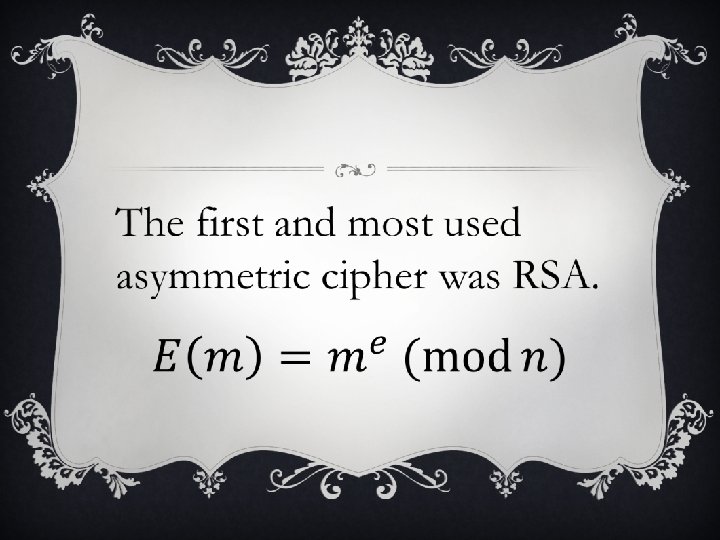
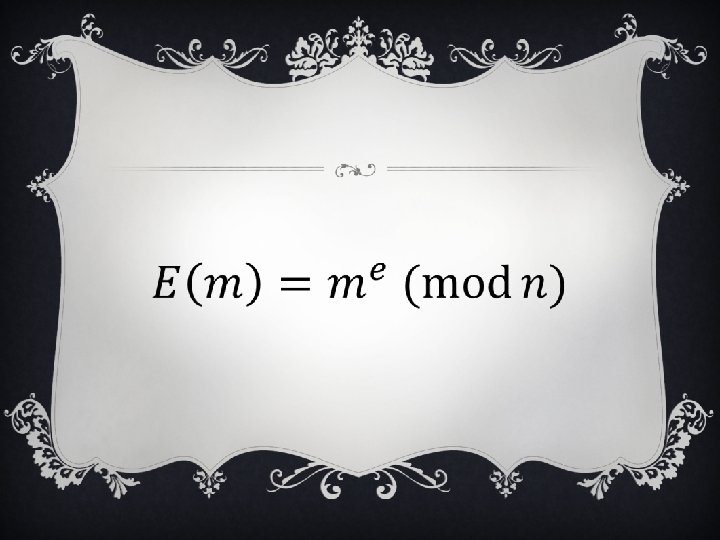
The first and most used asymmetric cipher was RSA.
v

The world was black and white:
The world was black and white: The only thing anyone did with encrypted data was …
The world was black and white: The only thing anyone did with encrypted data was … … decrypt it.
v

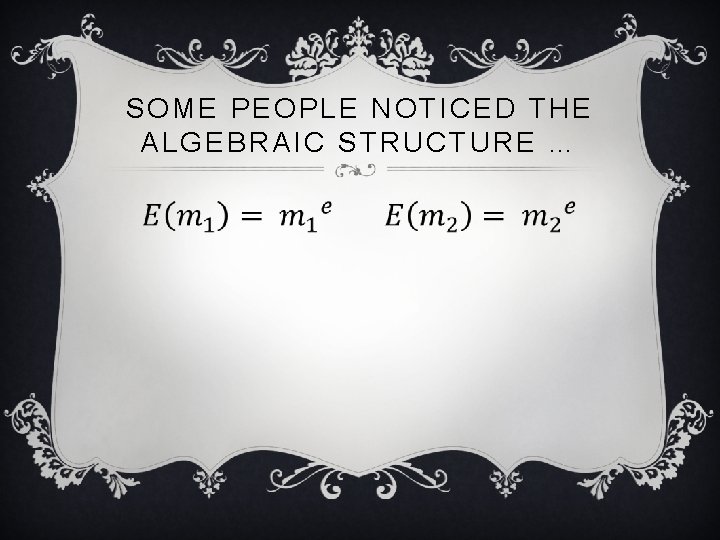
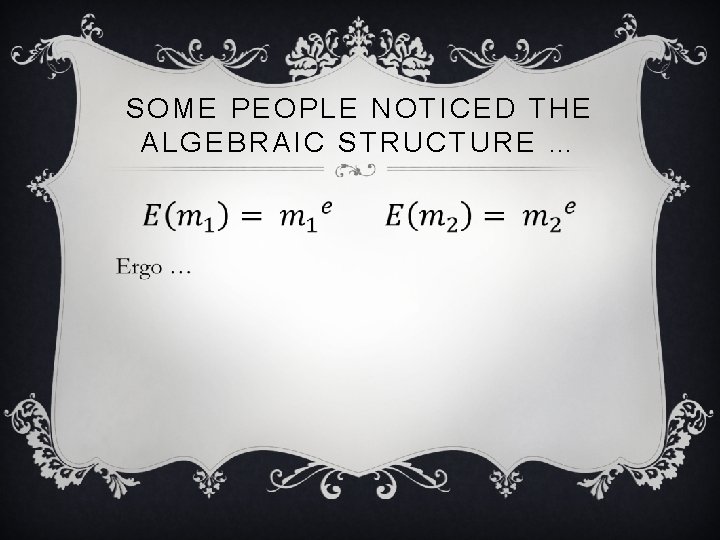
SOME PEOPLE NOTICED THE ALGEBRAIC STRUCTURE …
SOME PEOPLE NOTICED THE ALGEBRAIC STRUCTURE … v
SOME PEOPLE NOTICED THE ALGEBRAIC STRUCTURE … v
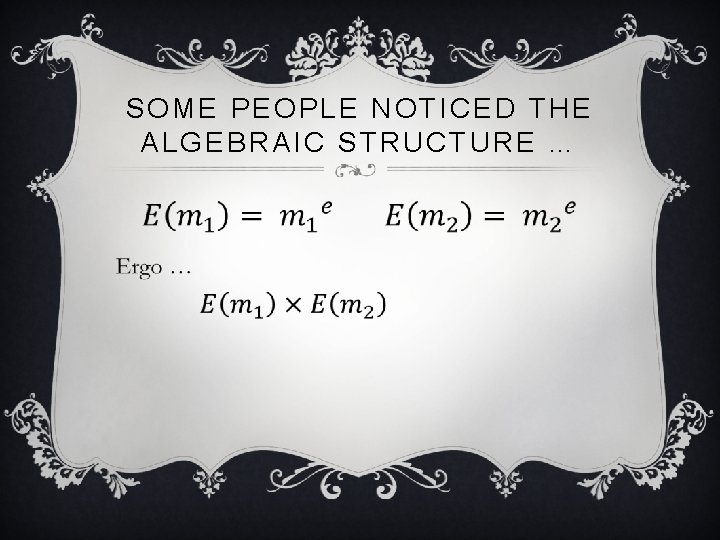
SOME PEOPLE NOTICED THE ALGEBRAIC STRUCTURE … v
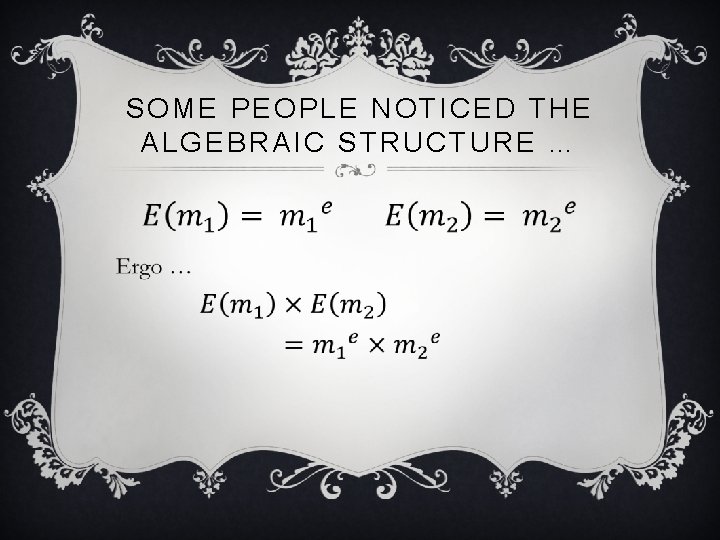
SOME PEOPLE NOTICED THE ALGEBRAIC STRUCTURE … v
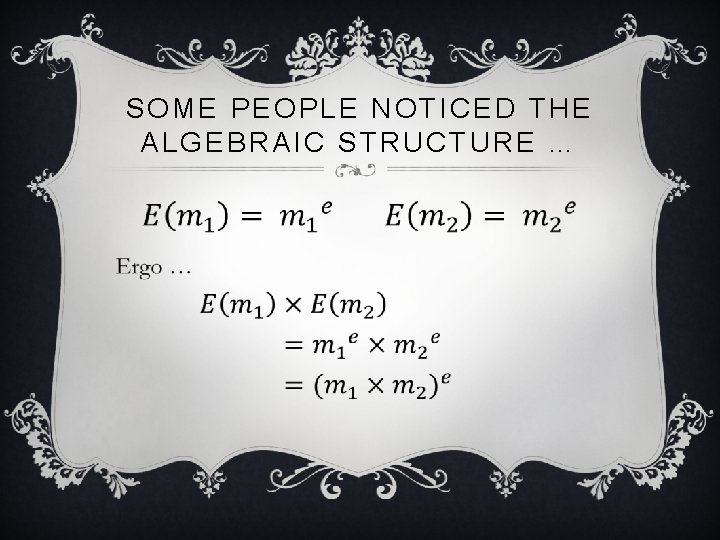
SOME PEOPLE NOTICED THE ALGEBRAIC STRUCTURE … v
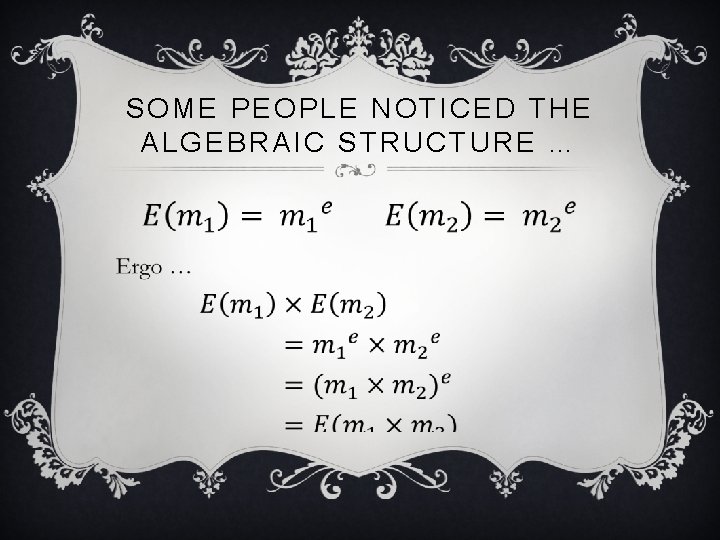
SOME PEOPLE NOTICED THE ALGEBRAIC STRUCTURE … v

They looked for interesting applications …

They looked for interesting applications … … and they failed.

PEOPLE MUSED …

PEOPLE MUSED … If only RSA worked additively …
PEOPLE MUSED … If only RSA worked additively … we could compute sums …
PEOPLE MUSED … If only RSA worked additively … we could compute sums … and averages …

PEOPLE MUSED … If only RSA worked additively … we could compute sums … and averages … and tally elections …

I WAS ONE OF THOSE MUSING.
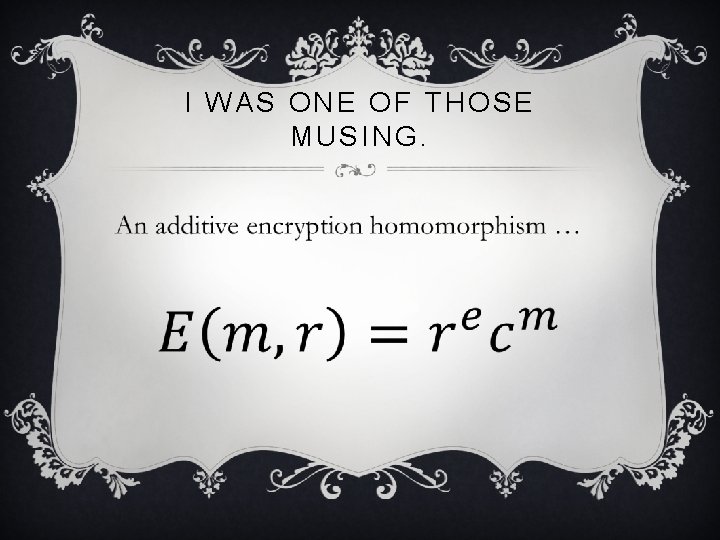
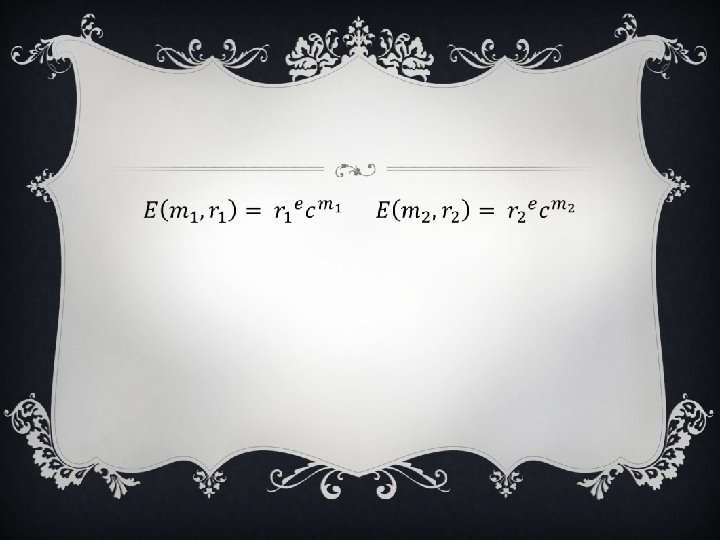
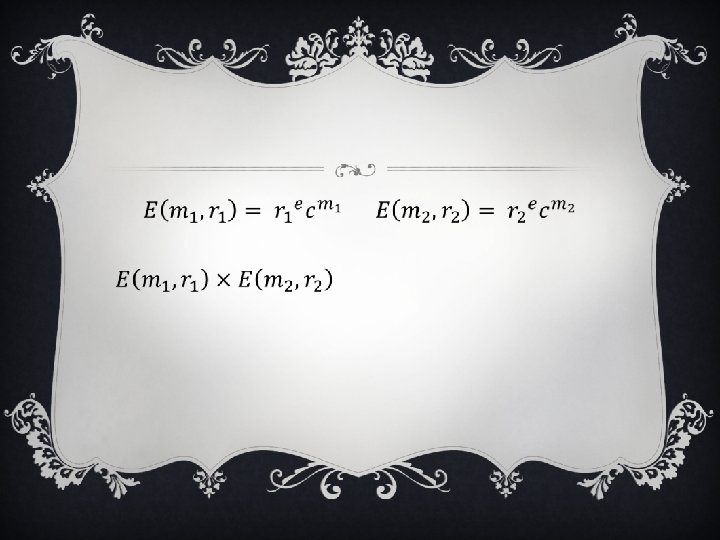
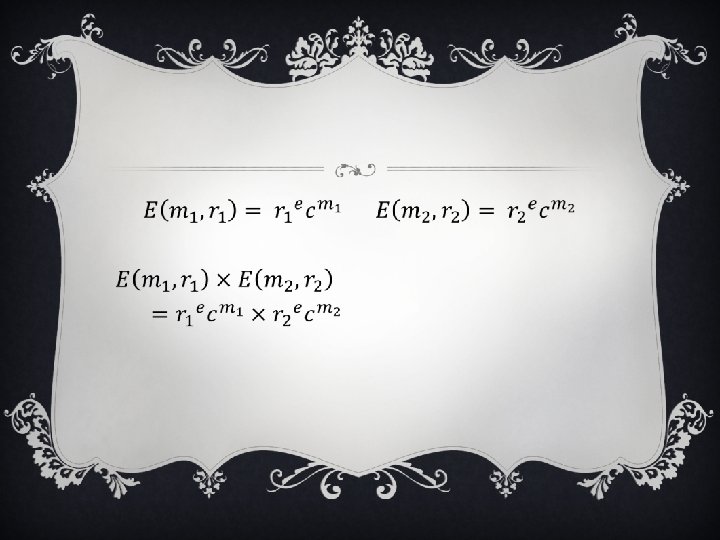
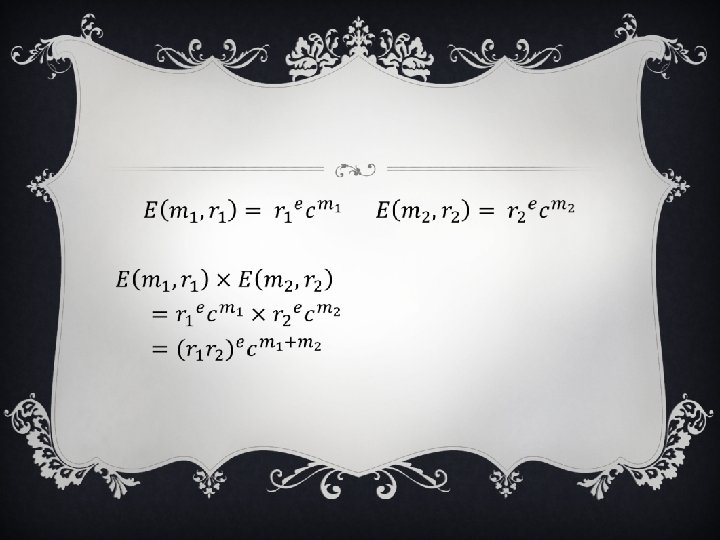
I WAS ONE OF THOSE MUSING. An additive encryption homomorphism …
I WAS ONE OF THOSE MUSING. v
v
v
v
v
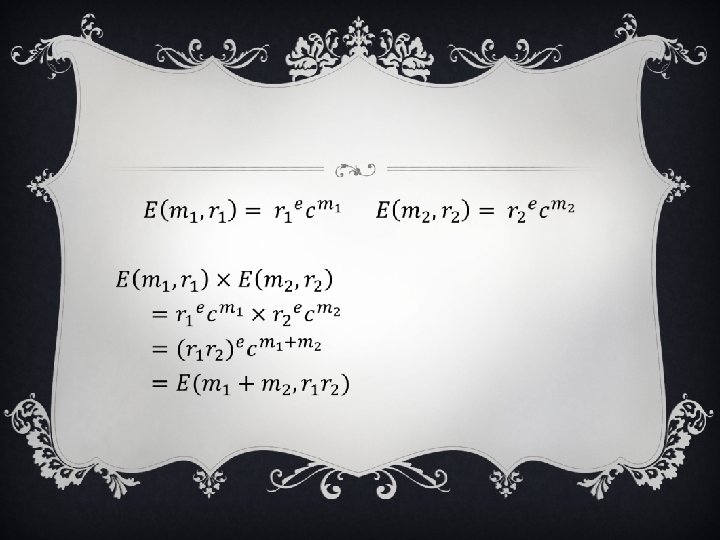
v
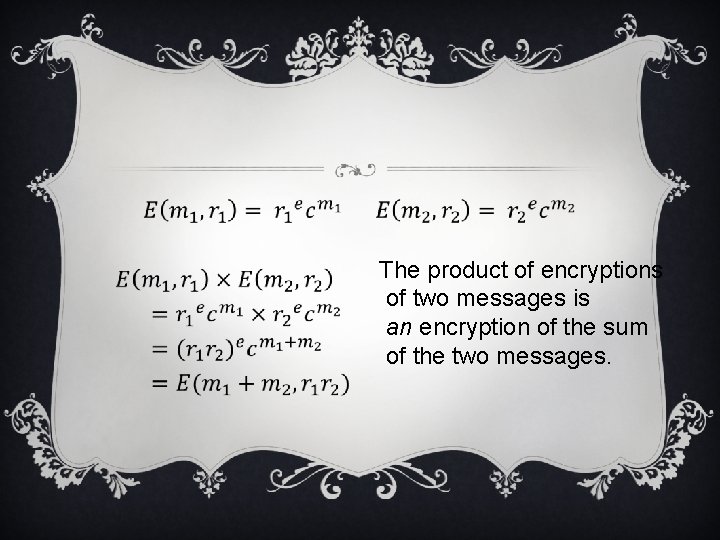
v The product of encryptions of two messages is an encryption of the sum of the two messages.

I used this to build verifiable election systems …

I used this to build verifiable election systems … … and I was really happy …

I used this to build verifiable election systems … … and I was really happy … and the world didn’t change much.

What people really wanted was the ability to do arbitrary computing on encrypted data…

What people really wanted was the ability to do arbitrary computing on encrypted data… … and this required the ability to compute both sums and products …
What people really wanted was the ability to do arbitrary computing on encrypted data… … and this required the ability to compute both sums and products … … on the same encrypted data set!
Fully-Homomorphic Encryption!

People tried to do this for years …

People tried to do this for years … … and years …

People tried to do this for years … … and years …

People tried to do this for years … … and years … … with no success.

What people really wanted was the ability to compute both sums and products on encrypted data…
What people really wanted was the ability to compute both sums and products on encrypted data… … but why?
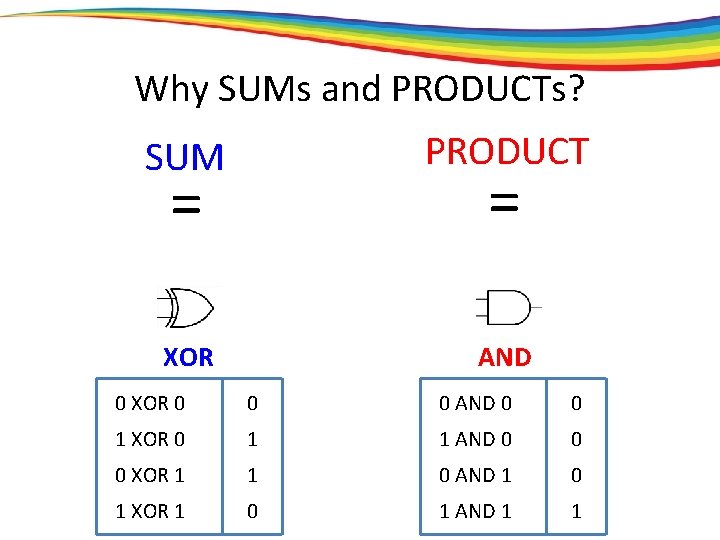
Why SUMs and PRODUCTs? SUM PRODUCT XOR AND = = 0 XOR 0 0 0 AND 0 0 1 XOR 0 1 1 AND 0 0 0 XOR 1 1 0 AND 1 0 1 XOR 1 0 1 AND 1 1
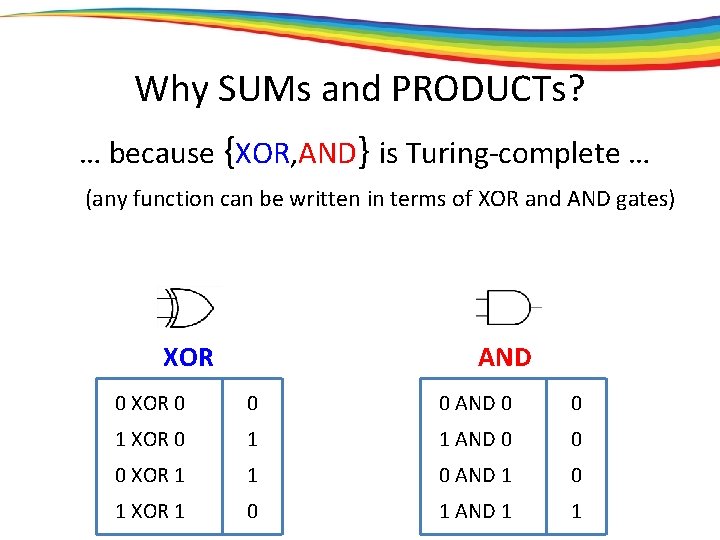
Why SUMs and PRODUCTs? … because {XOR, AND} is Turing-complete … (any function can be written in terms of XOR and AND gates) XOR AND 0 XOR 0 0 0 AND 0 0 1 XOR 0 1 1 AND 0 0 0 XOR 1 1 0 AND 1 0 1 XOR 1 0 1 AND 1 1
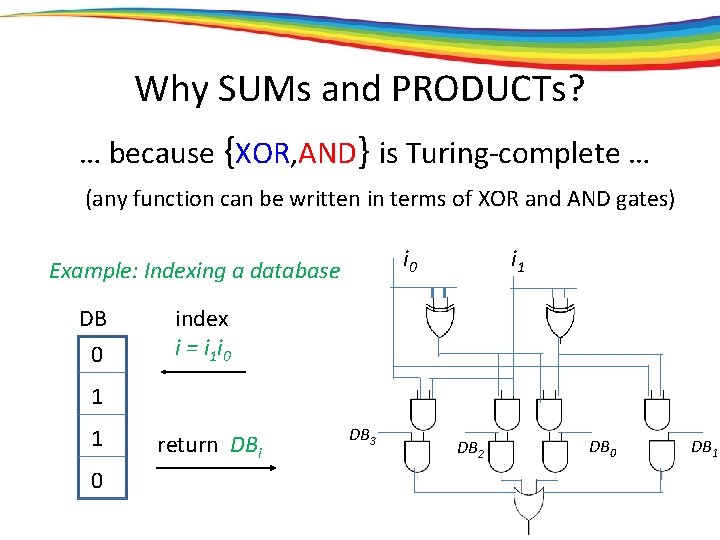
Why SUMs and PRODUCTs? … because {XOR, AND} is Turing-complete … (any function can be written in terms of XOR and AND gates) i 0 Example: Indexing a database DB 0 i 1 index i = i 1 i 0 1 1 0 return DBi DB 3 DB 2 DB 0 DB 1
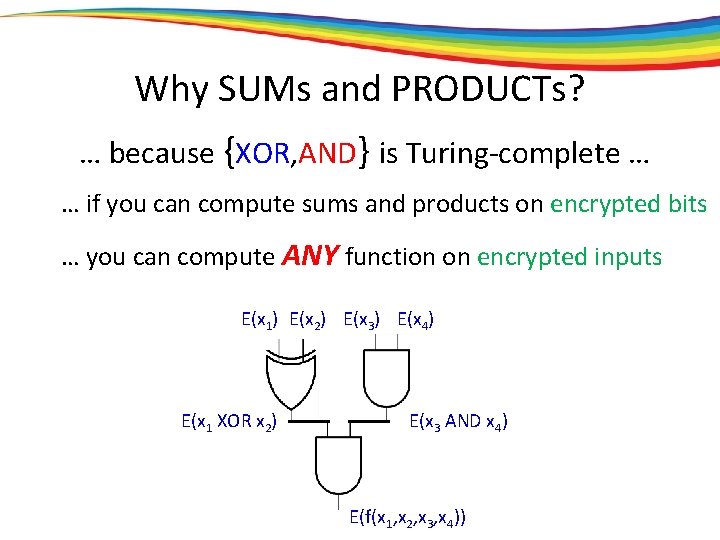
Why SUMs and PRODUCTs? … because {XOR, AND} is Turing-complete … … if you can compute sums and products on encrypted bits … you can compute ANY function on encrypted inputs E(x 1) E(x 2) E(x 3) E(x 4) E(x 1 XOR x 2) E(x 3 AND x 4) E(f(x 1, x 2, x 3, x 4))

This is A M A Z I N G! Private Search Private Cloud computing

This is A M A Z I N G! Private Search Private Cloud computing Delegate arbitrary processing of data without giving away access to it

People tried to compute both AND and XOR on encrypted bits … … for years … … and years … … with no success.
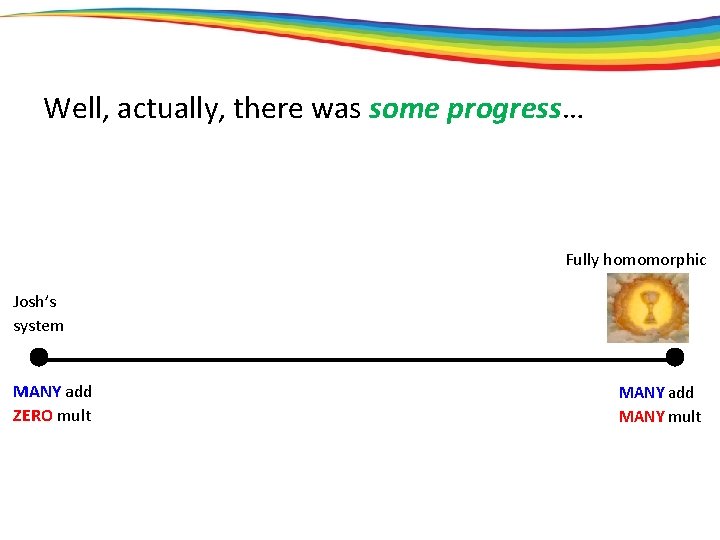
Well, actually, there was some progress… Fully homomorphic Josh’s system MANY add ZERO mult MANY add MANY mult
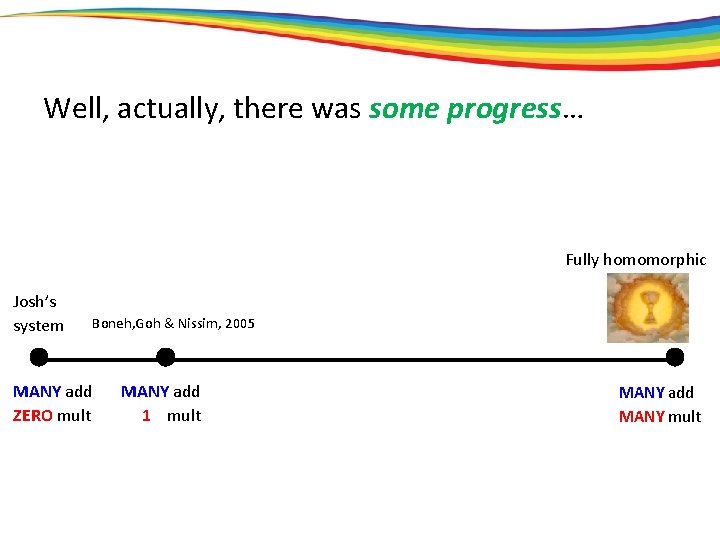
Well, actually, there was some progress… Fully homomorphic Josh’s system Boneh, Goh & Nissim, 2005 MANY add ZERO mult MANY add 1 mult MANY add MANY mult
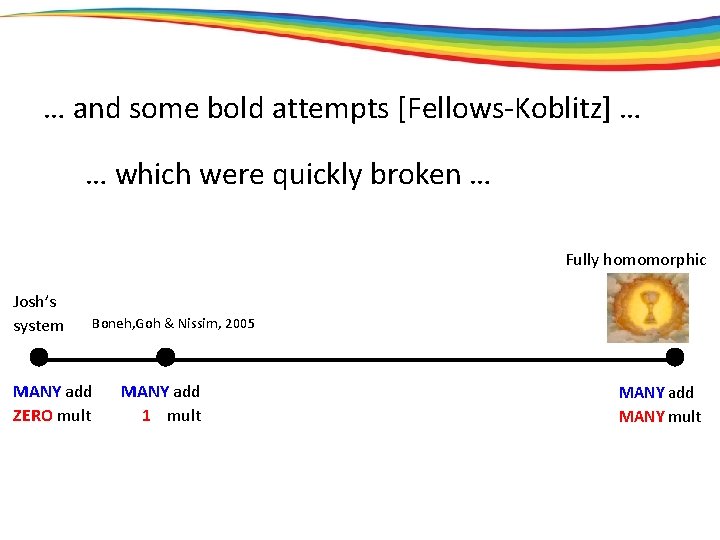
… and some bold attempts [Fellows-Koblitz] … … which were quickly broken … Fully homomorphic Josh’s system Boneh, Goh & Nissim, 2005 MANY add ZERO mult MANY add 1 mult MANY add MANY mult

… until, in October 2008 …

… until, in October 2008 … … Craig Gentry came up with the first fully homomorphic encryption scheme …

How does it work? What is the magic?
Gentry’s scheme was complex … … it relied on tools from algebraic number theory …

Some of us asked: can we make this really simple?
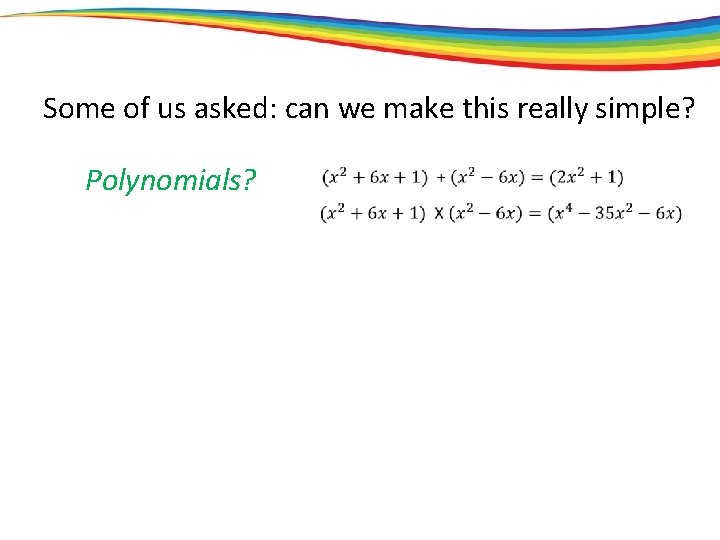
Some of us asked: can we make this really simple? Polynomials?
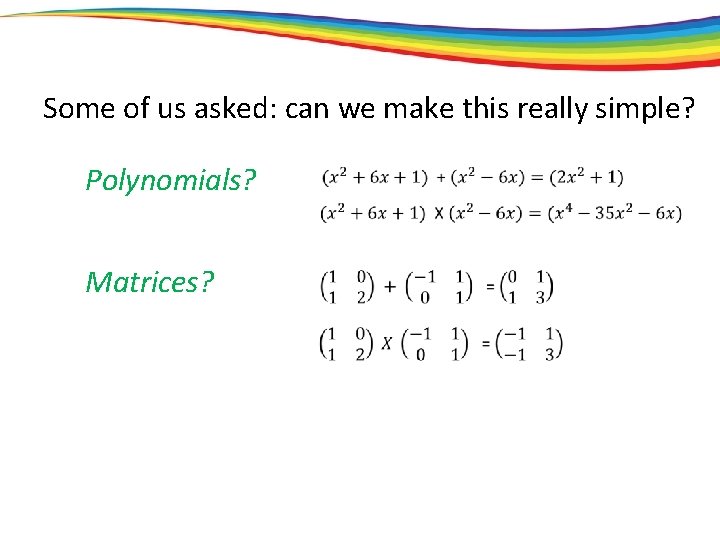
Some of us asked: can we make this really simple? Polynomials? Matrices?
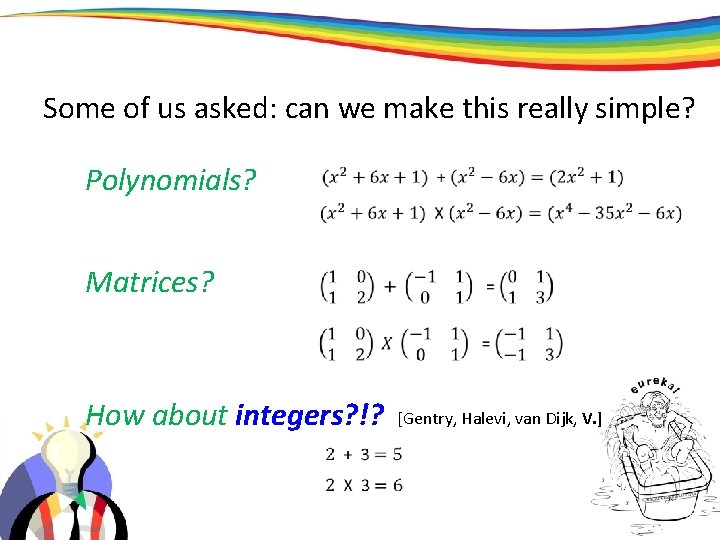
Some of us asked: can we make this really simple? Polynomials? Matrices? How about integers? !? [Gentry, Halevi, van Dijk, V. ]
TODAY: Secret-key (Symmetric-key) Encryption
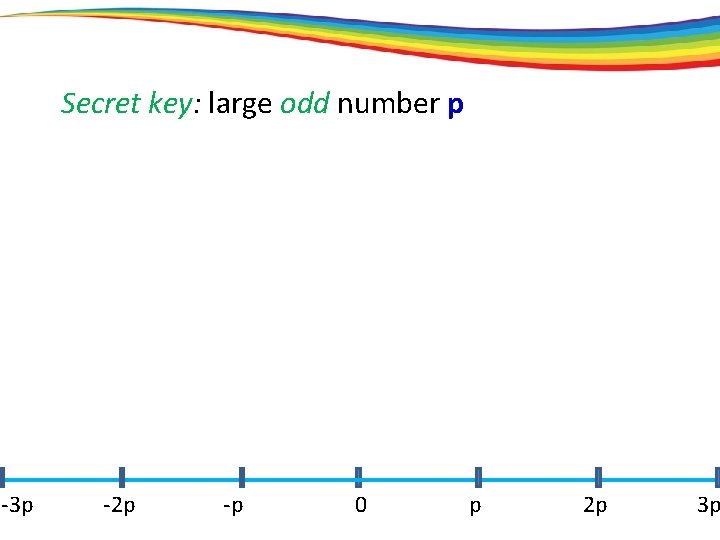
Secret key: large odd number p -3 p -2 p -p 0 p 2 p 3 p
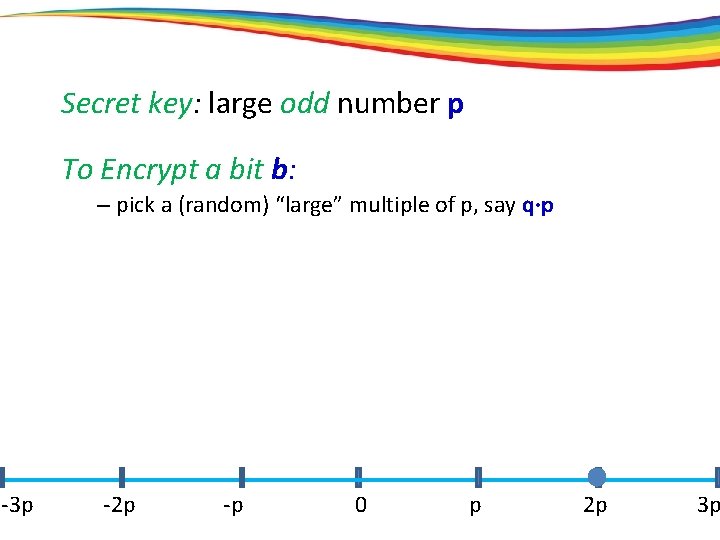
Secret key: large odd number p To Encrypt a bit b: – pick a (random) “large” multiple of p, say q·p -3 p -2 p -p 0 p 2 p 3 p
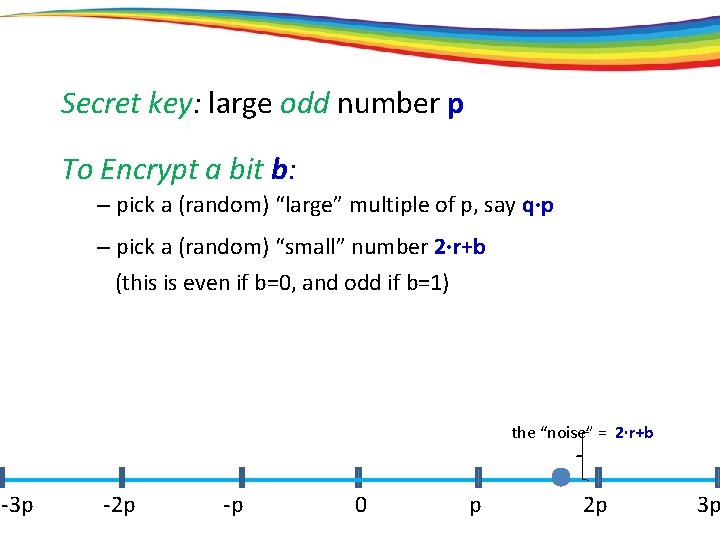
Secret key: large odd number p To Encrypt a bit b: – pick a (random) “large” multiple of p, say q·p – pick a (random) “small” number 2·r+b (this is even if b=0, and odd if b=1) the “noise” = 2·r+b -3 p -2 p -p 0 p 2 p 3 p
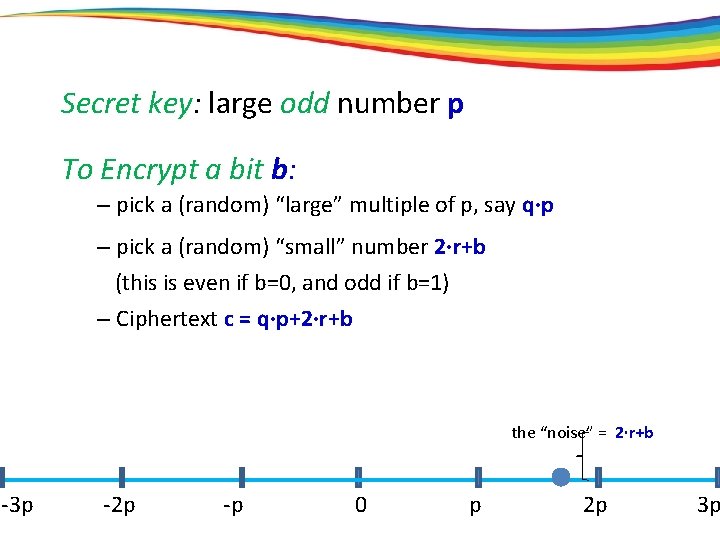
Secret key: large odd number p To Encrypt a bit b: – pick a (random) “large” multiple of p, say q·p – pick a (random) “small” number 2·r+b (this is even if b=0, and odd if b=1) – Ciphertext c = q·p+2·r+b the “noise” = 2·r+b -3 p -2 p -p 0 p 2 p 3 p
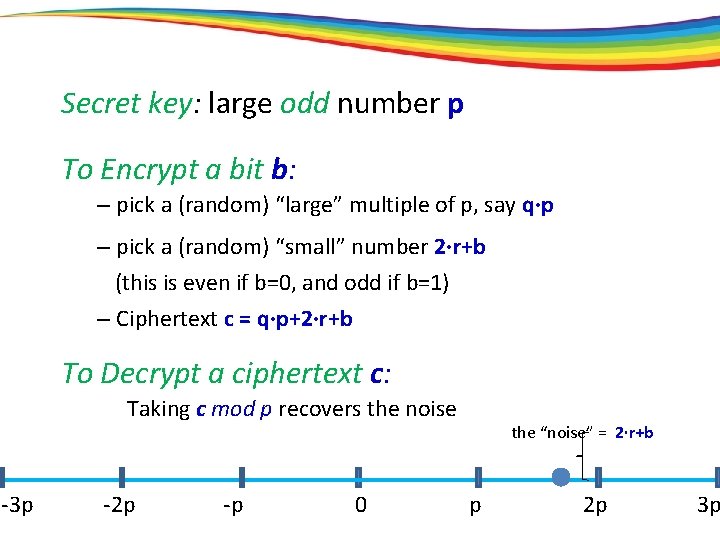
Secret key: large odd number p To Encrypt a bit b: – pick a (random) “large” multiple of p, say q·p – pick a (random) “small” number 2·r+b (this is even if b=0, and odd if b=1) – Ciphertext c = q·p+2·r+b To Decrypt a ciphertext c: Taking c mod p recovers the noise -3 p -2 p -p 0 the “noise” = 2·r+b p 2 p 3 p
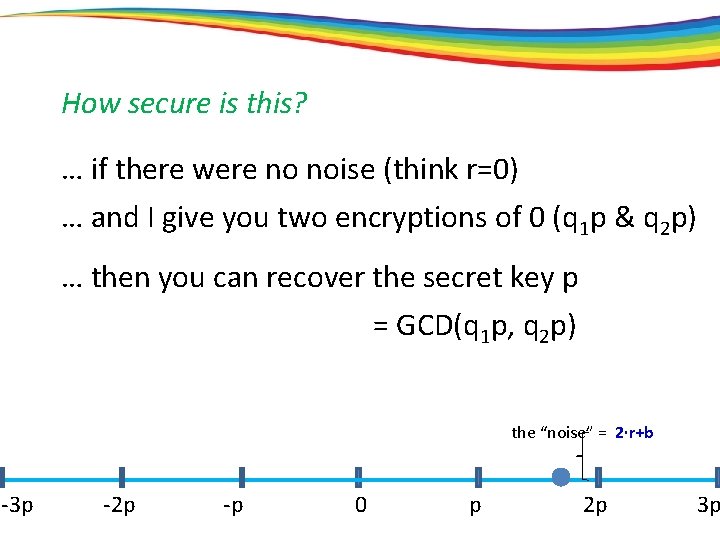
How secure is this? … if there were no noise (think r=0) … and I give you two encryptions of 0 (q 1 p & q 2 p) … then you can recover the secret key p = GCD(q 1 p, q 2 p) the “noise” = 2·r+b -3 p -2 p -p 0 p 2 p 3 p
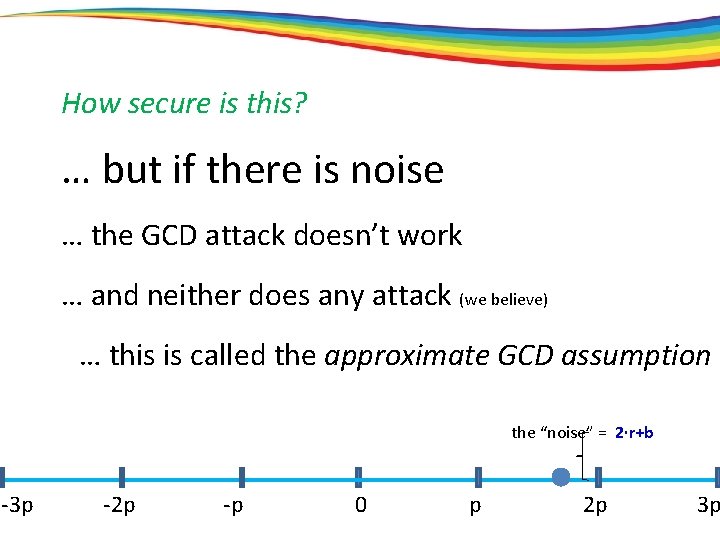
How secure is this? … but if there is noise … the GCD attack doesn’t work … and neither does any attack (we believe) … this is called the approximate GCD assumption the “noise” = 2·r+b -3 p -2 p -p 0 p 2 p 3 p
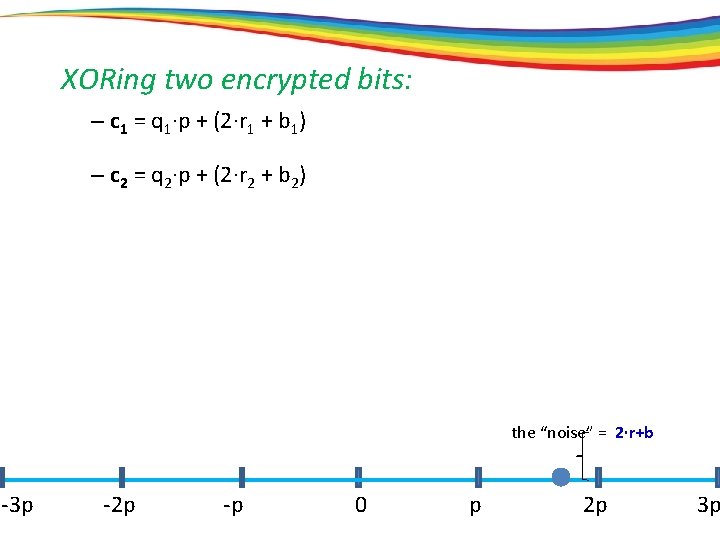
XORing two encrypted bits: – c 1 = q 1·p + (2·r 1 + b 1) – c 2 = q 2·p + (2·r 2 + b 2) the “noise” = 2·r+b -3 p -2 p -p 0 p 2 p 3 p
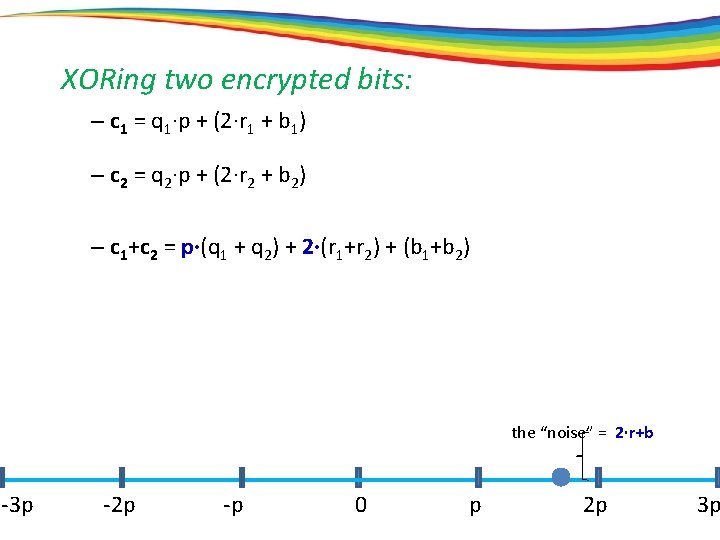
XORing two encrypted bits: – c 1 = q 1·p + (2·r 1 + b 1) – c 2 = q 2·p + (2·r 2 + b 2) – c 1+c 2 = p·(q 1 + q 2) + 2·(r 1+r 2) + (b 1+b 2) the “noise” = 2·r+b -3 p -2 p -p 0 p 2 p 3 p
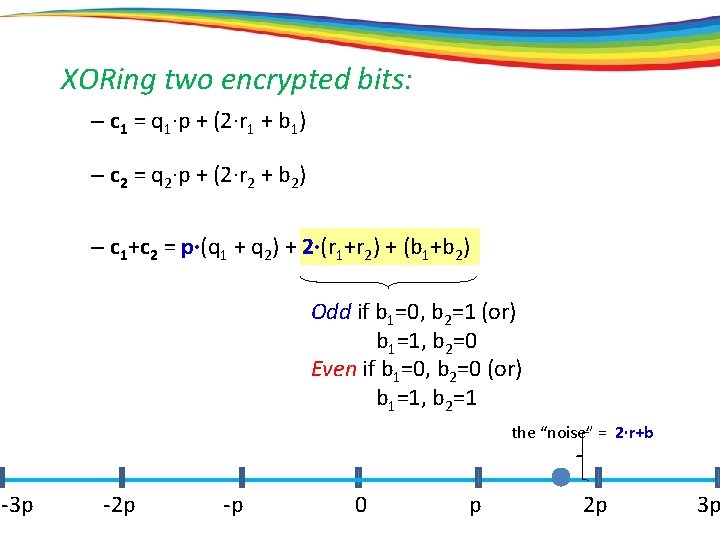
XORing two encrypted bits: – c 1 = q 1·p + (2·r 1 + b 1) – c 2 = q 2·p + (2·r 2 + b 2) – c 1+c 2 = p·(q 1 + q 2) + 2·(r 1+r 2) + (b 1+b 2) Odd if b 1=0, b 2=1 (or) b 1=1, b 2=0 Even if b 1=0, b 2=0 (or) b 1=1, b 2=1 the “noise” = 2·r+b -3 p -2 p -p 0 p 2 p 3 p
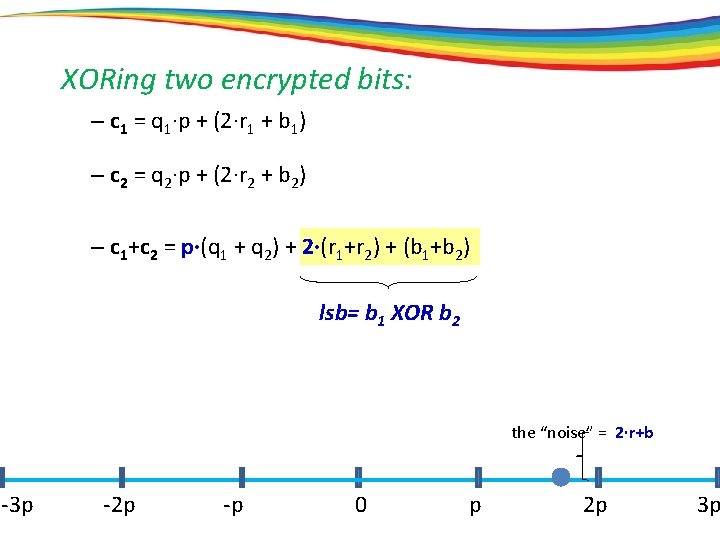
XORing two encrypted bits: – c 1 = q 1·p + (2·r 1 + b 1) – c 2 = q 2·p + (2·r 2 + b 2) – c 1+c 2 = p·(q 1 + q 2) + 2·(r 1+r 2) + (b 1+b 2) lsb= b 1 XOR b 2 the “noise” = 2·r+b -3 p -2 p -p 0 p 2 p 3 p
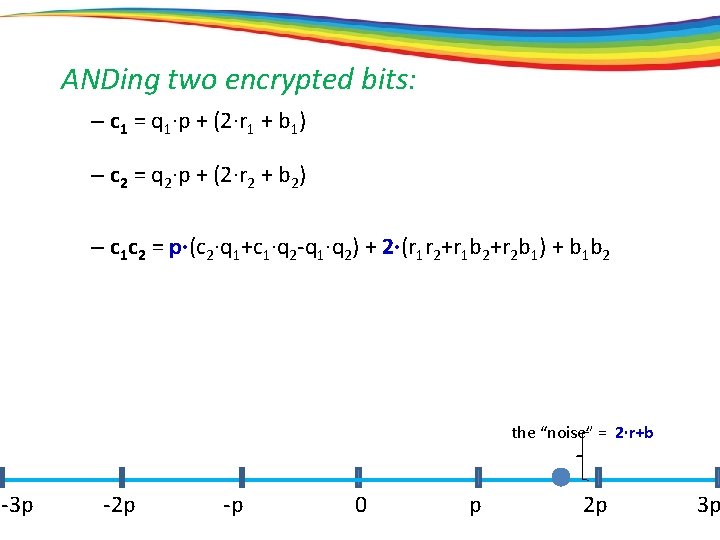
ANDing two encrypted bits: – c 1 = q 1·p + (2·r 1 + b 1) – c 2 = q 2·p + (2·r 2 + b 2) – c 1 c 2 = p·(c 2·q 1+c 1·q 2 -q 1·q 2) + 2·(r 1 r 2+r 1 b 2+r 2 b 1) + b 1 b 2 the “noise” = 2·r+b -3 p -2 p -p 0 p 2 p 3 p
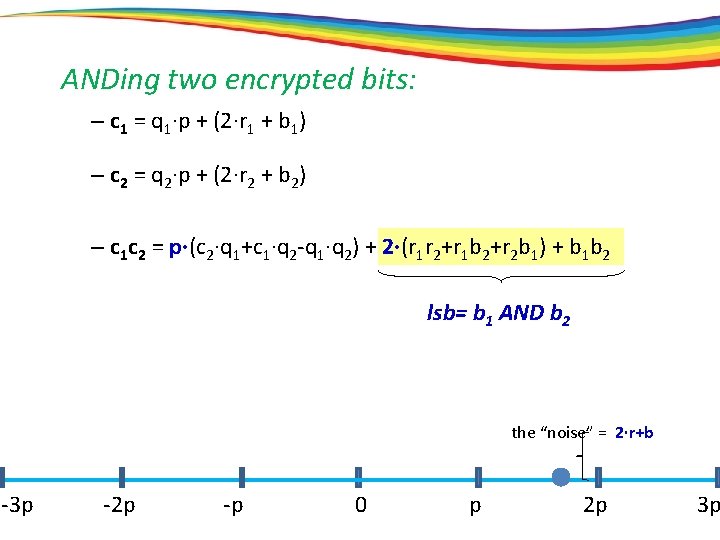
ANDing two encrypted bits: – c 1 = q 1·p + (2·r 1 + b 1) – c 2 = q 2·p + (2·r 2 + b 2) – c 1 c 2 = p·(c 2·q 1+c 1·q 2 -q 1·q 2) + 2·(r 1 r 2+r 1 b 2+r 2 b 1) + b 1 b 2 lsb= b 1 AND b 2 the “noise” = 2·r+b -3 p -2 p -p 0 p 2 p 3 p
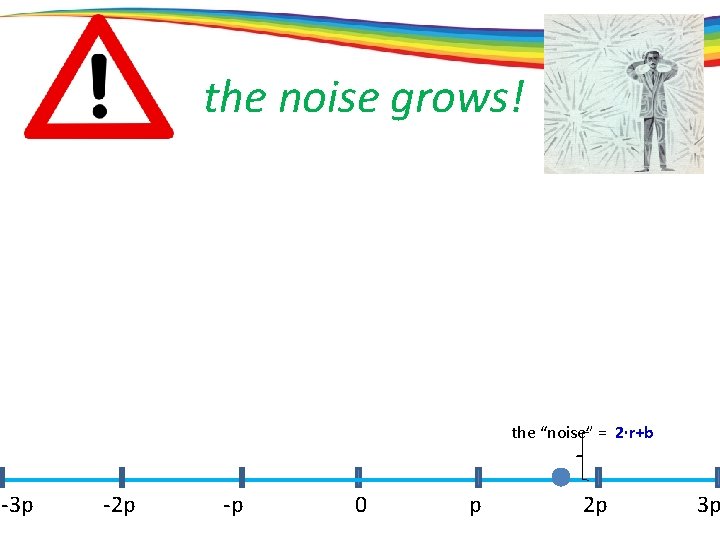
the noise grows! the “noise” = 2·r+b -3 p -2 p -p 0 p 2 p 3 p
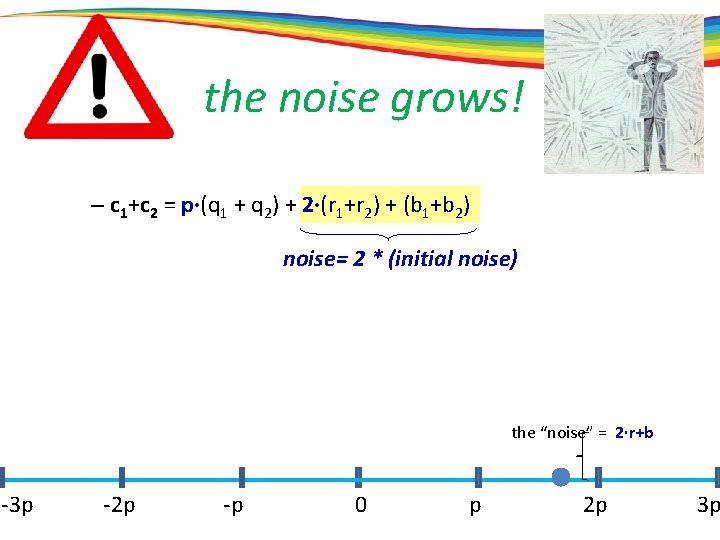
the noise grows! – c 1+c 2 = p·(q 1 + q 2) + 2·(r 1+r 2) + (b 1+b 2) noise= 2 * (initial noise) the “noise” = 2·r+b -3 p -2 p -p 0 p 2 p 3 p
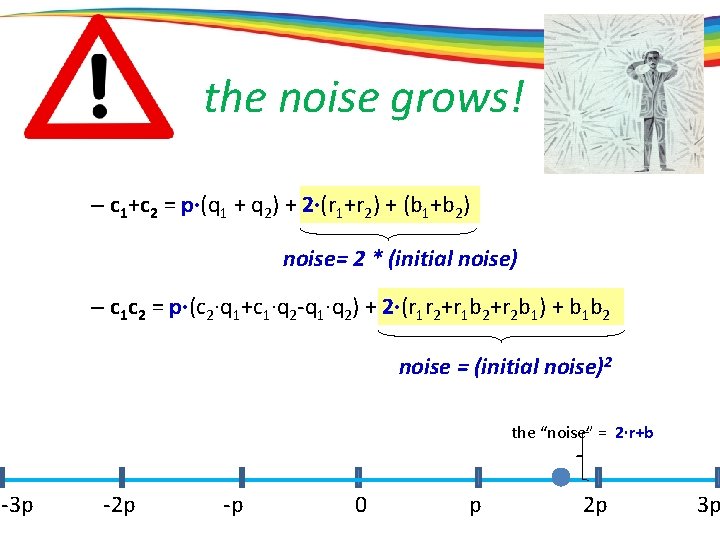
the noise grows! – c 1+c 2 = p·(q 1 + q 2) + 2·(r 1+r 2) + (b 1+b 2) noise= 2 * (initial noise) – c 1 c 2 = p·(c 2·q 1+c 1·q 2 -q 1·q 2) + 2·(r 1 r 2+r 1 b 2+r 2 b 1) + b 1 b 2 noise = (initial noise)2 the “noise” = 2·r+b -3 p -2 p -p 0 p 2 p 3 p
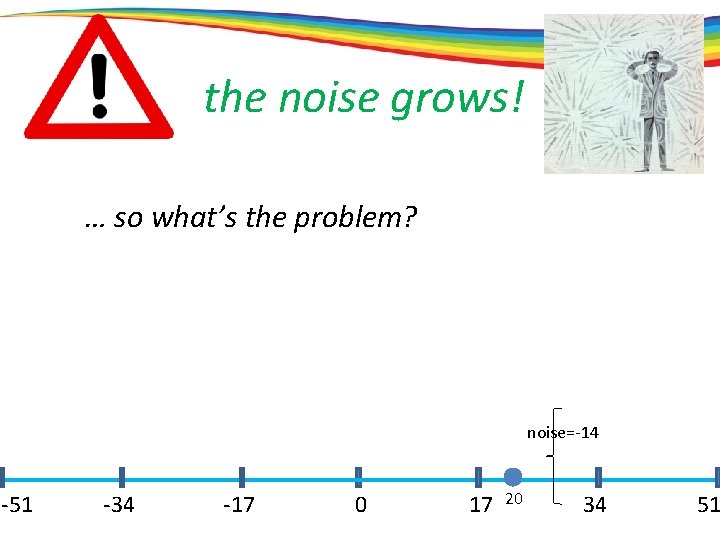
the noise grows! … so what’s the problem? noise=-14 -51 -34 -17 0 17 20 34 51
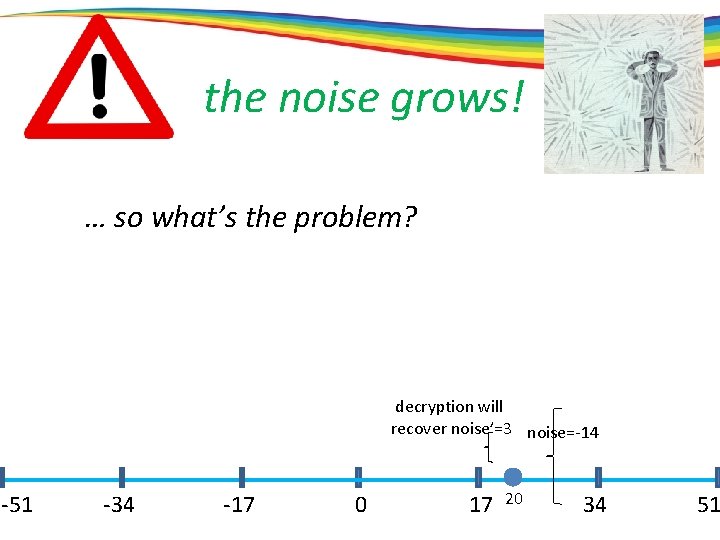
the noise grows! … so what’s the problem? decryption will recover noise’=3 noise=-14 -51 -34 -17 0 17 20 34 51
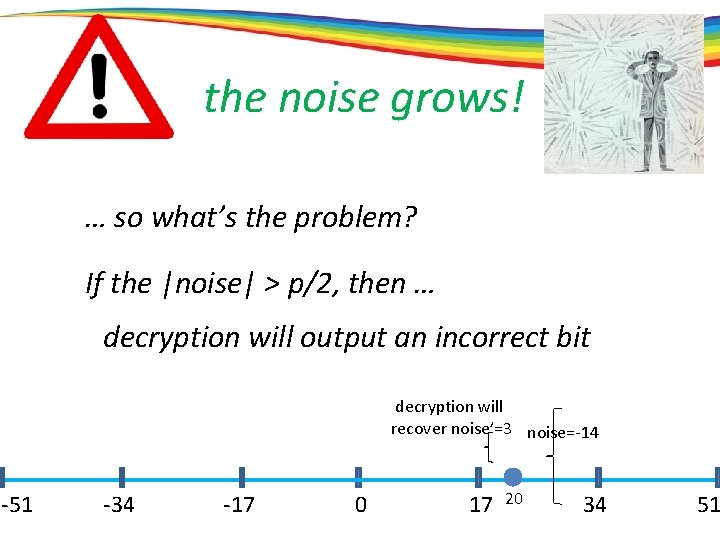
the noise grows! … so what’s the problem? If the |noise| > p/2, then … decryption will output an incorrect bit decryption will recover noise’=3 noise=-14 -51 -34 -17 0 17 20 34 51
So, what did we accomplish? … we can do lots of additions and … some multiplications (= a “somewhat homomorphic” encryption)
So, what did we accomplish? … we can do lots of additions and … some multiplications (= a “somewhat homomorphic” encryption) … enough to do many useful tasks, e. g. , database search, spam filtering etc.
So, what did we accomplish? … we can do lots of additions and … some multiplications (= a “somewhat homomorphic” encryption) … enough to do many useful tasks, e. g. , database search, spam filtering etc. But I promised much more …
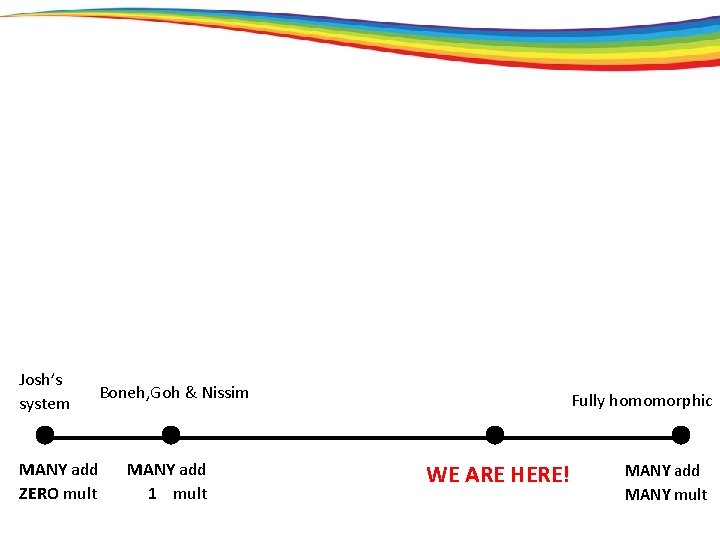
Josh’s system MANY add ZERO mult Boneh, Goh & Nissim MANY add 1 mult Fully homomorphic WE ARE HERE! MANY add MANY mult
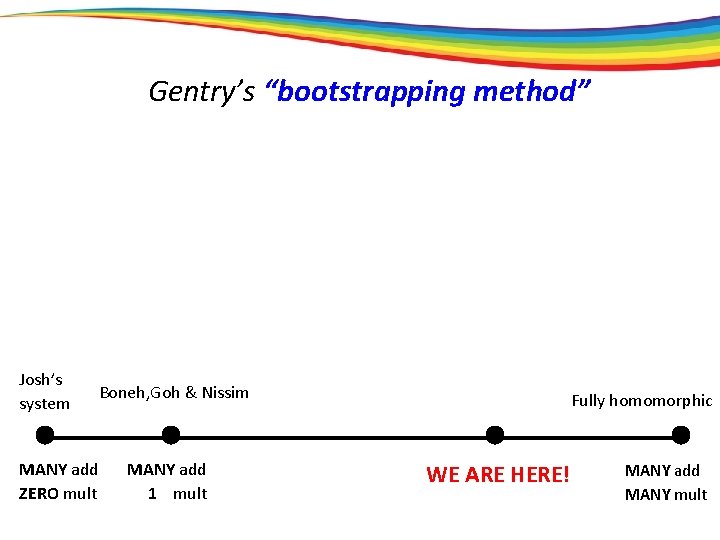
Gentry’s “bootstrapping method” Josh’s system MANY add ZERO mult Boneh, Goh & Nissim MANY add 1 mult Fully homomorphic WE ARE HERE! MANY add MANY mult
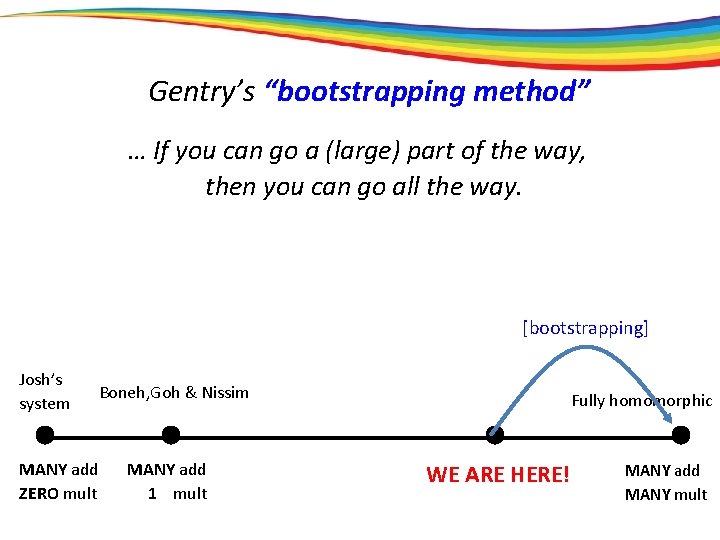
Gentry’s “bootstrapping method” … If you can go a (large) part of the way, then you can go all the way. [bootstrapping] Josh’s system MANY add ZERO mult Boneh, Goh & Nissim MANY add 1 mult Fully homomorphic WE ARE HERE! MANY add MANY mult
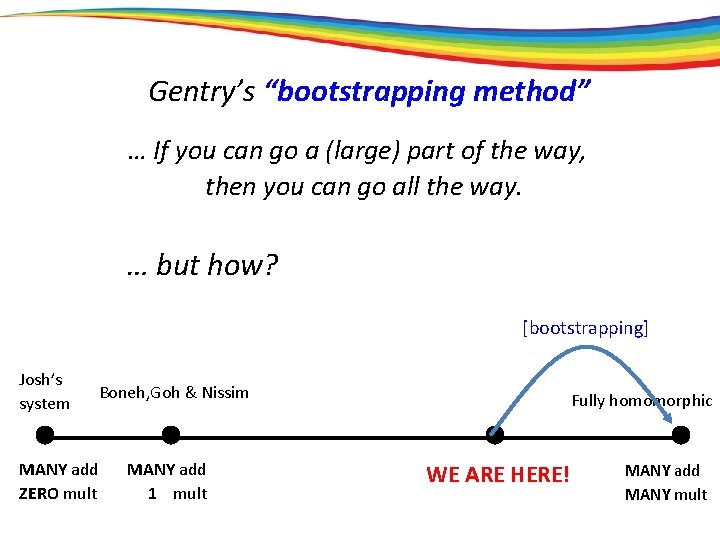
Gentry’s “bootstrapping method” … If you can go a (large) part of the way, then you can go all the way. … but how? [bootstrapping] Josh’s system MANY add ZERO mult Boneh, Goh & Nissim MANY add 1 mult Fully homomorphic WE ARE HERE! MANY add MANY mult
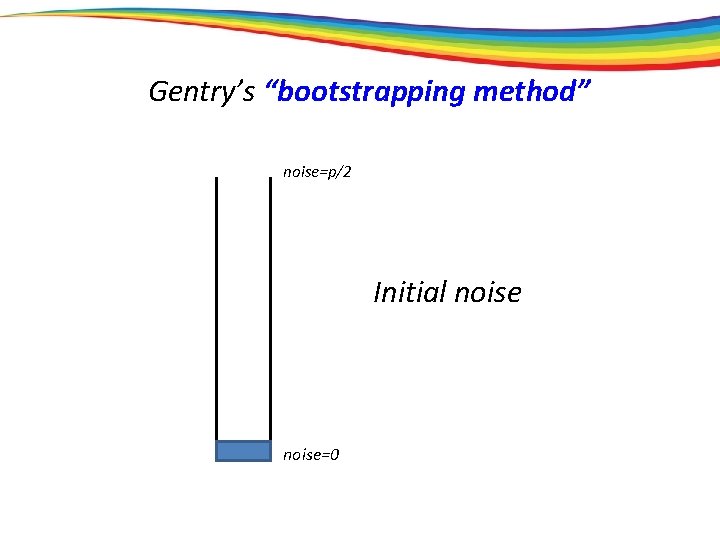
Gentry’s “bootstrapping method” noise=p/2 Initial noise=0
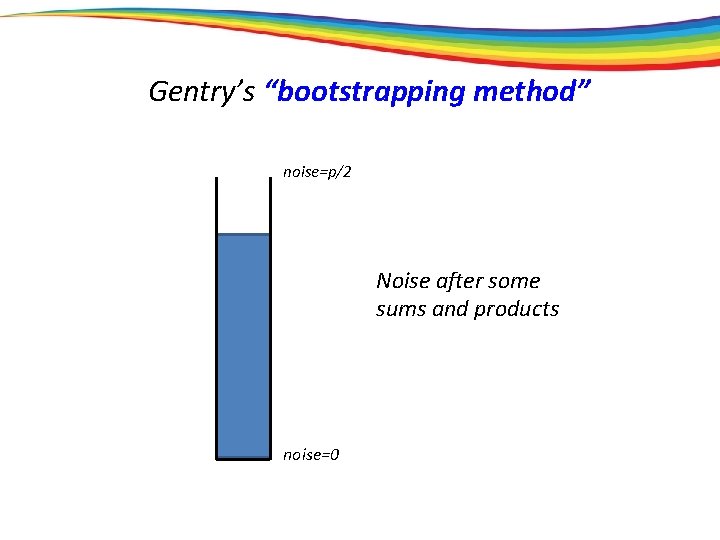
Gentry’s “bootstrapping method” noise=p/2 Noise after some sums and products noise=0
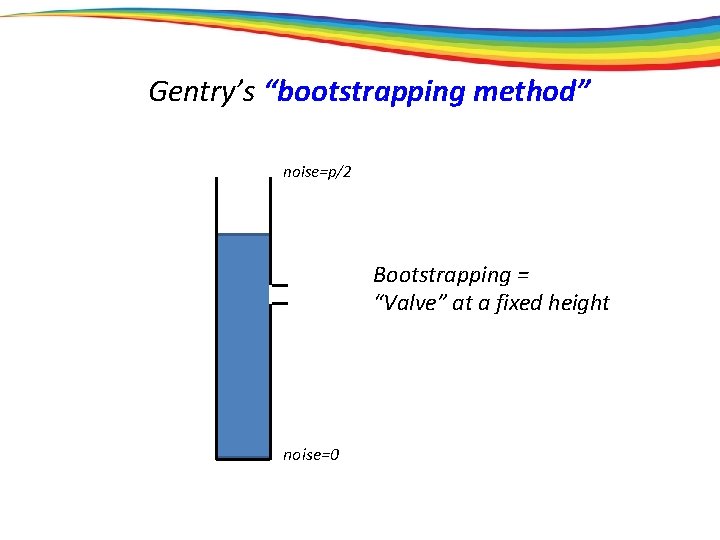
Gentry’s “bootstrapping method” noise=p/2 Bootstrapping = “Valve” at a fixed height noise=0
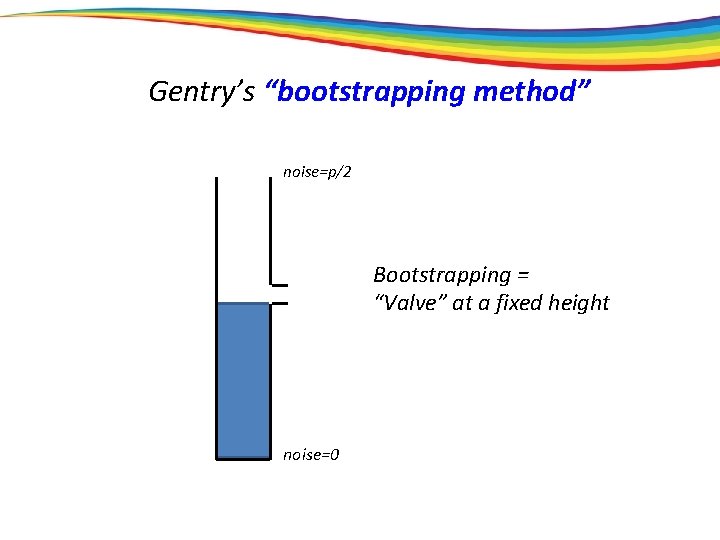
Gentry’s “bootstrapping method” noise=p/2 Bootstrapping = “Valve” at a fixed height noise=0
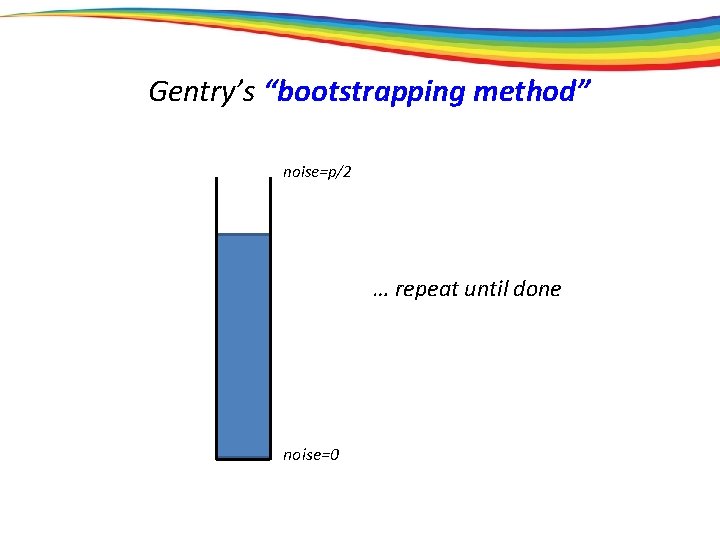
Gentry’s “bootstrapping method” noise=p/2 … repeat until done noise=0
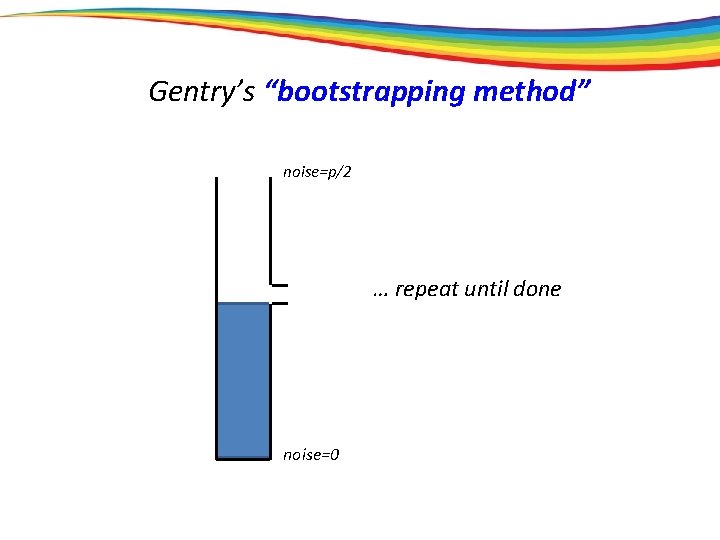
Gentry’s “bootstrapping method” noise=p/2 … repeat until done noise=0

How efficient is all this? … can I buy a homomorphic encryption software and start encrypting my data? Hom Inc.
How efficient is all this? … can I buy a homomorphic encryption software and start encrypting my data? … well, not quite yet
How efficient is all this? … can I buy a homomorphic encryption software and start encrypting my data? … well, not quite yet … encrypting a bit takes ~19 s (!) with the current best implementation
How efficient is all this? … can I buy a homomorphic encryption software and start encrypting my data? … well, not quite yet … encrypting a bit takes ~19 s (!) with the current best implementation … it takes 99 min to encrypt this sentence
How efficient is all this? … can I buy a homomorphic encryption software and start encrypting my data? … well, not quite yet … encrypting a bit takes ~19 s (!) with the current best implementation … but we are improving rapidly…

… a number of new, more efficient schemes … optimized implementation efforts (in hardware and software) … and a $20 M DARPA project to fund all this

… a number of new, more efficient schemes … optimized implementation efforts (in hardware and software) … and a $20 M DARPA project to fund all this So … watch out for new developments!

References: [1] “Computing arbitrary functions of Encrypted Data”, Craig Gentry, Communications of the ACM 53(3), 2010. [2] “Fully Homomorphic Encryption from the Integers”, Marten van Dijk, Craig Gentry, Shai Halevi, Vinod Vaikuntanathan http: //eprint. iacr. org/2009/616, Eurocrypt 2010. [3] “Implementing Gentry’s Fully Homomorphic Encryption”, Craig Gentry and Shai Halevi https: //researcher. ibm. com/researcher/files/us-shaih/fheimplementation. pdf, Eurocrypt 2011.
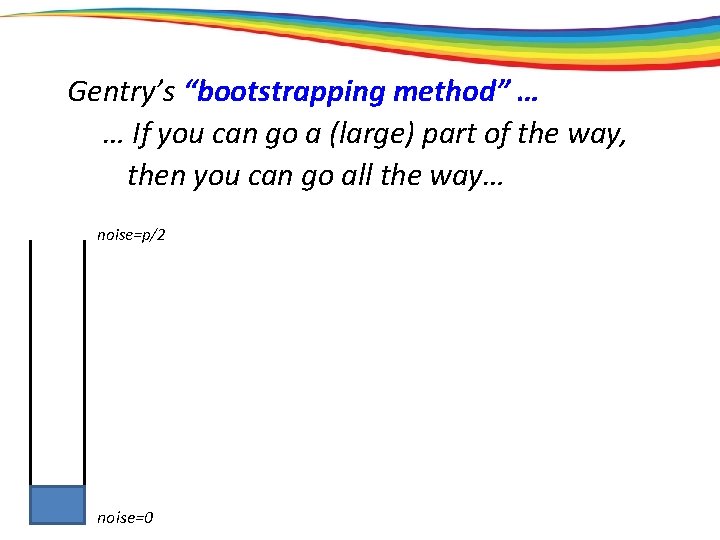
Gentry’s “bootstrapping method” … … If you can go a (large) part of the way, then you can go all the way… noise=p/2 noise=0
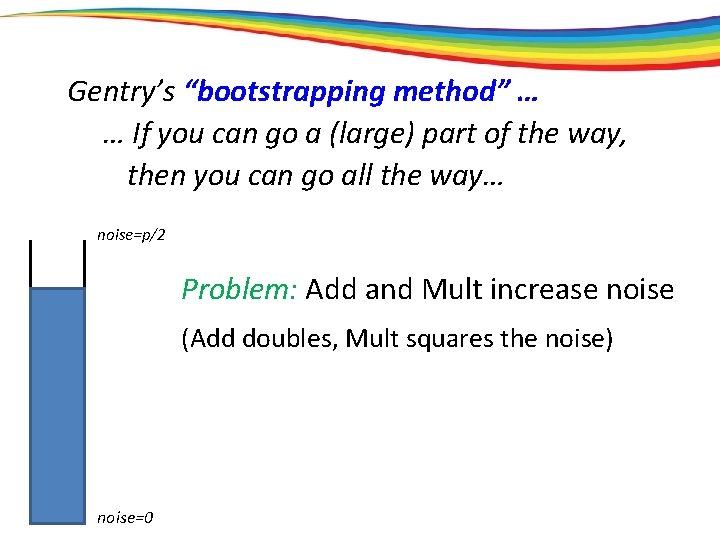
Gentry’s “bootstrapping method” … … If you can go a (large) part of the way, then you can go all the way… noise=p/2 Problem: Add and Mult increase noise (Add doubles, Mult squares the noise) noise=0
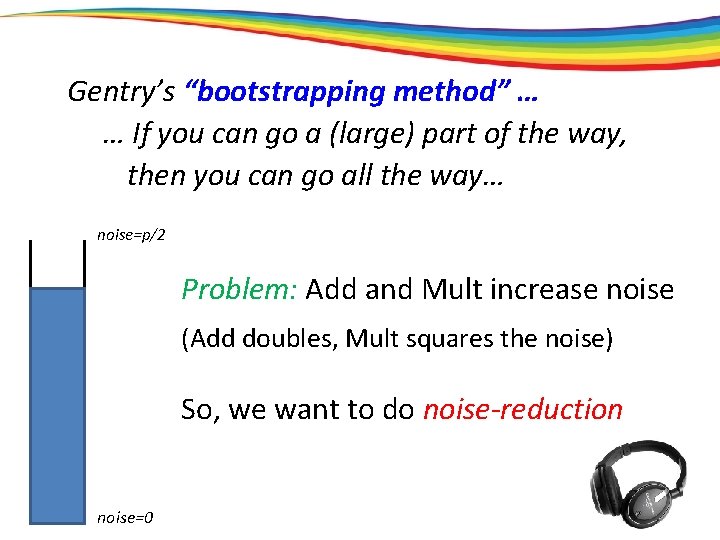
Gentry’s “bootstrapping method” … … If you can go a (large) part of the way, then you can go all the way… noise=p/2 Problem: Add and Mult increase noise (Add doubles, Mult squares the noise) So, we want to do noise-reduction noise=0
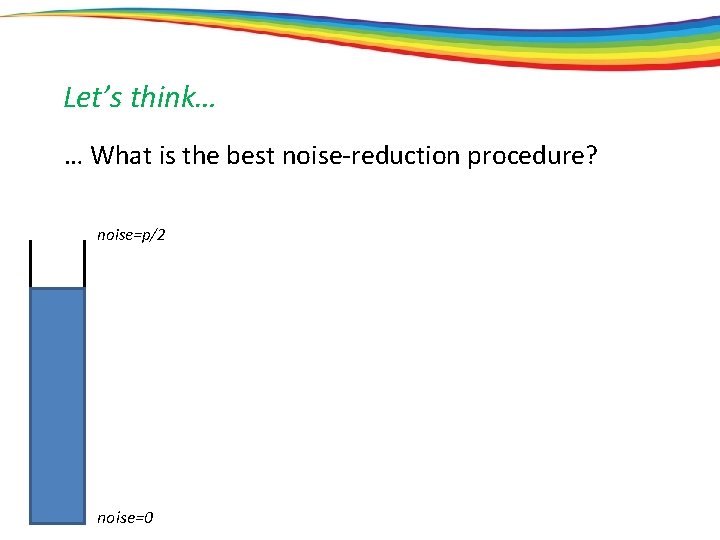
Let’s think… … What is the best noise-reduction procedure? noise=p/2 noise=0
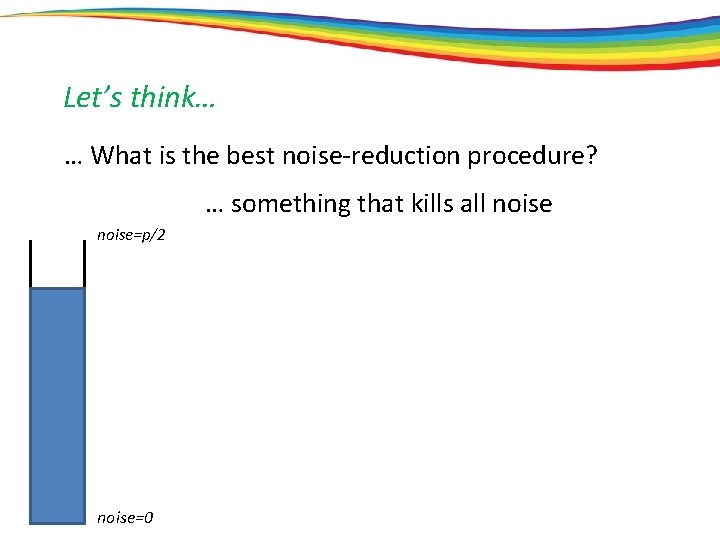
Let’s think… … What is the best noise-reduction procedure? … something that kills all noise=p/2 noise=0
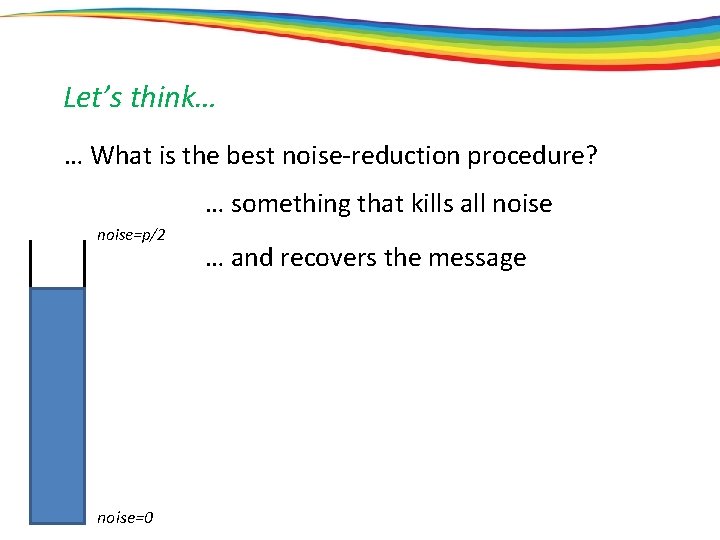
Let’s think… … What is the best noise-reduction procedure? … something that kills all noise=p/2 noise=0 … and recovers the message
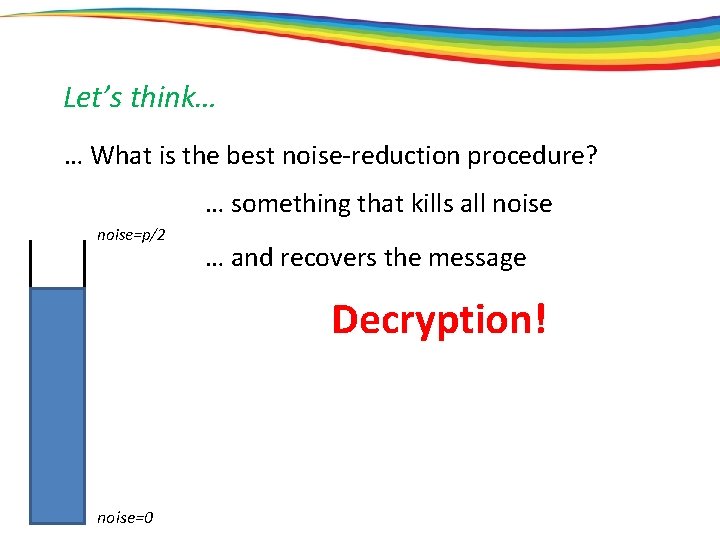
Let’s think… … What is the best noise-reduction procedure? … something that kills all noise=p/2 … and recovers the message Decryption! noise=0
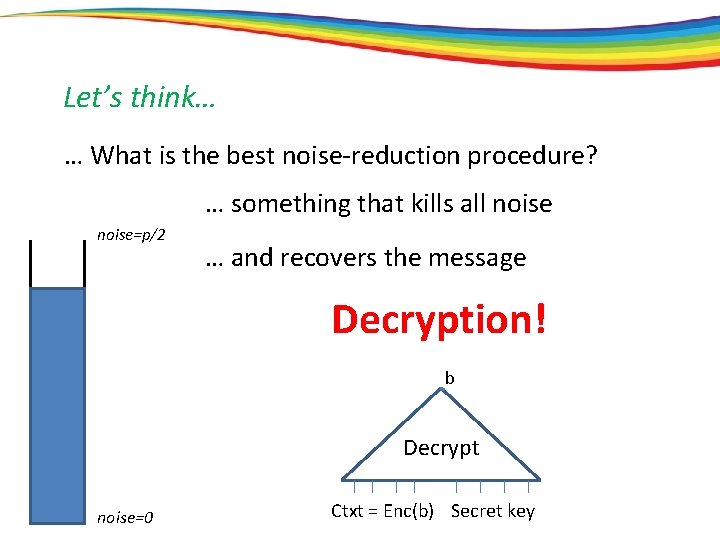
Let’s think… … What is the best noise-reduction procedure? … something that kills all noise=p/2 … and recovers the message Decryption! b Decrypt noise=0 Ctxt = Enc(b) Secret key
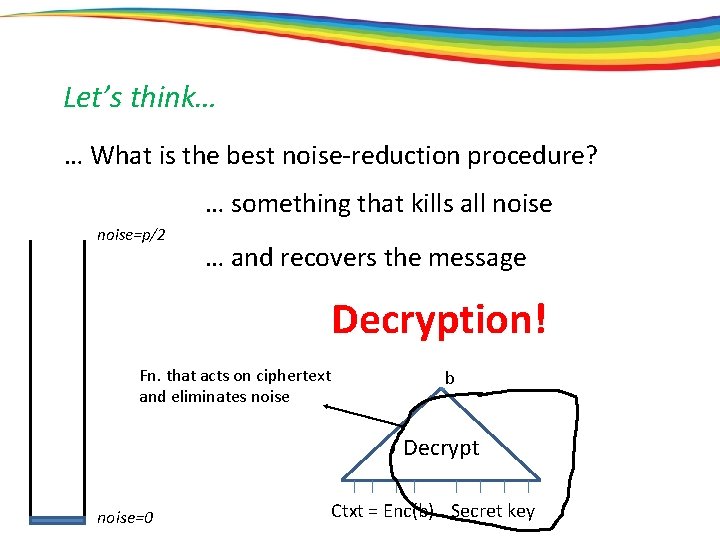
Let’s think… … What is the best noise-reduction procedure? … something that kills all noise=p/2 … and recovers the message Decryption! Fn. that acts on ciphertext and eliminates noise b Decrypt noise=0 Ctxt = Enc(b) Secret key
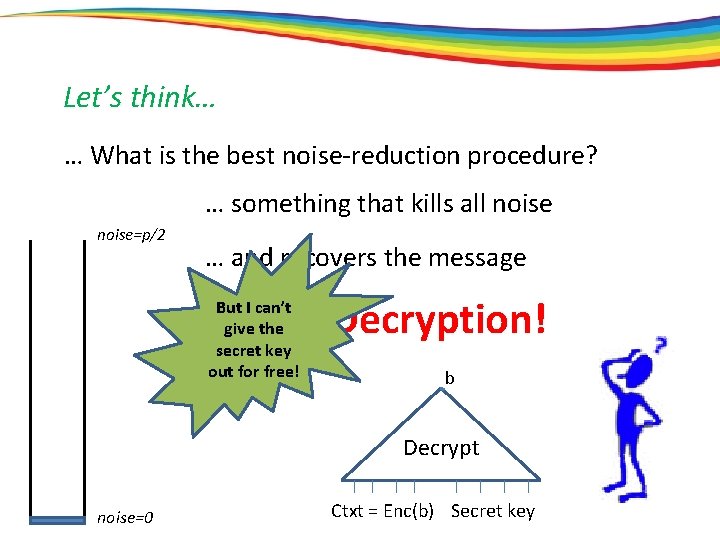
Let’s think… … What is the best noise-reduction procedure? … something that kills all noise=p/2 … and recovers the message But I can’t give the secret key out for free! Decryption! b Decrypt noise=0 Ctxt = Enc(b) Secret key
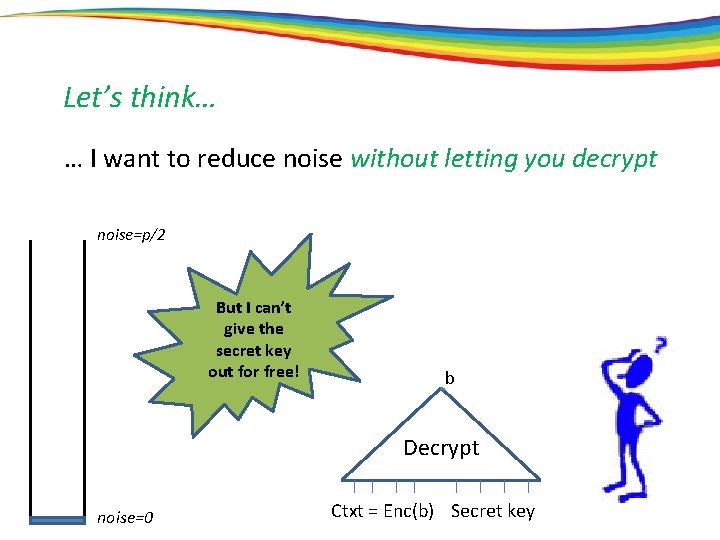
Let’s think… … I want to reduce noise without letting you decrypt noise=p/2 But I can’t give the secret key out for free! b Decrypt noise=0 Ctxt = Enc(b) Secret key
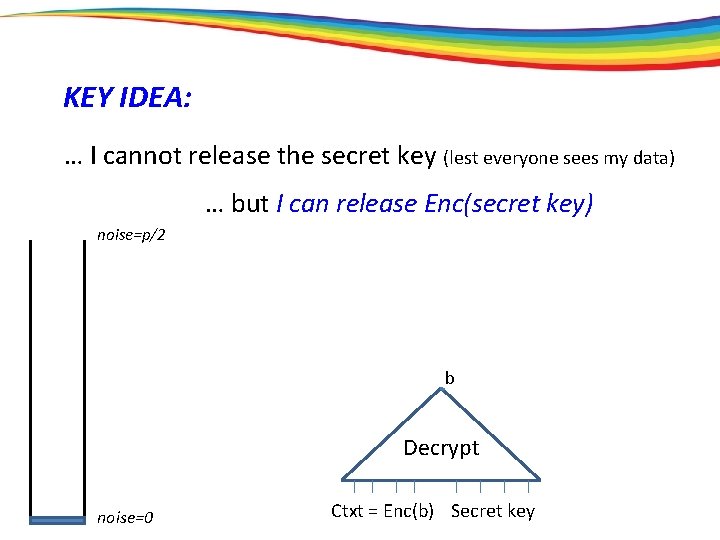
KEY IDEA: … I cannot release the secret key (lest everyone sees my data) … but I can release Enc(secret key) noise=p/2 b Decrypt noise=0 Ctxt = Enc(b) Secret key
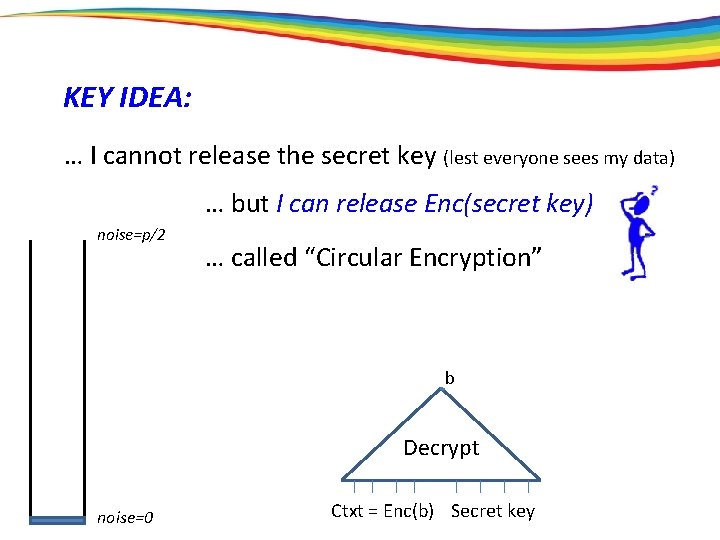
KEY IDEA: … I cannot release the secret key (lest everyone sees my data) … but I can release Enc(secret key) noise=p/2 … called “Circular Encryption” b Decrypt noise=0 Ctxt = Enc(b) Secret key
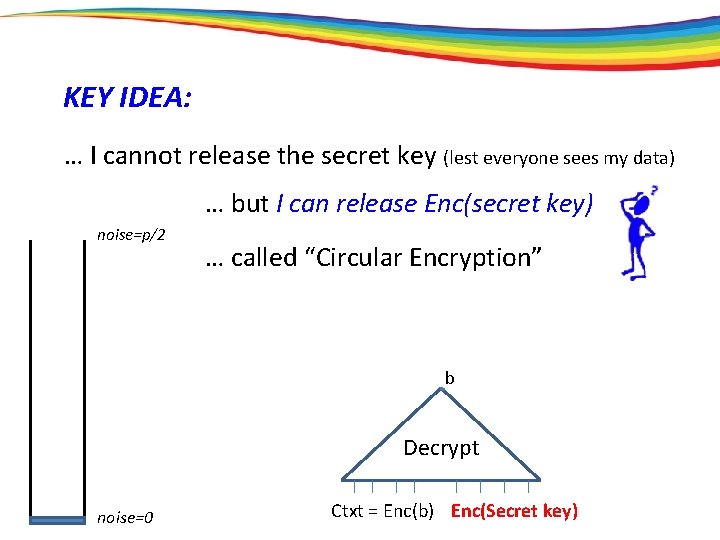
KEY IDEA: … I cannot release the secret key (lest everyone sees my data) … but I can release Enc(secret key) noise=p/2 … called “Circular Encryption” b Decrypt noise=0 Ctxt = Enc(b) Enc(Secret key)
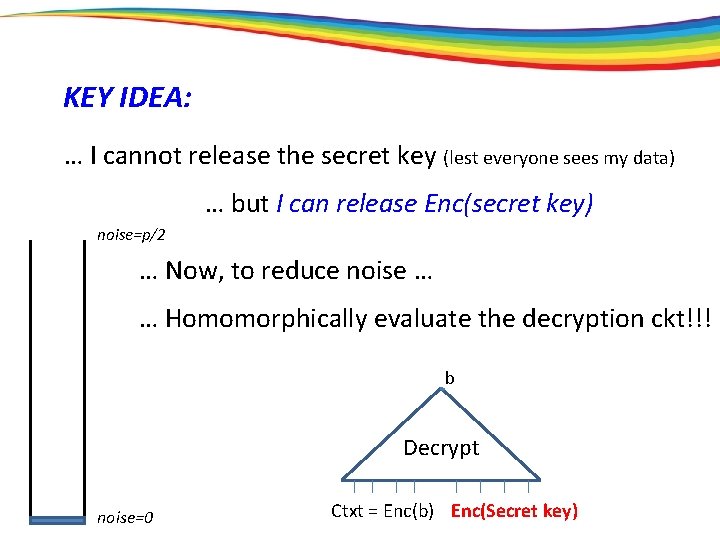
KEY IDEA: … I cannot release the secret key (lest everyone sees my data) … but I can release Enc(secret key) noise=p/2 … Now, to reduce noise … … Homomorphically evaluate the decryption ckt!!! b Decrypt noise=0 Ctxt = Enc(b) Enc(Secret key)
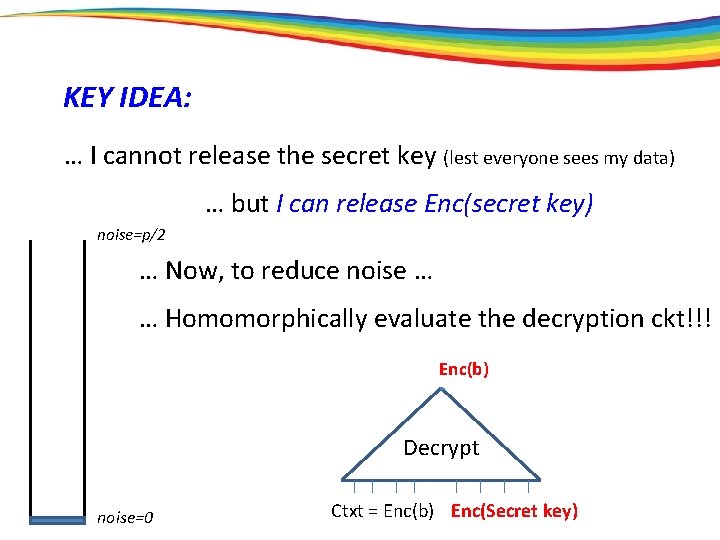
KEY IDEA: … I cannot release the secret key (lest everyone sees my data) … but I can release Enc(secret key) noise=p/2 … Now, to reduce noise … … Homomorphically evaluate the decryption ckt!!! Enc(b) Decrypt noise=0 Ctxt = Enc(b) Enc(Secret key)
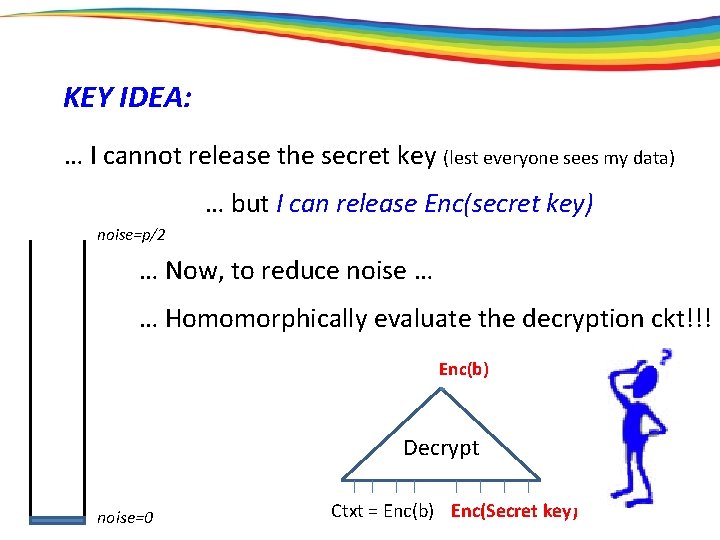
KEY IDEA: … I cannot release the secret key (lest everyone sees my data) … but I can release Enc(secret key) noise=p/2 … Now, to reduce noise … … Homomorphically evaluate the decryption ckt!!! Enc(b) Decrypt noise=0 Ctxt = Enc(b) Enc(Secret key)
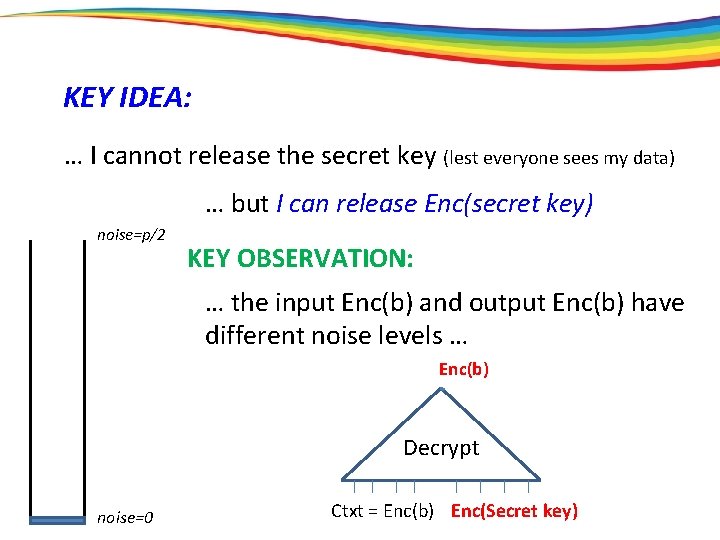
KEY IDEA: … I cannot release the secret key (lest everyone sees my data) … but I can release Enc(secret key) noise=p/2 KEY OBSERVATION: … the input Enc(b) and output Enc(b) have different noise levels … Enc(b) Decrypt noise=0 Ctxt = Enc(b) Enc(Secret key)
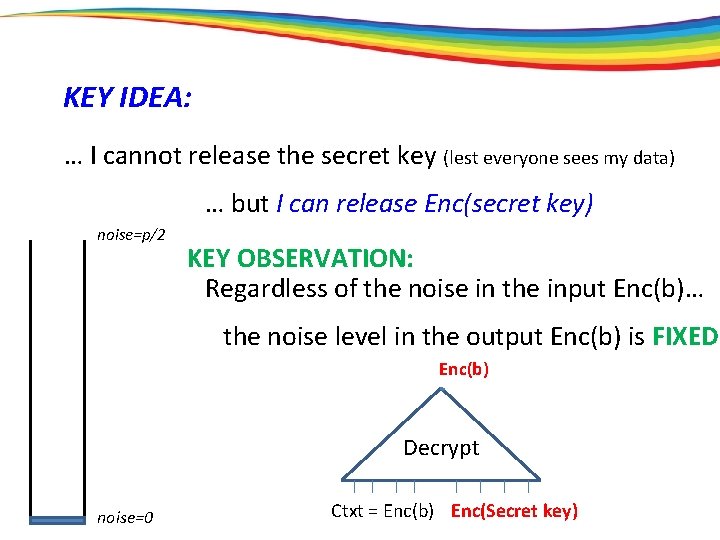
KEY IDEA: … I cannot release the secret key (lest everyone sees my data) … but I can release Enc(secret key) noise=p/2 KEY OBSERVATION: Regardless of the noise in the input Enc(b)… the noise level in the output Enc(b) is FIXED Enc(b) Decrypt noise=0 Ctxt = Enc(b) Enc(Secret key)
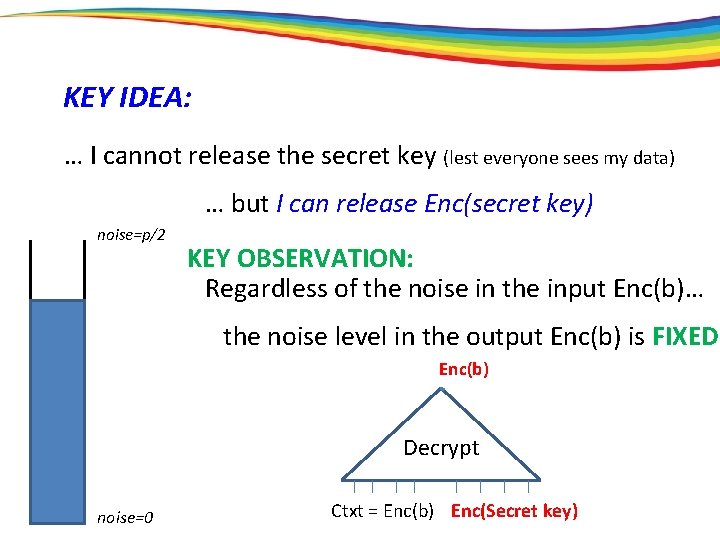
KEY IDEA: … I cannot release the secret key (lest everyone sees my data) … but I can release Enc(secret key) noise=p/2 KEY OBSERVATION: Regardless of the noise in the input Enc(b)… the noise level in the output Enc(b) is FIXED Enc(b) Decrypt noise=0 Ctxt = Enc(b) Enc(Secret key)
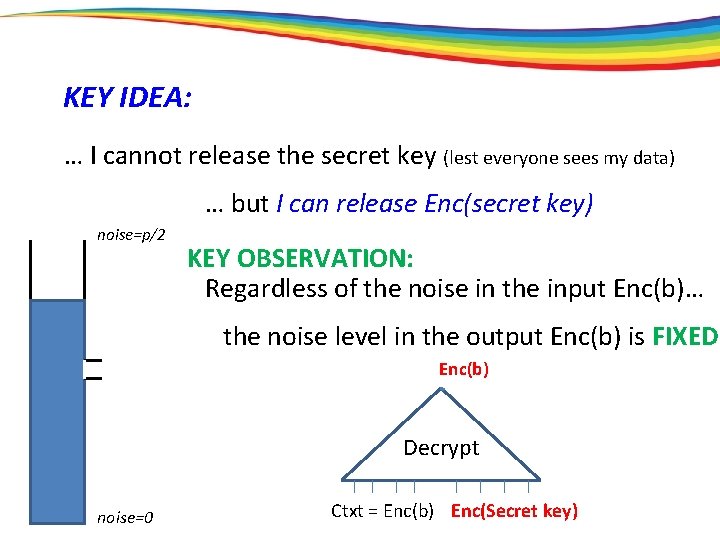
KEY IDEA: … I cannot release the secret key (lest everyone sees my data) … but I can release Enc(secret key) noise=p/2 KEY OBSERVATION: Regardless of the noise in the input Enc(b)… the noise level in the output Enc(b) is FIXED Enc(b) Decrypt noise=0 Ctxt = Enc(b) Enc(Secret key)
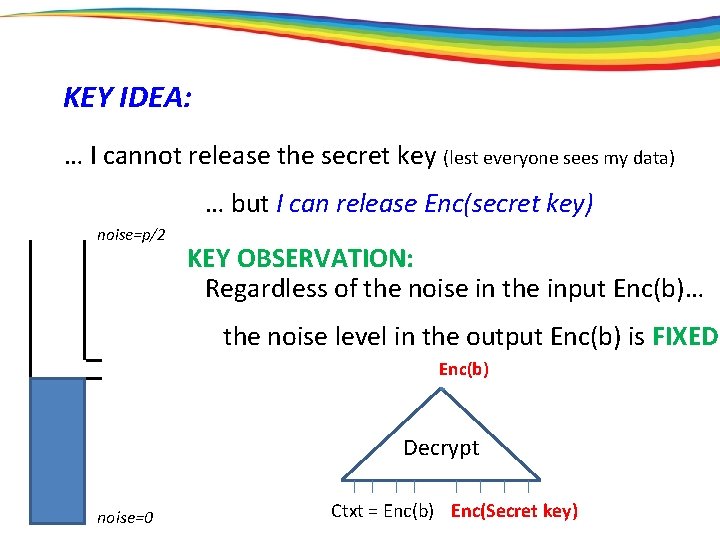
KEY IDEA: … I cannot release the secret key (lest everyone sees my data) … but I can release Enc(secret key) noise=p/2 KEY OBSERVATION: Regardless of the noise in the input Enc(b)… the noise level in the output Enc(b) is FIXED Enc(b) Decrypt noise=0 Ctxt = Enc(b) Enc(Secret key)
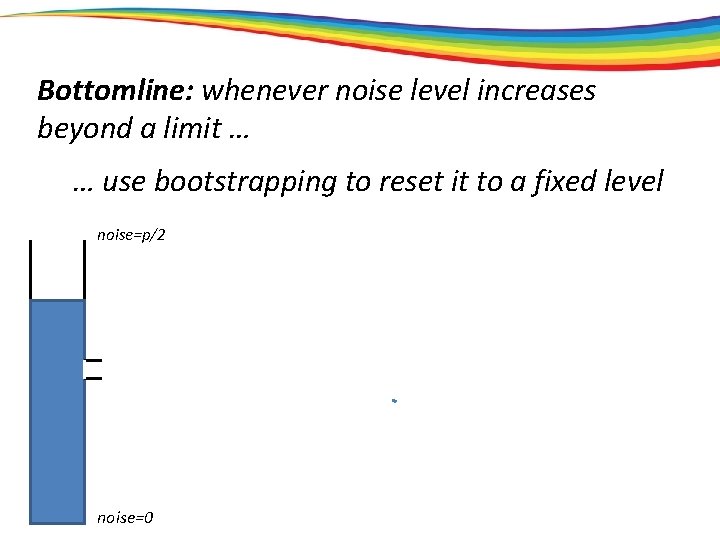
Bottomline: whenever noise level increases beyond a limit … … use bootstrapping to reset it to a fixed level noise=p/2 noise=0
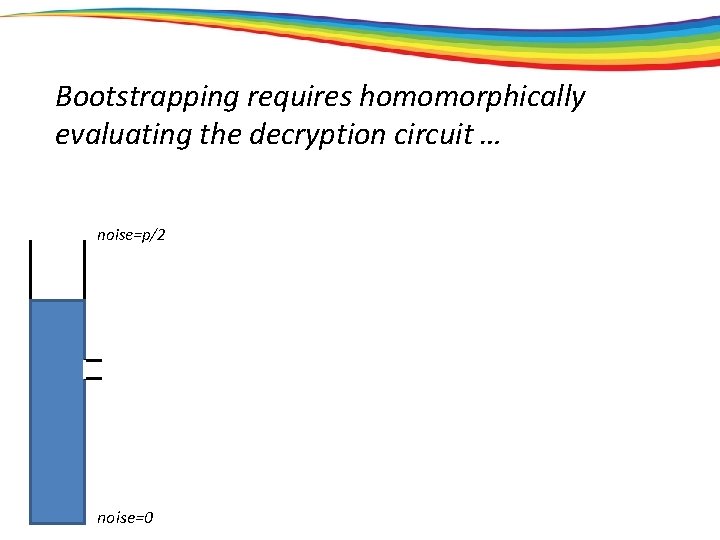
Bootstrapping requires homomorphically evaluating the decryption circuit … noise=p/2 noise=0
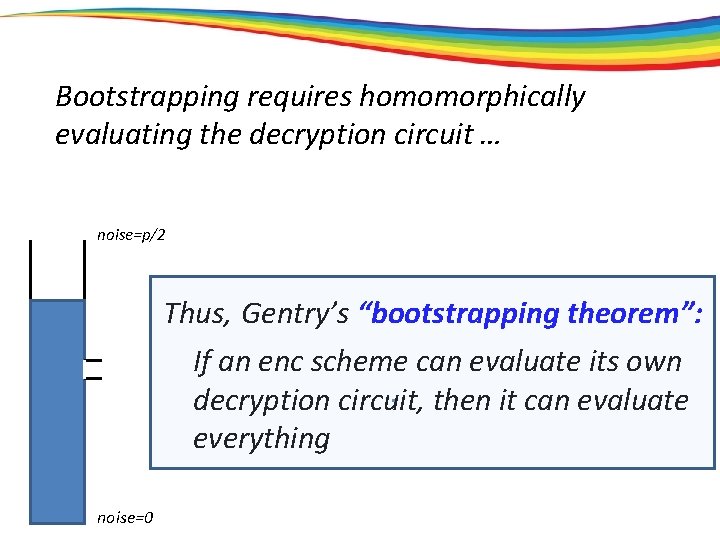
Bootstrapping requires homomorphically evaluating the decryption circuit … noise=p/2 Thus, Gentry’s “bootstrapping theorem”: If an enc scheme can evaluate its own decryption circuit, then it can evaluate everything noise=0
- Slides: 141