
Homomorphic Encryption Part I SWHE Shai Halevi Many


- Slides: 40
Homomorphic Encryption (Part I): SWHE Shai Halevi * Many slides taken from Craig Gentry May 18, 2015 Simons Institute, Cryptography Boot Camp
Computing on Encrypted Data Can we delegate the processing of data, without giving away access to it.
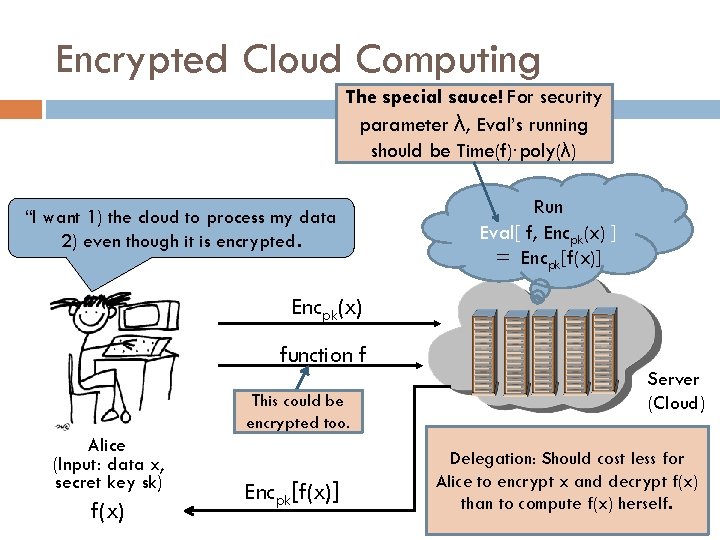
Encrypted Cloud Computing The special sauce! For security parameter λ, Eval’s running should be Time(f)∙poly(λ) “I want 1) the cloud to process my data 2) even though it is encrypted. Run Eval[ f, Encpk(x) ] = Encpk[f(x)] Encpk(x) function f This could be encrypted too. Alice (Input: data x, secret key sk) f(x) Encpk[f(x)] Server (Cloud) Delegation: Should cost less for Alice to encrypt x and decrypt f(x) than to compute f(x) herself.
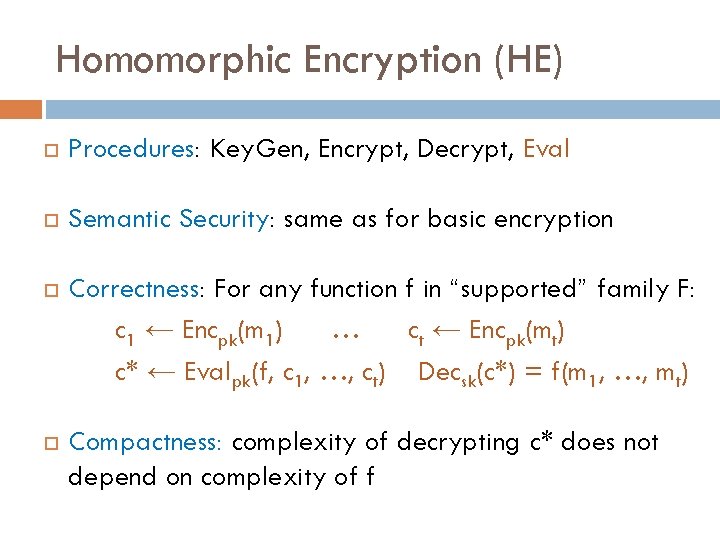
Homomorphic Encryption (HE) Procedures: Key. Gen, Encrypt, Decrypt, Eval Semantic Security: same as for basic encryption Correctness: For any function f in “supported” family F: c 1 ← Encpk(m 1) … ct ← Encpk(mt) c* ← Evalpk(f, c 1, …, ct) Decsk(c*) = f(m 1, …, mt) Compactness: complexity of decrypting c* does not depend on complexity of f
An Analogy: Alice’s Jewelry Store Alice wants workers to assemble raw materials into jewelry But Alice is worried about theft: She wants workers to process raw materials without having access. Alice puts raw materials in locked glovebox. Workers assemble jewelry inside glovebox, using the gloves. Alice unlocks box to get “results”.
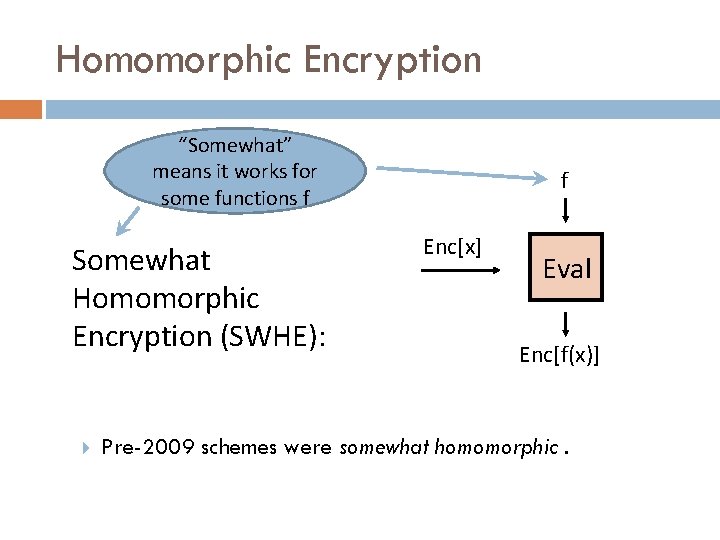
Homomorphic Encryption “Somewhat” means it works for some functions f Somewhat Homomorphic Encryption (SWHE): f Enc[x] Eval Enc[f(x)] Pre-2009 schemes were somewhat homomorphic.
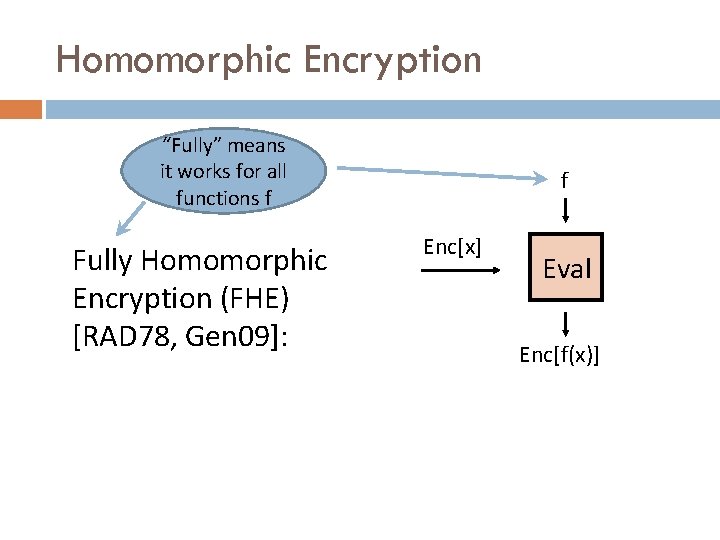
Homomorphic Encryption “Fully” means it works for all functions f Fully Homomorphic Encryption (FHE) [RAD 78, Gen 09]: f Enc[x] Eval Enc[f(x)]
HE Security: A Paradox? Cloud stores my encrypted files: pk, Encpk(f 1), …, Encpk(fn). Later, I want f 3, but want to hide “ 3” from cloud. I send Encpk (3) to the cloud. Cloud runs Evalpk (F, Encpk(3), Encpk(f 1), …, Encpk(fn)), where F(n, {files}) is the function that outputs the nth file. It sends me the (encrypted) file f 3. Paradox? : Can’t the cloud “see” it is sending the 3 rd encrypted file? By comparing the stored value Encpk(f 3) to the ciphertext it sends? Resolution of paradox: Semantic security implies: Ø Many encryptions of f 3, Ø Hard to tell when two ciphertexts encrypt the same thing.
Properties/Limitations of HE
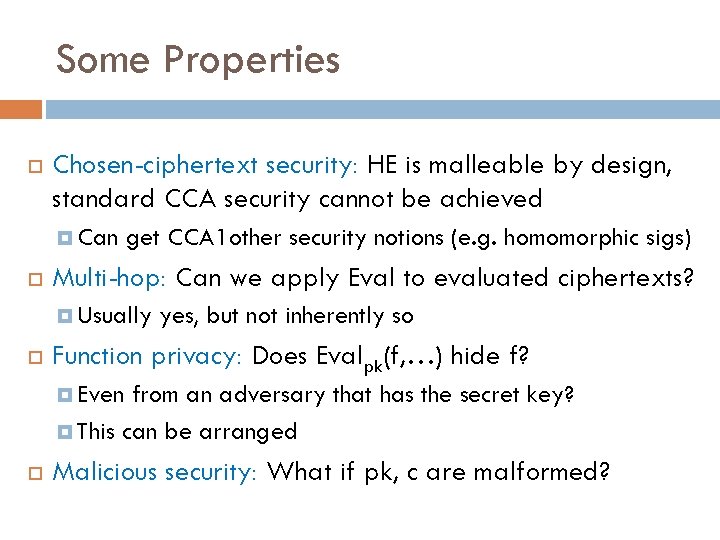
Some Properties Chosen-ciphertext security: HE is malleable by design, standard CCA security cannot be achieved Can get CCA 1 other security notions (e. g. homomorphic sigs) Multi-hop: Can we apply Eval to evaluated ciphertexts? Usually yes, but not inherently so Function privacy: Does Evalpk(f, …) hide f? Even from an adversary that has the secret key? This can be arranged Malicious security: What if pk, c are malformed?
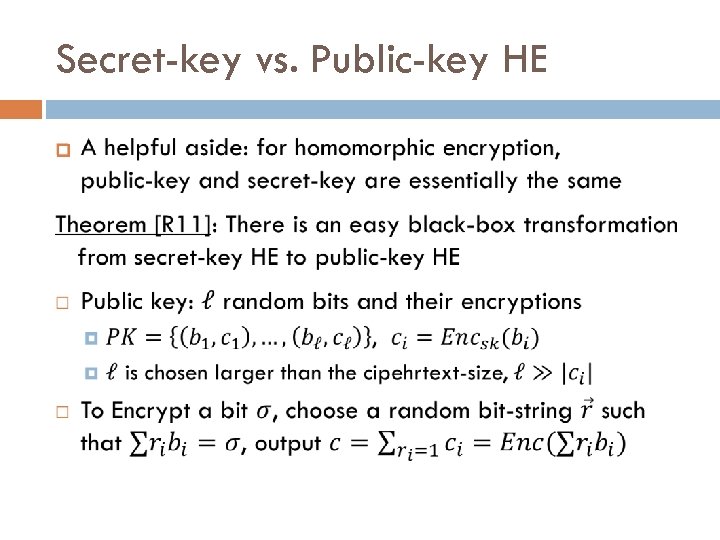
Secret-key vs. Public-key HE
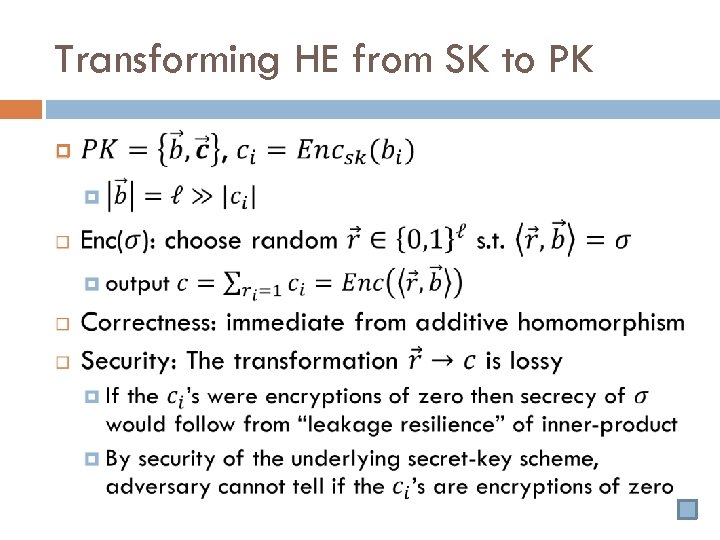
Transforming HE from SK to PK
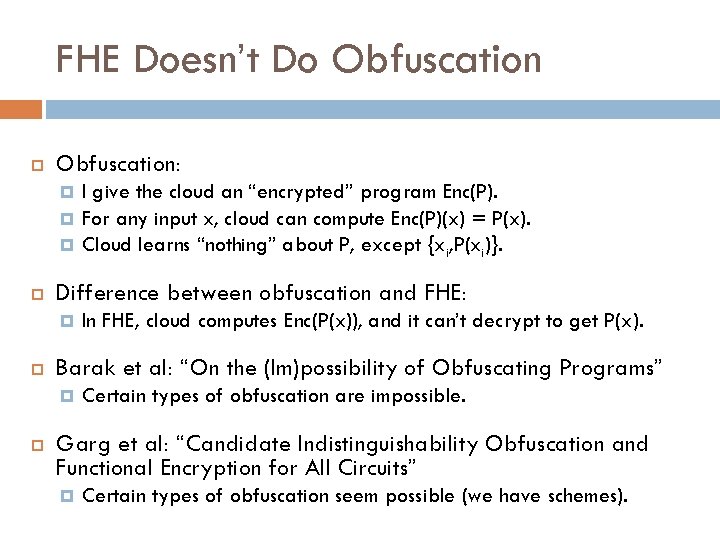
FHE Doesn’t Do Obfuscation: Difference between obfuscation and FHE: In FHE, cloud computes Enc(P(x)), and it can’t decrypt to get P(x). Barak et al: “On the (Im)possibility of Obfuscating Programs” I give the cloud an “encrypted” program Enc(P). For any input x, cloud can compute Enc(P)(x) = P(x). Cloud learns “nothing” about P, except {xi, P(xi)}. Certain types of obfuscation are impossible. Garg et al: “Candidate Indistinguishability Obfuscation and Functional Encryption for All Circuits” Certain types of obfuscation seem possible (we have schemes).
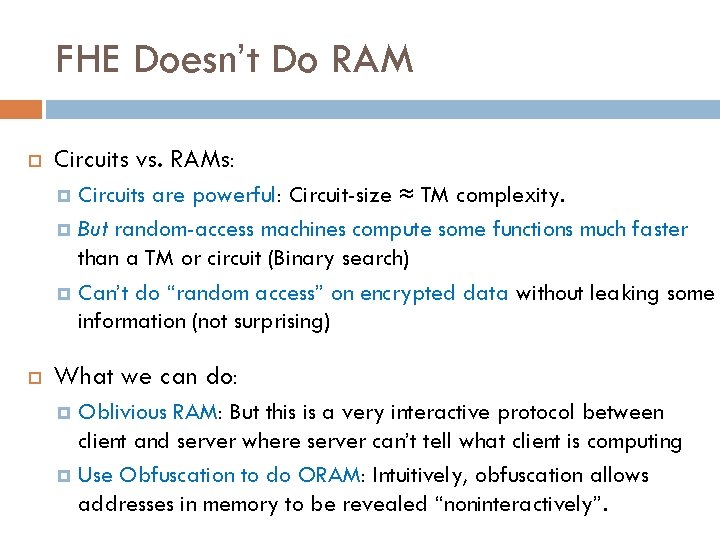
FHE Doesn’t Do RAM Circuits vs. RAMs: Circuits are powerful: Circuit-size ≈ TM complexity. But random-access machines compute some functions much faster than a TM or circuit (Binary search) Can’t do “random access” on encrypted data without leaking some information (not surprising) What we can do: Oblivious RAM: But this is a very interactive protocol between client and server where server can’t tell what client is computing Use Obfuscation to do ORAM: Intuitively, obfuscation allows addresses in memory to be revealed “noninteractively”.
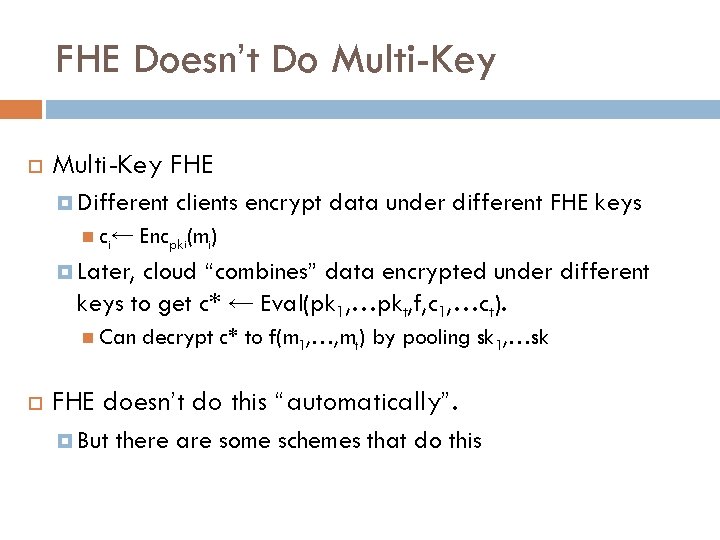
FHE Doesn’t Do Multi-Key FHE Different c i← clients encrypt data under different FHE keys Encpki(mi) Later, cloud “combines” data encrypted under different keys to get c* ← Eval(pk 1, …pkt, f, c 1, …ct). Can decrypt c* to f(m 1, …, mt) by pooling sk 1, …sk FHE doesn’t do this “automatically”. But there are some schemes that do this
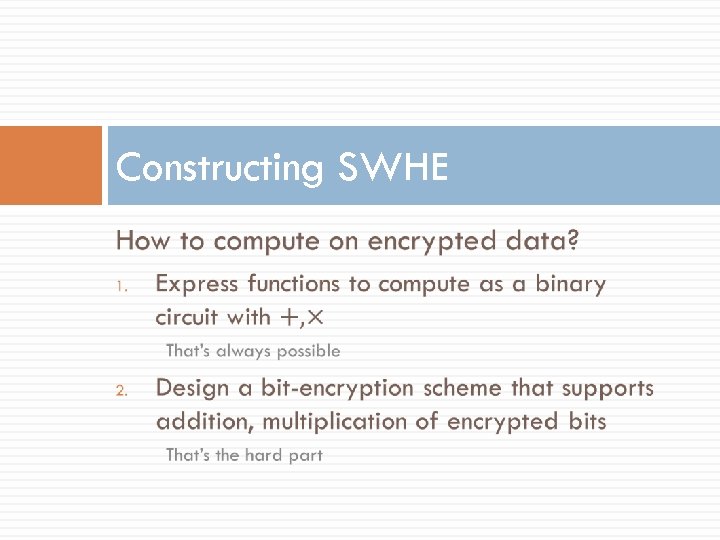
Constructing SWHE
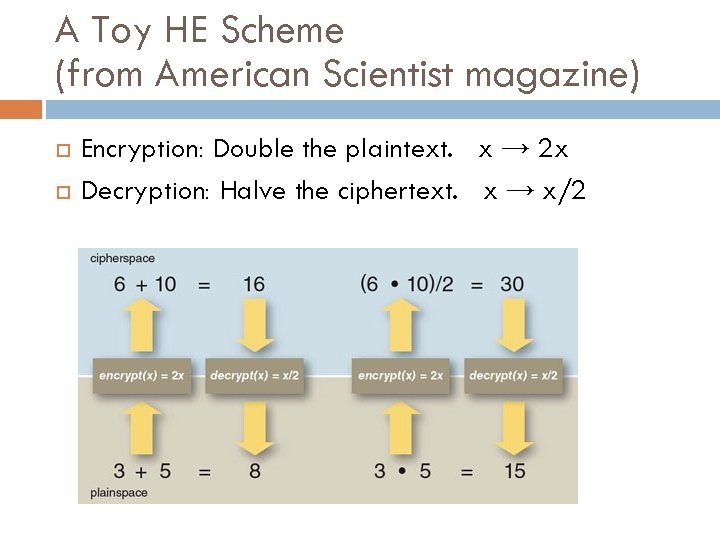
A Toy HE Scheme (from American Scientist magazine) Encryption: Double the plaintext. x → 2 x Decryption: Halve the ciphertext. x → x/2
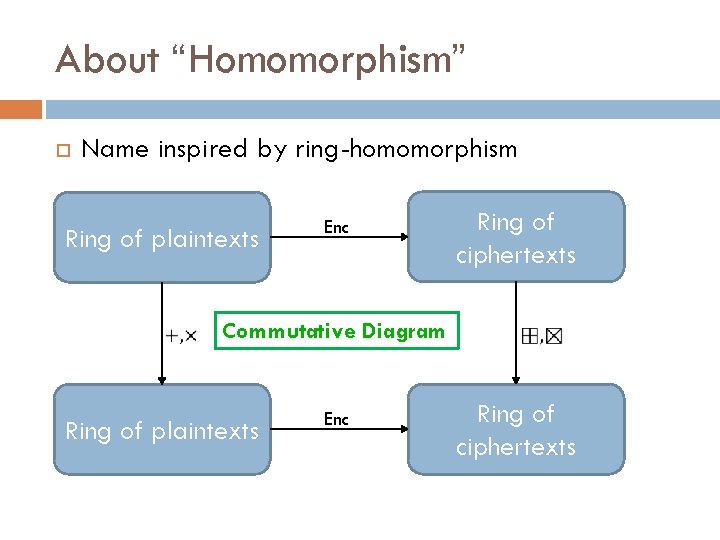
About “Homomorphism” Name inspired by ring-homomorphism Ring of plaintexts Enc Commutative Diagram Ring of plaintexts Enc Ring of ciphertexts
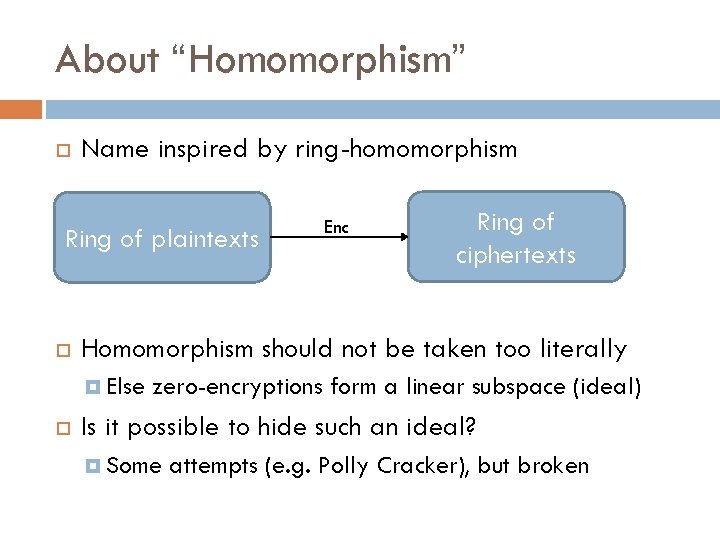
About “Homomorphism” Name inspired by ring-homomorphism Ring of plaintexts Ring of ciphertexts Homomorphism should not be taken too literally Else Enc zero-encryptions form a linear subspace (ideal) Is it possible to hide such an ideal? Some attempts (e. g. Polly Cracker), but broken
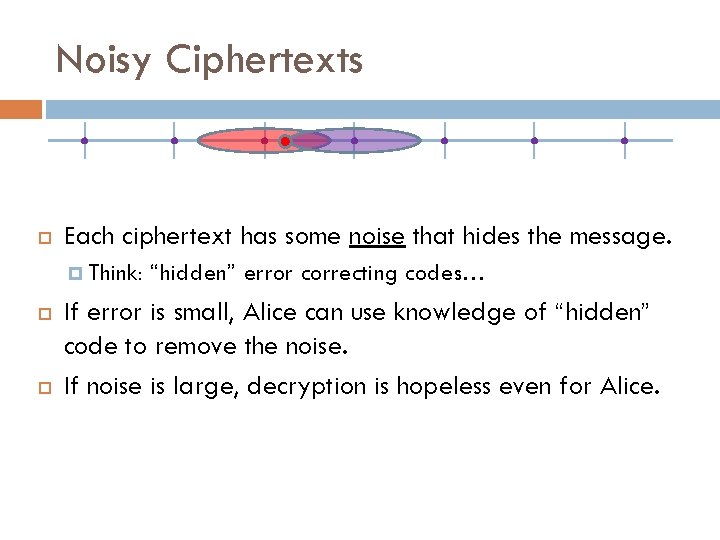
Noisy Ciphertexts Each ciphertext has some noise that hides the message. Think: “hidden” error correcting codes… If error is small, Alice can use knowledge of “hidden” code to remove the noise. If noise is large, decryption is hopeless even for Alice.
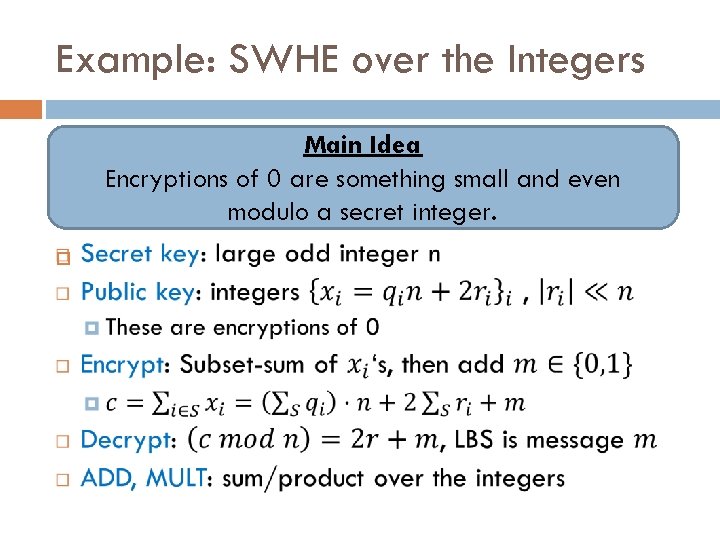
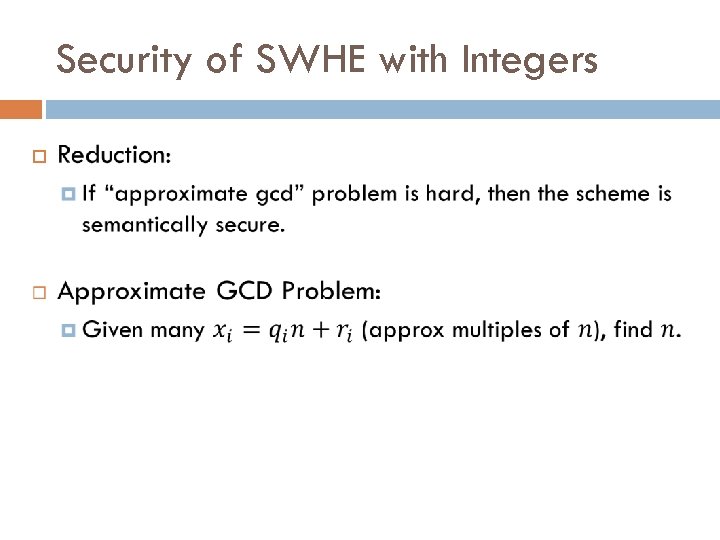
Example: SWHE over the Integers Main Idea Encryptions of 0 are something small and even modulo a secret integer.
Security of SWHE with Integers
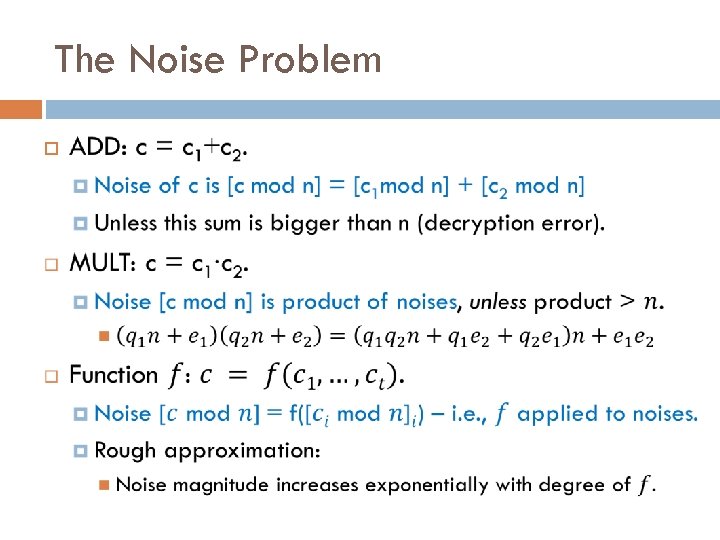
The Noise Problem
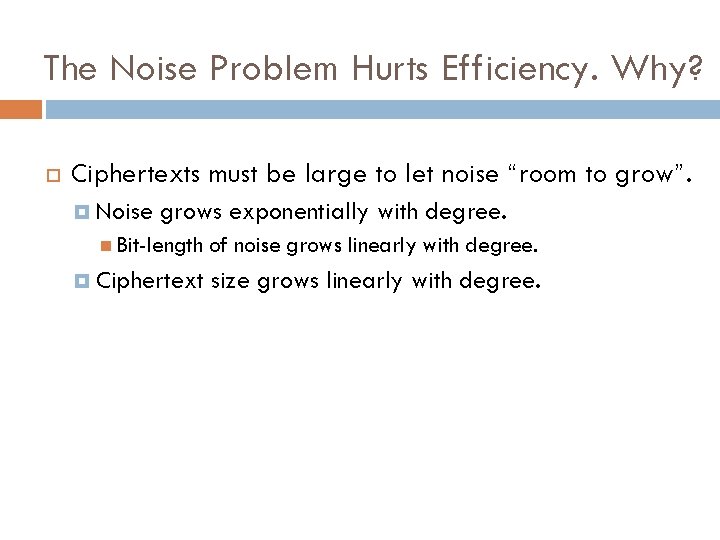
The Noise Problem Hurts Efficiency. Why? Ciphertexts must be large to let noise “room to grow”. Noise grows exponentially with degree. Bit-length of noise grows linearly with degree. Ciphertext size grows linearly with degree.
Somewhat Homomorphic Encryption Based on LWE Focusing on the Gentry-Sahai-Waters scheme. (Brakerski and Vaikuntanathan were the first to construct HE based on LWE. )
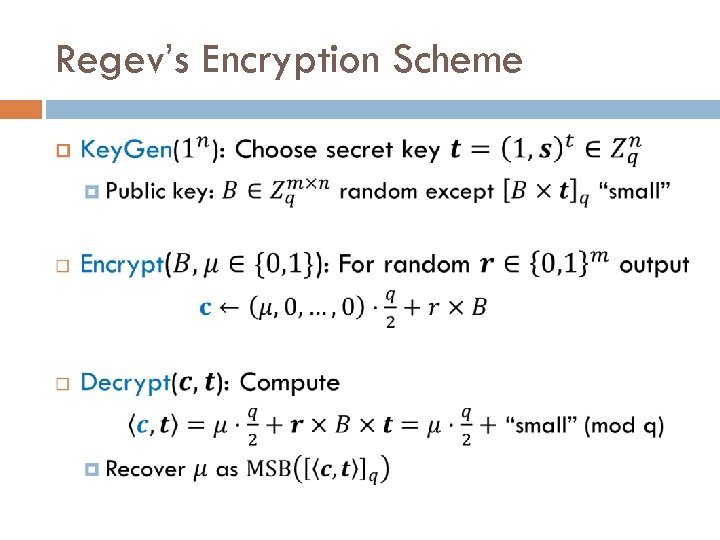
Regev’s Encryption Scheme
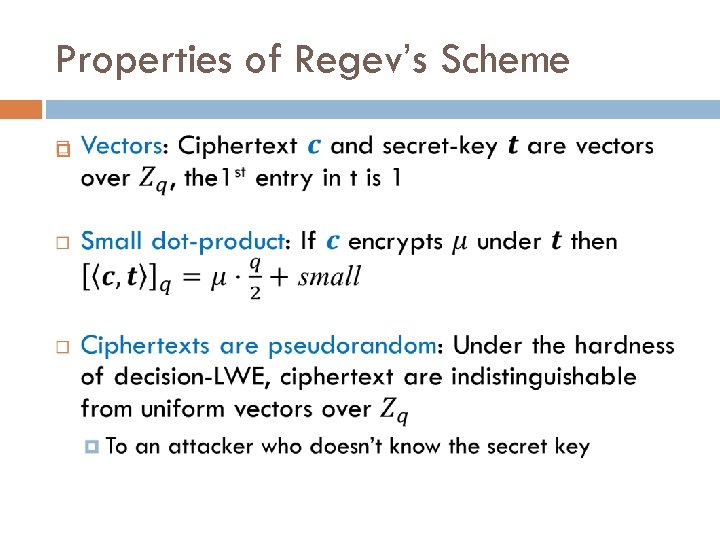
Properties of Regev’s Scheme
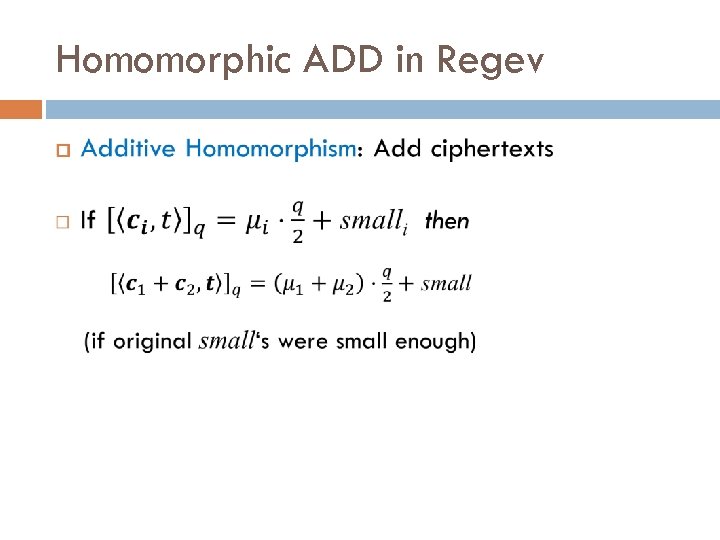
Homomorphic ADD in Regev
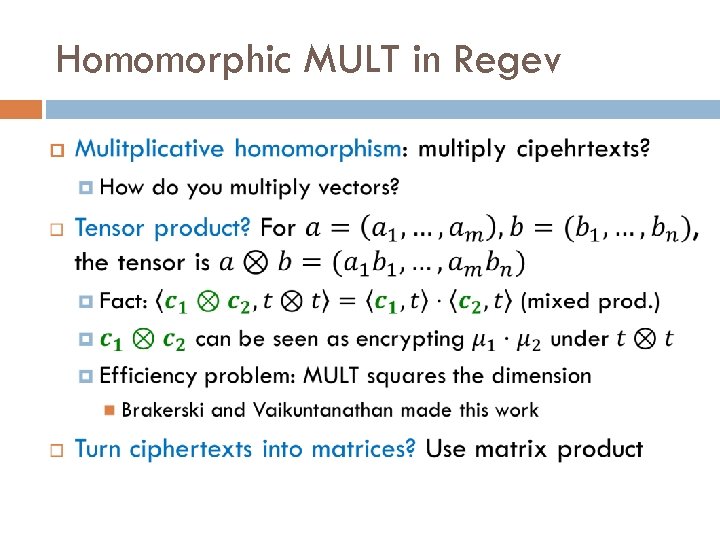
Homomorphic MULT in Regev
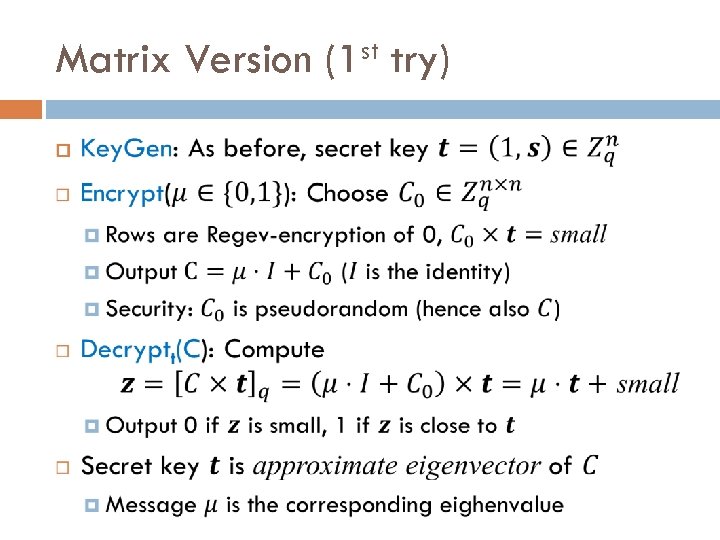
Matrix Version st (1 try)
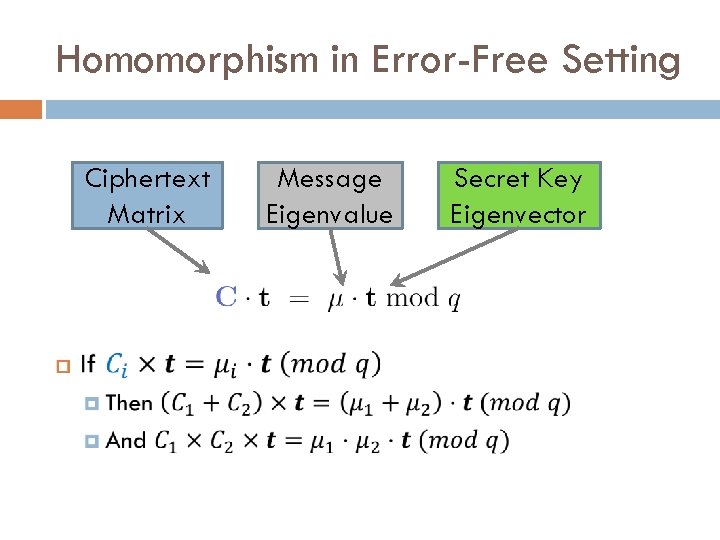
Homomorphism in Error-Free Setting Ciphertext Matrix Message Eigenvalue Secret Key Eigenvector
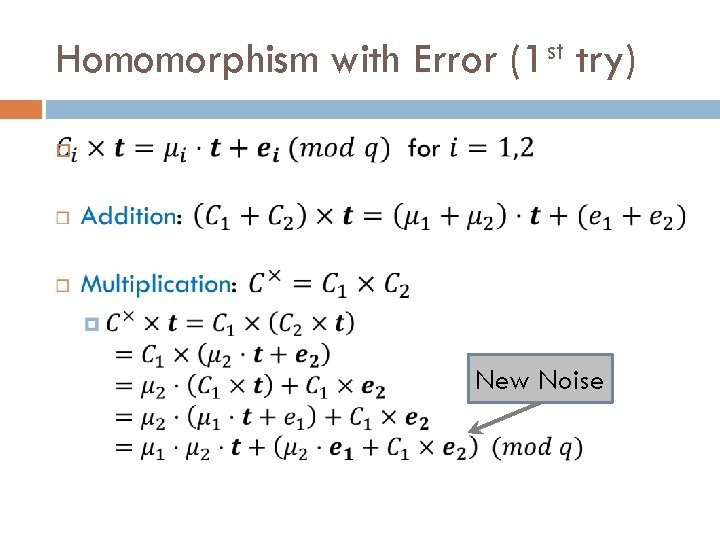
Homomorphism with Error st (1 try) New Noise
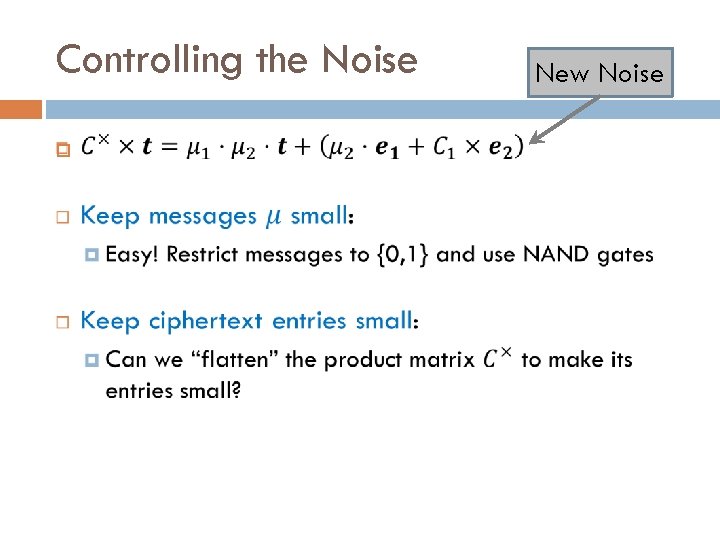
Controlling the Noise New Noise
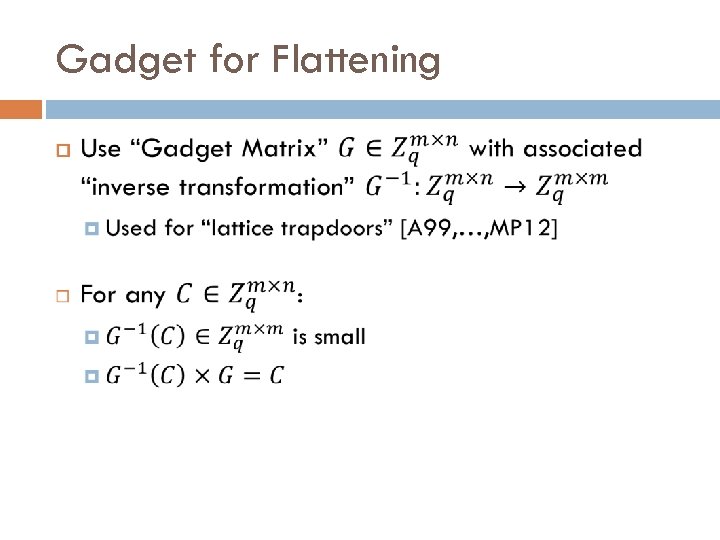
Gadget for Flattening
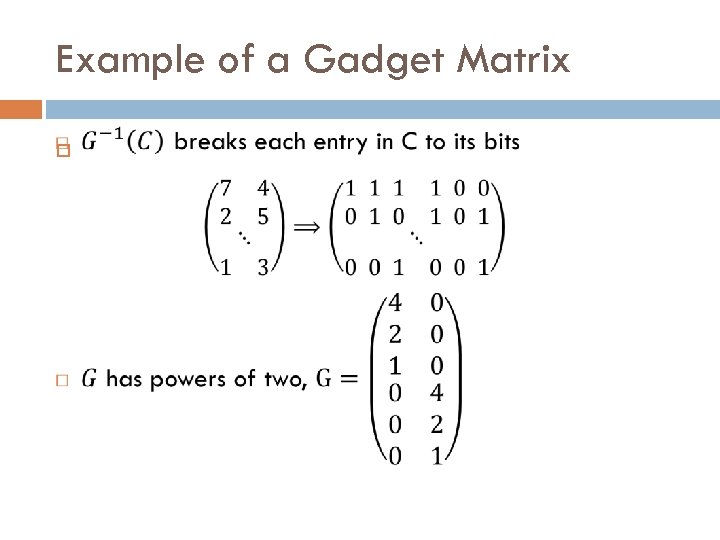
Example of a Gadget Matrix
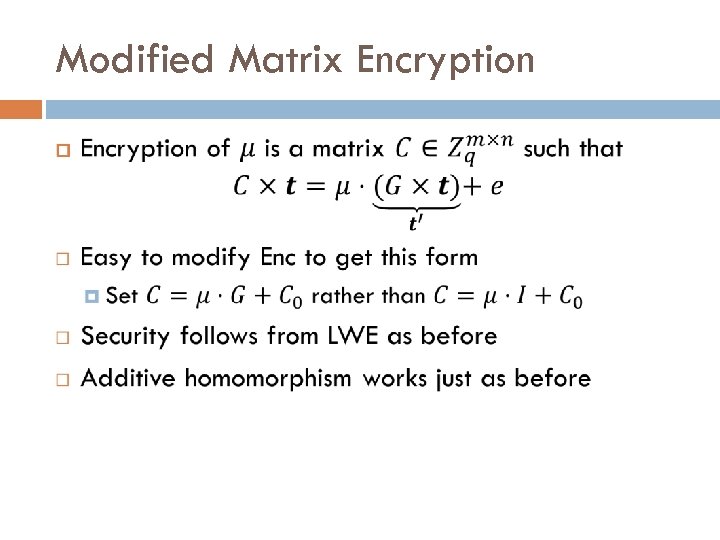
Modified Matrix Encryption
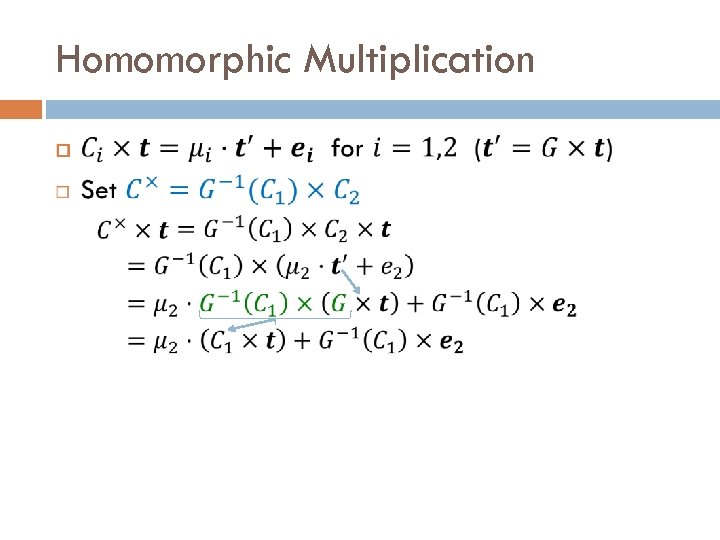
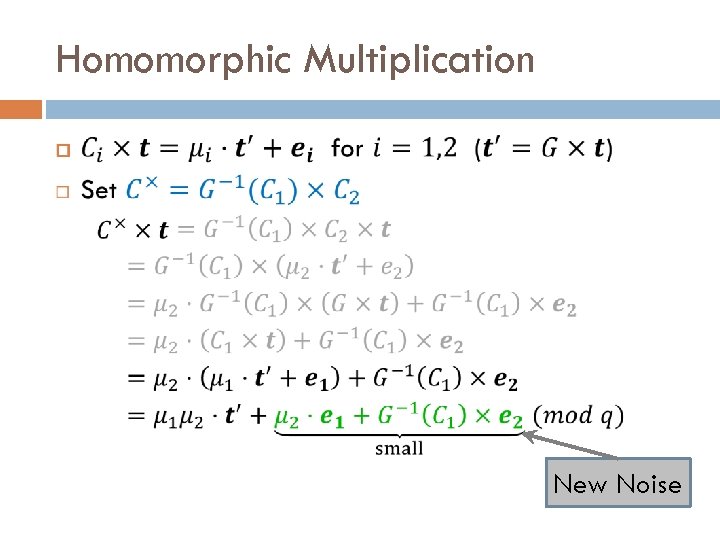
Homomorphic Multiplication
Homomorphic Multiplication New Noise
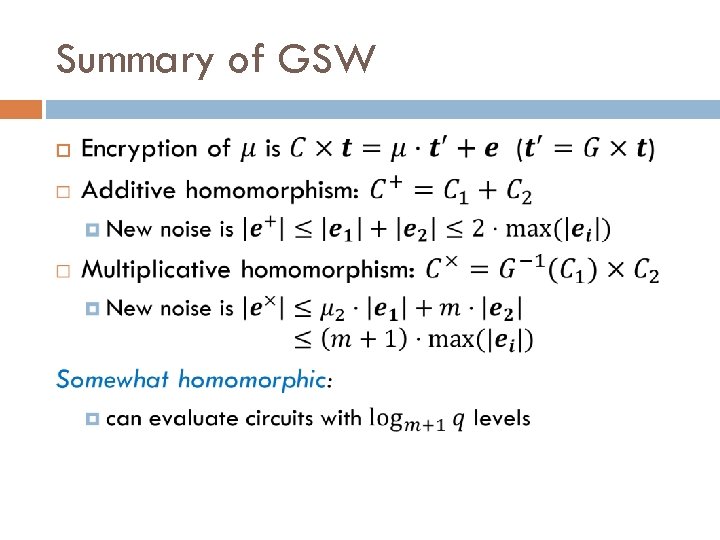
Summary of GSW
Questions? a or f e k m i T re a b ?