
Homologous Chromosomes Chromosomes that have a corresponding partner


- Slides: 50
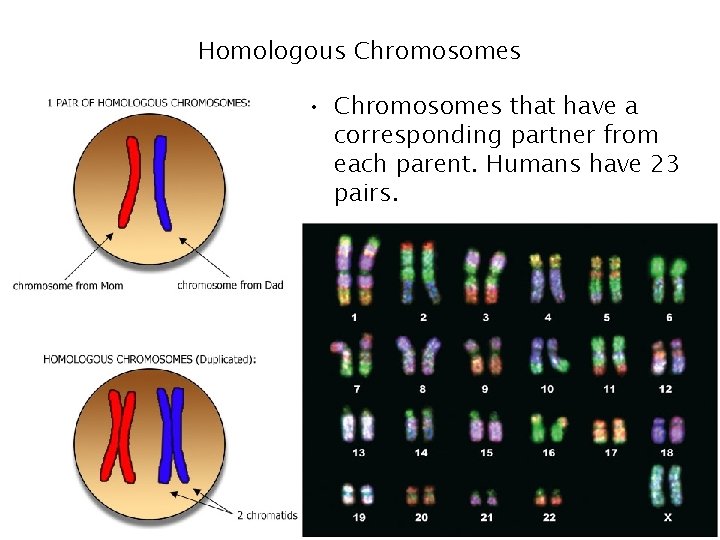
Homologous Chromosomes • Chromosomes that have a corresponding partner from each parent. Humans have 23 pairs.
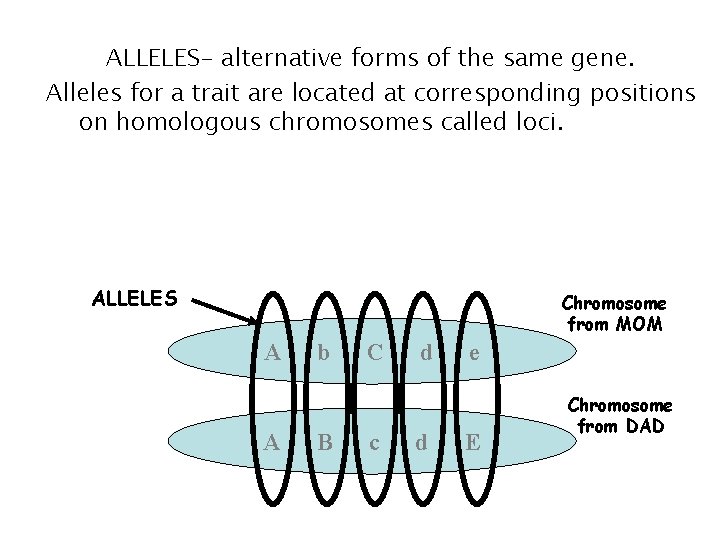
ALLELES- alternative forms of the same gene. Alleles for a trait are located at corresponding positions on homologous chromosomes called loci. ALLELES Chromosome from MOM A A b B C c d d e E Chromosome from DAD
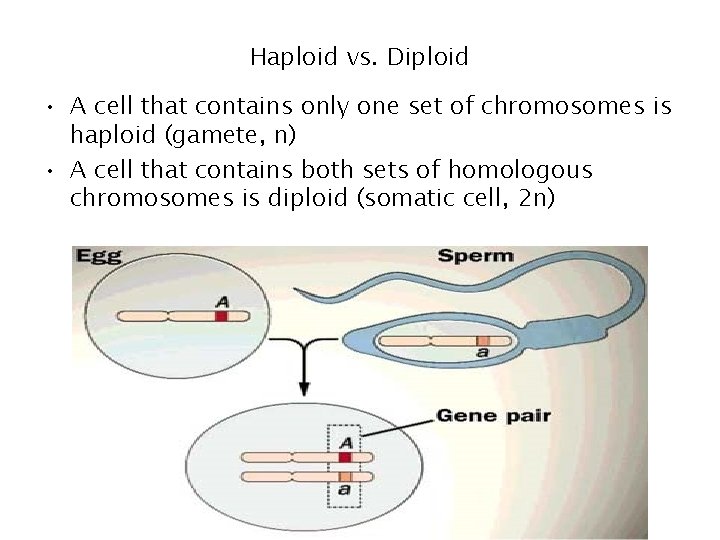
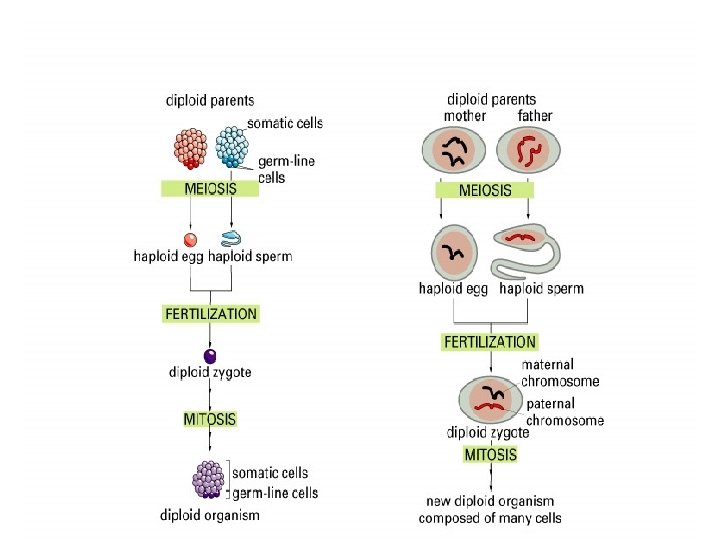
Haploid vs. Diploid • A cell that contains only one set of chromosomes is haploid (gamete, n) • A cell that contains both sets of homologous chromosomes is diploid (somatic cell, 2 n)
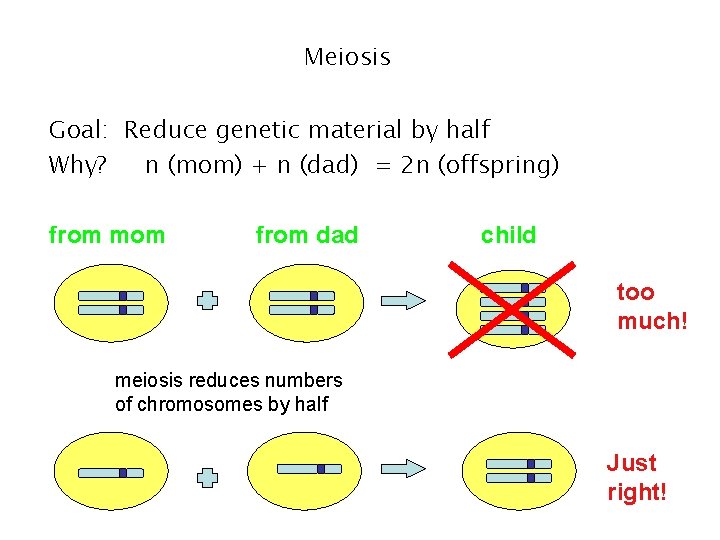
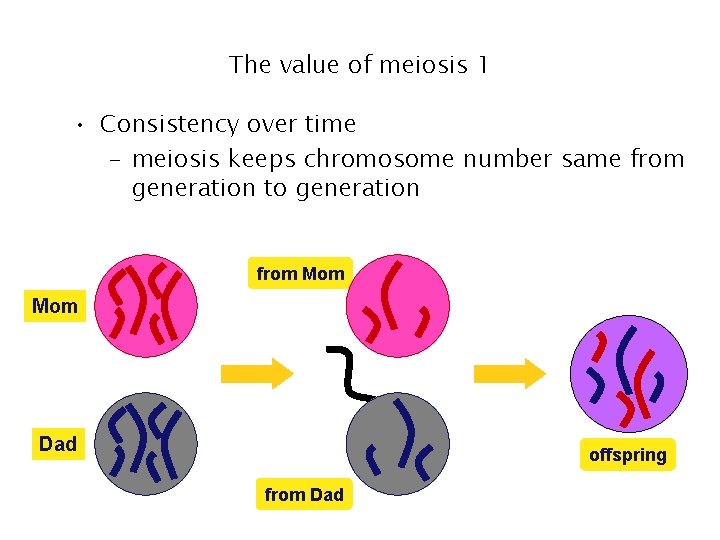
Meiosis Goal: Reduce genetic material by half Why? n (mom) + n (dad) = 2 n (offspring) from mom from dad child too much! meiosis reduces numbers of chromosomes by half Just right!
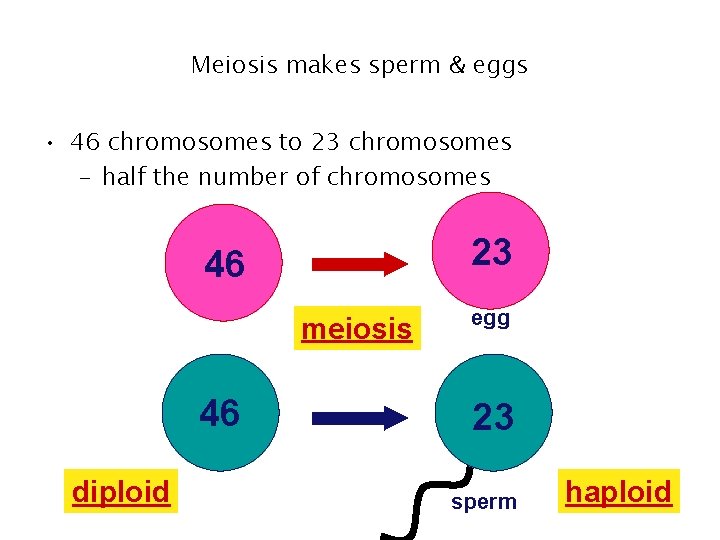
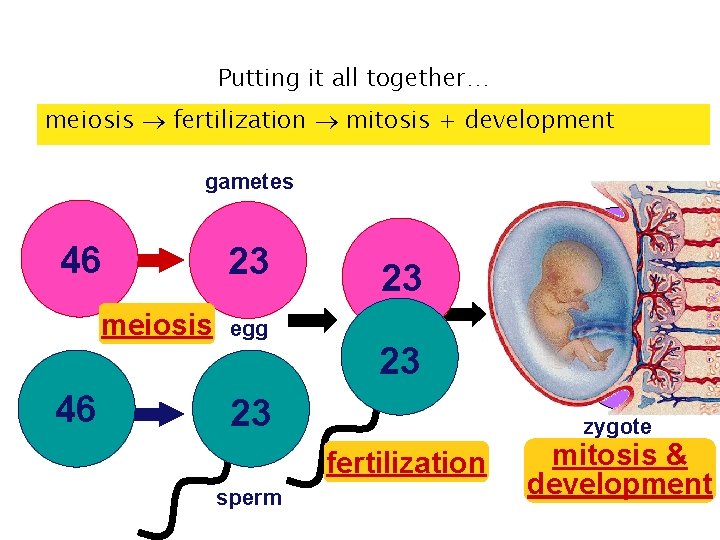
Meiosis makes sperm & eggs • 46 chromosomes to 23 chromosomes – half the number of chromosomes 23 46 meiosis 46 diploid egg 23 sperm haploid
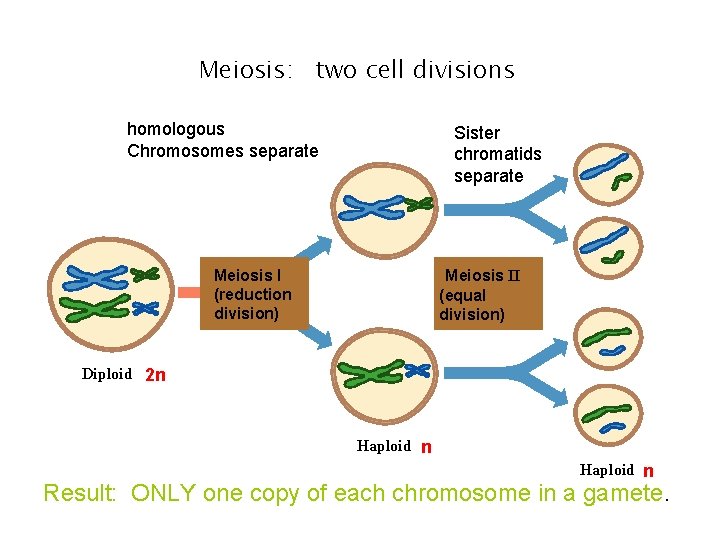
Meiosis: two cell divisions homologous Chromosomes separate Sister chromatids separate Meiosis I (reduction division) Meiosis II (equal division) Diploid 2 n Haploid n Result: ONLY one copy of each chromosome in a gamete.
The value of meiosis 1 • Consistency over time – meiosis keeps chromosome number same from generation to generation from Mom Dad offspring from Dad
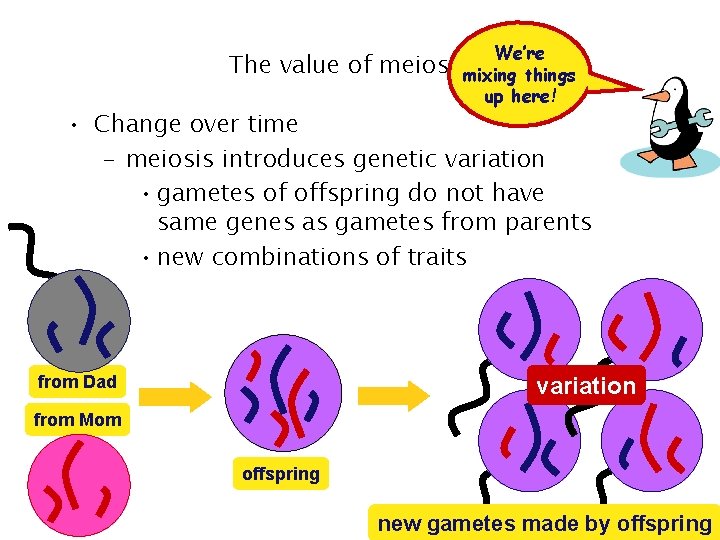
The value of We’re meiosismixing 2 things up here! • Change over time – meiosis introduces genetic variation • gametes of offspring do not have same genes as gametes from parents • new combinations of traits from Dad variation from Mom offspring new gametes made by offspring
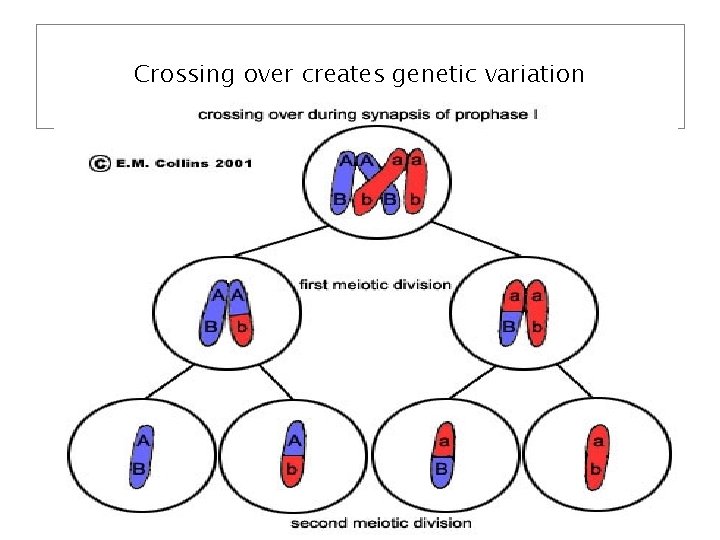
Crossing over creates genetic variation
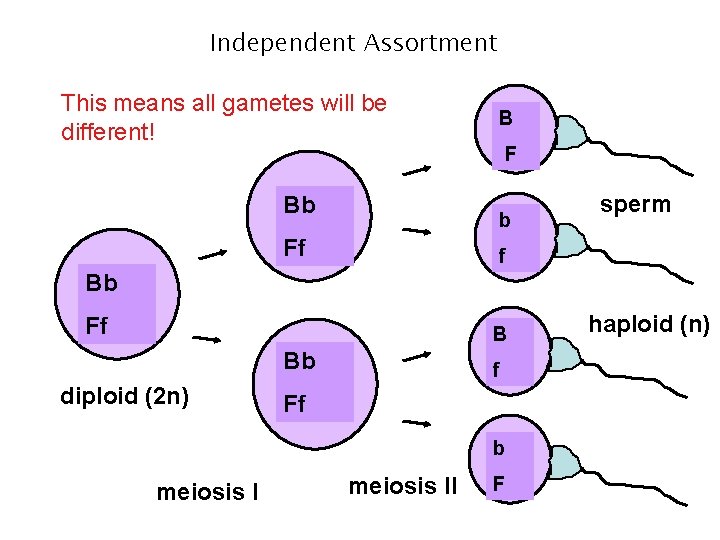
Independent Assortment This means all gametes will be different! B B F Bb B b Ff f sperm B Bb Bb Ff B Bb diploid (2 n) f b b Ff b meiosis II b F haploid (n)
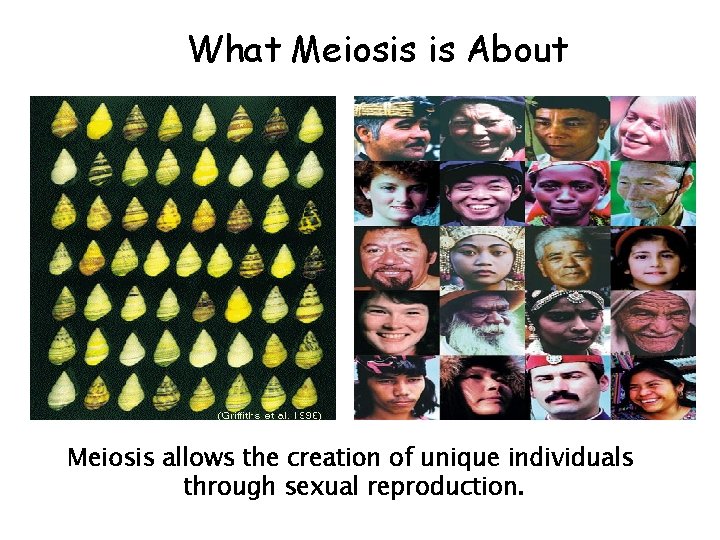
What Meiosis is About Meiosis allows the creation of unique individuals through sexual reproduction.
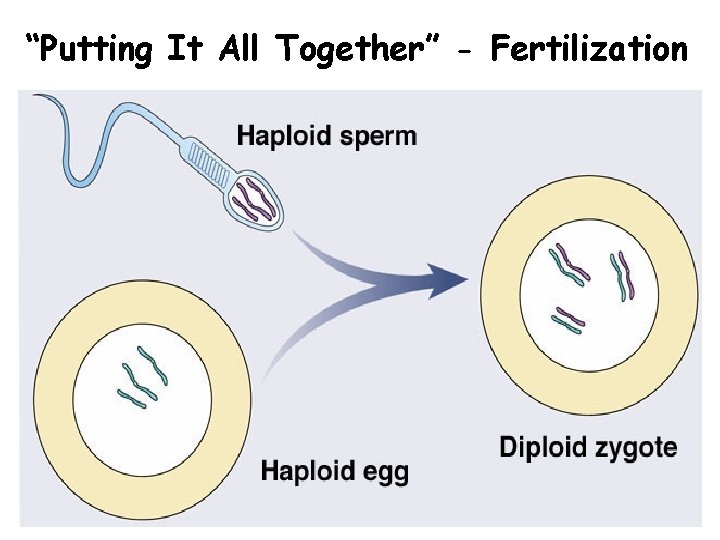
“Putting It All Together” - Fertilization
Putting it all together… meiosis fertilization mitosis + development gametes 46 meiosis 46 23 egg 23 23 23 zygote fertilization sperm 46 46 46 mitosis & mitosis development
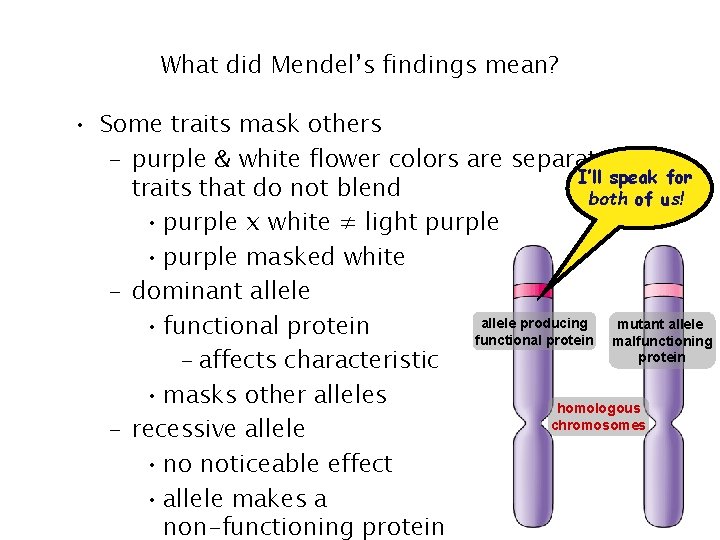
What did Mendel’s findings mean? • Some traits mask others – purple & white flower colors are separate I’ll speak for traits that do not blend both of us! • purple x white ≠ light purple • purple masked white – dominant allele producing mutant allele • functional protein malfunctioning protein – affects characteristic • masks other alleles homologous chromosomes – recessive allele • no noticeable effect • allele makes a non-functioning protein
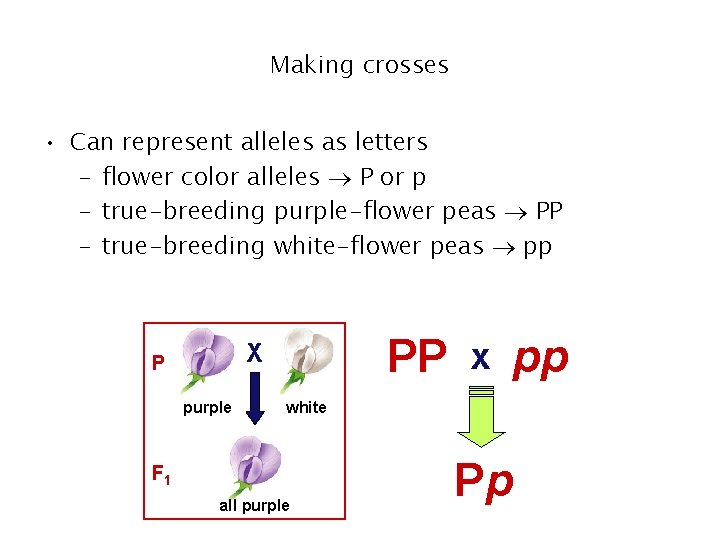
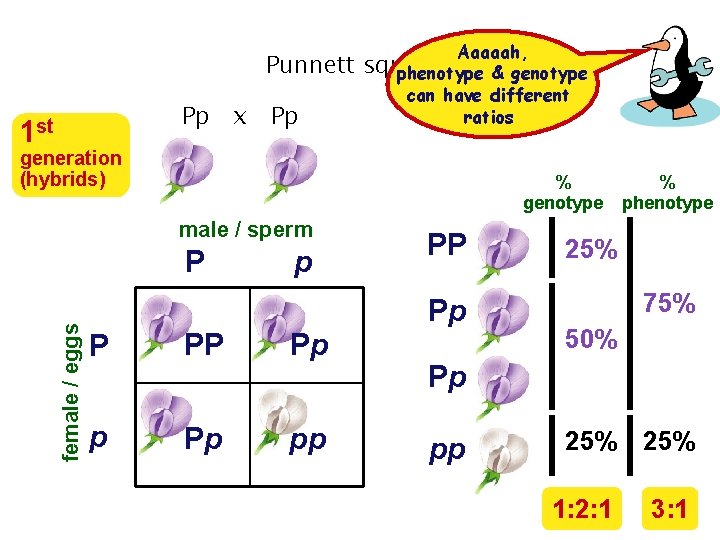
Making crosses • Can represent alleles as letters – flower color alleles P or p – true-breeding purple-flower peas PP – true-breeding white-flower peas pp PP x pp X P purple white F 1 all purple Pp
Punnett Pp x Pp 1 st Aaaaah, squares phenotype & genotype can have different ratios generation (hybrids) % genotype male / sperm female / eggs P p PP Pp P PP Pp pp % phenotype 25% 75% 50% Pp pp 25% 1: 2: 1 3: 1
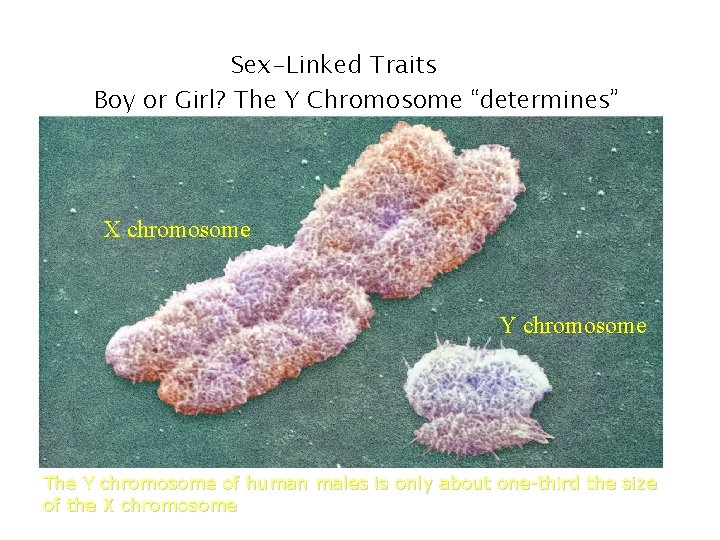
Sex-Linked Traits Boy or Girl? The Y Chromosome “determines” X chromosome Y chromosome The Y chromosome of human males is only about one-third the size of the X chromosome
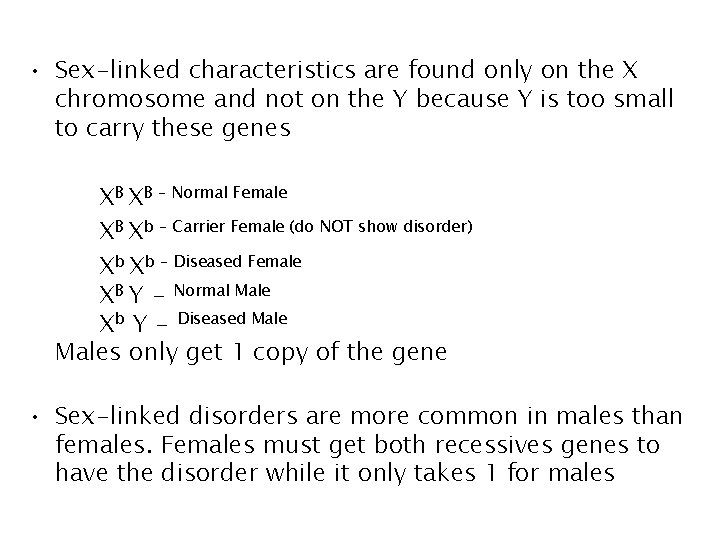
• Sex-linked characteristics are found only on the X chromosome and not on the Y because Y is too small to carry these genes XB XB – Normal Female XB Xb – Carrier Female (do NOT show disorder) Xb Xb – Diseased Female XB Y - Normal Male Xb Y - Diseased Males only get 1 copy of the gene • Sex-linked disorders are more common in males than females. Females must get both recessives genes to have the disorder while it only takes 1 for males
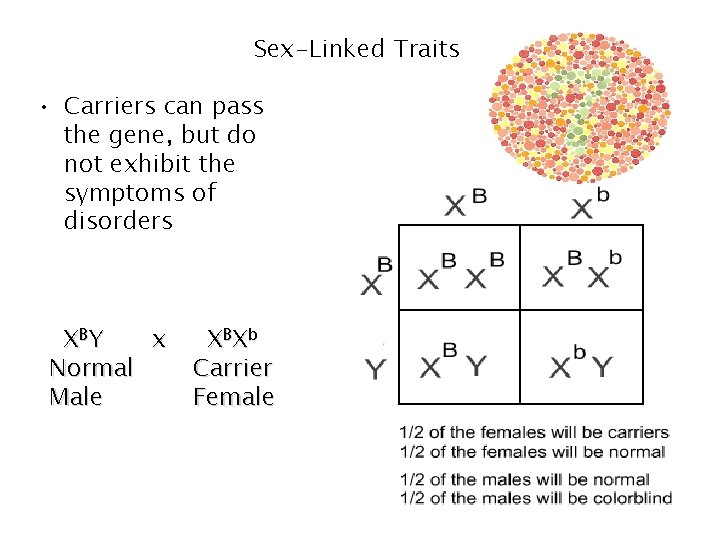
Sex-Linked Traits • Carriers can pass the gene, but do not exhibit the symptoms of disorders X BY x Normal Male X BX b Carrier Female
Sex-Linked Traits • Fathers= pass X-linked alleles to all daughters only (but not to sons) • Mothers= pass X-linked alleles to both sons & daughters
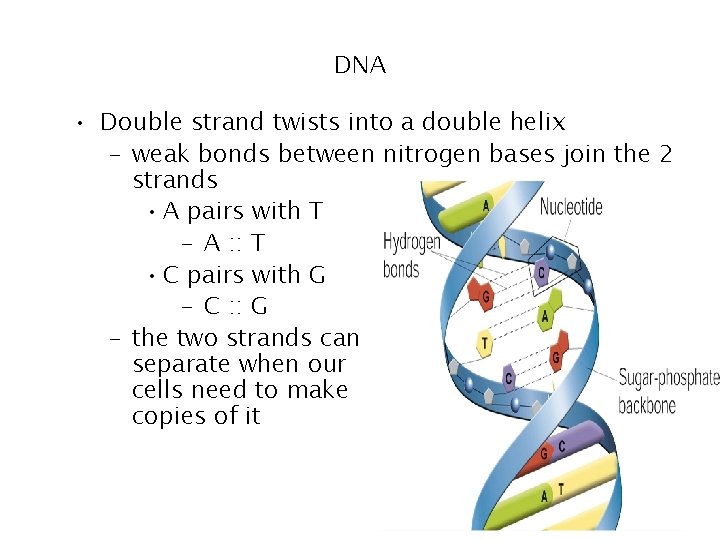
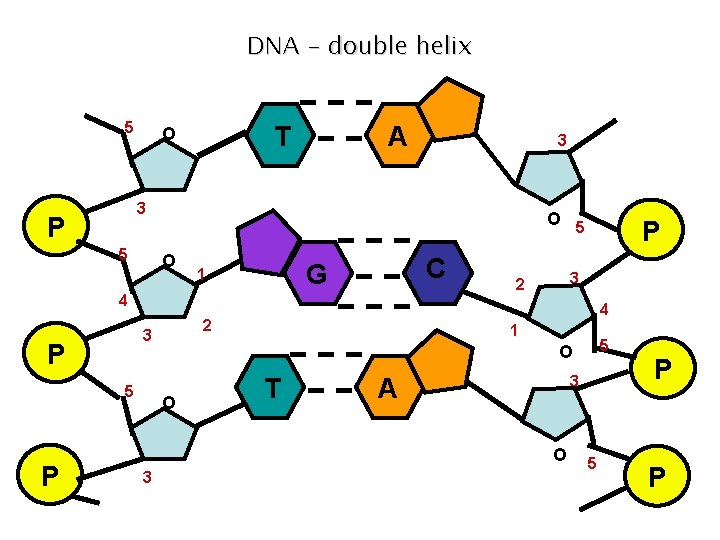
DNA • Double strand twists into a double helix – weak bonds between nitrogen bases join the 2 strands • A pairs with T – A : : T • C pairs with G – C : : G – the two strands can separate when our cells need to make copies of it
DNA - double helix 5 T O A 3 P 5 O C G 1 4 5 3 2 1 5 O O T 3 A O 3 P 4 2 3 P P 3 5 P P
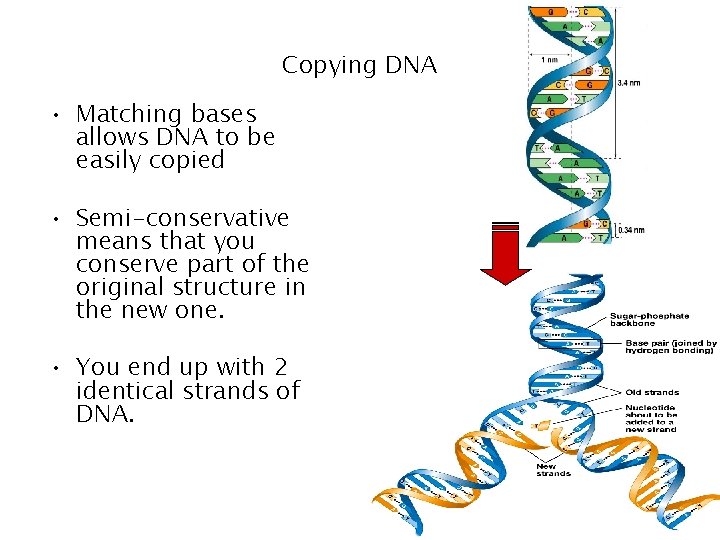
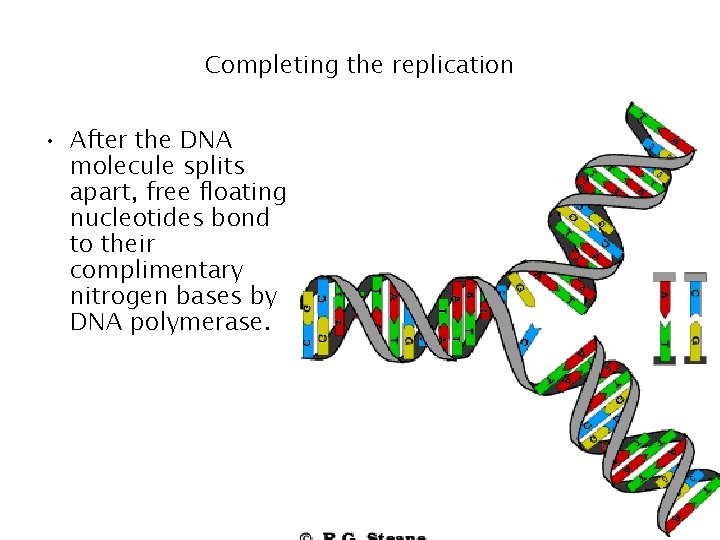
Copying DNA • Matching bases allows DNA to be easily copied • Semi-conservative means that you conserve part of the original structure in the new one. • You end up with 2 identical strands of DNA.
Completing the replication • After the DNA molecule splits apart, free floating nucleotides bond to their complimentary nitrogen bases by DNA polymerase.
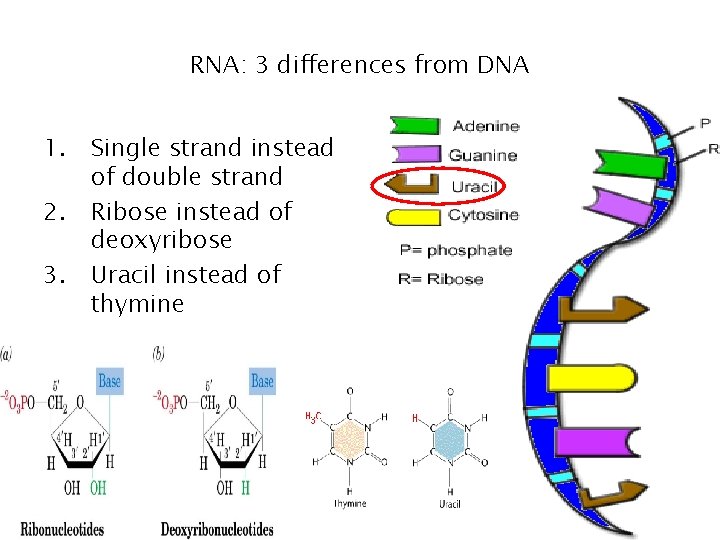
RNA: 3 differences from DNA 1. 2. 3. Single strand instead of double strand Ribose instead of deoxyribose Uracil instead of thymine
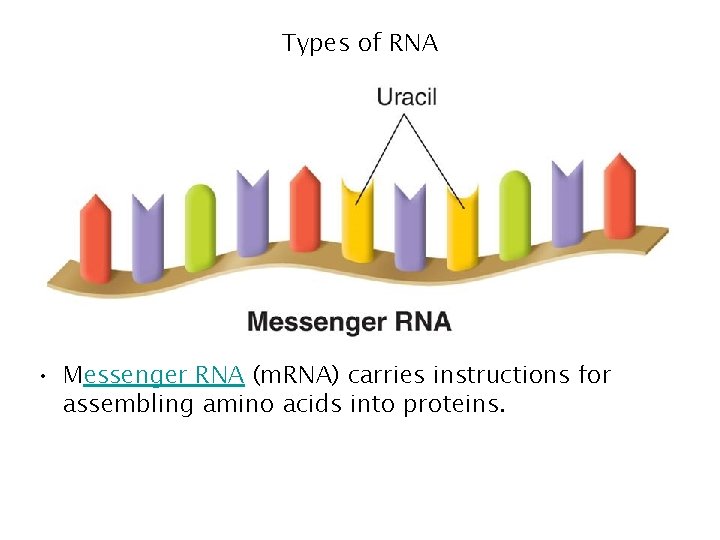
Types of RNA • Messenger RNA (m. RNA) carries instructions for assembling amino acids into proteins.
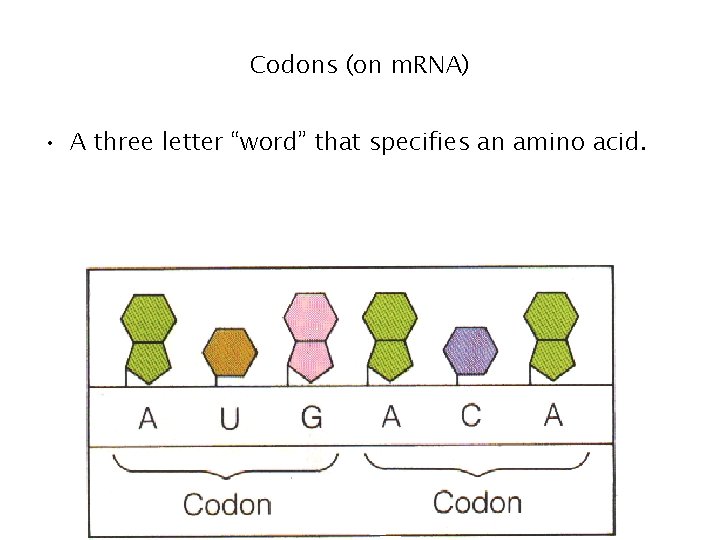
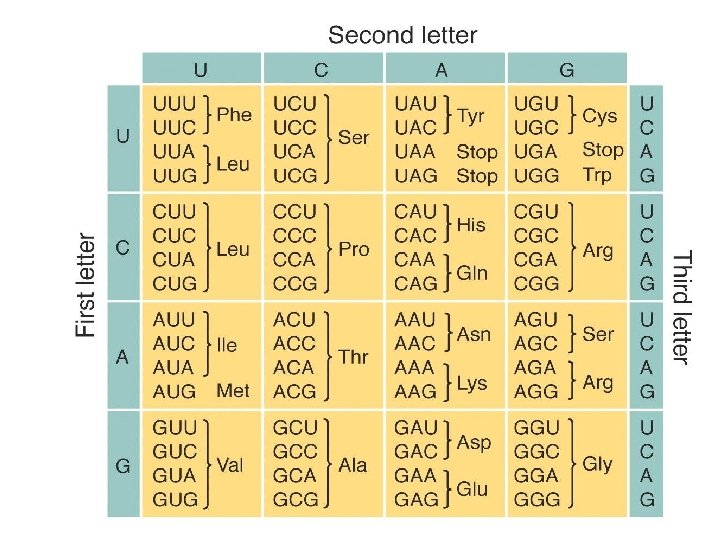
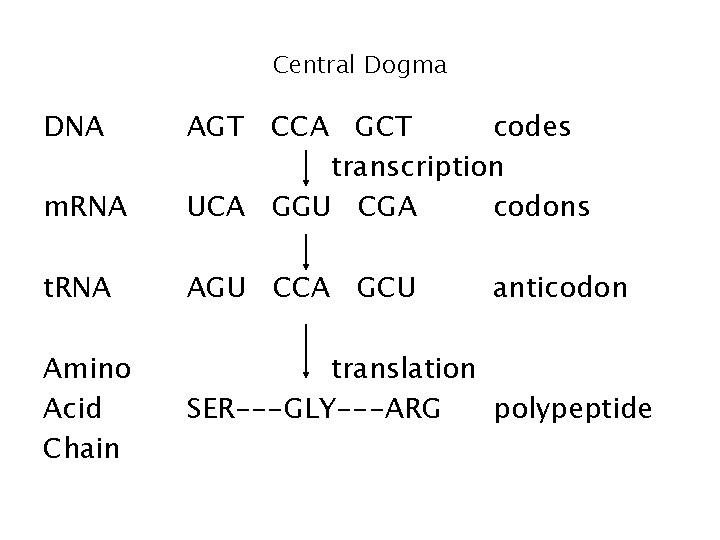
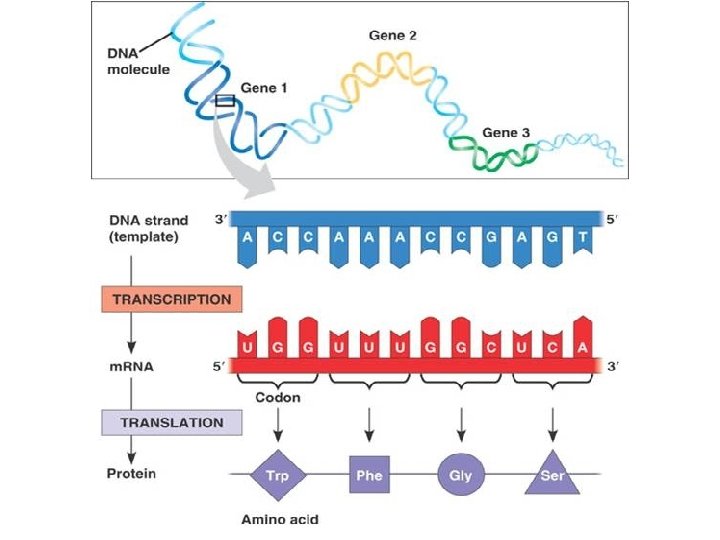
Codons (on m. RNA) • A three letter “word” that specifies an amino acid.
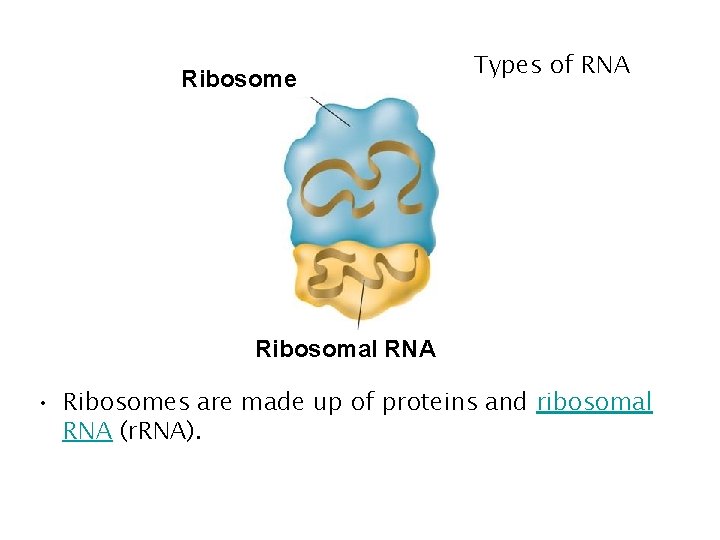
Ribosome Types of RNA Ribosomal RNA • Ribosomes are made up of proteins and ribosomal RNA (r. RNA).
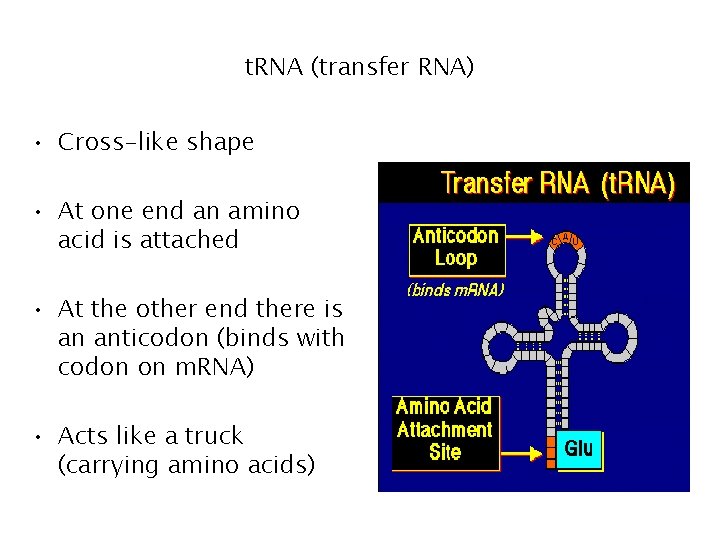
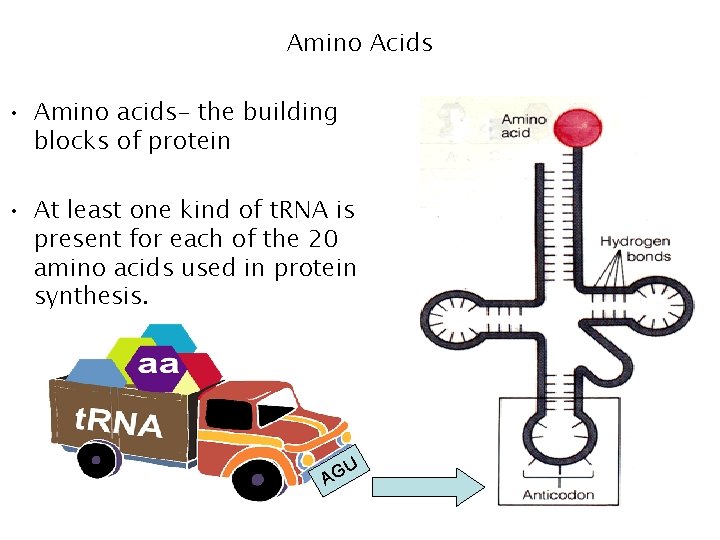
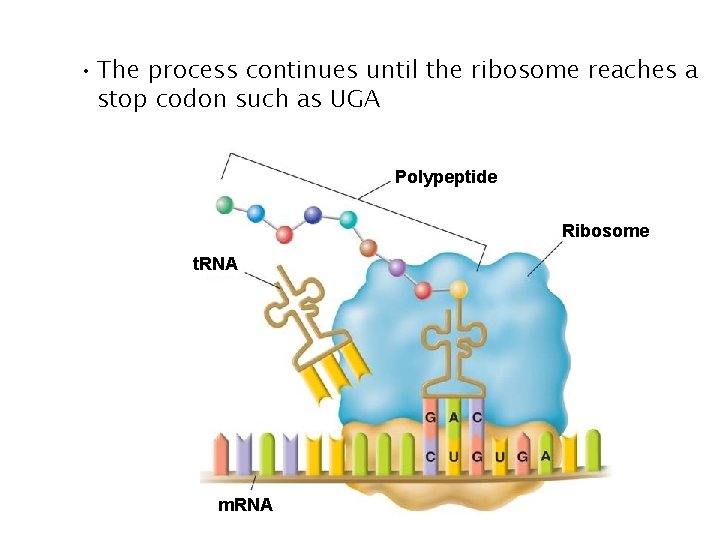
t. RNA (transfer RNA) • Cross-like shape • At one end an amino acid is attached • At the other end there is an anticodon (binds with codon on m. RNA) • Acts like a truck (carrying amino acids)
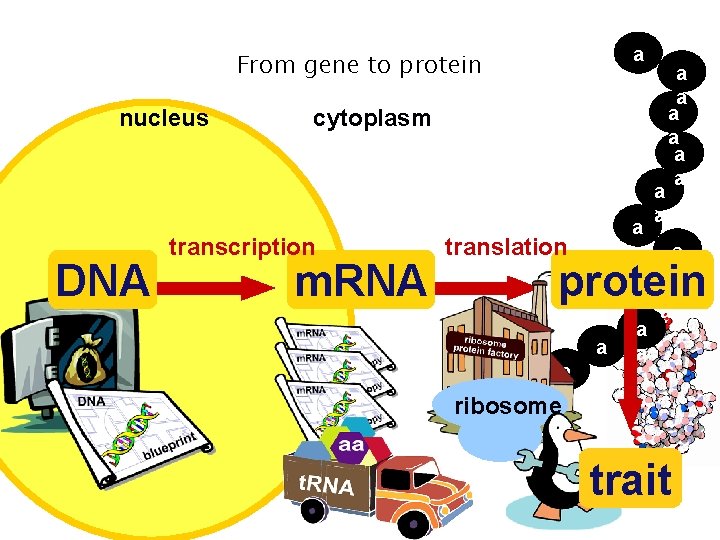
a a From gene to protein nucleus DNA cytoplasm transcription m. RNA a a translation a a a protein a a a a ribosome trait
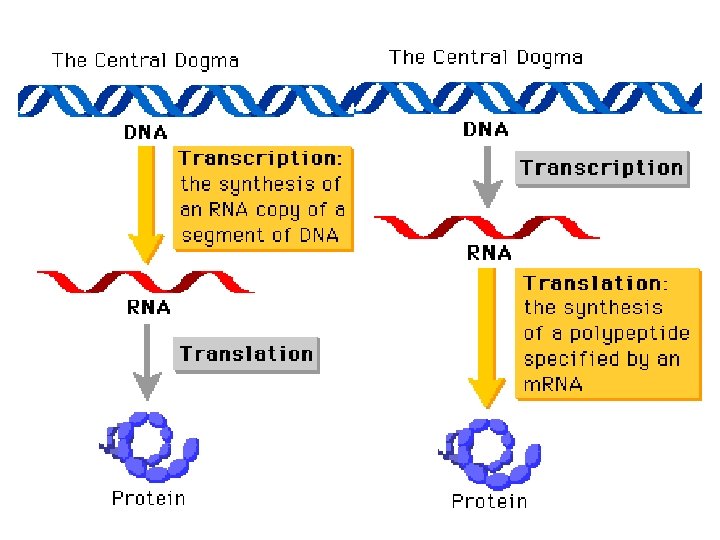
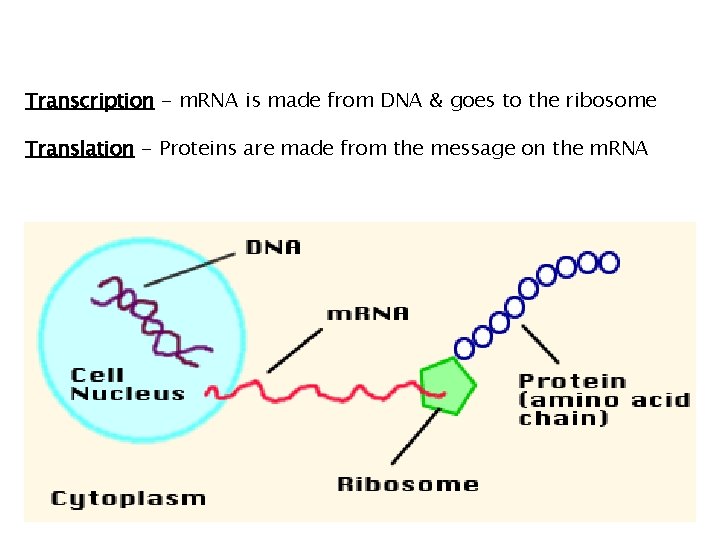
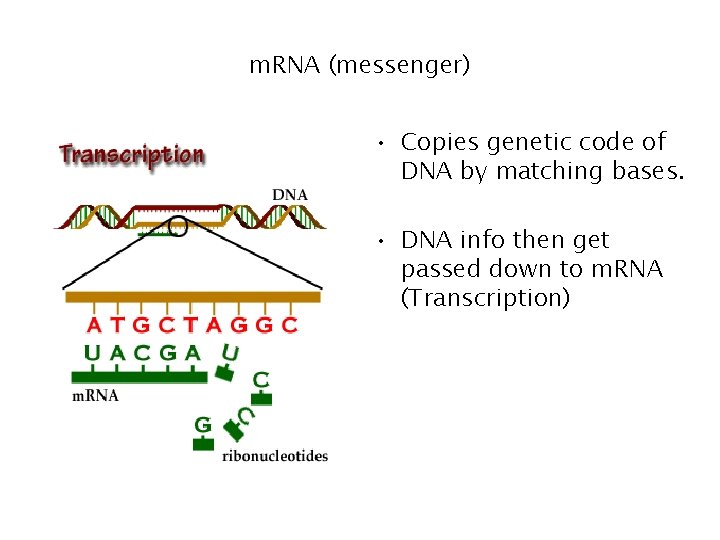
Transcription - m. RNA is made from DNA & goes to the ribosome Translation - Proteins are made from the message on the m. RNA
m. RNA (messenger) • Copies genetic code of DNA by matching bases. • DNA info then get passed down to m. RNA (Transcription)
Amino Acids • Amino acids- the building blocks of protein • At least one kind of t. RNA is present for each of the 20 amino acids used in protein synthesis. U AG
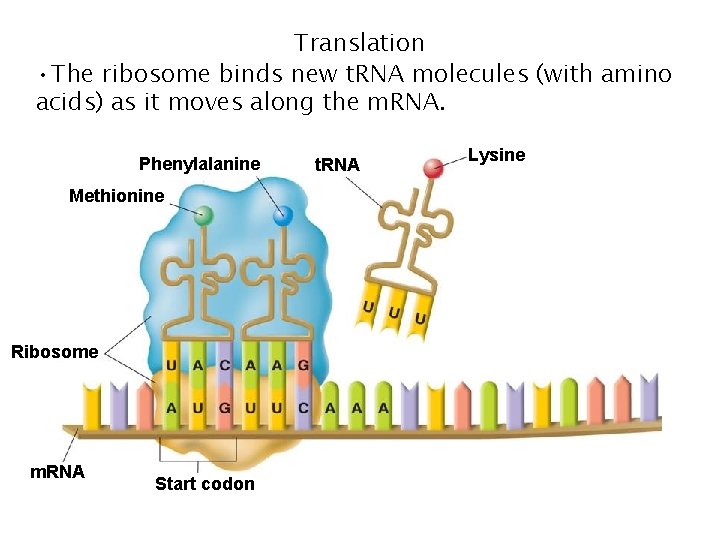
Translation • The ribosome binds new t. RNA molecules (with amino acids) as it moves along the m. RNA. Phenylalanine Methionine Ribosome m. RNA Start codon t. RNA Lysine
• Continued Protein Synthesis Lysine t. RNA Translation direction m. RNA Ribosome
• The process continues until the ribosome reaches a stop codon such as UGA Polypeptide Ribosome t. RNA m. RNA
Central Dogma DNA m. RNA AGT CCA GCT codes transcription UCA GGU CGA codons t. RNA AGU CCA GCU Amino Acid Chain translation SER---GLY---ARG polypeptide anticodon
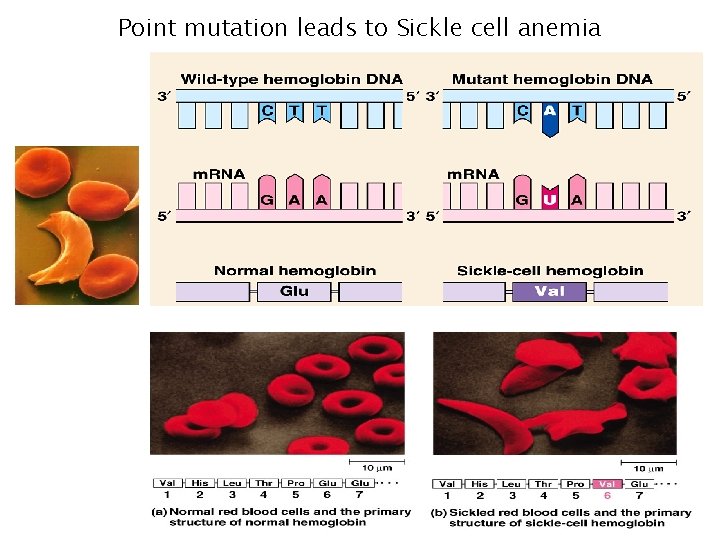
Point mutation leads to Sickle cell anemia
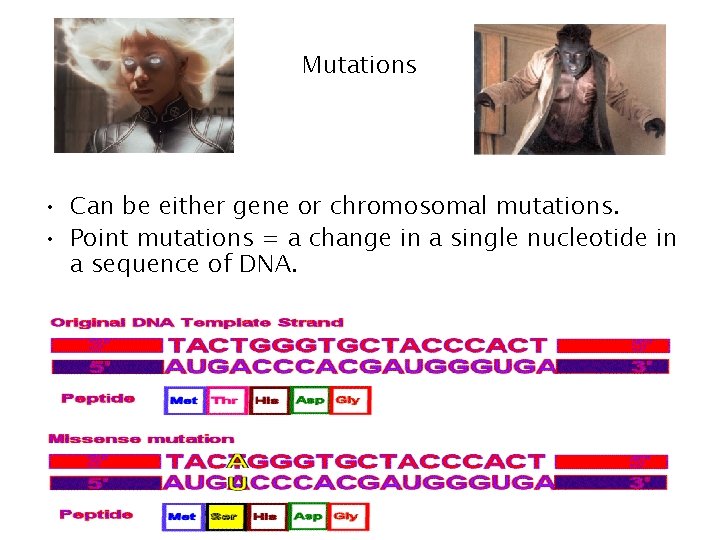
Mutations • Can be either gene or chromosomal mutations. • Point mutations = a change in a single nucleotide in a sequence of DNA.
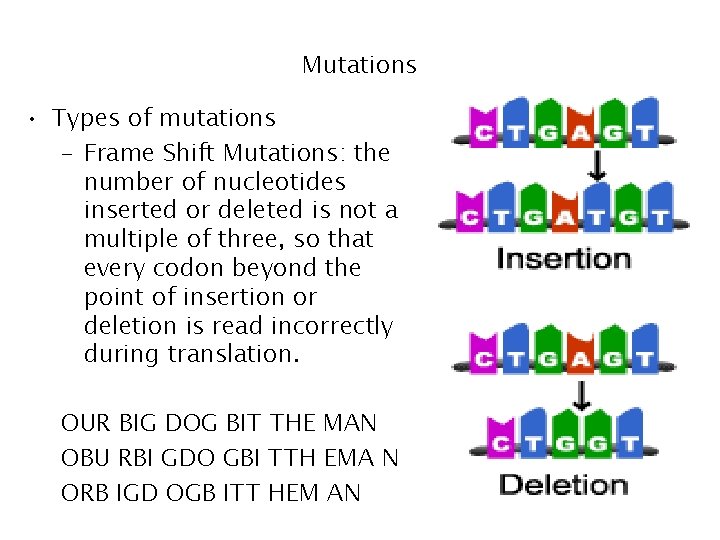
Mutations • Types of mutations – Frame Shift Mutations: the number of nucleotides inserted or deleted is not a multiple of three, so that every codon beyond the point of insertion or deletion is read incorrectly during translation. OUR BIG DOG BIT THE MAN OBU RBI GDO GBI TTH EMA N ORB IGD OGB ITT HEM AN
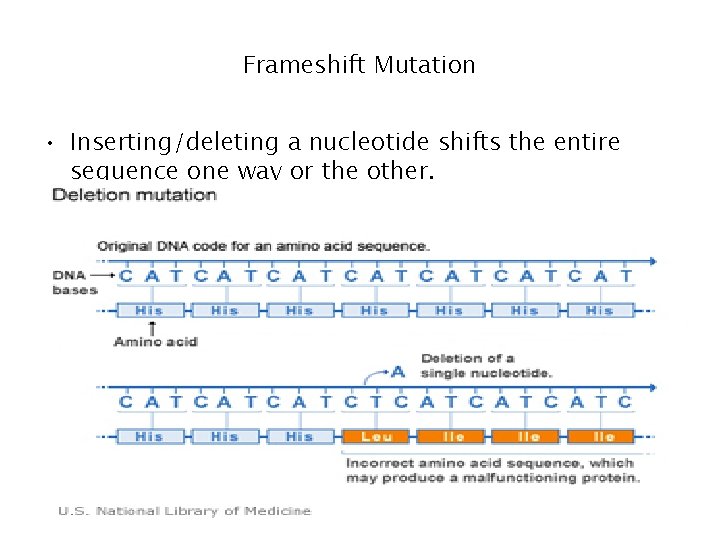
Frameshift Mutation • Inserting/deleting a nucleotide shifts the entire sequence one way or the other.
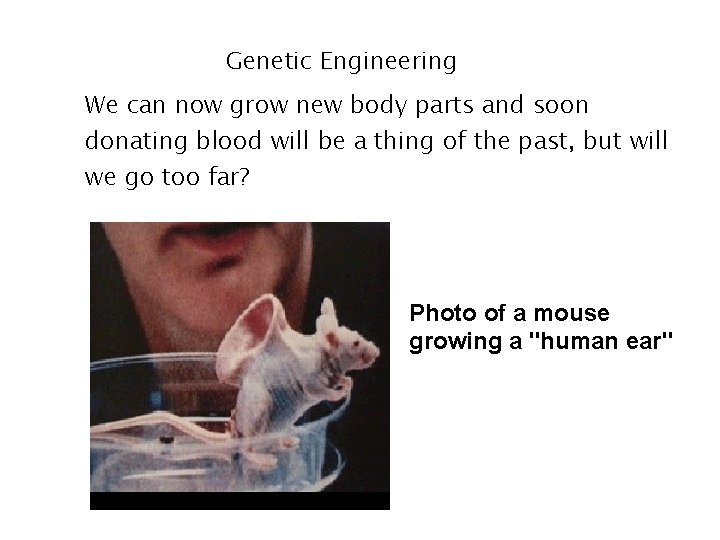
Genetic Engineering • We can now grow new body parts and soon donating blood will be a thing of the past, but will we go too far? Photo of a mouse growing a "human ear"
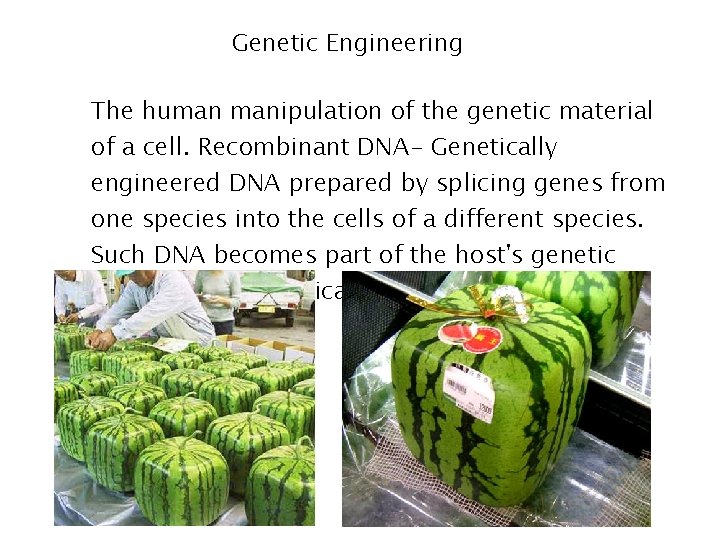
Genetic Engineering • The human manipulation of the genetic material of a cell. Recombinant DNA- Genetically engineered DNA prepared by splicing genes from one species into the cells of a different species. Such DNA becomes part of the host's genetic makeup and is replicated.
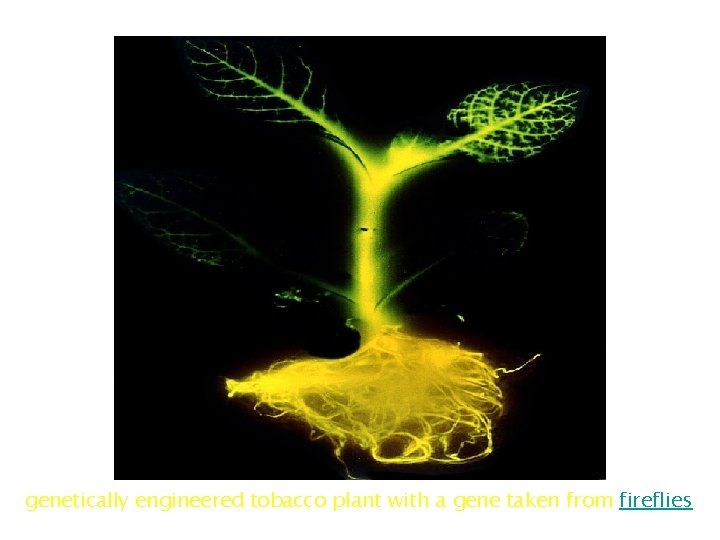
genetically engineered tobacco plant with a gene taken from fireflies
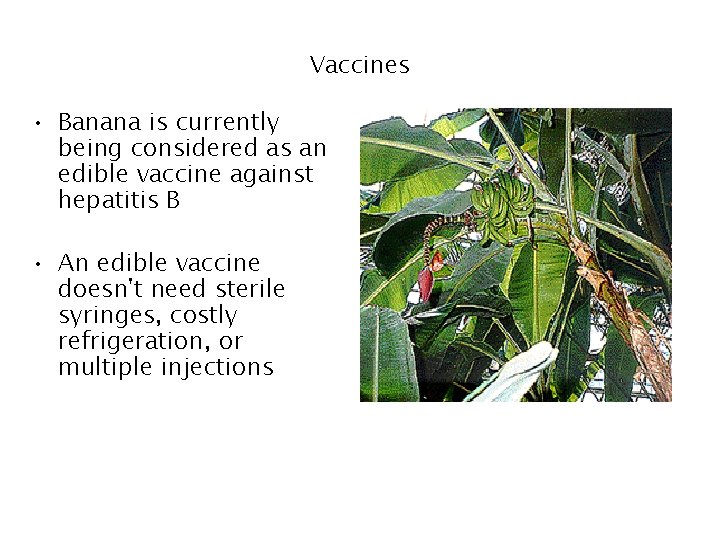
Vaccines • Banana is currently being considered as an edible vaccine against hepatitis B • An edible vaccine doesn't need sterile syringes, costly refrigeration, or multiple injections
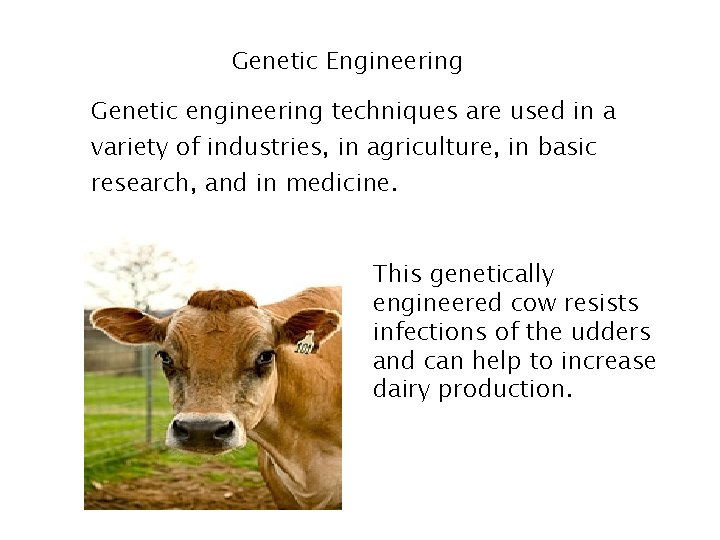
Genetic Engineering • Genetic engineering techniques are used in a variety of industries, in agriculture, in basic research, and in medicine. This genetically engineered cow resists infections of the udders and can help to increase dairy production.