
Homogeneous broadening linewidth reduction at room temperature at
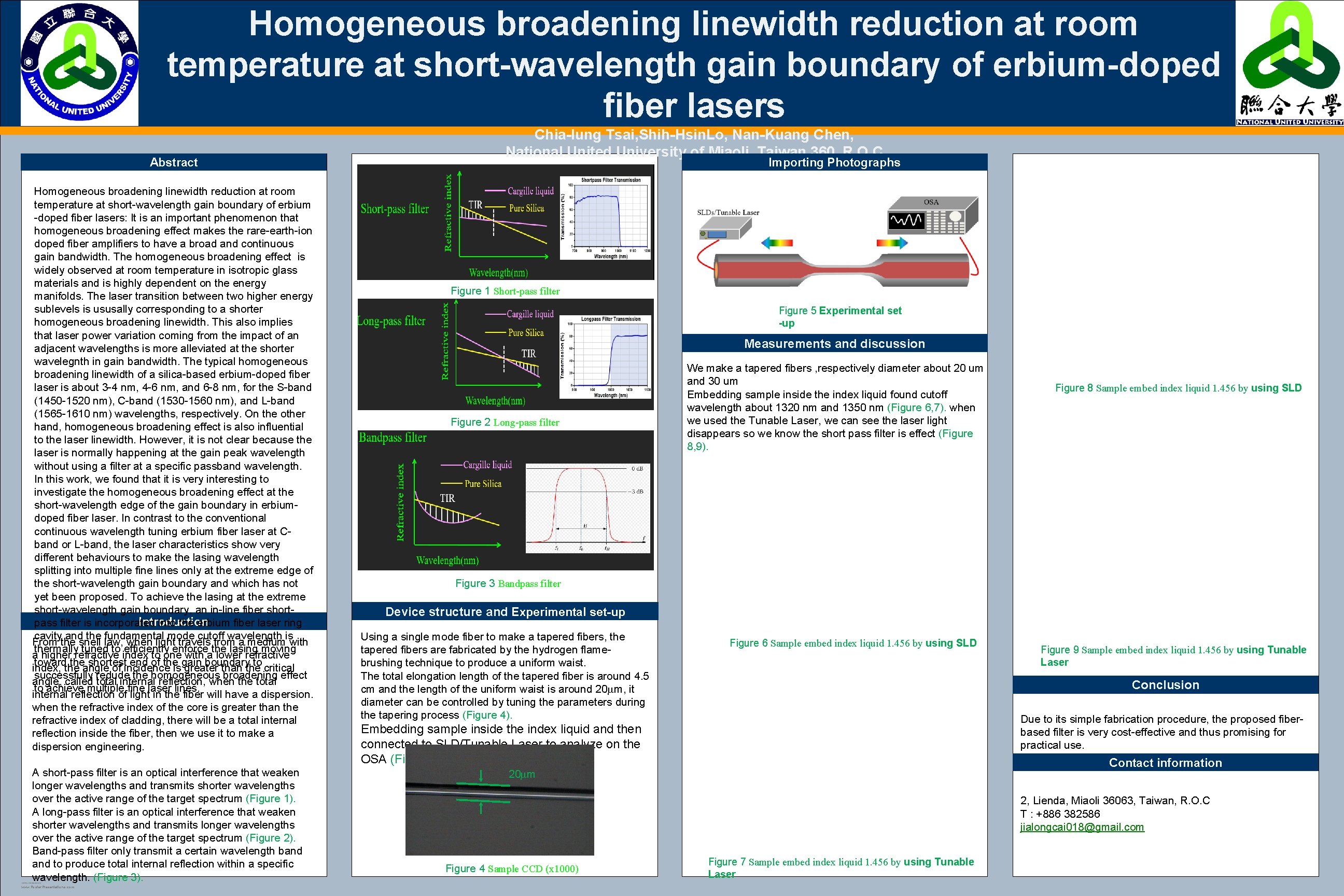
Homogeneous broadening linewidth reduction at room temperature at short-wavelength gain boundary of erbium-doped fiber lasers Abstract Homogeneous broadening linewidth reduction at room temperature at short-wavelength gain boundary of erbium -doped fiber lasers: It is an important phenomenon that homogeneous broadening effect makes the rare-earth-ion doped fiber amplifiers to have a broad and continuous gain bandwidth. The homogeneous broadening effect is widely observed at room temperature in isotropic glass materials and is highly dependent on the energy manifolds. The laser transition between two higher energy sublevels is ususally corresponding to a shorter homogeneous broadening linewidth. This also implies that laser power variation coming from the impact of an adjacent wavelengths is more alleviated at the shorter wavelegnth in gain bandwidth. The typical homogeneous broadening linewidth of a silica-based erbium-doped fiber laser is about 3 -4 nm, 4 -6 nm, and 6 -8 nm, for the S-band (1450 -1520 nm), C-band (1530 -1560 nm), and L-band (1565 -1610 nm) wavelengths, respectively. On the other hand, homogeneous broadening effect is also influential to the laser linewidth. However, it is not clear because the laser is normally happening at the gain peak wavelength without using a filter at a specific passband wavelength. In this work, we found that it is very interesting to investigate the homogeneous broadening effect at the short-wavelength edge of the gain boundary in erbiumdoped fiber laser. In contrast to the conventional continuous wavelength tuning erbium fiber laser at Cband or L-band, the laser characteristics show very different behaviours to make the lasing wavelength splitting into multiple fine lines only at the extreme edge of the short-wavelength gain boundary and which has not yet been proposed. To achieve the lasing at the extreme short-wavelength gain boundary, an in-line fiber short. Introduction pass filter is incorporated into the erbium fiber laser ring cavity and the fundamental mode cutoff wavelength is From the snell law, when light travels from a medium with thermally tuned to efficiently enforce the lasing moving a higher refractive index to one with a lower refractive toward the shortest end of the gain boundary to index, the angle of incidence is greater than the critical successfully redude the homogeneous broadening effect angle, called total internal reflection, when the total to achieve multiple fine laser lines. internal reflection of light in the fiber will have a dispersion. when the refractive index of the core is greater than the refractive index of cladding, there will be a total internal reflection inside the fiber, then we use it to make a dispersion engineering. A short-pass filter is an optical interference that weaken longer wavelengths and transmits shorter wavelengths over the active range of the target spectrum (Figure 1). A long-pass filter is an optical interference that weaken shorter wavelengths and transmits longer wavelengths over the active range of the target spectrum (Figure 2). Band-pass filter only transmit a certain wavelength band to produce total internal reflection within a specific wavelength. (Figure 3). TEMPLATE DESIGN © 2008 www. Poster. Presentations. com Chia-lung Tsai, Shih-Hsin. Lo, Nan-Kuang Chen, National United University of Miaoli, Taiwan 360, R. O. C. Importing Photographs Figure 1 Short-pass filter Figure 5 Experimental set -up Measurements and discussion Figure 2 Long-pass filter We make a tapered fibers , respectively diameter about 20 um and 30 um Embedding sample inside the index liquid found cutoff wavelength about 1320 nm and 1350 nm (Figure 6, 7). when we used the Tunable Laser, we can see the laser light disappears so we know the short pass filter is effect (Figure 8, 9). Figure 8 Sample embed index liquid 1. 456 by using SLD Figure 3 Bandpass filter Device structure and Experimental set-up Using a single mode fiber to make a tapered fibers, the tapered fibers are fabricated by the hydrogen flamebrushing technique to produce a uniform waist. The total elongation length of the tapered fiber is around 4. 5 cm and the length of the uniform waist is around 20 mm, it diameter can be controlled by tuning the parameters during the tapering process (Figure 4). Figure 6 Sample embed index liquid 1. 456 by using SLD Figure 9 Sample embed index liquid 1. 456 by using Tunable Laser Conclusion Due to its simple fabrication procedure, the proposed fiberbased filter is very cost-effective and thus promising for practical use. Embedding sample inside the index liquid and then connected to SLD/Tunable Laser to analyze on the OSA (Figure 5). Contact information 20 mm 2, Lienda, Miaoli 36063, Taiwan, R. O. C T : +886 382586 jialongcai 018@gmail. com Figure 4 Sample CCD (x 1000) Figure 7 Sample embed index liquid 1. 456 by using Tunable Laser
- Slides: 1