
HOMOEOPATHIC DRUG PROVINGS Dr Ramya S S Assistant


- Slides: 33
HOMOEOPATHIC DRUG PROVINGS Dr. Ramya S. S Assistant Professor Dept of Homoeopathic Pharmacy
“This spirit-like power to alter man’s state of health which lies hidden in the inner nature of medicines can in itself never be discovered by us by a mere effort of reason; it is only by experience of the phenomena it displays when acting on the state of health of man that we can become clearly cognizant of it. ” Aphorism 20, Organon of Medicine, 6 th edition
THE STUDY OF PROVINGS The three basic components of a proving are : 1. The Test Substance 1. The Proving Team 1. The Methodology
THE TEST SUBSTANCE • Drug should be proved alone, singly and in a pure and unadulterated form. • The test drug should be natural, authentic and from a reliable source. • Exact description of the pharmaceutical preparation procedure should be detailed.
• Proving is recommended with different range of potencies, including the fifty millesimal scale potencies. • Toxicological action should be studied. The fatal dose should also be determined.
DETERMINATION OF DOSAGE • Any drug that in its natural state hardly affects the vital force will develop a proving only in high potency. • Any drug that in its natural state disturbs the vital energy to functional manifestations only may be proven in a crude form. • Any drug that in its natural state disturbs the vital energy to destructive manifestations should be proved only in a potentised form.
THE PROVING TEAM Project Director / Master Prover Advisor / Expert Proving Supervisors / Panel of Investigators Provers
SELECTION OF PROVERS • The prover should be reasonably healthy. • Age - between 18 -45 years of age. • Drug must be proved on both males & females and of various constitutions. • Hysterical and stoic personalities should be avoided.
• Women during pregnancy or during breast-feeding are to be excluded from provings. • Provers should not be paid for the provings. • At least 20 -30 provers should be employed, including 25 -30% controls that receive placebo.
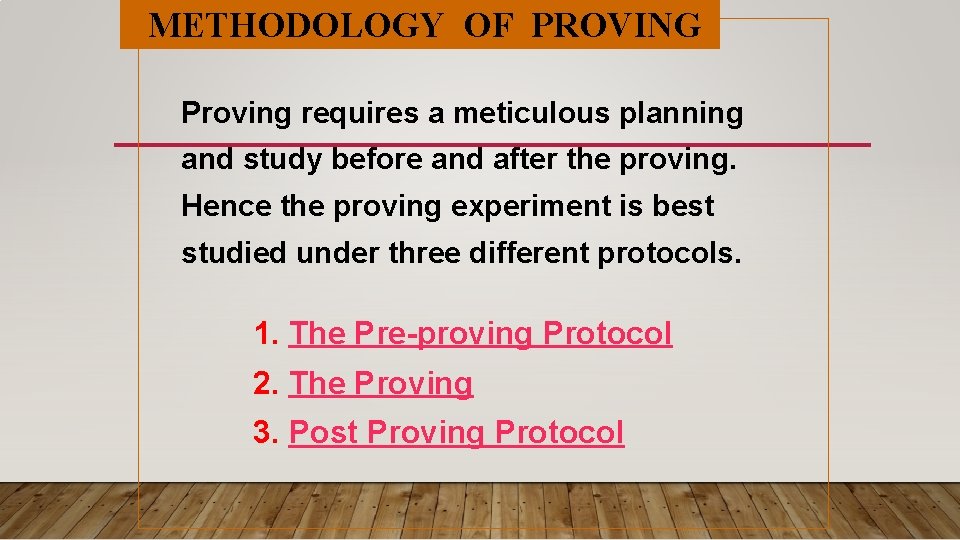
METHODOLOGY OF PROVING Proving requires a meticulous planning and study before and after the proving. Hence the proving experiment is best studied under three different protocols. 1. The Pre-proving Protocol 2. The Proving 3. Post Proving Protocol
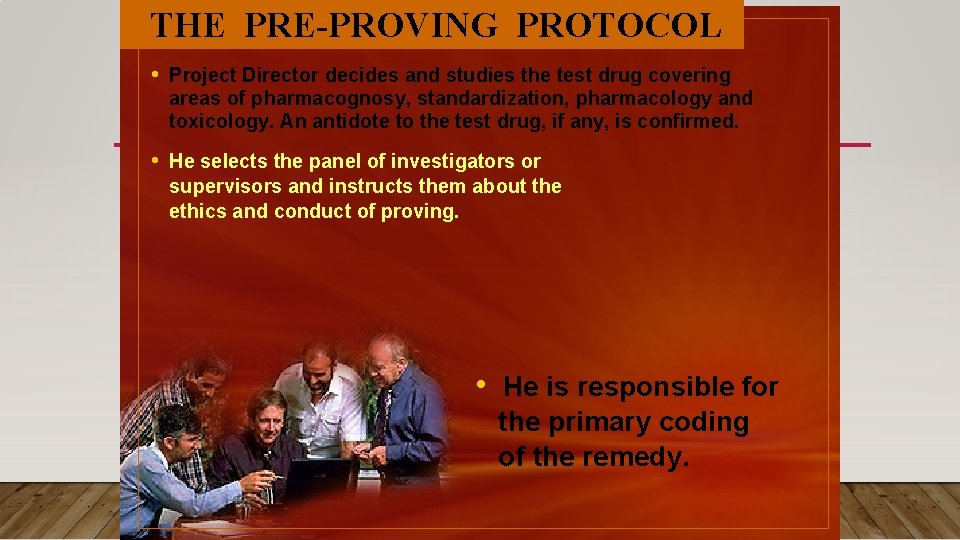
THE PRE-PROVING PROTOCOL • Project Director decides and studies the test drug covering areas of pharmacognosy, standardization, pharmacology and toxicology. An antidote to the test drug, if any, is confirmed. • He selects the panel of investigators or supervisors and instructs them about the ethics and conduct of proving. • He is responsible for the primary coding of the remedy.
• Along with the supervisors and the experts, he screens the possible provers. The Supervisors prepare the Initial Medical Report Proforma. • The provers are briefed about the importance, ethics and details of the proving programme. • Consent should be obtained in writing from prover. • The investigating team should discontinue the provings if in their judgement, if any, if continued, be harmful to the subject.
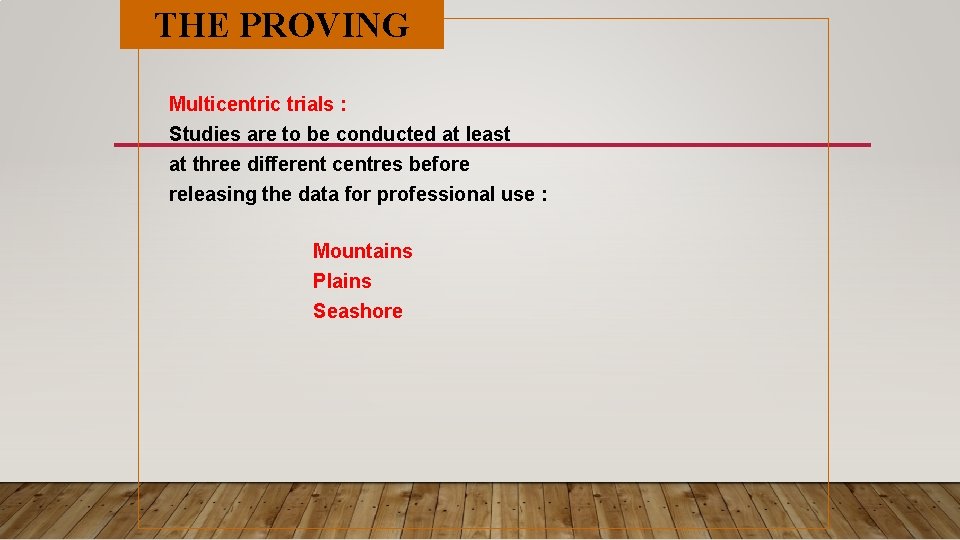
THE PROVING Multicentric trials : Studies are to be conducted at least at three different centres before releasing the data for professional use : Mountains Plains Seashore
Orientation meeting : Orientation meetings are arranged at the commencement of the proving. The aim of the orientation meeting is to explain the importance and conduct of the proving process in detail. The daybooks are also provided to the provers for the recording of the proving.
NATURE OF TRIALS • Randomized • Double Blind • Double Controlled Provings • Croos Over Studies
RECORDING OF PROVING • Initial Medical Report Proforma • Prover’s Daybook / Logbook • Response Monitoring Proforma
RECORDING OF SYMPTOMS How to note : • Provers and supervisors should refrain from discussing symptoms or experiences. • Recording should be as frequently as possible. • Each day is started on a new page with the date and which day of the proving it is, noted at the top of each page. The day of the first dose is day one.
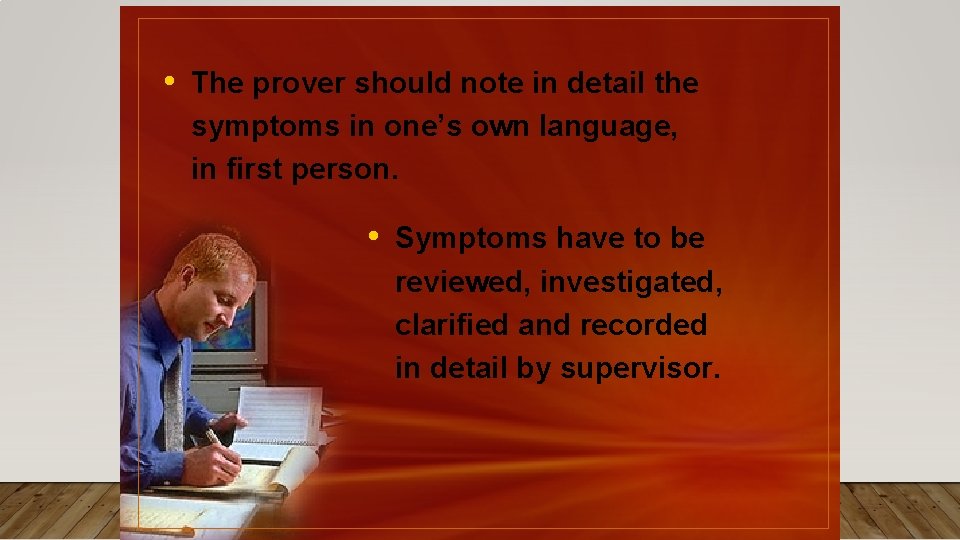
• The prover should note in detail the symptoms in one’s own language, in first person. • Symptoms have to be reviewed, investigated, clarified and recorded in detail by supervisor.
What to note : • Prover notes down any symptoms that arise, whether they are old or new and at what time of the day or night they occurred. • The prover must note down distinctly the sensation, sufferings, accidents and changes of health he experiences at the time of their occurrence, mentioning the time after the ingestion of the drug.
• This information should be recorded on the right hand page of the daybook. • The left hand page is devoted to recording the details and circumstances of the proving experiences in one’s own words.
CRITERIA FOR INCLUDING SYMPTOMS • New symptoms, unfamiliar to the prover. • Usual or current symptoms that are intensified. • Current symptoms modified or altered. • Old symptoms that have not occurred for at least one year.
• Present symptoms that have disappeared during the proving. • If a symptom is in doubt, it is included in brackets. If another prover experienced the same symptom it could be valid. If not, it is excluded.
PRECAUTIONS TO BE TAKEN BY PROVER DURING DRUG PROVING • Avoid all substances with medicinal properties. • Provers must be at least 3 months clear of any previous treatment or of a homeopathic remedy. • There should be a strict regulation of diet when the drug is being proved.
• Diet during proving should be purely nutritious and of simple character. • Overexertion of mind and body should be avoided. • Provers should stick to their normal habits and way of life.
POST PROVING PROTOCOL • The proving records are thoroughly screened analysed. • The symptoms collected from all the provers is to be sifted in such a manner that all the relevant data collected is not lost, but shall have a proper flow of thought, so that the mental, physical and functional state of the drug is understood. • Adequate data indexing is done as per the pattern of Kent's repertory so that the data is rendered clinically useful.
ANALYSIS OF PROVING RECORDS Extracting, collating, analysing, theming Into Materia Medica and repertorising are the most laborious, painstaking and timeconsuming stages of carrying out a proving. A well-balanced group for this task should be of experienced homeopaths, well acquainted with different repertories and repertory language. A good working knowledge of the native language of the provers is also required.
EXTRACTION This involves converting daybooks into format of the Materia Medica and the extracting of valid symptoms. The observations and experiences of all the provers have to be analyzed, compared with their Initial Medical Report Proforma, and finally comparision of the control, test and crossover groups is done.
COLLATION The aim of collation stage is to synthesise the proving from all separate accounts of each prover as if it belonged to and evolved in a single person. All the prover's separate sheets are put together. Symptoms with a common denominator are grouped together under each section.
REPERTORISATION The aim of repertorising stage is to accurately and truthfully interpret the proving information into repertory language. Each symptom is accurately analysed and translated into a rubric. Certain symptoms may require creating new rubrics. The remedy is then considered for addition into the rubrics.
THEMING THE SYMPTOMS These symptoms are studied for its peculiar pattern that emerges out of the proving. The Generalities at the physical level, the constitutional affinity, the characteristic peculiar state of mind and disposition is then studied. This theming of the proving is the practical outcome of the painstaking effort of the entire project.
PUBLICATION The final publication, in book form or in a journal or electronic form should include Materia Medica, repertorization, information about the substance and its toxicology. This should give the complete view of the remedy picture and a summary of the proving, with discussion and conclusions. Data indexing should be as per the scheme followed in Kent’s repertory.
CRITERIA FOR THOROUGH PROVING • Drug must be proved on suitable persons of both sexes and of various constitutions. • Almost always only the same symptoms as had already been observed by others are exhibited during reproving.
• The symptoms are most carefully recorded with regard to their specific sensations, locations, modalities with their concomitant factors, so that a complete individual picture of the drug is established. • Clinically verified.