
HOMODYNE AND HETERODYNE READOUT OF A SIGNALRECYCLED GRAVITATIONAL
- Slides: 1
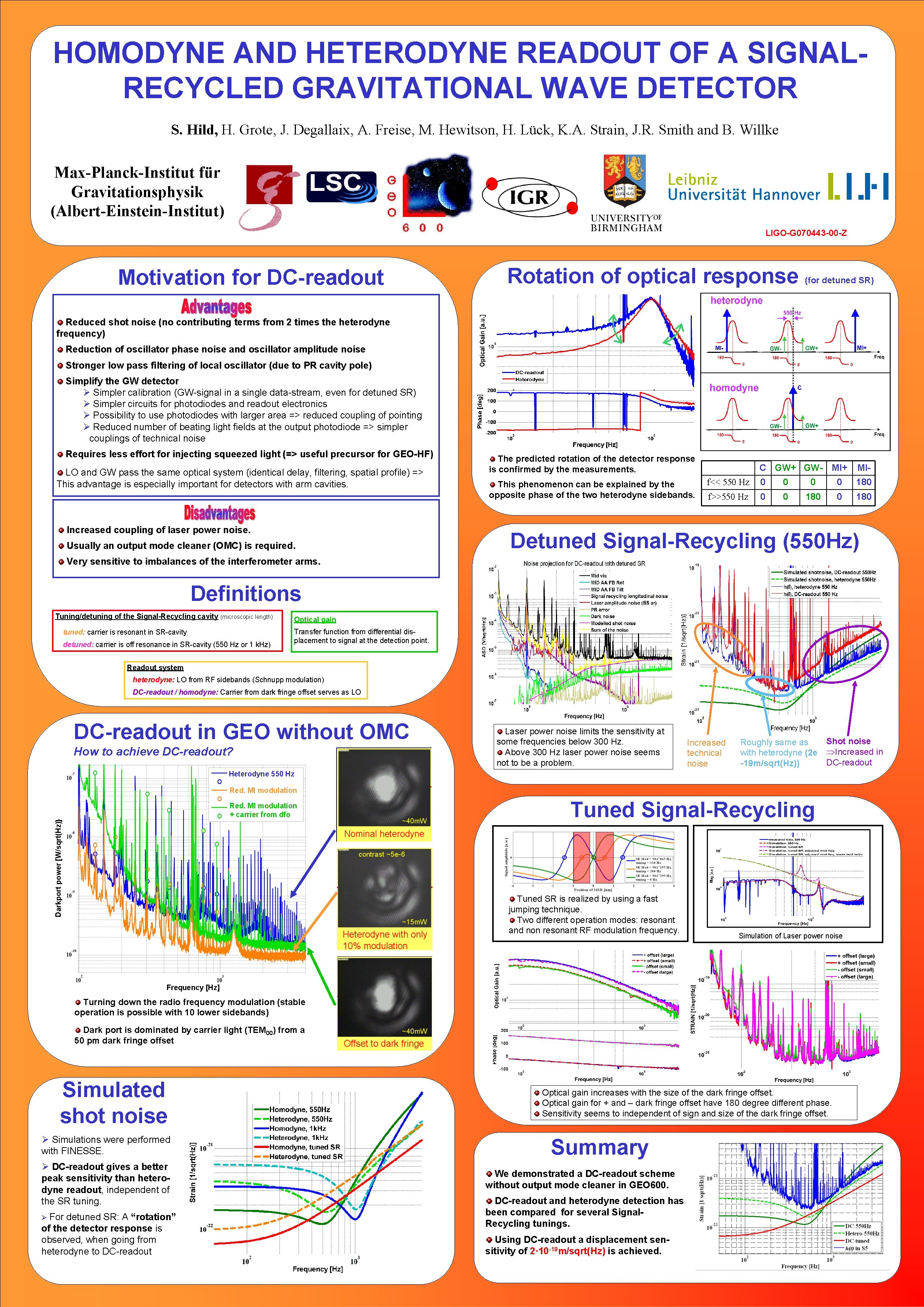
HOMODYNE AND HETERODYNE READOUT OF A SIGNALRECYCLED GRAVITATIONAL WAVE DETECTOR S. Hild, H. Grote, J. Degallaix, A. Freise, M. Hewitson, H. Lück, K. A. Strain, J. R. Smith and B. Willke Max-Planck-Institut für Gravitationsphysik (Albert-Einstein-Institut) LIGO-G 070443 -00 -Z Motivation for DC-readout Rotation of optical response (for detuned SR) Reduced shot noise (no contributing terms from 2 times the heterodyne frequency) Reduction of oscillator phase noise and oscillator amplitude noise Stronger low pass filtering of local oscillator (due to PR cavity pole) Simplify the GW detector Ø Simpler calibration (GW-signal in a single data-stream, even for detuned SR) Ø Simpler circuits for photodiodes and readout electronics Ø Possibility to use photodiodes with larger area => reduced coupling of pointing Ø Reduced number of beating light fields at the output photodiode => simpler couplings of technical noise Requires less effort for injecting squeezed light (=> useful precursor for GEO-HF) LO and GW pass the same optical system (identical delay, filtering, spatial profile) => This advantage is especially important for detectors with arm cavities. Increased coupling of laser power noise. Usually an output mode cleaner (OMC) is required. The predicted rotation of the detector response is confirmed by the measurements. This phenomenon can be explained by the opposite phase of the two heterodyne sidebands. C GW+ GW- MI+ MI- f<< 550 Hz 0 0 180 f>>550 Hz 0 0 180 Detuned Signal-Recycling (550 Hz) Very sensitive to imbalances of the interferometer arms. Definitions Tuning/detuning of the Signal-Recycling cavity (microscopic length) • tuned: carrier is resonant in SR-cavity • detuned: carrier is off resonance in SR-cavity (550 Hz or 1 k. Hz) Optical gain Transfer function from differential displacement to signal at the detection point. Readout system • heterodyne: LO from RF sidebands (Schnupp modulation) • DC-readout / homodyne: Carrier from dark fringe offset serves as LO DC-readout in GEO without OMC How to achieve DC-readout? Laser power noise limits the sensitivity at some frequencies below 300 Hz. Above 300 Hz laser power noise seems not to be a problem. Increased technical noise Shot noise Roughly same as with heterodyne (2 e ÞIncreased in DC-readout -19 m/sqrt(Hz)) Heterodyne 550 Hz Red. MI modulation Darkport power [W/sqrt(Hz)} Red. MI modulation + carrier from dfo Tuned Signal-Recycling Tuned SR is realized by using a fast jumping technique. Two different operation modes: resonant and non resonant RF modulation frequency. Simulation of Laser power noise Frequency [Hz] Turning down the radio frequency modulation (stable operation is possible with 10 lower sidebands) Dark port is dominated by carrier light (TEM 00) from a 50 pm dark fringe offset Simulated shot noise Ø Simulations were performed with FINESSE. Ø DC-readout gives a better peak sensitivity than heterodyne readout, independent of the SR tuning. Ø For detuned SR: A “rotation” of the detector response is observed, when going from heterodyne to DC-readout Optical gain increases with the size of the dark fringe offset. Optical gain for + and – dark fringe offset have 180 degree different phase. Sensitivity seems to independent of sign and size of the dark fringe offset. Summary We demonstrated a DC-readout scheme without output mode cleaner in GEO 600. DC-readout and heterodyne detection has been compared for several Signal. Recycling tunings. Using DC-readout a displacement sensitivity of 2· 10 -19 m/sqrt(Hz) is achieved.