
Homicide Service Meet the Market Event 14 February

Homicide Service Meet the Market Event 14 February 2014 Royal Courts of Justice
Agenda for today 11. 00 11. 10 11. 30 12. 00 12. 10 12. 45 Introduction Background (i) National Commissioning in a national-local model (ii) Code of Practice for Victims (iii) EU Directive (iv) Demand eligibility Key Requirements Process and Timelines Question and Answer session Networking
Introduction Ministry of Justice Tony Rafter and Peter Brown Victims and Witnesses Delivery Unit Tim Charlton Victim and Criminal Proceedings Policy Bridghe Forde Procurement Team Foreign and Commonwealth Office Paul Kaye Assistance Policy Team
Aims for today • raise awareness of the forthcoming grant competition exercise for the coordination and delivery of support services for victims bereaved by homicide; • allow potential bidders to start thinking about building relationships with other organisations with which they may wish to work in providing the national service
National Commissioning in a national-local model The Government’s Response to the consultation “Getting it Right for Victims and Witnesses” announced that in future the majority of services for victims would be commissioned locally, by Police and Crime Commissioners Some services are being nationally commissioned by Ministry of Justice, including support for victims of high-impact but relatively low volume crime The aim in national commissioning is to provide a service that provides support available to all victims and witnesses in England Wales Police and Crime Commissioners can choose to augment support locally, but it is not intended that they need to replicate the support provided through national commissioning
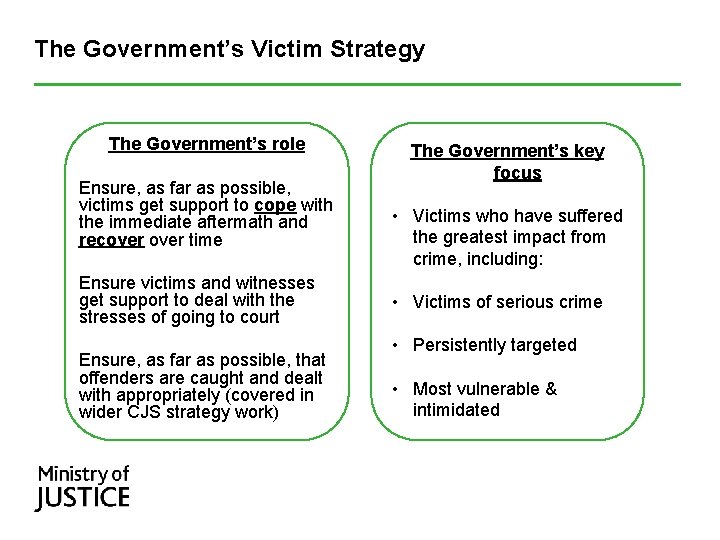
The Government’s Victim Strategy The Government’s role Ensure, as far as possible, victims get support to cope with the immediate aftermath and recover time Ensure victims and witnesses get support to deal with the stresses of going to court Ensure, as far as possible, that offenders are caught and dealt with appropriately (covered in wider CJS strategy work) The Government’s key focus • Victims who have suffered the greatest impact from crime, including: • Victims of serious crime • Persistently targeted • Most vulnerable & intimidated
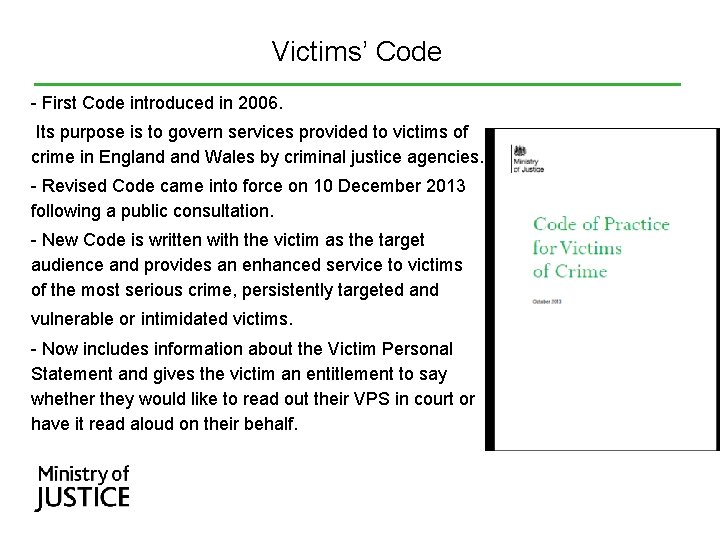
Victims’ Code - First Code introduced in 2006. Its purpose is to govern services provided to victims of crime in England Wales by criminal justice agencies. - Revised Code came into force on 10 December 2013 following a public consultation. - New Code is written with the victim as the target audience and provides an enhanced service to victims of the most serious crime, persistently targeted and vulnerable or intimidated victims. - Now includes information about the Victim Personal Statement and gives the victim an entitlement to say whether they would like to read out their VPS in court or have it read aloud on their behalf.
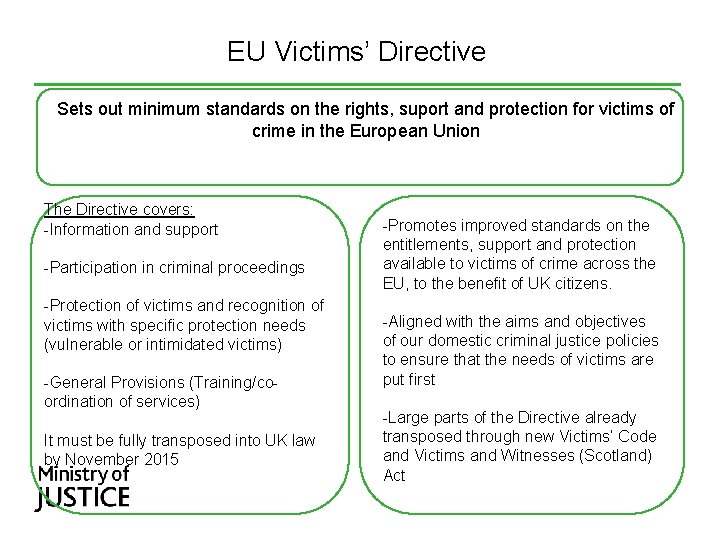
EU Victims’ Directive Sets out minimum standards on the rights, suport and protection for victims of crime in the European Union The Directive covers: -Information and support -Participation in criminal proceedings -Protection of victims and recognition of victims with specific protection needs (vulnerable or intimidated victims) -General Provisions (Training/coordination of services) It must be fully transposed into UK law by November 2015 -Promotes improved standards on the entitlements, support and protection available to victims of crime across the EU, to the benefit of UK citizens. -Aligned with the aims and objectives of our domestic criminal justice policies to ensure that the needs of victims are put first -Large parts of the Directive already transposed through new Victims’ Code and Victims and Witnesses (Scotland) Act
Homicide Service A national Homicide Service will provide a range of practical, emotional and specialist support to individuals who have been bereaved by homicide, based on need

Needs The needs of those bereaved by homicide are variable and dynamic. There is a range of literature covering these needs; and in addition there have been a number of reviews and learning from the needs of those supported under current arrangements. We have drawn on these reviews and also on feedback from support practitioners to inform the specification. Set out on the following slides are high level category of needs for victims and for those bereaved by homicide developed under the getting it right for Victims and Witnesses consultation and Evidence and Practice Reviews of victim services, illustrated by examples of the type of specific needs encountered by support practitioners. These are NOT exhaustive lists or examples. Whilst the service will deliver across a range of practical, emotional and specialist support needs, the type and balance of services delivered will be shaped within this by the needs of those supported.

Types of need Information Practical Support Emotional Support navigating Safety and protection from legal processes victimisation On a general range Help with wide Help with short and of issues range of day-to-day long-term effects of activities around bereavement such things as schooling, employment, finance; shopping Advice on Advice and practicalities of court assistance or attendance; legal signposting for rights; processes of assistance with recoroner/inquests; housing. compensation processes and claims Advocacy as part of support on legal processes, including for example on Domestic Homicide Reviews, Inquests, IPCC and Mental Health Inquiries.

Types of need Education, Finance Outlook and Mental and skills and attitudes physical employment benefits health Help to reduce/cope with impact on these areas of life by the often lengthy CJS processes Info on Support entitlemen against ts / claims effects of possible isolation, across help to criminal rebuild and civil social areas interaction Education, Drugs skills and employment alcohol Social Family, Shelter and interaction friends and accommodati children on Bereavement Potential Support Help to Advice and / trauma need to deal need to against rebuild assistance or counselling – with deal with effects of social signposting immediate resultant isolation, interaction; for assistance and later; dependency dependen help to Support with recy rebuild adaptation housing. social to change interaction of life
Key facts The total number of individuals supported following cases referred to the Homicide Service during the years 2010 -2013 was 4, 229 (including 131 bereaved through homicide abroad). The total number of individuals currently being supported by the Homicide Service is around 2, 400.
Foreign and Commonwealth Office Context: 60 – 70 murder cases abroad every year; cases are challenging and high-profile, with significant press and Parliamentary interest; need for long-term, flexible levels of support, delivered working with other partners; detailed reporting and quick response to info requests needed. Aim: to provide support to those bereaved by homicide abroad in accordance with the following terms of reference: - Murder or manslaughter of British national abroad; - Murder or manslaughter investigation in that country; - Bereaved must reside in England Wales. Process: FCO notifies provider discussion offer to bereaved coordinated support Services specific to deaths abroad: Additional requirements can include repatriation, travel, legal advice, and translation/interpretation costs.
Key principles The aim of the grant award is to maximise the amount of support delivered to those who need it, for as long as they need it There are some systemic or process requirements: • Secure and appropriate holding and use of personal data • Work with police and FCO processes for referral • Effective assessment of the needs of the person being supported, early and on ongoing And • Needs are wide ranging and dynamic and will need a range of skills and specialisms: provision of information on what these needs are and how service is deploying to support them will be required
Questions
- Slides: 16