
Homework Write a letter Write a letter home




- Slides: 19
Homework - Write a letter �Write a letter home, describing a particular school day. �Use the language of narration, the notes we are taking down today.
Homework – take it out and hand it up. � As President, you want to work with a celebrity to help a charity. � Write a report conveying information about this activity. � This should include information on the charity, the celebrity and what you hope to do. (One Page) � I also heard that you’re not having a Christmas test, that your homework each week is part of your grade. Guess what?
Describe what you see in detail - adjectives
Today’s Heading The Language of Narration
The objective of this class is: � To examine the language of narration. � To read several stories as to highlight plot, setting and characterisation. � To increase your descriptive skills.
Definition � Narration literally means to tell a story. Plot, setting & characterization = 3 key elements. � Target audience – those who read for pleasure. � Purpose – to give a connected account of events. (Used in letters, diaries, articles and essays)
Reading short story �The story of Sinead.
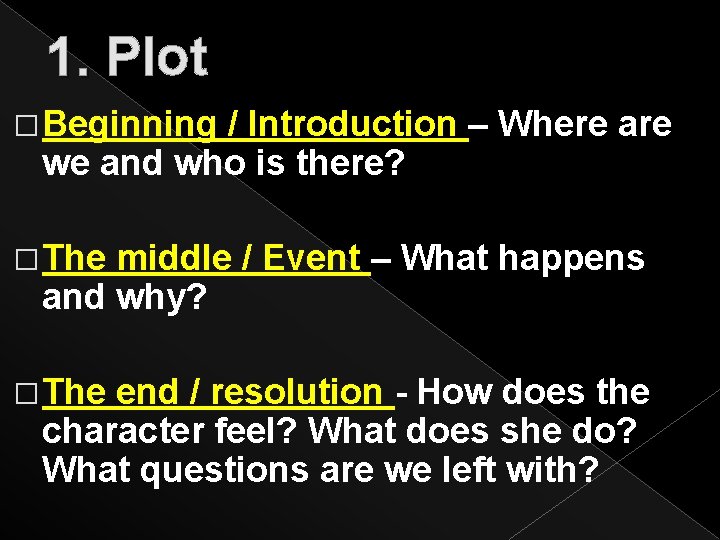
1. Plot � Beginning / Introduction – Where are we and who is there? � The middle / Event – What happens and why? � The end / resolution - How does the character feel? What does she do? What questions are we left with?
Setting � Clearly describing your setting allows the reader to imagine being in that place. � The details you convey can set the tone or mood of the setting.
2. Setting � Use vivid imagery – describe every detail of the image. � Use many adverbs and adjectives – show off your description vocabulary. � He read to the children’ vs ‘He read loudly to the demonic children’.
Describe what you see – 5 details (use adjectives and adverbs)
Characterisation � Readers get to know a character’s personality through: � what they say � what they do � how � and they look from other people’s opinions attitudes towards this character. &
3. Characterisation � Characterisation – achieved by describing what people say, do, look like and think. � Similes and Metaphors – An image says a thousand words. Making comparisons really helps. � He rushed me like a bull � She was a princess, an angel, a star before my eyes. � Jack believed that Gavin was a right maggot. � (The following paragraph is from Herman Melville’s ‘Moby Dick’. )
� "Landlord!" said I, "what sort of chap is he -- does he always keep such late hours? " It was now hard upon twelve o'clock. The landlord chuckled again with his lean chuckle, and seemed to be mightily tickled at something beyond my comprehension. "No, " he answered, "generally he's an early bird -- airley to bed and airley to rise -- yea, he's the bird what catches the worm. -- But to-night he went out a peddling, you see, and I don't see what on airth keeps him so late, unless, may be, he can't sell his head. ""Can't sell his head? -- What sort of a bamboozingly story is this you are telling me? " getting into a towering rage. "Do you pretend to say, landlord, that this harpooneer is actually engaged this blessed Saturday night, or rather Sunday morning, in peddling his head around this town? “ (Head means body)
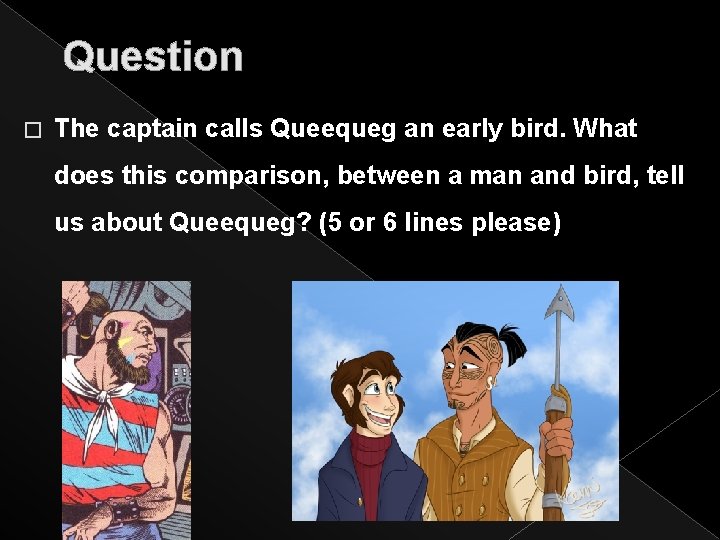
Question � The captain calls Queequeg an early bird. What does this comparison, between a man and bird, tell us about Queequeg? (5 or 6 lines please)
3. Characterisation � Only have one or two characters in your story to avoid confusion. � Base them on real people or other characters. � Try and make the reader feel something for the character.
Final bit of advise � Tenses - Pick a tense and stick with it. Past is easier than present. � Use the five senses to describe things. Rather than keep saying what things look like, say how they smell, what they sound like, etc. � You cannot copy a well known story but you can be inspired by it.
Story – can you guess the title? � Now you have all read a bit of Twilight. � Write a diary entry of you having entered a new town. � Remember: � Plot – beginning, middle, end � Setting – vivid imagery, adverbs, adjectives � Characterisation – simile and metaphor
Write a letter �Write a letter home, describing a particular school day. �Use the language of narration, the notes we were taking down today.