
Homework Textbook Interpretations in American History Read Chapter
Homework: Textbook: Interpretations in American History Read Chapter 2 Source Reader: “Bacon’s Rebellion: A Declaration” “A Model of Christian Charity”
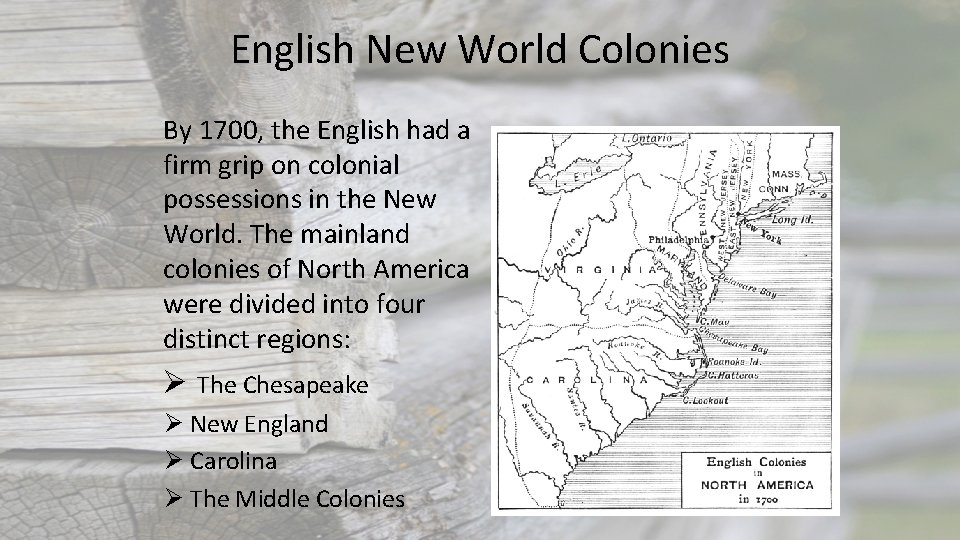
English New World Colonies By 1700, the English had a firm grip on colonial possessions in the New World. The mainland colonies of North America were divided into four distinct regions: Ø The Chesapeake Ø New England Ø Carolina Ø The Middle Colonies
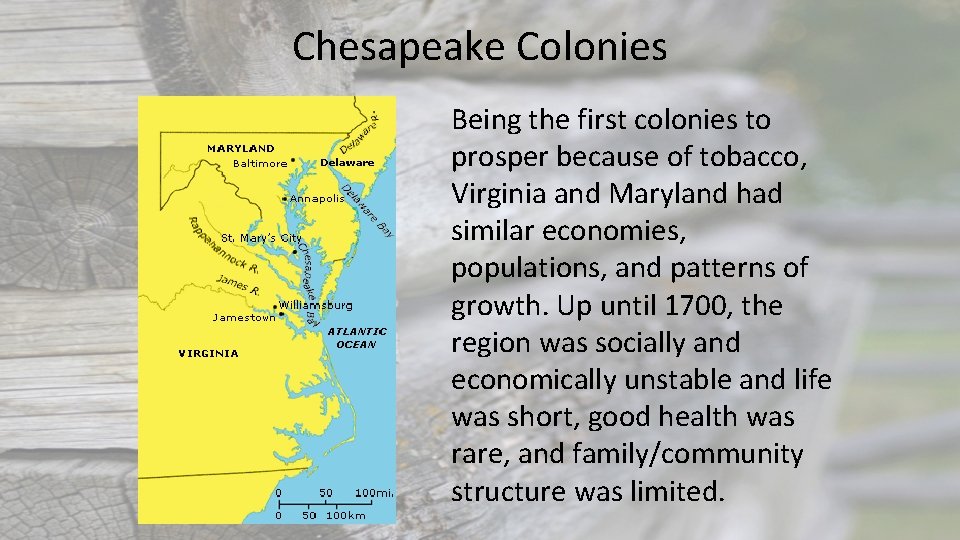
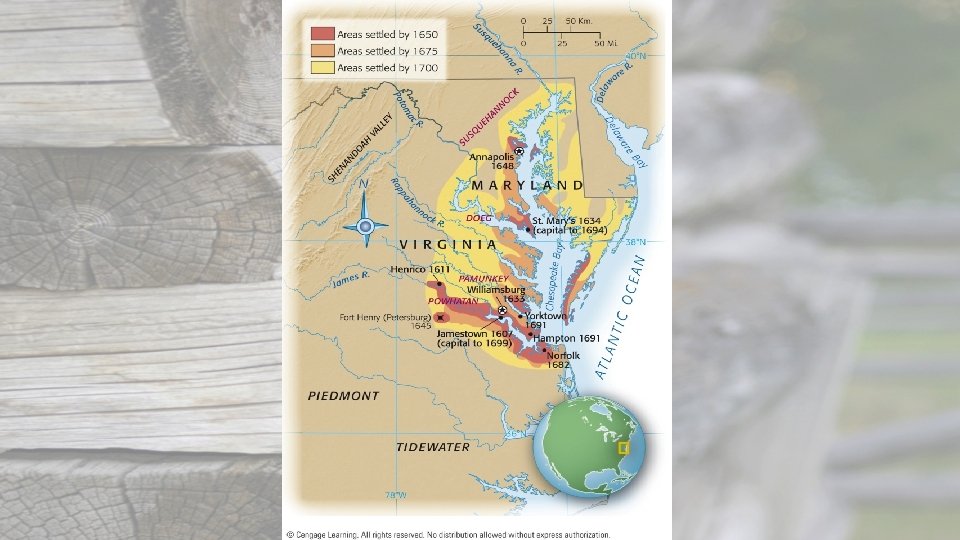
Chesapeake Colonies Being the first colonies to prosper because of tobacco, Virginia and Maryland had similar economies, populations, and patterns of growth. Up until 1700, the region was socially and economically unstable and life was short, good health was rare, and family/community structure was limited.
Structure of Virginia Ø Charles I restored the colonial assembly in 1636, but kept Virginia a royal colony Ø In the 1650 s, the legislative assembly became a bicameral body Ø Virginia adopted the county-system, where justices and sheriffs were appointed by the governor Ø The Church of England was the official established church of the colony.
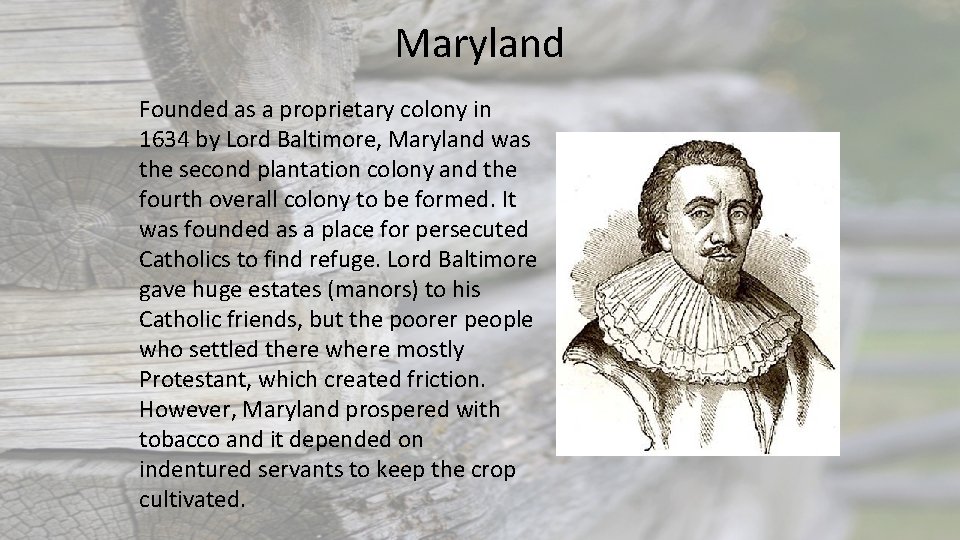
Maryland Founded as a proprietary colony in 1634 by Lord Baltimore, Maryland was the second plantation colony and the fourth overall colony to be formed. It was founded as a place for persecuted Catholics to find refuge. Lord Baltimore gave huge estates (manors) to his Catholic friends, but the poorer people who settled there where mostly Protestant, which created friction. However, Maryland prospered with tobacco and it depended on indentured servants to keep the crop cultivated.
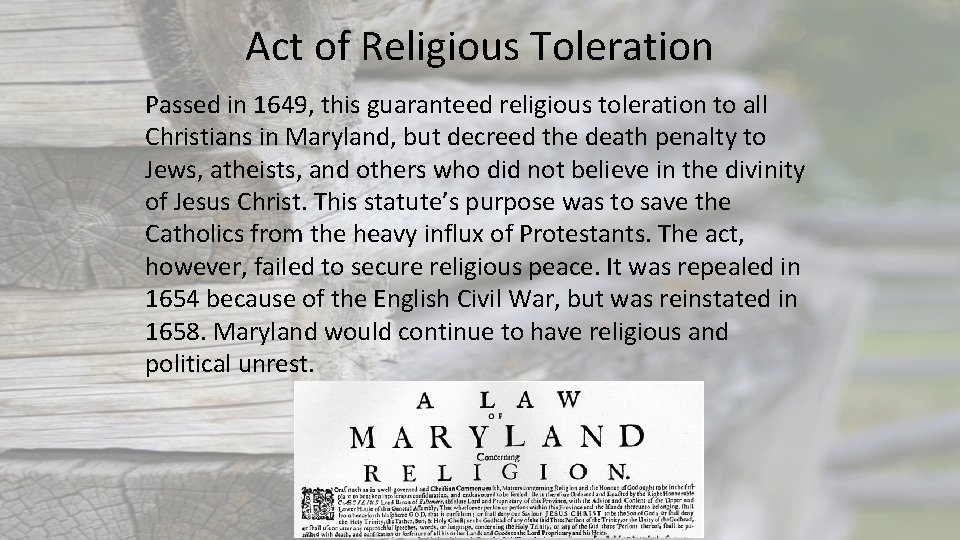
Act of Religious Toleration Passed in 1649, this guaranteed religious toleration to all Christians in Maryland, but decreed the death penalty to Jews, atheists, and others who did not believe in the divinity of Jesus Christ. This statute’s purpose was to save the Catholics from the heavy influx of Protestants. The act, however, failed to secure religious peace. It was repealed in 1654 because of the English Civil War, but was reinstated in 1658. Maryland would continue to have religious and political unrest.
Life in the Chesapeake Ø Tobacco required labor, thus 90% of immigrants were indentured servants and 80% of them were men. Ø Death rate was very high. Average life expectancy was 48 for men, 44 for women. Ø High death rate and uneven distribution of the genders crippled family life and limited population growth Ø Widows received more economic power in the Chesapeake as compared to other areas because of the short life span.
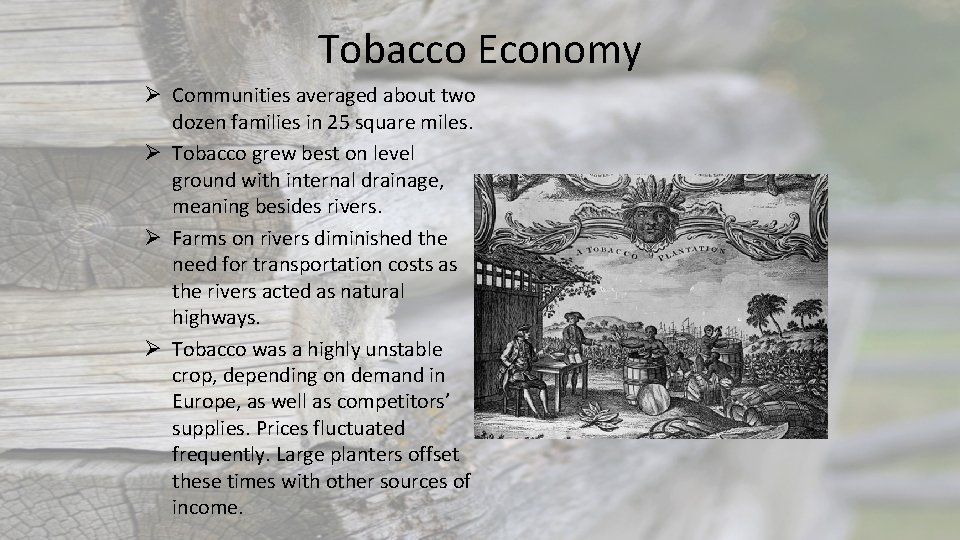
Tobacco Economy Ø Communities averaged about two dozen families in 25 square miles. Ø Tobacco grew best on level ground with internal drainage, meaning besides rivers. Ø Farms on rivers diminished the need for transportation costs as the rivers acted as natural highways. Ø Tobacco was a highly unstable crop, depending on demand in Europe, as well as competitors’ supplies. Prices fluctuated frequently. Large planters offset these times with other sources of income.
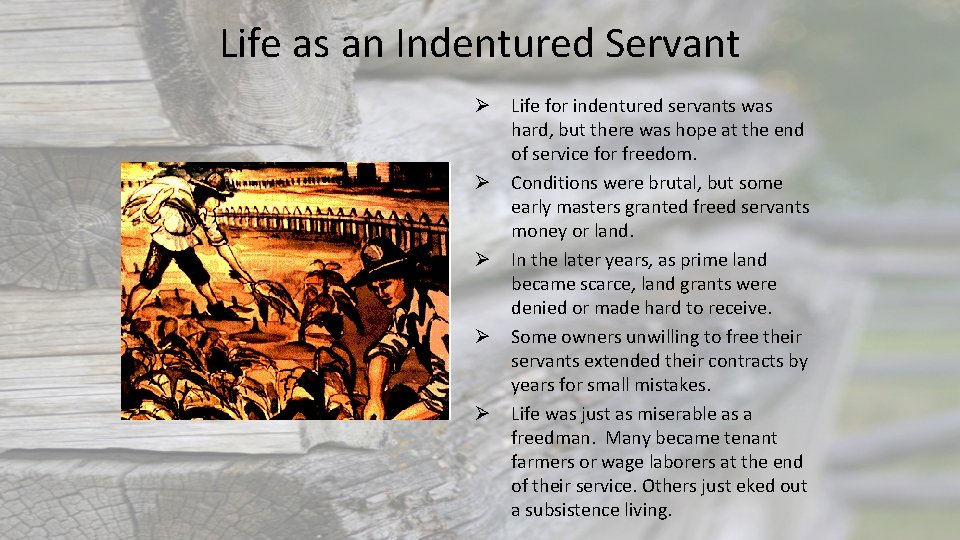
Life as an Indentured Servant Ø Life for indentured servants was hard, but there was hope at the end of service for freedom. Ø Conditions were brutal, but some early masters granted freed servants money or land. Ø In the later years, as prime land became scarce, land grants were denied or made hard to receive. Ø Some owners unwilling to free their servants extended their contracts by years for small mistakes. Ø Life was just as miserable as a freedman. Many became tenant farmers or wage laborers at the end of their service. Others just eked out a subsistence living.
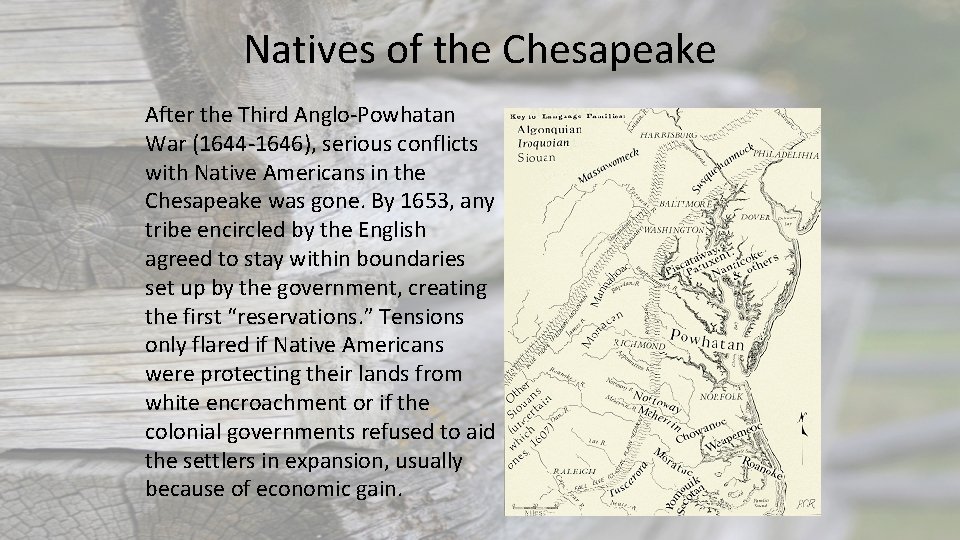
Natives of the Chesapeake After the Third Anglo-Powhatan War (1644 -1646), serious conflicts with Native Americans in the Chesapeake was gone. By 1653, any tribe encircled by the English agreed to stay within boundaries set up by the government, creating the first “reservations. ” Tensions only flared if Native Americans were protecting their lands from white encroachment or if the colonial governments refused to aid the settlers in expansion, usually because of economic gain.
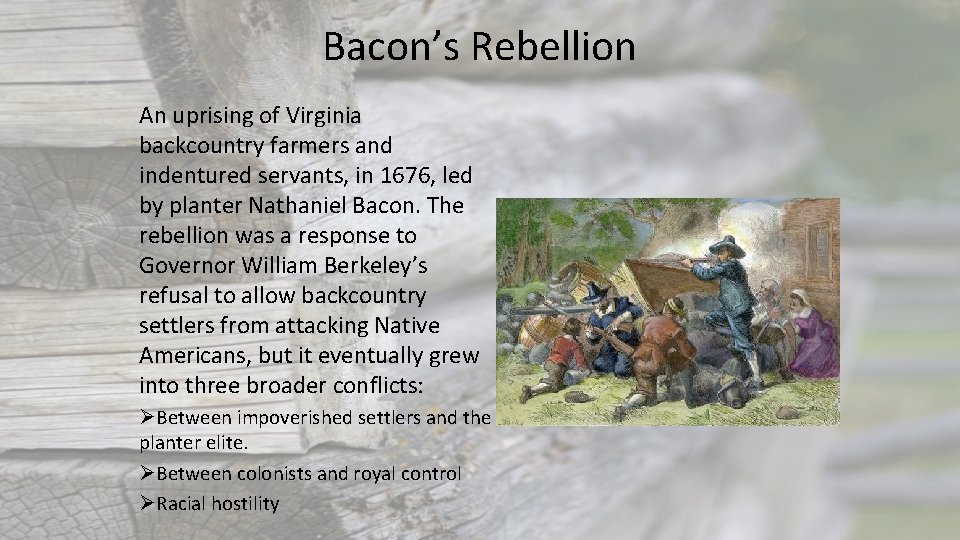
Bacon’s Rebellion An uprising of Virginia backcountry farmers and indentured servants, in 1676, led by planter Nathaniel Bacon. The rebellion was a response to Governor William Berkeley’s refusal to allow backcountry settlers from attacking Native Americans, but it eventually grew into three broader conflicts: ØBetween impoverished settlers and the planter elite. ØBetween colonists and royal control ØRacial hostility
Development of Slavery Racial slavery developed in three phases in the Chesapeake: ØFirst (1619 -1640), on legal documents, whites, blacks, and Native Americans were distinguished from each other, but none were assumed slaves for life ØSecond (1640 -1660), as the influx of blacks and captured natives became more prevalent, these groups were treated as slaves for life. Children inherited their parents’ status. ØThird, because of growing cooperation between white and black laborers, planters legally distinguished between the two and provided strict legal codes for slaves and racial etiquette.
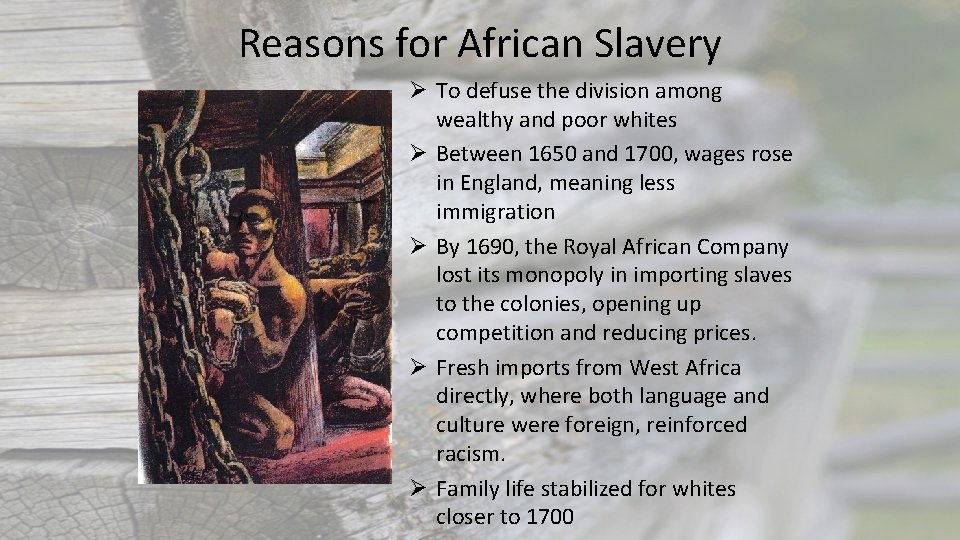
Reasons for African Slavery Ø To defuse the division among wealthy and poor whites Ø Between 1650 and 1700, wages rose in England, meaning less immigration Ø By 1690, the Royal African Company lost its monopoly in importing slaves to the colonies, opening up competition and reducing prices. Ø Fresh imports from West Africa directly, where both language and culture were foreign, reinforced racism. Ø Family life stabilized for whites closer to 1700
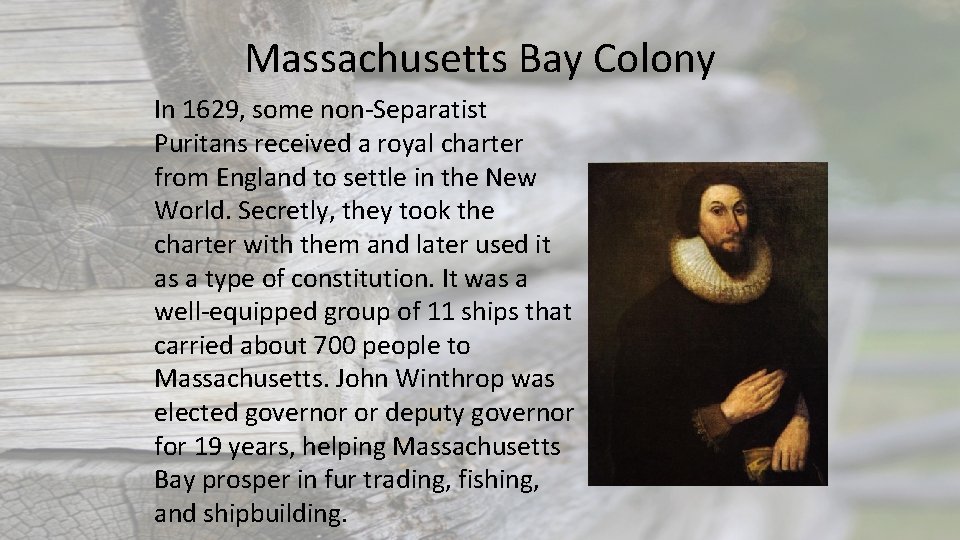
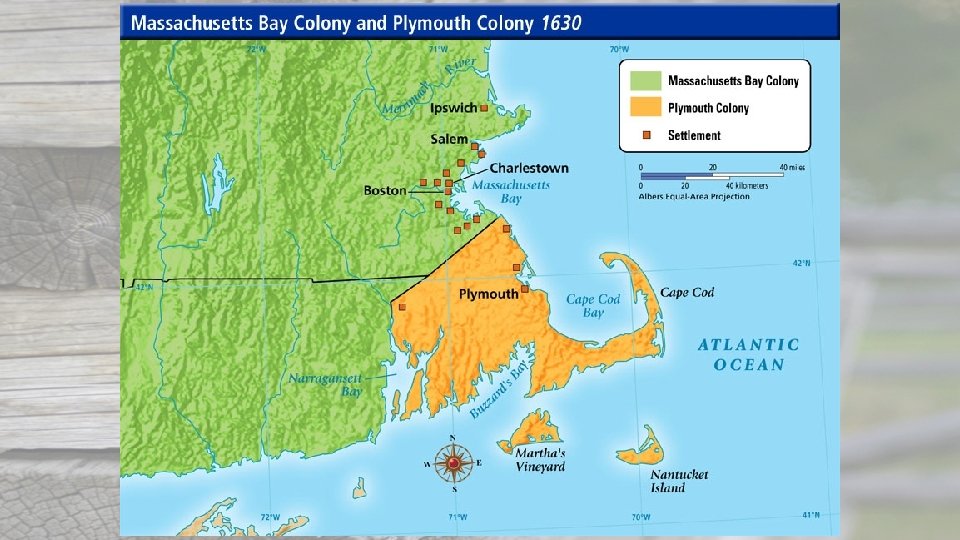
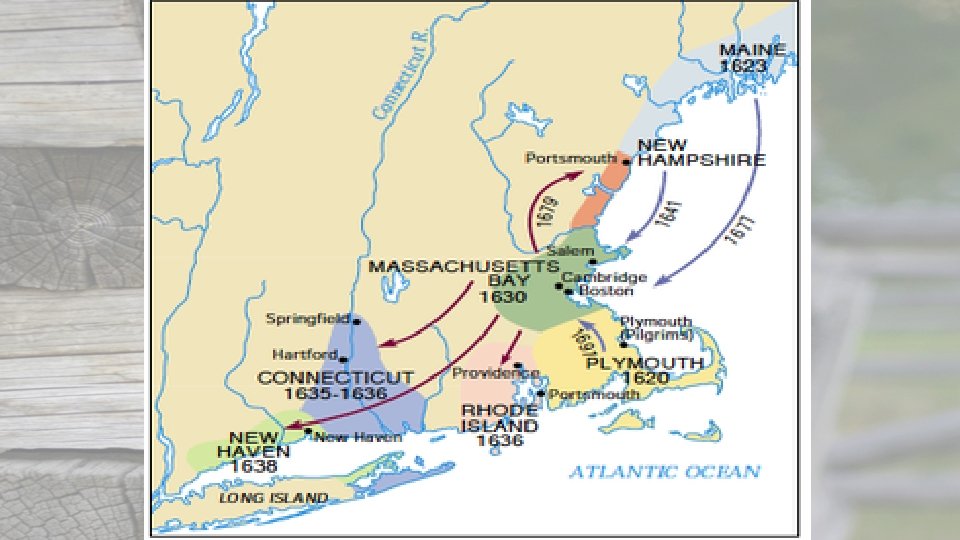
Massachusetts Bay Colony In 1629, some non-Separatist Puritans received a royal charter from England to settle in the New World. Secretly, they took the charter with them and later used it as a type of constitution. It was a well-equipped group of 11 ships that carried about 700 people to Massachusetts. John Winthrop was elected governor or deputy governor for 19 years, helping Massachusetts Bay prosper in fur trading, fishing, and shipbuilding.
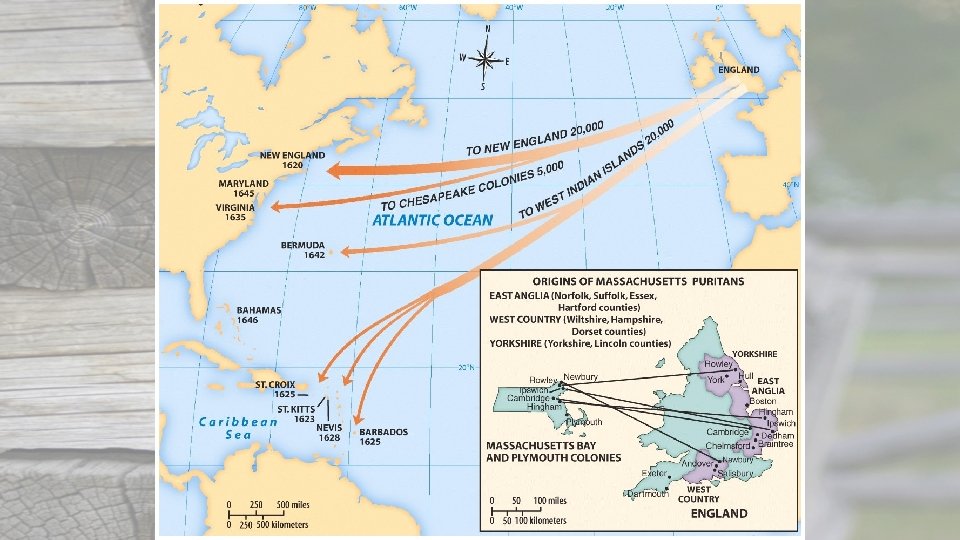
Great English Migration The migration of 70, 000 refugees, in the 1630 s, from England to North American colonies, primarily New England the Caribbean. The 20, 000 migrants who came to Massachusetts largely shared a common sense of purpose; to establish a model Christian settlement in the New World.
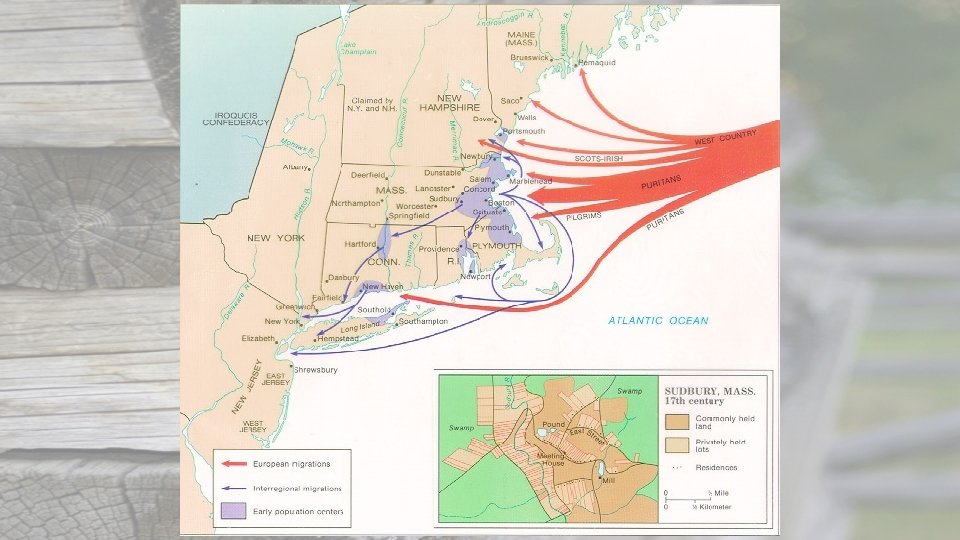
Running the Bay Colony Soon after the establishment of the colony, the franchise (right to vote) was extended to all “freemen, ” adult males who belonged to the Puritan congregations, which, by 1641, was about 55% of the male population. Un-churched men and women were not allowed into matters of provincial or colonial government. The provincial government was not a democracy. Governor Winthrop feared and distrusted the common people, calling democracy the “meanest and worst” of all forms of government. However, in 1644, the General Court became a bicameral body, allowing towns to elect deputies to one house.
Massachusetts Body of Liberties Compiled by the Puritan minister Nathaniel Ward, the laws were established by the Massachusetts General Court in 1641. They are one of the earliest protections of individual rights in America. Unlike many of the English sources of the time, the Body of Liberties were expressed in many of their grants and far more supportive of individual rights. Despite these grants, the rights were modifiable by the General Court.
Rights Under the “Liberties” To varying degrees, the document contained rights that would later be included in the Bill of Rights. Ø fundamental components of procedural due process, such as rights to notice and hearing before the court. Ø freedom of speech Ø a right against uncompensated takings Ø a right to bail and a right to jury trial Ø a right against cruel and unusual punishment Ø a right against double jeopardy The Body of Liberties also contained other individual rights: Ø Ø a prohibition of a compulsory draft except for territorial defense a prohibition of monopolies prohibition of an estate tax the freedom of all "house holders" to fishing and fowling on public lands.

Religious Life in Puritan New England Ø Religious leaders wielded powerful influence over the admission to church membership. (“New England Way”) Ø Congregations could hire and fire their ministers at will and ministers could not be elected to office (first signs of separation of church and state). However, taxes were levied to support the local church. Ø Reading scripture was important. Towns of 50 or more families had to hire a teacher. 100 or more had to have grammar school (public education) Ø Harvard College was founded in 1636 to train future clergy. Ø The Puritan concept of Hell was very serious, frightening, and very real. (Michael Wigglesworth’s “Day of Doom, ” 1662) Church services were mandatory.
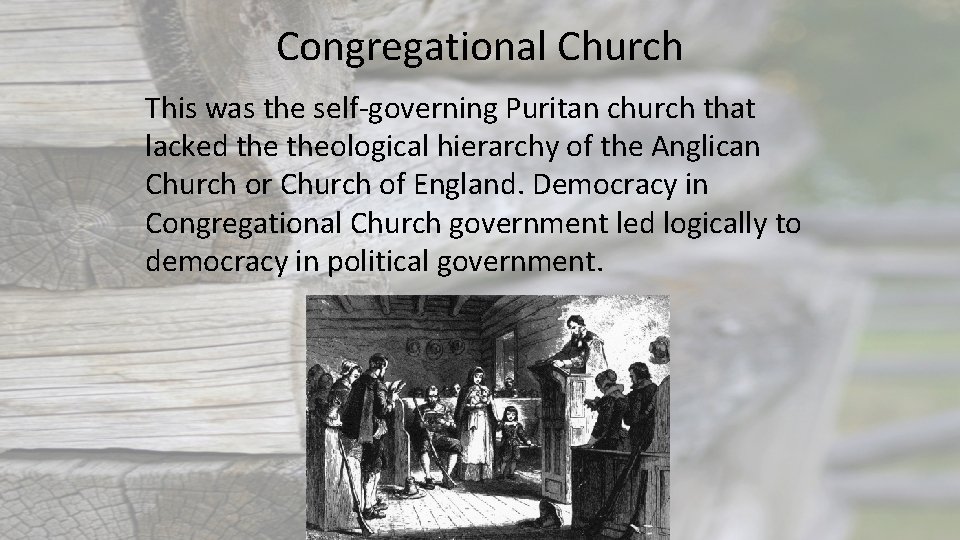
Congregational Church This was the self-governing Puritan church that lacked theological hierarchy of the Anglican Church or Church of England. Democracy in Congregational Church government led logically to democracy in political government.
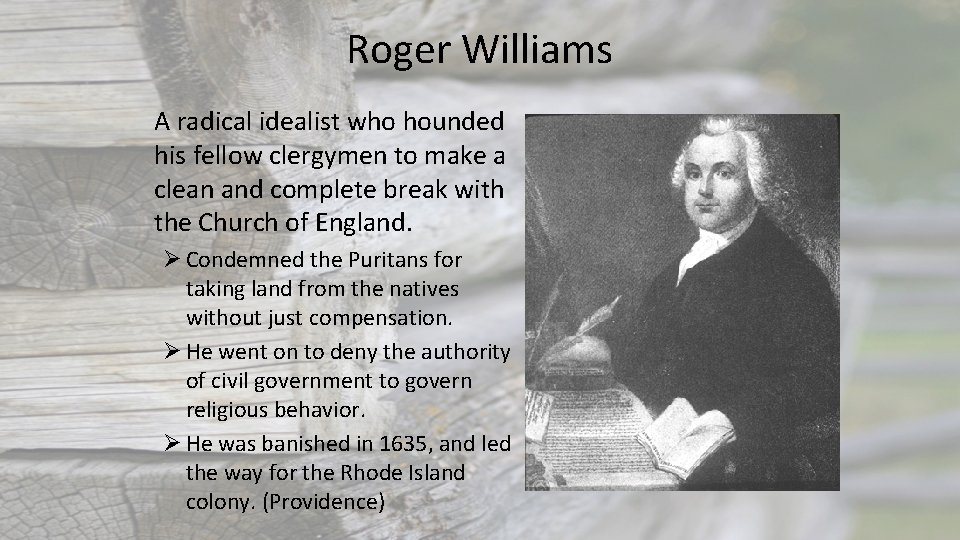
Roger Williams A radical idealist who hounded his fellow clergymen to make a clean and complete break with the Church of England. Ø Condemned the Puritans for taking land from the natives without just compensation. Ø He went on to deny the authority of civil government to govern religious behavior. Ø He was banished in 1635, and led the way for the Rhode Island colony. (Providence)
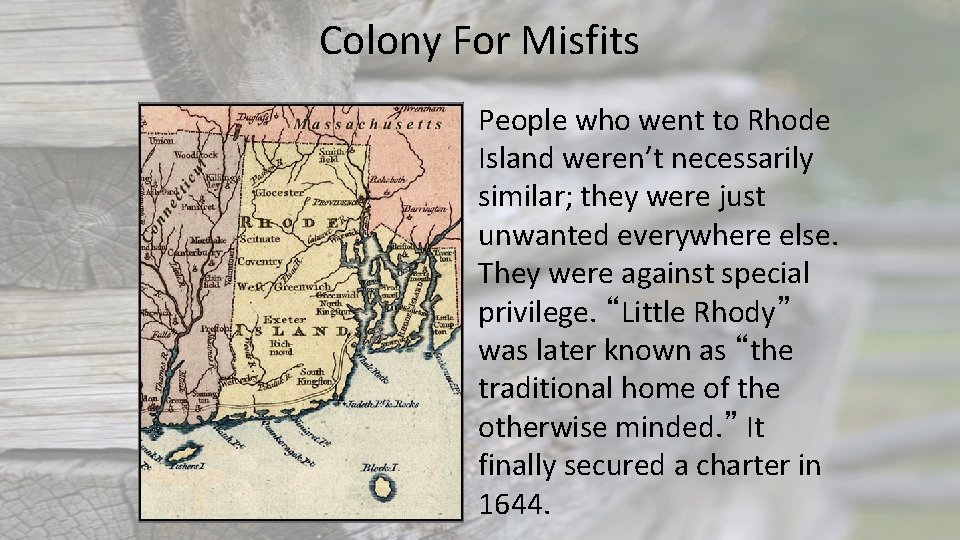
Colony For Misfits People who went to Rhode Island weren’t necessarily similar; they were just unwanted everywhere else. They were against special privilege. “Little Rhody” was later known as “the traditional home of the otherwise minded. ” It finally secured a charter in 1644.
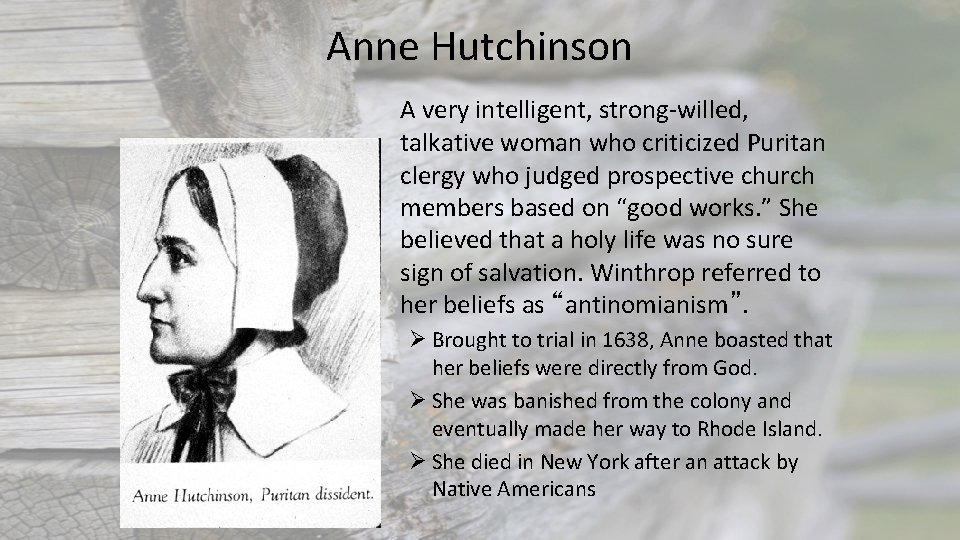
Anne Hutchinson A very intelligent, strong-willed, talkative woman who criticized Puritan clergy who judged prospective church members based on “good works. ” She believed that a holy life was no sure sign of salvation. Winthrop referred to her beliefs as “antinomianism”. Ø Brought to trial in 1638, Anne boasted that her beliefs were directly from God. Ø She was banished from the colony and eventually made her way to Rhode Island. Ø She died in New York after an attack by Native Americans
New England Towns Life in New England was organized. Ø New towns were legally chartered by colonial authorities and the distribution of land was entrusted to proprietors. Ø A town usually had a meetinghouse surrounded by houses and a village green, used for colonial militias. Ø Each family received several plots of land, for fuel, agriculture, and livestock Ø Unlike the county-system of the Chesapeake and England, the town meeting took on administrative roles locally. Ø Each town determined who could participate in voting and holding office, although most allowed all taxpaying males (including non-saints)
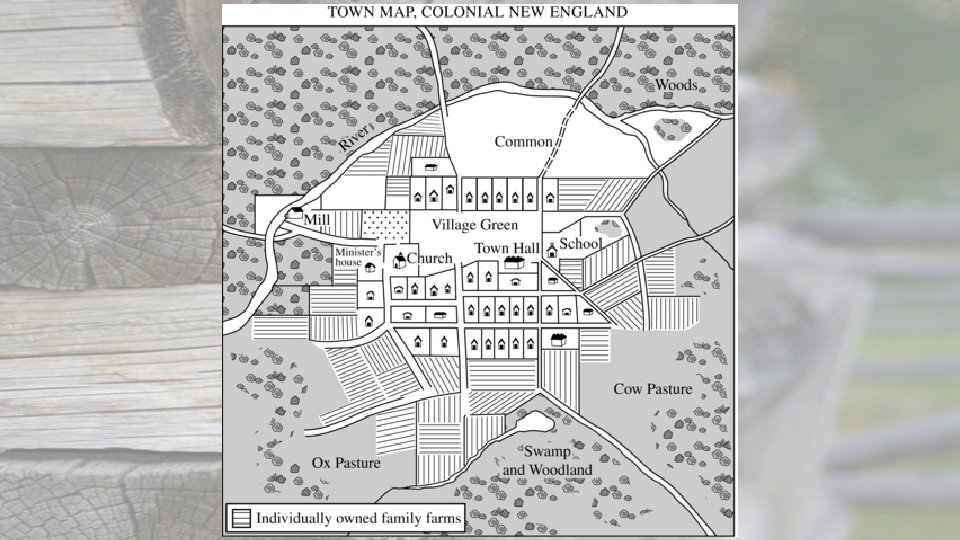
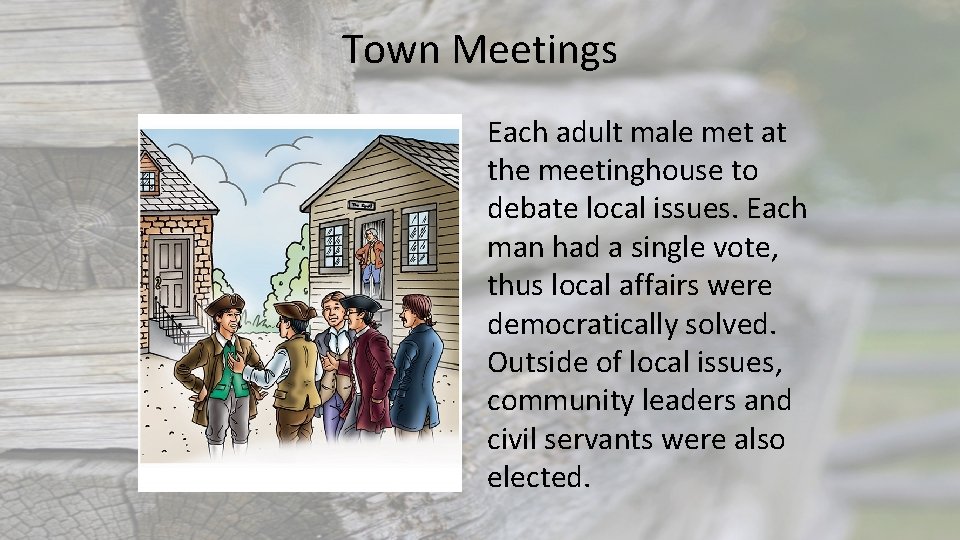
Town Meetings Each adult male met at the meetinghouse to debate local issues. Each man had a single vote, thus local affairs were democratically solved. Outside of local issues, community leaders and civil servants were also elected.
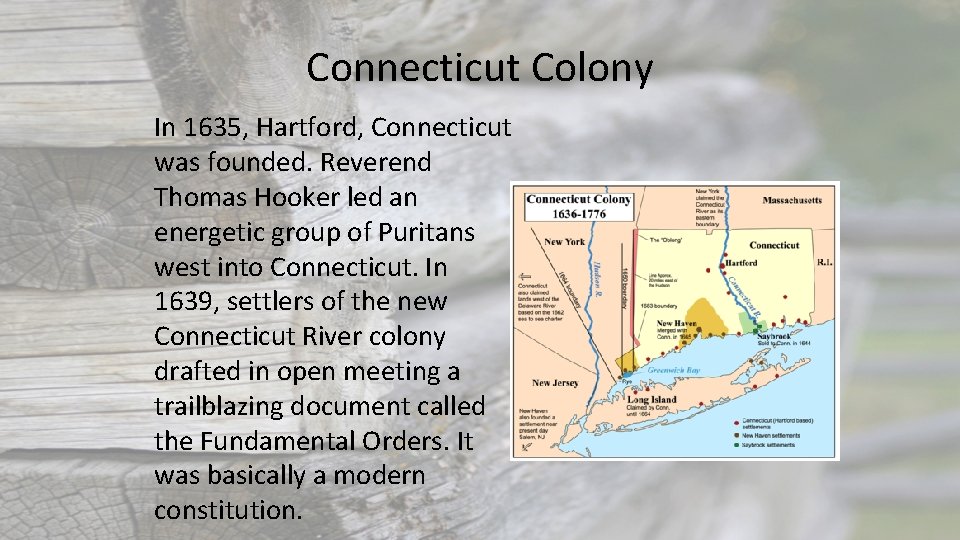
Connecticut Colony In 1635, Hartford, Connecticut was founded. Reverend Thomas Hooker led an energetic group of Puritans west into Connecticut. In 1639, settlers of the new Connecticut River colony drafted in open meeting a trailblazing document called the Fundamental Orders. It was basically a modern constitution.
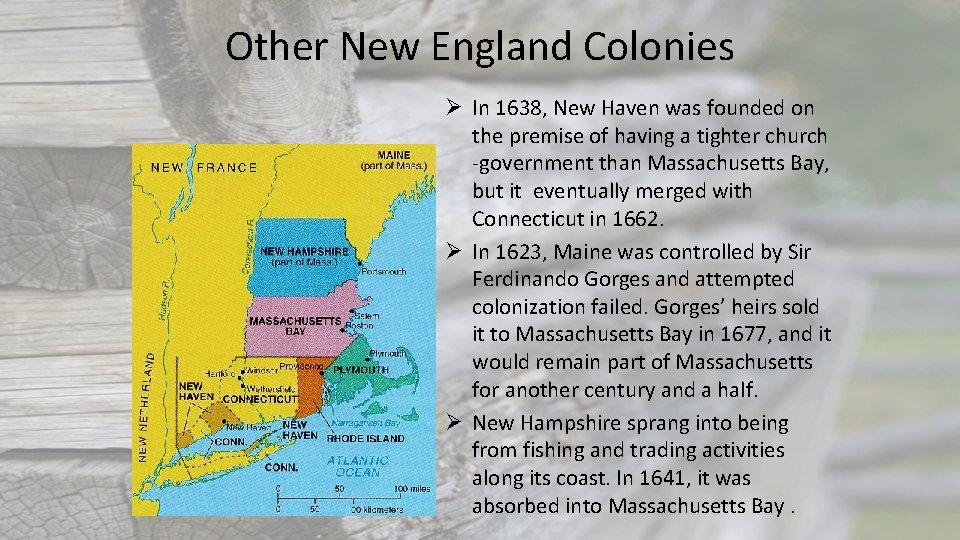
Other New England Colonies Ø In 1638, New Haven was founded on the premise of having a tighter church -government than Massachusetts Bay, but it eventually merged with Connecticut in 1662. Ø In 1623, Maine was controlled by Sir Ferdinando Gorges and attempted colonization failed. Gorges’ heirs sold it to Massachusetts Bay in 1677, and it would remain part of Massachusetts for another century and a half. Ø New Hampshire sprang into being from fishing and trading activities along its coast. In 1641, it was absorbed into Massachusetts Bay.
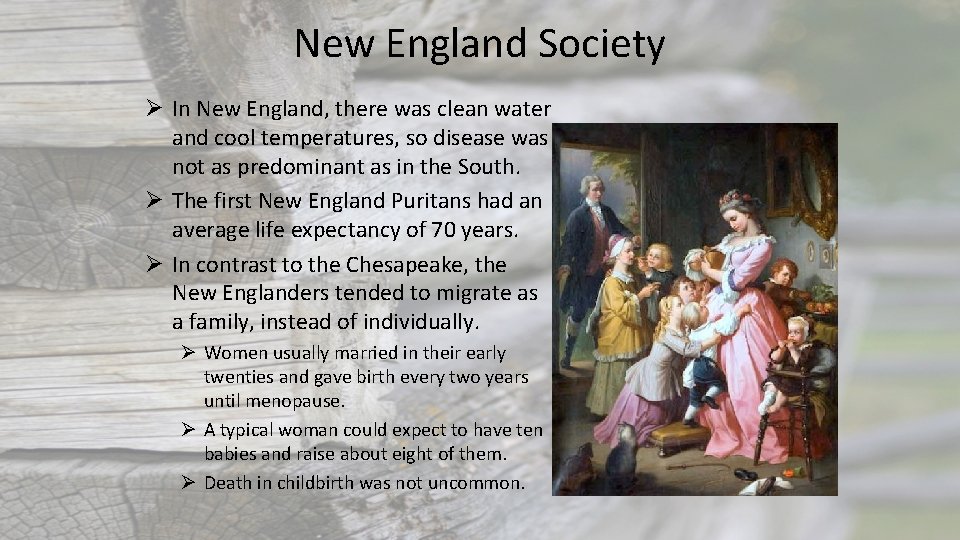
New England Society Ø In New England, there was clean water and cool temperatures, so disease was not as predominant as in the South. Ø The first New England Puritans had an average life expectancy of 70 years. Ø In contrast to the Chesapeake, the New Englanders tended to migrate as a family, instead of individually. Ø Women usually married in their early twenties and gave birth every two years until menopause. Ø A typical woman could expect to have ten babies and raise about eight of them. Ø Death in childbirth was not uncommon.
Other Differences: New England v. the Chesapeake Ø In the Chesapeake, women usually had more power, since the Southern men typically died young and women could inherit the estate and hold a private title of their own property, even after marriage. New England was the opposite, however, laws were made to protect widow’s property rights Ø In New England, men did not have absolute power over their wives (as evidenced by the punishments of unruly husbands), and some women had the ability to retain autonomy. Ø New England law was very severe and strict. Ø For example, adulterous women especially, were whipped in public and had to wear the letter “A” on their clothing if they were caught (as with The Scarlet Letter by Nathaniel Hawthorne). Ø There were laws to limit Earthly pleasures, such as a fine of twenty shillings for couples caught kissing in public (Blue Laws).
Economic Issues with Winthrop’s Vision Ø Due to the hard New England soil, New Englanders became great in trading, lumbering, fur trading, shipbuilding, and rum distilling. Fishing became a very popular industry. It is said New England was built on “God and cod. ” Ø Government officials tried to regulate prices, not wanting greed to overtake piety. Ø Division grew between merchants and western farmers Ø Farmers voted themselves larger tracts of land, that eventually dispersed the populations
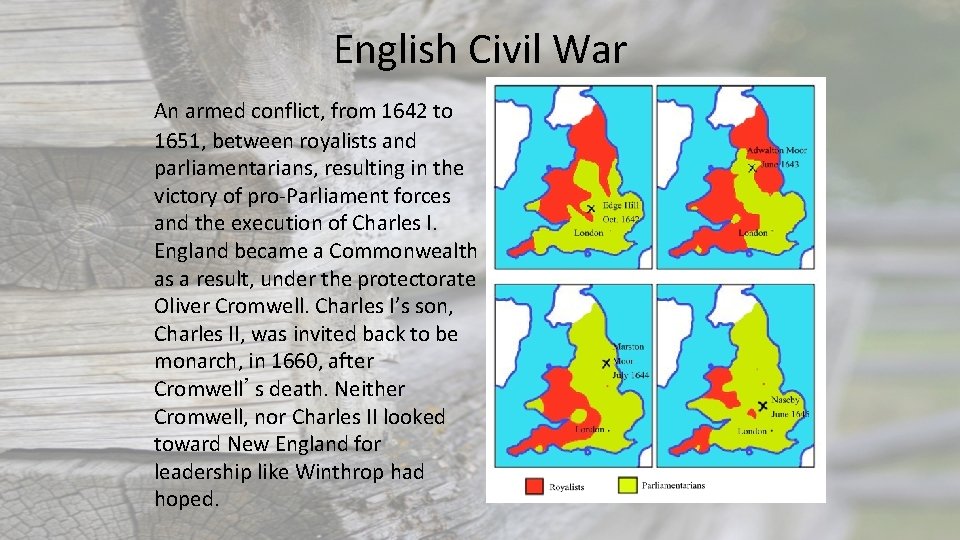
English Civil War An armed conflict, from 1642 to 1651, between royalists and parliamentarians, resulting in the victory of pro-Parliament forces and the execution of Charles I. England became a Commonwealth as a result, under the protectorate Oliver Cromwell. Charles I’s son, Charles II, was invited back to be monarch, in 1660, after Cromwell’s death. Neither Cromwell, nor Charles II looked toward New England for leadership like Winthrop had hoped.
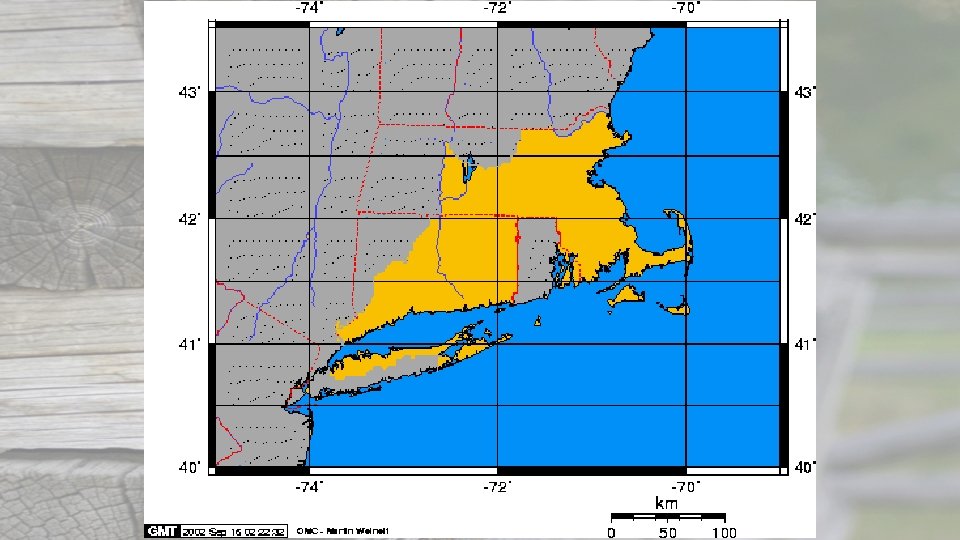
Colonial Unity In 1643, four colonies banded together to form the New England Confederation. It was almost all Puritan. It was weak, but still a notable milestone toward American unity. The colonies were basically allowed to be semiautonomous commonwealths. Its primary purpose was to unite the Puritan colonies in support of the church, and for defense against the Native Americans and the Dutch colonies. Its charter provided for the return of fugitive criminals and indentured servants, and served as a forum for resolving inter-colonial disputes.
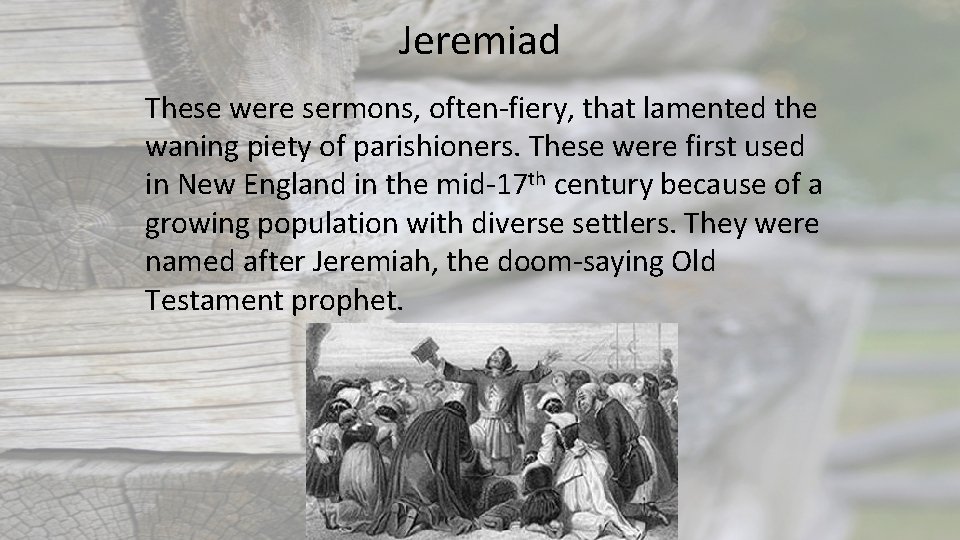
Jeremiad These were sermons, often-fiery, that lamented the waning piety of parishioners. These were first used in New England in the mid-17 th century because of a growing population with diverse settlers. They were named after Jeremiah, the doom-saying Old Testament prophet.
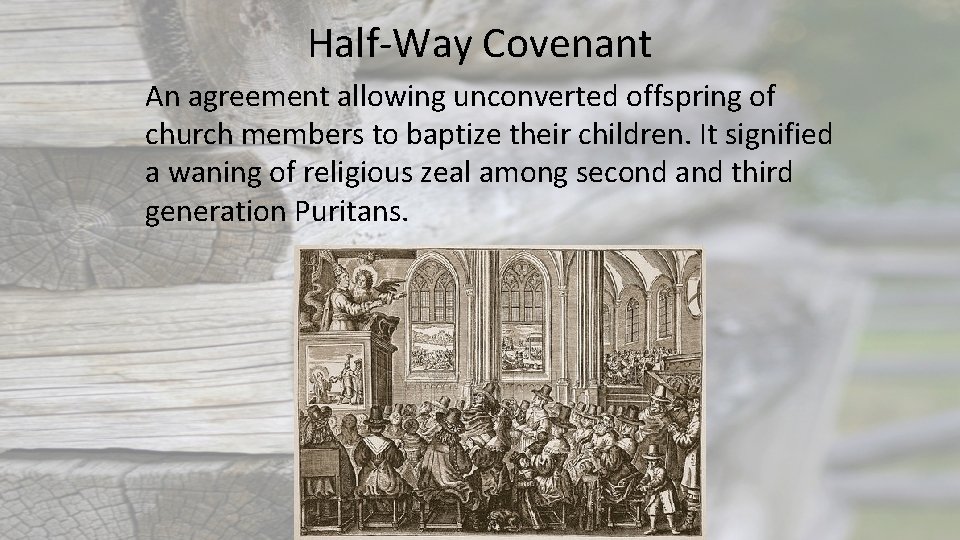
Half-Way Covenant An agreement allowing unconverted offspring of church members to baptize their children. It signified a waning of religious zeal among second and third generation Puritans.
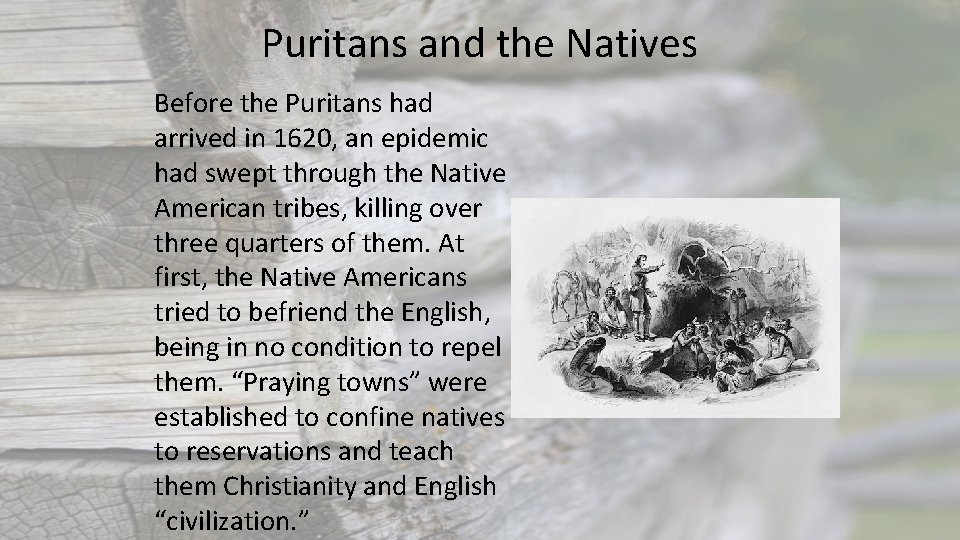
Puritans and the Natives Before the Puritans had arrived in 1620, an epidemic had swept through the Native American tribes, killing over three quarters of them. At first, the Native Americans tried to befriend the English, being in no condition to repel them. “Praying towns” were established to confine natives to reservations and teach them Christianity and English “civilization. ”
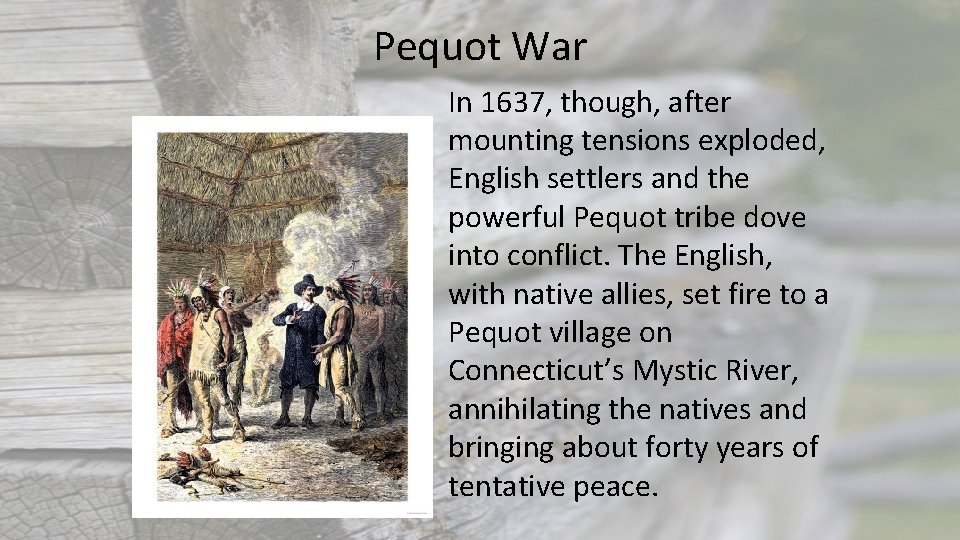
Pequot War In 1637, though, after mounting tensions exploded, English settlers and the powerful Pequot tribe dove into conflict. The English, with native allies, set fire to a Pequot village on Connecticut’s Mystic River, annihilating the natives and bringing about forty years of tentative peace.
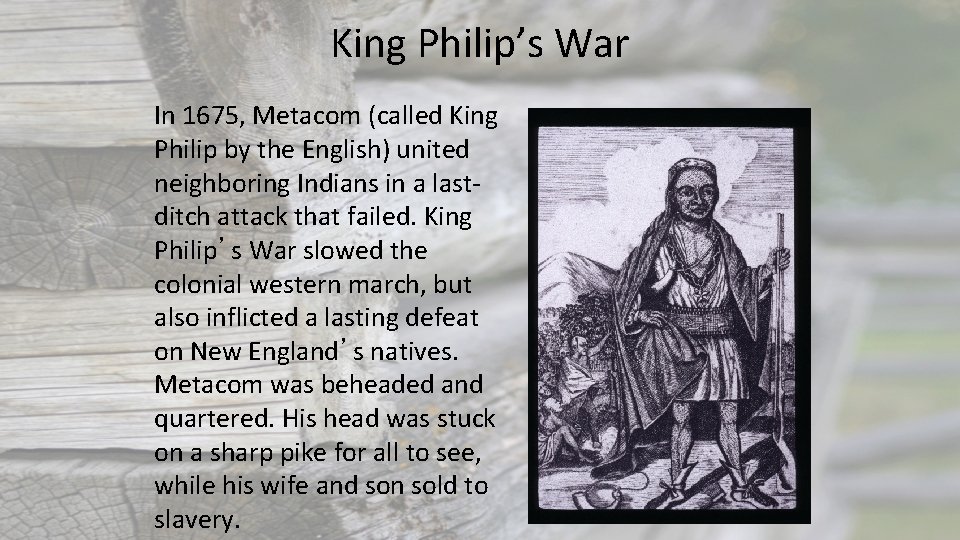
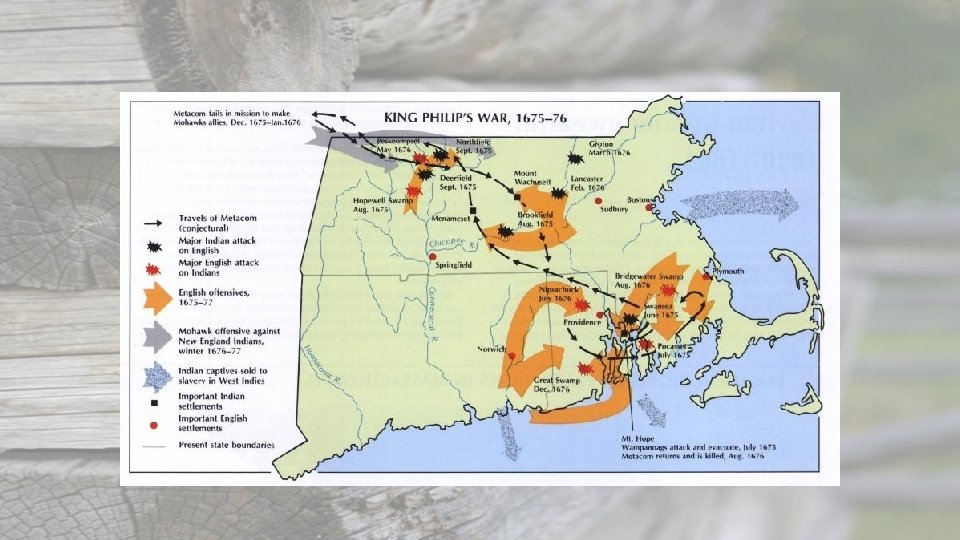
King Philip’s War In 1675, Metacom (called King Philip by the English) united neighboring Indians in a lastditch attack that failed. King Philip’s War slowed the colonial western march, but also inflicted a lasting defeat on New England’s natives. Metacom was beheaded and quartered. His head was stuck on a sharp pike for all to see, while his wife and son sold to slavery.
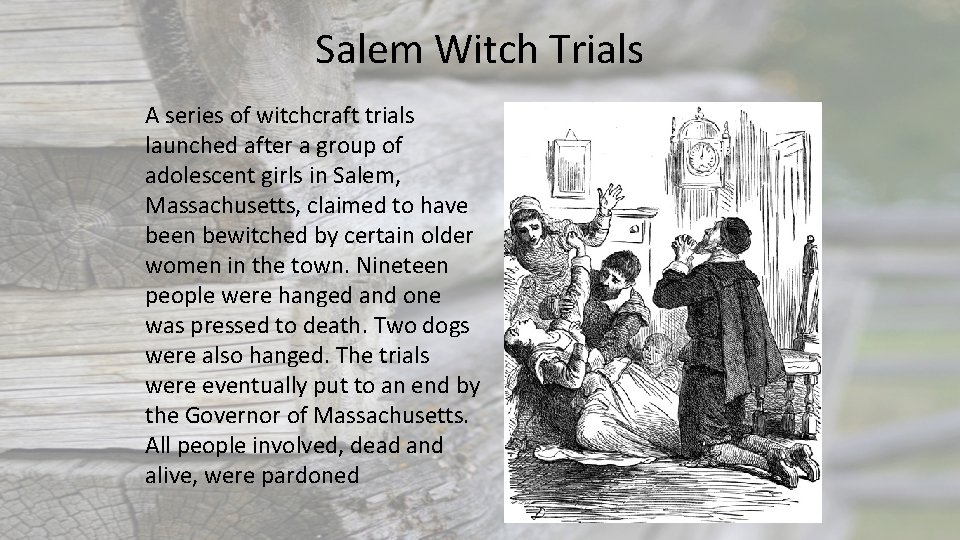
Salem Witch Trials A series of witchcraft trials launched after a group of adolescent girls in Salem, Massachusetts, claimed to have been bewitched by certain older women in the town. Nineteen people were hanged and one was pressed to death. Two dogs were also hanged. The trials were eventually put to an end by the Governor of Massachusetts. All people involved, dead and alive, were pardoned
Causes and Effects of the Salem Witch Trials Ø The hysteria grew from a combination of superstitions and prejudices, turmoil from the wars with Native Americans, and rising social and religious conflicts within Puritan villages Ø The trials reflected the growing social change in New England between religious traditionalism and New World commercialism Ø “Witch-hunting” will be passed into American vocabulary as a dangerous and irrational urge to find a scapegoat for social resentments
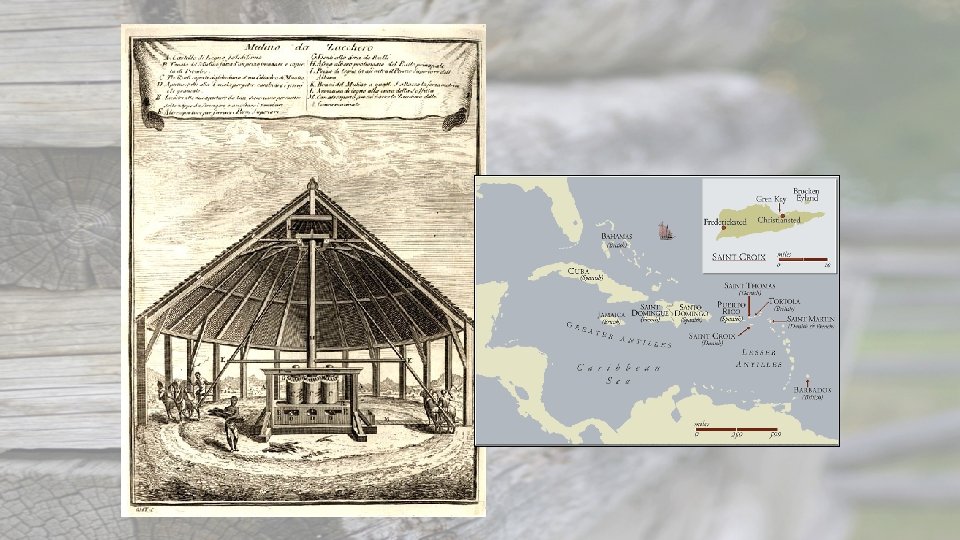
England in the West Indies Ø As the British were colonizing Virginia, they were also settling into the West Indies (Spain’s declining power opened the door). Ø By mid-1600 s, England had secured claim to several West Indies islands, including Jamaica in 1655. Ø Sugar became the primary crop grown on plantations. Ø Thousands of African slaves were needed to operate sugar plantations. At first, Native Americans were intended to be used, but disease killed most of the populations. Indentured servants were an option, but their terms of service would eventually end. Africans were then brought in because of their immunity to European diseases, compatibility to work in tropical climates, and they were slaves for life. Ø To control so many slaves, the “Barbados Slave Codes” were set up that defined the legal status of slaves and the rights of the masters. They were typically strict and exacted severe punishments on offenders.
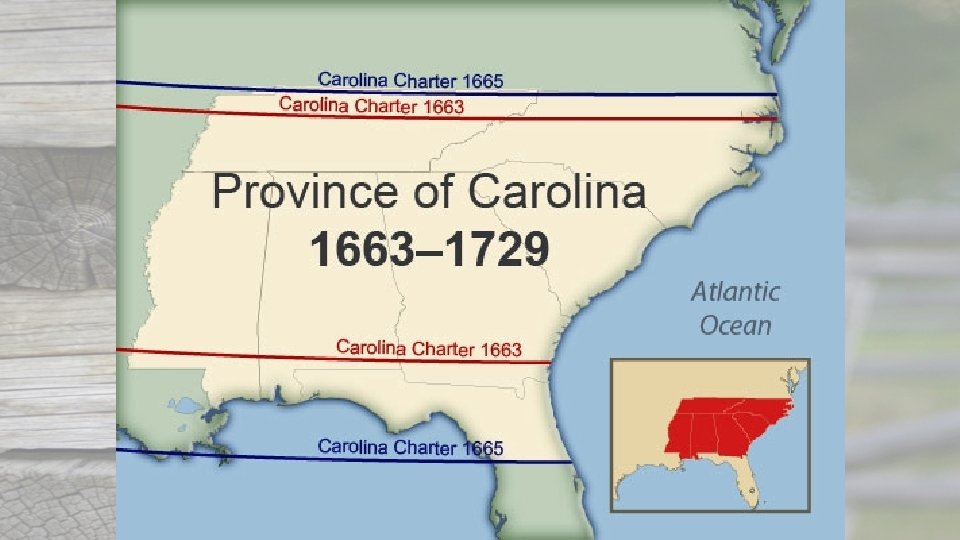
Founding Carolina Ø First of the Restoration colonies, it was named after Charles II. Ø Proprietors created the “Fundamental Constitutions” setting up a bicameral legislature. Upper house and judiciary controlled by nobility and the lower class could elect to the assembly. Ø Instituted the headright system to induce colonization Ø Early settlers to southern Carolina came from Barbados, while many in the north trickled in from Virginia. (Southern –Livestock and slave hunting, Northern-tobacco farming, lumber, “tarheels”) Ø Rice eventually emerged as the principle crop in southern Carolina (Charles Town). African slaves were imported to work on rice plantations, due to their resistance to malaria and their familiarity with rice.
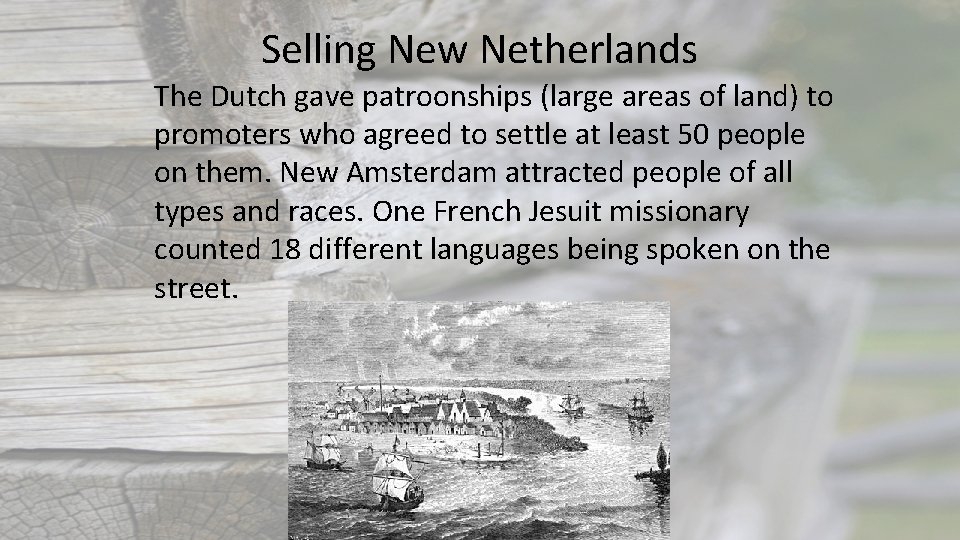
Selling New Netherlands The Dutch gave patroonships (large areas of land) to promoters who agreed to settle at least 50 people on them. New Amsterdam attracted people of all types and races. One French Jesuit missionary counted 18 different languages being spoken on the street.
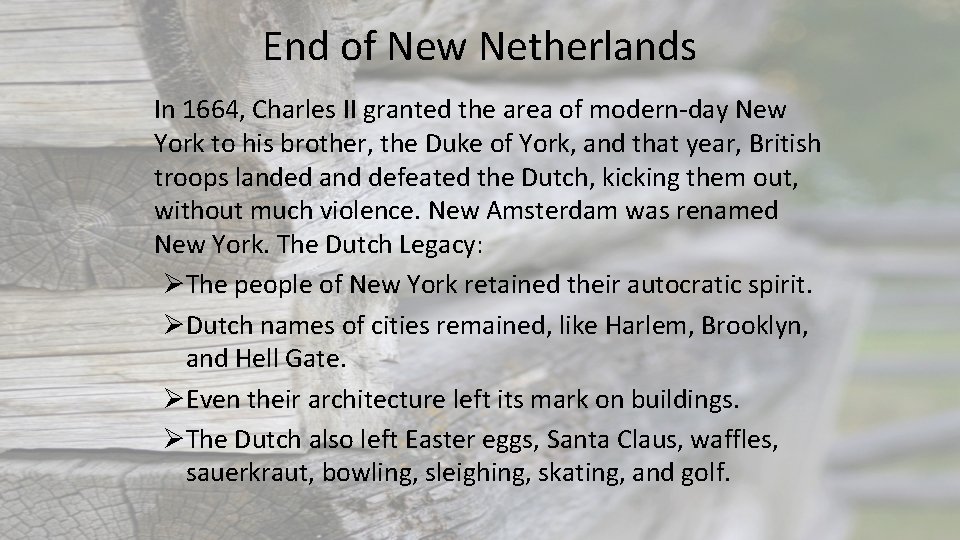
Dutch Relations with Neighbors Ø Instigated the “beaver wars” when privatization of the fur trade was permitted Ø Local Indians attacked the Dutch because of “Kieft’s War. ” The Dutch erected a wall in New Amsterdam, which Wall Street is named today, for protection. Ø New England was hostile against Dutch growth, ejecting Hollanders from Connecticut. Ø The Swedes trespassed Dutch reserves from 1638 to 1655 by planting the anemic colony of New Sweden on the Delaware River. In 1655, the Dutch sent onelegged Peter Stuyvesant to besiege the main Swedish fort, and he won, ending Swedish colonial rule.
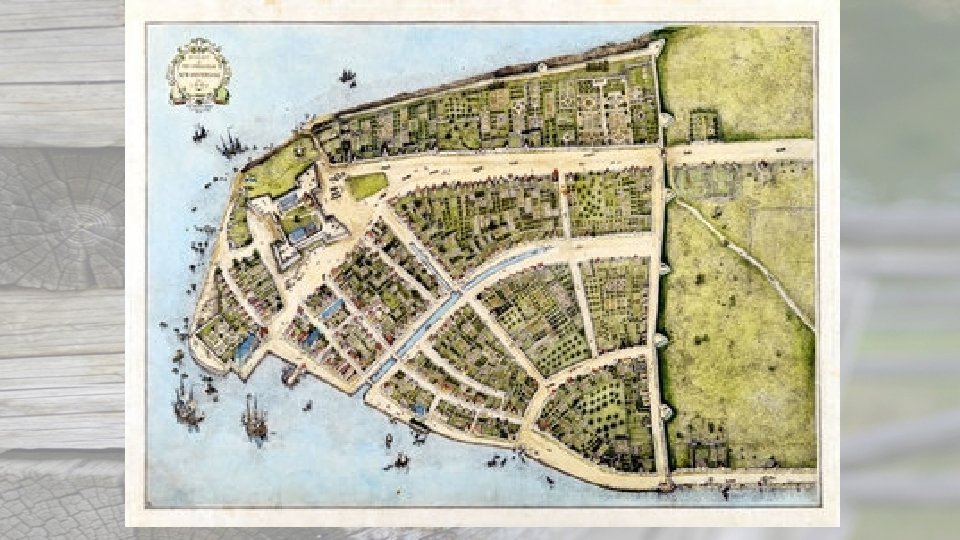
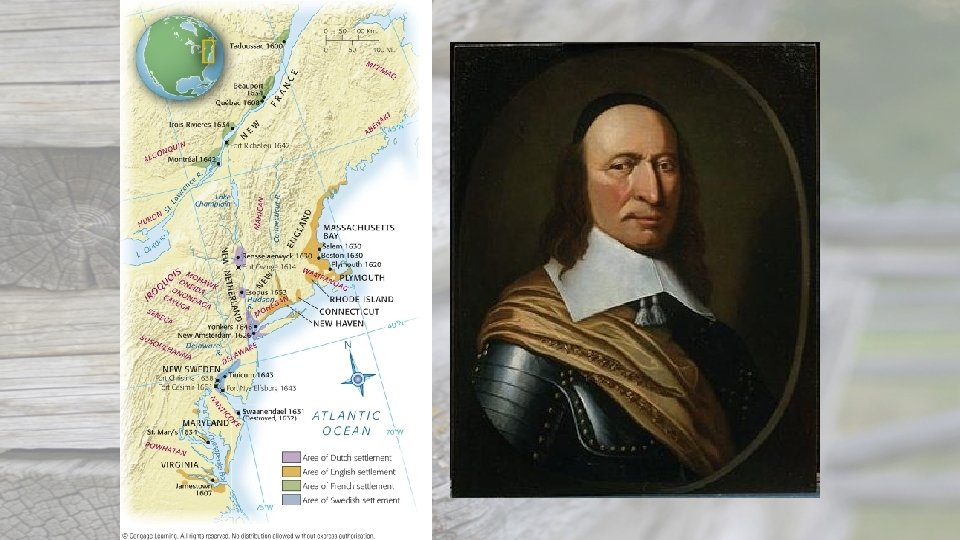
End of New Netherlands In 1664, Charles II granted the area of modern-day New York to his brother, the Duke of York, and that year, British troops landed and defeated the Dutch, kicking them out, without much violence. New Amsterdam was renamed New York. The Dutch Legacy: ØThe people of New York retained their autocratic spirit. ØDutch names of cities remained, like Harlem, Brooklyn, and Hell Gate. ØEven their architecture left its mark on buildings. ØThe Dutch also left Easter eggs, Santa Claus, waffles, sauerkraut, bowling, sleighing, skating, and golf.
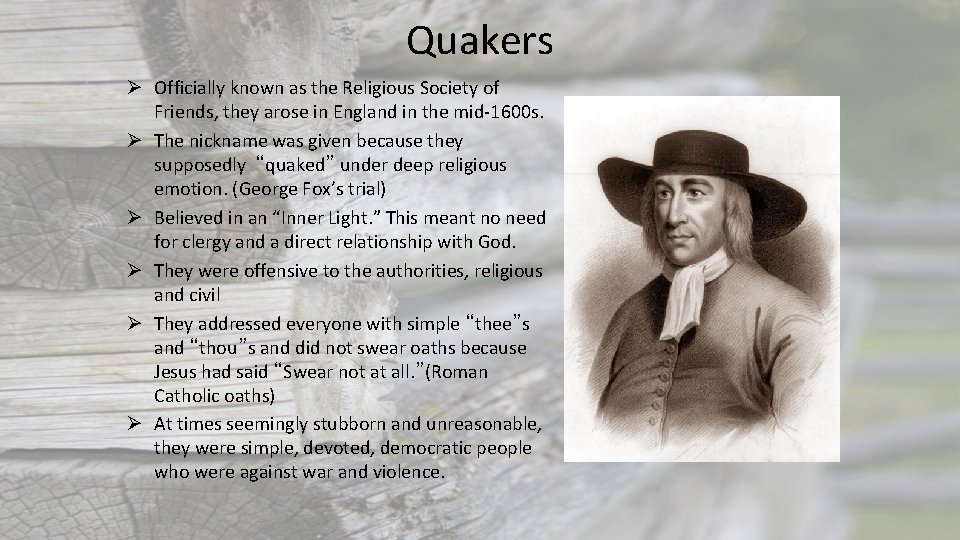
Quakers Ø Officially known as the Religious Society of Friends, they arose in England in the mid-1600 s. Ø The nickname was given because they supposedly “quaked” under deep religious emotion. (George Fox’s trial) Ø Believed in an “Inner Light. ” This meant no need for clergy and a direct relationship with God. Ø They were offensive to the authorities, religious and civil Ø They addressed everyone with simple “thee”s and “thou”s and did not swear oaths because Jesus had said “Swear not at all. ”(Roman Catholic oaths) Ø At times seemingly stubborn and unreasonable, they were simple, devoted, democratic people who were against war and violence.
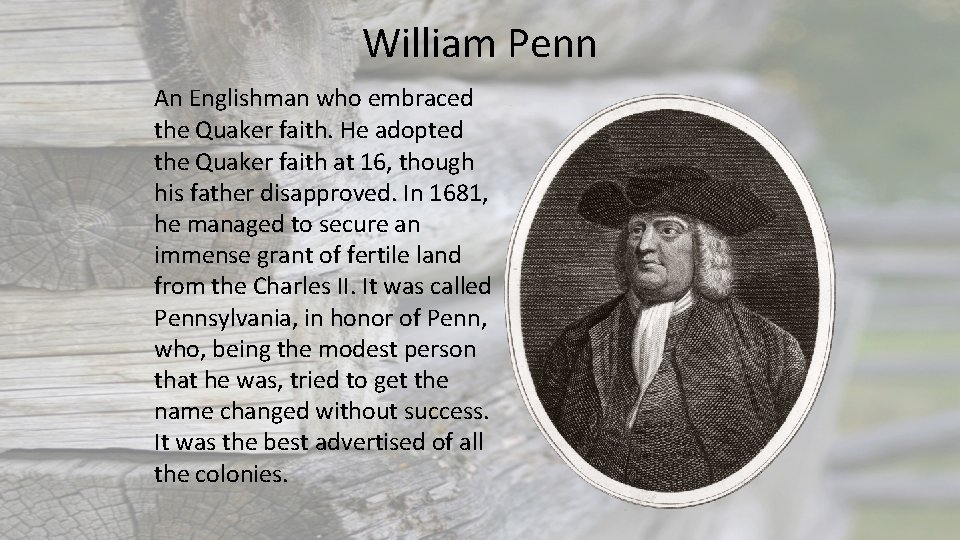
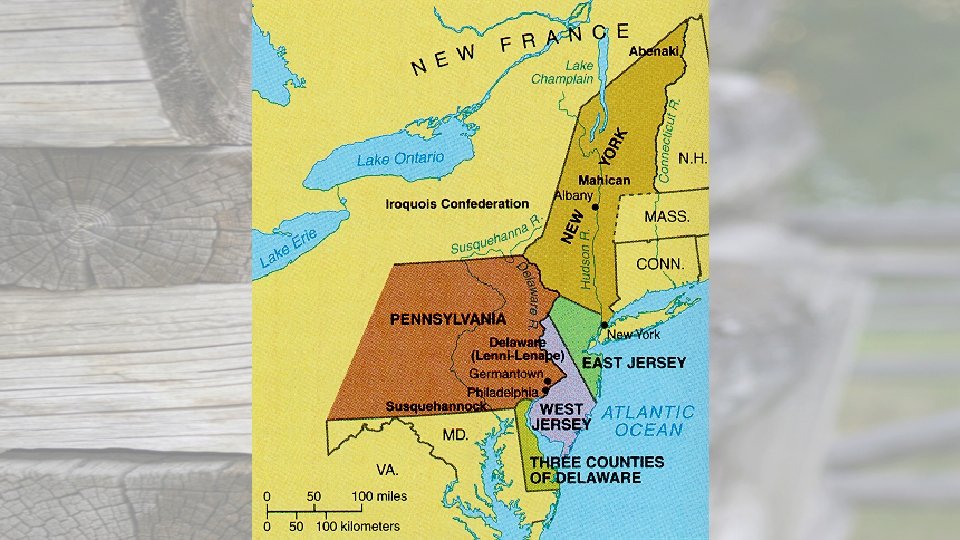
William Penn An Englishman who embraced the Quaker faith. He adopted the Quaker faith at 16, though his father disapproved. In 1681, he managed to secure an immense grant of fertile land from the Charles II. It was called Pennsylvania, in honor of Penn, who, being the modest person that he was, tried to get the name changed without success. It was the best advertised of all the colonies.
Pennsylvania: The Holy Experiment Ø Philadelphia was more carefully planned than most cities, with beautiful, wide streets. Ø Penn bought land from the Indians. His treatment of the Indians was so gentle that Quakers could walk through Indian territory unarmed without fear of being hurt. Ø Freedom of worship was available to everyone, but, because of pressure from London, Jews and Catholics were denied voting and holding office privileges Ø The death penalty was only for murder and treason. Ø No restrictions were placed on immigration, and naturalization was made easy. Pennsylvania attracted a great variety of people from all races, classes, and religions. Ø The Quakers also developed a dislike toward slavery. Ø Blue Laws, designed to restrict personal behavior in accord with a strict code of morality, were passed. Ø Created a strong executive branch for the colony. Eventually made a unicameral legislature
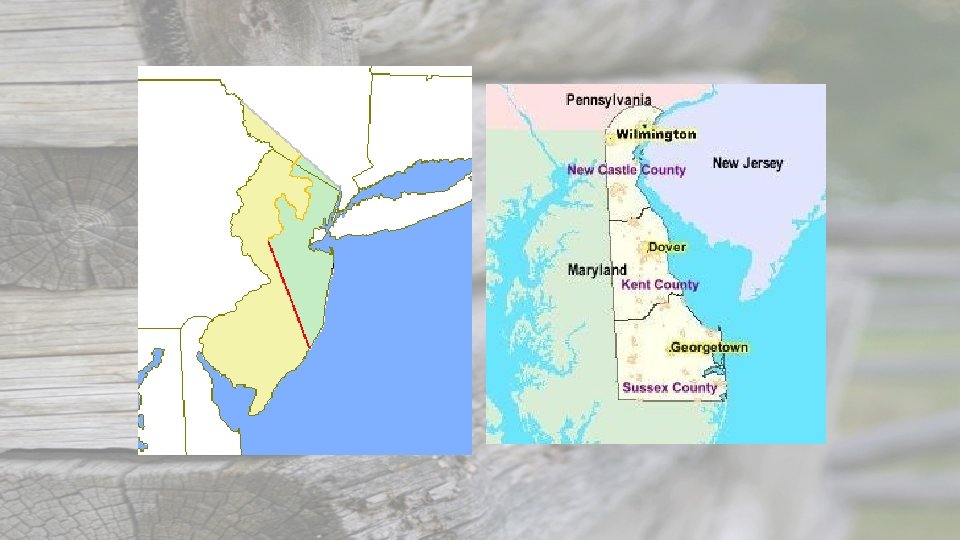
New Jersey and Delaware Ø New Jersey was given to a group of proprietors who were friends with Duke of York; the main two being Lord John Berkeley and Sir George Carteret. They eventually sold to the Quakers, it was divided into two sections (West/East). The diversity of the colony created turmoil for the governments, and the sections were made into a royal colony in 1702. Ø Delaware was made up of only three counties and the good land was settled by mainly Swedes and Dutch. It received its own assembly in 1704, but remained under the governor of Pennsylvania until the American Revolution.
Commonalities of the Middle Colonies Ø All had fertile soil and broad expanse of land. Ø All, except for Delaware, exported lots of grain (known as the bread colonies). Ø The Susquehanna, Delaware, and Hudson Rivers tapped the fur trade of the interior, and the rivers were gentle, with little cascading waterfalls, sparking milling and manufacturing with water-wheels. Ø The middle colonies were the middle way between New England the southern plantation states. Ø Landholdings were generally intermediate in size. Ø Colonial governments were also a mixtures of New England South Ø With deep water harbors, industry sprung up in port towns, like Philadelphia, New York, and Albany, though not to the extent as in New England Ø The middle colonies were more ethnically mixed than other colonies. Ø A considerable amount of economic and social democracy prevailed.
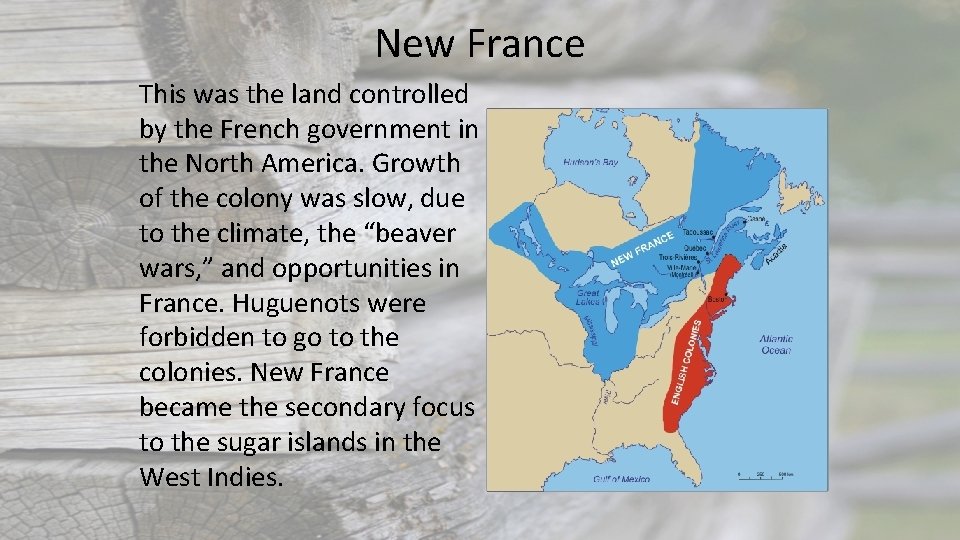
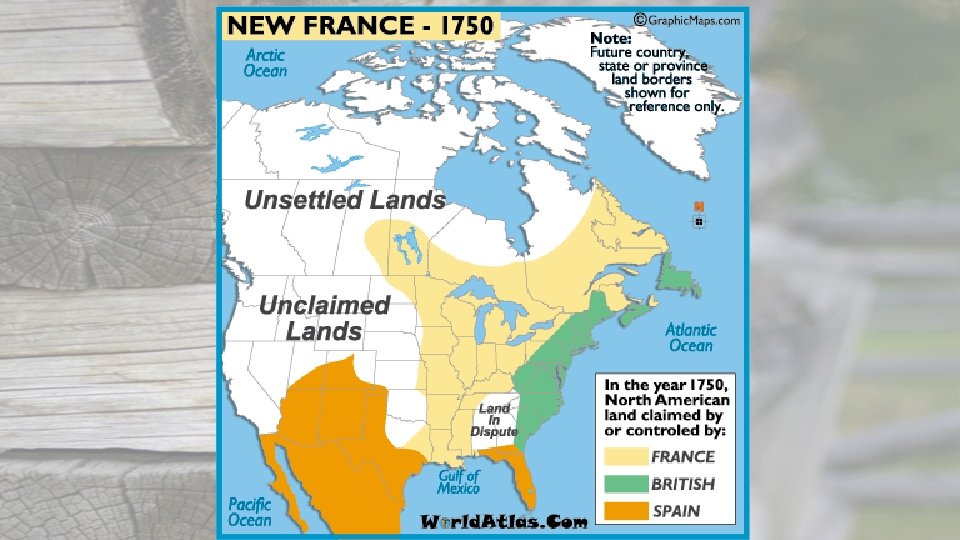
New France This was the land controlled by the French government in the North America. Growth of the colony was slow, due to the climate, the “beaver wars, ” and opportunities in France. Huguenots were forbidden to go to the colonies. New France became the secondary focus to the sugar islands in the West Indies.
New France Spreads Out Ø New France did find a valuable product in beaver skins. Coureurs de bois became more bold and traveled south and west to search for more hunting grounds. Ø Jesuits traveled to New France to convert Native Americans. Though few natives were converted, they did play a vital role as explorers and geographers of New France. Ø Robert de La Salle was a French explorer who floated down the Mississippi River and claimed the river and its point of entering the Gulf of Mexico for France. He named it Louisiana after Louis XIV. New Orleans eventually became the port city protecting the Mississippi.
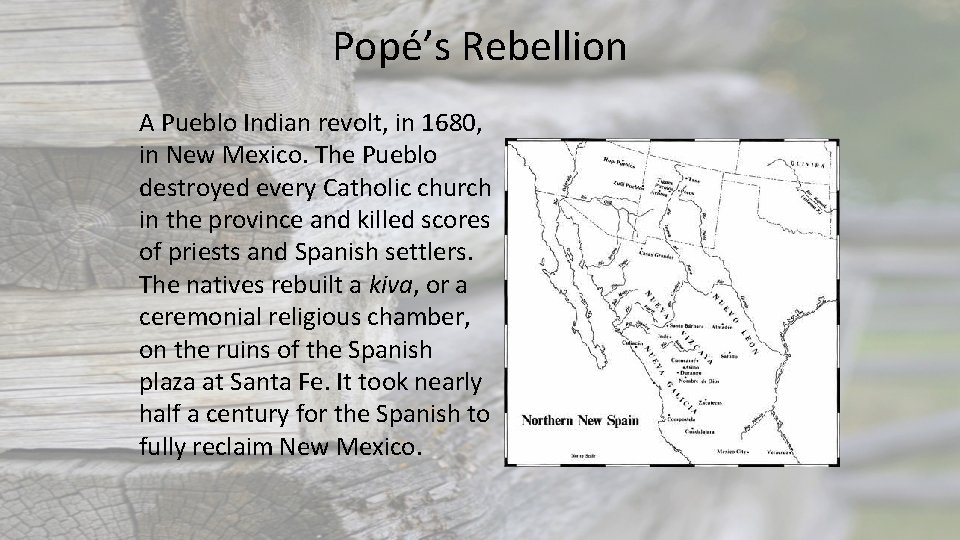
Popé’s Rebellion A Pueblo Indian revolt, in 1680, in New Mexico. The Pueblo destroyed every Catholic church in the province and killed scores of priests and Spanish settlers. The natives rebuilt a kiva, or a ceremonial religious chamber, on the ruins of the Spanish plaza at Santa Fe. It took nearly half a century for the Spanish to fully reclaim New Mexico.
Other Weaknesses of Spain’s Northern Colonies Ø Florida’s population by 1700 only numbered in the hundreds, mainly soldiers and missionaries. Ø Periodic rebellions took place by various Floridian tribes protesting forced labor and Catholic conversions Ø Florida was under constant raid by English-friendly Native Americans looking for slaves to sell in Carolina Ø The province of Texas was proclaimed in 1691 to counter French encroachment with Louisiana. No permanent settlements were established in the province until 1716.

- Slides: 69