
Homework scrivo alcune frasi usando le regole viste
- Slides: 13
Homework scrivo alcune frasi usando le regole viste in aula (avverbi di frequenza, aggettivi, esprimere gusti, vocaboli cibo…) o un breve dialogo ripassare i vocaboli visti finora
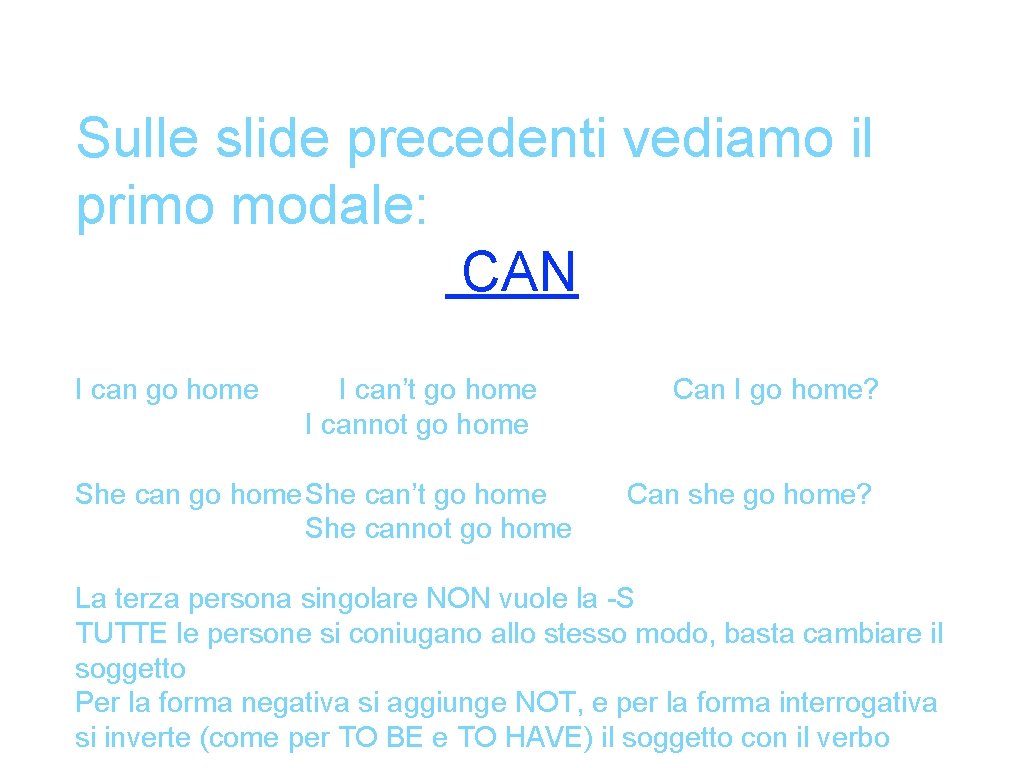
Sulle slide precedenti vediamo il primo modale: CAN I can go home I can’t go home I cannot go home She can go home. She can’t go home She cannot go home Can I go home? Can she go home? La terza persona singolare NON vuole la -S TUTTE le persone si coniugano allo stesso modo, basta cambiare il soggetto Per la forma negativa si aggiunge NOT, e per la forma interrogativa si inverte (come per TO BE e TO HAVE) il soggetto con il verbo
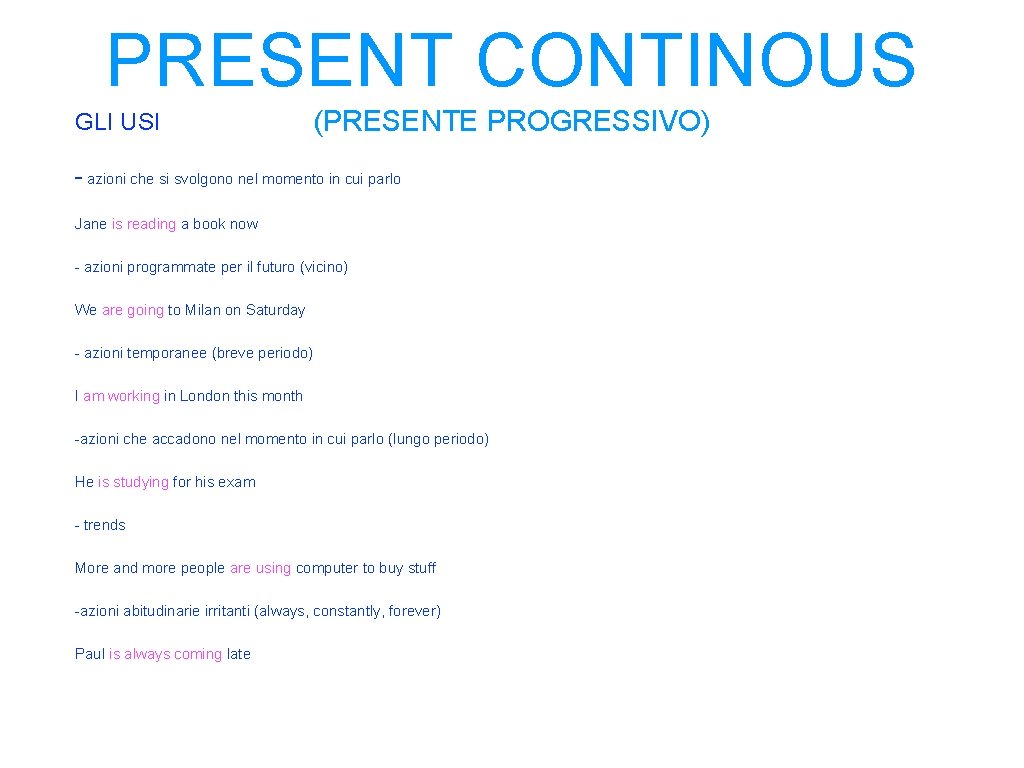
PRESENT CONTINOUS GLI USI (PRESENTE PROGRESSIVO) - azioni che si svolgono nel momento in cui parlo Jane is reading a book now - azioni programmate per il futuro (vicino) We are going to Milan on Saturday - azioni temporanee (breve periodo) I am working in London this month -azioni che accadono nel momento in cui parlo (lungo periodo) He is studying for his exam - trends More and more people are using computer to buy stuff -azioni abitudinarie irritanti (always, constantly, forever) Paul is always coming late
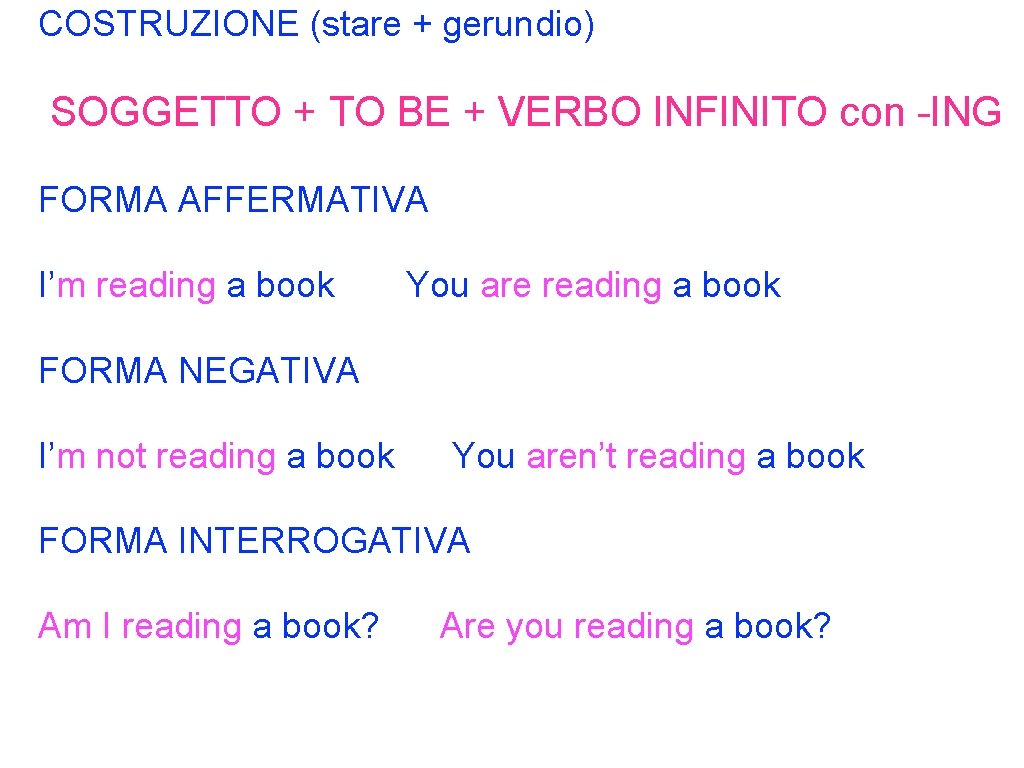
COSTRUZIONE (stare + gerundio) SOGGETTO + TO BE + VERBO INFINITO con -ING FORMA AFFERMATIVA I’m reading a book You are reading a book FORMA NEGATIVA I’m not reading a book You aren’t reading a book FORMA INTERROGATIVA Am I reading a book? Are you reading a book?
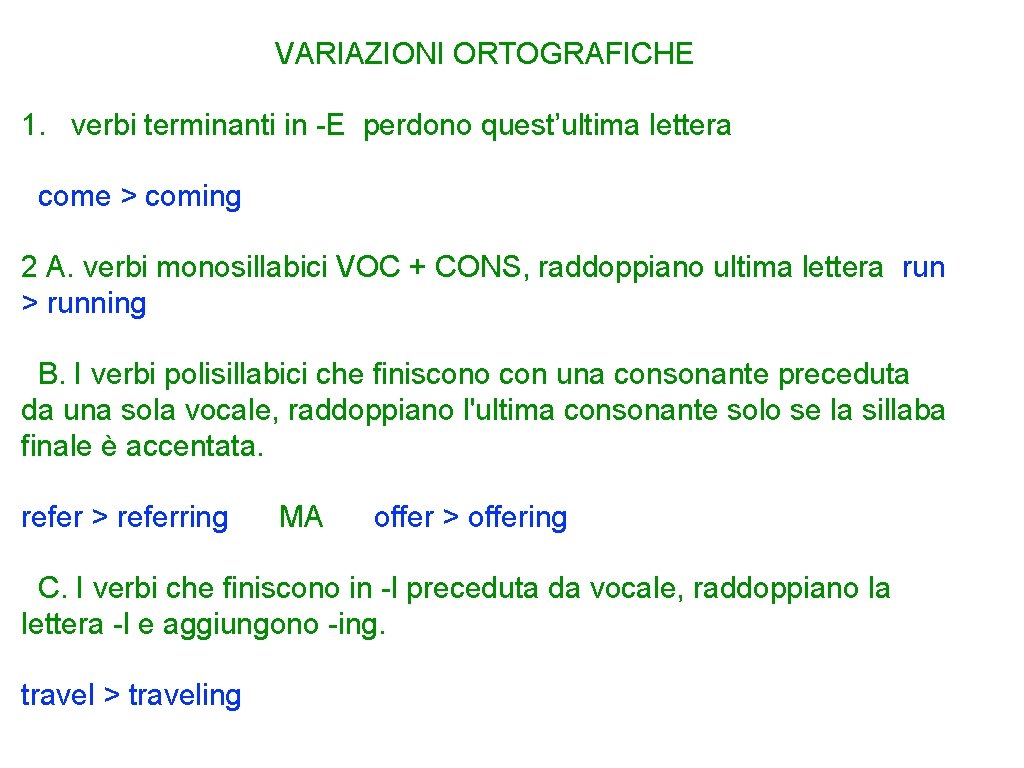
VARIAZIONI ORTOGRAFICHE 1. verbi terminanti in -E perdono quest’ultima lettera come > coming 2 A. verbi monosillabici VOC + CONS, raddoppiano ultima lettera run > running B. I verbi polisillabici che finiscono con una consonante preceduta da una sola vocale, raddoppiano l'ultima consonante solo se la sillaba finale è accentata. refer > referring MA offer > offering C. I verbi che finiscono in -l preceduta da vocale, raddoppiano la lettera -l e aggiungono -ing. travel > traveling
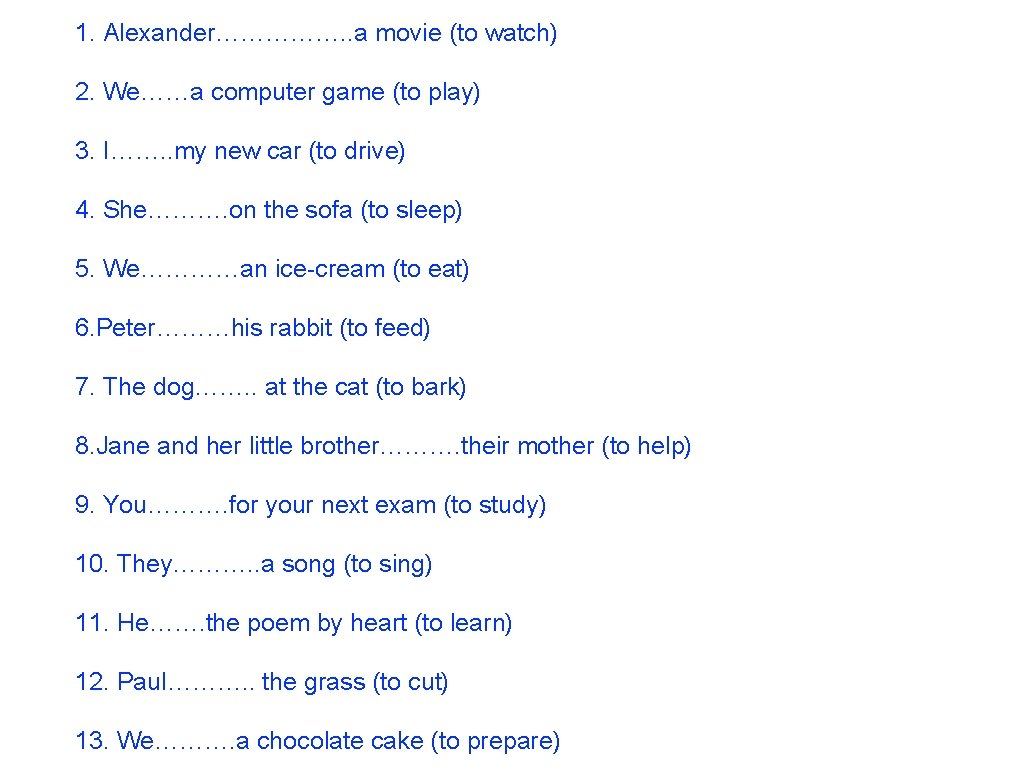
1. Alexander……………. . a movie (to watch) 2. We……a computer game (to play) 3. I……. . my new car (to drive) 4. She………. on the sofa (to sleep) 5. We…………an ice-cream (to eat) 6. Peter………his rabbit (to feed) 7. The dog……. . at the cat (to bark) 8. Jane and her little brother………. their mother (to help) 9. You………. for your next exam (to study) 10. They………. . a song (to sing) 11. He……. the poem by heart (to learn) 12. Paul………. . the grass (to cut) 13. We………. a chocolate cake (to prepare)
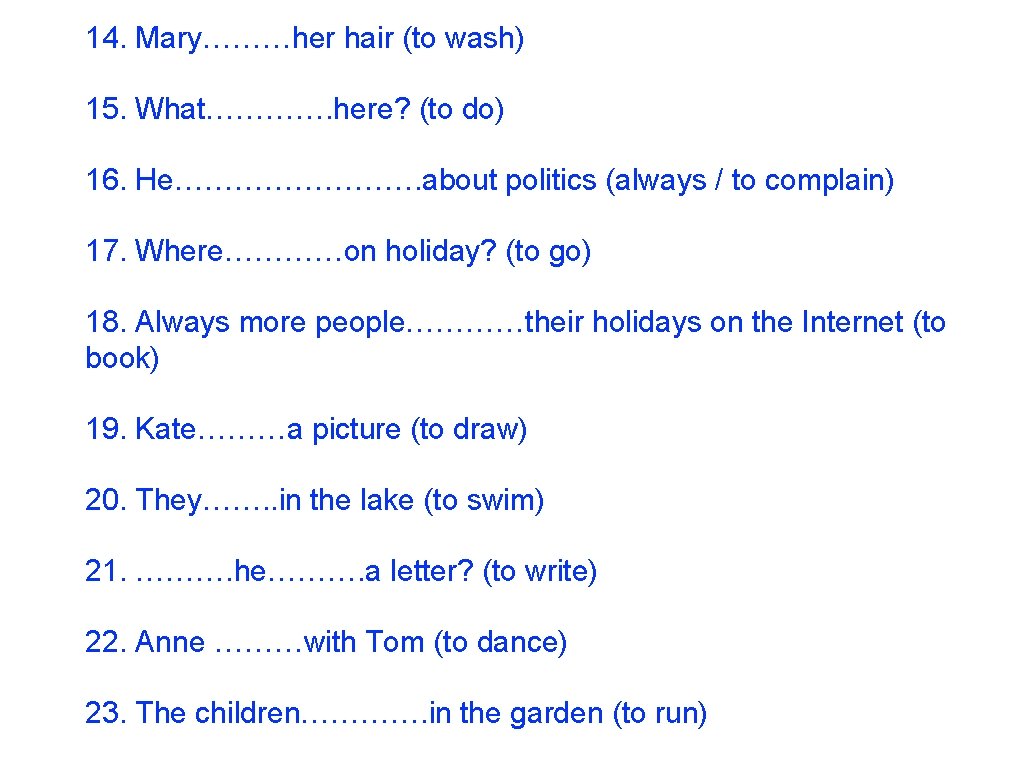
14. Mary………her hair (to wash) 15. What…………. here? (to do) 16. He…………. about politics (always / to complain) 17. Where…………on holiday? (to go) 18. Always more people…………their holidays on the Internet (to book) 19. Kate………a picture (to draw) 20. They……. . in the lake (to swim) 21. ………. he………. a letter? (to write) 22. Anne ………with Tom (to dance) 23. The children…………. in the garden (to run)
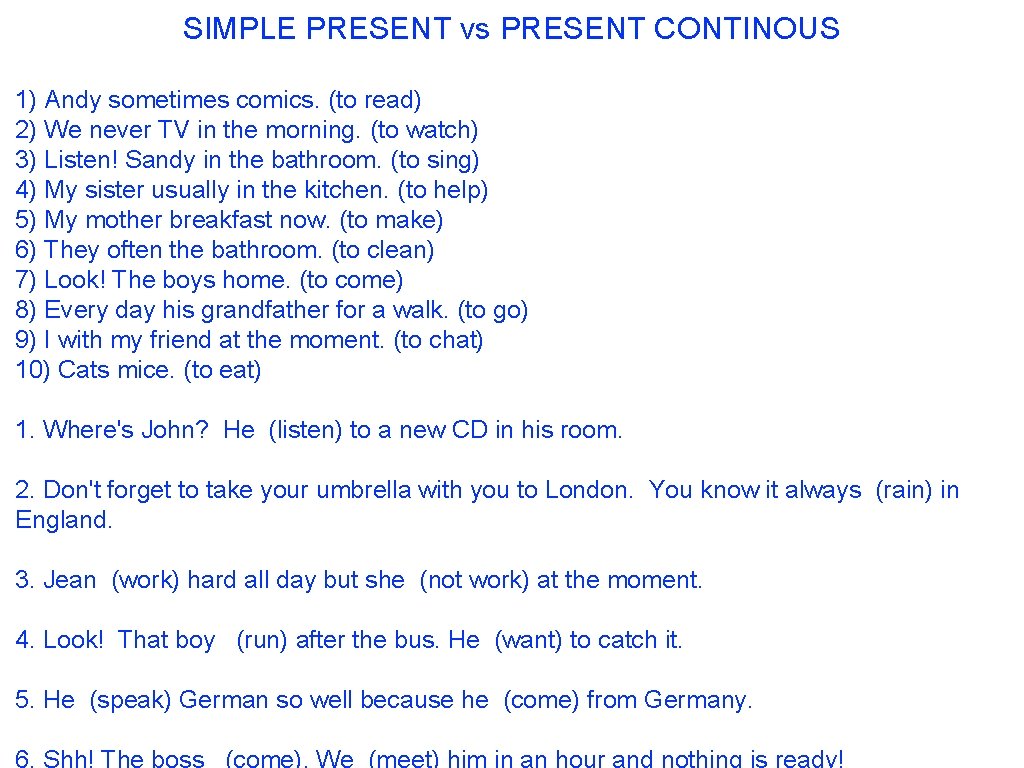
SIMPLE PRESENT vs PRESENT CONTINOUS 1) Andy sometimes comics. (to read) 2) We never TV in the morning. (to watch) 3) Listen! Sandy in the bathroom. (to sing) 4) My sister usually in the kitchen. (to help) 5) My mother breakfast now. (to make) 6) They often the bathroom. (to clean) 7) Look! The boys home. (to come) 8) Every day his grandfather for a walk. (to go) 9) I with my friend at the moment. (to chat) 10) Cats mice. (to eat) 1. Where's John? He (listen) to a new CD in his room. 2. Don't forget to take your umbrella with you to London. You know it always (rain) in England. 3. Jean (work) hard all day but she (not work) at the moment. 4. Look! That boy (run) after the bus. He (want) to catch it. 5. He (speak) German so well because he (come) from Germany. 6. Shh! The boss (come). We (meet) him in an hour and nothing is ready!
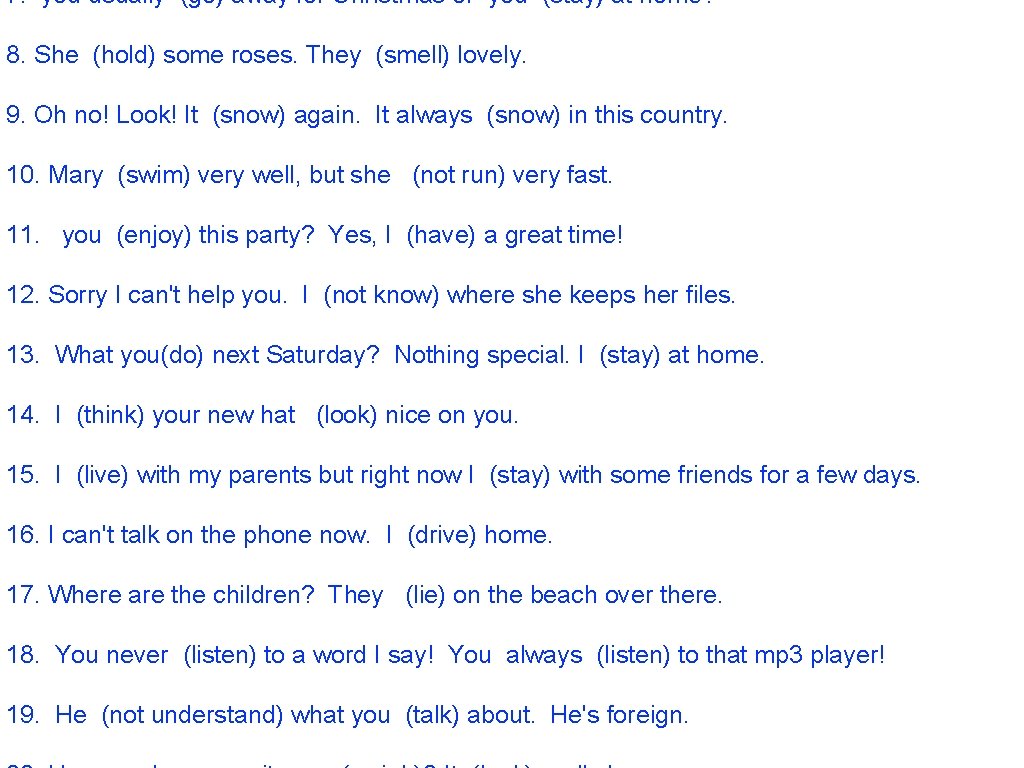
7. you usually (go) away for Christmas or you (stay) at home? 8. She (hold) some roses. They (smell) lovely. 9. Oh no! Look! It (snow) again. It always (snow) in this country. 10. Mary (swim) very well, but she (not run) very fast. 11. you (enjoy) this party? Yes, I (have) a great time! 12. Sorry I can't help you. I (not know) where she keeps her files. 13. What you(do) next Saturday? Nothing special. I (stay) at home. 14. I (think) your new hat (look) nice on you. 15. I (live) with my parents but right now I (stay) with some friends for a few days. 16. I can't talk on the phone now. I (drive) home. 17. Where are the children? They (lie) on the beach over there. 18. You never (listen) to a word I say! You always (listen) to that mp 3 player! 19. He (not understand) what you (talk) about. He's foreign.
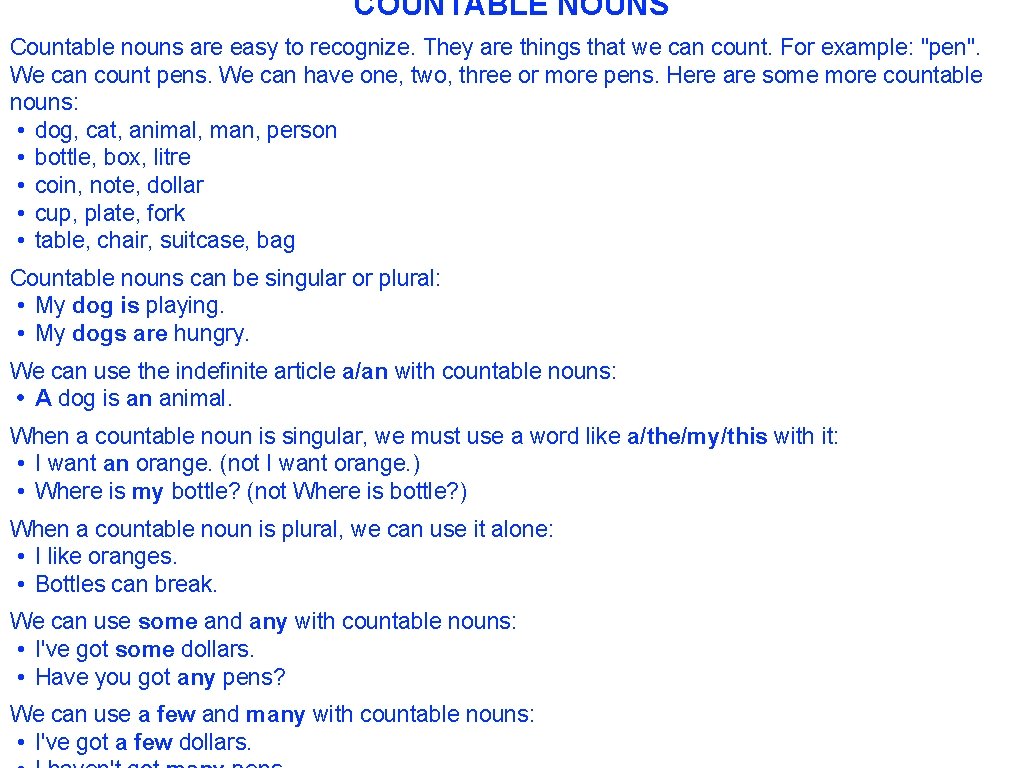
COUNTABLE NOUNS Countable nouns are easy to recognize. They are things that we can count. For example: "pen". We can count pens. We can have one, two, three or more pens. Here are some more countable nouns: • dog, cat, animal, man, person • bottle, box, litre • coin, note, dollar • cup, plate, fork • table, chair, suitcase, bag Countable nouns can be singular or plural: • My dog is playing. • My dogs are hungry. We can use the indefinite article a/an with countable nouns: • A dog is an animal. When a countable noun is singular, we must use a word like a/the/my/this with it: • I want an orange. (not I want orange. ) • Where is my bottle? (not Where is bottle? ) When a countable noun is plural, we can use it alone: • I like oranges. • Bottles can break. We can use some and any with countable nouns: • I've got some dollars. • Have you got any pens? We can use a few and many with countable nouns: • I've got a few dollars.
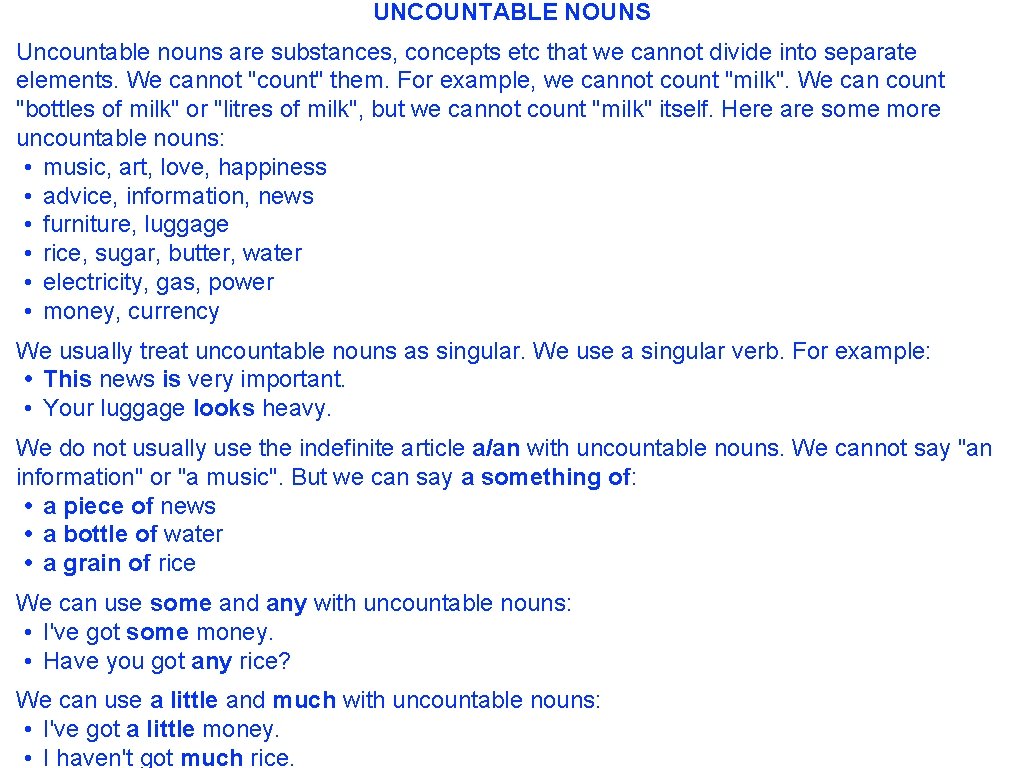
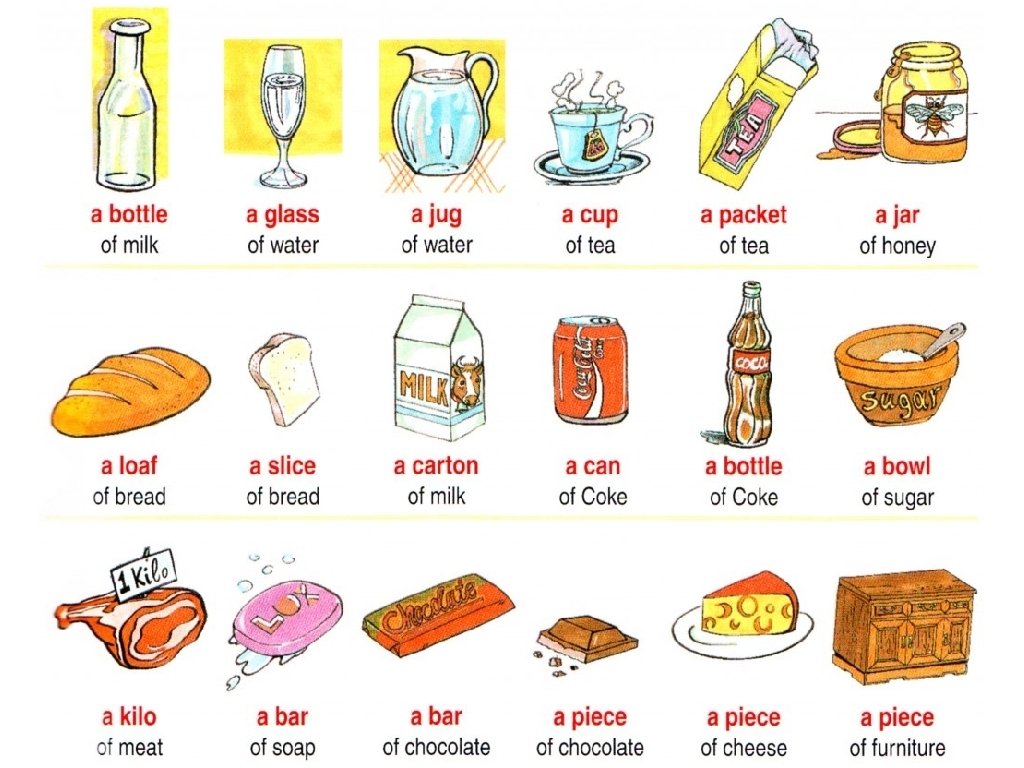
UNCOUNTABLE NOUNS Uncountable nouns are substances, concepts etc that we cannot divide into separate elements. We cannot "count" them. For example, we cannot count "milk". We can count "bottles of milk" or "litres of milk", but we cannot count "milk" itself. Here are some more uncountable nouns: • music, art, love, happiness • advice, information, news • furniture, luggage • rice, sugar, butter, water • electricity, gas, power • money, currency We usually treat uncountable nouns as singular. We use a singular verb. For example: • This news is very important. • Your luggage looks heavy. We do not usually use the indefinite article a/an with uncountable nouns. We cannot say "an information" or "a music". But we can say a something of: • a piece of news • a bottle of water • a grain of rice We can use some and any with uncountable nouns: • I've got some money. • Have you got any rice? We can use a little and much with uncountable nouns: • I've got a little money. • I haven't got much rice.
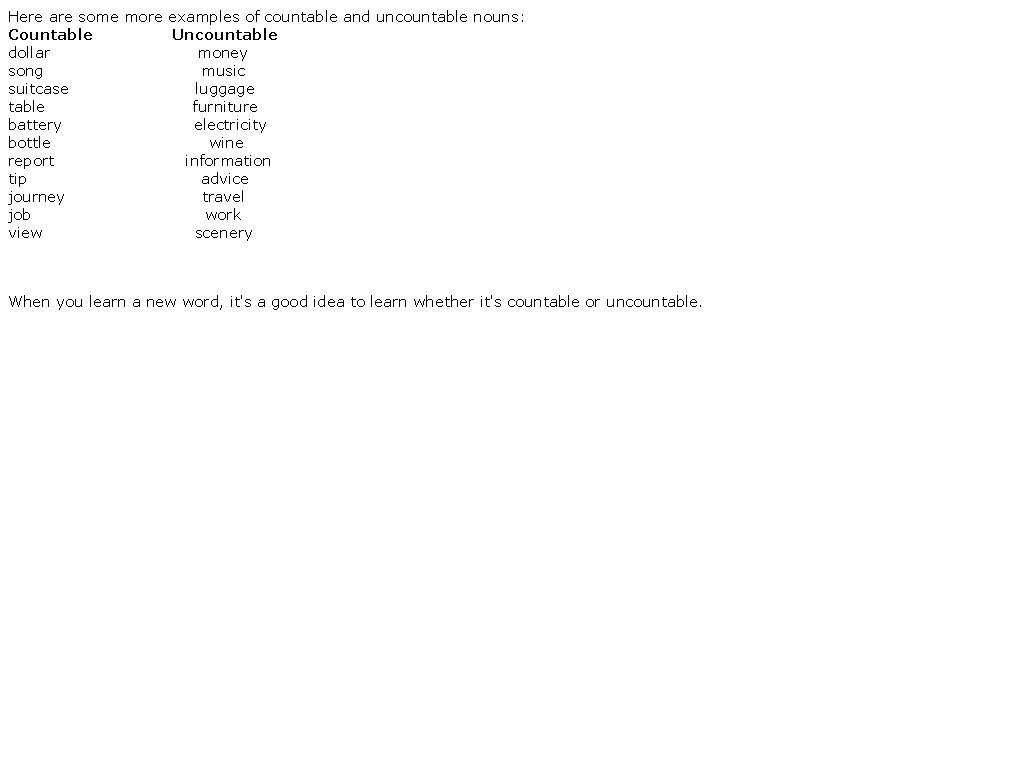
Here are some more examples of countable and uncountable nouns: Countable Uncountable dollar money song music suitcase luggage table furniture battery electricity bottle wine report information tip advice journey travel job work view scenery When you learn a new word, it's a good idea to learn whether it's countable or uncountable.