
Homework Reading Professional Assembly Language pp 17 32
Homework • Reading – Professional Assembly Language, pp 17 -32, 34 -37 – Selecting Intel Registers http: //www. swansontec. com/sregisters. html • Lab with your assigned section starts this week 1
General Computer Architecture • Processor – Controls fetching and execution of instructions – Moves data between memory, registers, the arithmetic / logic unit (ALU), and I/O devices • Memory – Stores instructions and data • I/O Devices – Bring data into system – Send data out from system 2
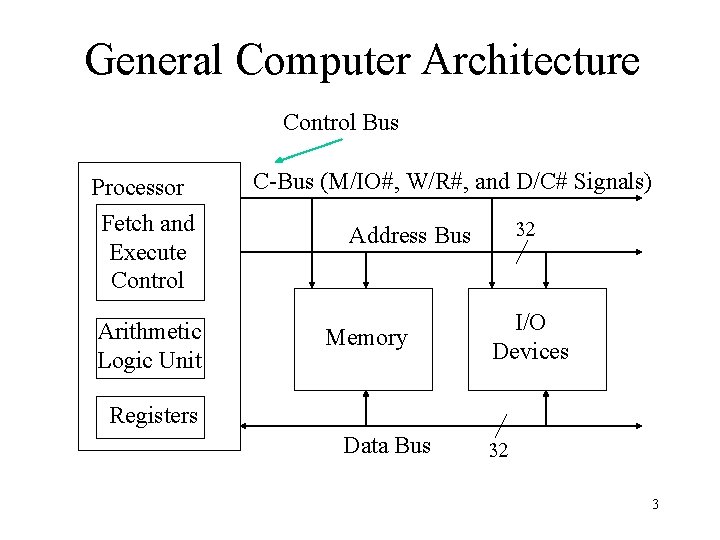
General Computer Architecture Control Bus Processor Fetch and Execute Control Arithmetic Logic Unit C-Bus (M/IO#, W/R#, and D/C# Signals) 32 Address Bus Memory I/O Devices Registers Data Bus 32 3
Signals and Busses • A “signal” is a logical value represented as a voltage on a wire inside the machine • A signal is binary (on (value=1) and off (value=0)) • There is a specific function assigned to each value of a signal, e. g. the memory or I/O select (M/IO#) – M/IO# = 1 means access memory – M/IO# = 0 means access an I/O device • A “bus” is a group of signals with one purpose 4
Processor Model • An assembly language programmer usually thinks of the processor in terms of its: – Registers – Arithmetic Logic Unit (ALU) – Instructions – Address and data bus sizes • An example of a Generic Processor: PIPPIN http: //www. cs. bc. edu/~muller/teaching/cs 074/f 08/lib/dist/pippin. pdf 5
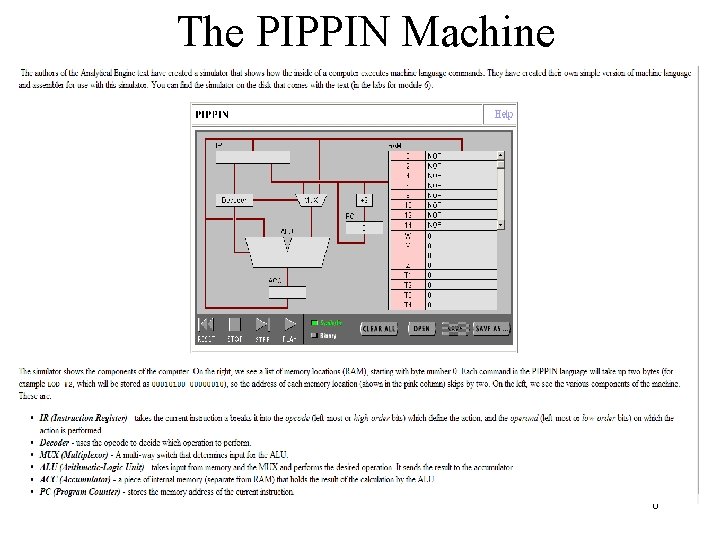
The PIPPIN Machine 6
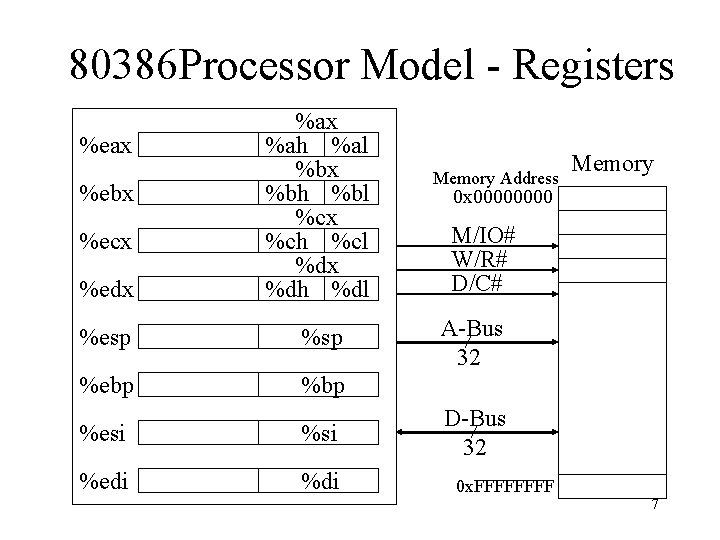
80386 Processor Model - Registers %edx %ah %al %bx %bh %bl %cx %ch %cl %dx %dh %dl %esp %ebp %eax %ebx %ecx %esi %edi %di Memory Address Memory 0 x 0000 M/IO# W/R# D/C# A-Bus 32 D-Bus 32 0 x. FFFF 7
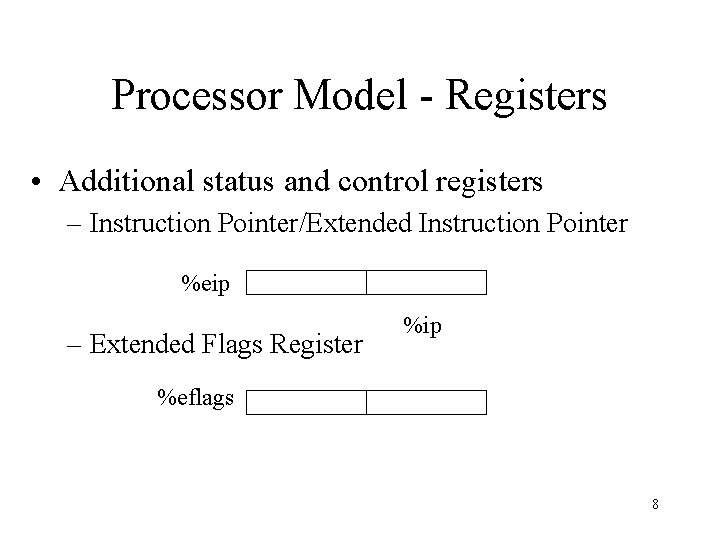
Processor Model - Registers • Additional status and control registers – Instruction Pointer/Extended Instruction Pointer %eip – Extended Flags Register %ip %eflags 8
Arithmetic Logic Unit(ALU) • Capable of performing arithmetic – Addition, Subtraction, Multiplication, Division • Capable of performing logic operations – and, or, exclusive or • Takes operands from source(s) specified in the instruction • Delivers results to destination specified in the instruction 9
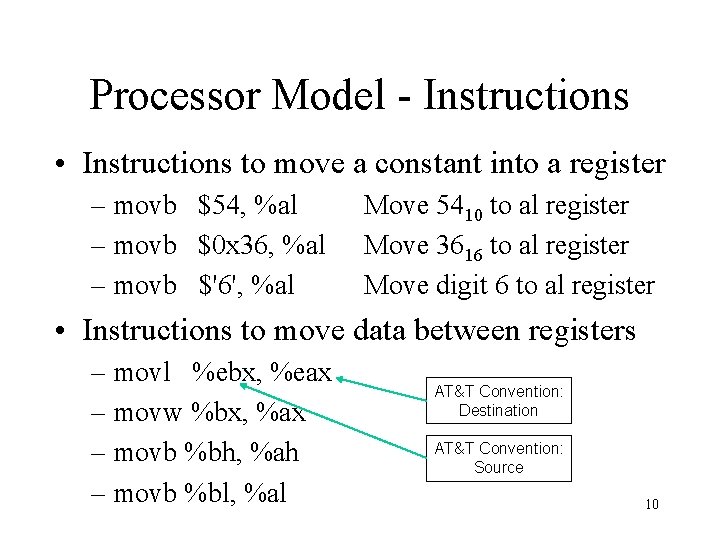
Processor Model - Instructions • Instructions to move a constant into a register – movb $54, %al – movb $0 x 36, %al – movb $'6', %al Move 5410 to al register Move 3616 to al register Move digit 6 to al register • Instructions to move data between registers – movl %ebx, %eax – movw %bx, %ax – movb %bh, %ah – movb %bl, %al AT&T Convention: Destination AT&T Convention: Source 10
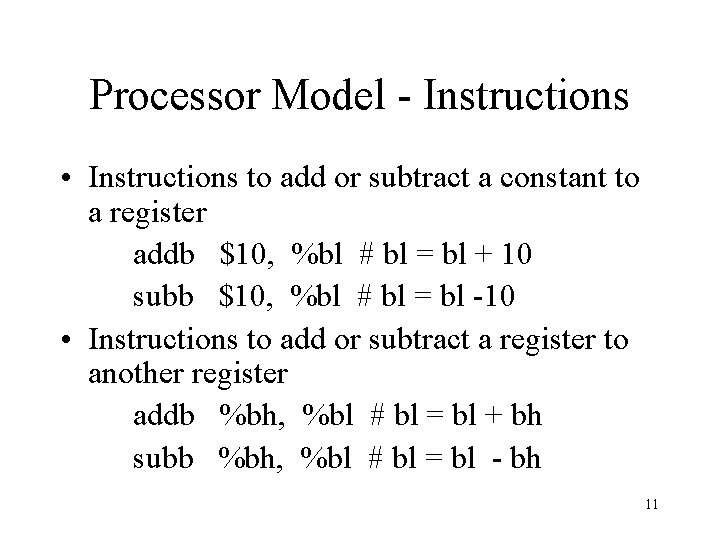
Processor Model - Instructions • Instructions to add or subtract a constant to a register addb $10, %bl # bl = bl + 10 subb $10, %bl # bl = bl -10 • Instructions to add or subtract a register to another register addb %bh, %bl # bl = bl + bh subb %bh, %bl # bl = bl - bh 11
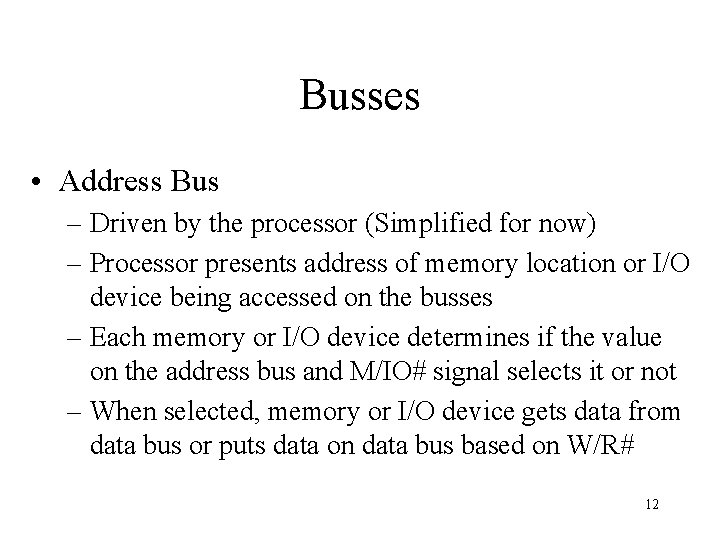
Busses • Address Bus – Driven by the processor (Simplified for now) – Processor presents address of memory location or I/O device being accessed on the busses – Each memory or I/O device determines if the value on the address bus and M/IO# signal selects it or not – When selected, memory or I/O device gets data from data bus or puts data on data bus based on W/R# 12
Busses • Data Bus – Used as a conduit for data between devices – Specific operations performed on the data bus are driven by control and address bus signals – Can be driven by processor, memory, or an I/O device depending on the type of transfer done – Interfaces to data bus require a special kind of “tri-state” logic which we will discuss later 13
Busses • Control Bus Signals – M/IO# signal selects • Memory when set (= 1) • I/O devices when reset (= 0) – W/R# signal moves data from • Processor to memory or I/O device when set (= 1) • Memory or I/O device to processor when reset (= 0) – D/C# signal indicates • Data (instruction execute phase) when set (=1) • Control (instruction fetch phase) when reset (=0) 14
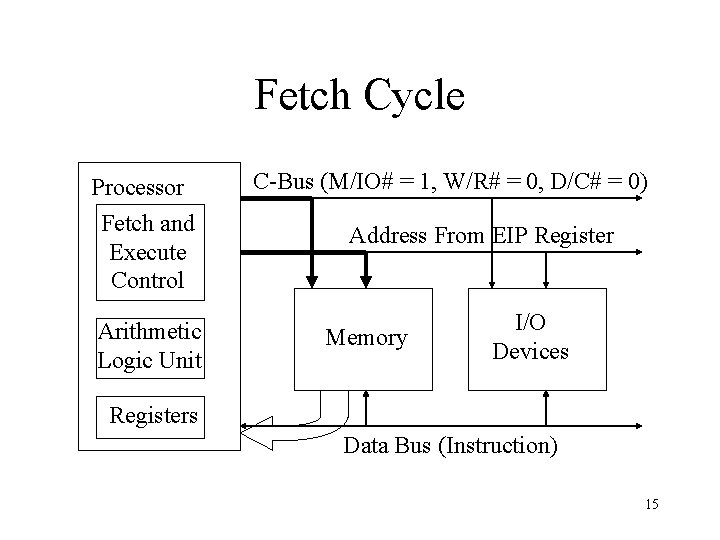
Fetch Cycle Processor Fetch and Execute Control Arithmetic Logic Unit C-Bus (M/IO# = 1, W/R# = 0, D/C# = 0) Address From EIP Register Memory I/O Devices Registers Data Bus (Instruction) 15
Fetch Cycle • On each fetch cycle, processor – Puts signal M/IO# = 1 on control bus – Puts signal W/R# = 0 on control bus – Puts signal D/C# = 0 on control bus – Puts address of next instruction from the EIP register on address bus signals – Reads next instruction on data bus 16
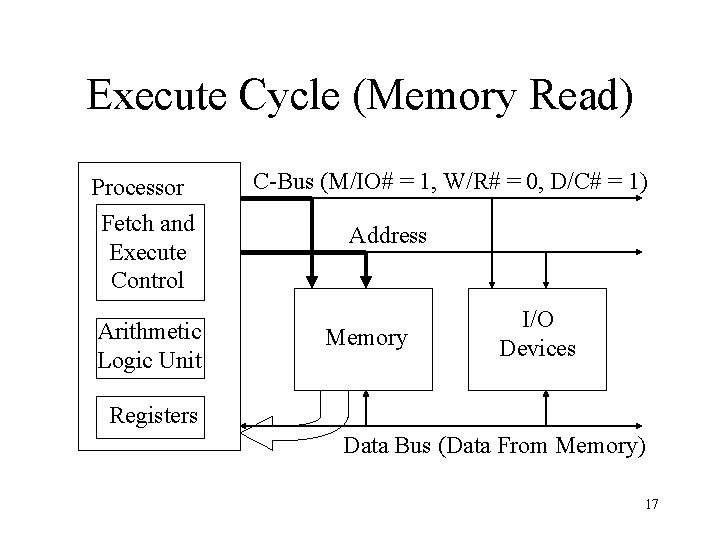
Execute Cycle (Memory Read) Processor Fetch and Execute Control Arithmetic Logic Unit C-Bus (M/IO# = 1, W/R# = 0, D/C# = 1) Address Memory I/O Devices Registers Data Bus (Data From Memory) 17
Execute Cycle • On each execute cycle, processor – May or may not need to access memory or I/O – Some instructions act inside processor only, e. g. instruction to move a constant to a register • When processor accesses memory or an I/O device during execute cycle, there are four possible combinations: 18
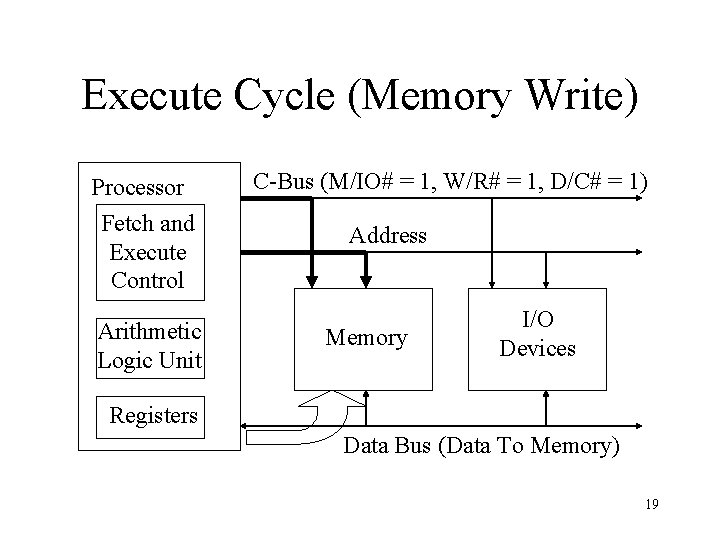
Execute Cycle (Memory Write) Processor Fetch and Execute Control Arithmetic Logic Unit C-Bus (M/IO# = 1, W/R# = 1, D/C# = 1) Address Memory I/O Devices Registers Data Bus (Data To Memory) 19
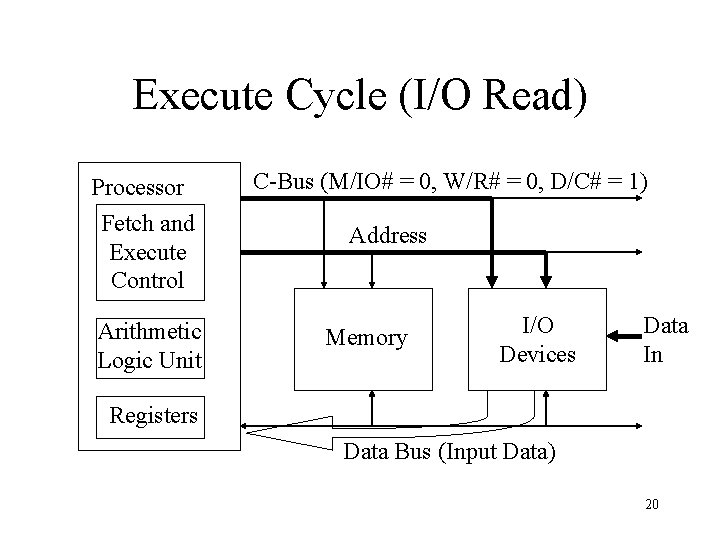
Execute Cycle (I/O Read) Processor Fetch and Execute Control Arithmetic Logic Unit C-Bus (M/IO# = 0, W/R# = 0, D/C# = 1) Address Memory I/O Devices Data In Registers Data Bus (Input Data) 20
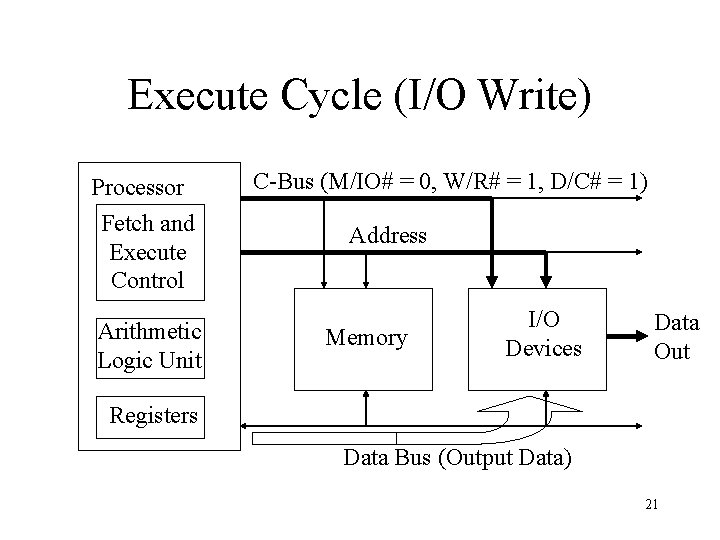
Execute Cycle (I/O Write) Processor Fetch and Execute Control Arithmetic Logic Unit C-Bus (M/IO# = 0, W/R# = 1, D/C# = 1) Address Memory I/O Devices Data Out Registers Data Bus (Output Data) 21
- Slides: 21