
Homework Quadrilaterals Coordinate Geometry Day 1 Wkst BIG
• Homework: Quadrilaterals & Coordinate Geometry Day 1 Wkst – BIG QUIZ on Friday • Warm-Up: Draw a picture of each of the following and write down as much as you can remember – – – Trapezoid Parallelogram Rectangle Square Rhombus Kite
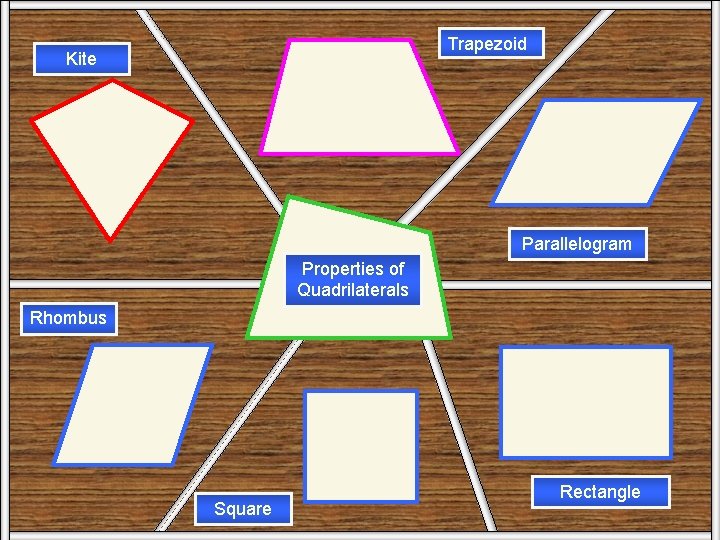
Trapezoid Kite Parallelogram Names Properties of Quadrilaterals Rhombus Square Rectangle
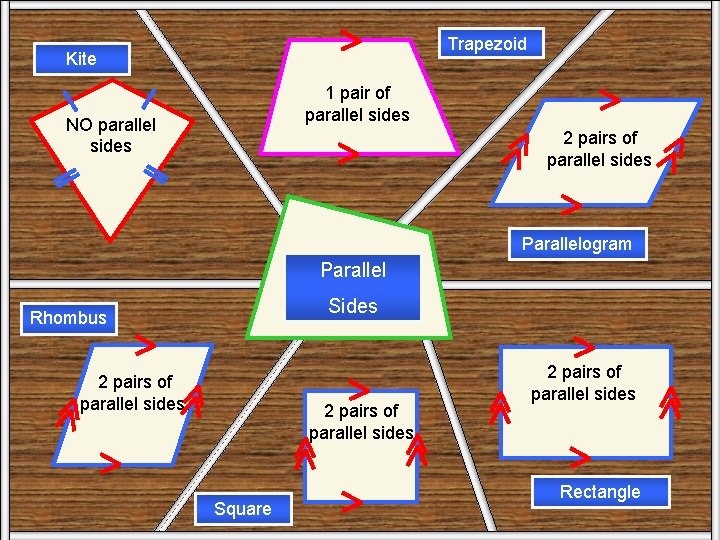
Trapezoid Kite Sides 1 pair of parallel sides NO parallel sides 2 pairs of parallel sides Parallelogram Parallel Sides Rhombus 2 pairs of parallel sides Square 2 pairs of parallel sides Rectangle
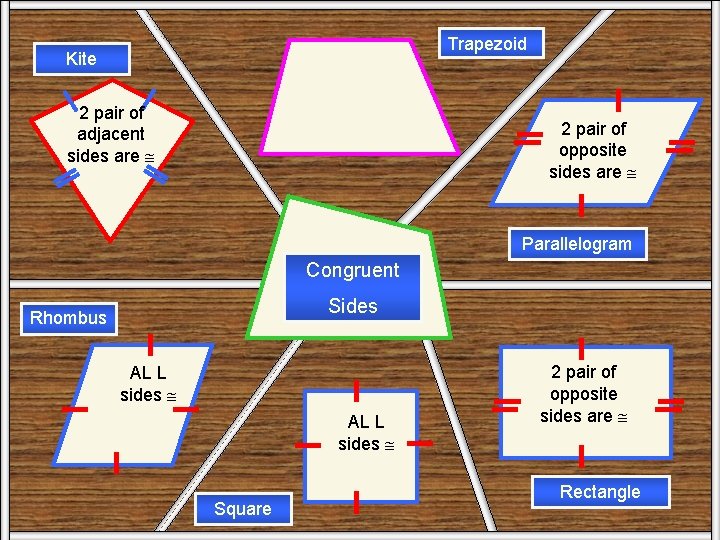
Trapezoid Kite Sides 2 pair of adjacent sides are 2 pair of opposite sides are Parallelogram Congruent Sides Rhombus AL L sides Square 2 pair of opposite sides are Rectangle
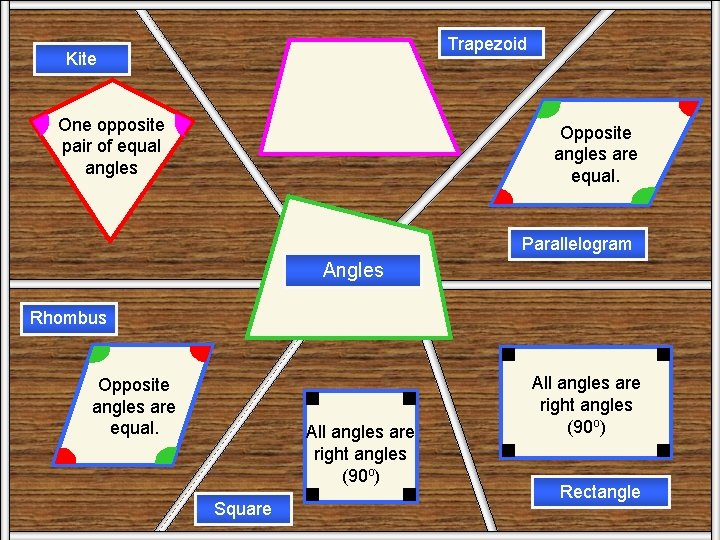
Trapezoid Kite One opposite pair of equal angles Opposite angles are equal. Parallelogram Angles Rhombus Opposite angles are equal. All angles are right angles (90 o) Square All angles are right angles (90 o) Rectangle
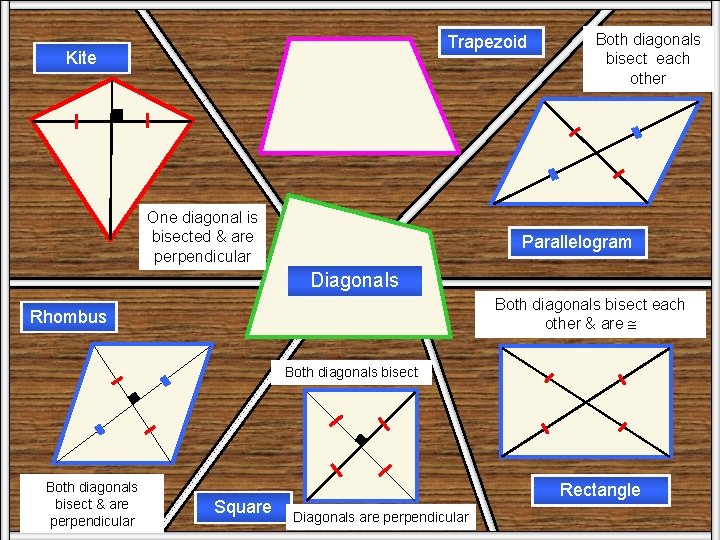
Trapezoid Kite One diagonal is bisected & are perpendicular Rhombus Diagonals Both diagonals bisect each other Parallelogram Both diagonals bisect each other & are Both diagonals bisect & are perpendicular Square Rectangle Diagonals are perpendicular
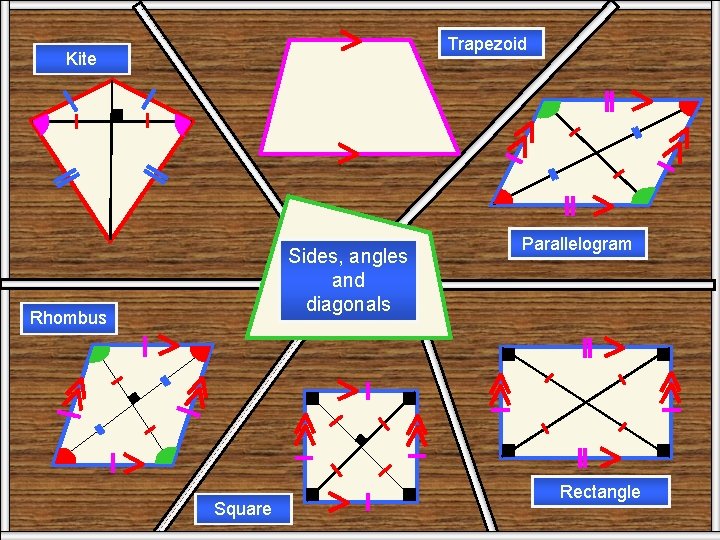
Trapezoid Kite All Three Sides, angles and diagonals Rhombus Square Parallelogram Rectangle
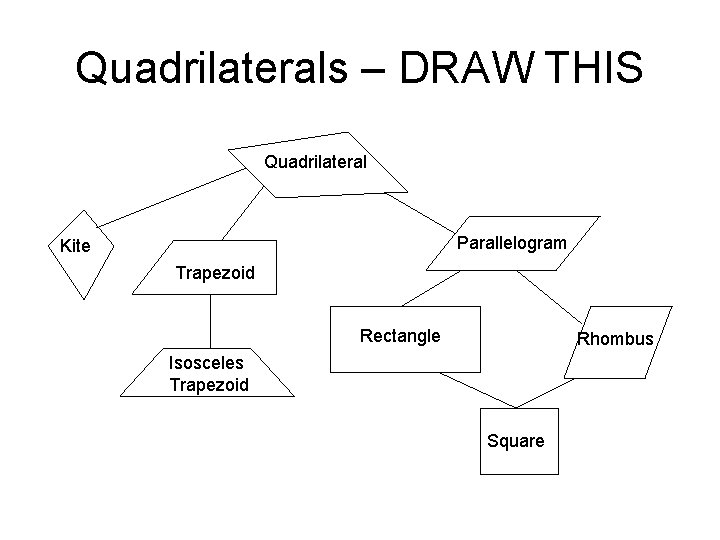
Quadrilaterals – DRAW THIS Quadrilateral Parallelogram Kite Trapezoid Rectangle Rhombus Isosceles Trapezoid Square
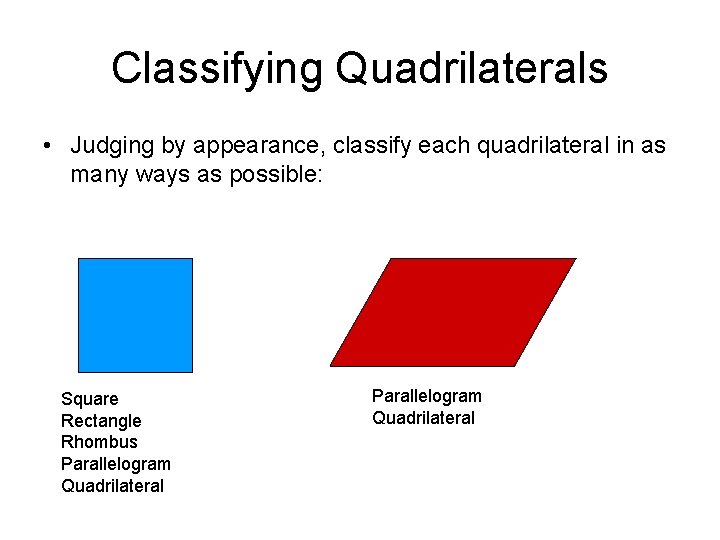
Classifying Quadrilaterals • Judging by appearance, classify each quadrilateral in as many ways as possible: Square Rectangle Rhombus Parallelogram Quadrilateral
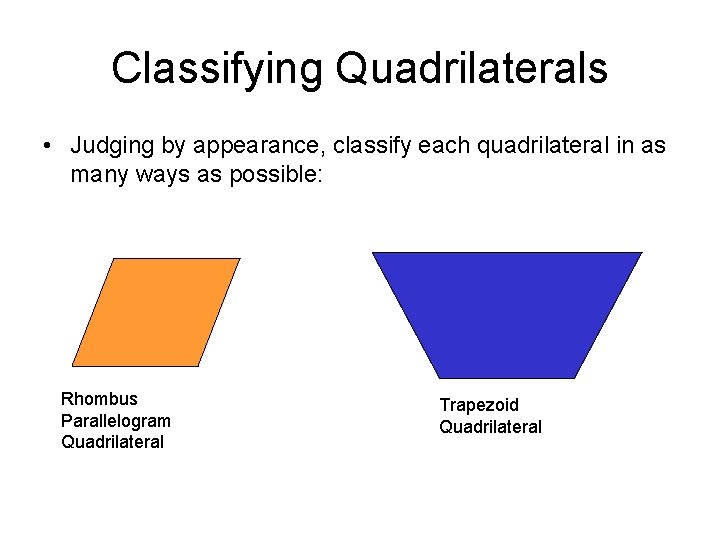
Classifying Quadrilaterals • Judging by appearance, classify each quadrilateral in as many ways as possible: Rhombus Parallelogram Quadrilateral Trapezoid Quadrilateral
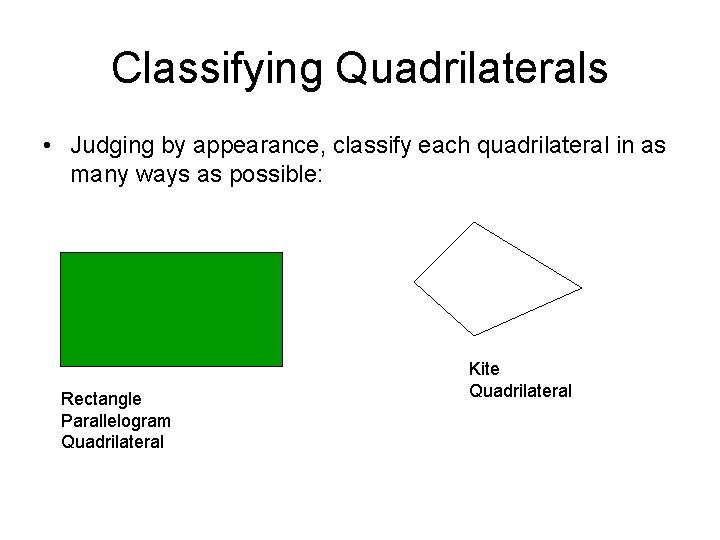
Classifying Quadrilaterals • Judging by appearance, classify each quadrilateral in as many ways as possible: Rectangle Parallelogram Quadrilateral Kite Quadrilateral
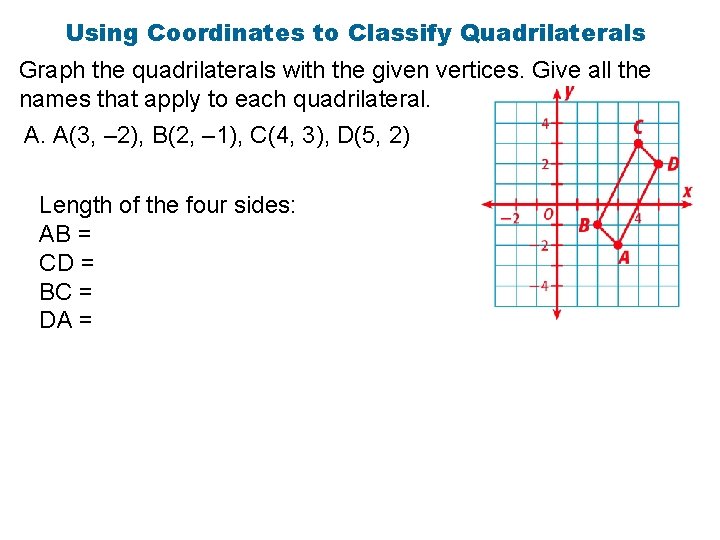
Using Coordinates to Classify Quadrilaterals Graph the quadrilaterals with the given vertices. Give all the names that apply to each quadrilateral. A. A(3, – 2), B(2, – 1), C(4, 3), D(5, 2) Length of the four sides: AB = CD = BC = DA =
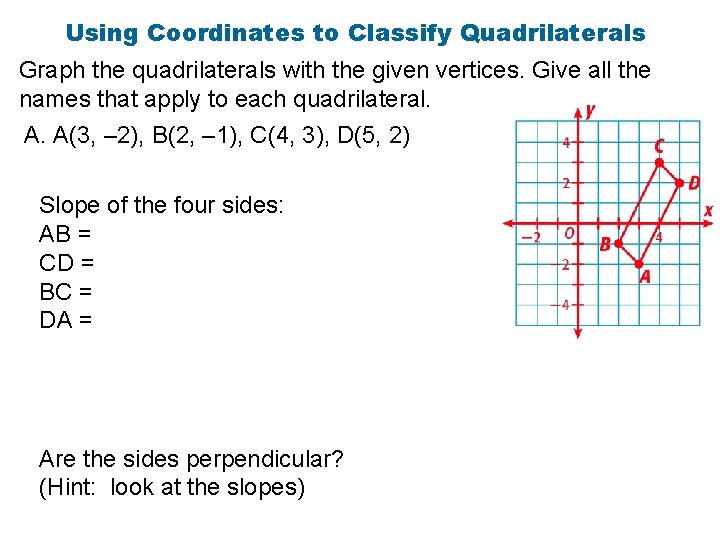
Using Coordinates to Classify Quadrilaterals Graph the quadrilaterals with the given vertices. Give all the names that apply to each quadrilateral. A. A(3, – 2), B(2, – 1), C(4, 3), D(5, 2) Slope of the four sides: AB = CD = BC = DA = Are the sides perpendicular? (Hint: look at the slopes)
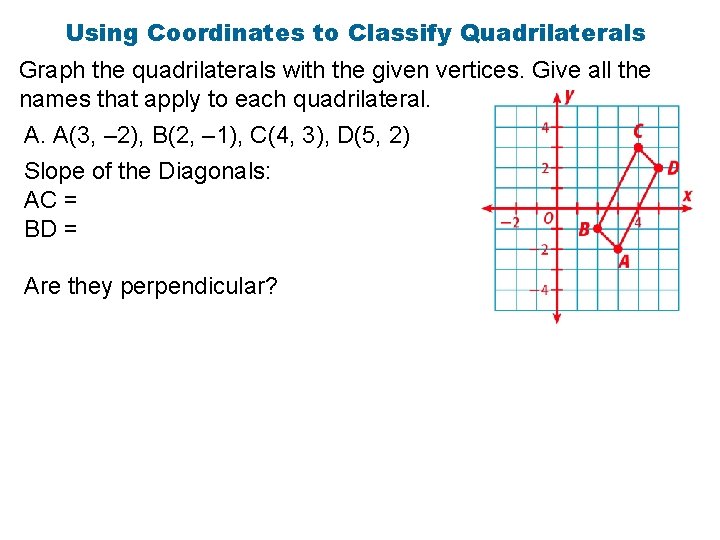
Using Coordinates to Classify Quadrilaterals Graph the quadrilaterals with the given vertices. Give all the names that apply to each quadrilateral. A. A(3, – 2), B(2, – 1), C(4, 3), D(5, 2) Slope of the Diagonals: AC = BD = Are they perpendicular?
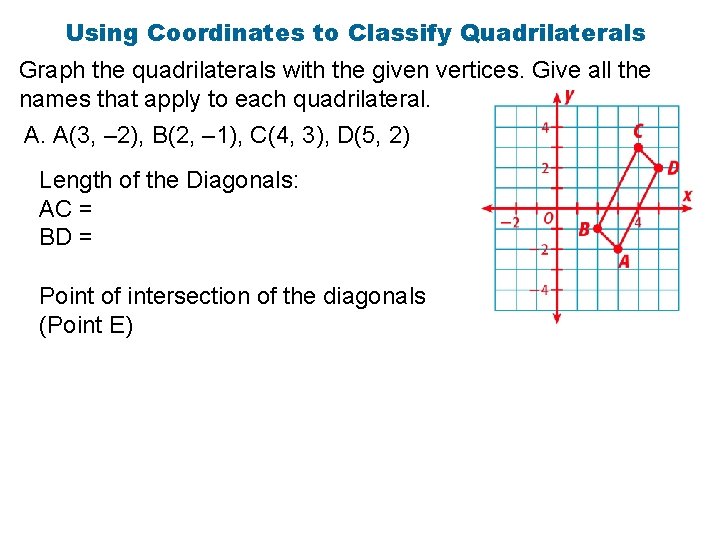
Using Coordinates to Classify Quadrilaterals Graph the quadrilaterals with the given vertices. Give all the names that apply to each quadrilateral. A. A(3, – 2), B(2, – 1), C(4, 3), D(5, 2) Length of the Diagonals: AC = BD = Point of intersection of the diagonals (Point E)
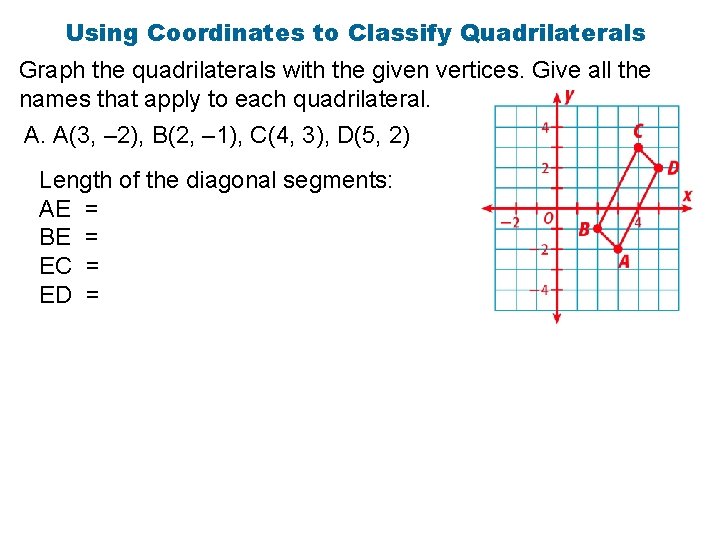
Using Coordinates to Classify Quadrilaterals Graph the quadrilaterals with the given vertices. Give all the names that apply to each quadrilateral. A. A(3, – 2), B(2, – 1), C(4, 3), D(5, 2) Length of the diagonal segments: AE = BE = EC = ED =
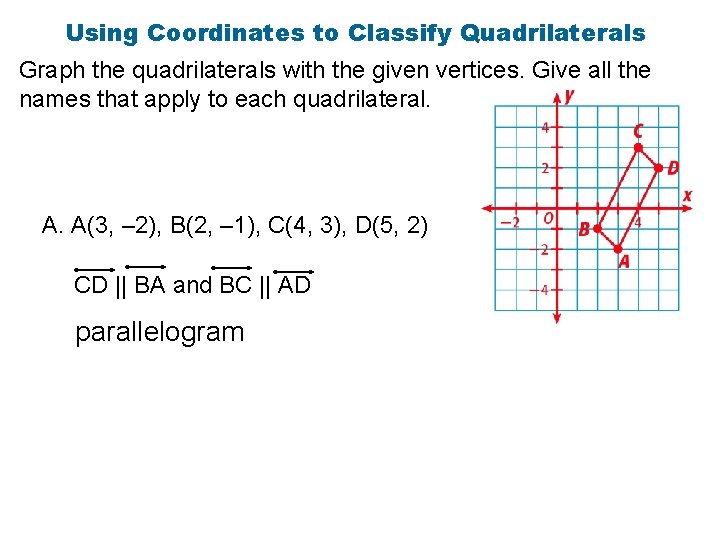
Using Coordinates to Classify Quadrilaterals Graph the quadrilaterals with the given vertices. Give all the names that apply to each quadrilateral. A. A(3, – 2), B(2, – 1), C(4, 3), D(5, 2) CD || BA and BC || AD parallelogram
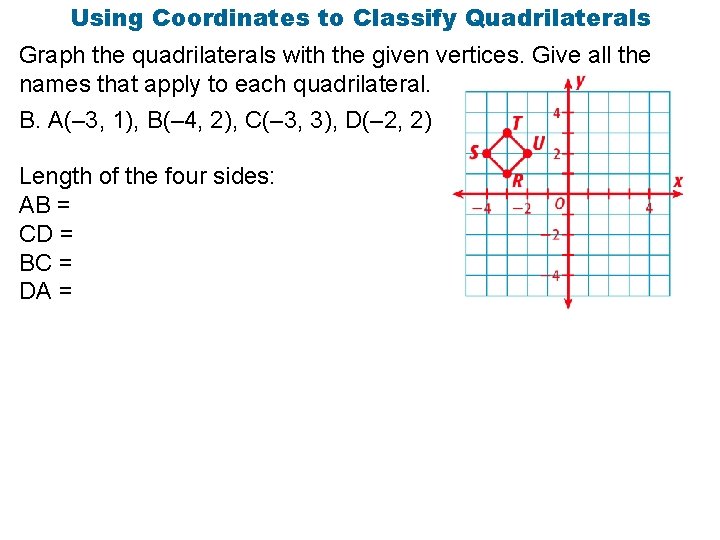
Using Coordinates to Classify Quadrilaterals Graph the quadrilaterals with the given vertices. Give all the names that apply to each quadrilateral. B. A(– 3, 1), B(– 4, 2), C(– 3, 3), D(– 2, 2) Length of the four sides: AB = CD = BC = DA =
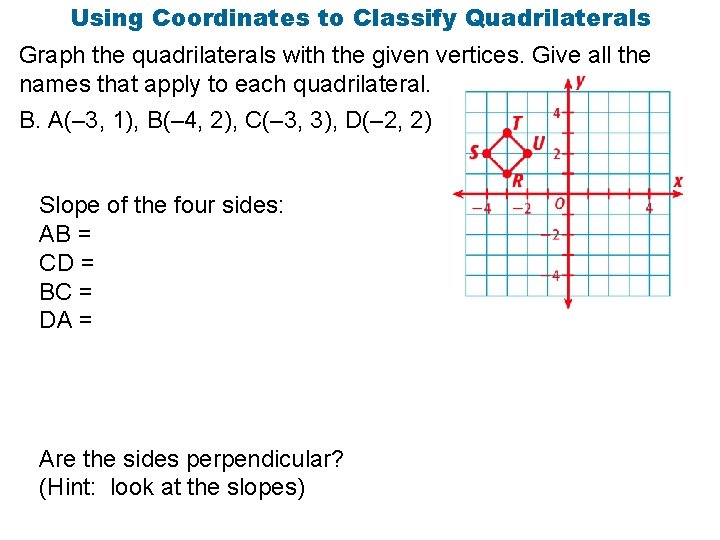
Using Coordinates to Classify Quadrilaterals Graph the quadrilaterals with the given vertices. Give all the names that apply to each quadrilateral. B. A(– 3, 1), B(– 4, 2), C(– 3, 3), D(– 2, 2) Slope of the four sides: AB = CD = BC = DA = Are the sides perpendicular? (Hint: look at the slopes)
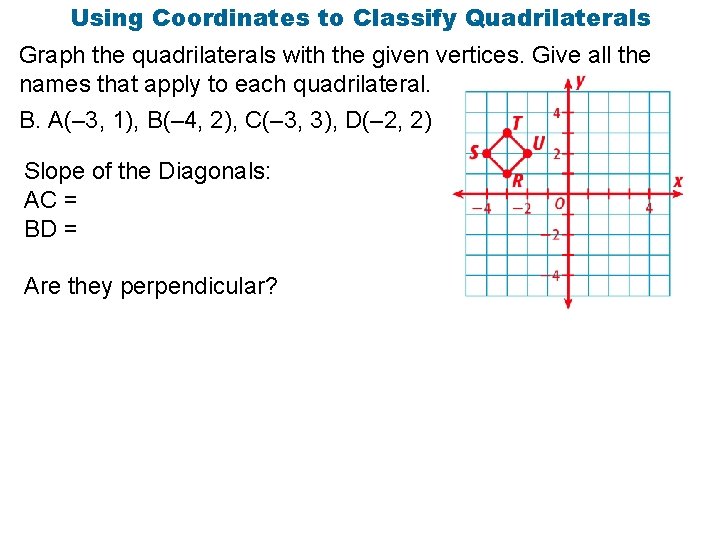
Using Coordinates to Classify Quadrilaterals Graph the quadrilaterals with the given vertices. Give all the names that apply to each quadrilateral. B. A(– 3, 1), B(– 4, 2), C(– 3, 3), D(– 2, 2) Slope of the Diagonals: AC = BD = Are they perpendicular?
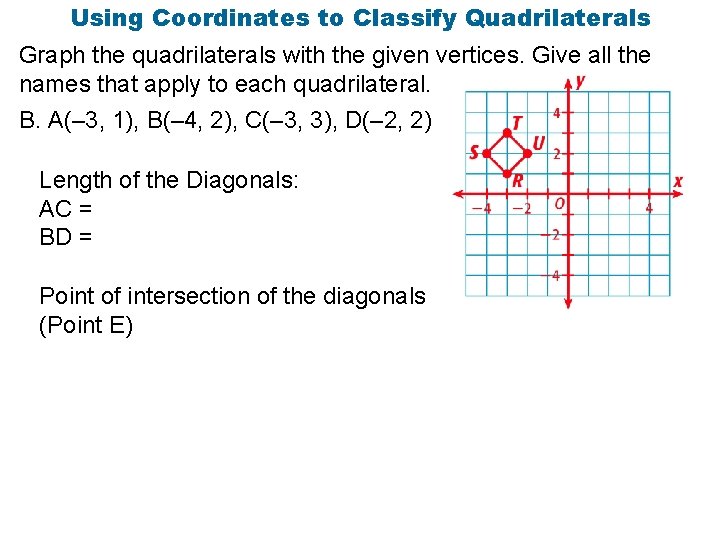
Using Coordinates to Classify Quadrilaterals Graph the quadrilaterals with the given vertices. Give all the names that apply to each quadrilateral. B. A(– 3, 1), B(– 4, 2), C(– 3, 3), D(– 2, 2) Length of the Diagonals: AC = BD = Point of intersection of the diagonals (Point E)
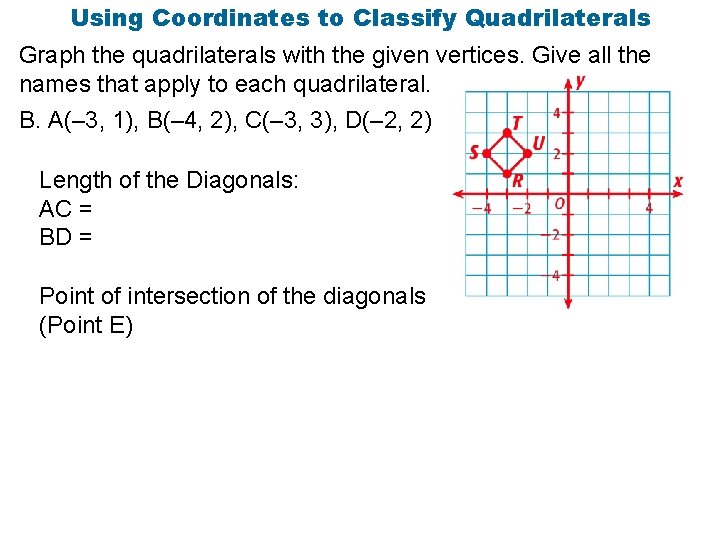
Using Coordinates to Classify Quadrilaterals Graph the quadrilaterals with the given vertices. Give all the names that apply to each quadrilateral. B. A(– 3, 1), B(– 4, 2), C(– 3, 3), D(– 2, 2) Length of the Diagonals: AC = BD = Point of intersection of the diagonals (Point E)
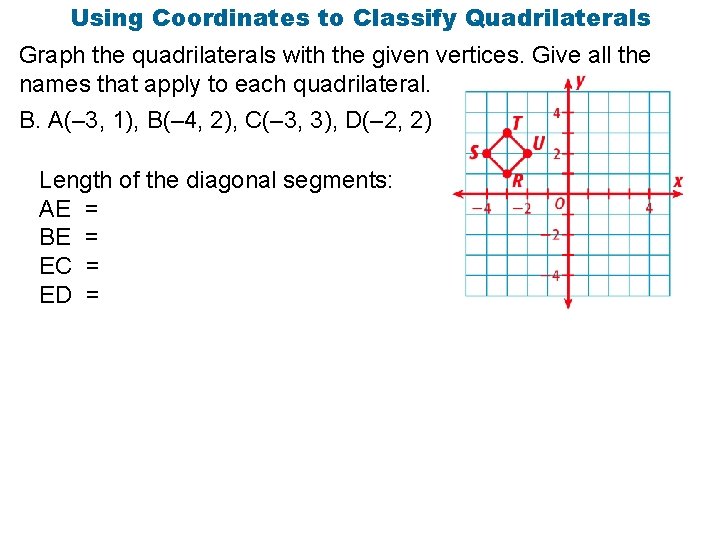
Using Coordinates to Classify Quadrilaterals Graph the quadrilaterals with the given vertices. Give all the names that apply to each quadrilateral. B. A(– 3, 1), B(– 4, 2), C(– 3, 3), D(– 2, 2) Length of the diagonal segments: AE = BE = EC = ED =
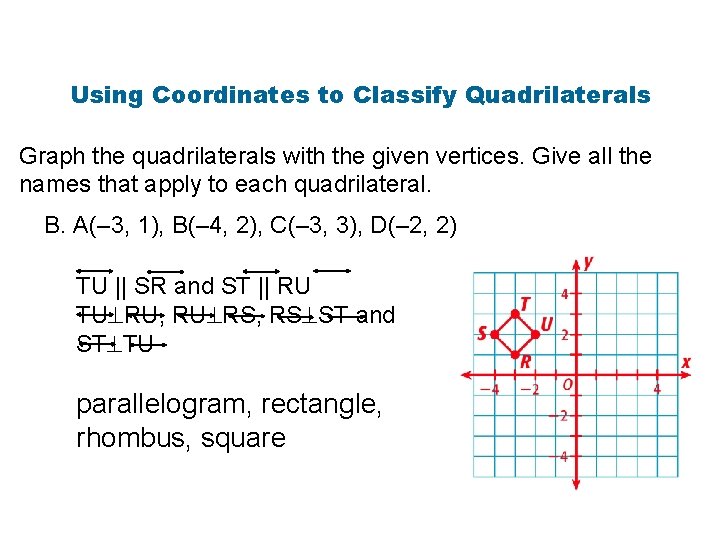
Using Coordinates to Classify Quadrilaterals Graph the quadrilaterals with the given vertices. Give all the names that apply to each quadrilateral. B. A(– 3, 1), B(– 4, 2), C(– 3, 3), D(– 2, 2) TU || SR and ST || RU TU^RU, RU^RS, RS^ST and ST^TU parallelogram, rectangle, rhombus, square
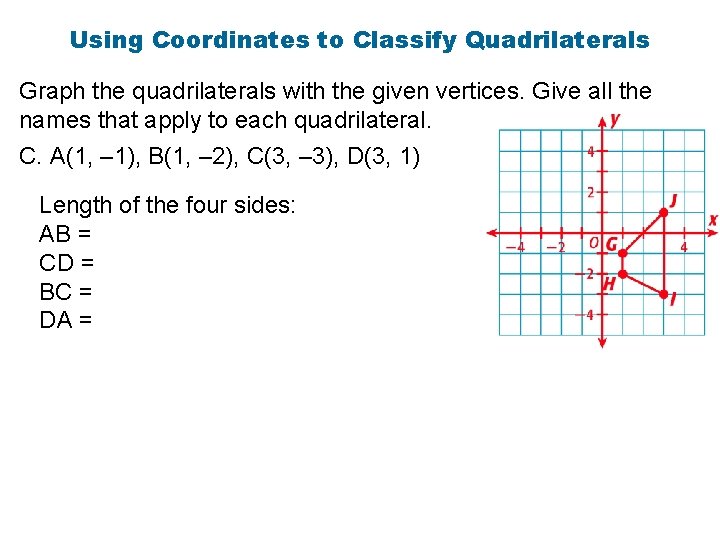
Using Coordinates to Classify Quadrilaterals Graph the quadrilaterals with the given vertices. Give all the names that apply to each quadrilateral. C. A(1, – 1), B(1, – 2), C(3, – 3), D(3, 1) Length of the four sides: AB = CD = BC = DA =
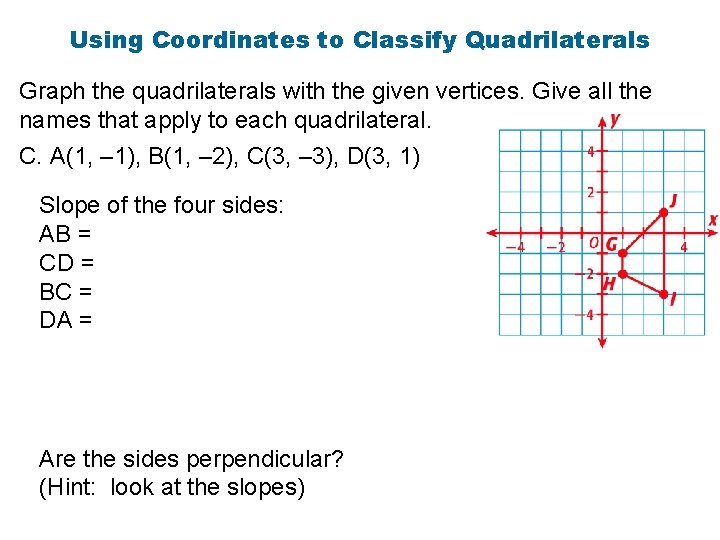
Using Coordinates to Classify Quadrilaterals Graph the quadrilaterals with the given vertices. Give all the names that apply to each quadrilateral. C. A(1, – 1), B(1, – 2), C(3, – 3), D(3, 1) Slope of the four sides: AB = CD = BC = DA = Are the sides perpendicular? (Hint: look at the slopes)
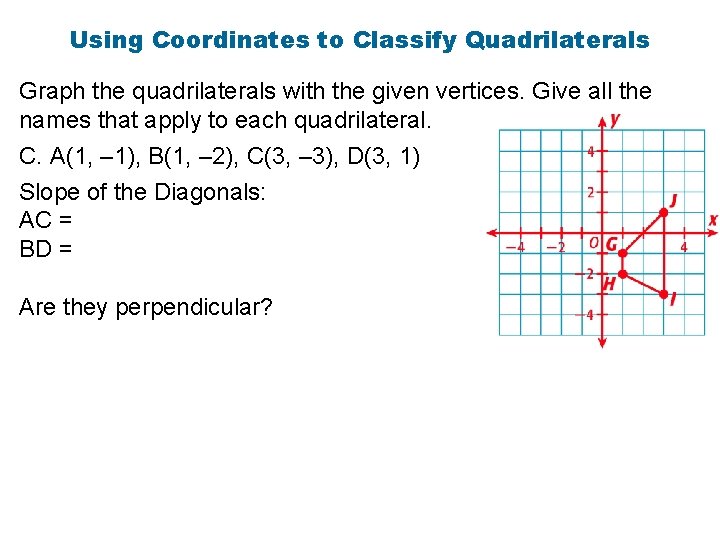
Using Coordinates to Classify Quadrilaterals Graph the quadrilaterals with the given vertices. Give all the names that apply to each quadrilateral. C. A(1, – 1), B(1, – 2), C(3, – 3), D(3, 1) Slope of the Diagonals: AC = BD = Are they perpendicular?
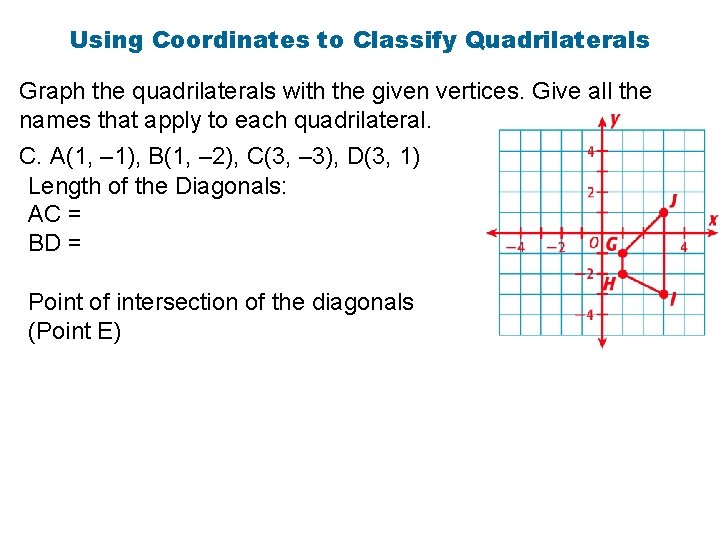
Using Coordinates to Classify Quadrilaterals Graph the quadrilaterals with the given vertices. Give all the names that apply to each quadrilateral. C. A(1, – 1), B(1, – 2), C(3, – 3), D(3, 1) Length of the Diagonals: AC = BD = Point of intersection of the diagonals (Point E)
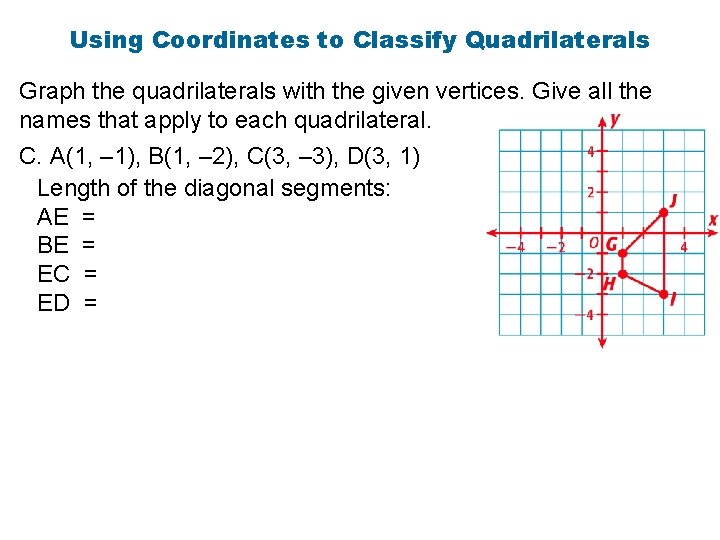
Using Coordinates to Classify Quadrilaterals Graph the quadrilaterals with the given vertices. Give all the names that apply to each quadrilateral. C. A(1, – 1), B(1, – 2), C(3, – 3), D(3, 1) Length of the diagonal segments: AE = BE = EC = ED =
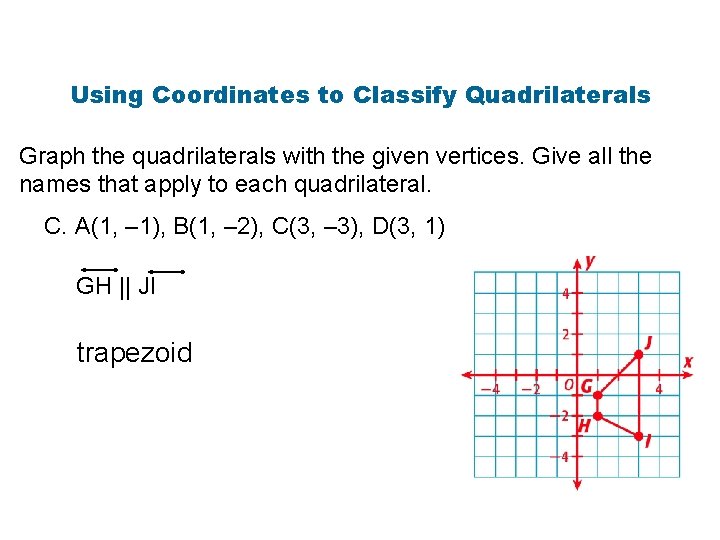
Using Coordinates to Classify Quadrilaterals Graph the quadrilaterals with the given vertices. Give all the names that apply to each quadrilateral. C. A(1, – 1), B(1, – 2), C(3, – 3), D(3, 1) GH || JI trapezoid

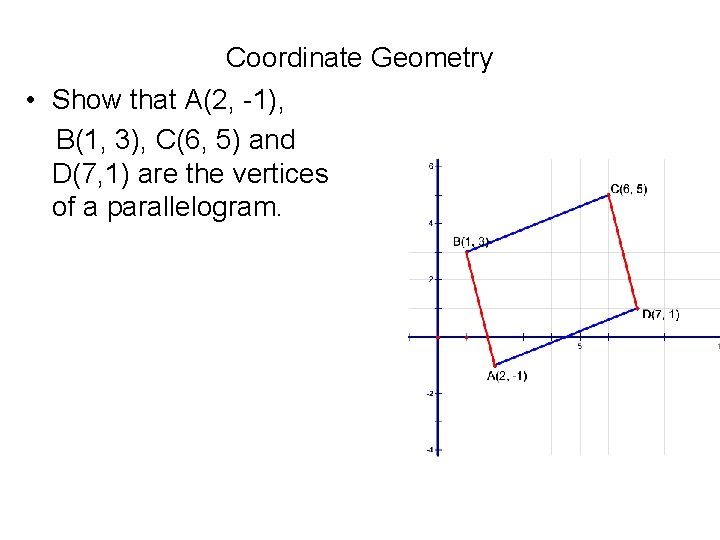
Coordinate Geometry • Show that A(2, -1), B(1, 3), C(6, 5) and D(7, 1) are the vertices of a parallelogram.
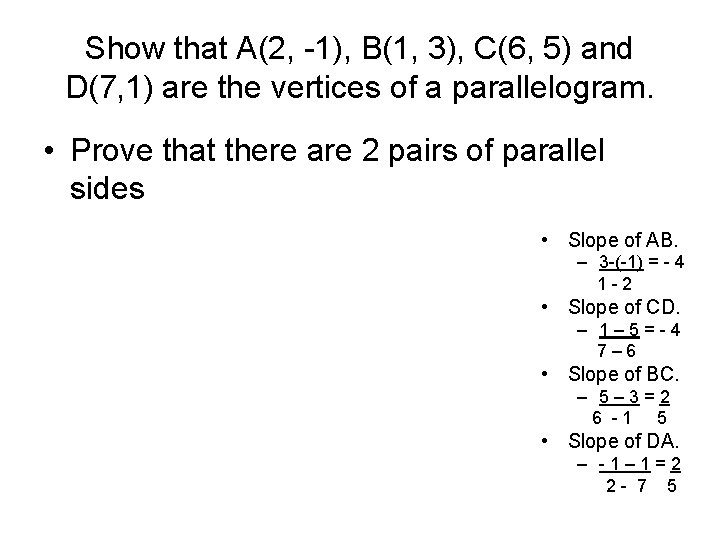
Show that A(2, -1), B(1, 3), C(6, 5) and D(7, 1) are the vertices of a parallelogram. • Prove that there are 2 pairs of parallel sides • Slope of AB. – 3 -(-1) = - 4 1 -2 • Slope of CD. – 1– 5=-4 7– 6 • Slope of BC. – 5– 3=2 6 -1 5 • Slope of DA. – -1– 1=2 2 - 7 5
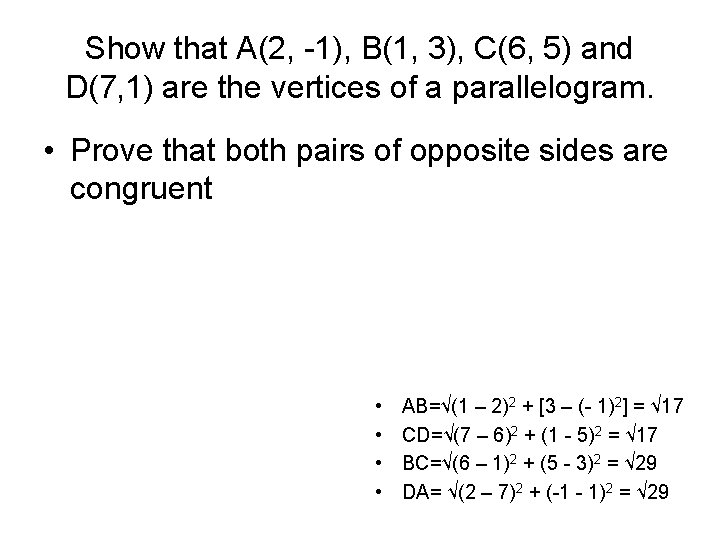
Show that A(2, -1), B(1, 3), C(6, 5) and D(7, 1) are the vertices of a parallelogram. • Prove that both pairs of opposite sides are congruent • • AB=√(1 – 2)2 + [3 – (- 1)2] = √ 17 CD=√(7 – 6)2 + (1 - 5)2 = √ 17 BC=√(6 – 1)2 + (5 - 3)2 = √ 29 DA= √(2 – 7)2 + (-1 - 1)2 = √ 29
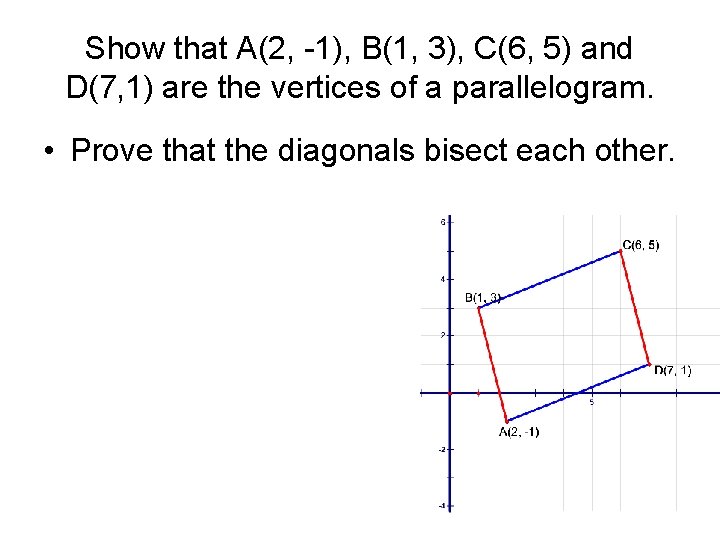
Show that A(2, -1), B(1, 3), C(6, 5) and D(7, 1) are the vertices of a parallelogram. • Prove that the diagonals bisect each other.
- Slides: 35