
Homework 6 Goals Semantics Gain better understanding of

Homework #6
Goals Semantics Gain better understanding of semantic representations Develop experience with lambda calculus and FOL Create semantic attachments Understand semantic composition
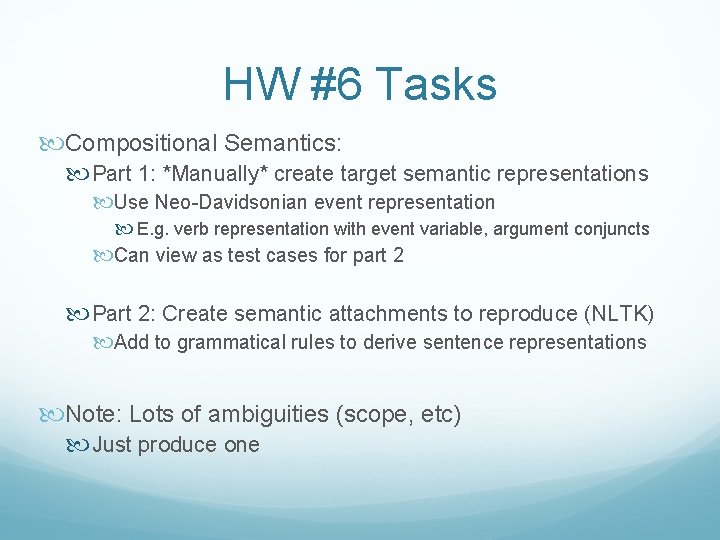
HW #6 Tasks Compositional Semantics: Part 1: *Manually* create target semantic representations Use Neo-Davidsonian event representation E. g. verb representation with event variable, argument conjuncts Can view as test cases for part 2 Part 2: Create semantic attachments to reproduce (NLTK) Add to grammatical rules to derive sentence representations Note: Lots of ambiguities (scope, etc) Just produce one
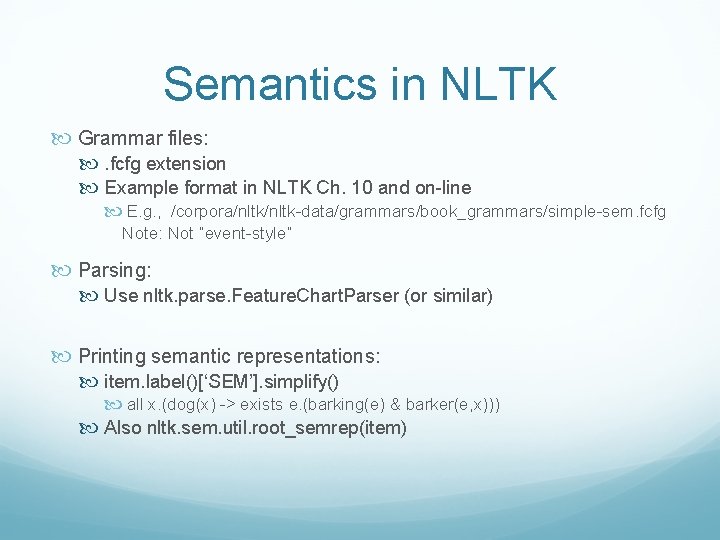
Semantics in NLTK Grammar files: . fcfg extension Example format in NLTK Ch. 10 and on-line E. g. , /corpora/nltk-data/grammars/book_grammars/simple-sem. fcfg Note: Not “event-style” Parsing: Use nltk. parse. Feature. Chart. Parser (or similar) Printing semantic representations: item. label()[‘SEM’]. simplify() all x. (dog(x) -> exists e. (barking(e) & barker(e, x))) Also nltk. sem. util. root_semrep(item)

Semantic attachments in NLTK FOL syntax: l ∃ exists all & | -> a, b, e, x: lowercase lambda variables can be arguments, x. dog(x) P, Q, X: uppercase lambda variables are functors P. P(john)
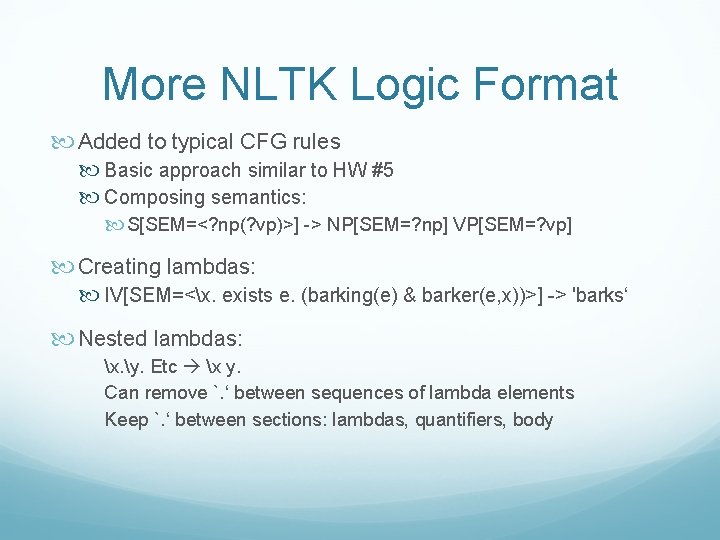
More NLTK Logic Format Added to typical CFG rules Basic approach similar to HW #5 Composing semantics: S[SEM=<? np(? vp)>] -> NP[SEM=? np] VP[SEM=? vp] Creating lambdas: IV[SEM=<x. exists e. (barking(e) & barker(e, x))>] -> 'barks‘ Nested lambdas: x. y. Etc x y. Can remove `. ‘ between sequences of lambda elements Keep `. ‘ between sections: lambdas, quantifiers, body
- Slides: 6