
Homer in the Baltic A research on Homeric
Homer in the Baltic A research on Homeric geography by Felice Vinci (Rev. 0)
Why Homeric geography could still be an interesting topic? Ever since ancient times, scholars noticed that Homeric geography was undermined by a lot of anomalies: the Peloponnese is flat, the location of Ithaca is wrong, many islands and peoples are misplaced or not to be found, weather is usually cold and bad, and so on. Recently, after the English architect Michael Ventris interpreted the scripts on the Mycenaean tablets (the so-called “Linear B”), this topic has come up again and extended to searching for the relationship between the Homeric world and the Mycenaean civilization.
The puzzling relationship between Homer and the Mycenaean civilization On this topic Prof. Moses Finley claims: “I shall briefly illustrate how little remains of Homer today as a witness for the world in which the Trojan War is traditionally held to have occurred (. . . ) It would almost be enough to compare the relatively lengthy and optimistic list of Homeric-Mycenaean parallels in the material remains to be found in Helen Lorimer’s Homer and the Monuments, published in 1950, with the paltry half-dozen or so that survived by the time Kirk’s Songs of Homer appeared in 1962. Since then, the Homeric palace and the Homeric war-chariot have been jettisoned, together with their accoutrements. And, finally, the worst blow of all: the surrender of the last bastion, Homer’s ‘Mycenaean geography’” (Finley, The World of Odysseus)
Still on the puzzling relationship between Homer and the Mycenaean civilization Chadwich claims “the complete lack of contact between Mycenaean geography as now known from the tablets and from archaeology on the one hand, and from Homeric accounts on the other” (Finley, The World of Odysseus) “As to the correspondence between Homeric geography and the Mycenaean one, many steps backwards were taken, so far as people stress divergences now” (Montanari, Introduction to Homer)
A key-statement by Plutarch “A certain island, Ogygia, lies a long way off in the sea”. It is situated “five days’ sail from Britain, towards the west”. Beyond it other islands are to be found, that are “inhabited by Greeks” and, farther on, one comes to “the great continent, which surrounds the ocean”. In these “external islands” the summer Sun “disappears for less than an hour per night, over a period of thirty days”. (Plutarch, De facie quae in orbe lunae apparet, chap. XXVI)
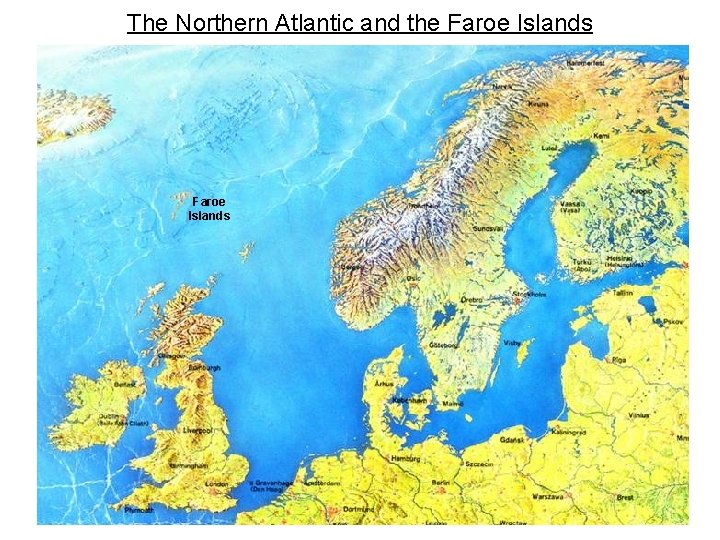
The Northern Atlantic and the Faroe Islands
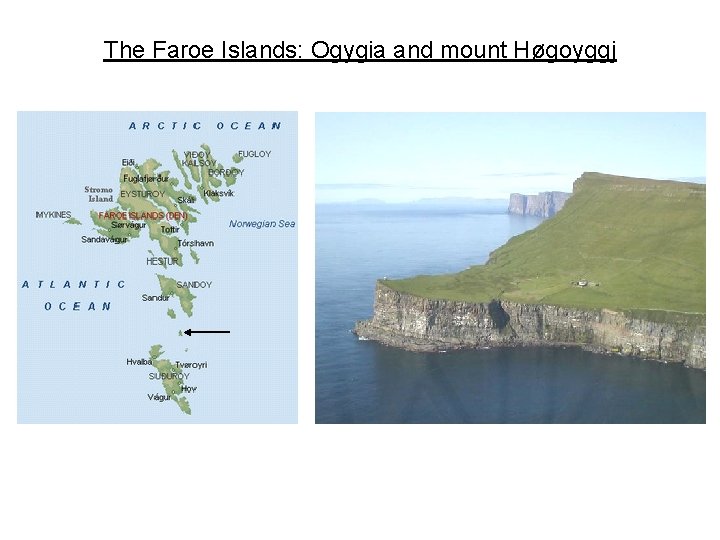
The Faroe Islands: Ogygia and mount Høgoyggj
Crossing from Ogygia to Scheria “The bright goddess Calypso told him to keep [the Bear] on his left-hand while sailing across the sea. He sailed through the sea for seventeen days, and on the eighteenth the shadowy mountains of the Phaeacian land appeared, which grew very close to him and looked like a shield on the misty sea” (Od. V, 276 -281)
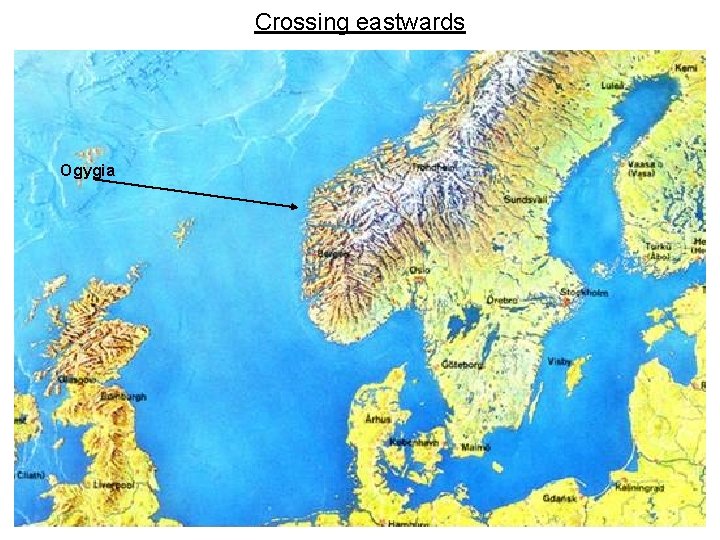
Crossing eastwards Ogygia
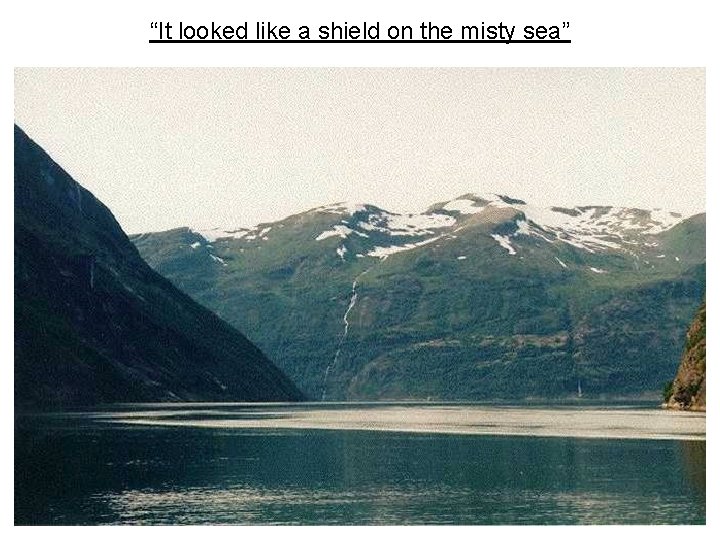
“It looked like a shield on the misty sea”
The North Wind carries Ulysses towards the Phaeacian land Here a violent storm breaks, and the goddess Athena goes to Ulysses’ rescue: “She locked the ways of the other winds, told them to stop and go to sleep, then called for the violent Boreas (the North Wind) and broke [the waves in front of him, so that he reached the Phaeacians, who are keen on ships” (Od. V, 383 -386)
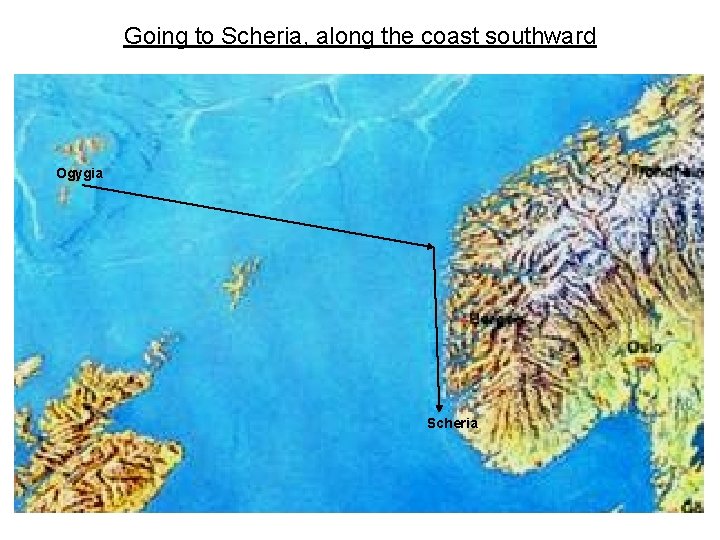
Going to Scheria, along the coast southward Ogygia Scheria
Scheria, the land of the Phaeacians “Scheria, ” has no meaning in Greek but is very close to a Old Norse word: “skerja, ” which means “sea rock” (“skjær” in modern Norwegian, similar to scar and skerry). Thus “Scheria” could be the “rocky land”, which squares with Homer’s descriptions, such as: “There were no coves or harbors for ships, only sheer cliffs, rocks and reefs” (Od. V, 404 -405)
Ulysses’ prodigious landing “By swimming he reached the mouth of a fine river which seemed to him to be the best place as it was free of rocks (…) It stopped its current at once, halted its flow, became still, and drew him to safety in the mouth of the river” (Od. V, 441 -443, 451 -453)
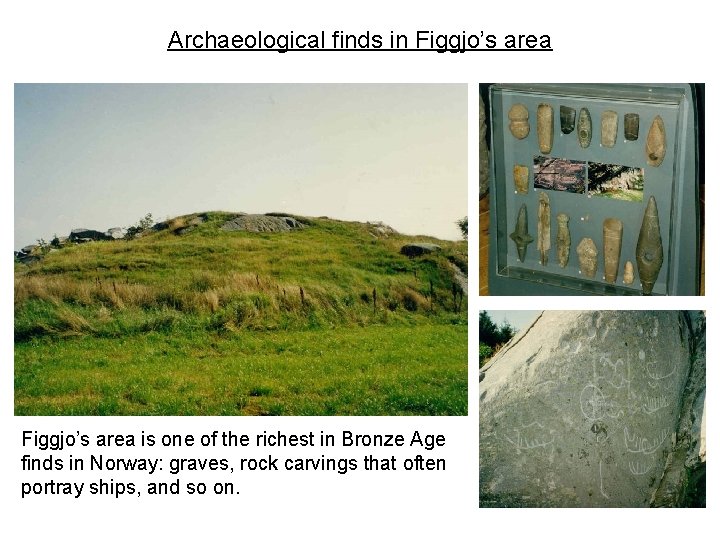
Archaeological finds in Figgjo’s area is one of the richest in Bronze Age finds in Norway: graves, rock carvings that often portray ships, and so on.
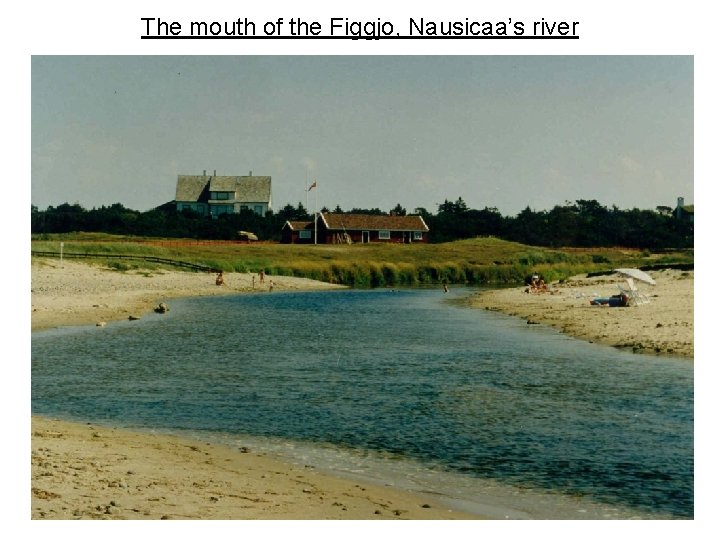
The mouth of the Figgjo, Nausicaa’s river
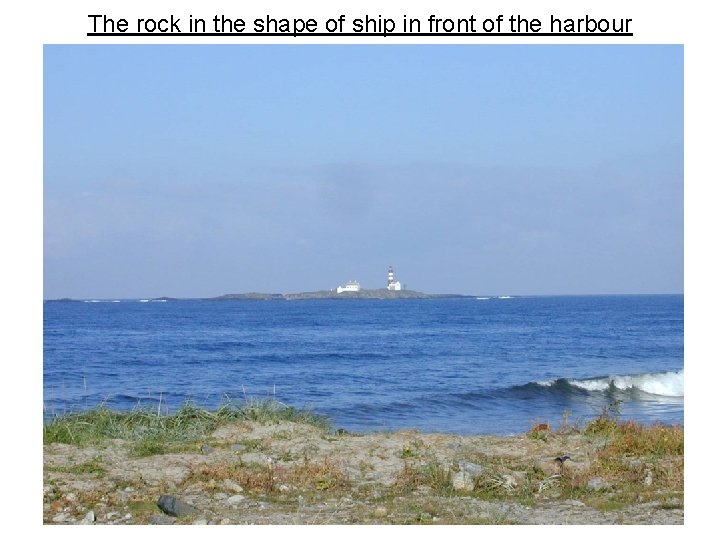
The rock in the shape of ship in front of the harbour
Ithaca’s archipelago “I live in bright Ithaca; here there is the famous Mount Neriton with its rustling leaves; many islands lie hereabouts, very close to each other, Dulichium, Same and wooded Zacynthus. But Ithaca lies down there, the last in the sea towards the night, whereas the others lie towards the dawn and the Sun” (Od. IX, 21 -26)
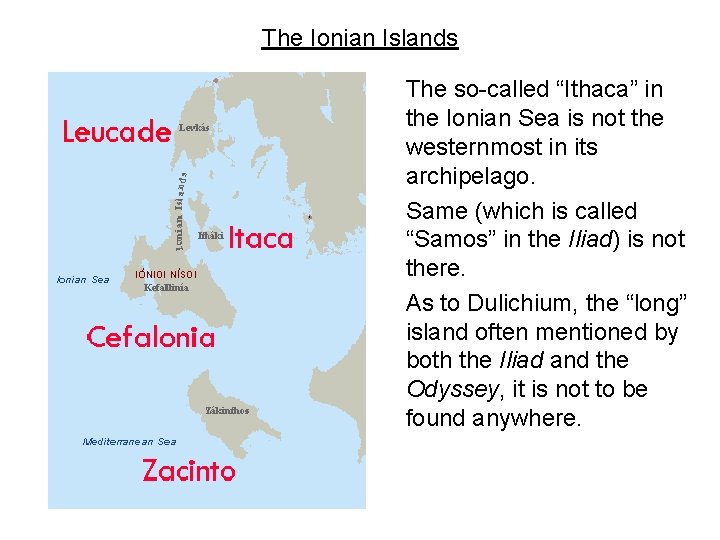
The Ionian Islands The so-called “Ithaca” in the Ionian Sea is not the westernmost in its archipelago. Same (which is called “Samos” in the Iliad) is not there. As to Dulichium, the “long” island often mentioned by both the Iliad and the Odyssey, it is not to be found anywhere.
The islands near the Homeric Ithaca 1. There are three main islands: Dulichium, Same, Zacynthus; 2. Ithaca is the westernmost island; 3. Same is close to Ithaca; 4. there is a small island in the strait between Ithaca and Same; 5. Dulichium is a “long” island (“δουλιχος”) facing Peloponnese; 6. the Homeric Peloponnese is flat.
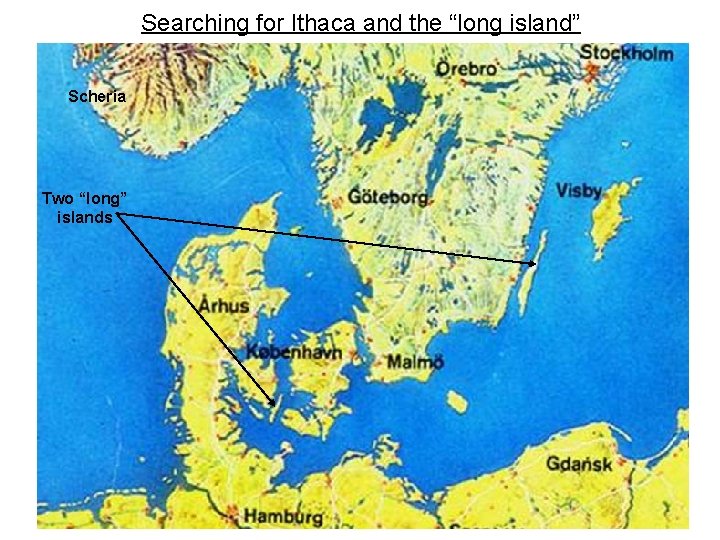
Searching for Ithaca and the “long island” Scheria Two “long” islands
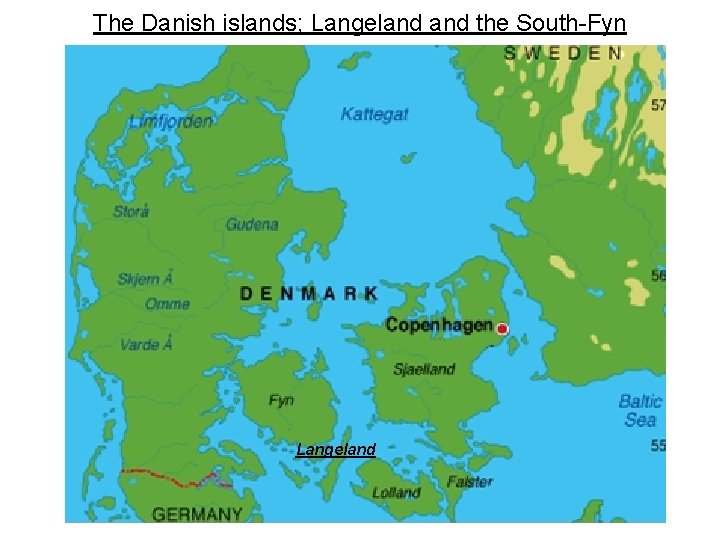
The Danish islands; Langeland the South-Fyn Langeland
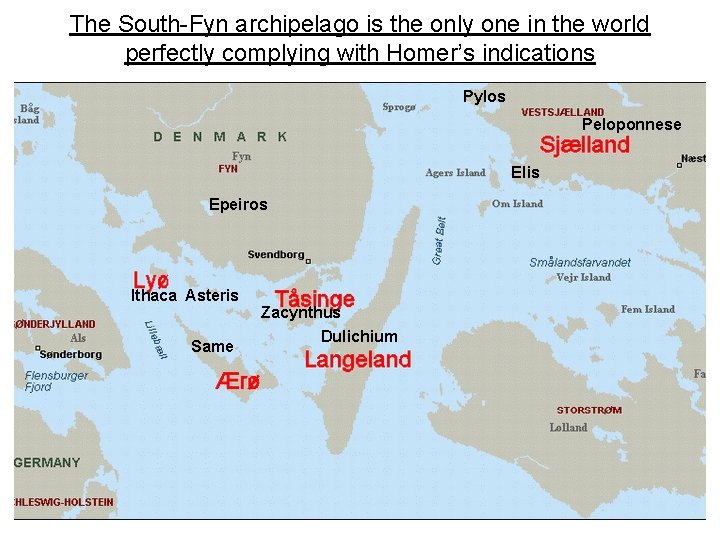
The South-Fyn archipelago is the only one in the world perfectly complying with Homer’s indications Pylos Peloponnese Elis Epeiros Ithaca Asteris Same Zacynthus Dulichium
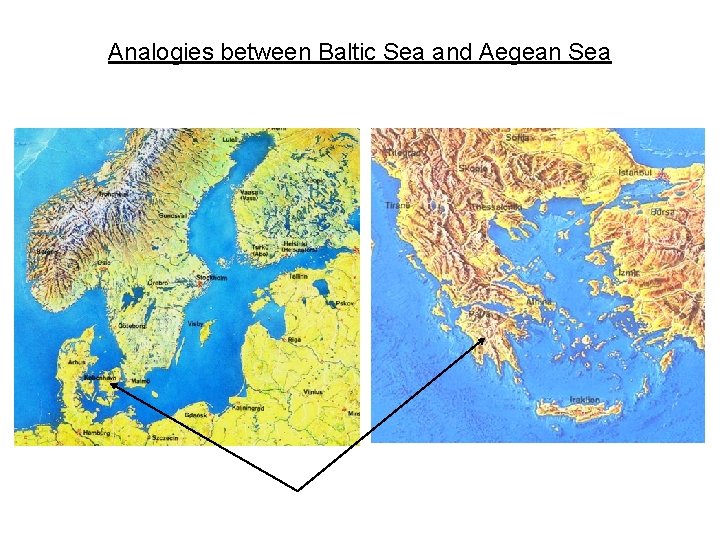
Analogies between Baltic Sea and Aegean Sea
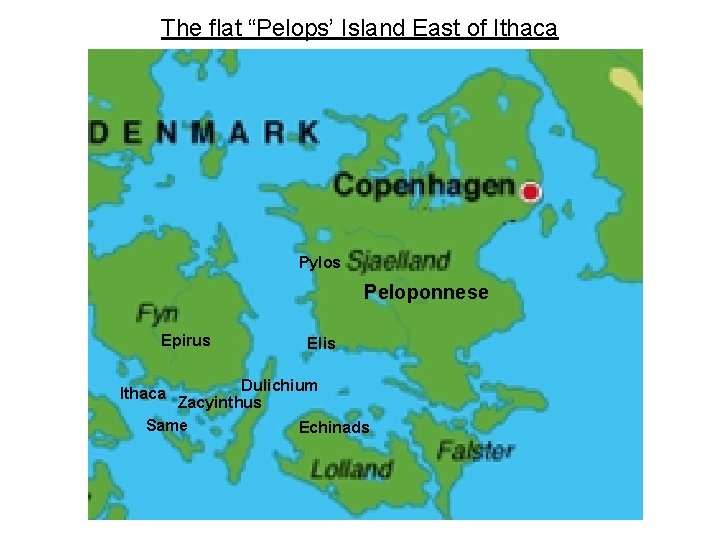
The flat “Pelops’ Island East of Ithaca Pylos Peloponnese Epirus Elis Dulichium Zacyinthus Same Echinads Ithaca
The map of the Ionian Ithaca “Even the topographical detail of Odysseus’ home island of Ithaca can be shown to be in a jumble, with several essential points appropriate to the neighboring island of Leucas but quite impossible for Ithaca” (Moses Finley, The World of Odysseus ) “Regarding the identification of the places described in Homer’s poems, if the hypotheses put forward about Thiaki are puzzling, then those regarding Leucas are not convincing either” (Treccani Italian Encyclopaedia)
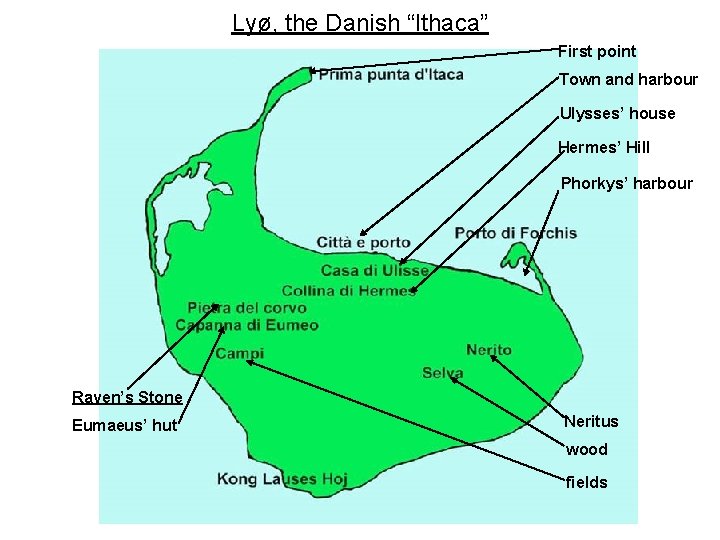
Lyø, the Danish “Ithaca” First point Town and harbour Ulysses’ house Hermes’ Hill Phorkys’ harbour Raven’s Stone Eumaeus’ hut Neritus wood fields
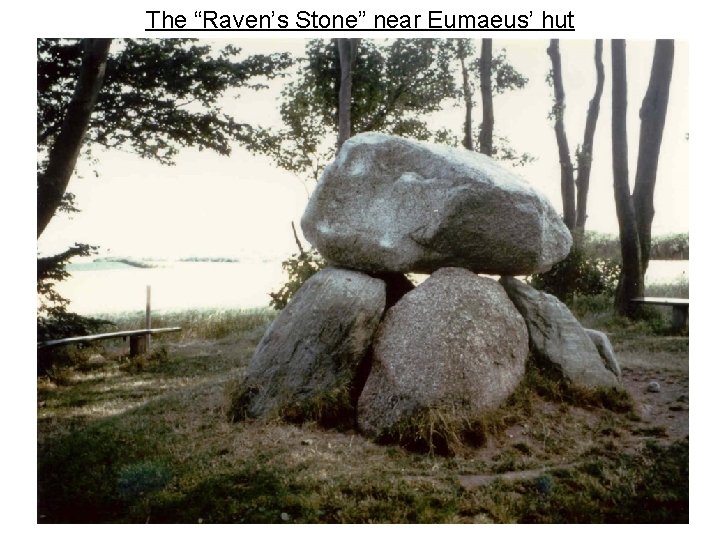
The “Raven’s Stone” near Eumaeus’ hut
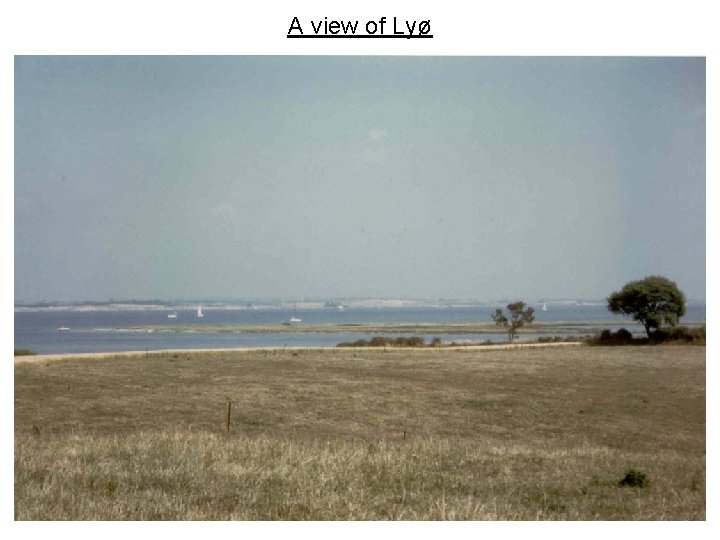
A view of Lyø
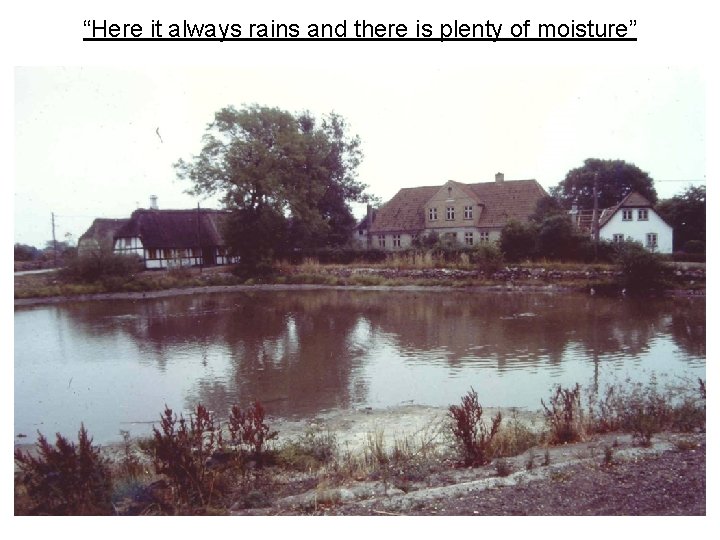
“Here it always rains and there is plenty of moisture”
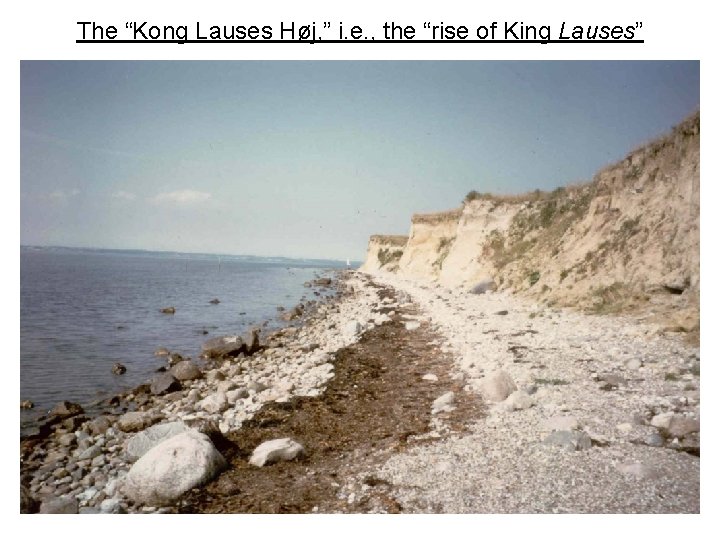
The “Kong Lauses Høj, ” i. e. , the “rise of King Lauses”
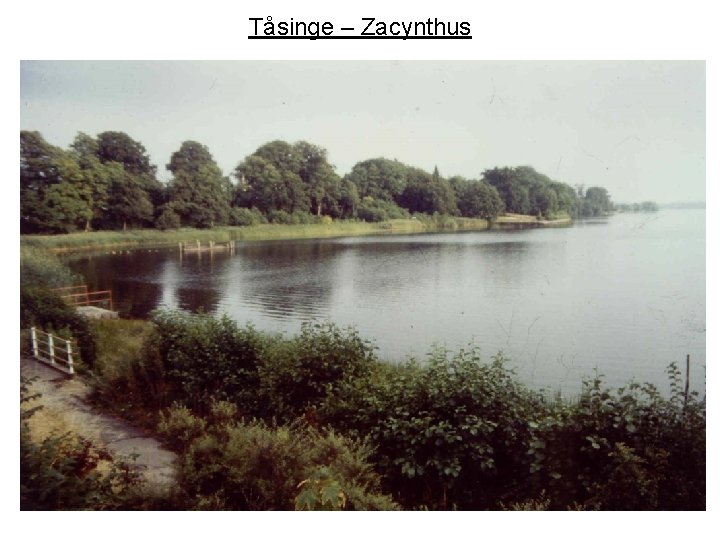
Tåsinge – Zacynthus
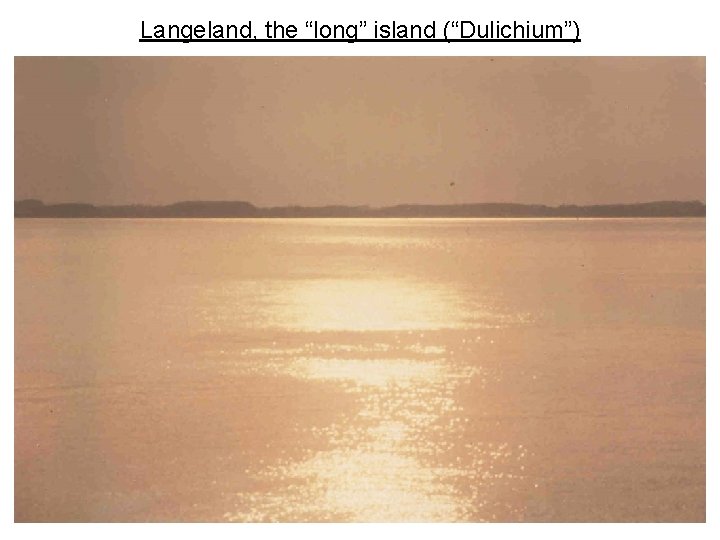
Langeland, the “long” island (“Dulichium”)
The fair-haired Ulysses “I am removing your blond hair (“ξανθάς τρίχας”) from your head” (Od. XIII, 399) Pindar mentions the “fair-haired Danaans” in his IX Nemean
A statement from Tacitus “Ceterum et Ulixen quidam opinantur longo illo et fabuloso errore in hunc Oceanum delatum adisse Germaniae terras” (Tacitus, Germania, 3, 2) “Some people believe that Ulysses too, in his long and fabulous wanderings arrived at this Ocean and visited the lands of Germany”
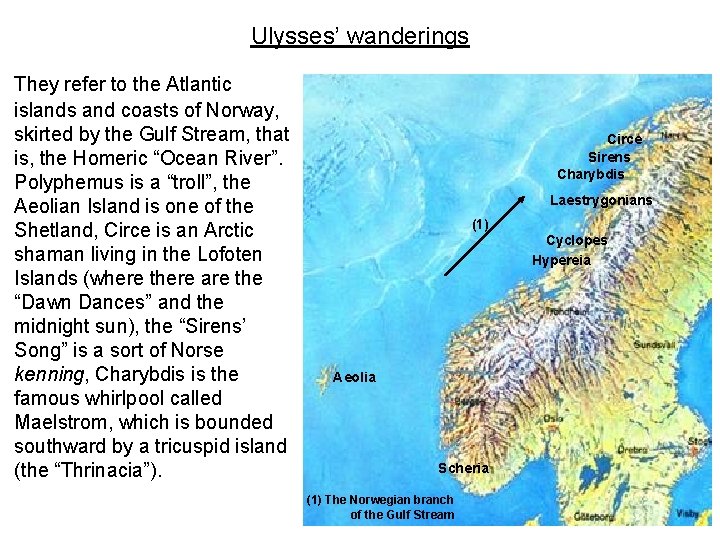
Ulysses’ wanderings They refer to the Atlantic islands and coasts of Norway, skirted by the Gulf Stream, that is, the Homeric “Ocean River”. Polyphemus is a “troll”, the Aeolian Island is one of the Shetland, Circe is an Arctic shaman living in the Lofoten Islands (where there are the “Dawn Dances” and the midnight sun), the “Sirens’ Song” is a sort of Norse kenning, Charybdis is the famous whirlpool called Maelstrom, which is bounded southward by a tricuspid island (the “Thrinacia”). Circe Sirens Charybdis Laestrygonians (1) Aeolia Scheria (1) The Norwegian branch of the Gulf Stream Cyclopes Hypereia
Calypso and the Celtic world One of the favourite destinations in Celtic tales are the paradisiacal islands situated in the middle of the ocean, towards the far west, where divine women refresh the heroes coming there and make love with them. They also offer them immortality and everlasting youth, as we see in Immram curaig Màele Dùin (The Voyage of Màel Dùin’s Ship) and Immram Brain maic Febail (The Voyage of Febal’s Son Bran). All of this is identical to the island of the goddess Calypso, remote in the ocean towards the west, who had promised to make Ulysses “immortal and ageless (“athànaton kaì agéron”) forever” (Od. V, 136)
The Northern origin of the Mycenaean civilization Bertrand Russell claims that the Mycenaean civilization originated from fair-haired Northern invaders taking the Greek language along with themselves. (Russell, History of Western Philosophy, Chap. 1)
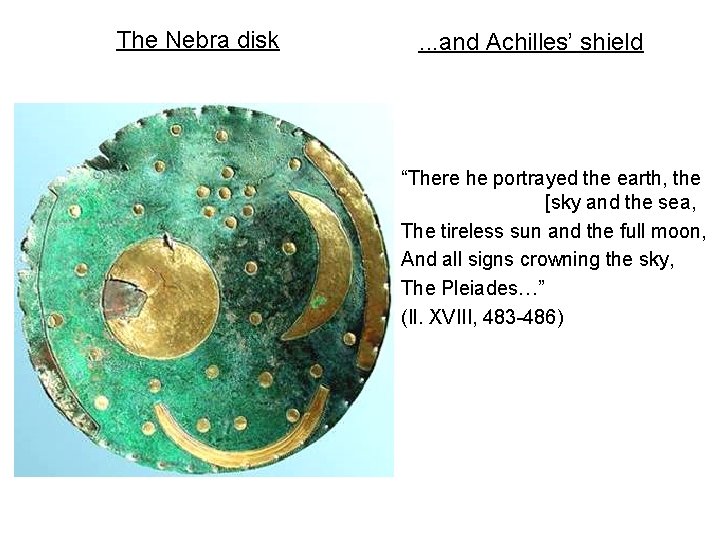
The Nebra disk . . . and Achilles’ shield “There he portrayed the earth, the [sky and the sea, The tireless sun and the full moon, And all signs crowning the sky, The Pleiades…” (Il. XVIII, 483 -486)
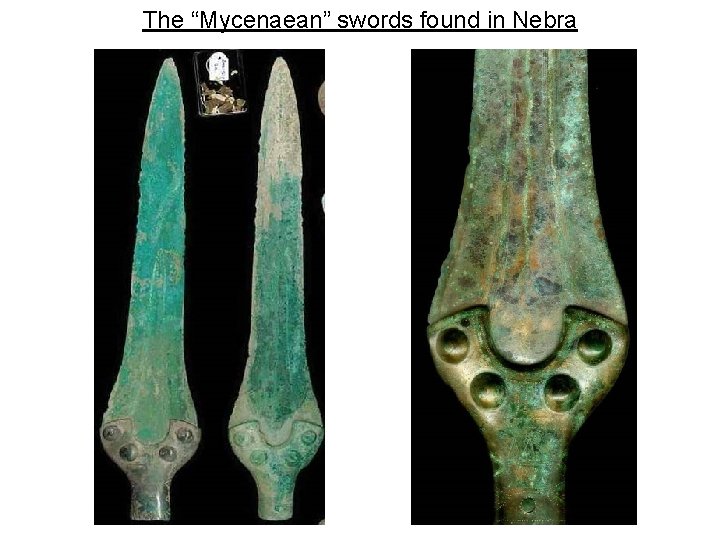
The “Mycenaean” swords found in Nebra
Homer, Mycenaeans and Northern Europe “The nobility of the [Homeric] hexameters shouldn’t deceive us, inducing us to believe that the Iliad and the Odyssey are something different from the poems of the largely barbaric Europe during the Bronze Age and the Early Iron Age. No Minoic or Asian blood runs in the veins of the Greek Muses: they are far away from the Cretan-Mycenaean world. Rather they are in contact with the European elements of Greek culture and language (…) Behind Mycenaean Greece Europe extends” (Piggott, Ancient Europe)
Mycenaean architecture “…Owing to many of these characteristics (gable roofs, closed buildings, fixed fireplaces) the Mycenaean palaces recall the cold and damp northern countries, from which they undoubtedly came (…) They are very different from the typically Mediterranean architectural conception of the buildings of Crete” (Lévêque, Greek Civilization)
The Northern origin of the Mycenaeans “A very important discovery was made in a chamber tomb at Dendra. It seems to have been a cenotaph (. . . ) Their similarity with the menhirs, known from the Bronze Age of Central Europe, is striking, and their identity with these sacred stones seems hardly possible to deny. If this is so, it is a very striking corroboration of the northern origin of the Mycenaeans” “The structure of the megaron, i. e. , the main hall of the Mycenaean buildings, was also very well suited for a chief surrounded by retainers and table companions, and is identical with the hall of the old Scandinavian kings” (Nilsson, Homer and Mycenae)
The Homeric world is more archaic than the Mycenaean one “The Linear B texts show that the Mycenaean society is very different from the Homeric one, both as to extension and quality: the former has a lot of riches, a complex political, administrative and military machinery, a population performing many dozens of different professional occupations, while in the Iliad the social division of labour is only beginning to loom” (Codino, preface to the Iliad)
The question of Dionysus is a very important god in the Greek world, both in Mycenaean civilization and in classical Greece. On the contrary, this god is almost entirely neglected by Homer. This is incomprehensible if one places the latter after the Mycenaean age. On the contrary, by admitting that Homer precedes it, everything becomes clear: Dionysus became important after the Mycenaeans settled in the Mediterranean. This is also consistent with the fact that the world of Homer is more archaic than that of the Mycenaeans. This could also explain the remarkable differences between Homer’s and Hesiod’s pantheons.
Analogies between Achaeans and Vikings There amazing analogies between Homeric Achaeans and Vikings, in the fields of their mythologies, social relations, interests, lifestyles and so on. For example, the Homeric sea-god called Aigaion, whose name is found in the Aegean Sea, corresponds to Aegir, the Norse Lord of seas. Moreover, the Valkyries, who carry the souls of the warriors fallen in battle to Valhalla, are identical to the Homeric Kere: “(…) The dreadful Kere seized now a warrior who had just been wounded, now another unhurt, now she dragged a corpse by its foot in the fight. She wore a cloak around her shoulders, which was red with human [blood” (Il. XVIII, 535 -538)
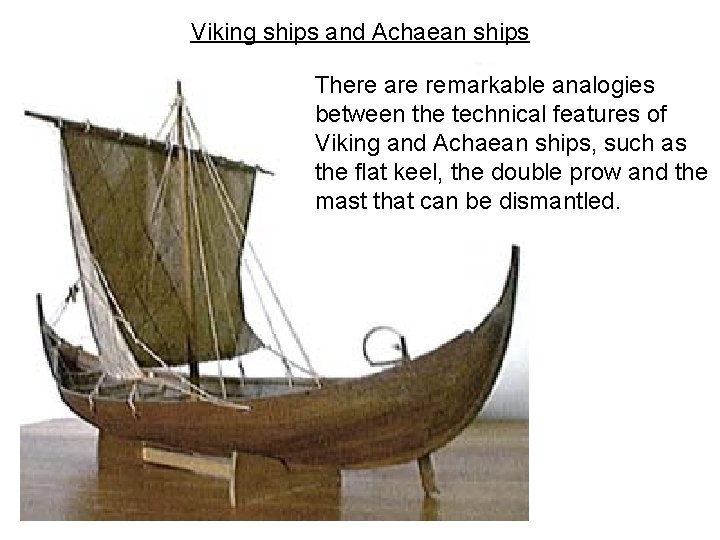
Viking ships and Achaean ships There are remarkable analogies between the technical features of Viking and Achaean ships, such as the flat keel, the double prow and the mast that can be dismantled.
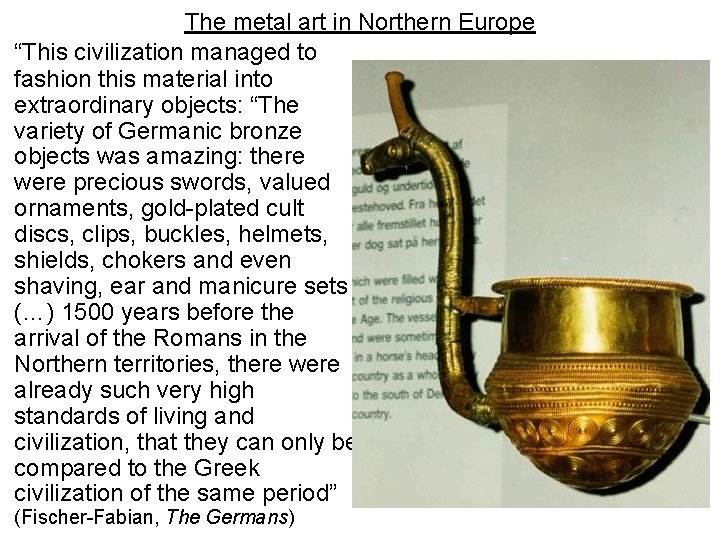
The metal art in Northern Europe “This civilization managed to fashion this material into extraordinary objects: “The variety of Germanic bronze objects was amazing: there were precious swords, valued ornaments, gold-plated cult discs, clips, buckles, helmets, shields, chokers and even shaving, ear and manicure sets (…) 1500 years before the arrival of the Romans in the Northern territories, there were already such very high standards of living and civilization, that they can only be compared to the Greek civilization of the same period” (Fischer-Fabian, The Germans)
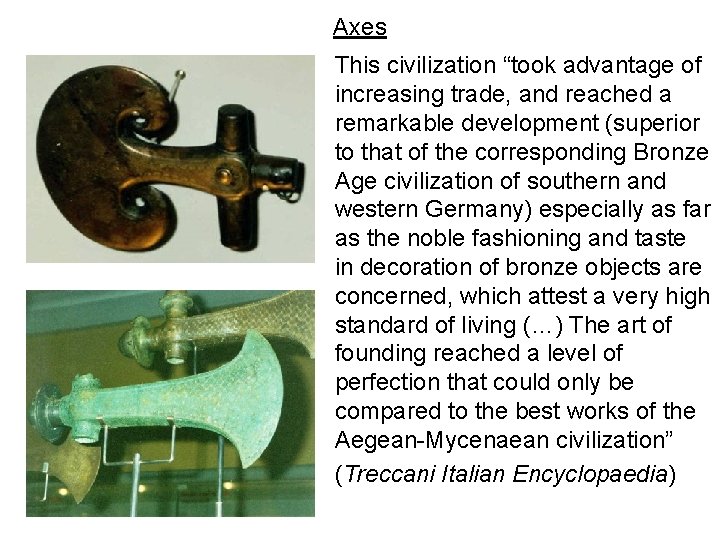
Axes This civilization “took advantage of increasing trade, and reached a remarkable development (superior to that of the corresponding Bronze Age civilization of southern and western Germany) especially as far as the noble fashioning and taste in decoration of bronze objects are concerned, which attest a very high standard of living (…) The art of founding reached a level of perfection that could only be compared to the best works of the Aegean-Mycenaean civilization” (Treccani Italian Encyclopaedia)
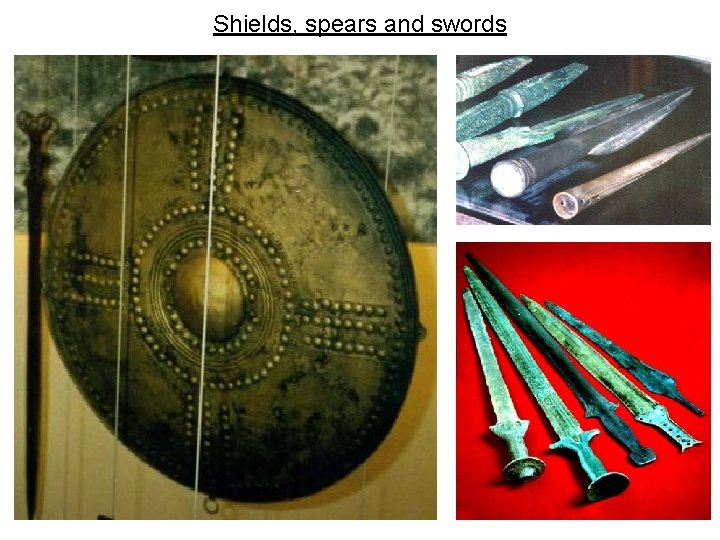
Shields, spears and swords
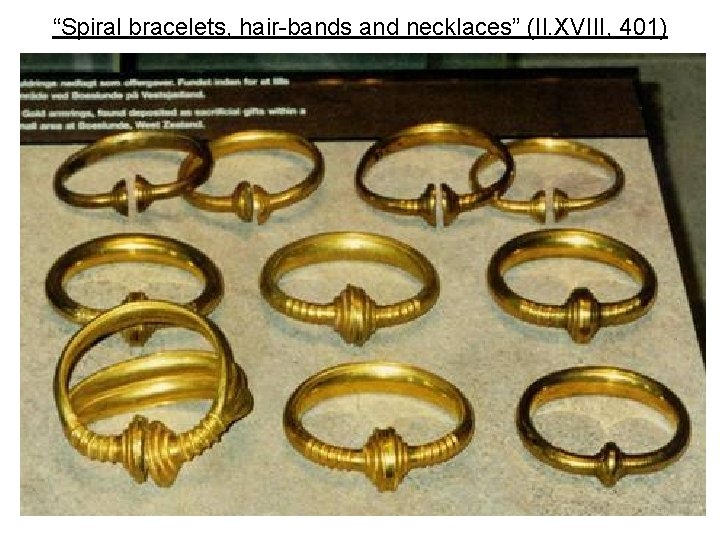
“Spiral bracelets, hair-bands and necklaces” (Il. XVIII, 401)
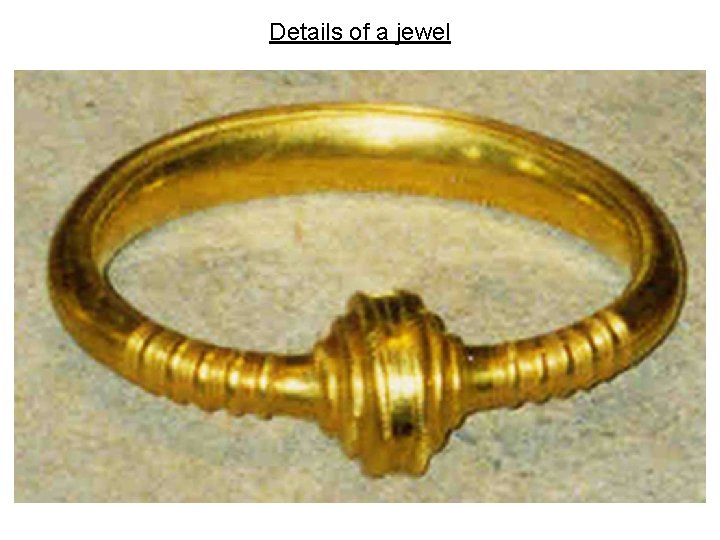
Details of a jewel
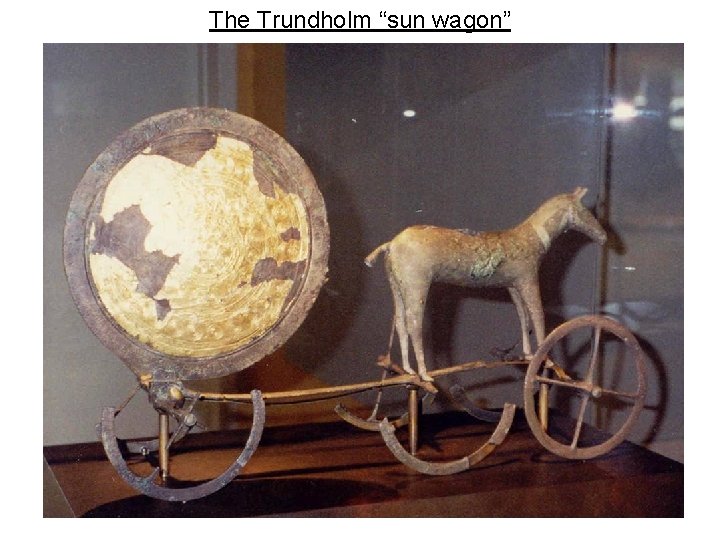
The Trundholm “sun wagon”
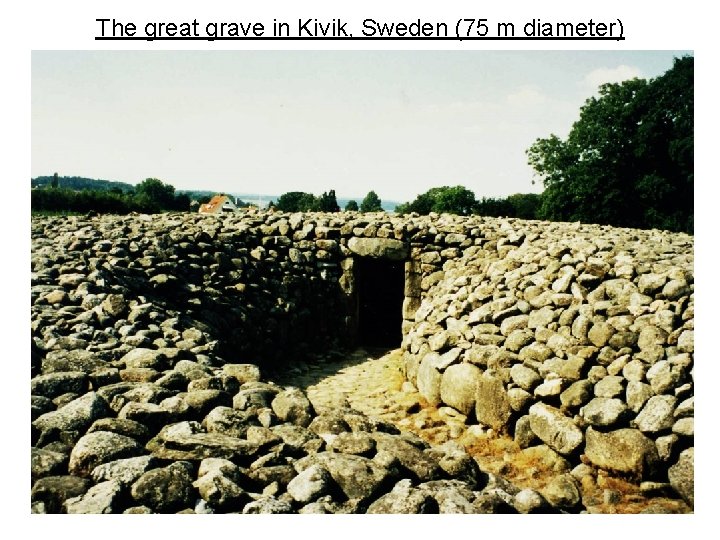
The great grave in Kivik, Sweden (75 m diameter)
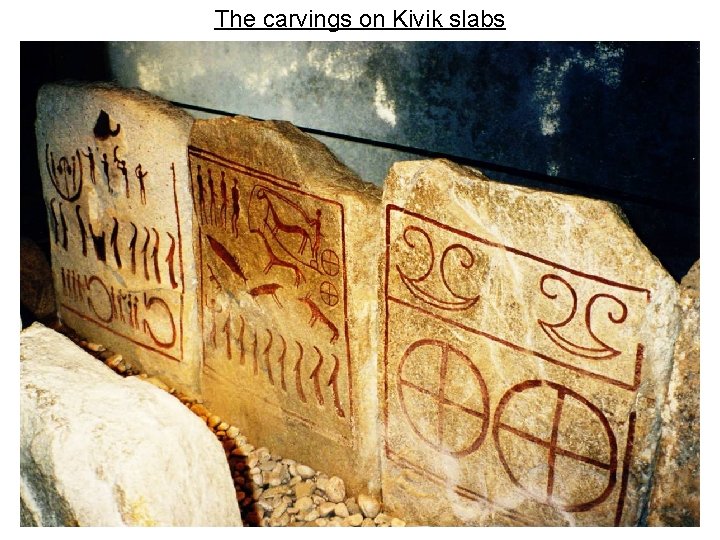
The carvings on Kivik slabs
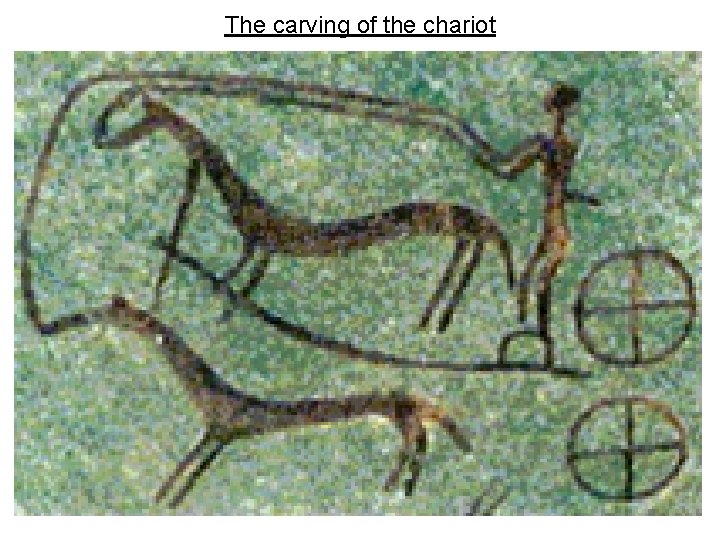
The carving of the chariot
The “Climatic Optimum” in Northern Europe It was “the best climatic period Scandinavian countries have ever known, which justifies the high cultural level reached in Scandinavia around 2500 B. C. (…) This long, favourable climatic period saw the development of the Northern culture, including the Maglemose and Ertebölle civilizations, the dolmens, the ‘passage grave’ tombs and the Bronze Age culture” However, afterwards “the temperature dropped (…) The beech trees spread and leafy flora migrated from northern Sweden to more southern areas (…) This cold climate, whose peak coincides with the Iron Age, blocked the northern culture’s most promising energies. The legendary Fimbul. Winter spread poverty and death with its chill, thus forcing the peoples to migrate” (Zambotti, The Most Ancient Northern Civilizations)
Sir Colin Renfrew Radiocarbon dating, corrected with dendrochronology, i. e. , tree-ring calibration, has recently corrected the idea of the Eastern origin of European civilization. Prof. Colin Renfrew describes the consequences for traditional chronology: “These changes bring with them a whole series of alarming reversals in chronological relationships. The megalithic tombs of Western Europe now become older than the Pyramids or the round tombs of Crete, their supposed predecessors. The early metal-using cultures of the Balkans antedate Troy and the early Bronze Age Aegean, from which they were supposedly derived. And in Britain, the final structure of Stonehenge, once thought to be the inspiration of Mycenaean architectural expertise, was complete well before the Mycenaean civilization began” (Renfrew, Before Civilization)
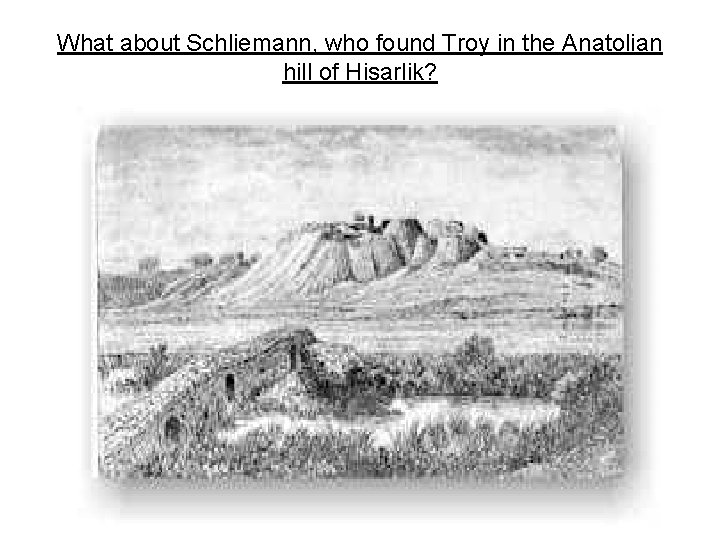
What about Schliemann, who found Troy in the Anatolian hill of Hisarlik?
Strabo and geology “Strabo reports that the plain had been an inlet of the sea at the time of the Trojan War and that since then it had been filled in by silt brought down by the river. Schliemann was eager to disprove this statement, for it was one of the chief arguments against the Troy-Hisarlik theory. If the sea had come up to the walls of Troy, how could the Greeks and Trojans have ranged back and forth on the plain between the city and the sea, as Homer tells us? (. . . ) Thanks to a series of core samples taken in 1977 we now know that in prehistoric times the plain was covered by an extensive arm of the sea, which reached up to Hisarlik (. . . ) Strabo therefore was correct and the findings of Schliemann, Burnouf and Virchow, based as they were on inadequate samples, were in error” (Traill, Schliemann of Troy)
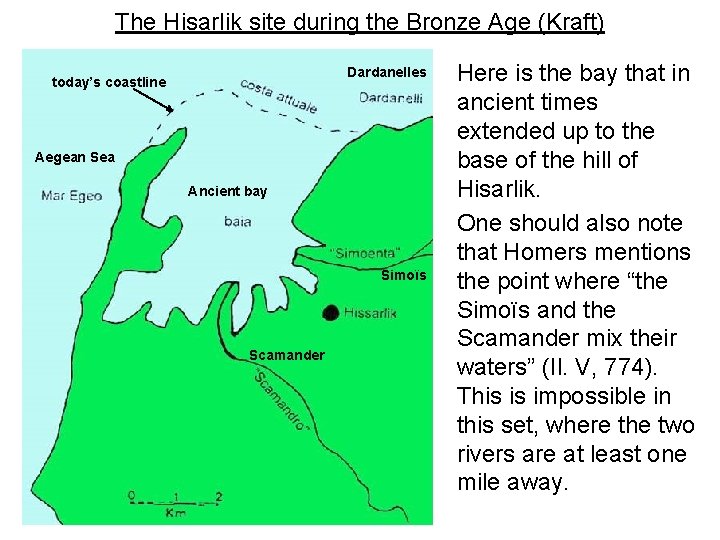
The Hisarlik site during the Bronze Age (Kraft) Dardanelles today’s coastline Aegean Sea Ancient bay Simoïs Scamander Here is the bay that in ancient times extended up to the base of the hill of Hisarlik. One should also note that Homers mentions the point where “the Simoïs and the Scamander mix their waters” (Il. V, 774). This is impossible in this set, where the two rivers are at least one mile away.
Moses Finley on the puzzling Hisarlik “Not a single scrap links the destruction of Troy VIIa with Mycenaean Greece, or with an invasion from any other source. Nor does anything known from the archaeology of Greece and Asia Minor or from the Linear B tablets fit with the Homeric tale of a great coalition sailing against Troy from Greece (…) nor is a Trojan War mentioned (. . . ) Not a scrap was uncovered at Troy to point to Agamemnon or any other conquering king or overlord, or to a Mycenaean coalition or even to a war (…) If this citadel was not sacked we are left without a compelling reason even to go on calling it Troy’” (Finley, The World of Odysseus)
Wilusa is not Ilium “Troy/Filium was not Wilusa (…) As to the supposed relationship between Wilusas’s King Alaksandus and Paris Alexandrus, Priam’s son, “King Alaksandus’ father was not called Priam but Kukunni” (moreover, Paris never was king of Troy) (Dieter Hertel, Troy)
The rigorous climate in the Homeric world “The night was bad, after the north wind dropped, and freezing; then the snow began to fall like icy frost and ice congealed on our shields” (Od. XIV, 475 -477)
The heavy clothes of the Homeric heroes In the episode where Telemachus and Peisistratus were guests of Menelaus in Sparta, they got ready for lunch after a bath: “They wore thick cloaks and tunics/ and sat down on chairs” (Od. IV, 50 -51) The same goes for Ulysses, at Alcinous’: “They dressed him in a fine woollen cloak and tunic; / he left the bath and joined the lords/ who were drinking” (Od. VIII, 455 -457) When Uysses was in Crete, he wore “a thick and double cloak” (Od. XIX, 225) Nestor’s cloak was “double and large; a thick fur stuck out” (Il. X, 134) When Achilles left for Troy, his mother prepared him a trunk “filled with tunics, / wind-proof thick cloaks and blankets” (Il. XVI, 223 -224)
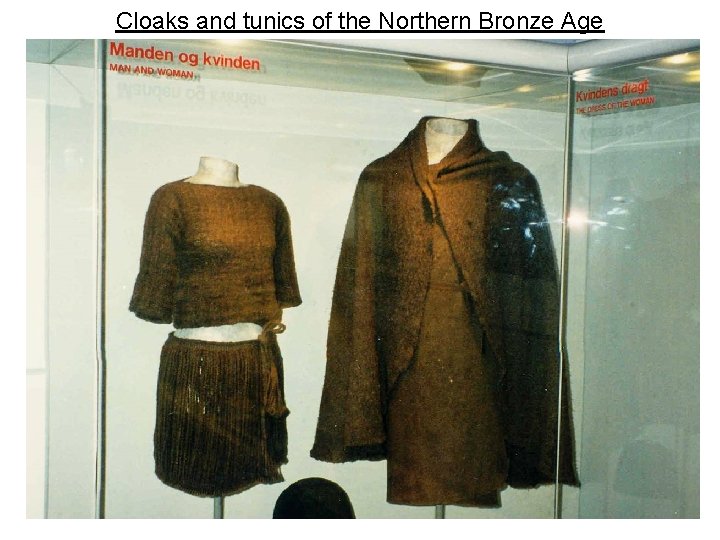
Cloaks and tunics of the Northern Bronze Age
Fog on the battlefield “You were not able to say whethere was still the Sun or the Moon; in the battle fog had closed in upon the strongest men” (Il. XVII, 366 -368) “I am not able to see any of the Achaeans! Men and horses are shrouded all and sundry in the fog. Thou, Father Zeus, free the sons of the Achaeans from the fog, make the sky clear and allow us to see!” (Il. XVII, 643 -646)
The Homeric “boundless Hellespont” Troy was lying near a wide sea called Hellespont: “In the whole of the country that is bounded by Lesbos upper Phrygia and boundless Hellespont” (Il. XXIV, 544 -545) In other passages where Hellespont is mentioned the adjective “πλατυς”, “wide” is found. It is very difficult to identify this wide sea with the narrow Mediterranean Hellespont, i. e. the Straits of the Dardanelles.
The northern Hellespont quoted by Saxo Grammaticus “After these events, Regner, who was preparing an expedition against the Hellespontians, convened a meeting of the Danes (…) After a series of repeated attacks, he defeated and subjected Hellespont and its King Dian. (Saxo Grammaticus, Gesta Danorum) Therefore, it is very likely that in Northern Europe there was another Hellespont, that is, the wide sea mentioned by Homer, which afterwards was transposed into the Mediterranean as it happened to the Peloponnese.
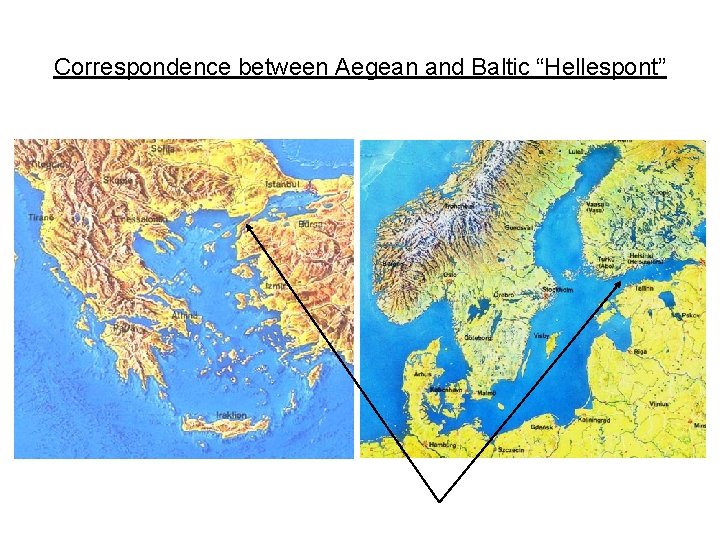
Correspondence between Aegean and Baltic “Hellespont”
Troy’s location as with respect to sea “I am going to arouse a violent storm of Zephyrus and bright Notus from sea” Zephyrus is the West Wind, Notus is the South Wind. This implies that sea lay south-west of the city. Thus Troy lay north-east of sea, in an area facing the Gulf of Finland.
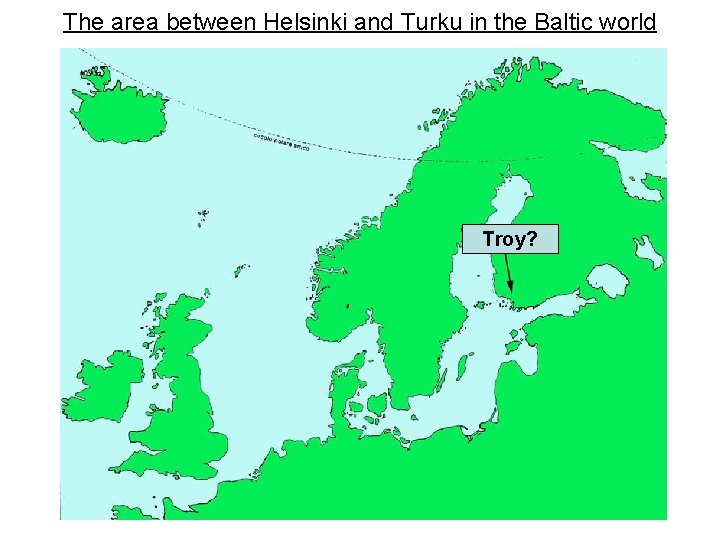
The area between Helsinki and Turku in the Baltic world Troy?
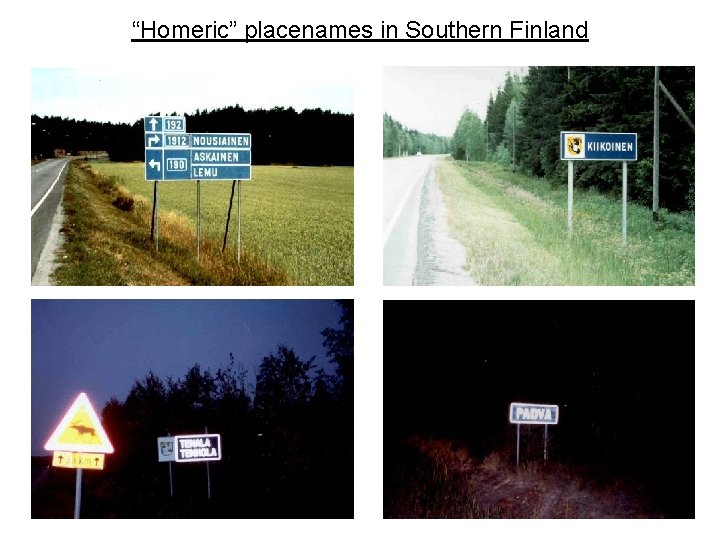
“Homeric” placenames in Southern Finland
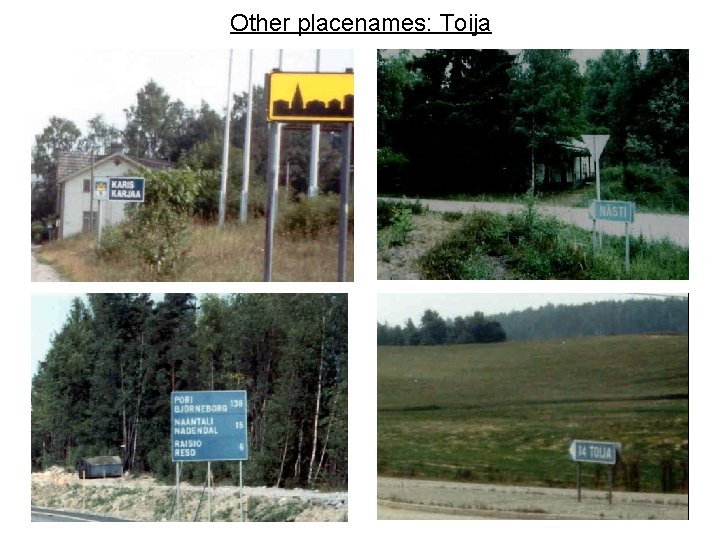
Other placenames: Toija
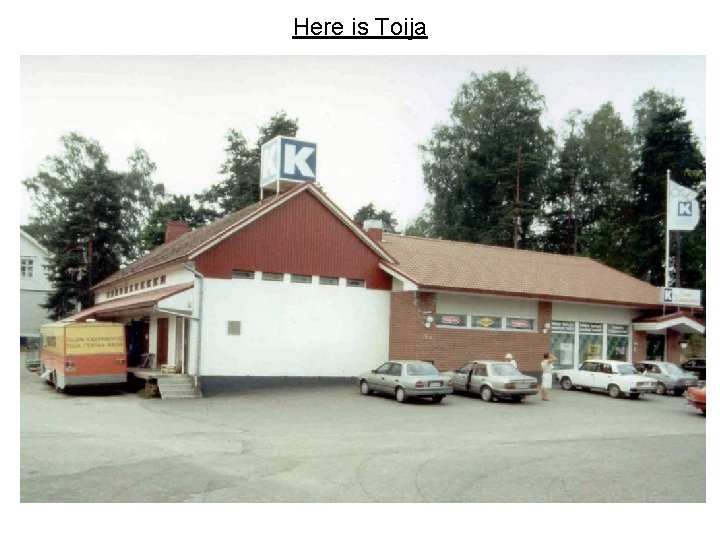
Here is Toija
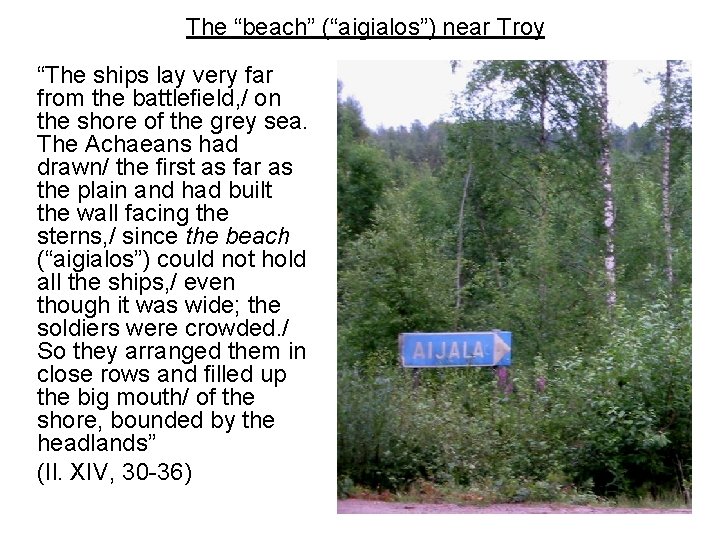
The “beach” (“aigialos”) near Troy “The ships lay very far from the battlefield, / on the shore of the grey sea. The Achaeans had drawn/ the first as far as the plain and had built the wall facing the sterns, / since the beach (“aigialos”) could not hold all the ships, / even though it was wide; the soldiers were crowded. / So they arranged them in close rows and filled up the big mouth/ of the shore, bounded by the headlands” (Il. XIV, 30 -36)
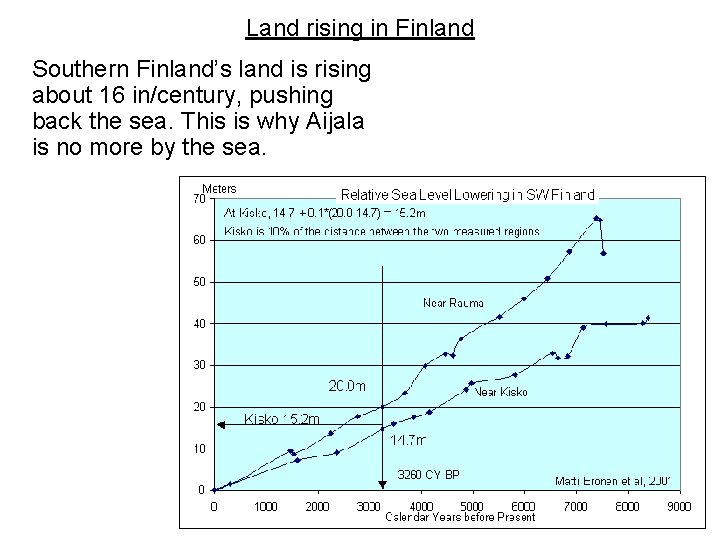
Land rising in Finland Southern Finland’s land is rising about 16 in/century, pushing back the sea. This is why Aijala is no more by the sea.
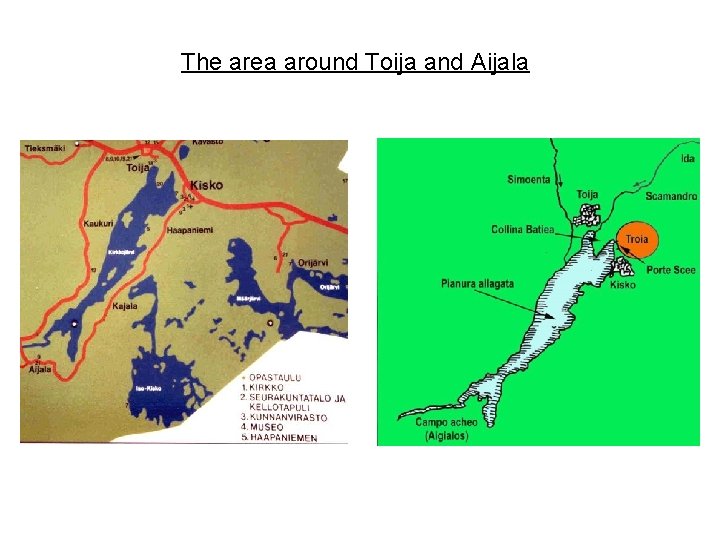
The area around Toija and Aijala
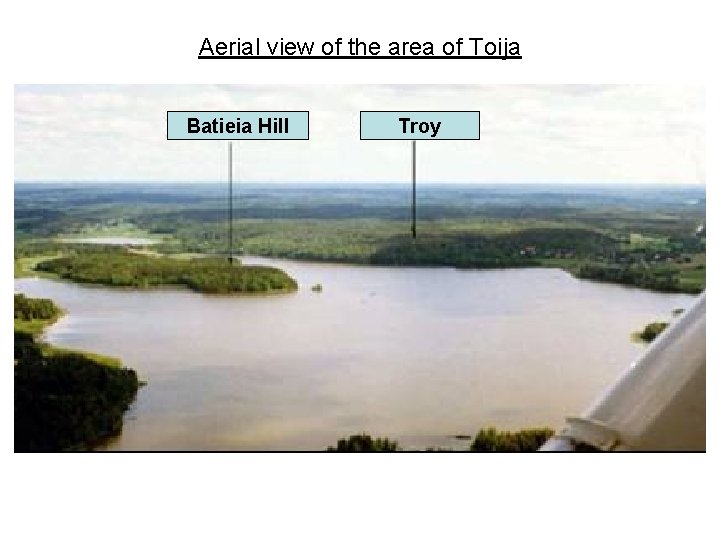
Aerial view of the area of Toija Batieia Hill Troy
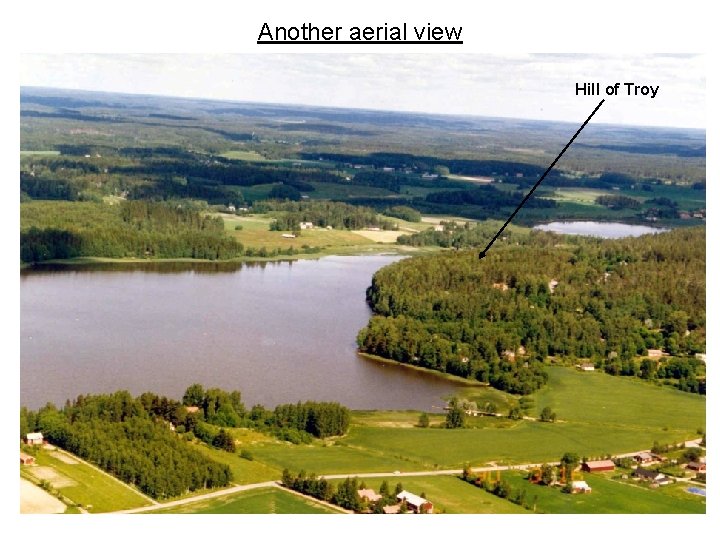
Another aerial view Hill of Troy
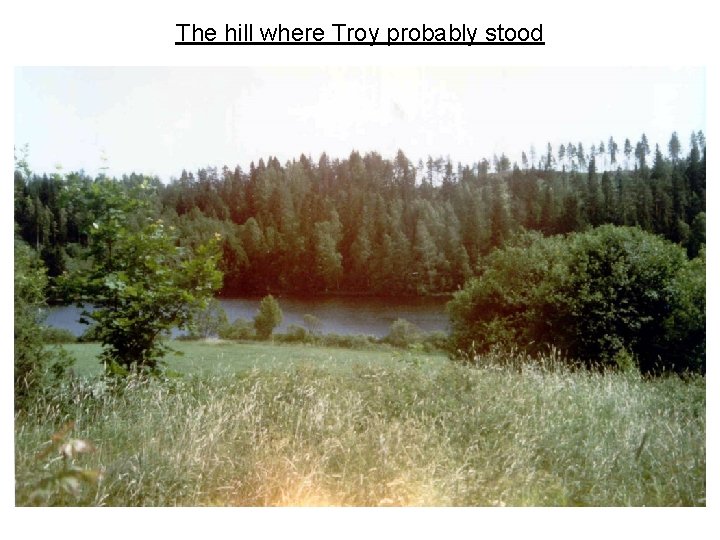
The hill where Troy probably stood
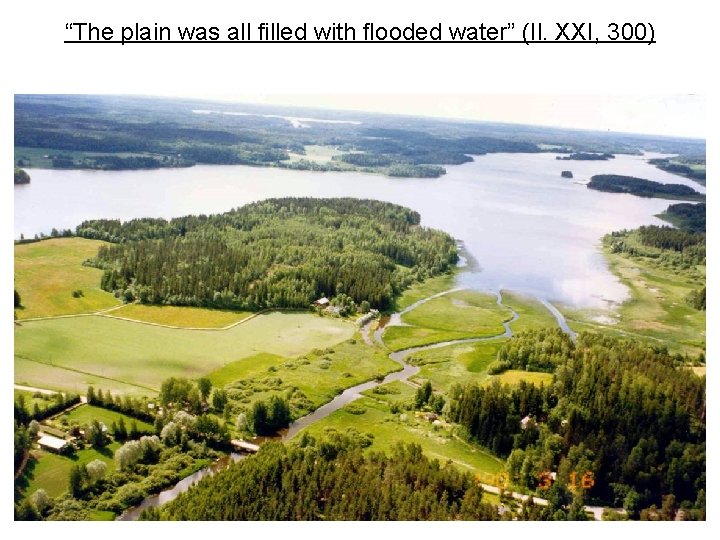
“The plain was all filled with flooded water” (Il. XXI, 300)
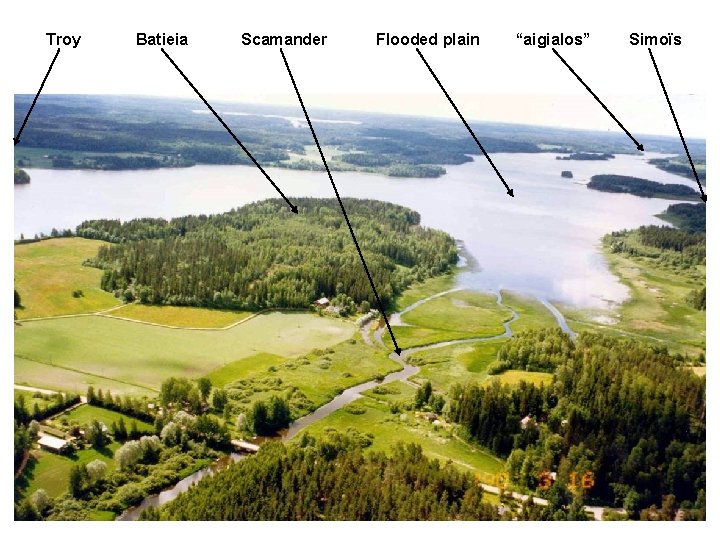
Troy Batieia Scamander Flooded plain “aigialos” Simoïs
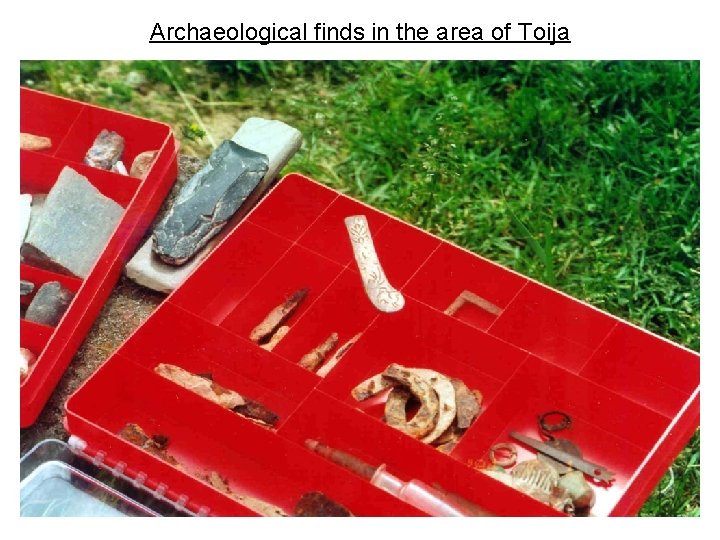
Archaeological finds in the area of Toija
Homeric and Northern graves Hector undertakes to give back the corpse of his opponent “so that the long-haired Achaeans can bury him, and erect a mound for him on the broad Hellespont; and some day one of the men to come, sailing with a multioared ship on the wine-dark sea, will say: This is the mound of a man slain in ancient times” (Il. VII, 85 -89) In the Beowulf the tomb of the protagonist is “a mound on the headland over the sea which will rise over Whale Cape so that sailors will later call it ‘Beowulf’s mound’ when they drive their ships beyond sea’s mist” (Beowulf, 2803 -2807)
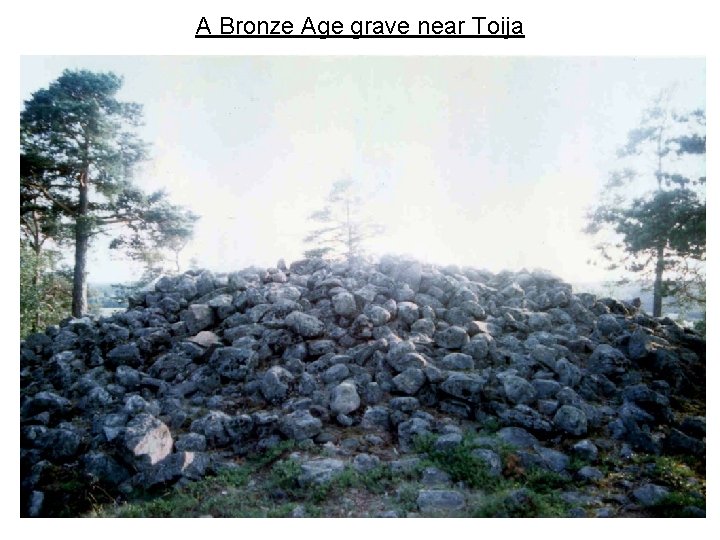
A Bronze Age grave near Toija
Homer and the ancient barbarian Europe “The world of second millennium barbarian Europe was essentially the world of the Iliad and the Odyssey (. . . ) The heroes of the stories, for all the poet’s skill, remain obstinately of an alien world, primitive and barbaric. Perhaps not enough stress is laid on the features of Homer’s world that are common to those of the Irish hero-tales, Beowulf or the Sagas, and must have been a commonplace of the lost oral literature of the whole of ancient barbarian Europe” (Piggott, Ancient Europe)
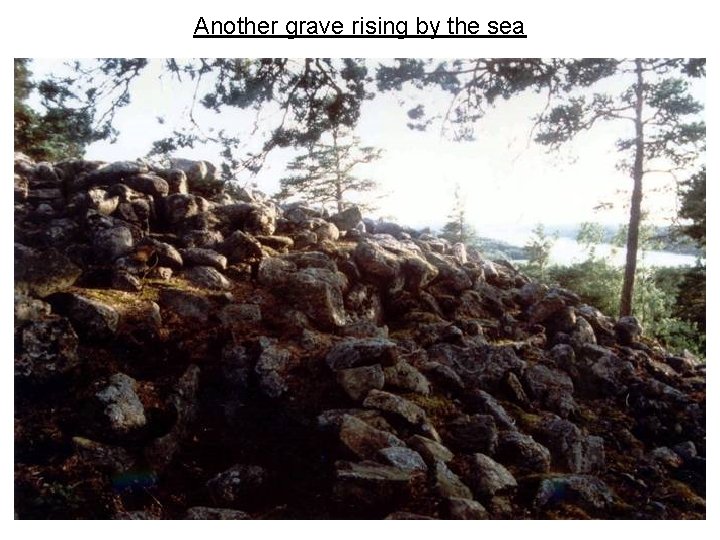
Another grave rising by the sea
The anomaly of the night battle In the longest battle of the Iliad there are two middays. This implies an interposed night, that is actually recorded: Zeus spread a dreadful night out over the strenuous battle so that the effort of the fight around his beloved son was [dreadful” (Il. XVI, 567 -568). What is anomalous is that the night does not stop the battle, that goes on nonstop until the following night. This is very strange in a Mediterranean set.
The clear night In the area of Toija, at about 60° latitude, the June nights are quite clears (according to Plutarch, this phenomenon is also found in Ogygia. Actually, Faroe Islands’ latitude is similar to Southern Finland). This phenomenon is recorded in the Iliad: When it was still dimly-lit night [“αμφιλύκη νύξ”], before dawn [broke, then a group of Achaeans gathered by the pyre, and made a tumulus over” (Il. VII, 433 -435). One should note that the Homeric term “amphilyke” is extremely uncommon in Greek literature. It is only found in the Argonautics by Apollonius Rodius, in a passage where the Hyperborean Apollo is mentioned (Arg. II, 671).
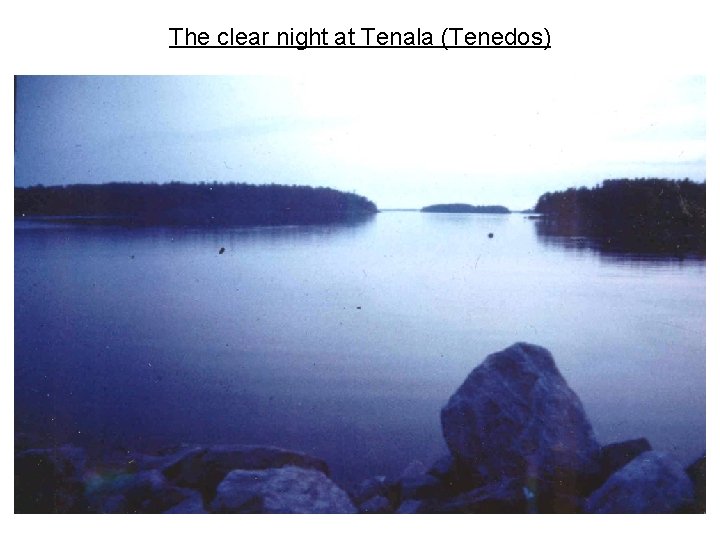
The clear night at Tenala (Tenedos)
Homer in person confirms that the battle lasted two days “They fought all day (“παν δ’ημαρ”) by the Scaean Gates” (Il. XVIII, 454)
The concomitance with the flood of the Trojan rivers The clear night in June, that allows to fight until the day after, squares with the overflowing of the River Scamander during the following battle, because overflowings of the Northern rivers usually occur in May or June owing to the spring thaw.
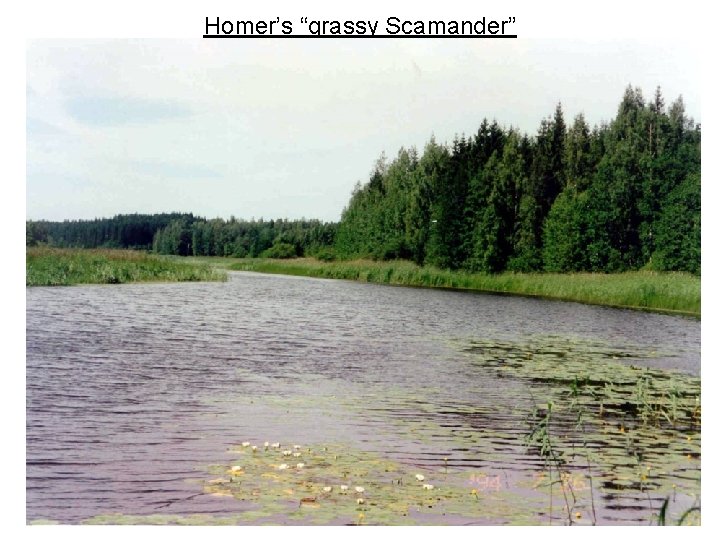
Homer’s “grassy Scamander”
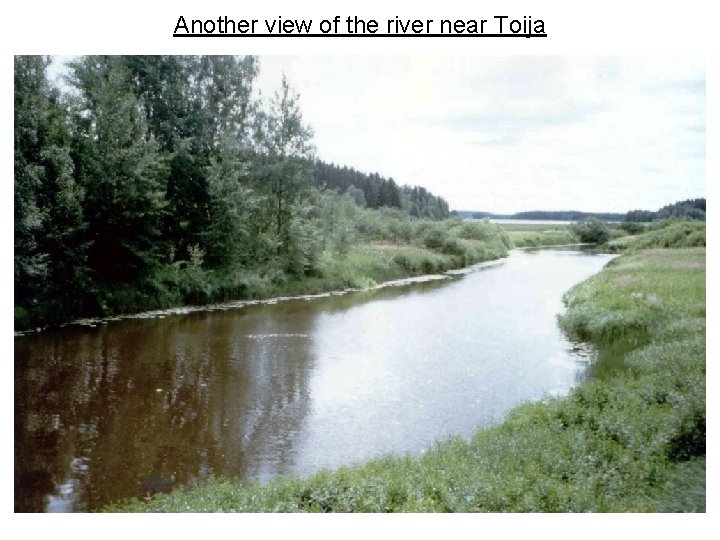
Another view of the river near Toija
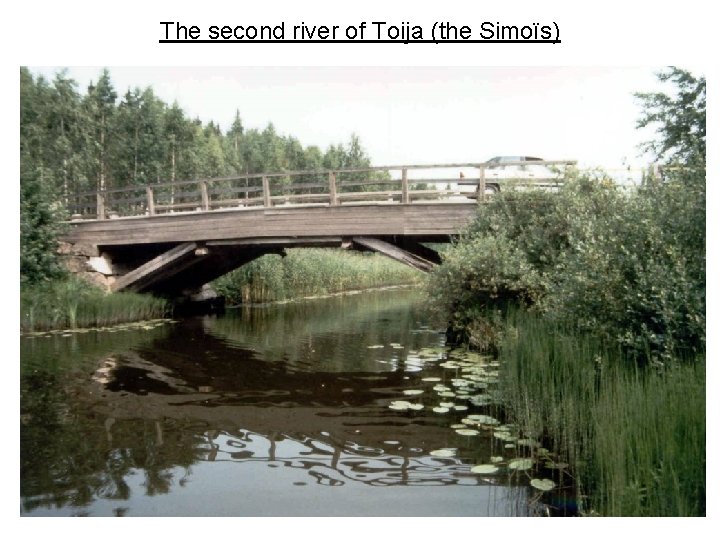
The second river of Toija (the Simoïs)
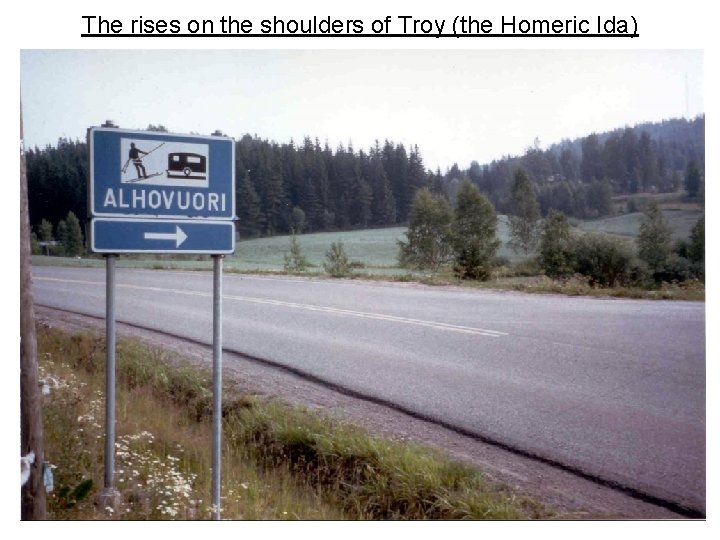
The rises on the shoulders of Troy (the Homeric Ida)
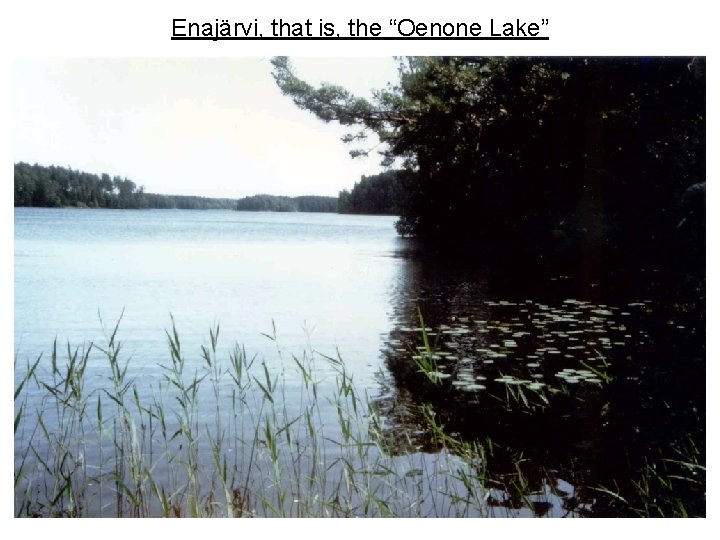
Enajärvi, that is, the “Oenone Lake”
Troy’s destiny after the War “Aeneas’ power will reign over Trojans, and the sons of his sons and the ones who will come after” (Il. XX, 307 -308) One should also note the similarity between the name of Aeneas (“Aineias” in Greek) and “Aeningia”, the Roman name of Finland (Pliny, Natural History IV, 96)
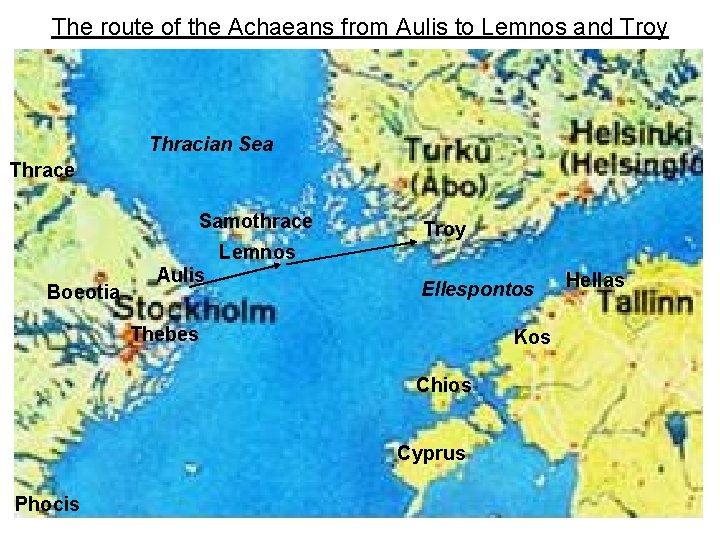
The route of the Achaeans from Aulis to Lemnos and Troy Thracian Sea Thrace Samothrace Troy Lemnos Boeotia Aulis Ellespontos Thebes Kos Chios Cyprus Phocis Hellas
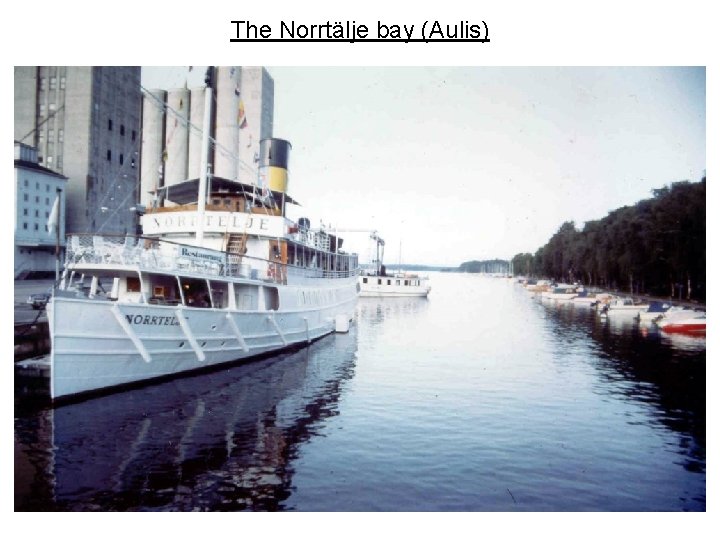
The Norrtälje bay (Aulis)
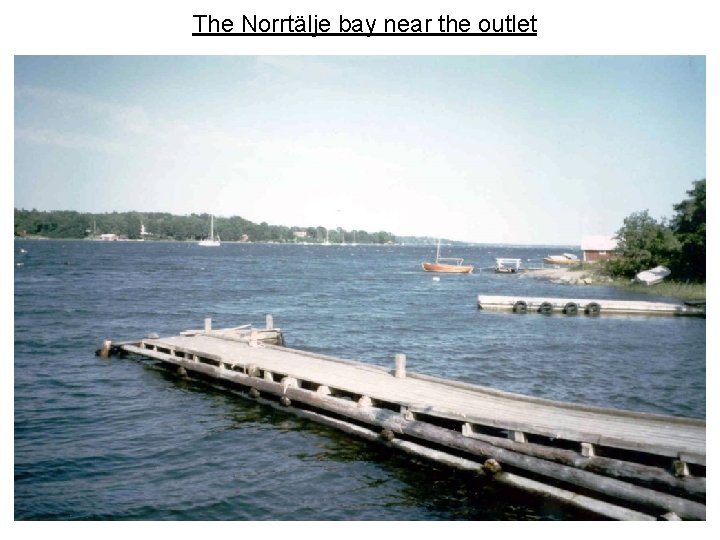
The Norrtälje bay near the outlet
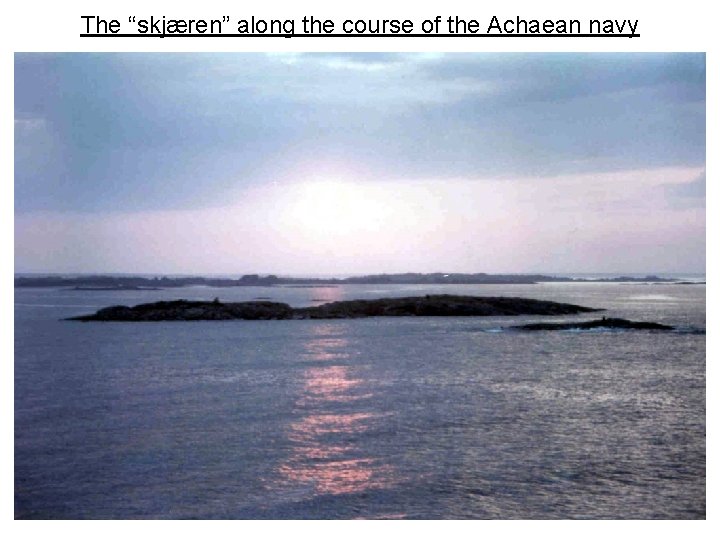
The “skjæren” along the course of the Achaean navy
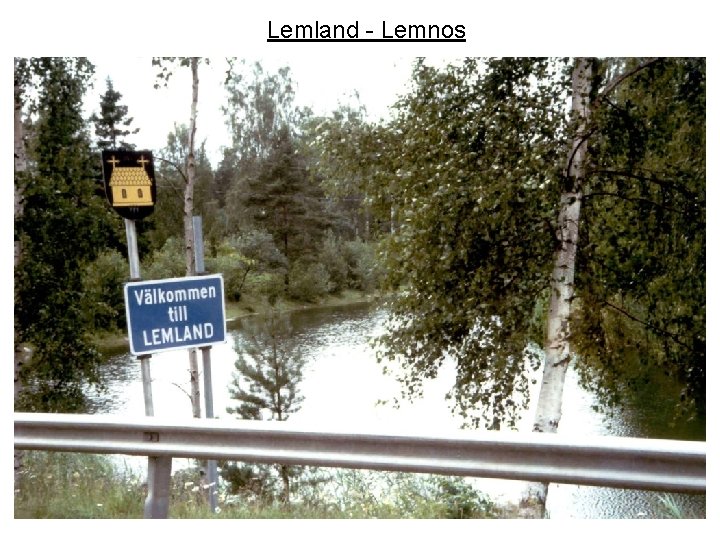
Lemland - Lemnos
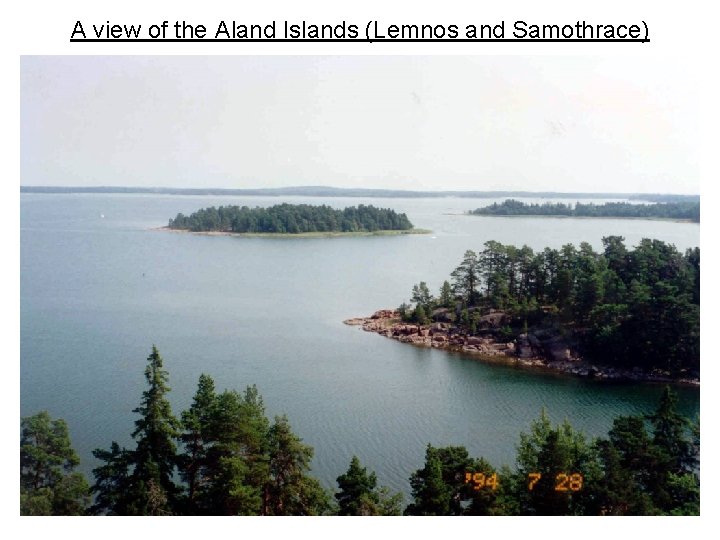
A view of the Aland Islands (Lemnos and Samothrace)
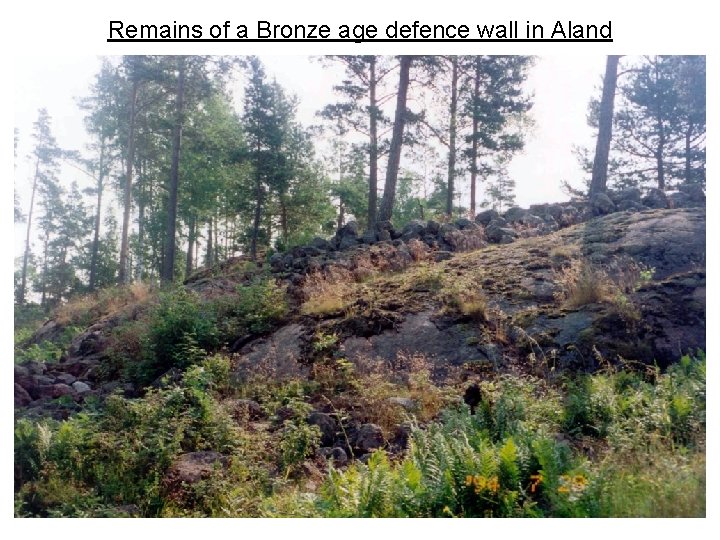
Remains of a Bronze age defence wall in Aland
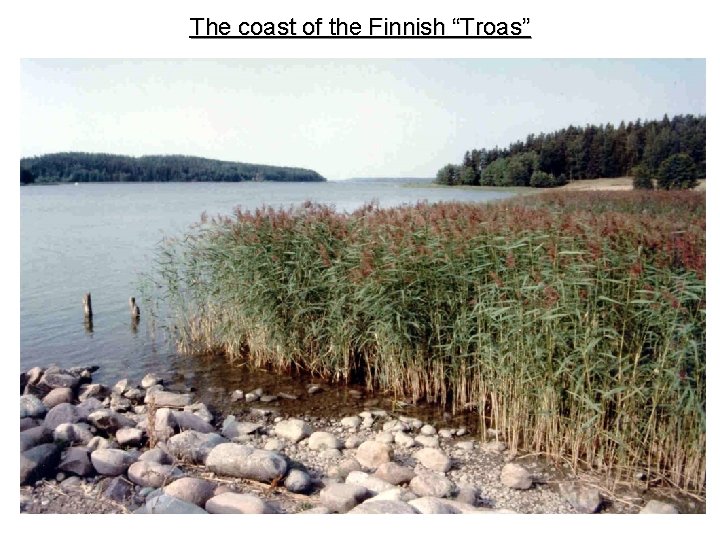
The coast of the Finnish “Troas”
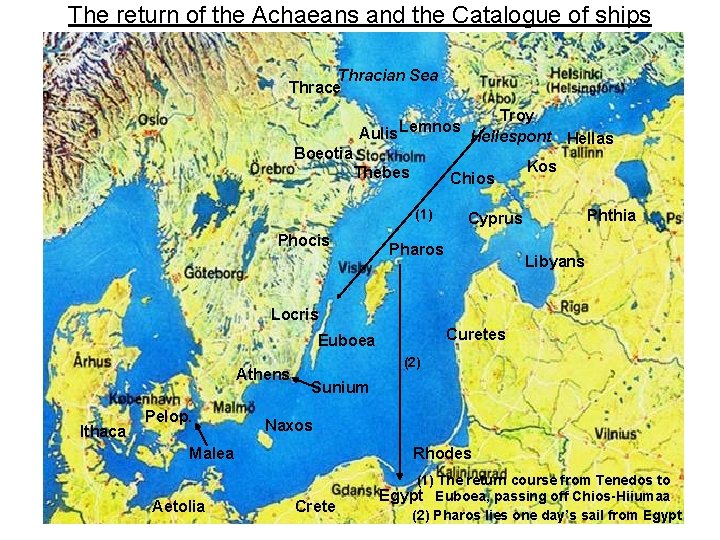
The return of the Achaeans and the Catalogue of ships Thracian Sea Thrace Aulis Lemnos Boeotia Thebes Chios (1) Phocis Troy Hellespont Hellas Kos Phthia Cyprus Pharos Libyans Locris Curetes Euboea Athens Ithaca Pelop. (2) Sunium Naxos Malea Aetolia Rhodes Crete (1) The return course from Tenedos to Egypt Euboea, passing off Chios-Hiiumaa (2) Pharos lies one day’s sail from Egypt
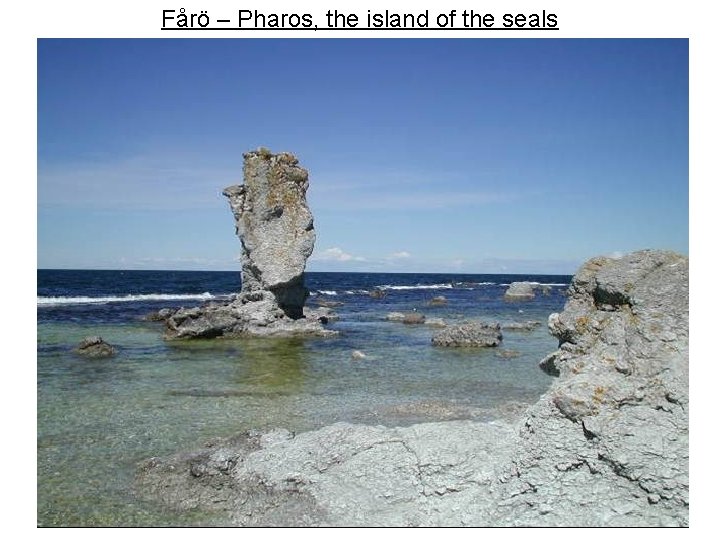
Fårö – Pharos, the island of the seals
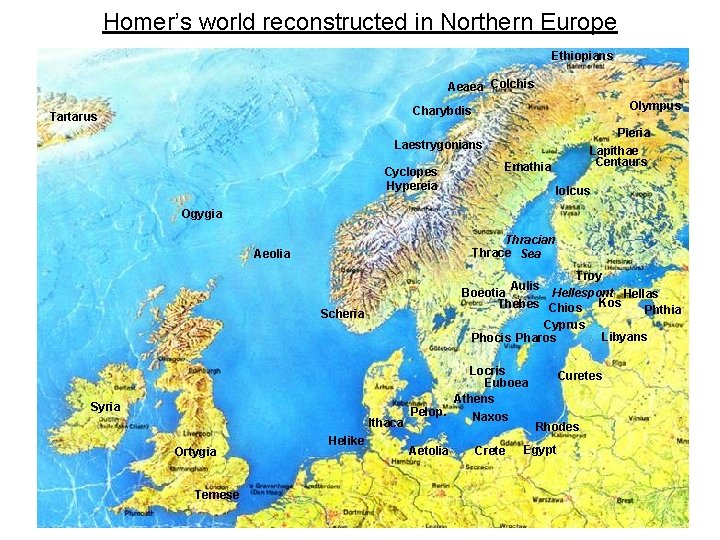
Homer’s world reconstructed in Northern Europe Ethiopians Aeaea Colchis Olympus Charybdis Tartarus Pieria Laestrygonians Cyclopes Hypereia Lapithae Centaurs Emathia Iolcus Ogygia Thracian Thrace Sea Aeolia Troy Boeotia Hellespont Hellas Thebes Chios Kos Phthia Cyprus Libyans Phocis Pharos Aulis Scheria Syria Ithaca Ortygia Temese Helike Pelop. Aetolia Locris Euboea Athens Naxos Crete Curetes Rhodes Egypt
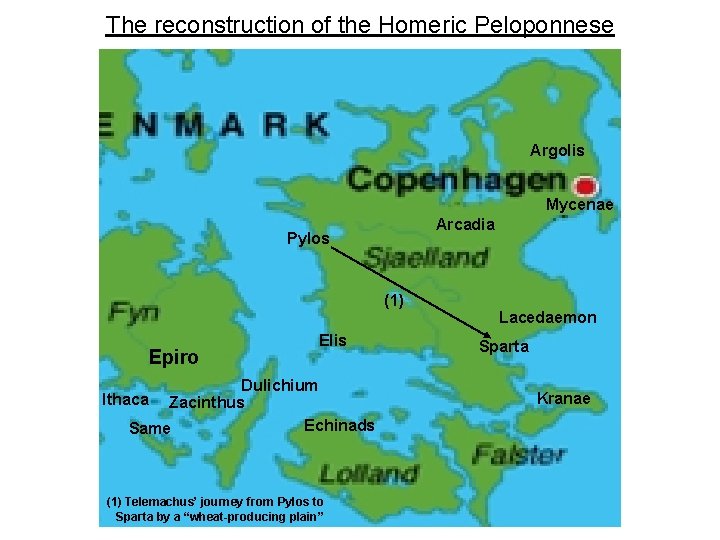
The reconstruction of the Homeric Peloponnese Argolis Mycenae Arcadia Pylos (1) Epiro Elis Dulichium Ithaca Zacinthus Echinads Same (1) Telemachus’ journey from Pylos to Sparta by a “wheat-producing plain” Lacedaemon Sparta Kranae
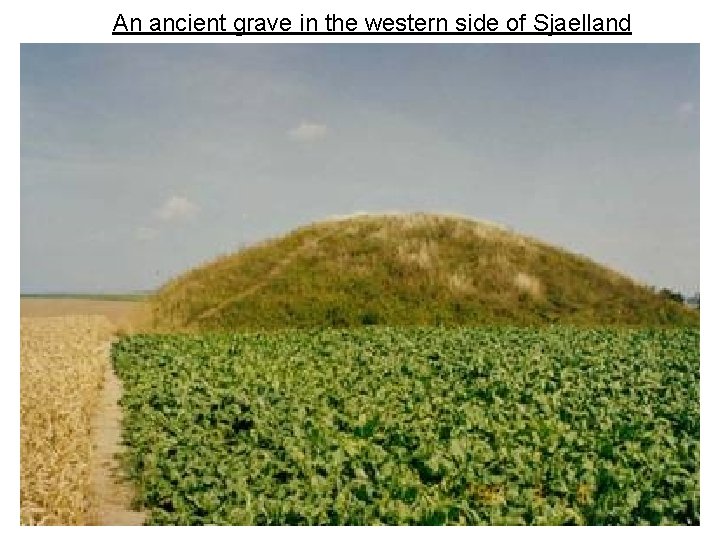
An ancient grave in the western side of Sjaelland
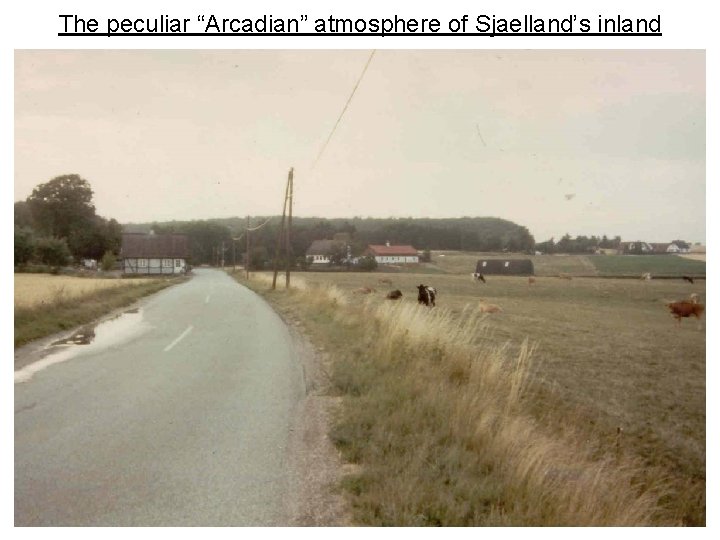
The peculiar “Arcadian” atmosphere of Sjaelland’s inland
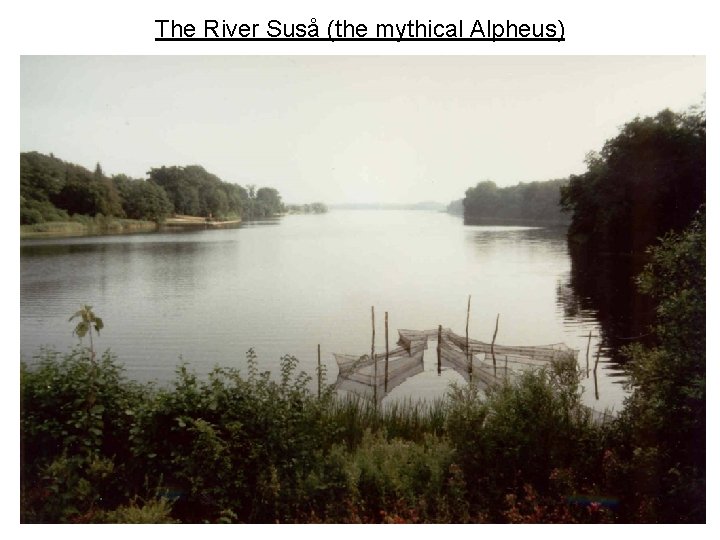
The River Suså (the mythical Alpheus)
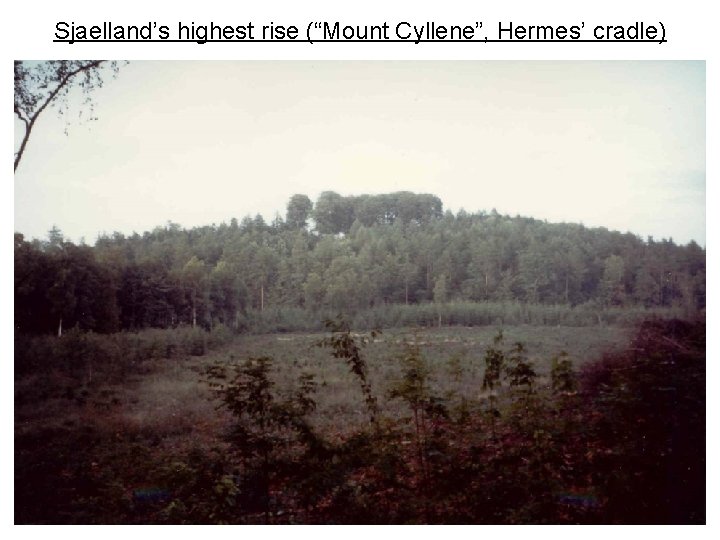
Sjaelland’s highest rise (“Mount Cyllene”, Hermes’ cradle)
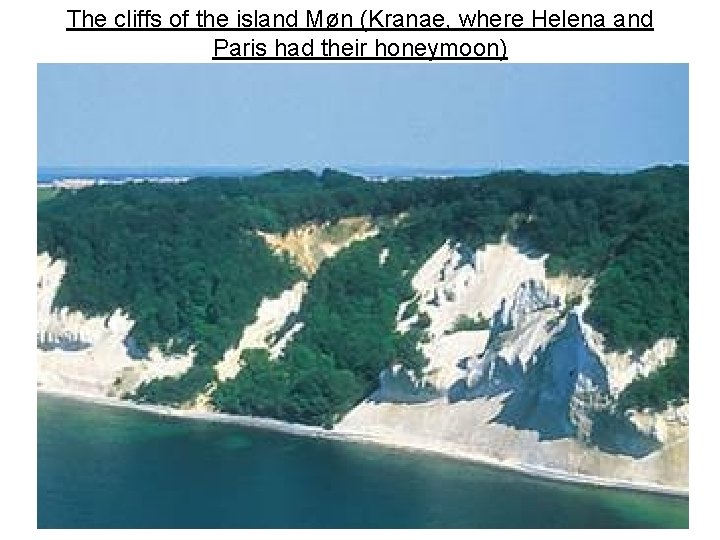
The cliffs of the island Møn (Kranae, where Helena and Paris had their honeymoon)
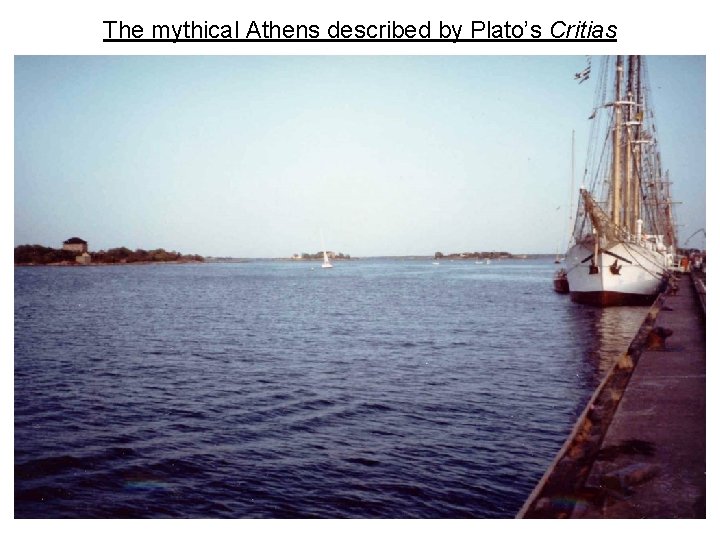
The mythical Athens described by Plato’s Critias
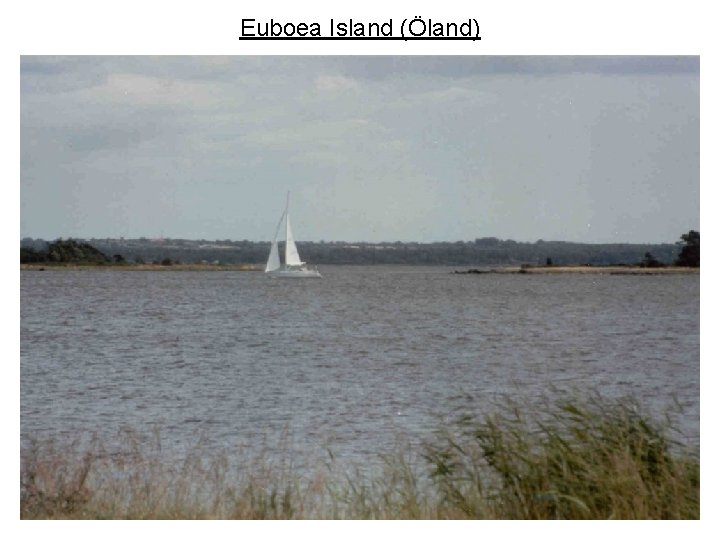
Euboea Island (Öland)
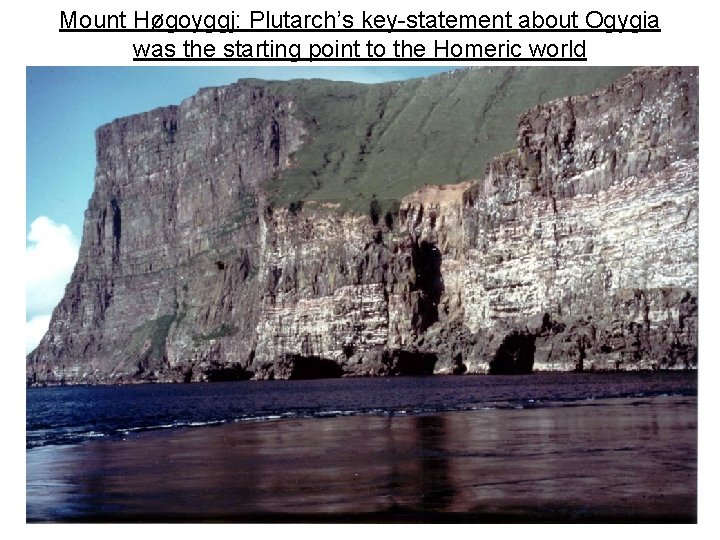
Mount Høgoyggj: Plutarch’s key-statement about Ogygia was the starting point to the Homeric world
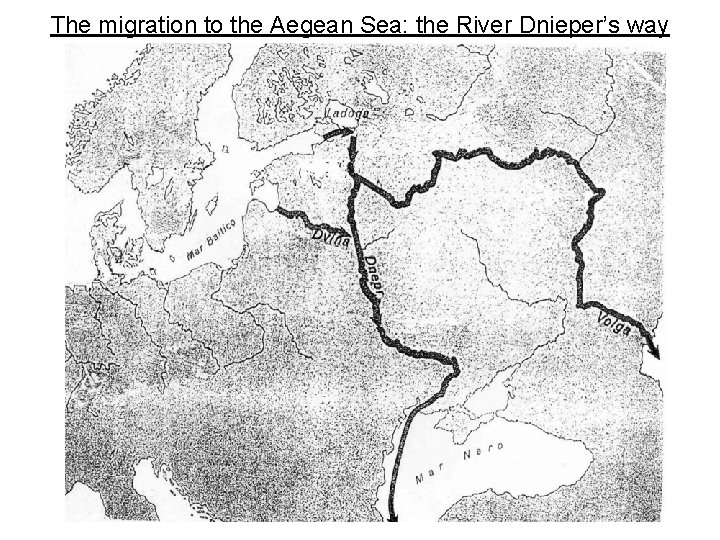
The migration to the Aegean Sea: the River Dnieper’s way
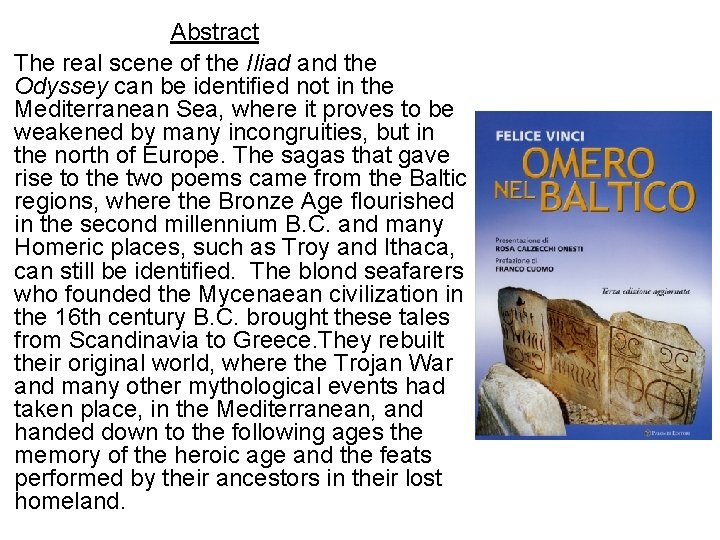
Abstract The real scene of the Iliad and the Odyssey can be identified not in the Mediterranean Sea, where it proves to be weakened by many incongruities, but in the north of Europe. The sagas that gave rise to the two poems came from the Baltic regions, where the Bronze Age flourished in the second millennium B. C. and many Homeric places, such as Troy and Ithaca, can still be identified. The blond seafarers who founded the Mycenaean civilization in the 16 th century B. C. brought these tales from Scandinavia to Greece. They rebuilt their original world, where the Trojan War and many other mythological events had taken place, in the Mediterranean, and handed down to the following ages the memory of the heroic age and the feats performed by their ancestors in their lost homeland.
- Slides: 121