
Homeowners Policies NamedPeril OpenPeril Forms Six Major HO
- Slides: 29
Homeowners Policies Named-Peril & Open-Peril Forms
Six Major HO Policies Each of which provides a different type of coverage
HO-2 Broad Form Insures against all 17 Broad Form Perils Covers the insured’s house and personal property
HO-4 Contents Broad Form Known as “renters insurance” “Think 4 -rent” Insures against all 17 Broad Form perils Only covers personal property Does not insure house and other structures
HO-6 Unit Owner’s Form (CONDO) Known as the Condo Form Covers the owner’s belongings Covers all finished surfaces of the individual condo unit Includes Broad Form Perils
HO-8 Modified Coverage Form Named-peril coverage Covers fewer perils Covers property at ACV (deducts depreciation for age, condition, and wear) It’s cheaper Example: fixer-upper in a run-down neighborhood, its value might be only $25, 000, but material and labor costs would make its replacement cost well over $100, 000. The HO-8 covers only the perils listed here, and pays only for repair costs or actual cash value, since replacement cost coverage would make it too expensive. Even number forms are named –peril (2, 4, , 6, 8). If it’s not even its an open peril form.
Covered Perils for HO-8 Fire Lightning Windstorm Hail Explosion Riot or Civil Commotion Aircraft Vehicles Smoke Vandalism or Malicious Mischief Theft Volcanic Eruption
Open-Peril Approach Covers damages caused by all perils, except those specifically excluded If loss is caused by unlisted peril, it is covered Increases the need for exclusions HO-3 & HO-5 use the Special Form Endorsement Grants ALL risks to be covered, but uses exclusions to determine what they will not cover.
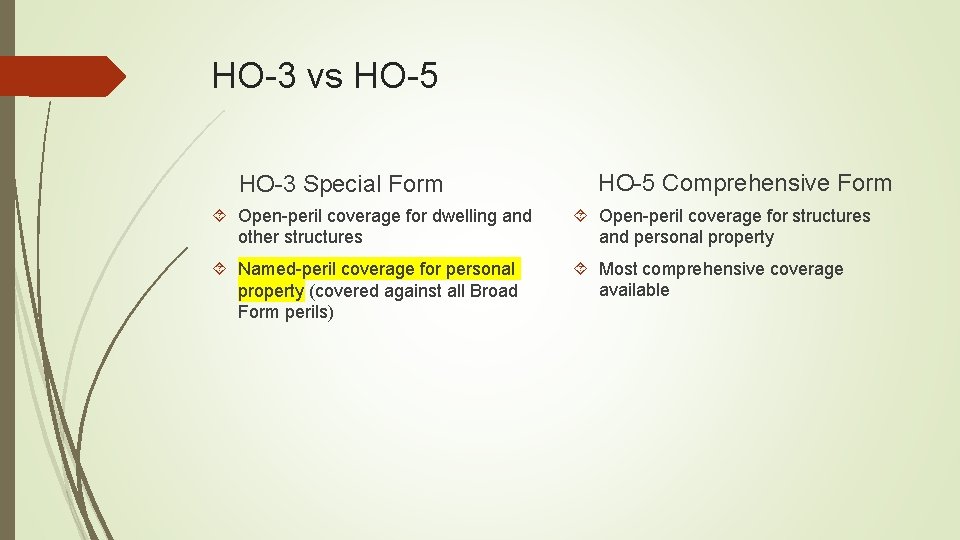
HO-3 vs HO-5 HO-3 Special Form HO-5 Comprehensive Form Open-peril coverage for dwelling and other structures Open-peril coverage for structures and personal property Named-peril coverage for personal property (covered against all Broad Form perils) Most comprehensive coverage available
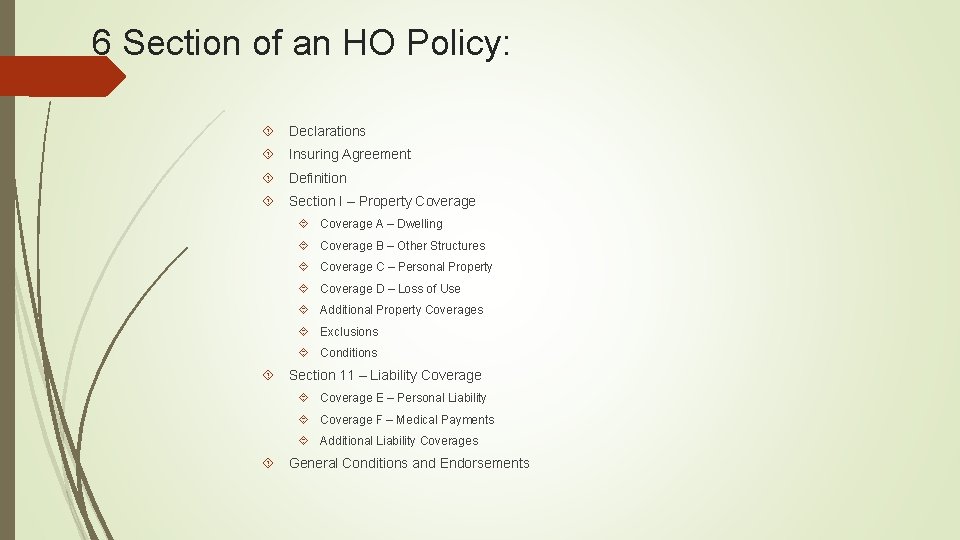
6 Section of an HO Policy: Declarations Insuring Agreement Definition Section I – Property Coverage A – Dwelling Coverage B – Other Structures Coverage C – Personal Property Coverage D – Loss of Use Additional Property Coverages Exclusions Conditions Section 11 – Liability Coverage E – Personal Liability Coverage F – Medical Payments Additional Liability Coverages General Conditions and Endorsements
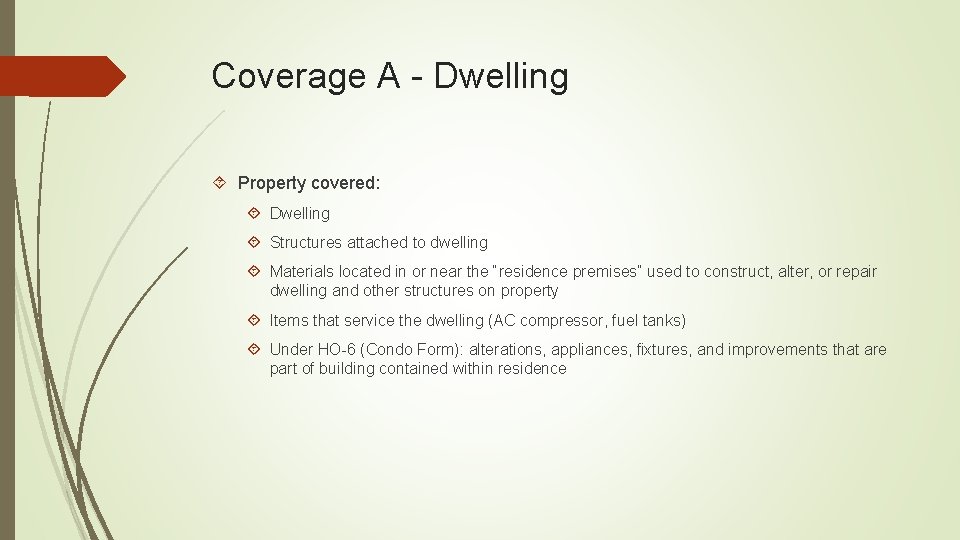
Coverage A - Dwelling Property covered: Dwelling Structures attached to dwelling Materials located in or near the “residence premises” used to construct, alter, or repair dwelling and other structures on property Items that service the dwelling (AC compressor, fuel tanks) Under HO-6 (Condo Form): alterations, appliances, fixtures, and improvements that are part of building contained within residence
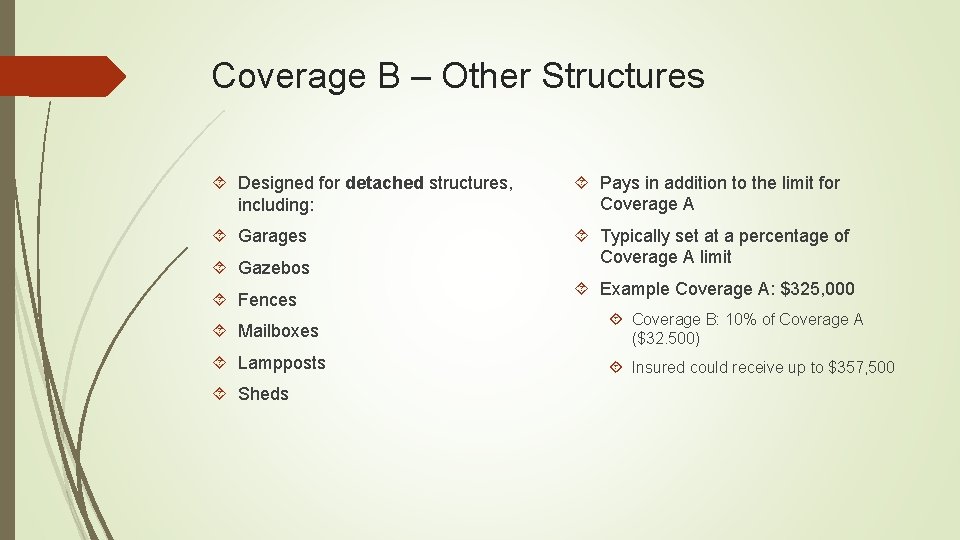
Coverage B – Other Structures Designed for detached structures, including: Pays in addition to the limit for Coverage A Garages Typically set at a percentage of Coverage A limit Gazebos Fences Example Coverage A: $325, 000 Mailboxes Coverage B: 10% of Coverage A ($32. 500) Lampposts Insured could receive up to $357, 500 Sheds
Coverage B does not cover: Detached structures wholly rented out Structures held for rental Detached structures used for business Here is what it covers: Structures rented to an insured or tenant of the primary dwelling Garages rented as private garages Example: Jeff operates a small engine repair shop out of a building on his residence premises that was originally intended to be a detached garage. Even when damaged by a covered peril, this structure would not be covered under Jeff’s Homeowners form, since he uses it for business purposes.
Coverage C – Personal Property Real Property: Buildings Elements attached to buildings Building materials/supplies that are located on or next to the residence premises and intended for use on those premises Personal Property All property that does not qualify as real property Covered anywhere in the world Buildings, furniture, clothes, belongings, food; toys; personal effects, etc
Coverage C – Personal Property Coverage C – Limits Two categories of personal property 1. Property usually situated at the residence premises: full coverage 2. Property usually situated somewhere other than the residence premises: 10% of Coverage C limit or $1000, whichever is greater
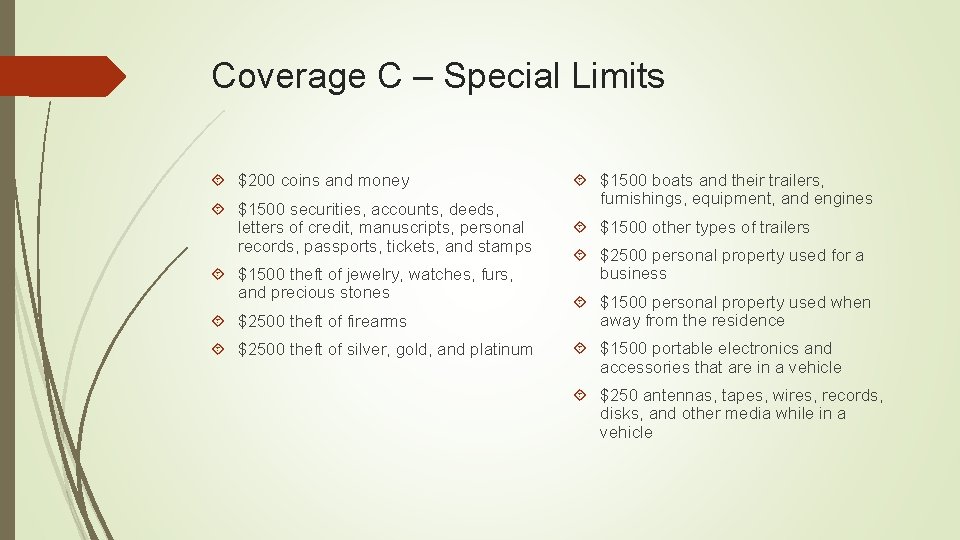
Coverage C – Special Limits $200 coins and money $1500 securities, accounts, deeds, letters of credit, manuscripts, personal records, passports, tickets, and stamps $1500 theft of jewelry, watches, furs, and precious stones $2500 theft of firearms $2500 theft of silver, gold, and platinum $1500 boats and their trailers, furnishings, equipment, and engines $1500 other types of trailers $2500 personal property used for a business $1500 personal property used when away from the residence $1500 portable electronics and accessories that are in a vehicle $250 antennas, tapes, wires, records, disks, and other media while in a vehicle
Coverage C Exclusions Personal Property not covered: Pets Motor vehicles Aircraft and hovercraft Property of a renter or boarder Personal property the insured is renting out Credit cards Value of water or steam (like from a water heater)
Coverage D – Loss of Use For Indirect losses that result from direct losses 3 coverages for Loss of Use: Additional Living Expenses (ALE) Fair Rental Value (FRV) Prohibited Use (a. k. a Civil Authority) Ben has to stay in a Airbnb because his home suffered broken windows after a storm. Coverage D pays for his stay during home repairs because the direct loss of the windows is the cause of the Airbnb expenses.
Additional Living Expenses Most common type of Coverage D – Loss of Use Pays increase in expenses needed for the insured to maintain normal standard of living after a covered loss Requirements: Dwelling must be uninhabitable Damage must have been caused by a covered peril Only covers costs that exceed the insured’s normal living expenses
Additional Living Expenses Example Coverage D – Loss of Use Amanda’s regular expenses: Mortgage payment $20/week for laundry and dry cleaning Amanda’s expenses after the loss: Mortgage payment Hotel bill $60/week for laundry and dry cleaning Increase in Amanda’s expenses due to the loss: Hotel bill $40/week for laundry
Fair Rental Value (FRV) – Coverage D – Loss of Use Type of Coverage D – Loss of Use Indemnifies insured for lost rent if a tenant has to move out due to covered damages Pays lost rental income until unit is habitable again Only pays net loss: subtracts any expenses that do not continue while the tenant is gone
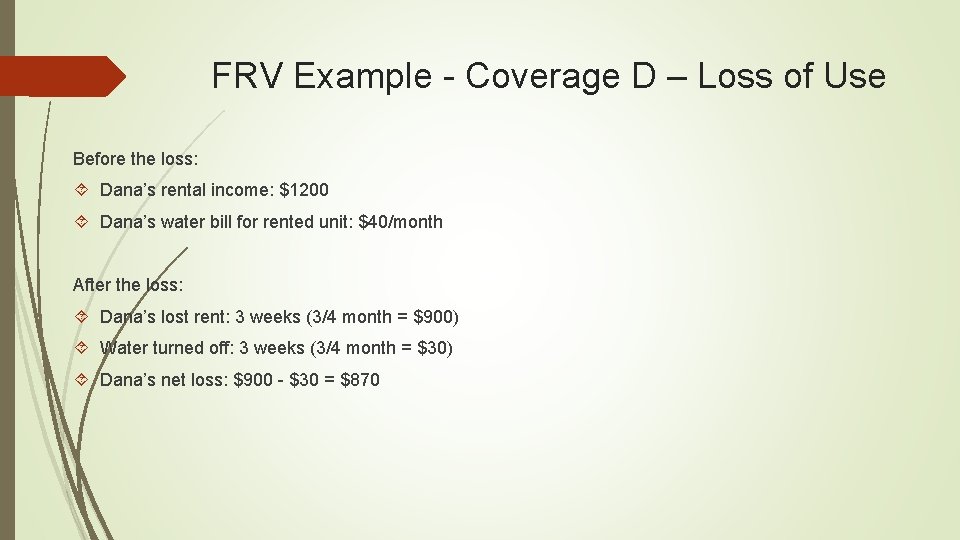
FRV Example - Coverage D – Loss of Use Before the loss: Dana’s rental income: $1200 Dana’s water bill for rented unit: $40/month After the loss: Dana’s lost rent: 3 weeks (3/4 month = $900) Water turned off: 3 weeks (3/4 month = $30) Dana’s net loss: $900 - $30 = $870
Fair Rental Value – Important Note Coverage D – Loss of Use Coverage does not include losses due to cancelled lease or agreement Only pays up until the unit is repaired, not until the insured finds a new tenant, if applicable
Civil Authority Coverage - Coverage D – Loss of Use Pays for ALE and FRV when a civil authority prevents the insured from using the home Civil authority: any government entity acting on behalf of, or to protect, people or property Only applies if the damage was caused by a peril covered in the insured’s policy
Civil Authority Example After a fire destroys a national landmark, the fire department block off access to Kevin’s house. Since fire is a covered peril in Kevin’s policy, and since a civil authority has prevented Kevin from access his home, Civil Authority coverage will apply.
Coverage D – Limits Measure in time rather than dollars Additional Living Expenses are paid: Until the premises is repaired or replaced or Until the insured’s household can settle elsewhere Fair Rental Value is paid: For the shortest amount of time needed to restore the rented area to rentable condition Civil authority coverage pays ALE and FRV: Until access to the home is restored Up to a max of 2 weeks
Limits of Coverage D Designed to cover the insured until the dwelling is habitable Allow additional living expenses and Fair Rental Value to extend beyond the policy expiration date if needed Remember: FRV does not include time spent finding a new tenant if precious tenant cancels lease
Loss of Use Deductibles Additional Living Expenses and FRV subject to the policy deductible Civil authority coverage: not subject to any deductible
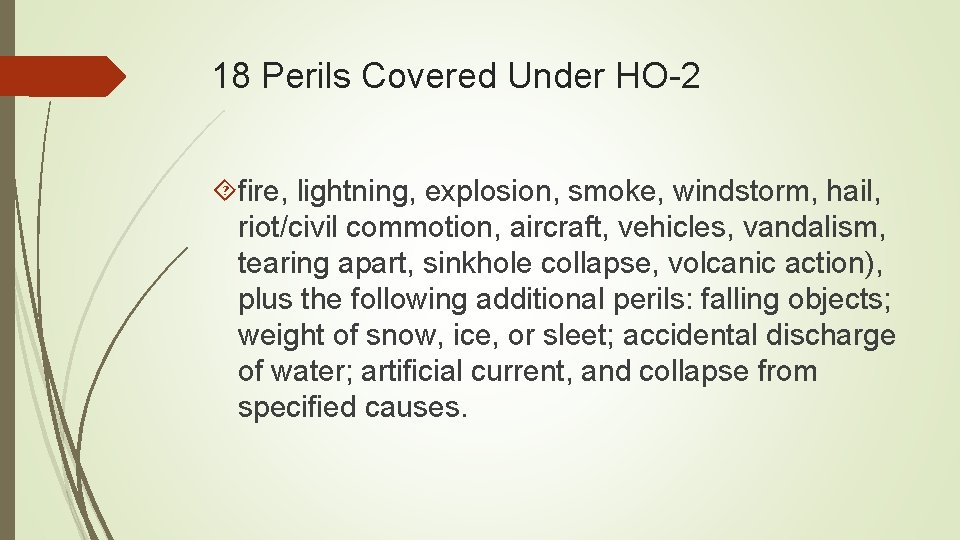
18 Perils Covered Under HO-2 fire, lightning, explosion, smoke, windstorm, hail, riot/civil commotion, aircraft, vehicles, vandalism, tearing apart, sinkhole collapse, volcanic action), plus the following additional perils: falling objects; weight of snow, ice, or sleet; accidental discharge of water; artificial current, and collapse from specified causes.