
Homeotic Gene K K Gupta Drosophila Cytogenetic Lab
Homeotic Gene K. K. Gupta Drosophila Cytogenetic Lab VBU, Hazaribag
Introduction • Development of any multi-cellular animal like Drosophila is a stepwise process involving cell division and differentiation of single zygotic cell under the mode of temporal and spatial gene expression. • In fact, every cells originating from zygotic cell has similar set of genes and it is the pattern of gene expression that differentiate each cell , tissues and organ from one another. •
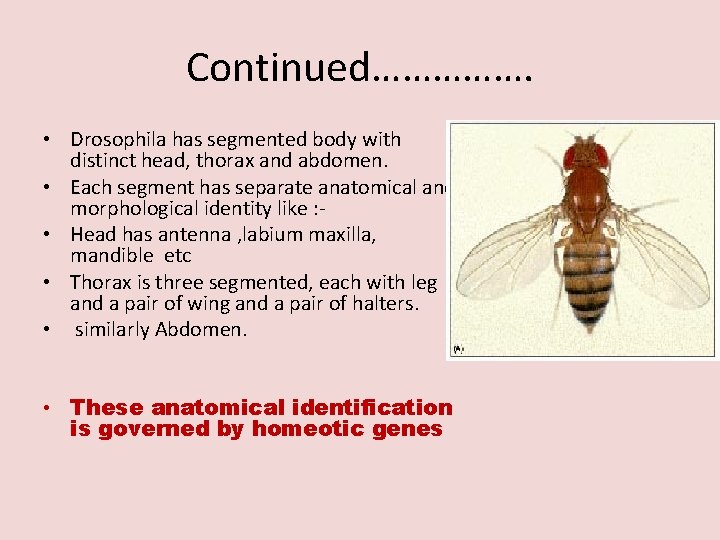
Continued……………. • Drosophila has segmented body with distinct head, thorax and abdomen. • Each segment has separate anatomical and morphological identity like : • Head has antenna , labium maxilla, mandible etc • Thorax is three segmented, each with leg and a pair of wing and a pair of halters. • similarly Abdomen. • These anatomical identification is governed by homeotic genes
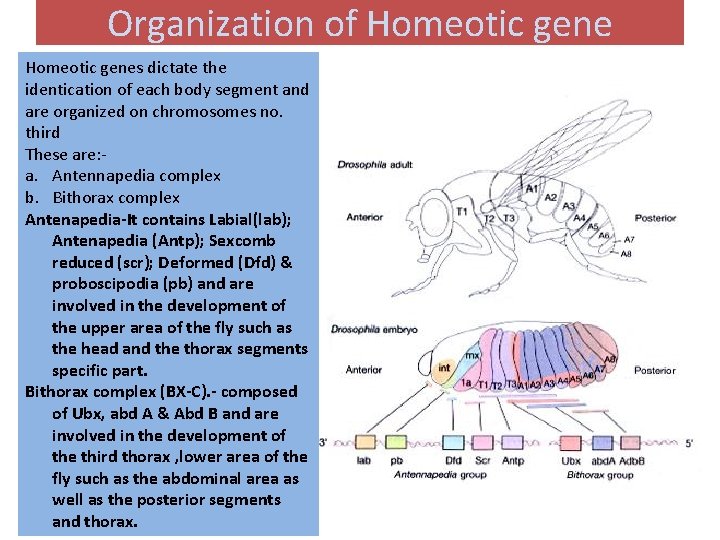
Organization of Homeotic genes dictate the identication of each body segment and are organized on chromosomes no. third These are: a. Antennapedia complex b. Bithorax complex Antenapedia-It contains Labial(lab); Antenapedia (Antp); Sexcomb reduced (scr); Deformed (Dfd) & proboscipodia (pb) and are involved in the development of the upper area of the fly such as the head and the thorax segments specific part. Bithorax complex (BX-C). - composed of Ubx, abd A & Abd B and are involved in the development of the third thorax , lower area of the fly such as the abdominal area as well as the posterior segments and thorax.
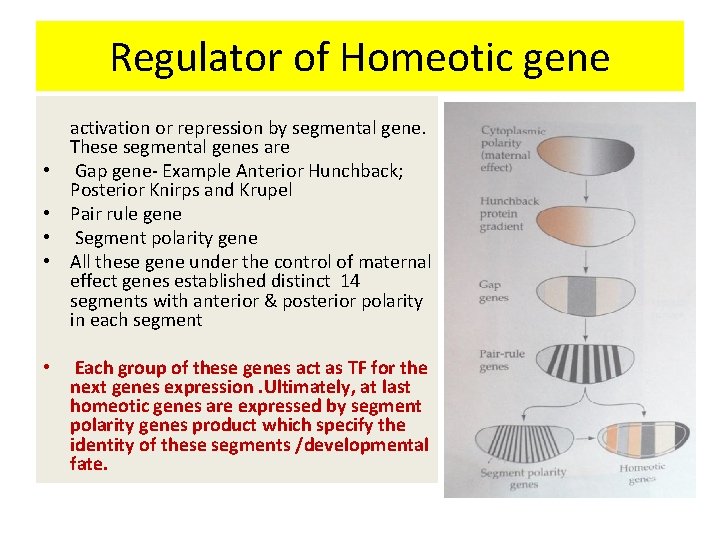
Regulator of Homeotic gene • • • activation or repression by segmental gene. These segmental genes are Gap gene- Example Anterior Hunchback; Posterior Knirps and Krupel Pair rule gene Segment polarity gene All these gene under the control of maternal effect genes established distinct 14 segments with anterior & posterior polarity in each segment Each group of these genes act as TF for the next genes expression. Ultimately, at last homeotic genes are expressed by segment polarity genes product which specify the identity of these segments /developmental fate.
Role of Homeotic gene • Homeotic genes dictate the realisator genes whose expression are restricted in each specific segment and specific tissues are formed • Realisator genes are either repressed or activated by homeotic gene product. • For example Antp gene product binds and repress enhancer of homeothorax and eye less gene which encodes transcription factor critical for antenna and eye formation. So Antp function suppresses antenna and eye formation in the thorax region. • Ubx is able to repress expression of wingless gene in those cells that will become halters of the fly. • Bxc is expressed in several segments and when deleted normal head, T 1 T 2 and all abdomen segments develop as T 2 •
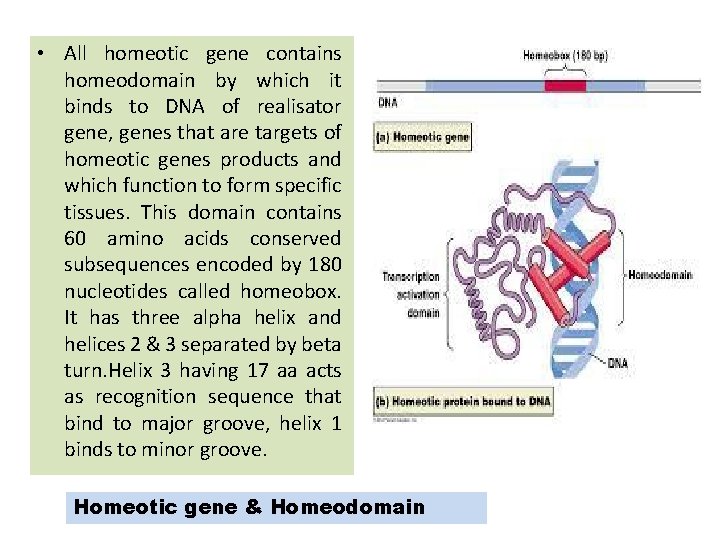
• All homeotic gene contains homeodomain by which it binds to DNA of realisator gene, genes that are targets of homeotic genes products and which function to form specific tissues. This domain contains 60 amino acids conserved subsequences encoded by 180 nucleotides called homeobox. It has three alpha helix and helices 2 & 3 separated by beta turn. Helix 3 having 17 aa acts as recognition sequence that bind to major groove, helix 1 binds to minor groove. Homeotic gene & Homeodomain
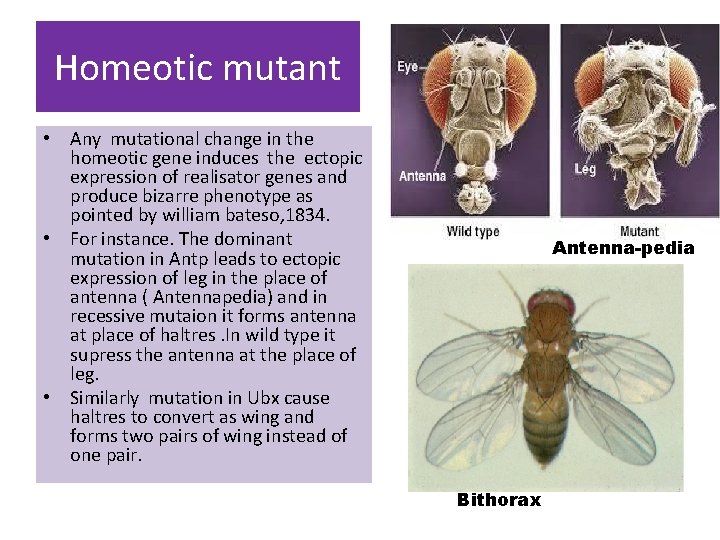
Homeotic mutant • Any mutational change in the homeotic gene induces the ectopic expression of realisator genes and produce bizarre phenotype as pointed by william bateso, 1834. • For instance. The dominant mutation in Antp leads to ectopic expression of leg in the place of antenna ( Antennapedia) and in recessive mutaion it forms antenna at place of haltres. In wild type it supress the antenna at the place of leg. • Similarly mutation in Ubx cause haltres to convert as wing and forms two pairs of wing instead of one pair. Antenna-pedia Bithorax
- Slides: 8