
Homeostasis Regulation How does the nervous system help
- Slides: 48
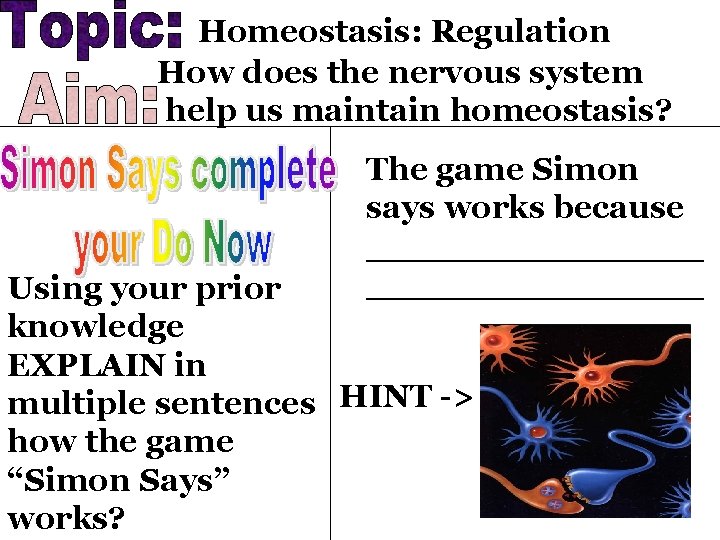
Homeostasis: Regulation How does the nervous system help us maintain homeostasis? The game Simon says works because _______________ Using your prior knowledge EXPLAIN in multiple sentences HINT -> how the game “Simon Says” works?
How does the nervous system maintain homeostasis? The stable internal balance of an organism that ensures survival
The process in which an organism controls and coordinates all its activities
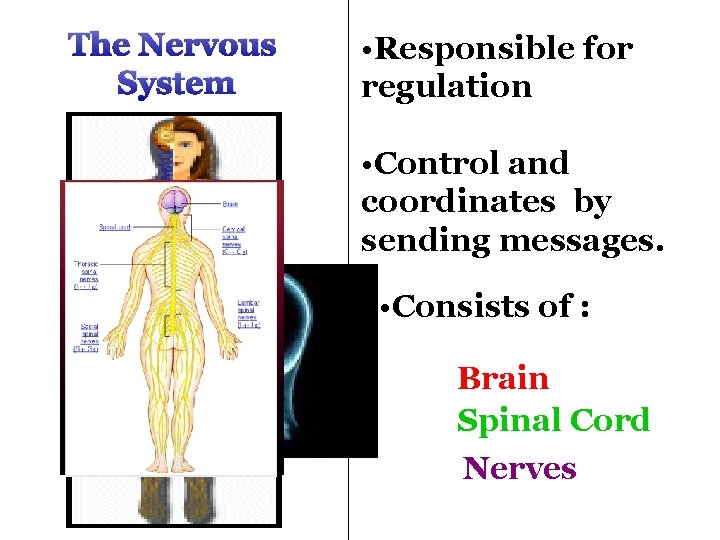
The Nervous System • Responsible for regulation • Control and coordinates by sending messages. • Consists of : Brain Spinal Cord Nerves
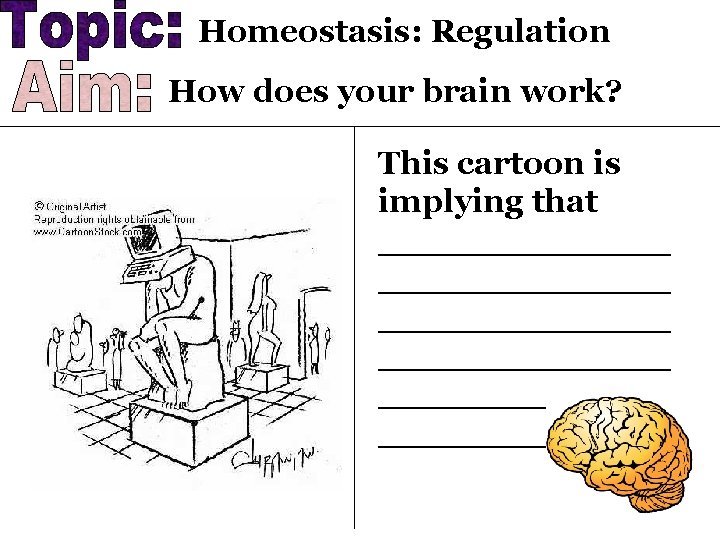
Homeostasis: Regulation How does your brain work? This cartoon is implying that _____________ _______
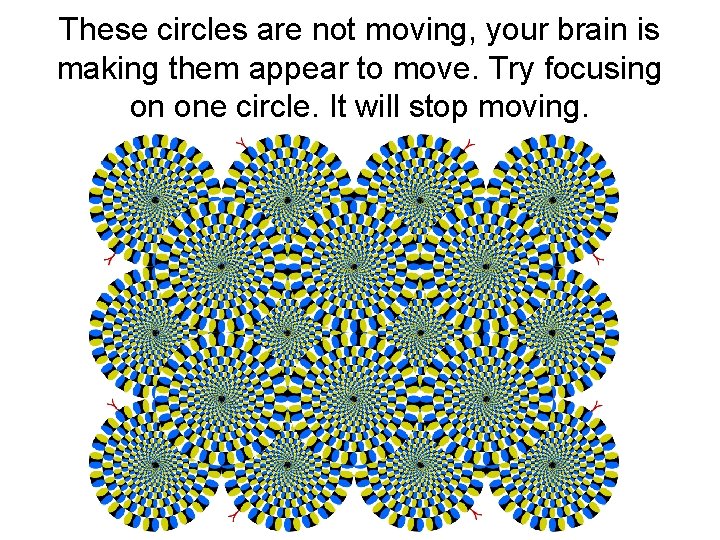
These circles are not moving, your brain is making them appear to move. Try focusing on one circle. It will stop moving.
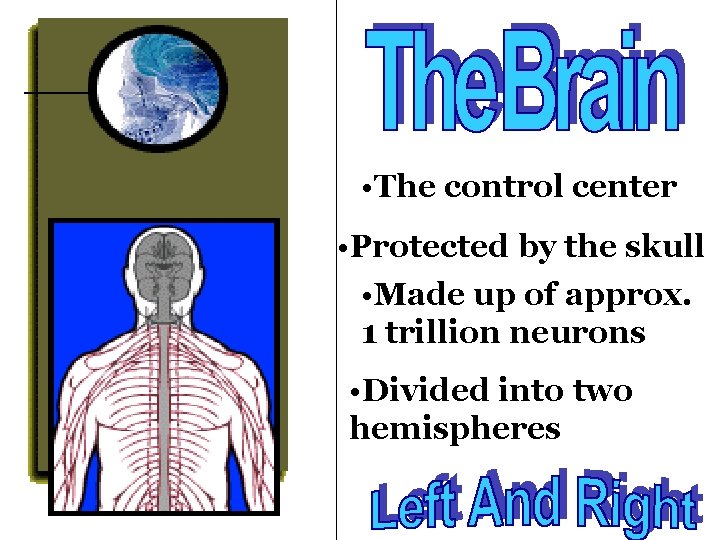
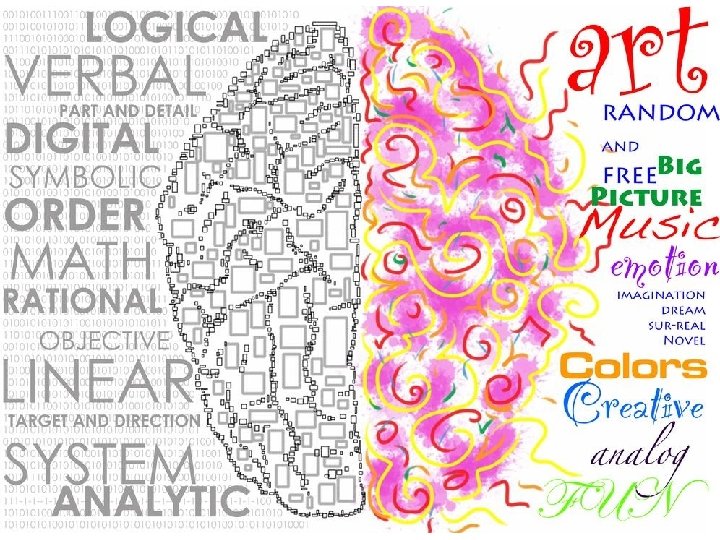
• The control center • Protected by the skull • Made up of approx. 1 trillion neurons • Divided into two hemispheres
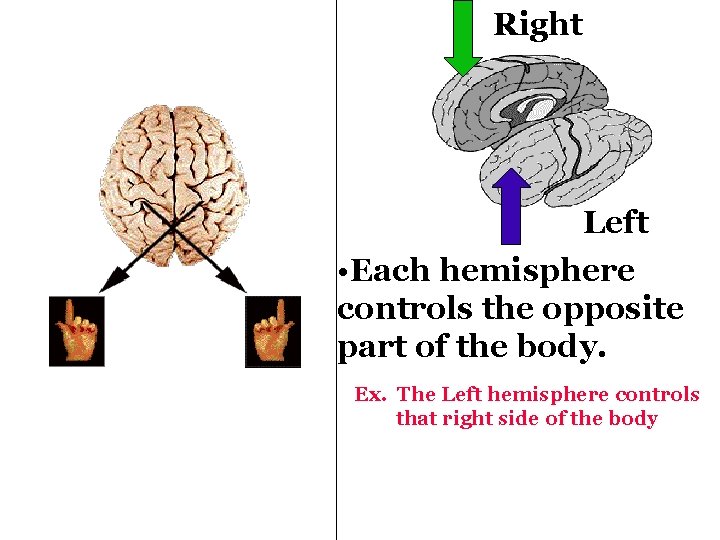
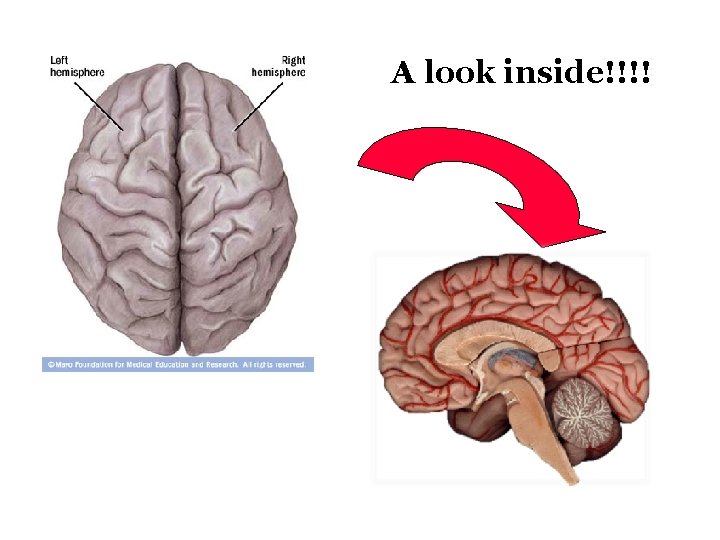
Right Left • Each hemisphere controls the opposite part of the body. Ex. The Left hemisphere controls that right side of the body
Look at the chart and say the color, NOT the word Your right brain tried to say the color, but your left brain was reading the word.
A look inside!!!!
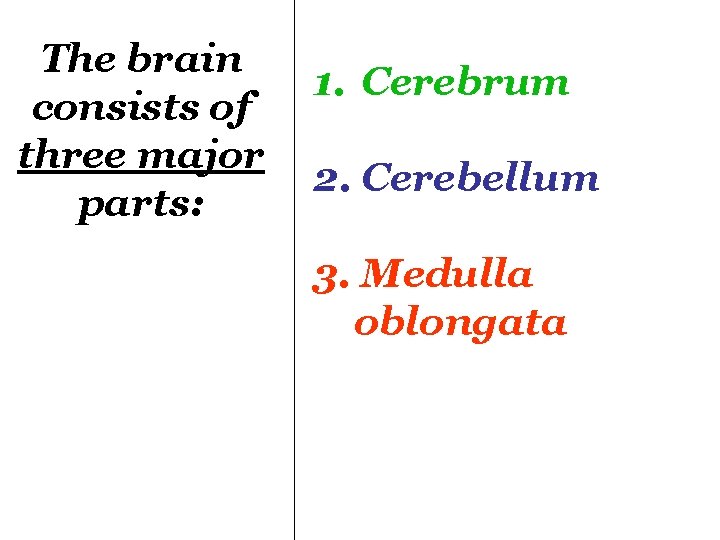
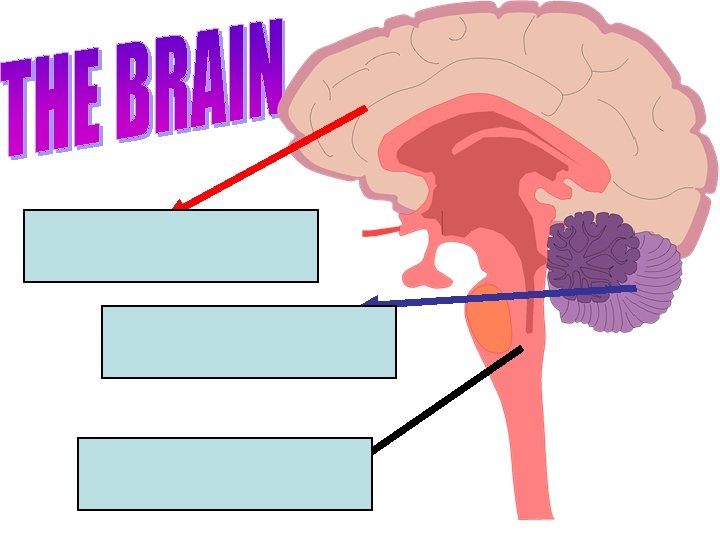
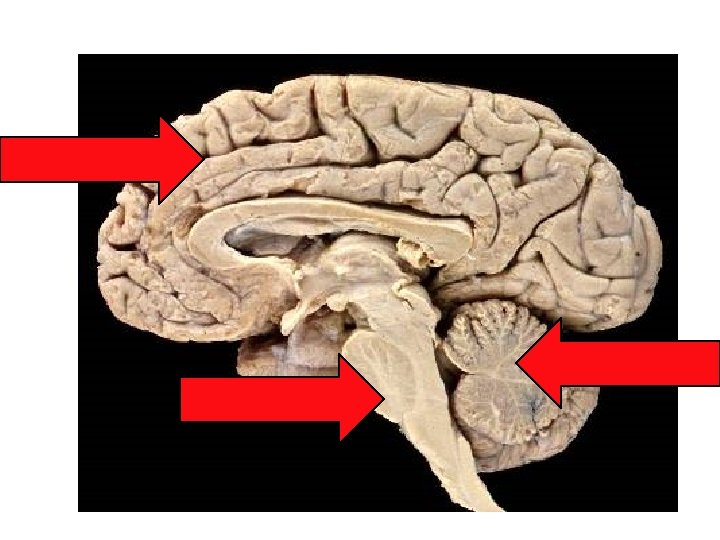
The brain consists of three major parts: 1. Cerebrum 2. Cerebellum 3. Medulla oblongata
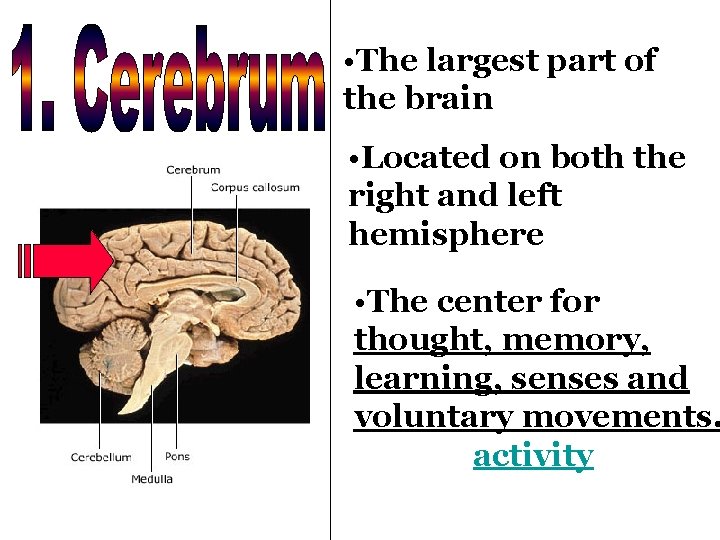
• The largest part of the brain • Located on both the right and left hemisphere • The center for thought, memory, learning, senses and voluntary movements. activity
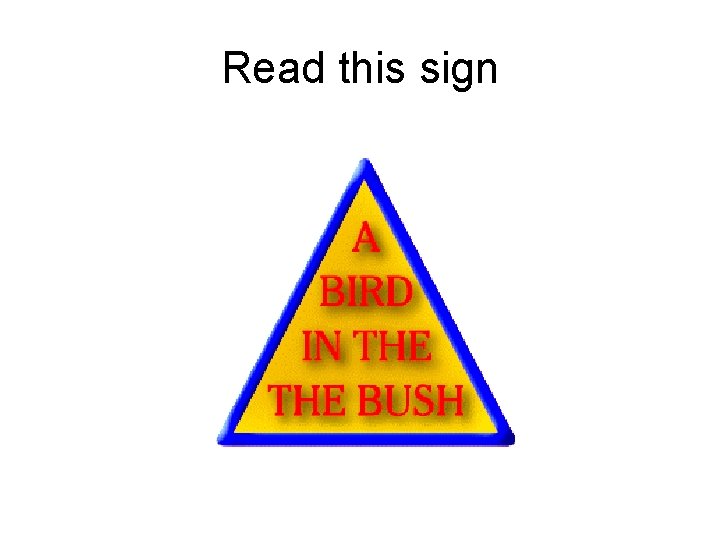
Read this sign
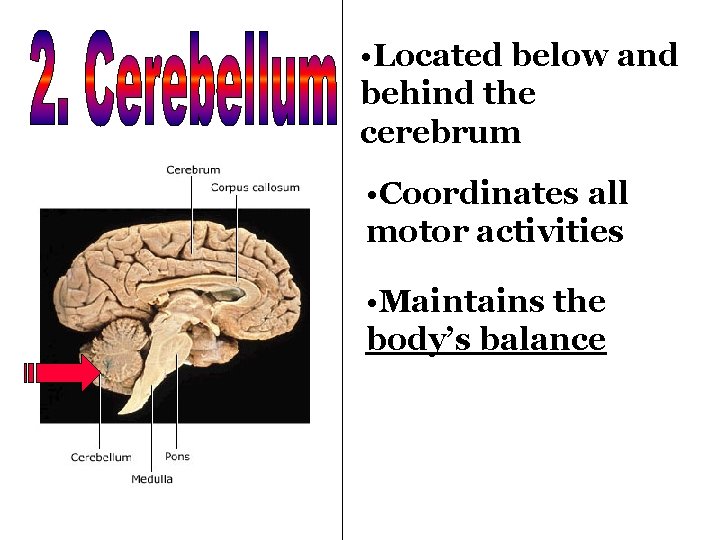
• Located below and behind the cerebrum • Coordinates all motor activities • Maintains the body’s balance
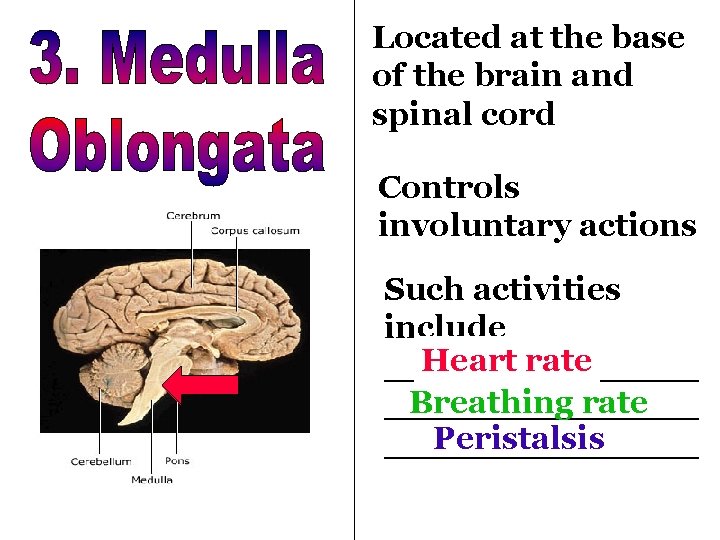
Located at the base of the brain and spinal cord Controls involuntary actions Such activities include Heart rate _______ Breathing rate _______ Peristalsis _______
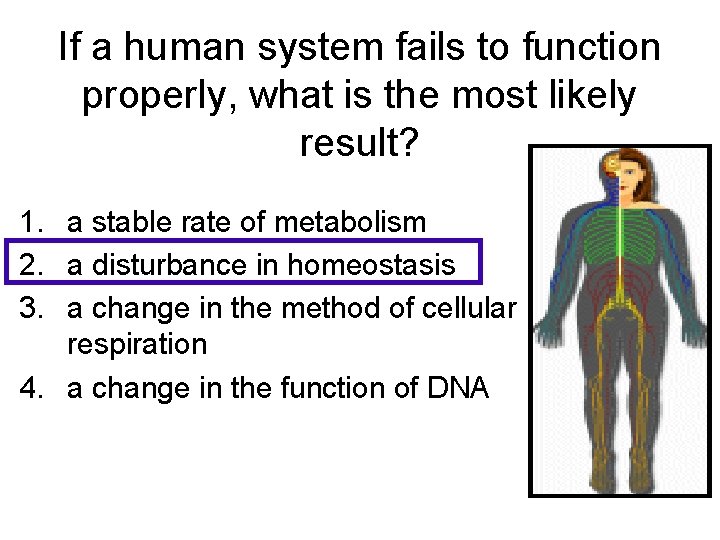
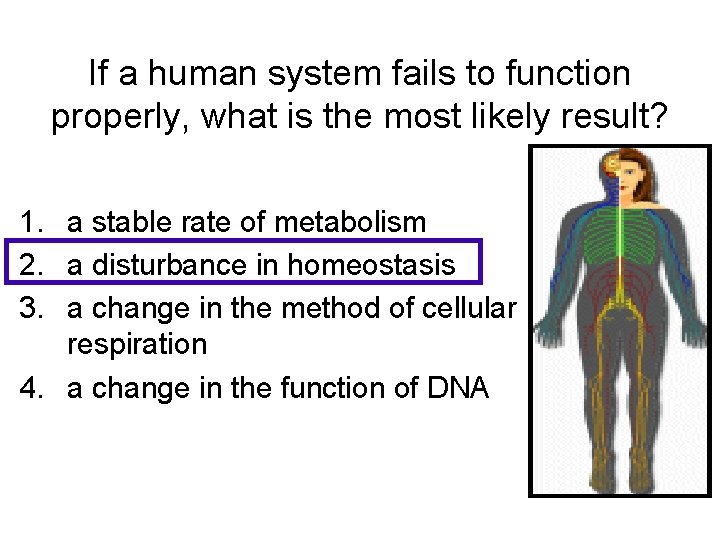
If a human system fails to function properly, what is the most likely result? 1. a stable rate of metabolism 2. a disturbance in homeostasis 3. a change in the method of cellular respiration 4. a change in the function of DNA
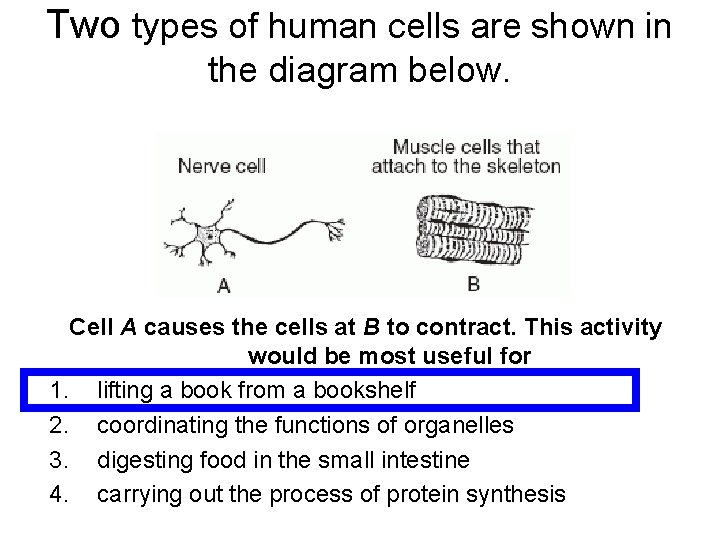
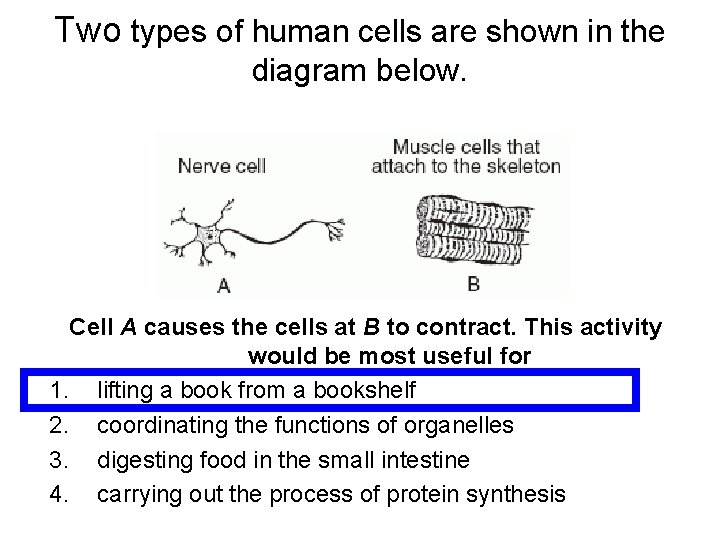
Two types of human cells are shown in the diagram below. Cell A causes the cells at B to contract. This activity would be most useful for 1. lifting a book from a bookshelf 2. coordinating the functions of organelles 3. digesting food in the small intestine 4. carrying out the process of protein synthesis
CEREBRUM CEREBELLUM MEDULLA
Two types of human cells are shown in the diagram below. Cell A causes the cells at B to contract. This activity would be most useful for 1. lifting a book from a bookshelf 2. coordinating the functions of organelles 3. digesting food in the small intestine 4. carrying out the process of protein synthesis
If a human system fails to function properly, what is the most likely result? 1. a stable rate of metabolism 2. a disturbance in homeostasis 3. a change in the method of cellular respiration 4. a change in the function of DNA
Brain freeze
Does this image appear to be moving? • It’s NOT! • Just kidding, this one is actually moving
Final Summary
Homework: Nervous system Handout
Imagine you’ve stepped off a curb and a car doing 70 mph, comes out of nowhere. Identify 2 human body systems at work to help you respond to this stimuli. How do they work together to help you maintain homeostasis? ? ?
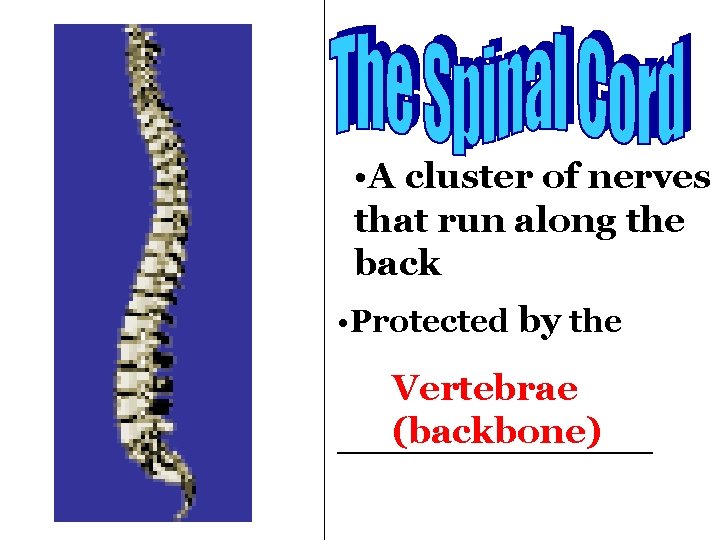
• A cluster of nerves that run along the back • Protected by the Vertebrae (backbone) _______
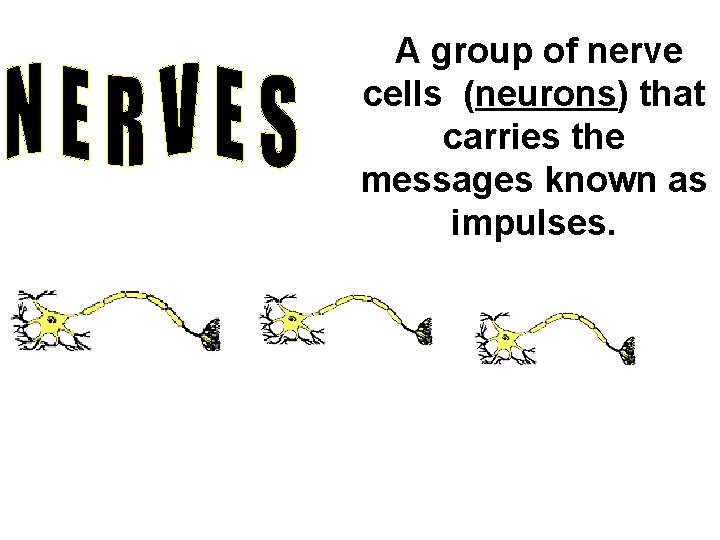
A group of nerve cells (neurons) that carries the messages known as impulses.
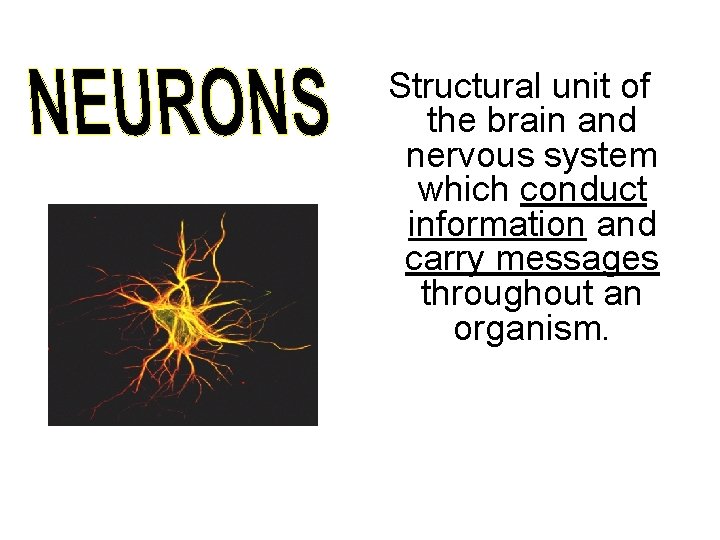
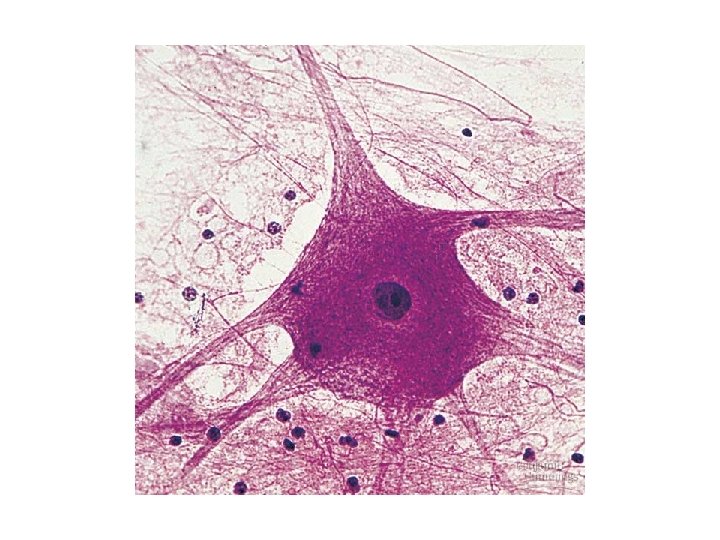
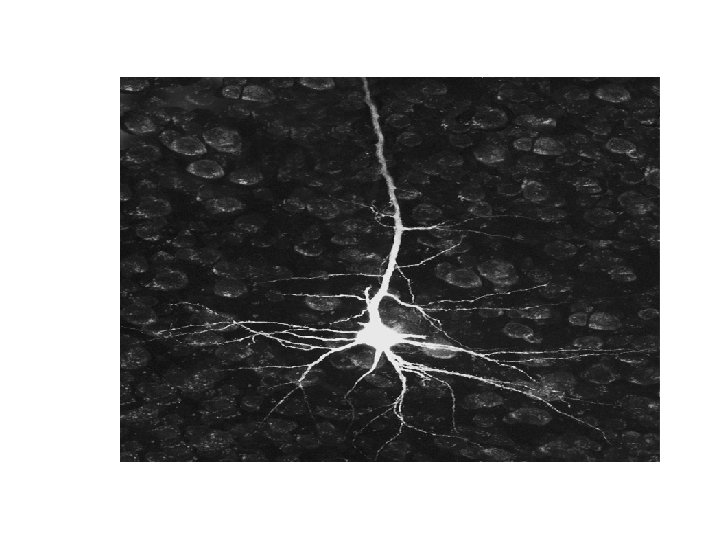
Structural unit of the brain and nervous system which conduct information and carry messages throughout an organism.
How do we relay the messages throughout our bodies to produce an action?
Topic: Nervous System AIM: How do nerve impulses reach an adjacent nerve cell? DO NOW: Identify the 3 sections of the brain describe their function
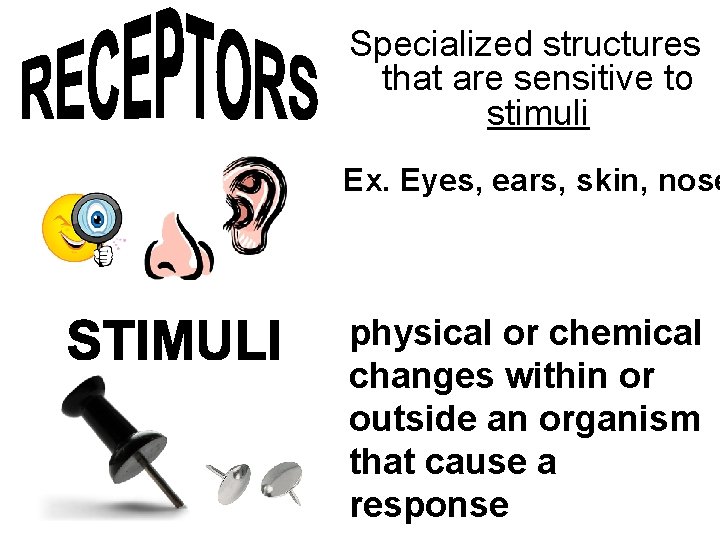
Specialized structures that are sensitive to stimuli Ex. Eyes, ears, skin, nose physical or chemical changes within or outside an organism that cause a response
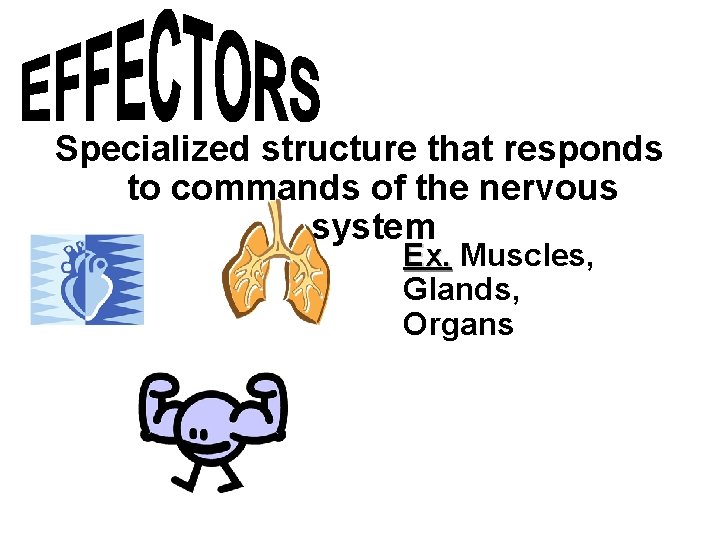
Specialized structure that responds to commands of the nervous system Ex. Muscles, Glands, Organs
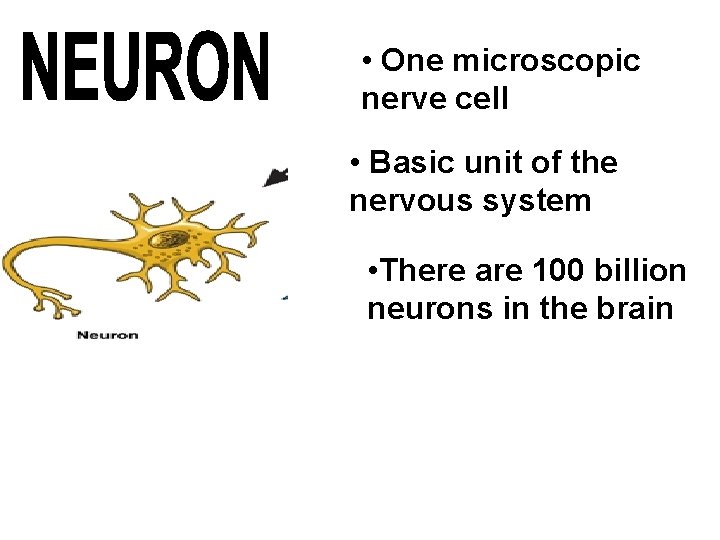
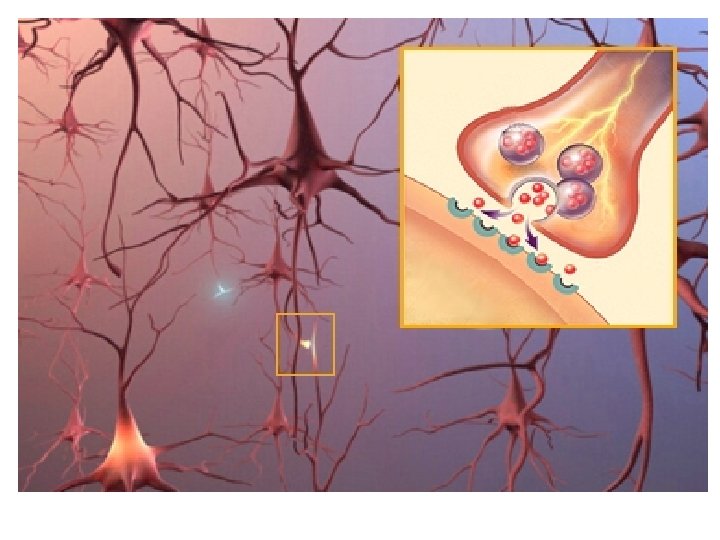
• One microscopic nerve cell • Basic unit of the nervous system • There are 100 billion neurons in the brain
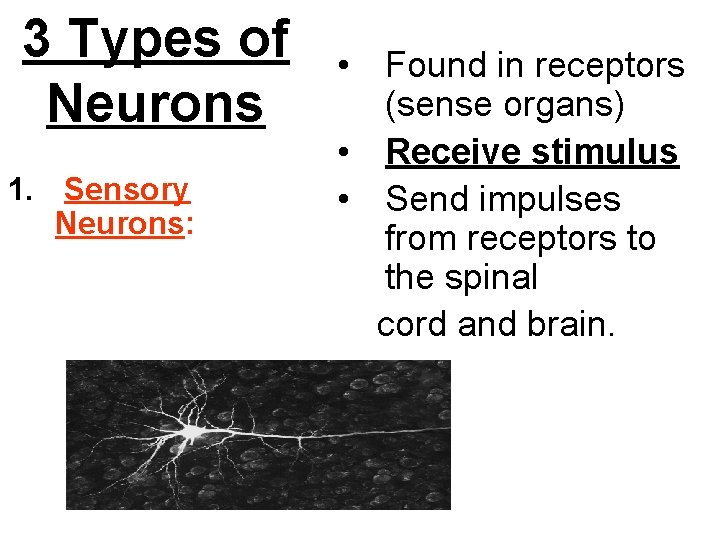
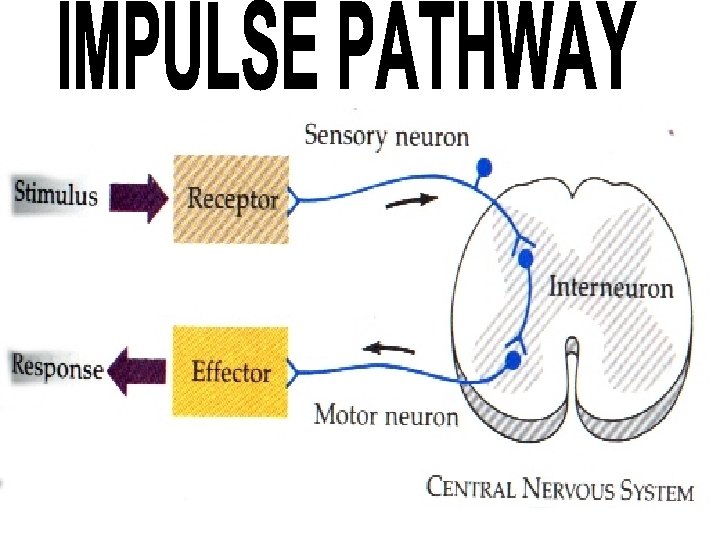
3 Types of Neurons 1. Sensory Neurons: • Found in receptors (sense organs) • Receive stimulus • Send impulses from receptors to the spinal cord and brain.
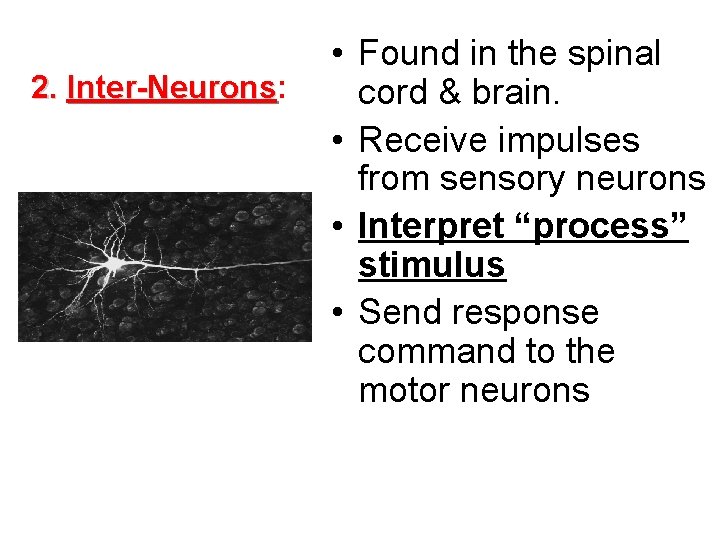
2. Inter-Neurons: Inter-Neurons • Found in the spinal cord & brain. • Receive impulses from sensory neurons • Interpret “process” stimulus • Send response command to the motor neurons
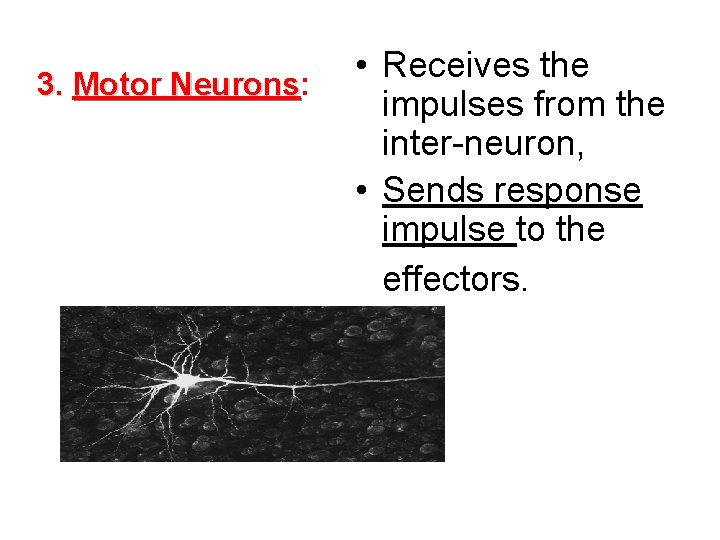
3. Motor Neurons: Neurons • Receives the impulses from the inter-neuron, • Sends response impulse to the effectors.
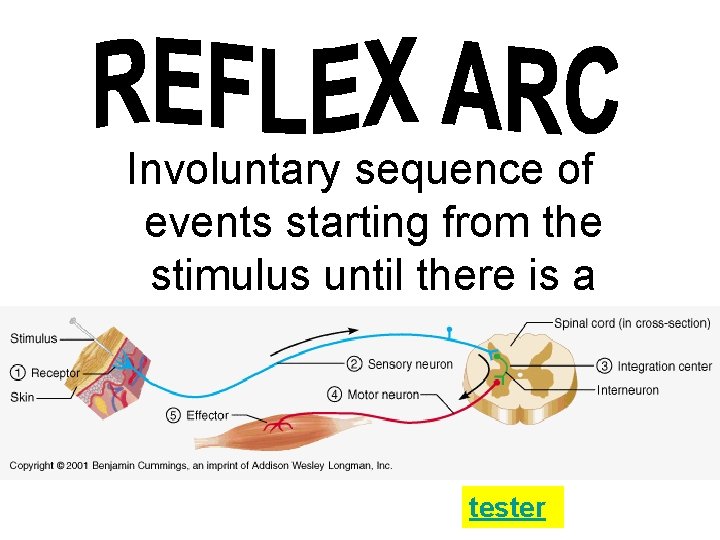
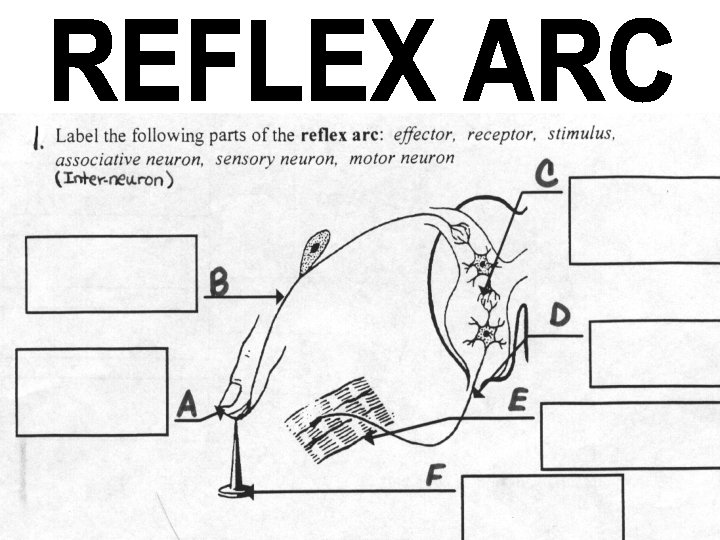
Involuntary sequence of events starting from the stimulus until there is a response. tester
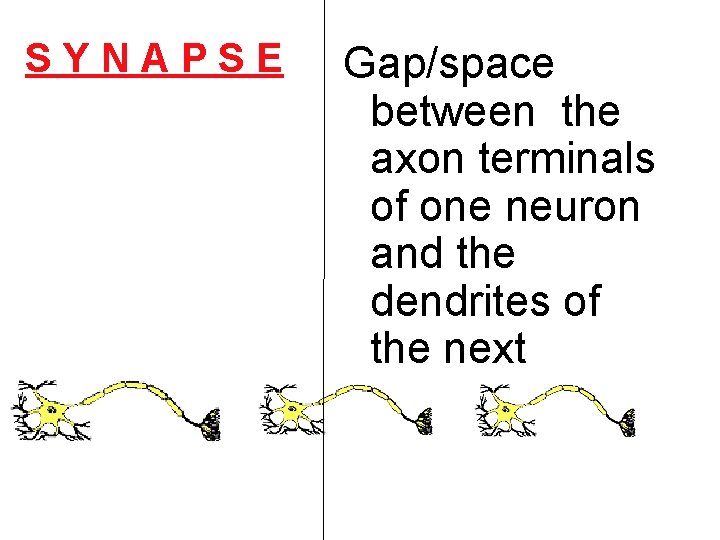
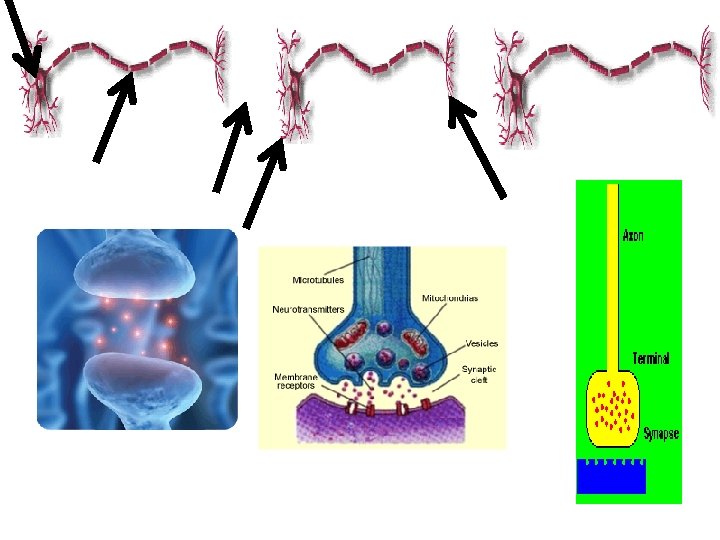
SYNAPSE Gap/space between the axon terminals of one neuron and the dendrites of the next
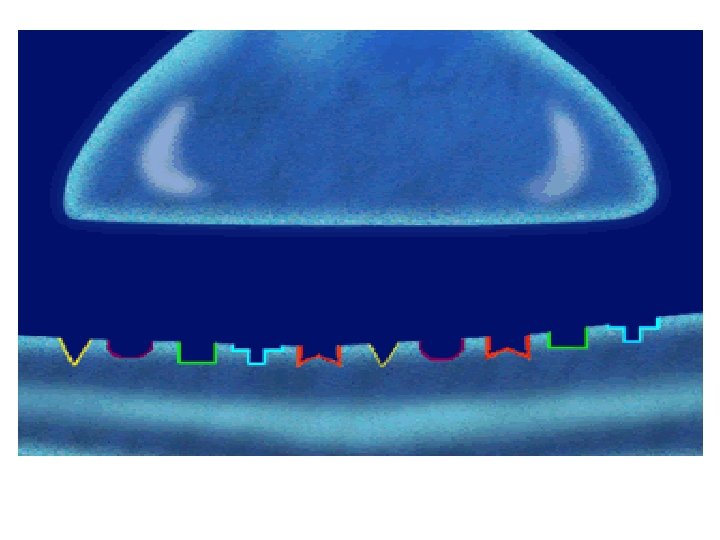
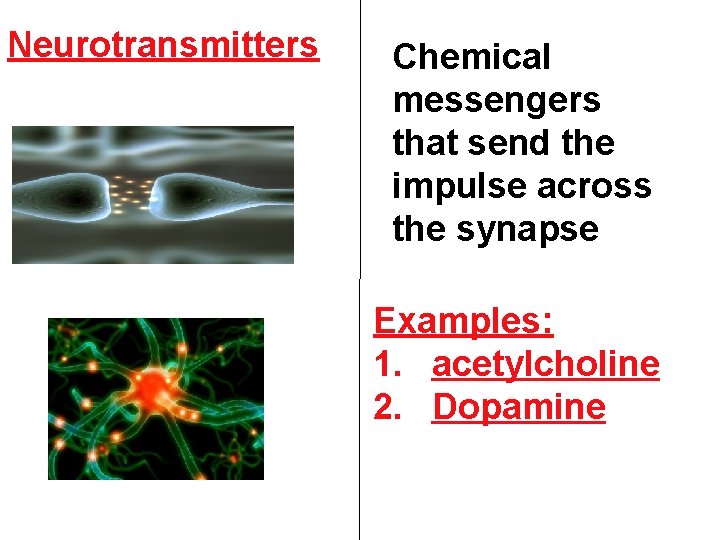
Neurotransmitters Chemical messengers that send the impulse across the synapse Examples: 1. acetylcholine 2. Dopamine