
Homeostasis Nod To understand the 3 main parts
- Slides: 27
Homeostasis Nod • To understand the 3 main parts involved in the homeostatic process. • To know the role of negative feedback in restoring conditions to their original levels.
Assessed Outcomes • Locate the assessed outcome for the topic 102 • Tick off each point as we study it. • Pg 103 -105 – contains essential info to learn for the exam.
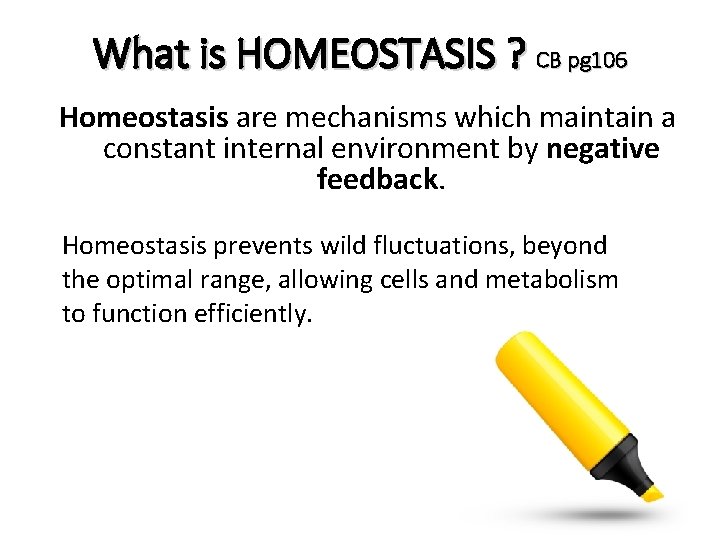
What is HOMEOSTASIS ? CB pg 106 Homeostasis are mechanisms which maintain a constant internal environment by negative feedback. Homeostasis prevents wild fluctuations, beyond the optimal range, allowing cells and metabolism to function efficiently.
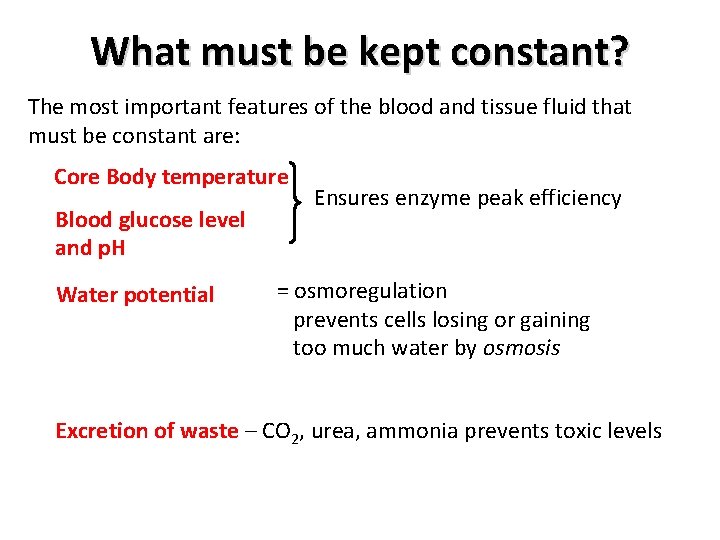
What must be kept constant? The most important features of the blood and tissue fluid that must be constant are: Core Body temperature Blood glucose level and p. H Water potential Ensures enzyme peak efficiency = osmoregulation prevents cells losing or gaining too much water by osmosis Excretion of waste – CO 2, urea, ammonia prevents toxic levels
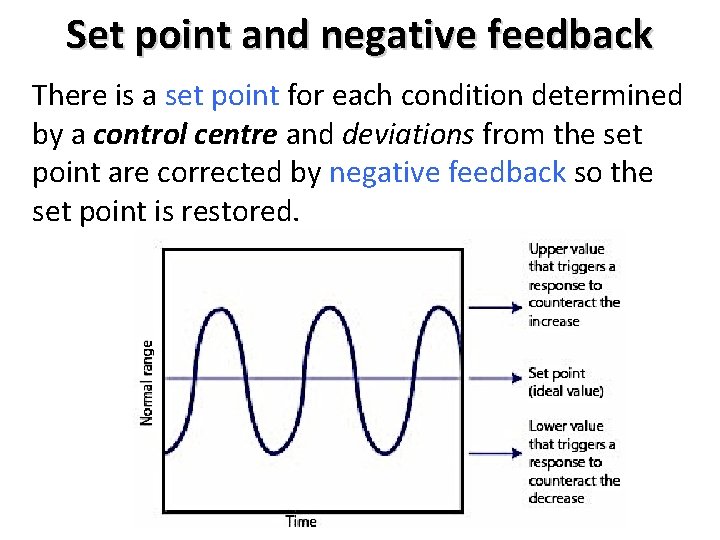
Set point and negative feedback There is a set point for each condition determined by a control centre and deviations from the set point are corrected by negative feedback so the set point is restored.
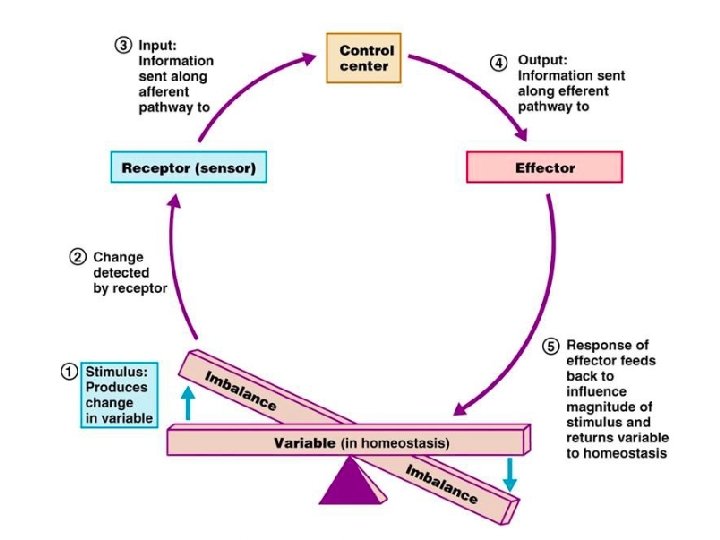
The Homeostatic Process and Negative Feedback CB pg 106 • • Receptor Coordinator Effector(s) Factor returns to normal and negative feedback to effector
Negative Feedback 1. A receptor detects a deviation from the set point in the internal environment. 2. The receptor sends instructions to a co-ordinator or controller. 3. The co-ordinator communicates with one or more effectors which make responses which are corrective. 4. The factor returns to normal (the set point), this is monitored by the receptor and information is fed back to the effectors, which stop making the correction.
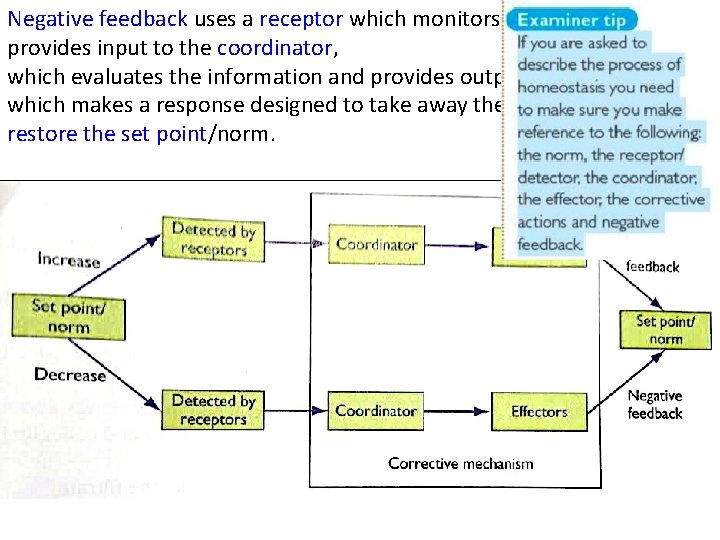
Negative feedback uses a receptor which monitors the condition and provides input to the coordinator, which evaluates the information and provides output to an effector, which makes a response designed to take away the deviation, i. e. restore the set point/norm.
Homeostatic Mechanism • An efficient homeostatic mechanism ensures that the factor being controlled shows minimal fluctuation around a set point.
The kidney Nod • Understand deamination. • Be able to label the mammalian kidney. • Know the parts of the urinary system.
Excretion ~ CB pg 107 • Excretion is the removal of wastes produced by the body due to metabolism. The mammalian body excretes compounds using four excretory organs: – Lungs – Carbon dioxide and water in expired air – Kidneys – Urea, creatinine and uric acid in urine – Skin – Urea in sweat – Liver - Bile pigments in faeces
RECAP The kidney is involved in homeostasis. What are the 3 main parts in the homeostatic process? Detector Coordinator Effector
Activate GCSE knowledge What are the 2 main functions of the kidney? • Excretion of nitrogenous waste • Osmoregulation (control of the water potential of the blood, tissue fluid and lymph)
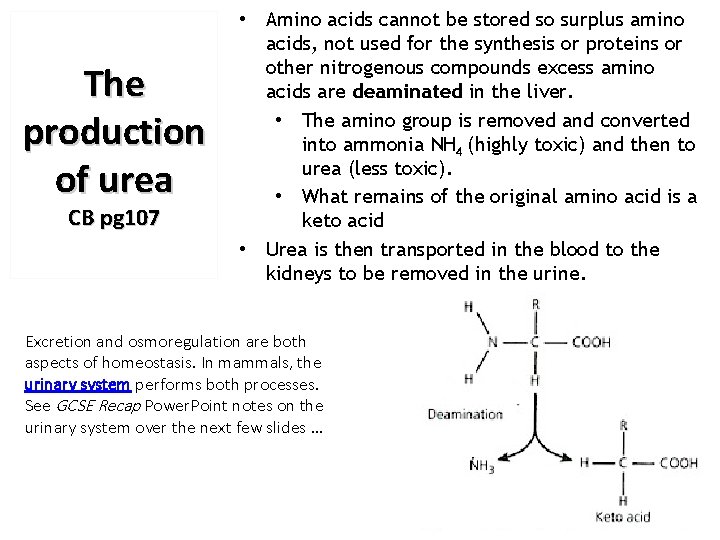
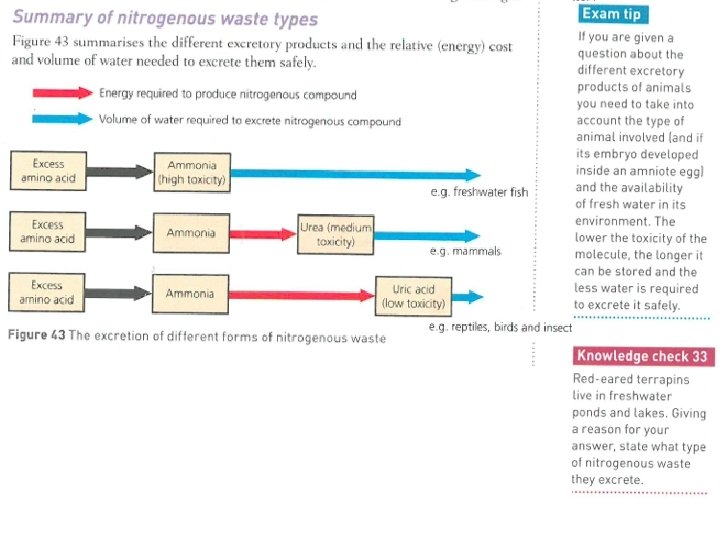
The production of urea CB pg 107 • Amino acids cannot be stored so surplus amino acids, not used for the synthesis or proteins or other nitrogenous compounds excess amino acids are deaminated in the liver. • The amino group is removed and converted into ammonia NH 4 (highly toxic) and then to urea (less toxic). • What remains of the original amino acid is a keto acid • Urea is then transported in the blood to the kidneys to be removed in the urine. Excretion and osmoregulation are both aspects of homeostasis. In mammals, the urinary system performs both processes. See GCSE Recap Power. Point notes on the urinary system over the next few slides …
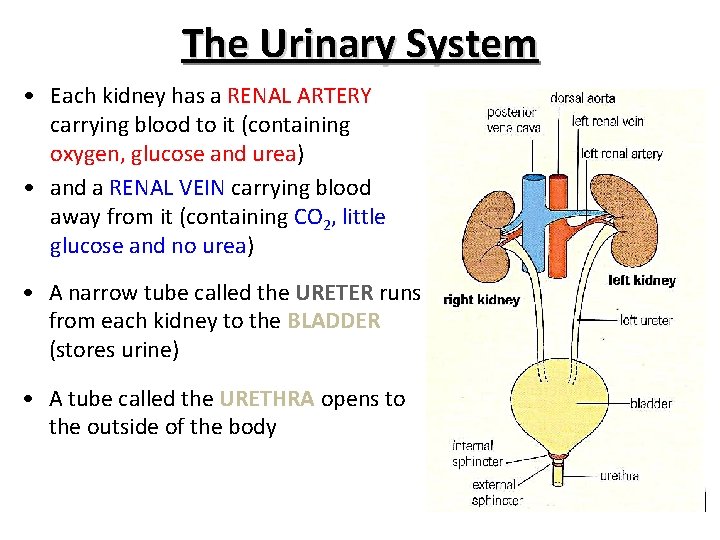
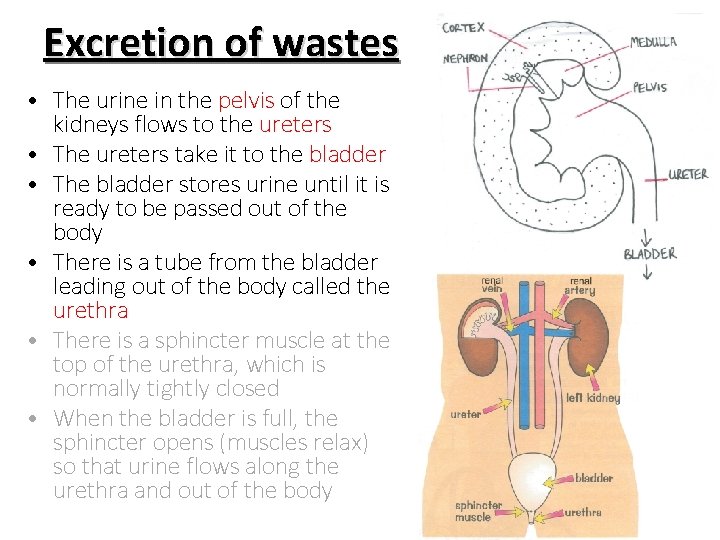
The Urinary System • Each kidney has a RENAL ARTERY carrying blood to it (containing oxygen, glucose and urea) • and a RENAL VEIN carrying blood away from it (containing CO 2, little glucose and no urea) • A narrow tube called the URETER runs from each kidney to the BLADDER (stores urine) • A tube called the URETHRA opens to the outside of the body
Excretion of wastes • The urine in the pelvis of the kidneys flows to the ureters • The ureters take it to the bladder • The bladder stores urine until it is ready to be passed out of the body • There is a tube from the bladder leading out of the body called the urethra • There is a sphincter muscle at the top of the urethra, which is normally tightly closed • When the bladder is full, the sphincter opens (muscles relax) so that urine flows along the urethra and out of the body
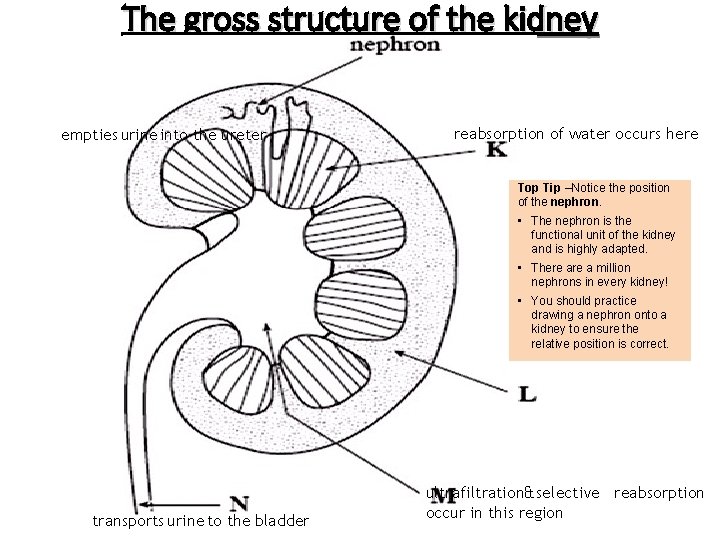
The gross structure of the kidney Booklet pg 108 empties urine into the ureter (inner) reabsorption of water occurs here Top Tip –Notice the position of the nephron. • The nephron is the functional unit of the kidney and is highly adapted. • There a million nephrons in every kidney! • You should practice drawing a nephron onto a kidney to ensure the relative position is correct. (outer) transports urine to the bladder ultrafiltration&selective reabsorption occur in this region
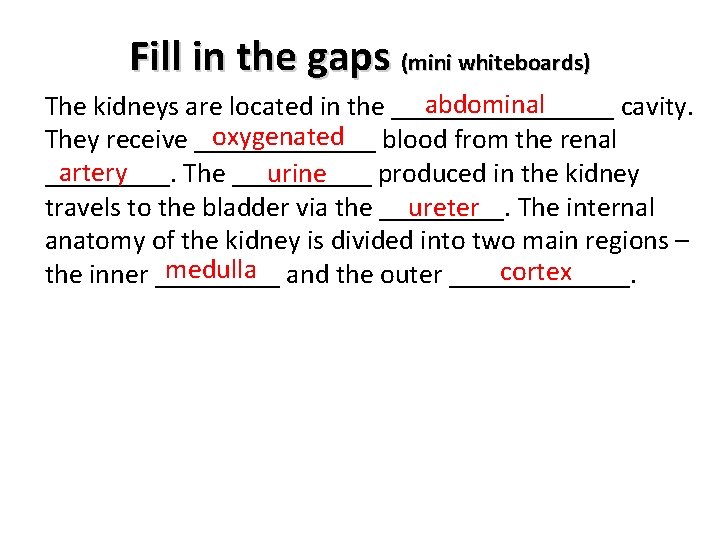
Fill in the gaps (mini whiteboards) abdominal The kidneys are located in the ________ cavity. oxygenated blood from the renal They receive _______ artery _____. The _____ produced in the kidney urine travels to the bladder via the _____. ureter The internal anatomy of the kidney is divided into two main regions – medulla and the outer _______. cortex the inner _____
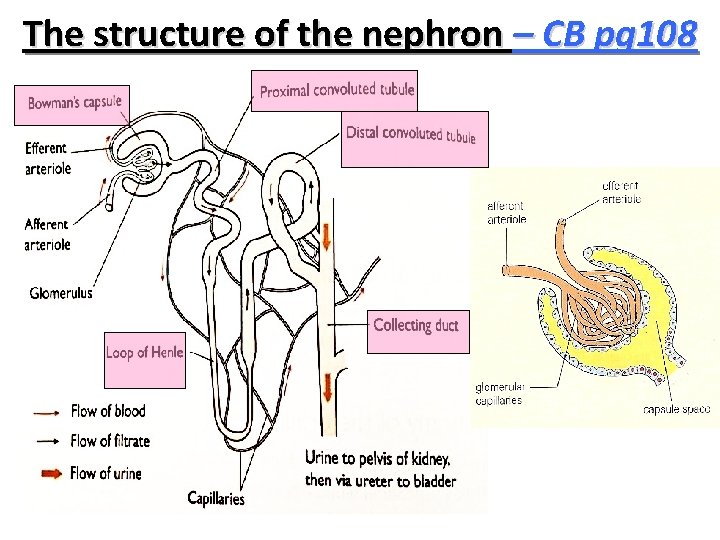
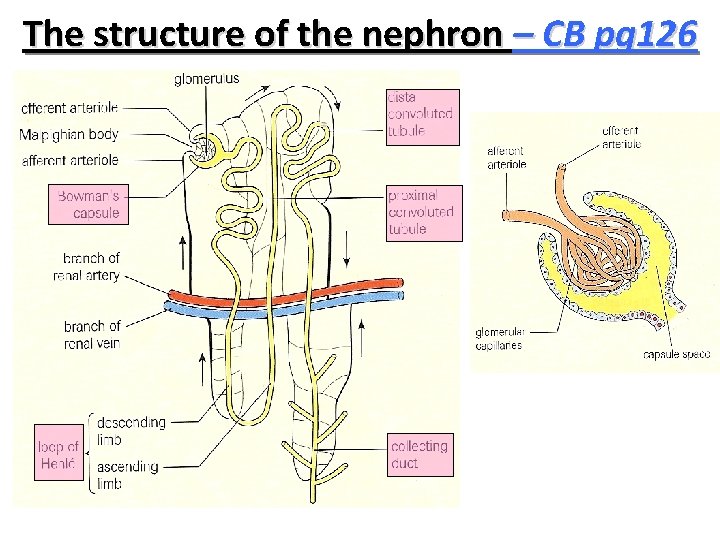
The Nephron CB Pg 108 • The functional unit of the kidney • Each kidney contains 1 million nephrons providing a large surface area for the exchange of materials. • The nephron spans both the cortex and medulla of the kidney. • Nephrons are microscopic structures that carry out the regulatory functions of the kidney, including the production of urine.
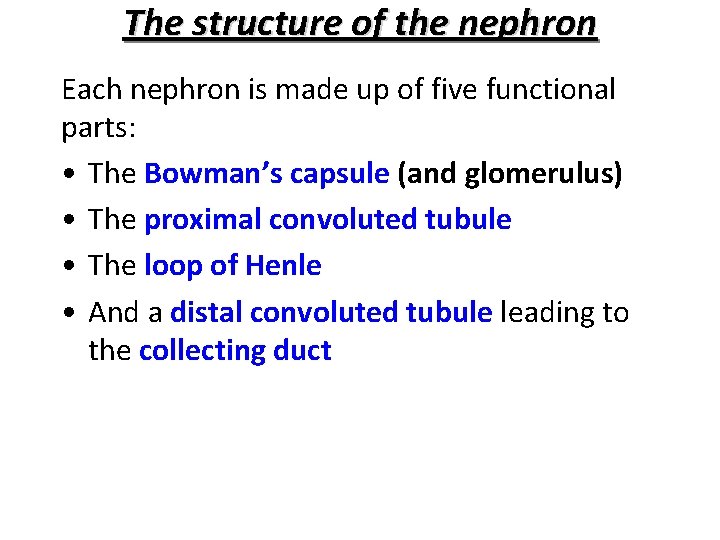
The structure of the nephron Each nephron is made up of five functional parts: • The Bowman’s capsule (and glomerulus) • The proximal convoluted tubule • The loop of Henle • And a distal convoluted tubule leading to the collecting duct
The structure of the nephron – CB pg 108
The structure of the nephron – CB pg 126
The kidney Gwaith Dosbarth Nod • Understand deamination. • Be able to label the mammalian kidney. • Know the parts of the urinary system. WALT gyflawni? ✓✓ LO achieved ✓ LO partly achieved ✗ LO not achieved
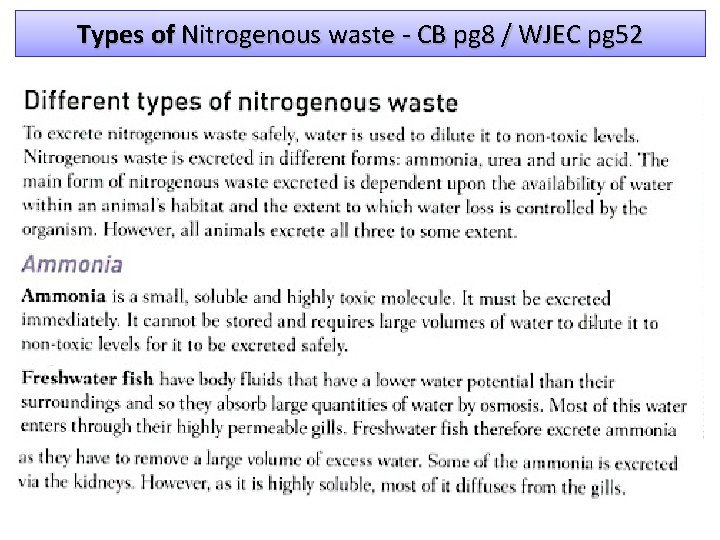
Types of Nitrogenous waste - CB pg 8 / WJEC pg 52
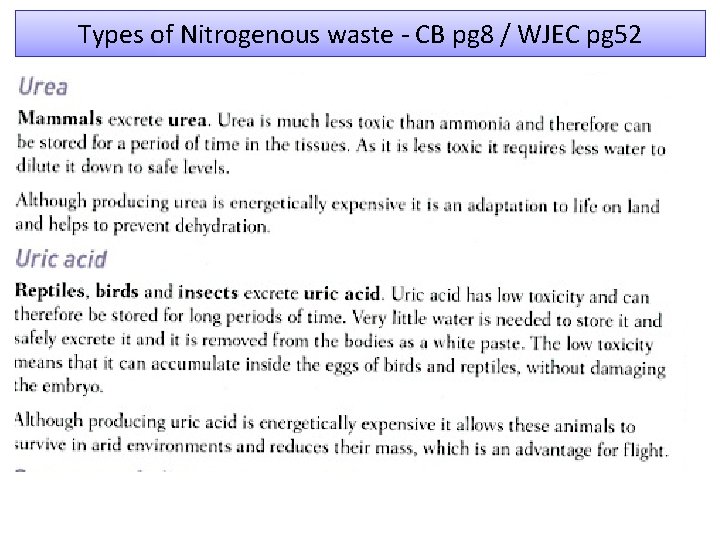
Types of Nitrogenous waste - CB pg 8 / WJEC pg 52