
Homeostasis L O to define homeostasis and explain



- Slides: 15
Homeostasis L. O: to define homeostasis and explain how homeostasis occurs Starter: Year 11 homeostasis quiz – what can you remember from two years ago? ? !
Homeostasis Definition: Definition Homeostasis is maintenance of a constant internal environment within a living organism. Homeo = same Stasis = state
Negative Feedback A series of changes that result in a substance being restored its normal / optimum level. Can you put the parts of a negative feedback system in the correct order? Then match up the sections with their correct description. Ask me to check before you glue them down! Once you’ve done, try to write an example of negative feedback next to each section. E. g a waterbath getting too hot – what would happen?
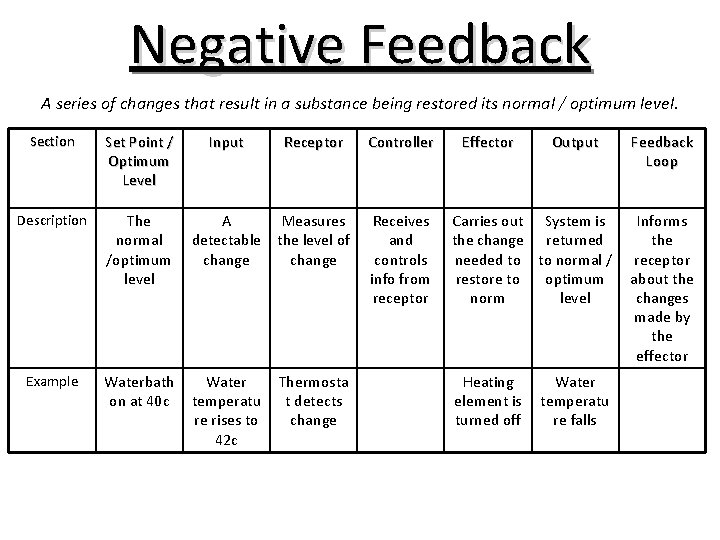
Negative Feedback A series of changes that result in a substance being restored its normal / optimum level. Section Set Point / Optimum Level Input Receptor Controller Description The normal /optimum level A detectable change Measures the level of change Receives and controls info from receptor Example Waterbath on at 40 c Water temperatu re rises to 42 c Thermosta t detects change Effector Output Carries out System is the change returned needed to to normal / restore to optimum norm level Heating element is turned off Water temperatu re falls Feedback Loop Informs the receptor about the changes made by the effector
What needs to be regulated by such a control system?
1: Examples of Homeostasis (in a quiz stylee!)
Examples of Homeostasis (in a quiz stylee !) 2:
Examples of Homeostasis (in a quiz stylee !) 3:
Examples of Homeostasis 1) Glucoregulation = keeping blood sugar levels constant 2) Thermoregulation = keeping body temperature constant at …? . . . °c 3) Osmoregulation = keeping water and ion levels constant
Osmoregulation • If your blood water conc falls…
Osmoregulation • If your blood water conc falls… • This is detected by osmoreceptors in the hypothalamus…
Osmoregulation • If your blood water conc falls… • This is detected by osmoreceptors in the hypothalamus… • Pituitary gland releases ADH (anti-diuretic hormone) into the blood…
Osmoregulation • If your blood water conc falls… • This is detected by osmoreceptors in the hypothalamus… • Pituitary gland releases ADH (anti-diuretic hormone) into the blood… • This makes your kidney tubules more permeable to water…
Osmoregulation • If your blood water conc falls… • This is detected by osmoreceptors in the hypothalamus… • Pituitary gland releases ADH (anti-diuretic hormone) into the blood… • This makes your kidney tubules more permeable to water… • So you absorb more water!
Osmoregulation However… Alcohol interferes and reduces the effect of ADH… what consequences does this have on your body? ? Interestingly… Boxers and jockeys who want to lose weight use diuretic drugs… how would this work? ?