
Homeostasis in Organisms Photosynthesis Cellular Enzymes Respiration Feedback

Homeostasis in Organisms
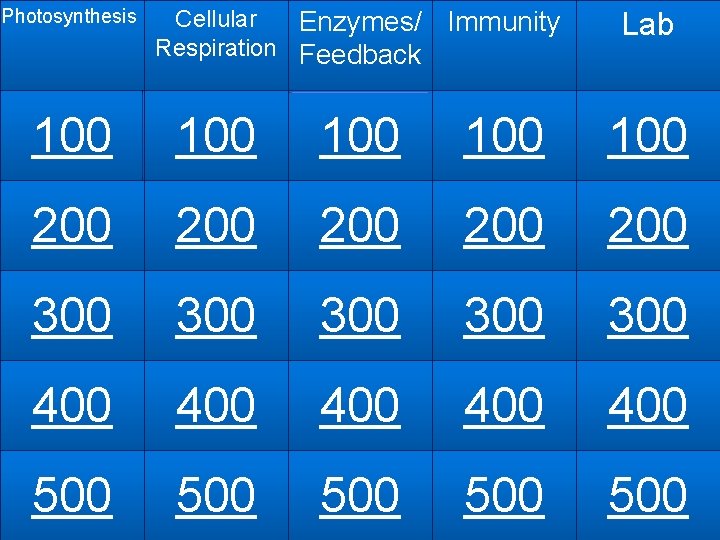
Photosynthesis Cellular Enzymes/ Respiration Feedback Immunity Lab 100 100 100 200 200 200 300 300 300 400 400 400 500 500 500
Photosynthesis – 100 The energy that photosynthesis transforms into glucose originates in A) Sunlight B) Minerals C) Chloroplasts A) Sunlight
Photosynthesis - 200 Guard cells control the opening and closing of stomates (pores) in leaves to control the loss of: A) Oxygen B) Carbon dioxide C) Glucose D) Water
Photosynthesis - 300 Which would be a way to stop photosynthesis? A) Stop light from reaching plant B) Stop eating vegetables C) Convert glucose to ATP D) Store sugar A) Stop light from reaching plant
Photosynthesis - 400 Light energy is captured in _______ and stored as _______. A) Photosynthesis, Inorganic Molecules B) Respiration, Inorganic Molecules C) Photosynthesis, Organic Molecules D) Respiration, Organic Molecules C) Photosynthesis, Organic Molecules
Photosynthesis - 500 Photosynthesis organisms undergo: A) Heterotrophic Nutrition B) Heterotrophic Absorption C) Autotrophic Nutrition D) Autotrophic Absorption C) Autotrophic Nutrition
Cellular Respiration - 100 Cellular Respiration stores energy as A) Lipids B) ATP C) Glucose D) Proteins B) ATP
Cellular Respiration - 200 Photosynthesis and Cellular Respiration take place in: A) Chlorophyll and Chloroplasts B) Cytoplasm and Cell membrane C) Vacuoles and Mitochondria D) Chloroplasts and Mitochondria
Cellular Respiration - 300 Which product of respiration would not be considered waste and be excreted? A) ATP B) Carbon Dioxide C) Water A) ATP
Cellular Respiration - 400 Respiration: ____+____ ATP + carbon dioxide + water A) Glucose and Oxygen B) Glucose and Sun C) Oxygen and Sun D) Water and Oxygen A) Glucose and Oxygen
Cellular Respiration - 500 During Respiration, energy is released from A) Oxygen Atoms B) Water Molecules C) Carbon Dioxide D) Chemical Bonds

Enzymes/Feedback – 100 Enzymes are a type of specifically folded ______. The folding determines its ____. A) Carbohydrate, Charm B) Nucleic Acid, p. H C) Protein, Function D) Lipid, Temperature C) Protein, Function
Enzymes/Feedback - 200 Feedback mechanisms are designed to help A) Keep you sane B) Keep the body in homeostasis C) Keep glucose from being used in respiration B) Keep the body in homeostasis
Enzymes/Feedback - 300 The body regulates the amount of glucose in the blood by releasing: Insulin
Enzymes/Feedback - 400 This is an example of: Negative or Positive Feedback? Negative
Enzymes/Feedback - 500 Which enzyme (line) will work best in the stomach? Blue Line
Immunity - 100 When an organism fails to maintain homeostasis, ______results. A) Illness B) Dynamic Equilibrium C) Increased enzyme activity D) Insulin production A) Illness
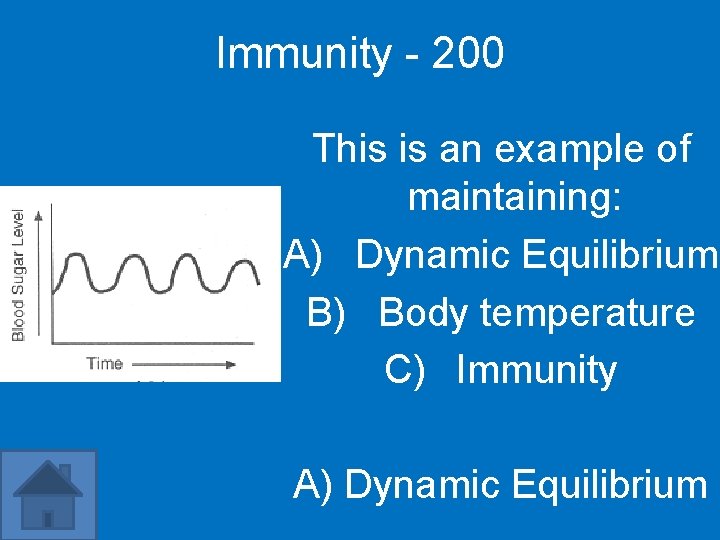
Immunity - 200 This is an example of maintaining: A) Dynamic Equilibrium B) Body temperature C) Immunity A) Dynamic Equilibrium
Immunity - 300 An organism that is harmful to the body is known as: A) Antigen B) Pathogen C) Antibody D) Waste B) Pathogen
Immunity - 400 The surface proteins on the outside of cell membrane that immune cells recognize are known as___. A) Antibodies B) Receptors C) Pathogens D) Antigens
Immunity - 500 White blood cells help cure illnesses by ____ pathogens and producing ____. A) attacking, antigens B) attacking, antibodies C) antigens, antibodies D) destroying, antigens B) attacking, antibodies
Lab - 100 Starch appears cloudy in solution but will turn ____ in the presence of iodine. A) Clear B) Blue C) Black D) Amber C) Black
Lab - 200 Plant cells can die due to A) Salt being added to environment B) Excess water being added to environment C) Moving glucose A) Salt being added to environment
Lab - 300 The formation of ______ in muscle cells is associated with muscle fatigue. A) Oxygen B) Carbohydrates C) Enzymes D) Lactic Acid
Lab - 400 Benedicts solution turns from _____to ____ in color in the presence of Glucose. A) White to Blue B) Orange to White C) Blue to White D) Blue to Black C) Blue to White
Lab - 500 Cell membrane is selectively permeable, which means A) It lets all things pass B) Lets some things pass C) Lets nothing pass B) Lets some things pass
- Slides: 27