
Homeostasis How living things maintain balance William Wilkinson
Homeostasis How living things maintain balance

© William Wilkinson, Interactive. Science. Teacher. com
Homeostasis: how living things/cells maintain balance cut every 7 cm © William Wilkinson, Interactive. Science. Teacher. com
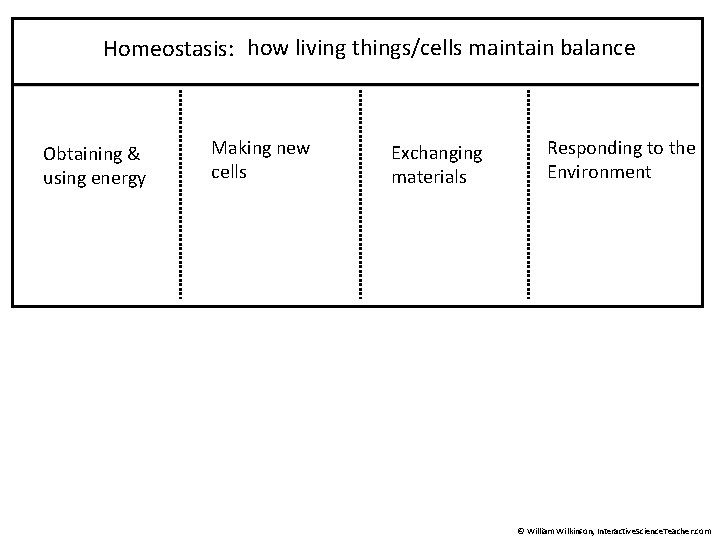
Homeostasis: how living things/cells maintain balance Obtaining & using energy Making new cells Exchanging materials Responding to the Environment © William Wilkinson, Interactive. Science. Teacher. com
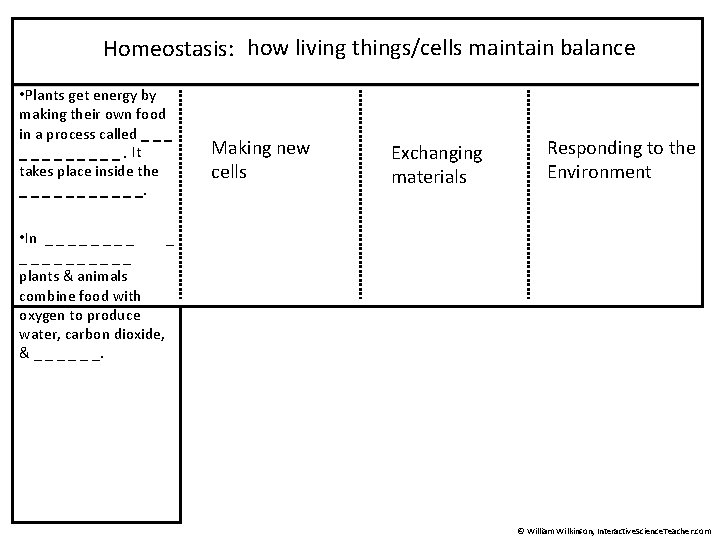
Homeostasis: how living things/cells maintain balance • Plants get energy by making their own food in a process called _ _ _. It takes place inside the _ _ _. Making new cells Exchanging materials Responding to the Environment • In _ _ _ _ ______ plants & animals combine food with oxygen to produce water, carbon dioxide, & _ _ _. © William Wilkinson, Interactive. Science. Teacher. com
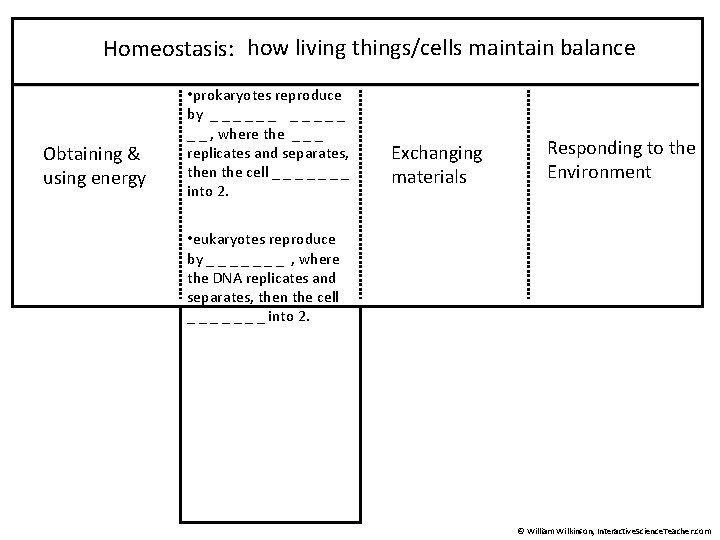
Homeostasis: how living things/cells maintain balance Obtaining & using energy • prokaryotes reproduce by _ _ _ _ , where the _ _ _ replicates and separates, then the cell _ _ _ _ into 2. Exchanging materials Responding to the Environment • eukaryotes reproduce by _ _ _ _ , where the DNA replicates and separates, then the cell _ _ _ _ into 2. © William Wilkinson, Interactive. Science. Teacher. com
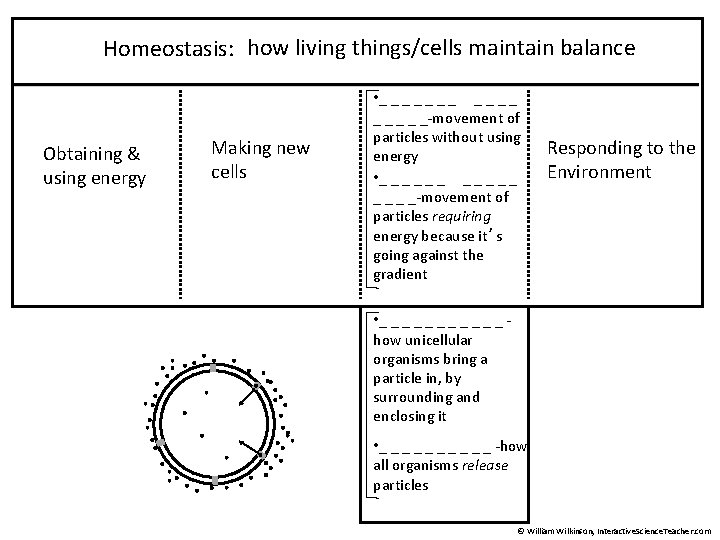
Homeostasis: how living things/cells maintain balance Obtaining & using energy Making new cells • _ _ _ _-movement of particles without using energy • _ _ _ _-movement of particles requiring energy because it’s going against the gradient Responding to the Environment • _ _ _ how unicellular organisms bring a particle in, by surrounding and enclosing it • _ _ _ _ _ -how all organisms release particles © William Wilkinson, Interactive. Science. Teacher. com
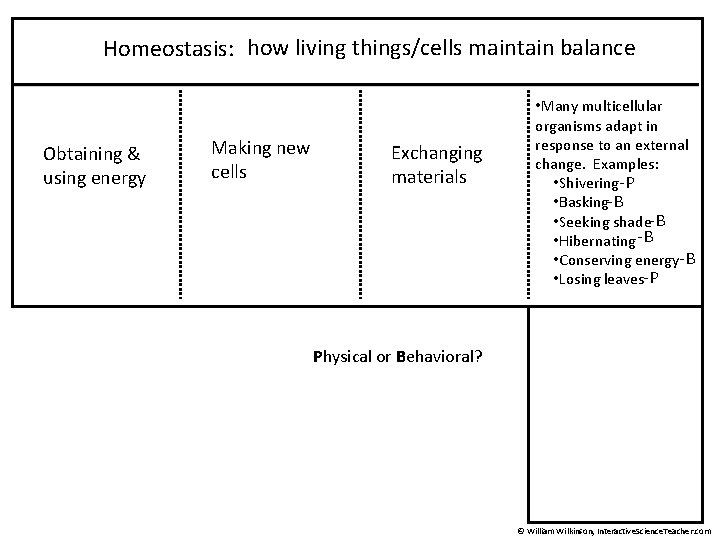
Homeostasis: how living things/cells maintain balance Obtaining & using energy Making new cells Exchanging materials • Many multicellular organisms adapt in response to an external change. Examples: • Shivering-P • Basking-B • Seeking shade-B • Hibernating -B • Conserving energy-B • Losing leaves-P Physical or Behavioral? © William Wilkinson, Interactive. Science. Teacher. com
- Slides: 8