
Homeostasis Feedback Loops Used at all levels of

Homeostasis
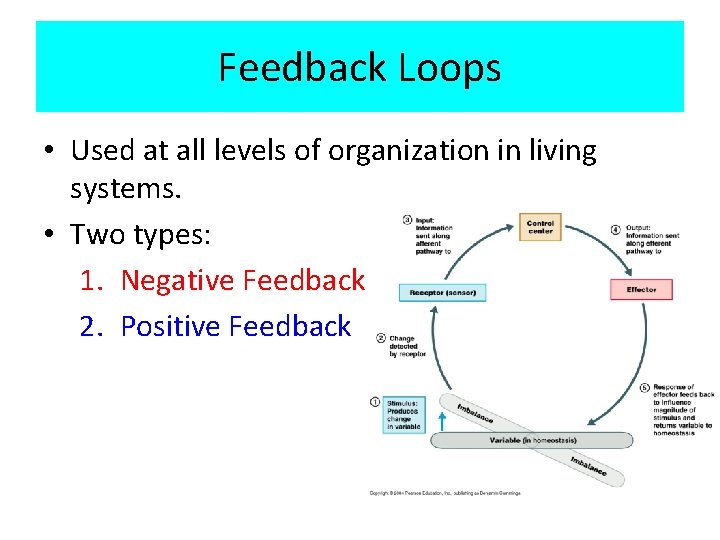
Feedback Loops • Used at all levels of organization in living systems. • Two types: 1. Negative Feedback 2. Positive Feedback
Negative Feedback • They regulate systems or processes • Maintains homeostasis at a set point or range • The response (or feedback) to the stimulus decreases the occurrence of the stimulus or is opposite of the stimulus. – Examples: Lac operon, temperature regulation, plant responses to water limitations, population growth, blood sugar and blood calcium regulation


Positive Feedback • Amplifying in nature • The response is to amplify or increase the occurrence of the stimulus. – Examples: labor, fruit ripening and lactation in mammals

Effects of Disruptions • Seen at all levels of organization • Molecular and cellular level: – Ex: Response to toxins • interferes with specific metabolic pathways or cause cell damage ( neurotoxins, poisons and pesticides) – Ex: Dehydration • Too much water loss causes cellular environment to be too hypertonic. Cellular work stops. Death… – Ex: Drugs- signals are blocked • High BP drugs, anesthetics, antihistamines, birth control pills – Ex: Diseases • Diabetes, heart disease, autoimmune disease, cancer

Ecological Disruptions • Affects balance of the ecosystems • Examples: – Invasive species: outcompetes native species or places a rapid stress on natives – Natural disturbances: fires, earthquakes etc.
Note: as long as disruption is not too large and too rapid for homeostatic feedback loops to function, rebound will occur. Otherwise, disease, degradation and death are unavoidable.
Physiological Interactions • Multicellular organisms are organized into organ systems, which contain organs that work together to accomplish life processes. • Organ systems also interact for life processes – Examples: • • • Stomach and small intestine Plant organs Respiratory and Circulatory System Nervous and Muscular System Kidney and bladder
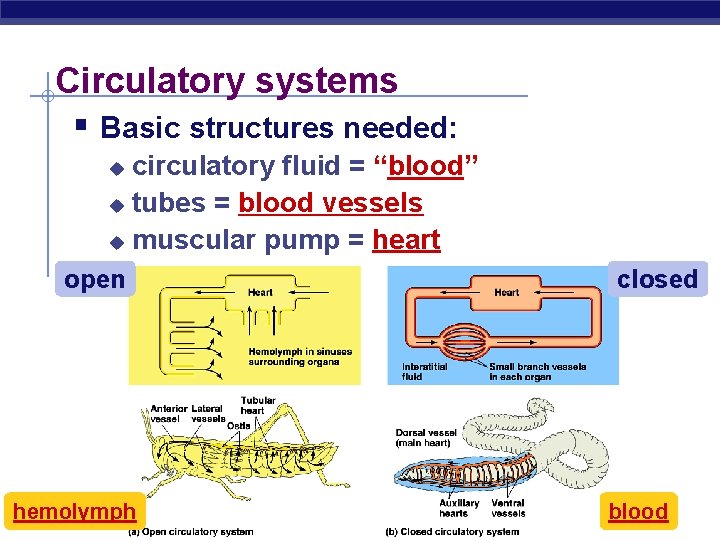
Circulatory systems § Basic structures needed: circulatory fluid = “blood” u tubes = blood vessels u muscular pump = heart u open hemolymph AP Biology closed blood

Vertebrate circulatory system § Adaptations in closed system u 2 low pressure to body number of heart chambers differs 3 4 low O 2 to body high pressure & high O 2 to body What’s the adaptive value of a 4 chamber heart? 4 chamber heart is double pump = separates oxygen-rich & AP Biology oxygen-poor blood; maintains high pressure
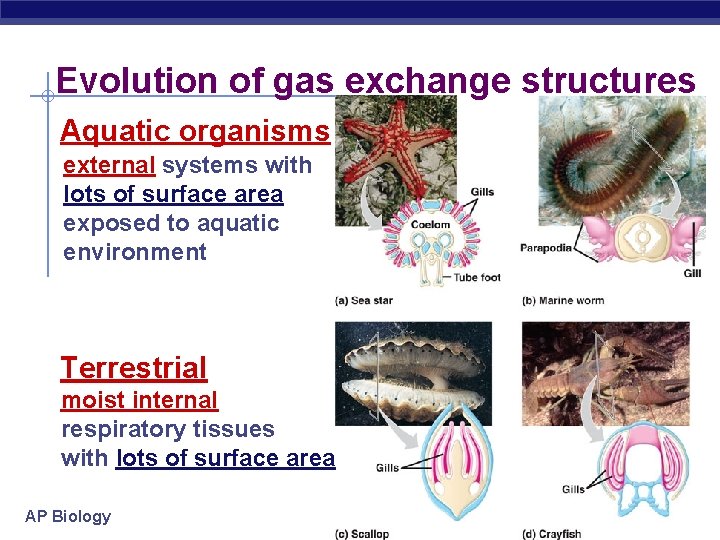
Evolution of gas exchange structures Aquatic organisms external systems with lots of surface area exposed to aquatic environment Terrestrial moist internal respiratory tissues with lots of surface area AP Biology
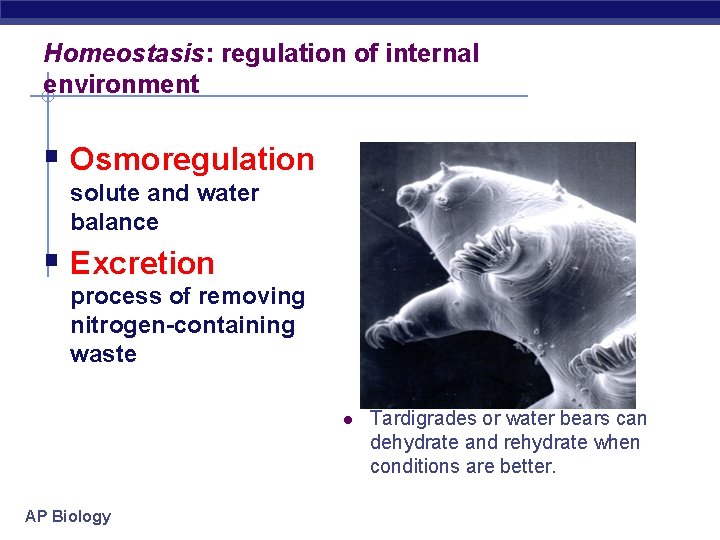
Homeostasis: regulation of internal environment § Osmoregulation solute and water balance § Excretion process of removing nitrogen-containing waste l AP Biology Tardigrades or water bears can dehydrate and rehydrate when conditions are better.
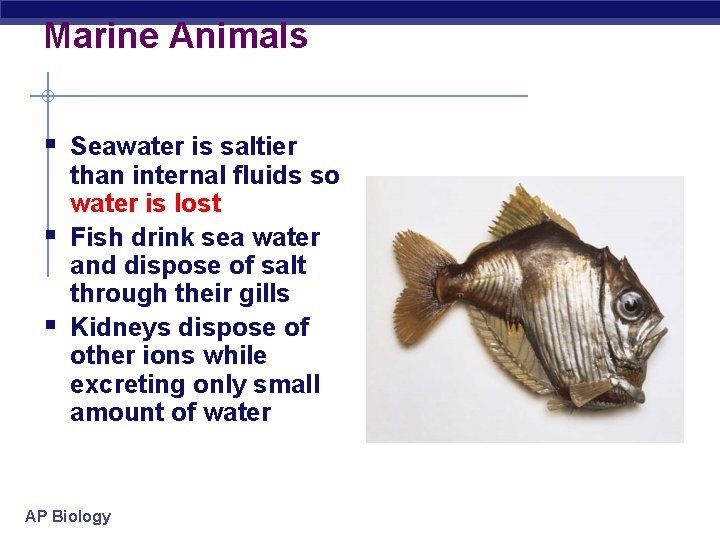
Marine Animals § Seawater is saltier § § than internal fluids so water is lost Fish drink sea water and dispose of salt through their gills Kidneys dispose of other ions while excreting only small amount of water AP Biology

Freshwater Fish § They gain water and § § § lose salts Drink little water Uptake salt by gills and from food Excrete large amounts of water in dilute urine l AP Biology Record Perch- 50 lbs
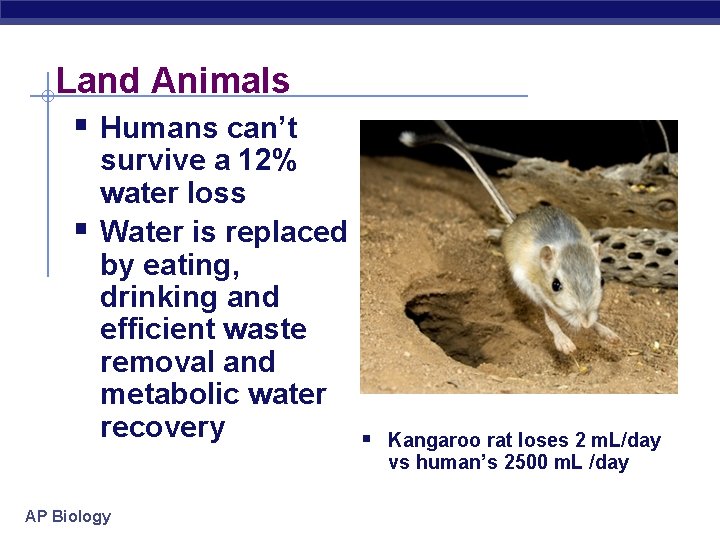
Land Animals § Humans can’t § survive a 12% water loss Water is replaced by eating, drinking and efficient waste removal and metabolic water recovery § AP Biology Kangaroo rat loses 2 m. L/day vs human’s 2500 m. L /day
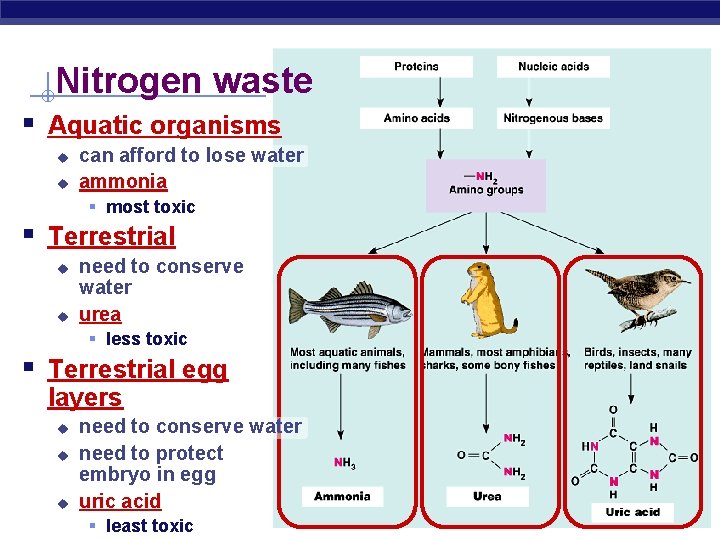
Nitrogen waste § Aquatic organisms u u can afford to lose water ammonia § most toxic § Terrestrial u u need to conserve water urea § less toxic § Terrestrial egg layers u u u need to conserve water need to protect embryo in egg uric acid AP Biology § least toxic

Uric Acid and Shelled Eggs § Metabolic waste must be stored until birth § Uric acid is not water soluble or toxic and needs little water AP Biology
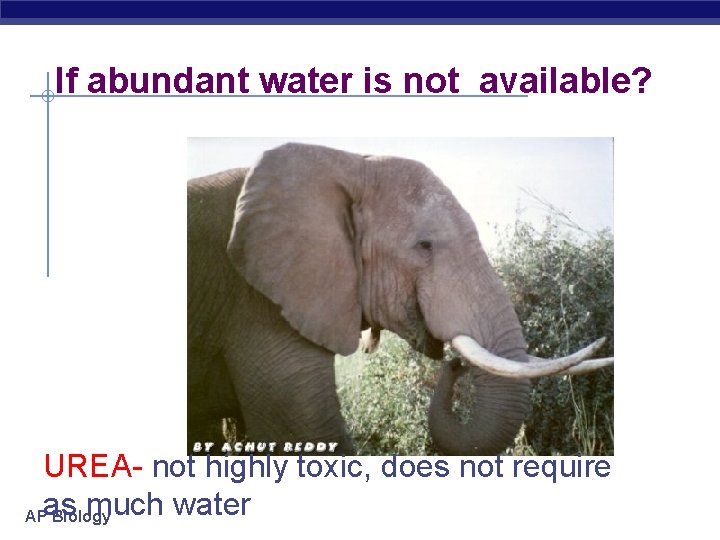
If abundant water is not available? UREA- not highly toxic, does not require much water APas Biology

AP Biology
- Slides: 20