
Homeostasis External Environment Internal Environment External Environment Paula
- Slides: 17
Homeostasis External Environment Internal Environment External Environment Paula Ellington
Objectives ¬ Define the term homeostasis. ¬ Distinguish briefly between an organisms internal and external environment. ¬ State and explain the basic components of a control system. ¬ Define the terms “ set- point”, “negative feedback”, “reference point”, “output”, “input”, “regulator”, “stimulus”, “receptor or detector”. ¬ Explain the importance of the negative feedback mechanism to homeostasis. ¬ Differentiate between negative and positive feedback. ¬ List examples of biological negative feedback mechanisms.
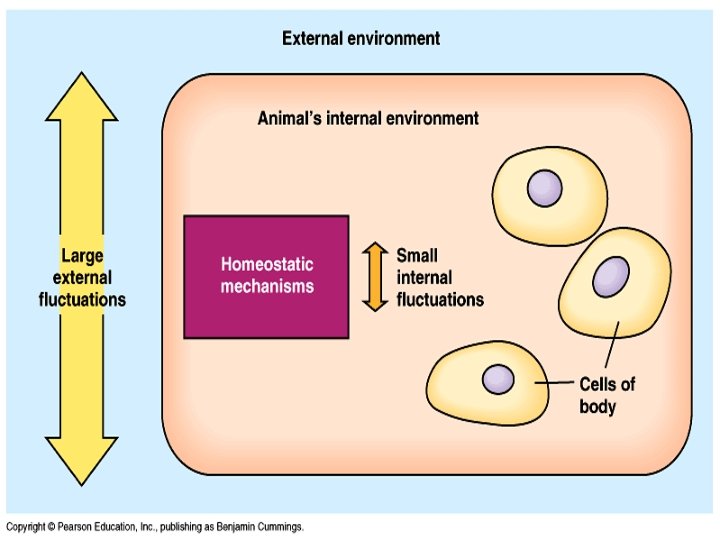
Homeostasis ¬ Homeostasis is the maintenance of a constant internal environment (the immediate surroundings of cells) in response to changes in: the changing conditions of the external environment. ¬ the changing conditions of the internal environment.
Cont’d Homeostasis is a self adjusting mechanism involving feedback where the response to a stimulus alters the internal conditions and may itself become a new stimulus. Homeostasis works to maintain the organism's internal environment within tolerance limits - the narrow range of conditions where cellular processes are able to function at a level consistent with the continuation of life.
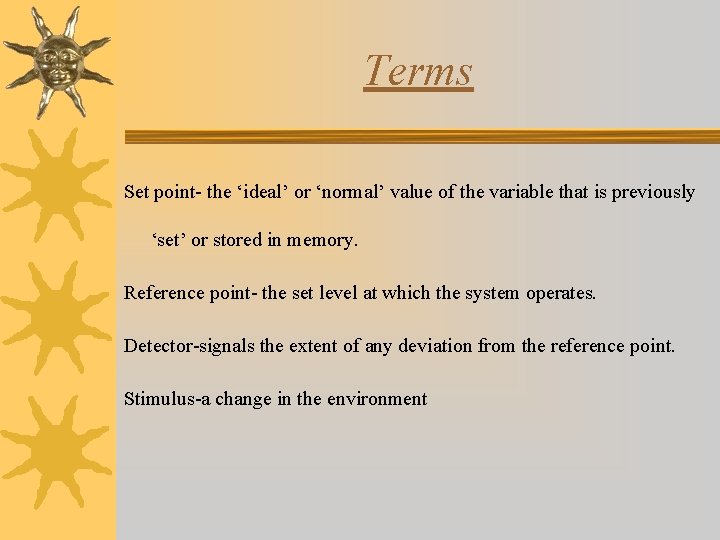
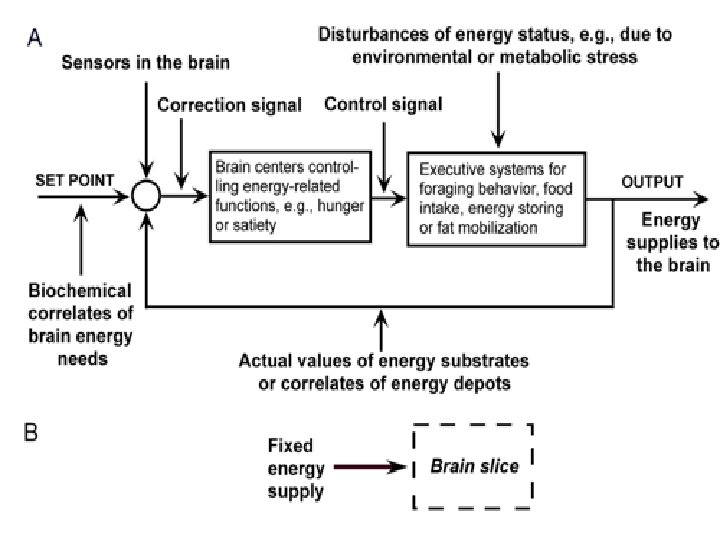
Terms Set point- the ‘ideal’ or ‘normal’ value of the variable that is previously ‘set’ or stored in memory. Reference point- the set level at which the system operates. Detector-signals the extent of any deviation from the reference point. Stimulus-a change in the environment
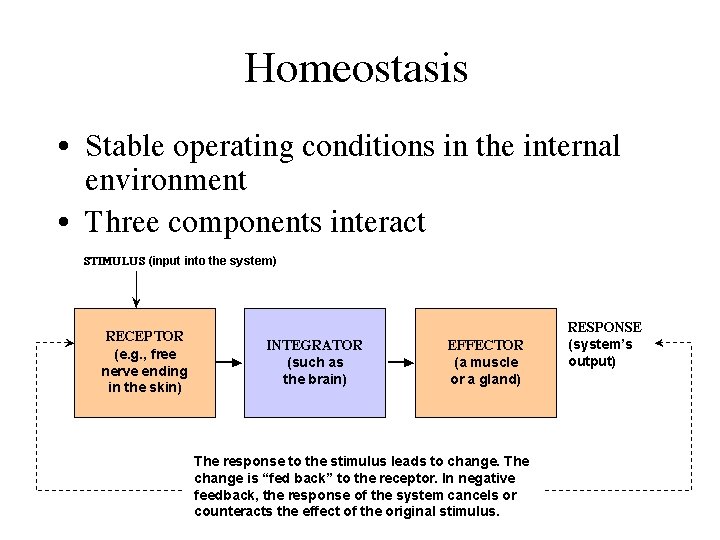
Negative and Positive Feedback ¬ Negative feedback Occurs when feedback (from sensor to integrator) results in a reversal of the direction of change Negative feedback tends to stabilize a system, correcting deviations from the set point Human example: shivering in response to cooling of body during cold weather
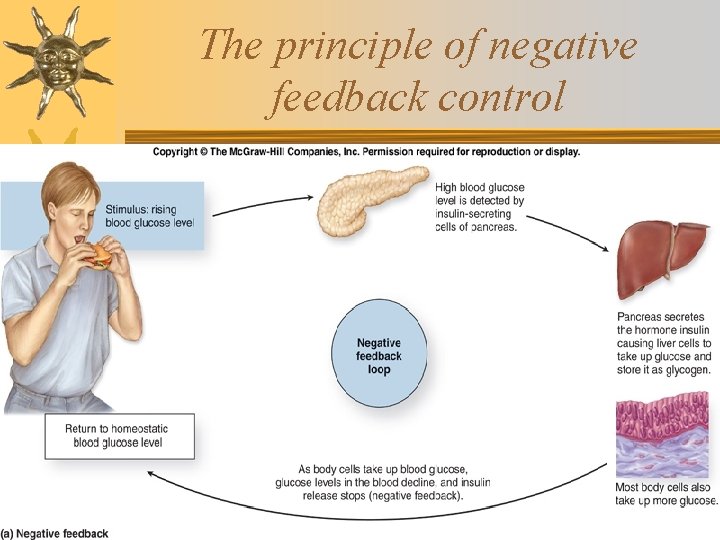
The principle of negative feedback control
Positive feedback Occurs when feedback (from sensor to integrator) results in an amplification of the change (same direction as deviation from set point) Example: audio "feedback" occurs when amplified sound is picked up by microphone and then amplified again then picked up and amplified again, and again --each time getting louder Can be stopped only if "feedback loop" is broken
Cont’d Human example: increased labor contractions stimulated by oxytocin (OT) hormone Fetus's head moves into birth canal (vagina) at start of labor, which causes the birth canal to stretch beyond its set point amount of stretch, which is detected by sensors (stretch receptors) in the vaginal wall and fed back to hypothalamus of brain, which releases OT, which stimulates stronger and more frequent uterine (womb) contractions, which pushes the fetus, which causes more vaginal stretch, which produces more OT, and so on --greatly amplifying and speeding up labor contractions Broken when baby is born (no more stretch, thank goodness)
Homeostasis depends on the action and interaction of a number of body systems to maintain a range of conditions within which the body can best operate.
Negative feedback control mechanisms ¬ Negative feedback- The stopping of the synthesis of an enzyme by the accumulation of the products of the enzymemediated reaction. ¬ Negative feedback control Occurs when information produced by the feedback reverses the direction of the response; regulates the secretion of most hormones. ¬ Negative feedback loop- A biochemical pathway where the products of the reaction inhibit production of the enzyme that controlled their formation.
Positive feedback control ¬ Biochemical control where the accumulation of the product stimulates production of an enzyme responsible for that product's production. ¬ Positive feedback control occurs when information produced by the feedback increases and accelerates the response.
Examples of biological negative feedback mechanisms ¬ secretion of sweat to lower the body temperature, ¬ secretion of greater amount of insulin to lower the blood sugar level, ¬ secretion of greater amount of glucagon to increase the blood sugar level, ¬ a type of receptor found in aorta that can detect the blood pressure if it is not in normal condition, for example if the blood pressure is high, the receptor will send nerve impulse to the medulla oblongata in the brain, and the brain will send nerve impulse to the heart to slow down to the heartbeat,
¬ secretion of more aldosterone (hormone) to absorb more mineral salt during reabsorption in kidney if the osmotic pressure in our blood is low(less salt, more water), ¬ secretion of more antidiuretic hormone to absorb more water during reabsorption in kidney if the blood osmotic pressure is high(more salt, less water).