
Homely Remedies in Care Homes What is Homely

- Slides: 16
Homely Remedies in Care Homes
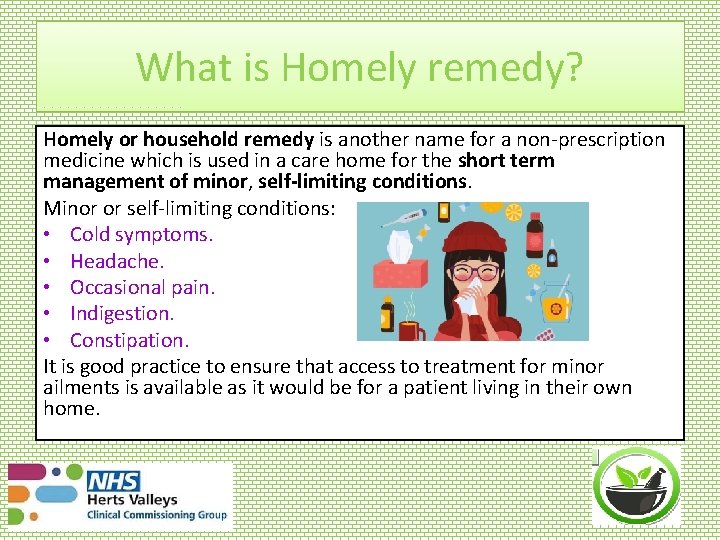
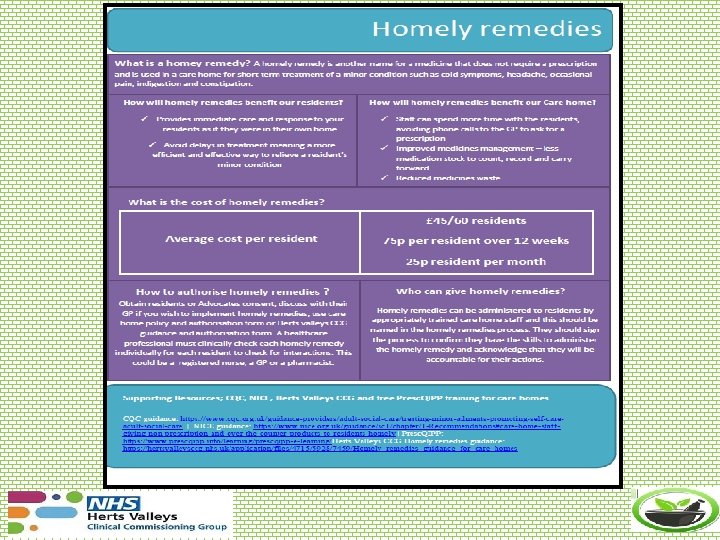
What is Homely remedy? Homely or household remedy is another name for a non-prescription medicine which is used in a care home for the short term management of minor, self-limiting conditions. Minor or self-limiting conditions: • Cold symptoms. • Headache. • Occasional pain. • Indigestion. • Constipation. It is good practice to ensure that access to treatment for minor ailments is available as it would be for a patient living in their own home.
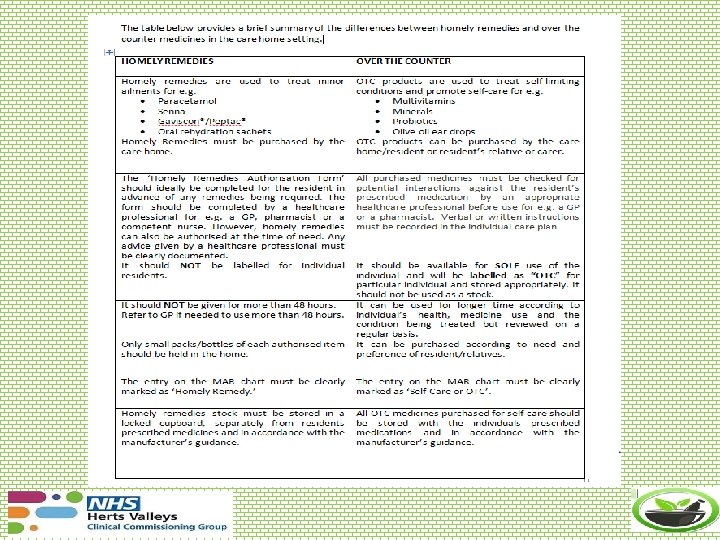
NATIONAL AND LOCAL KEY POINTS Ø Care Homes with or without nursing should have an approved list of products to treat minor ailments that they keep as stock. Ø Homely remedies must be purchased by the care home and should not be labelled for individual residents. Ø Homely remedies should only be given for a maximum of 48 hours, before referring to the GP if symptoms persist. If required for longer than 48 hours, the GP will need to assess and advise. Ø Homely remedies should not be requested on prescription from GPs or nonmedical prescribers. Ø Dressings and items for first-aid are NOT homely remedies.
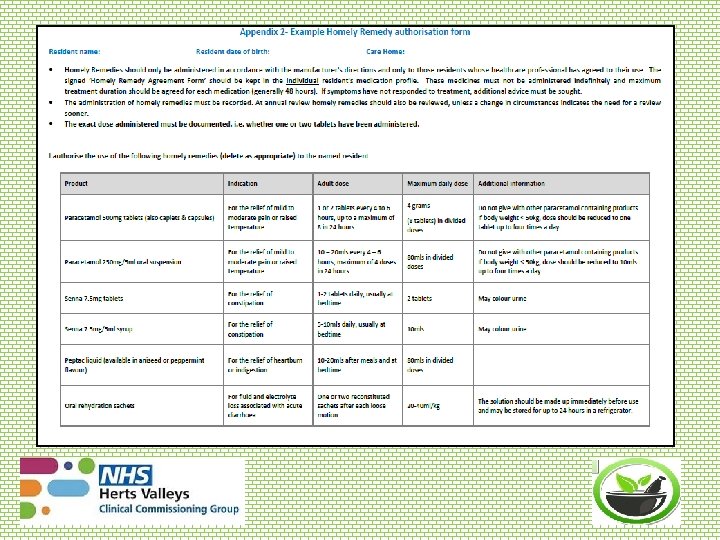
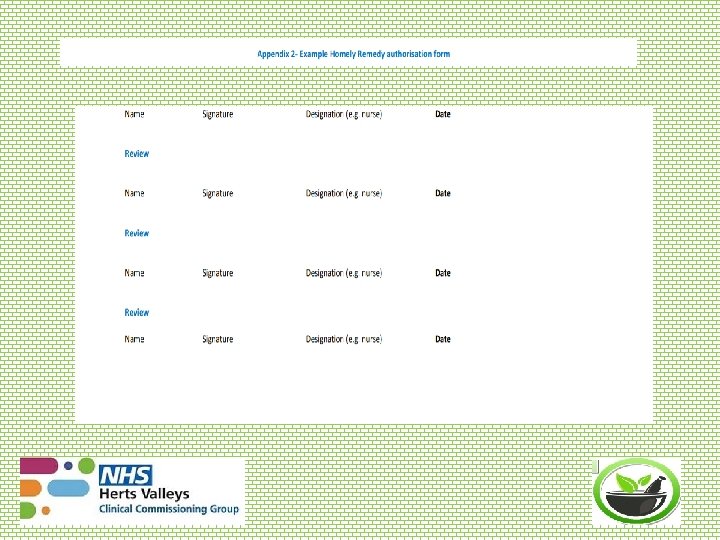
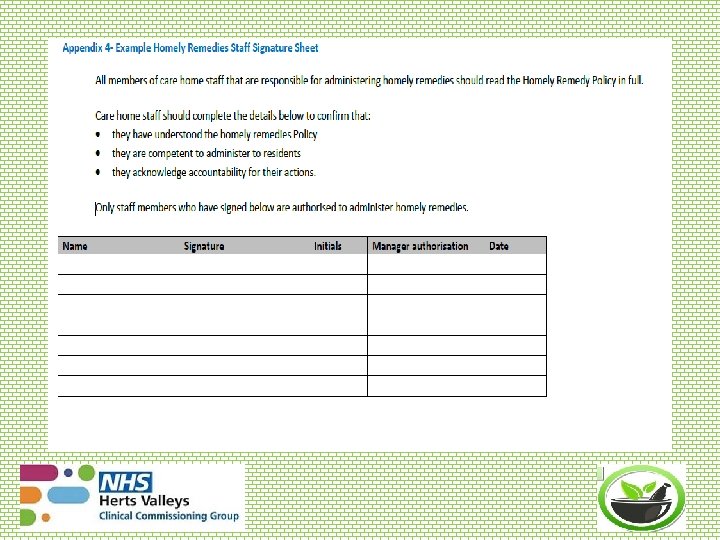
Managing Homely Remedies Ø Each care home should have specific homely medicines policy, appropriate training for staff and authorised staff signature list. Ø The homely remedy policy should describe how residents can access OTC medicines that would commonly be available in any household. Ø Advice should be taken from a healthcare professional, such as a GP, pharmacist (from the care home or community), or the care home nurse on the use of homely remedies. Ø In a nursing home or where the home employs their own pharmacist, it is expected that the designated nurse/ pharmacist will complete the authorisation form. Ø Each resident must be assessed individually by a healthcare professional for suitability for each remedy. This should include the medicine itself, and also the indication for which it will be used. It is recommended that this should be done using the ‘Homely Remedies Authorisation Form’.
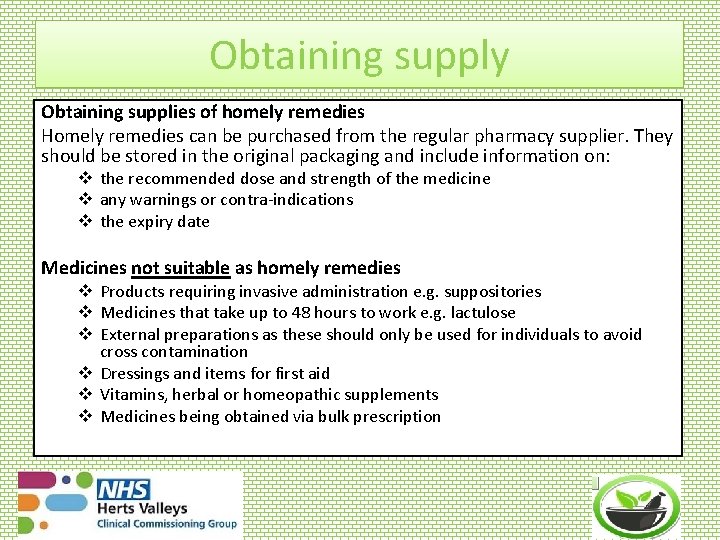
Obtaining supply Obtaining supplies of homely remedies Homely remedies can be purchased from the regular pharmacy supplier. They should be stored in the original packaging and include information on: v the recommended dose and strength of the medicine v any warnings or contra-indications v the expiry date Medicines not suitable as homely remedies v Products requiring invasive administration e. g. suppositories v Medicines that take up to 48 hours to work e. g. lactulose v External preparations as these should only be used for individuals to avoid cross contamination v Dressings and items for first aid v Vitamins, herbal or homeopathic supplements v Medicines being obtained via bulk prescription
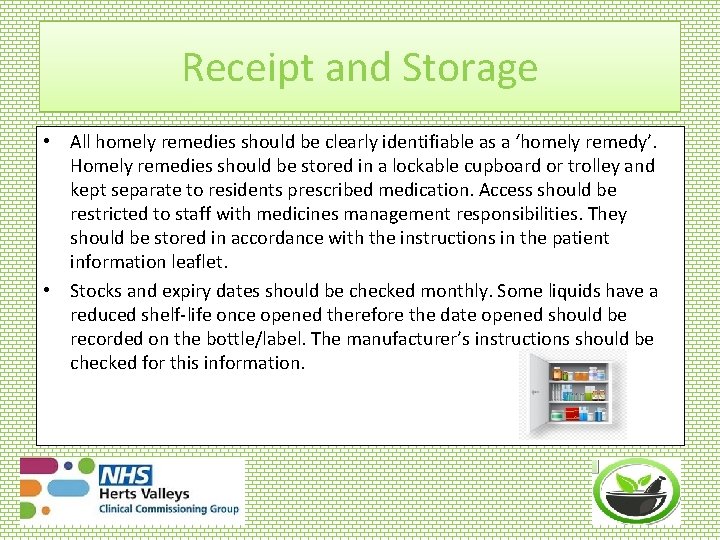
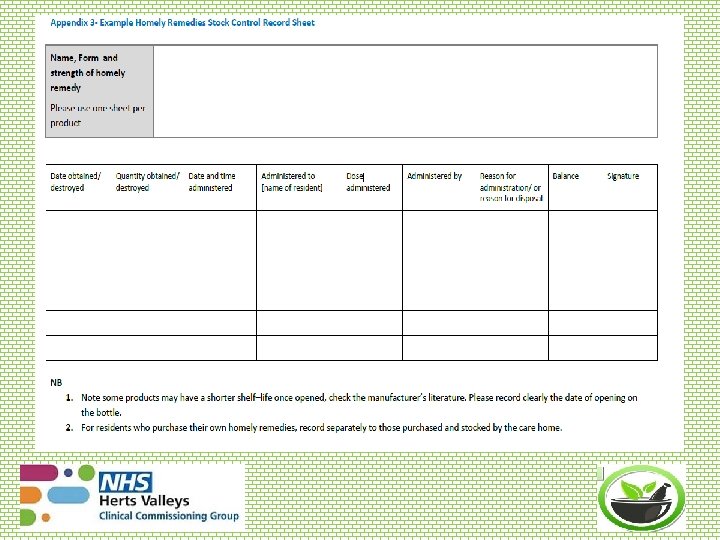
Receipt and Storage • All homely remedies should be clearly identifiable as a ‘homely remedy’. Homely remedies should be stored in a lockable cupboard or trolley and kept separate to residents prescribed medication. Access should be restricted to staff with medicines management responsibilities. They should be stored in accordance with the instructions in the patient information leaflet. • Stocks and expiry dates should be checked monthly. Some liquids have a reduced shelf-life once opened therefore the date opened should be recorded on the bottle/label. The manufacturer’s instructions should be checked for this information.
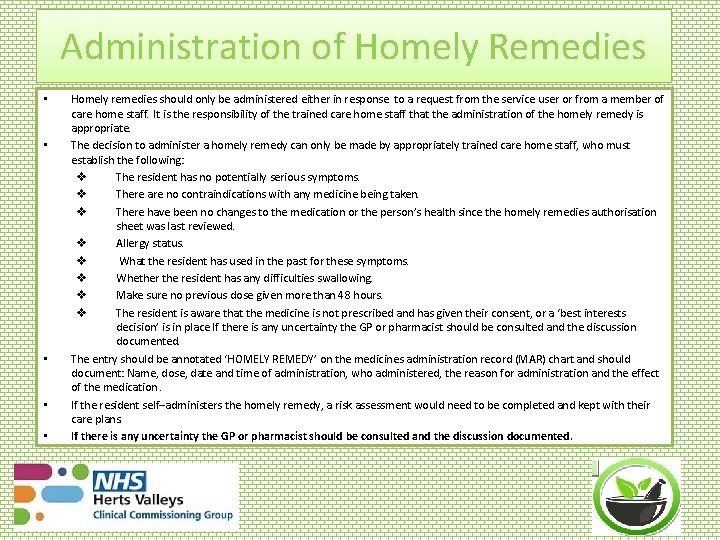
Administration of Homely Remedies • • • Homely remedies should only be administered either in response to a request from the service user or from a member of care home staff. It is the responsibility of the trained care home staff that the administration of the homely remedy is appropriate. The decision to administer a homely remedy can only be made by appropriately trained care home staff, who must establish the following: v The resident has no potentially serious symptoms. v There are no contraindications with any medicine being taken. v There have been no changes to the medication or the person’s health since the homely remedies authorisation sheet was last reviewed. v Allergy status. v What the resident has used in the past for these symptoms. v Whether the resident has any difficulties swallowing. v Make sure no previous dose given more than 48 hours. v The resident is aware that the medicine is not prescribed and has given their consent, or a ‘best interests decision’ is in place If there is any uncertainty the GP or pharmacist should be consulted and the discussion documented. The entry should be annotated ‘HOMELY REMEDY’ on the medicines administration record (MAR) chart and should document: Name, dose, date and time of administration, who administered, the reason for administration and the effect of the medication. If the resident self–administers the homely remedy, a risk assessment would need to be completed and kept with their care plans. If there is any uncertainty the GP or pharmacist should be consulted and the discussion documented.
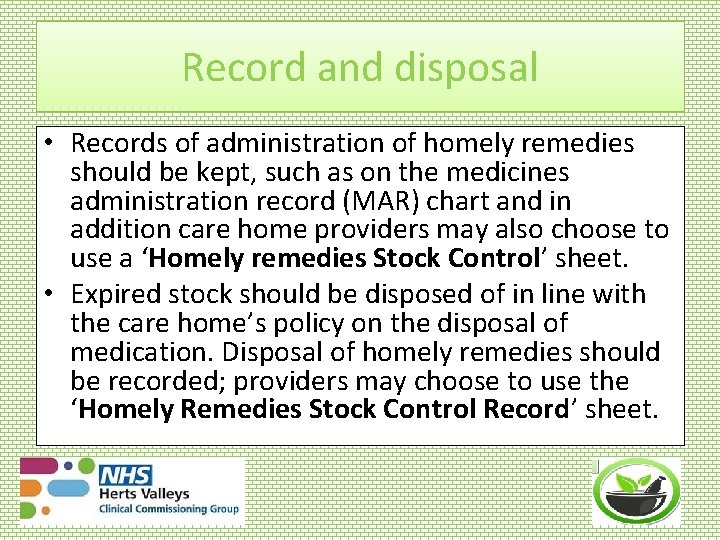
Record and disposal • Records of administration of homely remedies should be kept, such as on the medicines administration record (MAR) chart and in addition care home providers may also choose to use a ‘Homely remedies Stock Control’ sheet. • Expired stock should be disposed of in line with the care home’s policy on the disposal of medication. Disposal of homely remedies should be recorded; providers may choose to use the ‘Homely Remedies Stock Control Record’ sheet.
Useful resources • Homely remedies guidance for care homes. pdf • Managing medicines in care homes - NICE SC 1 • Nationalcareforum. org. uk/Homely-Remediesguide. pdf • CQC Over the counter medicines and homely remedies guidance • NHS England over the counter medicines frequently asked questions for people living in care homes.
Any Questions?