
Homeless Youth Homelessness Definition n Having no fixed
- Slides: 15
Homeless Youth
Homelessness Definition n Having no fixed place to sleep at night
Definitions of the Homeless n n n Absolutely homeless: individuals and families who sleep in outdoor or indoor places not intended for human habitation (street, parks, abandoned buildings) Lacking permanent housing: staying in temporary accommodations (emergency shelters, treatment programs, with family) At risk of homelessness: individuals and families whose current housing is unaffordable for them, unsafe, or inappropriate – may require supports to maintain appropriate housing
Degree of Homelessness n n n One-time homelessness: the result of an unexpected event ( employment loss, eviction, family breakdown Episodic: periods of housing stability interspersed with periods of housing instability and homelessness Chronic: a person who has spent more than 60 cummulative nights in the past year in an emergency shelter and has reach the point where he/she lacks the physical or mental health, skills or income to access and to mainatin housing
Chronic Homelessness n Chronic: a person who has spent more than 60 cumulative nights in the past year in an emergency shelter and/or on the street and has reach the point where he/she lacks the physical or mental health, skills or income to access and to maintain housing
Causes of Homelessness Mental Health Issues: between 30 and 67% of homeless people have some kind of mental illness n Addiction and Substance Abuse Issues: there is a larger number of homeless people with addictive disorders, however most drug and alcohol abusers don’t become homeless n It is those people with low incomes and these disorders that may find themselves homeless n
Violence against youth: particularly against girls and young women n Most homeless youth have histories of family instability, conflict and abuse n More young women then men have experienced sexual and physical abuse within their own families n Domestic abuse: many individuals using emergency shelters are fleeing domestic violence n
Youth n Disruptive family conditions Life on the street seems like a better alternative n Physical, psychological sexual abuse, abandonment or neglect n Marriage breakdown – youth not wanted (remember George? ) n
Residential instability n Over 50 000 young Canadians run away from home each year n Over 90% return home within 60 days, but the remaining 10% become homeless n
n Financial crisis: n Leave home to work and live independently but then unable to return home after the loss of a job etc
What Happens? n n n Youth live day to day – unable to develop plans for their lives Education is often disrupted – the prospect of returning to school difficult Homeless youth find themselves engaging in risky lifestyles, just to ‘get by’ This includes drug dealing, prostitution Their own health is compromised – many become drug users themselves, HIV rates are higher, sexually transmitted disease rate high
According to doctors in Montreal: street youth have a mortality rate 13 times higher than other youth n High rate of drug use is a coping strategy for dealing with the pain in their lives n
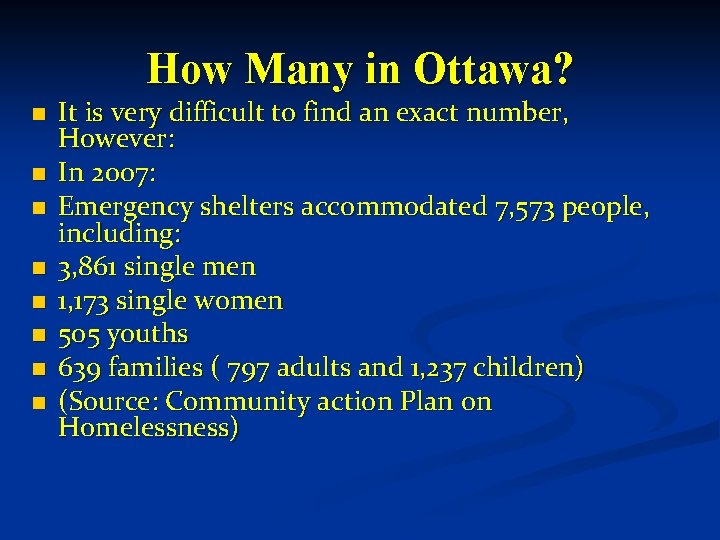
How Many in Ottawa? n n n n It is very difficult to find an exact number, However: In 2007: Emergency shelters accommodated 7, 573 people, including: 3, 861 single men 1, 173 single women 505 youths 639 families ( 797 adults and 1, 237 children) (Source: Community action Plan on Homelessness)
What’s to be done? This is a very complicated issue n There is no ‘magic’ bullet that can solve the issues n A multi-organization approach must be taken n Both for services for people who are currently homeless and for the prevention of other people n Within the city of Ottawa ( show continuum of housing and support services) n
Homework Read pg 150/151 and make notes on how theoretical perspectives discuss the reasons for homelessness n Read the point of view article on pg 148/149 and answer questions on pg. 149 n Answer question #4 on page 156 n