
Homeless Response System Roles and Responsibilities of Metro
Homeless Response System Roles and Responsibilities of Metro Dallas Homeless Alliance City of Dallas Citizen Homeless Commission November 17, 2017 1
Governance and Responsibility The HEARTH Act (24 CFR Part 578) Homeless Emergency Assistance and Rapid Transition to Housing Continuum of Care Program and Interim Final Rule 2
Governance and Responsibility HEARTH ACT: The purpose of the Continuum of Care program is to promote communitywide commitment to the goal of ending homelessness; provide funding for efforts by nonprofit providers, and State and local governments to quickly rehouse homeless individuals and families while minimizing the trauma and dislocation caused to homeless individuals, families, and communities by homelessness; promote access to and effective utilization of mainstream programs by homeless individuals and families; and optimize self-sufficiency among individuals and families experiencing homelessness. 3

Governance and Responsibility Co. C PROGRAM INTERIM RULE: 1. 2. 3. 4. Operate the Continuum of Care Designate an HMIS Plan for the Continuum of Care *Coordinated Assessment System The Co. C represents the Homeless Response System, operated by the Metro Dallas Homeless Alliance and takes on the leadership role to make the experience of homelessness rare, brief and non – recurring in Dallas and Collin Counties. 4
Governance and Responsibility Continuum of Care Board of Directors • Co. C/MDHA Bylaws • Up to 31 members: Private, Public, Non-Profits • Oversite, sets policies and procedures, directs Co. C planning 5
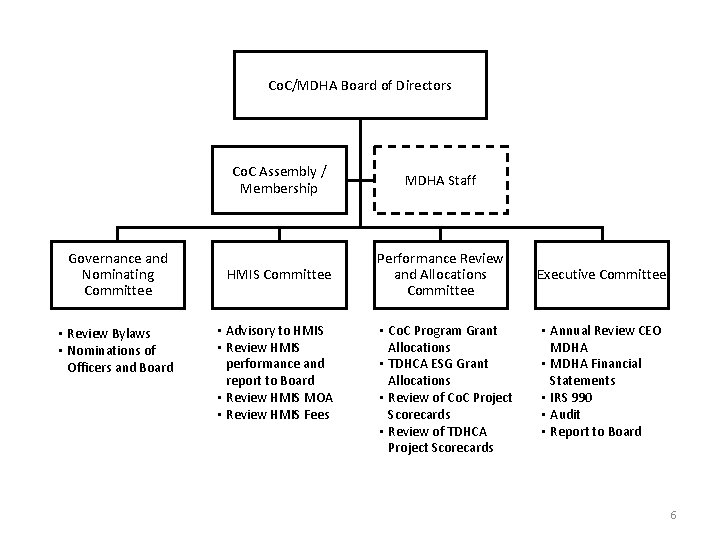
Co. C/MDHA Board of Directors Governance and Nominating Committee • Review Bylaws • Nominations of Officers and Board Co. C Assembly / Membership MDHA Staff HMIS Committee Performance Review and Allocations Committee • Advisory to HMIS • Review HMIS performance and report to Board • Review HMIS MOA • Review HMIS Fees • Co. C Program Grant Allocations • TDHCA ESG Grant Allocations • Review of Co. C Project Scorecards • Review of TDHCA Project Scorecards Executive Committee • Annual Review CEO MDHA • MDHA Financial Statements • IRS 990 • Audit • Report to Board 6
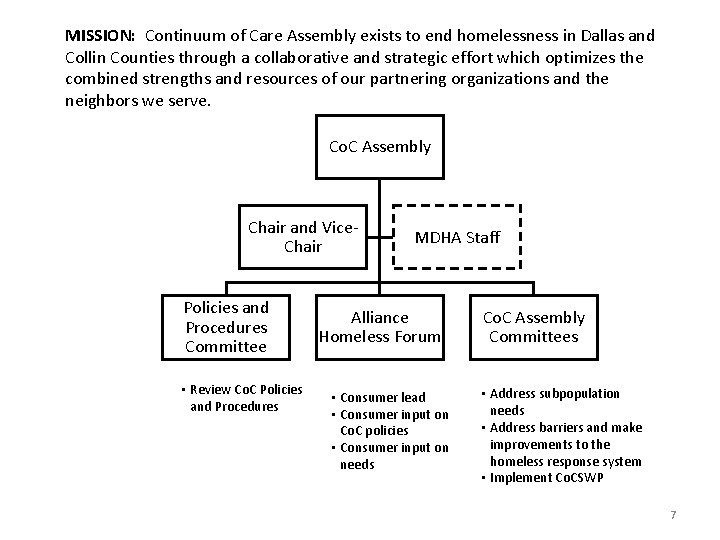
MISSION: Continuum of Care Assembly exists to end homelessness in Dallas and Collin Counties through a collaborative and strategic effort which optimizes the combined strengths and resources of our partnering organizations and the neighbors we serve. Co. C Assembly Chair and Vice. Chair Policies and Procedures Committee • Review Co. C Policies and Procedures MDHA Staff Alliance Homeless Forum • Consumer lead • Consumer input on Co. C policies • Consumer input on needs Co. C Assembly Committees • Address subpopulation needs • Address barriers and make improvements to the homeless response system • Implement Co. CSWP 7
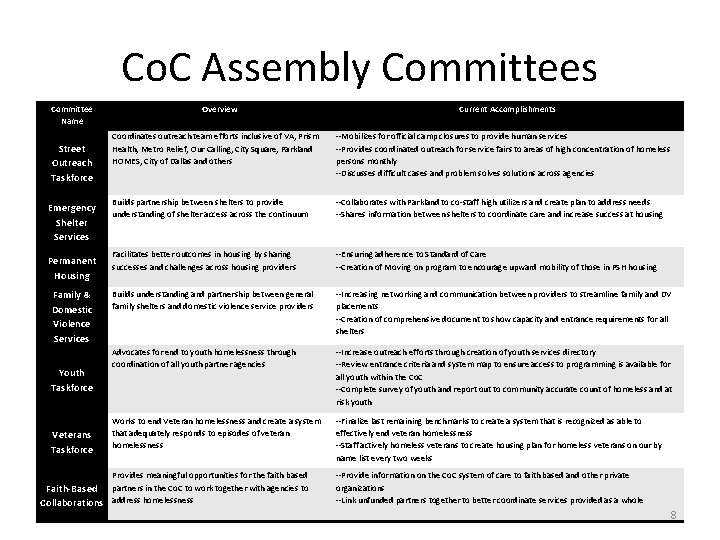
Co. C Assembly Committees Committee Name Street Outreach Taskforce Emergency Shelter Services Permanent Housing Family & Domestic Violence Services Youth Taskforce Veterans Taskforce Overview Current Accomplishments Coordinates outreach team efforts inclusive of VA, Prism Health, Metro Relief, Our Calling, City Square, Parkland HOMES, City of Dallas and others --Mobilizes for official camp closures to provide human services --Provides coordinated outreach for service fairs to areas of high concentration of homeless persons monthly --Discusses difficult cases and problem solves solutions across agencies Builds partnership between shelters to provide understanding of shelter access across the continuum --Collaborates with Parkland to co-staff high utilizers and create plan to address needs --Shares information between shelters to coordinate care and increase success at housing Facilitates better outcomes in housing by sharing successes and challenges across housing providers --Ensuring adherence to Standard of Care --Creation of Moving on program to encourage upward mobility of those in PSH housing Builds understanding and partnership between general family shelters and domestic violence service providers --Increasing networking and communication between providers to streamline family and DV placements --Creation of comprehensive document to show capacity and entrance requirements for all shelters Advocates for end to youth homelessness through coordination of all youth partner agencies --Increase outreach efforts through creation of youth services directory --Review entrance criteria and system map to ensure access to programming is available for all youth within the Co. C --Complete survey of youth and report out to community accurate count of homeless and at risk youth Works to end Veteran homelessness and create a system that adequately responds to episodes of veteran homelessness --Finalize last remaining benchmarks to create a system that is recognized as able to effectively end veteran homelessness --Staff actively homeless veterans to create housing plan for homeless veterans on our by name list every two weeks Provides meaningful opportunities for the faith based --Provide information on the Co. C system of care to faith based and other private organizations --Link unfunded partners together to better coordinate services provided as a whole Faith-Based partners in the Co. C to work together with agencies to Collaborations address homelessness 8

Metro Dallas Homeless Alliance Organizational Chart Staff Cindy Crain President and CEO Total: 14. 75 FTE Lynette Austin Victoria Jackson Resource Development VISTA Alexandra Espinosa HMIS Director Eryca Peters HMIS Analyst II James Mc. Clinton Co. C Housing Resource Director Cynthia Scaife Housing Search and Placement Coordinator Rebecca Cox Vice President Shavon Moore Director, Coordinated Access and Assessment PTI HMIS Software Contract Executive Assistant Lester Collins Co. C Performance Analyst David Gruber Development and Communications Director Wayne Waslien Finance Director D’Arcy Drescher Collin County CAS Coordinator Natalie Martinez DOPS Coordinator Freda Coleman HMIS Analyst I – Training Coordinator Derek Ruhl HMIS Data Clerk Contract Family Gateway Family CAS Coordination Contract Co. C Planning HMIS Coordinated Assessment System Administration 9
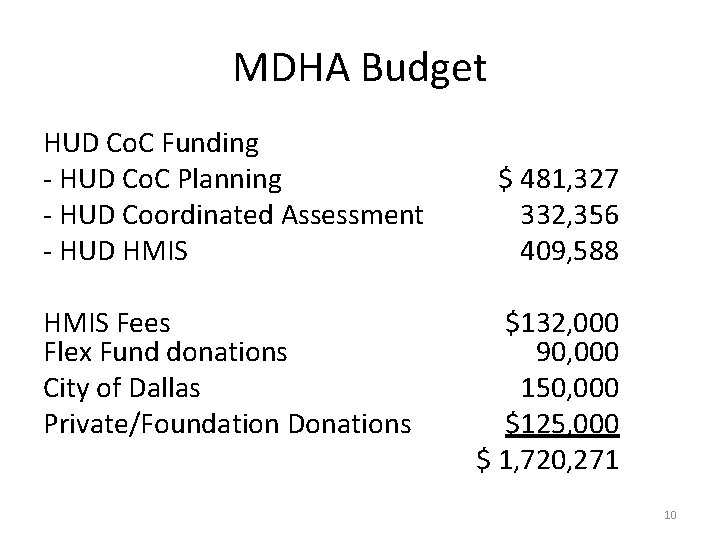
MDHA Budget HUD Co. C Funding - HUD Co. C Planning - HUD Coordinated Assessment - HUD HMIS Fees Flex Fund donations City of Dallas Private/Foundation Donations $ 481, 327 332, 356 409, 588 $132, 000 90, 000 150, 000 $125, 000 $ 1, 720, 271 10
Continuum of Care Planning 11
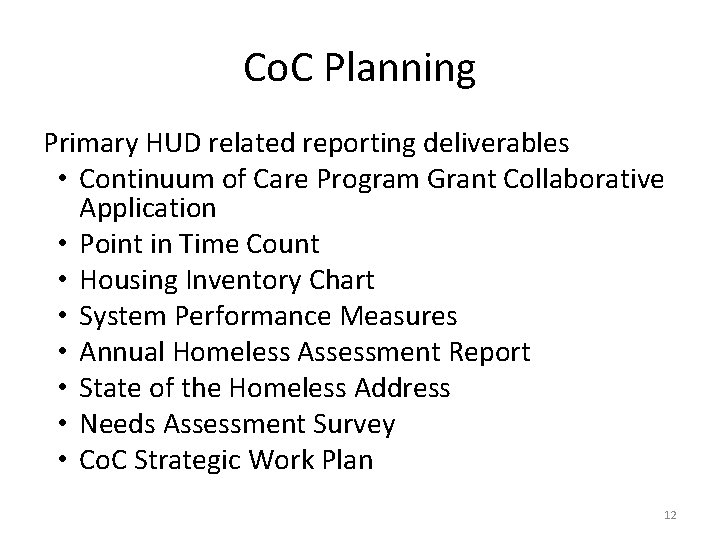
Co. C Planning Primary HUD related reporting deliverables • Continuum of Care Program Grant Collaborative Application • Point in Time Count • Housing Inventory Chart • System Performance Measures • Annual Homeless Assessment Report • State of the Homeless Address • Needs Assessment Survey • Co. C Strategic Work Plan 12

Co. C Planning Other Homeless Response System Activities • Implement the Co. C SWP • Monitor and evaluate Co. C Program projects • Monitor and evaluate Emergency Solutions Grant projects • Improve System Performance Measures • Staff Co. C Board, Assembly and Committees • Co. C Training and Roundtables • Education and Advocacy • Over 140 meetings per year 13
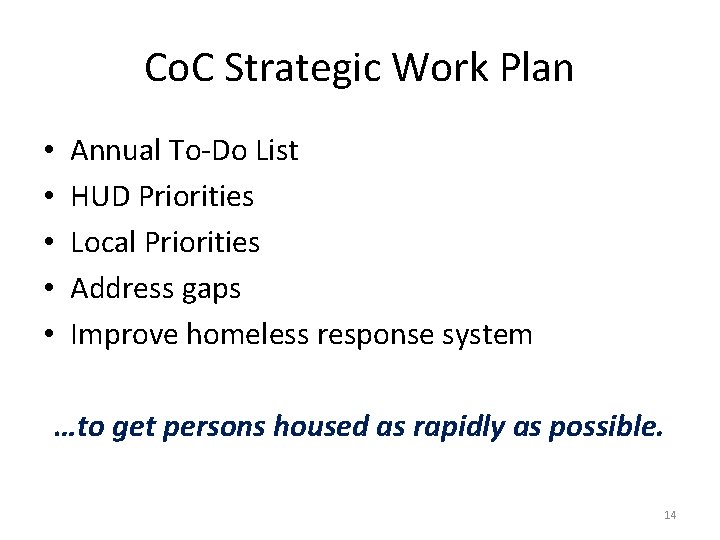
Co. C Strategic Work Plan • • • Annual To-Do List HUD Priorities Local Priorities Address gaps Improve homeless response system …to get persons housed as rapidly as possible. 14
Coordinated Assessment System 15
Coordinated Assessment System Regulations, Directives and Policies • Co. C Interim Rule • CPD Notices • Co. C Policies and Procedures Organizes the DEMAND for homeless housing and services, and, Organizes the SUPPLY of homeless housing and services …to get persons housed as rapidly as possible. 16
Coordinated Assessment Tasks • HMIS Data Entry – all agencies, the path to CAS is through HMIS • CAS assessment tool data quality and improvements – MDHA with Co. C Board Input, MDHA CEO • Eligibility Review of HUD standards – MDHA CAS DOPS Coordinator • Diversion/Self Resolve/Flex Fund – MDHA Co. C Resources Manager • Manage Housing Priority List – MDHA CAS DOPS Coordinator and CAS Housing Resources Manager • Develop and Manage Housing Resource Relationships, Landlords, PHA Resources – MDHA CEO, Co. C Housing Resources Manager, Housing Search and Placement Coordinator • Operates on the Best Practice of Progressive Engagement – we offer our most intensive and expensive resources to the people that need it most. We offer less intensive and less costly resources to persons that have more assets and strengths. We offer the lightest touch to the majority that will self resolve. 17
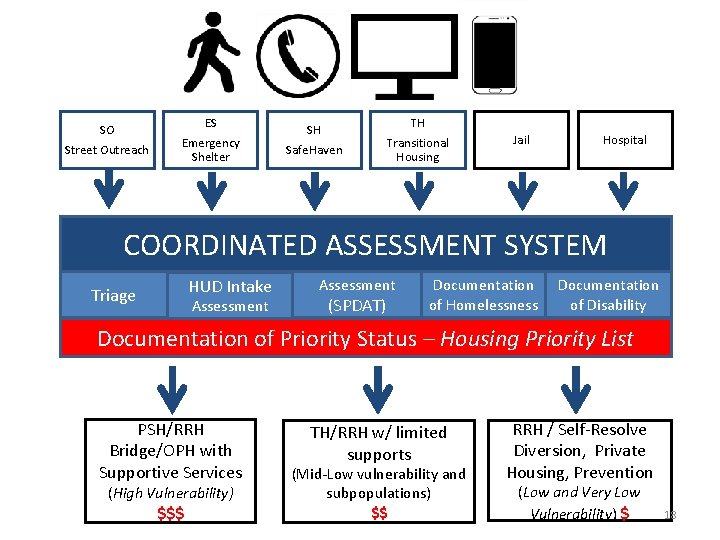
SO Street Outreach ES Emergency Shelter SH Safe. Haven TH Transitional Housing Jail Hospital COORDINATED ASSESSMENT SYSTEM HUD Intake Triage Assessment (SPDAT) Documentation of Homelessness Documentation of Disability Documentation of Priority Status – Housing Priority List PSH/RRH Bridge/OPH with Supportive Services (High Vulnerability) $$$ TH/RRH w/ limited supports (Mid-Low vulnerability and subpopulations) $$ RRH / Self-Resolve Diversion, Private Housing, Prevention (Low and Very Low Vulnerability) $ 18
“h” @ H No Empty Bed 19
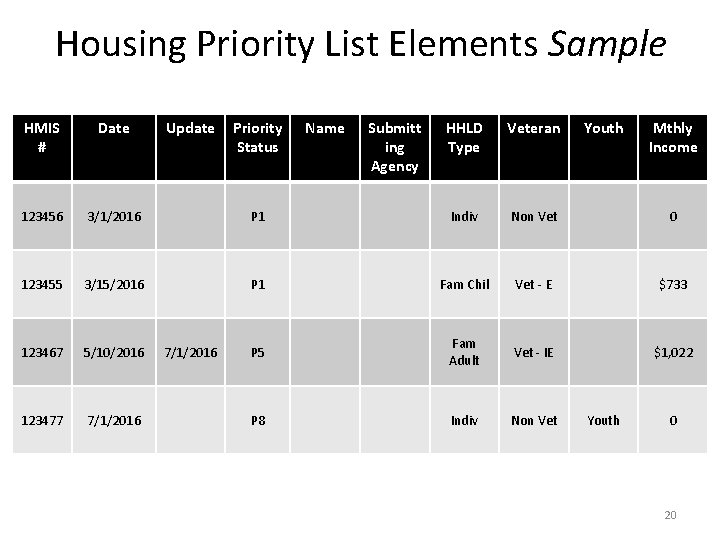
Housing Priority List Elements Sample HMIS # Date 123456 3/1/2016 123455 3/15/2016 123467 5/10/2016 123477 7/1/2016 Update 7/1/2016 Priority Status Name Submitt ing Agency HHLD Type Veteran Youth P 1 Indiv Non Vet 0 P 1 Fam Chil Vet - E $733 P 5 Fam Adult Vet - IE $1, 022 P 8 Indiv Non Vet Youth Mthly Income 0 20

21

COORDINATED ASSESSMENT SYSTEM MDHA, James Mc. Clinton Co. C Housing Resource Director MDHA, Cynthia Scaife Housing Search and Placement Coordinator Centralized Inventory of available housing Private Market Identified Available Multi-Family Units at or near Fair Market Rent Limited tenant screening – No source of income restrictions – HQS qualified units 22

Homeless Management Information System (HMIS) 23

Purpose of the HMIS • A Homeless Management Information System (HMIS) is a local information technology system used to collect client-level data and provision of housing and services to homeless individuals and families and persons at risk of homelessness. • The HMIS is required for certain programs by HUD, VA, and HHS 24
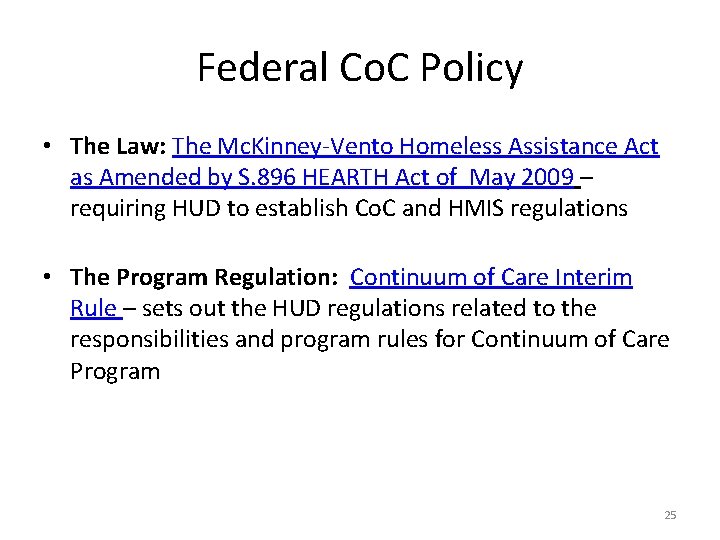
Federal Co. C Policy • The Law: The Mc. Kinney-Vento Homeless Assistance Act as Amended by S. 896 HEARTH Act of May 2009 – requiring HUD to establish Co. C and HMIS regulations • The Program Regulation: Continuum of Care Interim Rule – sets out the HUD regulations related to the responsibilities and program rules for Continuum of Care Program 25

Co. C Governs HMIS Continuum of Care Interim Rule 24 CFR 578. 7 Subpart B (b) Designating and operating an HMIS. The Continuum of Care must: (1) Designate a single Homeless Management Information System (HMIS) for the geographic area; (2) Designate an eligible applicant to manage the Continuum‘s HMIS, which will be known as the HMIS Lead; (3) Review, revise, and approve a privacy plan, security plan, and data quality plan for the HMIS. (4) Ensure consistent participation of recipients and subrecipients in the HMIS; and (5) Ensure the HMIS is administered in compliance with requirements prescribed by HUD. 26
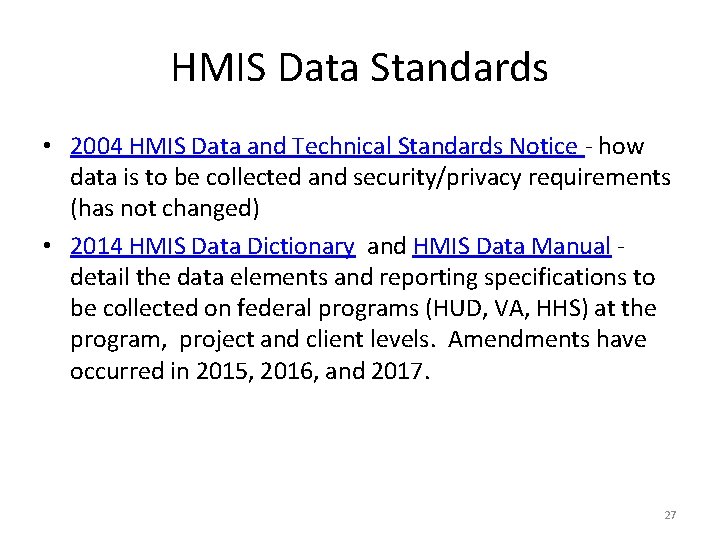
HMIS Data Standards • 2004 HMIS Data and Technical Standards Notice - how data is to be collected and security/privacy requirements (has not changed) • 2014 HMIS Data Dictionary and HMIS Data Manual detail the data elements and reporting specifications to be collected on federal programs (HUD, VA, HHS) at the program, project and client levels. Amendments have occurred in 2015, 2016, and 2017. 27

How HMIS Data Informs DEMAND for the Homeless Response System • Who becomes homeless? • Who are the most vulnerable? • What assets do they have? • What needs do they have? • How long are they in the Homeless Response System? • Who re-enters the Homeless Response System? 28

How HMIS Data Informs RESOURCES within the Homeless Response System What resources do clients access? What services are being provided by agencies? What are the outcomes of agency interventions? Are agencies spending down public resources efficiently? • What are the system level performance measures of individual projects and the Homeless Response System? • • 29

How HMIS Data Informs RESULTS in the Homeless Response System • Are agencies spending down public resources efficiently? • What are the system level performance measures of individual projects and the Homeless Response System? • Is homelessness increasing or decreasing? • Is time in homelessness increasing or decreasing? • What projects are under-performing? • What projects are performing well? 30
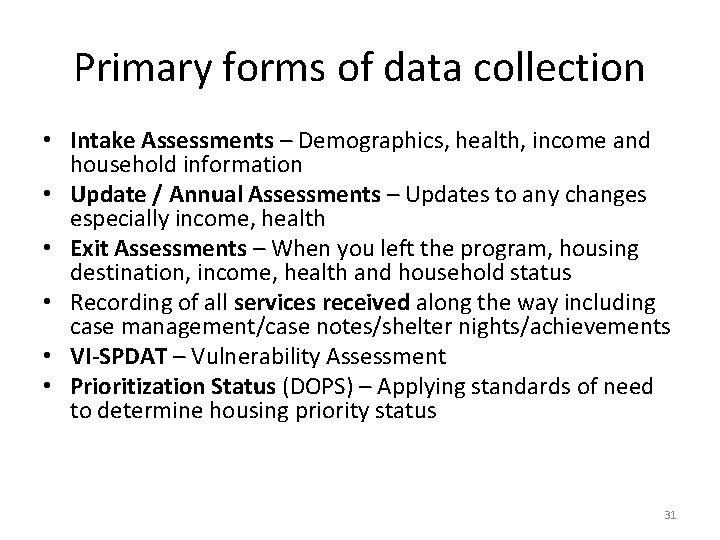
Primary forms of data collection • Intake Assessments – Demographics, health, income and household information • Update / Annual Assessments – Updates to any changes especially income, health • Exit Assessments – When you left the program, housing destination, income, health and household status • Recording of all services received along the way including case management/case notes/shelter nights/achievements • VI-SPDAT – Vulnerability Assessment • Prioritization Status (DOPS) – Applying standards of need to determine housing priority status 31
Data Quality Methods • Daily de-duplication service requests • Quarterly Data Quality Reports with Scoring • Annual Continuum of Care Program and Emergency Solutions Care • Regular Training for all Users • Documentation of Priority Status Validating documentation of homelessness and disability • Reviewed by HUD annually through Annual Homeless Assessment Report and Annual Performance Reports • Data quality HMIS user fee incentives 32

HMIS Transition Steps 2015 • MARCH 2015: Multiple client data systems used throughout the Co. C silos of data. HMIS performance requires a single HMIS. Low participation in the existing Co. C HMIS software • APRIL 2015: Concurrently Parkland Center for Clinical Innovation (PCCI), with sister organization Pieces Technologies, was rolling out a human services data information exchange portal (IEP) called “PIECES Iris” including a case management software tool • MAY - OCTOBER 2015: MDHA and PCCI discussions how Iris can meet HMIS requirements and how the homeless cohort can be a part of the community info exchange. HMIS interface concepts developed, reviewed by Co. C Assembly and Co. C Board. IRIS would be a sole – sourced local community client data system to serve as HMIS • NOVEMBER 2015: By resolution Continuum of Care Board designates PIECES Iris and HMIS system and to be a part of the PIECES Iris information exchange portal 33

34
HMIS Transition Steps • NOVEMBER 2016 - April 2017: System development, continual updates per HMIS data standards amendments and HMIS system tests environment • MARCH 2016: MDHA and PIECES Tech enter into service agreement for PIECES Iris/PIECES Plexus • AUGUST 2016: MDHA Caseworthy data mapping/migration • JANUARY – MARCH 2017: IRIS pre-production and HMIS data integration • FEBRUARY 2017: Co. C Wide timelines for staged go lives and service agreement process • MARCH – MAY 2017: Agency contracting, training, go live • JULY – SEPTEMBER 2017: Upgrades, improvements and back data entry for non-HMIS data entry (The Bridge, VA VASH) 35
HMIS Transition Steps • November 2017 and moving forward – Reporting compliance and optimization for ESG CAPER, CSV, SAGE APRs 36
Projecting HMIS Utilization • NEW Participation : – Additional Dallas Life Center programs – The Bridge day shelter and supportive services – The Salvation Army family, women’s and men’s shelter • HMIS participation rates of no less than 86% of each category of Housing Type year round will be achieved in the 2018 Annual Homeless Assessment Report (Oct 1, 2017 – September 30, 2018) 37
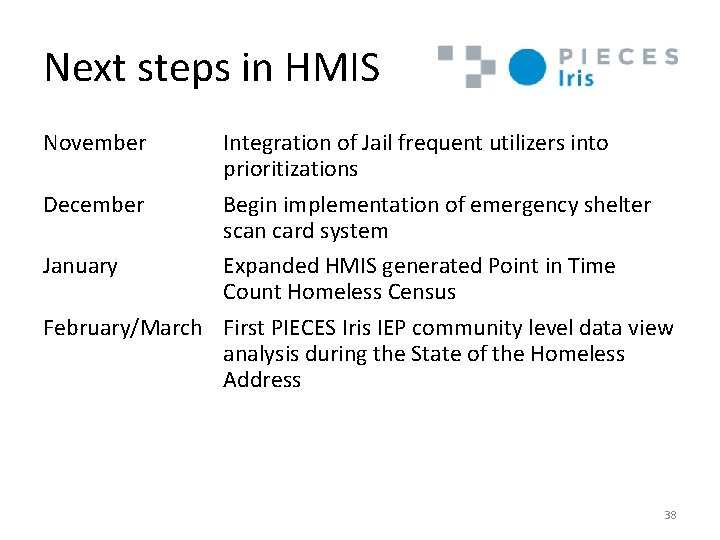
Next steps in HMIS November Integration of Jail frequent utilizers into prioritizations December Begin implementation of emergency shelter scan card system January Expanded HMIS generated Point in Time Count Homeless Census February/March First PIECES Iris IEP community level data view analysis during the State of the Homeless Address 38
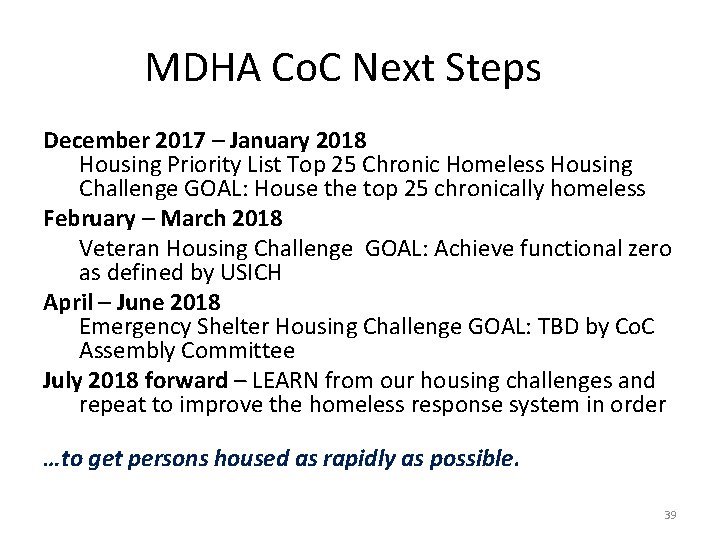
MDHA Co. C Next Steps December 2017 – January 2018 Housing Priority List Top 25 Chronic Homeless Housing Challenge GOAL: House the top 25 chronically homeless February – March 2018 Veteran Housing Challenge GOAL: Achieve functional zero as defined by USICH April – June 2018 Emergency Shelter Housing Challenge GOAL: TBD by Co. C Assembly Committee July 2018 forward – LEARN from our housing challenges and repeat to improve the homeless response system in order …to get persons housed as rapidly as possible. 39

Questions? Cindy J. Crain President and CEO 817 -991 -9127 Cindy. Crain@MDHADallas. org 40
- Slides: 40