
Homeless Outreach and Law Enforcement A COMMUNITY BASED
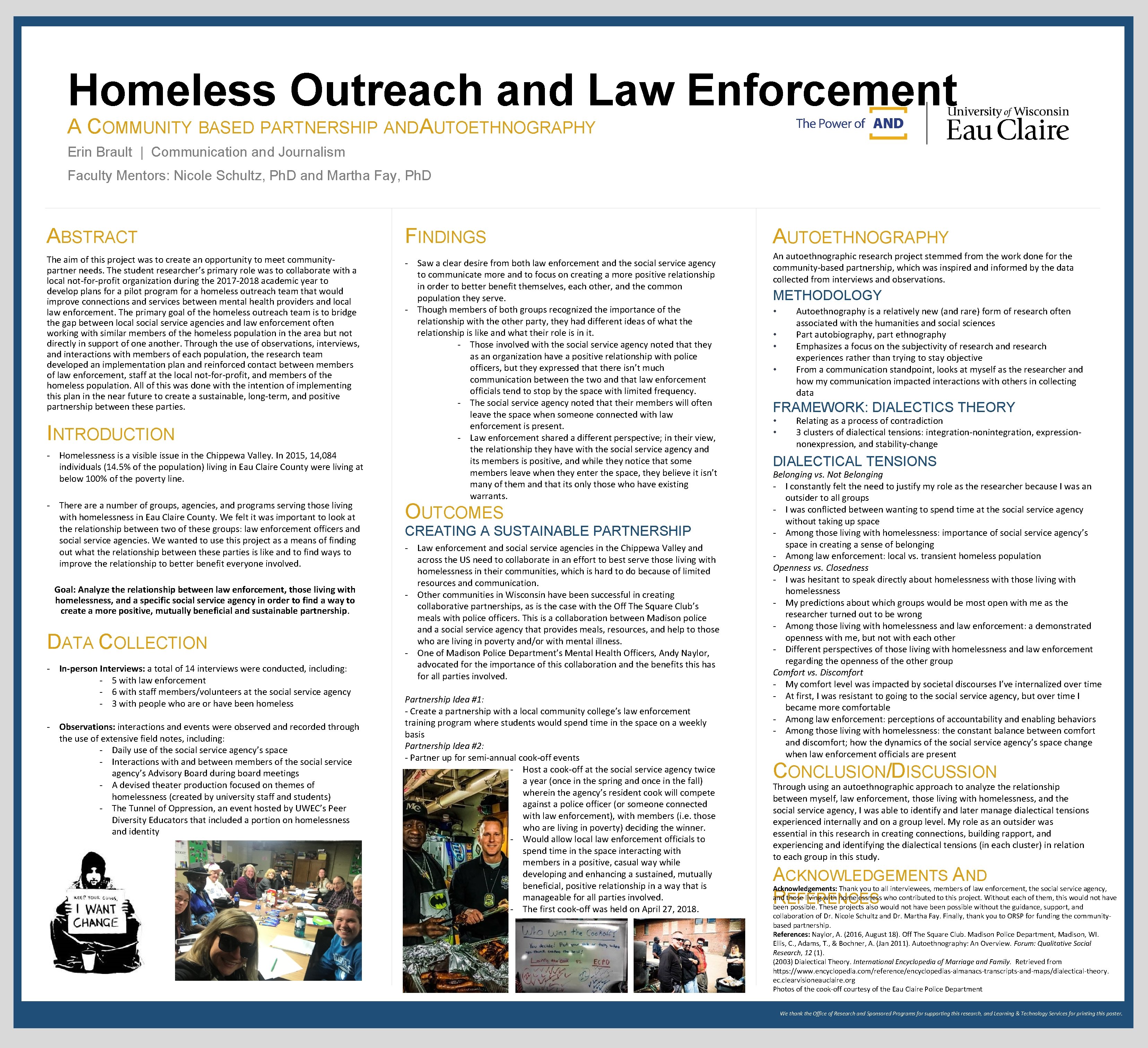
Homeless Outreach and Law Enforcement A COMMUNITY BASED PARTNERSHIP AND AUTOETHNOGRAPHY Erin Brault | Communication and Journalism Faculty Mentors: Nicole Schultz, Ph. D and Martha Fay, Ph. D ABSTRACT The aim of this project was to create an opportunity to meet communitypartner needs. The student researcher’s primary role was to collaborate with a local not-for-profit organization during the 2017 -2018 academic year to develop plans for a pilot program for a homeless outreach team that would improve connections and services between mental health providers and local law enforcement. The primary goal of the homeless outreach team is to bridge the gap between local social service agencies and law enforcement often working with similar members of the homeless population in the area but not directly in support of one another. Through the use of observations, interviews, and interactions with members of each population, the research team developed an implementation plan and reinforced contact between members of law enforcement, staff at the local not-for-profit, and members of the homeless population. All of this was done with the intention of implementing this plan in the near future to create a sustainable, long-term, and positive partnership between these parties. INTRODUCTION - Homelessness is a visible issue in the Chippewa Valley. In 2015, 14, 084 individuals (14. 5% of the population) living in Eau Claire County were living at below 100% of the poverty line. - There a number of groups, agencies, and programs serving those living with homelessness in Eau Claire County. We felt it was important to look at the relationship between two of these groups: law enforcement officers and social service agencies. We wanted to use this project as a means of finding out what the relationship between these parties is like and to find ways to improve the relationship to better benefit everyone involved. Goal: Analyze the relationship between law enforcement, those living with homelessness, and a specific social service agency in order to find a way to create a more positive, mutually beneficial and sustainable partnership. DATA COLLECTION - In-person Interviews: a total of 14 interviews were conducted, including: - 5 with law enforcement - 6 with staff members/volunteers at the social service agency - 3 with people who are or have been homeless - Observations: interactions and events were observed and recorded through the use of extensive field notes, including: - Daily use of the social service agency’s space - Interactions with and between members of the social service agency’s Advisory Board during board meetings - A devised theater production focused on themes of homelessness (created by university staff and students) - The Tunnel of Oppression, an event hosted by UWEC’s Peer Diversity Educators that included a portion on homelessness and identity FINDINGS - Saw a clear desire from both law enforcement and the social service agency to communicate more and to focus on creating a more positive relationship in order to better benefit themselves, each other, and the common population they serve. - Though members of both groups recognized the importance of the relationship with the other party, they had different ideas of what the relationship is like and what their role is in it. - Those involved with the social service agency noted that they as an organization have a positive relationship with police officers, but they expressed that there isn’t much communication between the two and that law enforcement officials tend to stop by the space with limited frequency. - The social service agency noted that their members will often leave the space when someone connected with law enforcement is present. - Law enforcement shared a different perspective; in their view, the relationship they have with the social service agency and its members is positive, and while they notice that some members leave when they enter the space, they believe it isn’t many of them and that its only those who have existing warrants. OUTCOMES CREATING A SUSTAINABLE PARTNERSHIP - Law enforcement and social service agencies in the Chippewa Valley and across the US need to collaborate in an effort to best serve those living with homelessness in their communities, which is hard to do because of limited resources and communication. - Other communities in Wisconsin have been successful in creating collaborative partnerships, as is the case with the Off The Square Club’s meals with police officers. This is a collaboration between Madison police and a social service agency that provides meals, resources, and help to those who are living in poverty and/or with mental illness. - One of Madison Police Department’s Mental Health Officers, Andy Naylor, advocated for the importance of this collaboration and the benefits this has for all parties involved. Partnership Idea #1: - Create a partnership with a local community college’s law enforcement training program where students would spend time in the space on a weekly basis Partnership Idea #2: - Partner up for semi-annual cook-off events - Host a cook-off at the social service agency twice a year (once in the spring and once in the fall) wherein the agency’s resident cook will compete against a police officer (or someone connected with law enforcement), with members (i. e. those who are living in poverty) deciding the winner. - Would allow local law enforcement officials to spend time in the space interacting with members in a positive, casual way while developing and enhancing a sustained, mutually beneficial, positive relationship in a way that is manageable for all parties involved. - The first cook-off was held on April 27, 2018. AUTOETHNOGRAPHY An autoethnographic research project stemmed from the work done for the community-based partnership, which was inspired and informed by the data collected from interviews and observations. METHODOLOGY • • Autoethnography is a relatively new (and rare) form of research often associated with the humanities and social sciences Part autobiography, part ethnography Emphasizes a focus on the subjectivity of research and research experiences rather than trying to stay objective From a communication standpoint, looks at myself as the researcher and how my communication impacted interactions with others in collecting data FRAMEWORK: DIALECTICS THEORY • • Relating as a process of contradiction 3 clusters of dialectical tensions: integration-nonintegration, expressionnonexpression, and stability-change DIALECTICAL TENSIONS Belonging vs. Not Belonging - I constantly felt the need to justify my role as the researcher because I was an outsider to all groups - I was conflicted between wanting to spend time at the social service agency without taking up space - Among those living with homelessness: importance of social service agency’s space in creating a sense of belonging - Among law enforcement: local vs. transient homeless population Openness vs. Closedness - I was hesitant to speak directly about homelessness with those living with homelessness - My predictions about which groups would be most open with me as the researcher turned out to be wrong - Among those living with homelessness and law enforcement: a demonstrated openness with me, but not with each other - Different perspectives of those living with homelessness and law enforcement regarding the openness of the other group Comfort vs. Discomfort - My comfort level was impacted by societal discourses I’ve internalized over time - At first, I was resistant to going to the social service agency, but over time I became more comfortable - Among law enforcement: perceptions of accountability and enabling behaviors - Among those living with homelessness: the constant balance between comfort and discomfort; how the dynamics of the social service agency’s space change when law enforcement officials are present CONCLUSION/DISCUSSION Through using an autoethnographic approach to analyze the relationship between myself, law enforcement, those living with homelessness, and the social service agency, I was able to identify and later manage dialectical tensions experienced internally and on a group level. My role as an outsider was essential in this research in creating connections, building rapport, and experiencing and identifying the dialectical tensions (in each cluster) in relation to each group in this study. ACKNOWLEDGEMENTS AND REFERENCES Acknowledgements: Thank you to all interviewees, members of law enforcement, the social service agency, and those living with homelessness who contributed to this project. Without each of them, this would not have been possible. These projects also would not have been possible without the guidance, support, and collaboration of Dr. Nicole Schultz and Dr. Martha Fay. Finally, thank you to ORSP for funding the communitybased partnership. References: Naylor, A. (2016, August 18). Off The Square Club. Madison Police Department, Madison, WI. Ellis, C. , Adams, T. , & Bochner, A. (Jan 2011). Autoethnography: An Overview. Forum: Qualitative Social Research, 12 (1). (2003) Dialectical Theory. International Encyclopedia of Marriage and Family. Retrieved from https: //www. encyclopedia. com/reference/encyclopedias-almanacs-transcripts-and-maps/dialectical-theory. ec. clearvisioneauclaire. org Photos of the cook-off courtesy of the Eau Claire Police Department We thank the Office of Research and Sponsored Programs for supporting this research, and Learning & Technology Services for printing this poster.
- Slides: 1