
Homeland Security Roles for the Atmospheric Sciences Meteorology
- Slides: 18
Homeland Security: Roles for the Atmospheric Sciences Meteorology goes to war, once again John T. Snow College of Geosciences The University of Oklahoma Presented at Board on Oceans and Atmosphere National Association for State Universities and Land Grant Colleges Chicago, Illinois 11 November 2002
The Threat • Release of chemical, biological, or radiological material Targets • Metropolitan areas • Agricultural targets (wheat, corn, soy bean monoculture; CAFOs)
Responding to the Threat Deliver the Right Information To the Right People Within the “Action Cycle” To Save the Greatest Number of Lives To Protect the Largest Amount of Property To Contain the Event at the Lowest Possible Level To Guarantee a Sustainable Economy for the United States Quote from: Computing and Communications in the Extreme – Research for Crisis Management and other Applications, NRC, 1996
Challenges • The “Action Cycle” – Recognize, identify a release – Determine the area that will be impacted – Alert first responders, government authorities; provide decision-support information – Alert the public – advise on response – Support response, recovery, restoration operations • CBR release in an urban environment, the time frame is very short – seconds to minutes
What Atmospheric Science Community Bring to the Table • Extensive R&D capabilities – basic research through product development • Extensive environmental monitoring networks • Data collection, analysis, assimilation tools -- provide continuously updated 3 -D representation of the atmosphere • Modeling simulations and predictions • Response to short time fuse events – warnings of severe thunderstorms, tornadoes, wildfires, flash floods • Credibility with the public
Research Topics • Dispersion of materials in an urban environment – – Aerosols Turbulence Photochemistry Complex terrain; interactions between natural and built environment – evolution of the urban boundary layer – Local meteorological phenomena, e. g. , sea/land breeze effects • Badly Needed: Appropriate sensors – Detect and rapidly identify agents
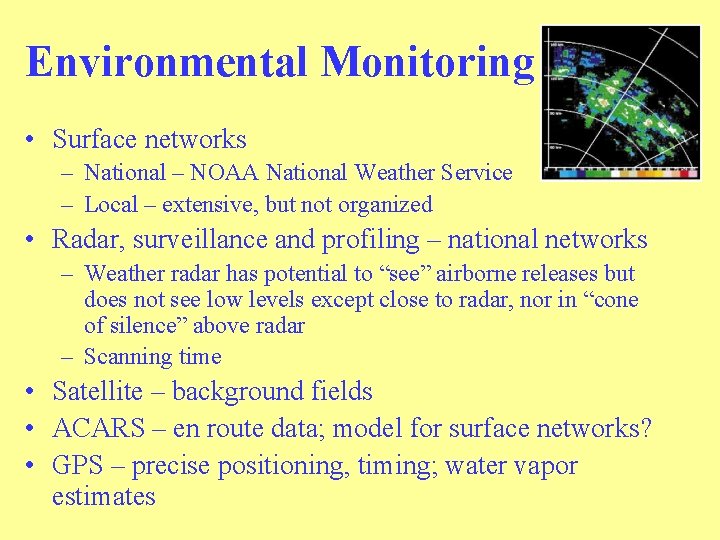
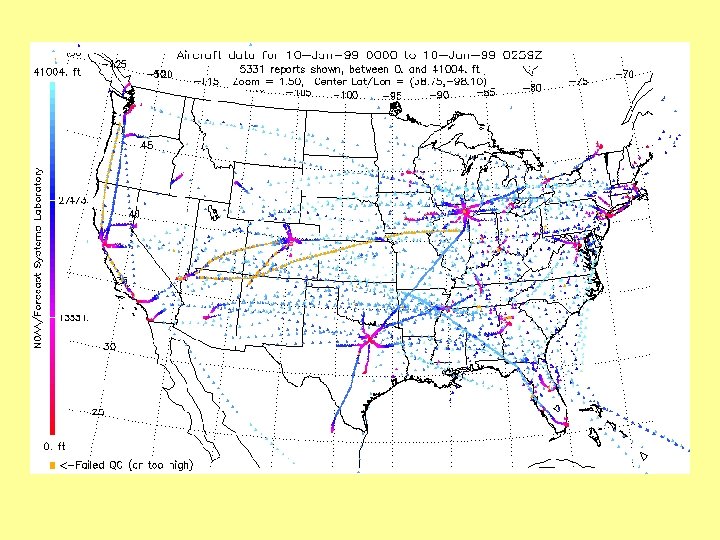
Environmental Monitoring • Surface networks – National – NOAA National Weather Service – Local – extensive, but not organized • Radar, surveillance and profiling – national networks – Weather radar has potential to “see” airborne releases but does not see low levels except close to radar, nor in “cone of silence” above radar – Scanning time • Satellite – background fields • ACARS – en route data; model for surface networks? • GPS – precise positioning, timing; water vapor estimates
What is Needed: Smart Sensors and Intelligent Networks • Current technology -- sensors and observing networks are fixed in place; use synchronous reporting schemes provide much data with low information content • Interim step -- utilize all existing measurements in and around urban complexes • Needed technology -– Smart sensor – reports only when something “interesting” happens; asynchronous – Intelligent network – reconfigures, adapt observing strategies as phenomena are detected Points: Maximize information flow while minimizing data handling; maximize speed of response
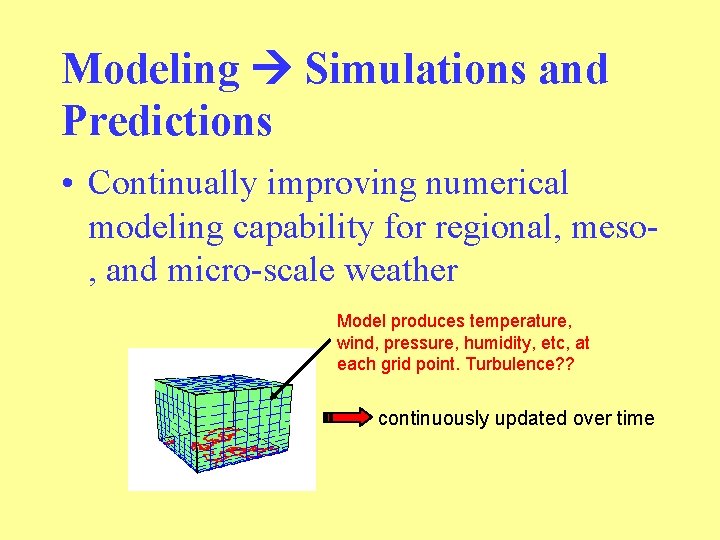
Modeling Simulations and Predictions • Continually improving numerical modeling capability for regional, meso, and micro-scale weather Model produces temperature, wind, pressure, humidity, etc, at each grid point. Turbulence? ? continuously updated over time
Estimating the Impacted Area • A numerical prediction system assimilates data, generates current, and then forecasts atmospheric conditions, which are then input to a second numerical (transport) model that calculates movement and dispersion of the plume of hazardous material – Transport model must be appropriate to the material being transported • Degree of predictability varies with situation; important to know degree of uncertainity in assessing risk in decisions – Use an ensemble forecast approach, requiring multiple computer runs in parallel with slightly different input conditions – Do not yet know how to do this effectively on meso- and micro -scales
What is Needed: Interactively Relocatable, Constantly Updated Plume Predictions • Current technology – Forecast grids are geographically fixed; predictions are made on a routine cycle; products largely “meteorological” – Difficult to respond to rapidly evolving needs for detailed information • Needed technology – A system that produces continually updated forecasts, when and where needed, in a format tailored to the decision maker
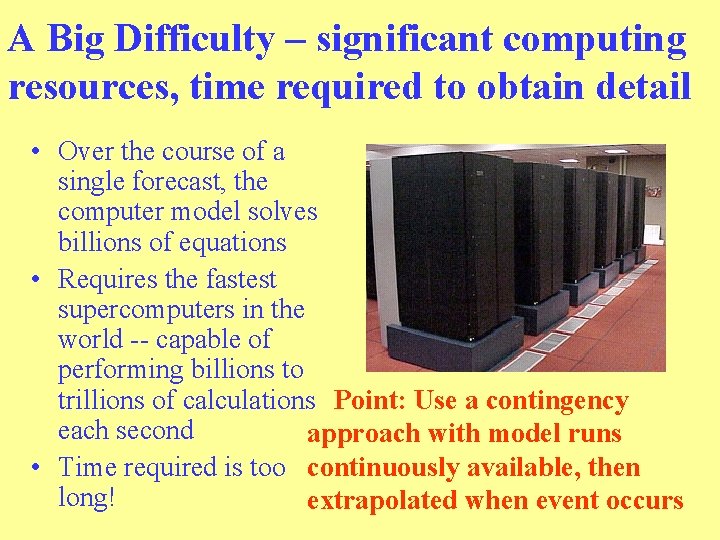
A Big Difficulty – significant computing resources, time required to obtain detail • Over the course of a single forecast, the computer model solves billions of equations • Requires the fastest supercomputers in the world -- capable of performing billions to trillions of calculations Point: Use a contingency each second approach with model runs • Time required is too continuously available, then long! extrapolated when event occurs
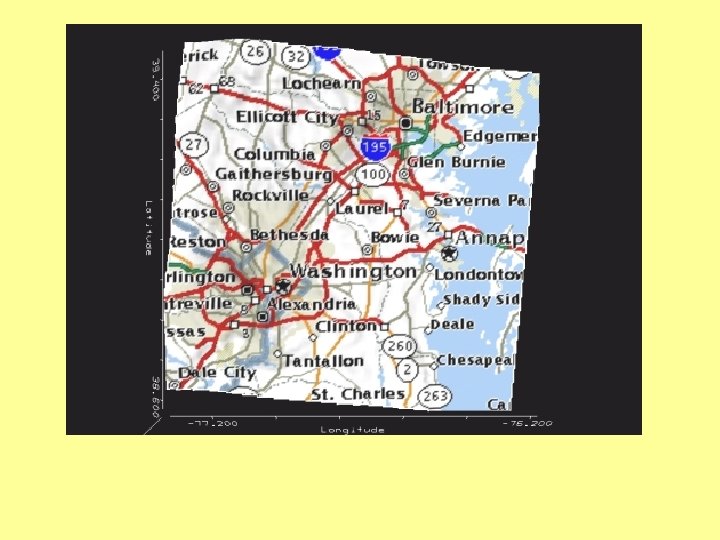
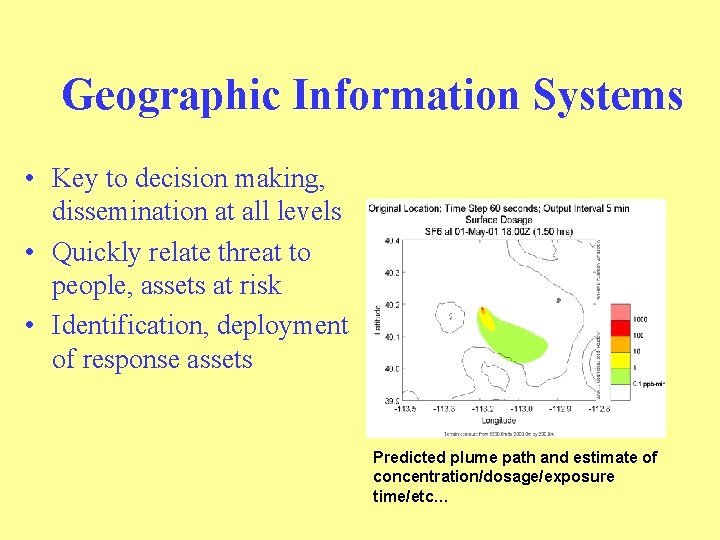
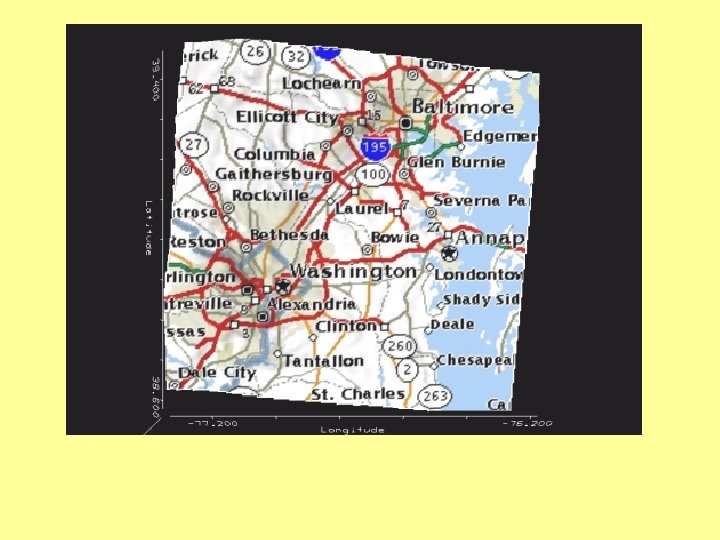
Geographic Information Systems • Key to decision making, dissemination at all levels • Quickly relate threat to people, assets at risk • Identification, deployment of response assets Predicted plume path and estimate of concentration/dosage/exposure time/etc…
Dual Use Systems – a few ideas • Cell telephones – Integral GPS for location (emerging 9 -1 -1 technology) – Towers -- fixed observation sites; ready access to communications – Incorporate NOAA Wx Radio? • Intelligent highways – Should become measurement-rich corridors • Public vehicles – Utilize government vehicle fleets (federal, state, local) as roving mesonet can be instrumented as continuously roving mesonet; with GPS and GIS, data immediately associated with proper locations • Regional air quality monitoring system – Peace time analogs: chemical plant, refinery fire; radioactive release; toxic spill POINT: Probably can not afford a dedicated system; must have utility in everyday operations
John T. Snow Dean, College of Geosciences The University of Oklahoma Sarkeys Energy Center, Suite 710 Norman Oklahoma 73072 T: 405 -325 -3101 F: 405 -325 -3148 C: 405 -590 -9689 E: jsnow@ou. edu W: http: //geosciences. ou. edu