
Home of 3 modern nations India Pakistan Bangladesh
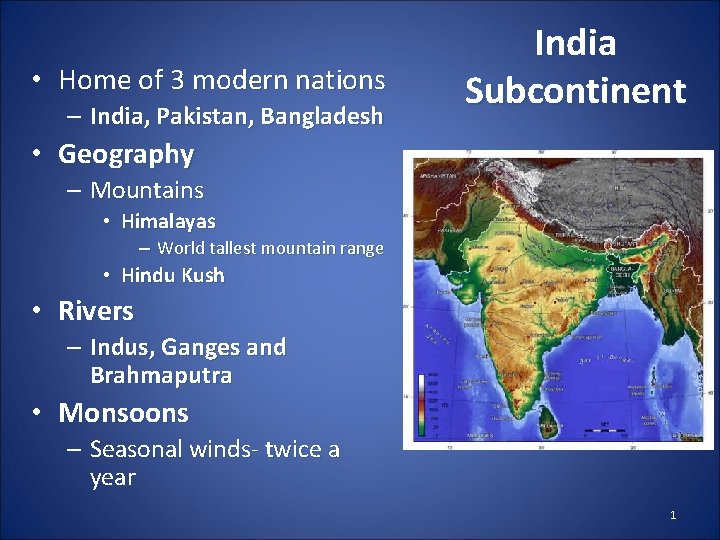
• Home of 3 modern nations – India, Pakistan, Bangladesh India Subcontinent • Geography – Mountains • Himalayas – World tallest mountain range • Hindu Kush • Rivers – Indus, Ganges and Brahmaputra • Monsoons – Seasonal winds- twice a year 1
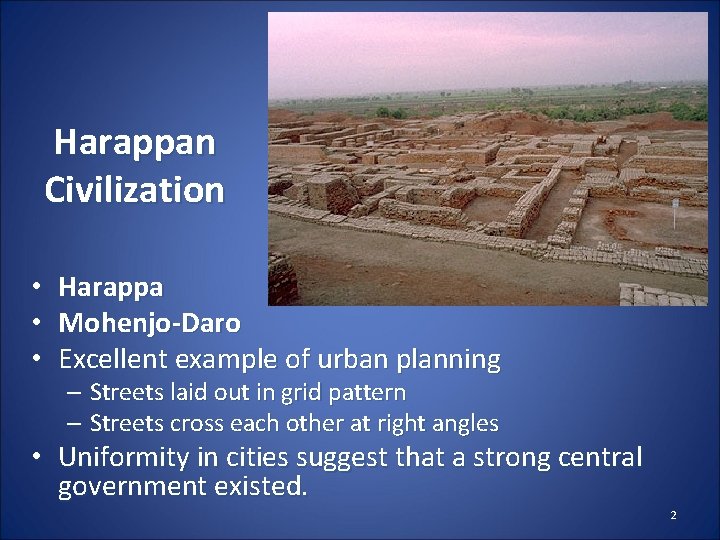
Harappan Civilization • Harappa • Mohenjo-Daro • Excellent example of urban planning – Streets laid out in grid pattern – Streets cross each other at right angles • Uniformity in cities suggest that a strong central government existed. 2
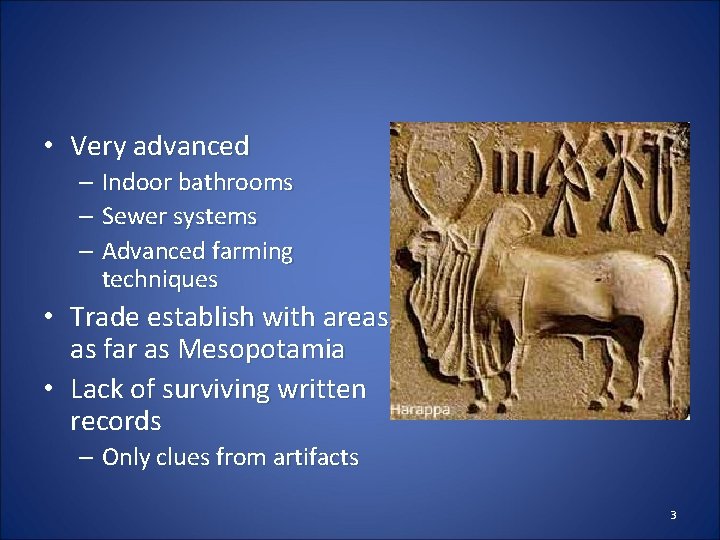
• Very advanced – Indoor bathrooms – Sewer systems – Advanced farming techniques • Trade establish with areas as far as Mesopotamia • Lack of surviving written records – Only clues from artifacts 3
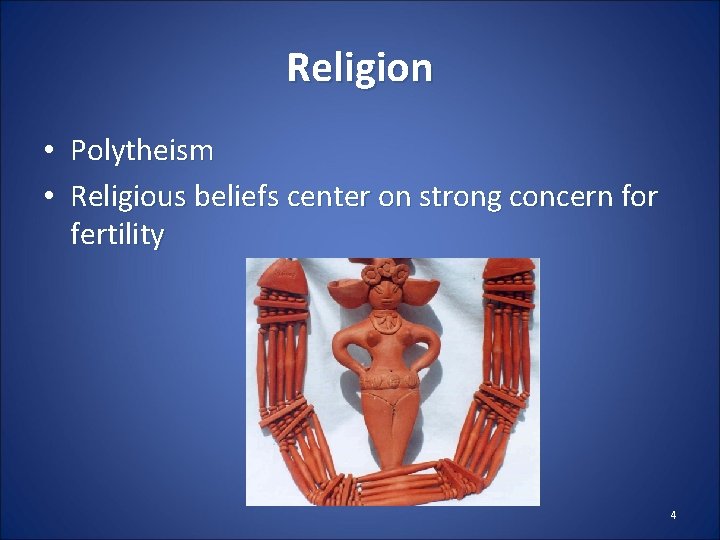
Religion • Polytheism • Religious beliefs center on strong concern for fertility 4
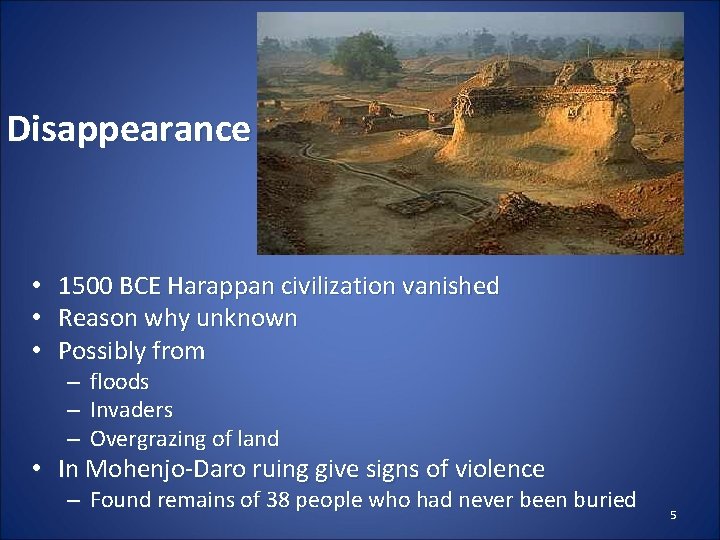
Disappearance • 1500 BCE Harappan civilization vanished • Reason why unknown • Possibly from – floods – Invaders – Overgrazing of land • In Mohenjo-Daro ruing give signs of violence – Found remains of 38 people who had never been buried 5

• • Aryans Led by rajah Economy based on cattle No written language Aryans – Epics passed down in native language called Sanskrit 6
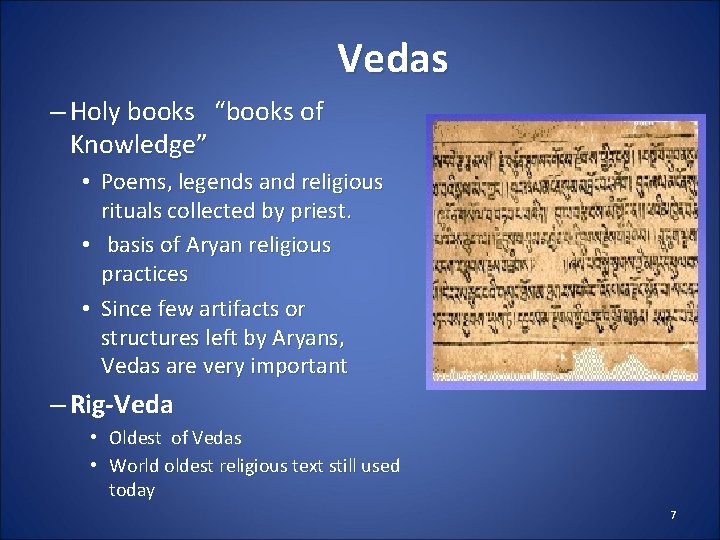
Vedas – Holy books “books of Knowledge” • Poems, legends and religious rituals collected by priest. • basis of Aryan religious practices • Since few artifacts or structures left by Aryans, Vedas are very important – Rig-Veda • Oldest of Vedas • World oldest religious text still used today 7
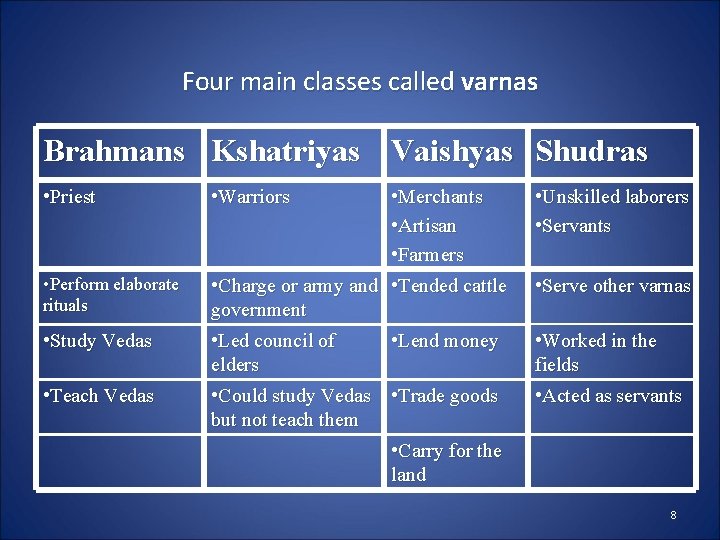
Four main classes called varnas Brahmans Kshatriyas Vaishyas Shudras • Priest • Perform elaborate rituals • Study Vedas • Teach Vedas • Warriors • Merchants • Artisan • Farmers • Charge or army and • Tended cattle government • Led council of • Lend money elders • Could study Vedas • Trade goods but not teach them • Carry for the land • Unskilled laborers • Servants • Serve other varnas • Worked in the fields • Acted as servants 8
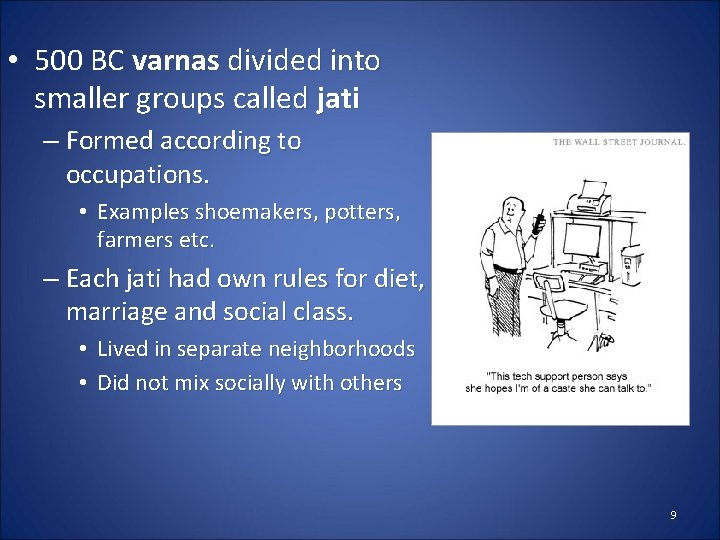
• 500 BC varnas divided into smaller groups called jati – Formed according to occupations. • Examples shoemakers, potters, farmers etc. – Each jati had own rules for diet, marriage and social class. • Lived in separate neighborhoods • Did not mix socially with others 9
• Europeans would later name varna and jati the caste system – Within system people are ranked – Born into a group and could not change – Only marry within the group – Rules not the same for all groups 10
• Pariahs – Later group outside the varna and jati – Did work that was considered unclean • Example skinning animals and tanning hides – Sometimes called “outcastes or untouchables” – Lived outside villages and shunned by most 11
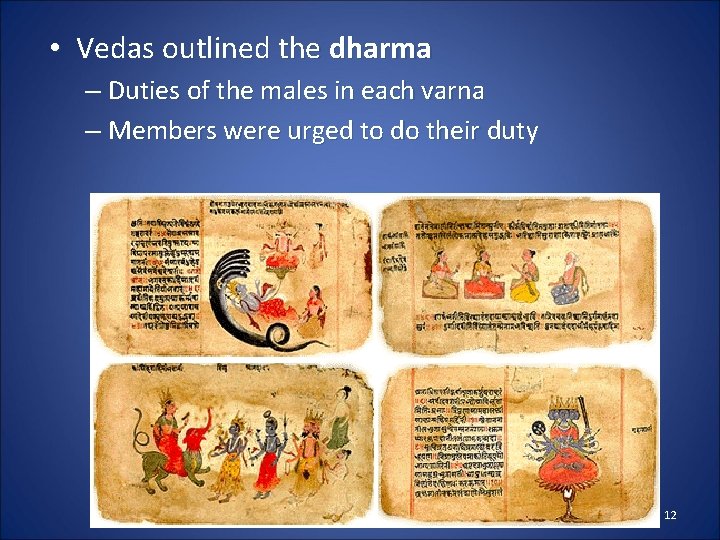
• Vedas outlined the dharma – Duties of the males in each varna – Members were urged to do their duty dut 12
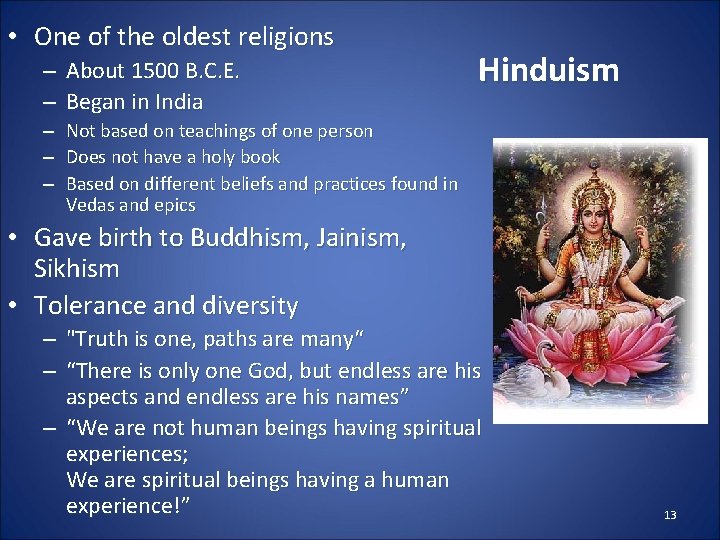
• One of the oldest religions – About 1500 B. C. E. – Began in India – – – Hinduism Not based on teachings of one person Does not have a holy book Based on different beliefs and practices found in Vedas and epics • Gave birth to Buddhism, Jainism, Sikhism • Tolerance and diversity – "Truth is one, paths are many“ – “There is only one God, but endless are his aspects and endless are his names” – “We are not human beings having spiritual experiences; We are spiritual beings having a human experience!” 13
Hindu Scriptures • Upanishads 900 -950 BCE – Essay and poems that outline Hindu spirituality • Emphasize simplicity • Inner development of individual • Methods for spiritual improvement – Yoga • Puranas – Popular tales about gods and heroes • Sutras – Moral teachings • Laws of Manu – Support caste system 14
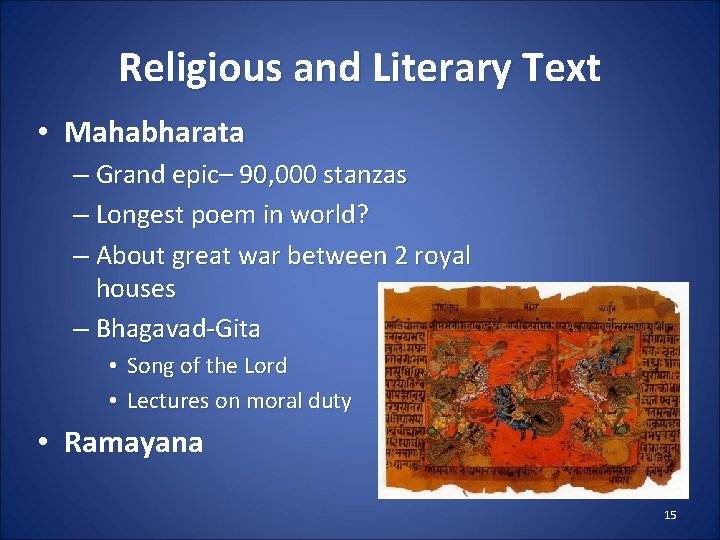
Religious and Literary Text • Mahabharata – Grand epic– 90, 000 stanzas – Longest poem in world? – About great war between 2 royal houses – Bhagavad-Gita • Song of the Lord • Lectures on moral duty • Ramayana 15

• Complex religion of many gods • Three most important are • Brahma ( the Creator) • Vishnu (the Preserver) • Siva (the destroyer) 16
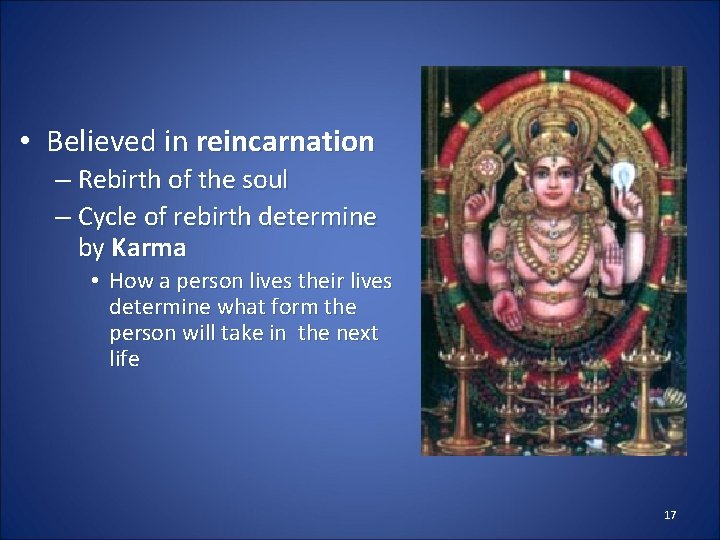
• Believed in reincarnation – Rebirth of the soul – Cycle of rebirth determine by Karma • How a person lives their lives determine what form the person will take in the next life 17

• Cycle of reincarnation continues until person has reached spiritual perfection. • Ultimate aim is moksha – Release from pain and suffering of rebirth • To achieve moksha you must: – Be committed to prayer – Religious rituals – Strict self denial – Rejection of all worldly possessions 18
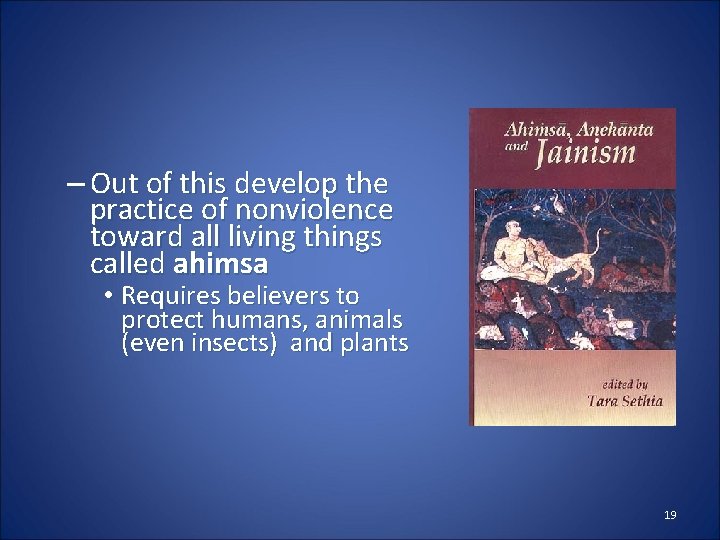
– Out of this develop the practice of nonviolence toward all living things called ahimsa • Requires believers to protect humans, animals (even insects) and plants 19
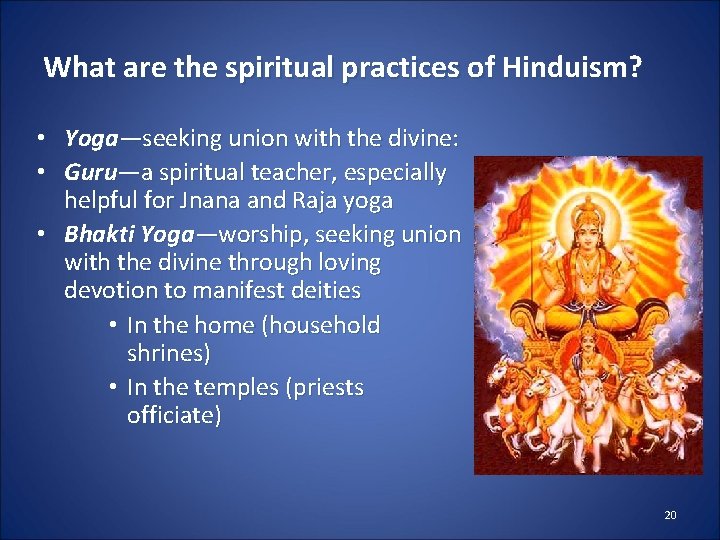
What are the spiritual practices of Hinduism? • Yoga—seeking union with the divine: • Guru—a spiritual teacher, especially helpful for Jnana and Raja yoga • Bhakti Yoga—worship, seeking union with the divine through loving devotion to manifest deities • In the home (household shrines) • In the temples (priests officiate) 20
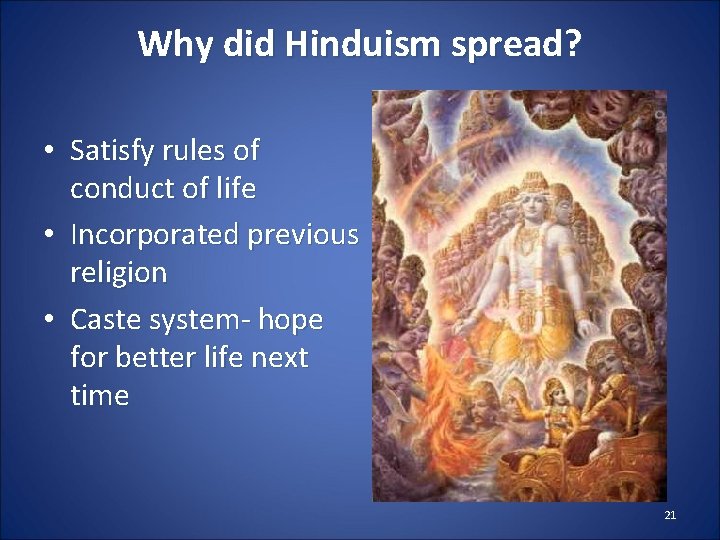
Why did Hinduism spread? • Satisfy rules of conduct of life • Incorporated previous religion • Caste system- hope for better life next time 21
How does Hinduism direct life in this world? • Respect for all life – vegetarian • Human life as supreme: – Four “stations” of life (Caste) – • priests & teachers, nobles & warriors, merchant class, servant class – Four stages of life – • student, householder, retired, wandering philosopher – Four duties of life – • pleasure, success, social responsibilities, religious responsibilities (moksha) 22
Impact of Hinduism • Religion as well as a social system – Born into caste– – If unhappy because you had not follow the dharma and you will have it worse in the next life – Explains why most quietly accept their station in life. – Social mobility not possible in this life but maybe the next. 23
• Hinduism close identification with caste system and its customs have prevent the acceptance of Hinduism in other parts of the world • In recent years modern Hindu are beginning to rebel against the structure of the caste system 24
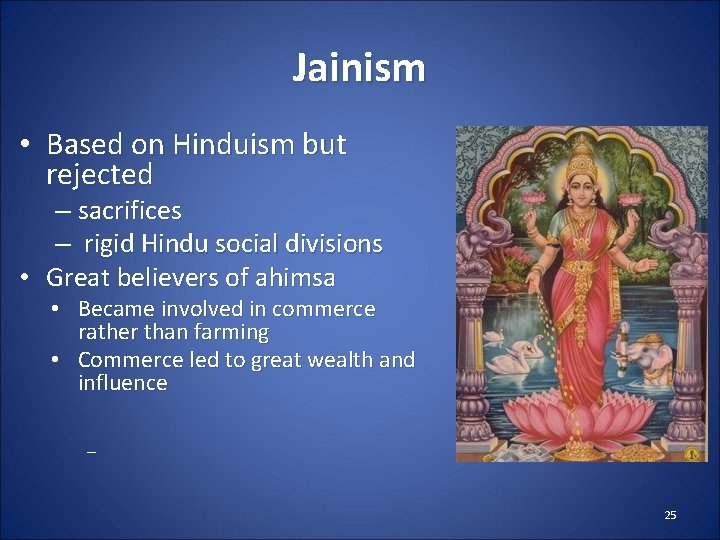
Jainism • Based on Hinduism but rejected – sacrifices – rigid Hindu social divisions • Great believers of ahimsa • Became involved in commerce rather than farming • Commerce led to great wealth and influence – 25
Buddhism • Originated in India • Similar to Judaism and Hinduism – All are tied to culture – Not evangelical movement trying to change civilizations • Challenges the social hierarchy of India – No caste system • One of several religious movements in 500 BCE • Early form was less a religion than a philosophy 26
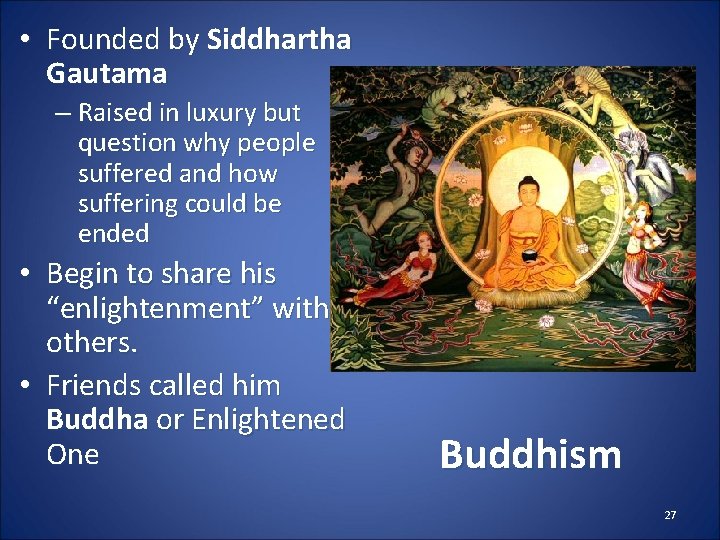
• Founded by Siddhartha Gautama – Raised in luxury but question why people suffered and how suffering could be ended • Begin to share his “enlightenment” with others. • Friends called him Buddha or Enlightened One Buddhism 27
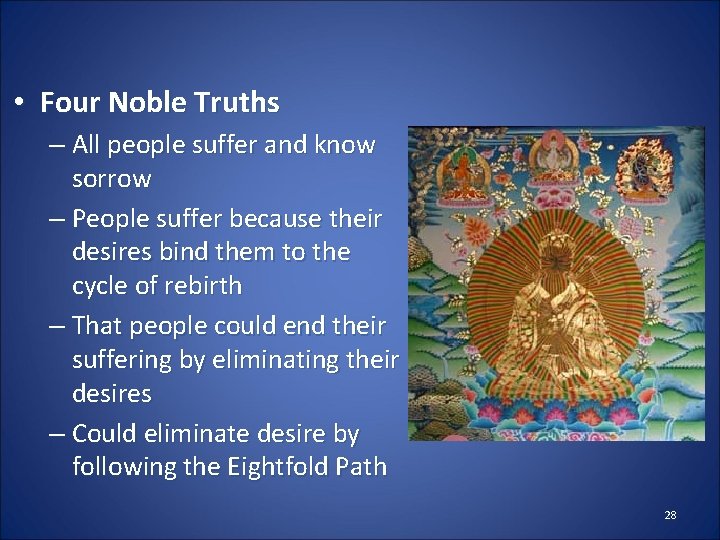
• Four Noble Truths – All people suffer and know sorrow – People suffer because their desires bind them to the cycle of rebirth – That people could end their suffering by eliminating their desires – Could eliminate desire by following the Eightfold Path 28
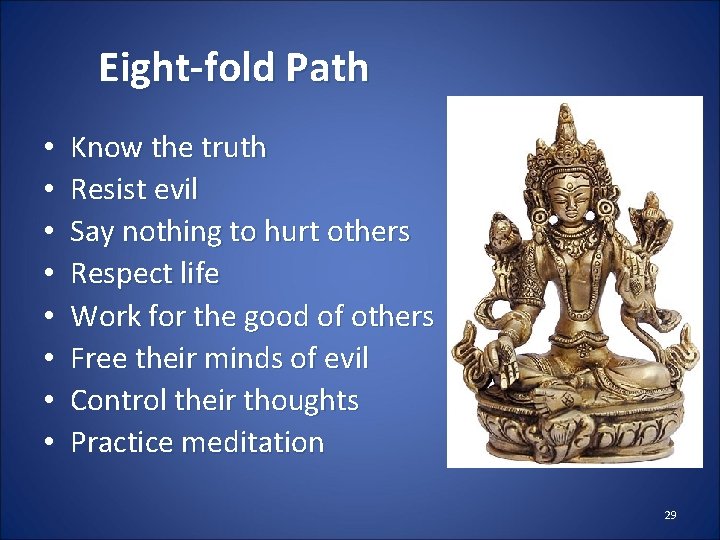
Eight-fold Path • • Know the truth Resist evil Say nothing to hurt others Respect life Work for the good of others Free their minds of evil Control their thoughts Practice meditation 29
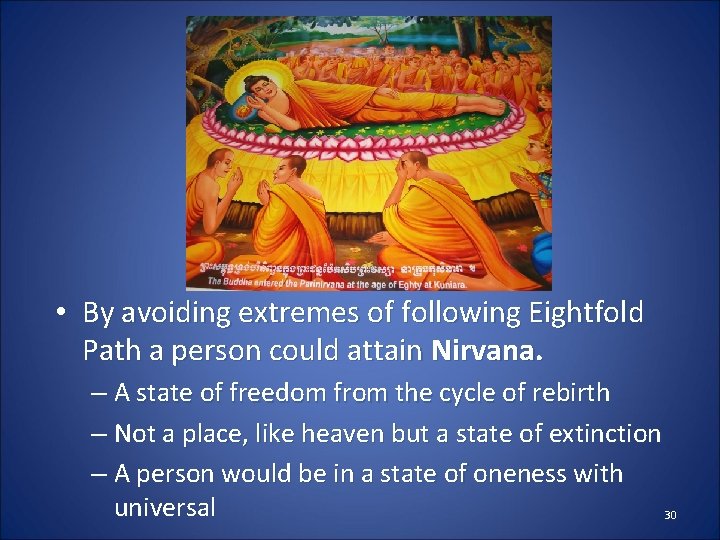
• By avoiding extremes of following Eightfold Path a person could attain Nirvana. – A state of freedom from the cycle of rebirth – Not a place, like heaven but a state of extinction – A person would be in a state of oneness with universal 30
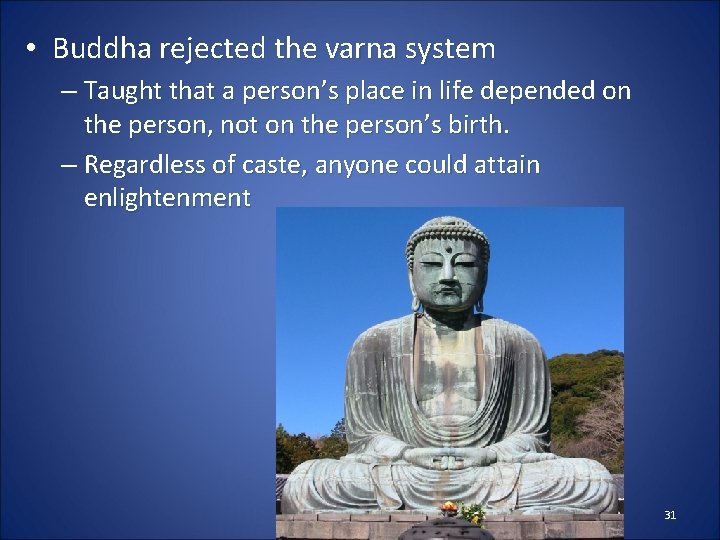
• Buddha rejected the varna system – Taught that a person’s place in life depended on the person, not on the person’s birth. – Regardless of caste, anyone could attain enlightenment 31
![The essence of Buddhism ] The “middle way of wisdom and compassion. ” ]](http://slidetodoc.com/presentation_image_h2/354e86bdf2b183897756bc323aa420ac/image-32.jpg "The essence of Buddhism ] The “middle way of wisdom and compassion. ” ]")
The essence of Buddhism ] The “middle way of wisdom and compassion. ” ] The 3 jewels of Buddhism: § Buddha, the teacher. § Dharma, the teachings. § Sangha, the community. 32
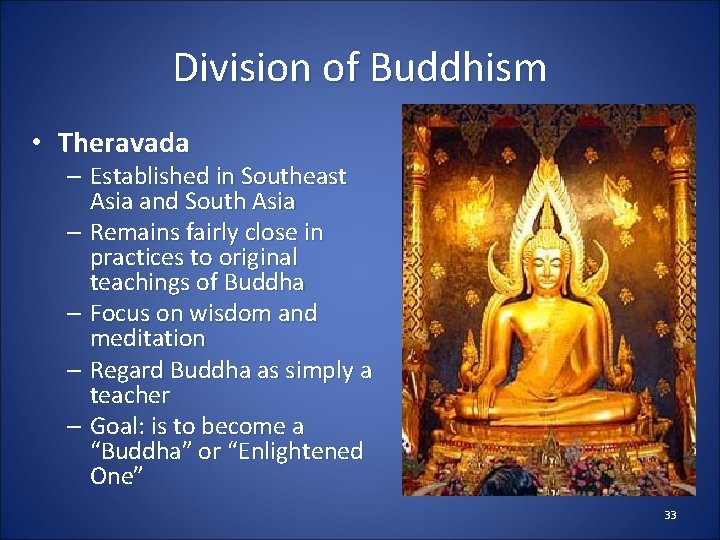
Division of Buddhism • Theravada – Established in Southeast Asia and South Asia – Remains fairly close in practices to original teachings of Buddha – Focus on wisdom and meditation – Regard Buddha as simply a teacher – Goal: is to become a “Buddha” or “Enlightened One” 33
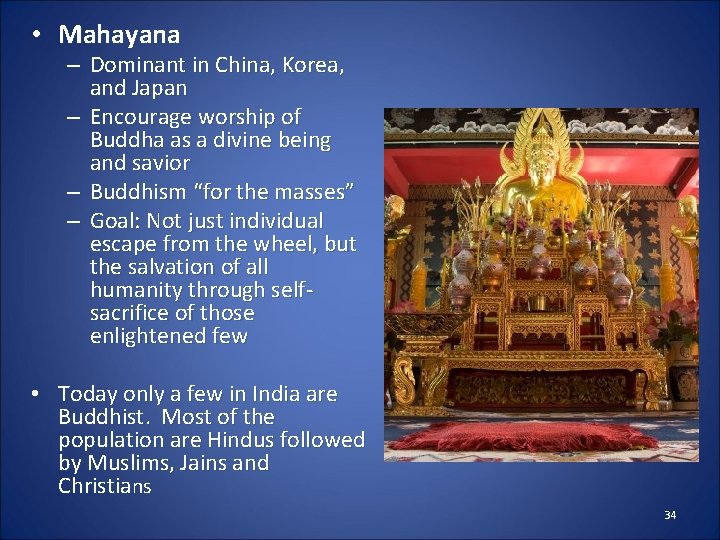
• Mahayana – Dominant in China, Korea, and Japan – Encourage worship of Buddha as a divine being and savior – Buddhism “for the masses” – Goal: Not just individual escape from the wheel, but the salvation of all humanity through selfsacrifice of those enlightened few • Today only a few in India are Buddhist. Most of the population are Hindus followed by Muslims, Jains and Christians 34
![] Zen Buddhism • Seeks sudden enlightenment through meditation, arriving at emptiness • Use](http://slidetodoc.com/presentation_image_h2/354e86bdf2b183897756bc323aa420ac/image-35.jpg "] Zen Buddhism • Seeks sudden enlightenment through meditation, arriving at emptiness • Use")
] Zen Buddhism • Seeks sudden enlightenment through meditation, arriving at emptiness • Use of meditation masters • Beauty, art, and aesthetics, such as gardens & calligraphy ] Tibetan Buddhism • Developed in Tibet in the 7 c CE. • A mix of Theravada and Mahayana • Include Lamas, like the Dalai Lama 35
Why did Buddhism spread? • Acceptance of men and women from all ranks of society • Religious communities of monks and nuns – Located along trade routes– provide lodging for traders – Merchants carried doctrines along Silk Road • Blended with Confucianism • Belief of bodhisattvas – Ordinary people reach nirvana through mediation • Asoka 36
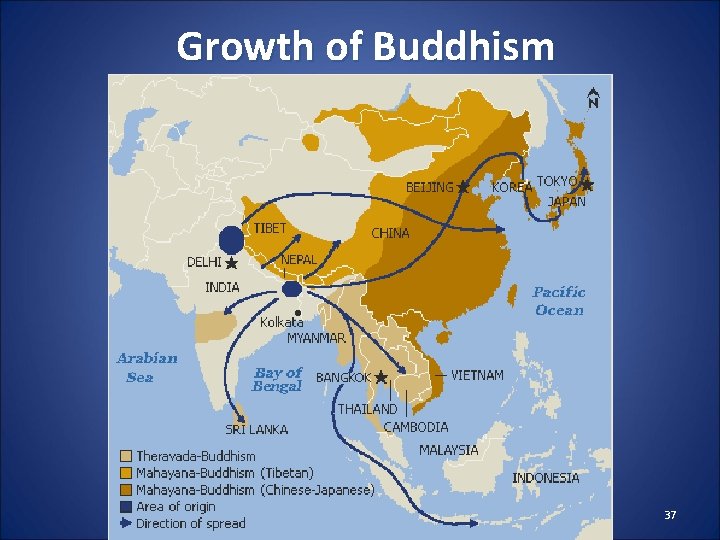
Growth of Buddhism 37
Impact of Buddhism • Because Buddhism reject caste system, it strongly appealed to members of lower rank • Because Buddhism is not attached to underlying social structure it can apply to almost anyone, anywhere. As consequence it spread rapidly to other cultures through Asia • Spread via trade routes as Asia cultures interwine 38
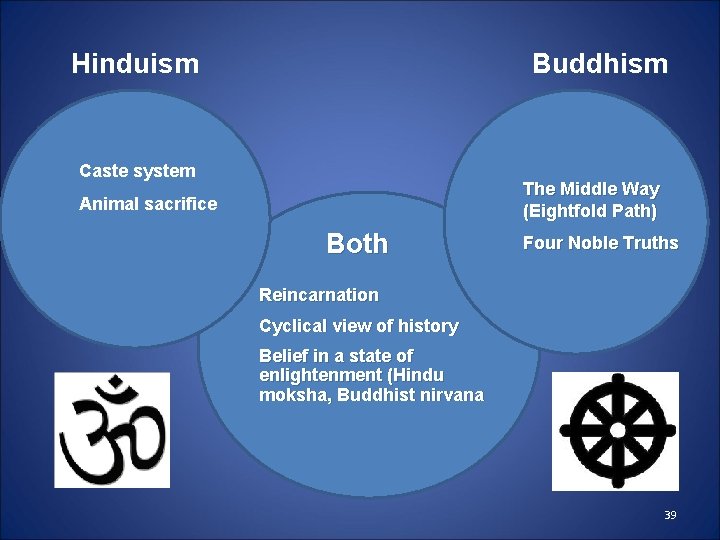
Hinduism Buddhism Caste system The Middle Way (Eightfold Path) Animal sacrifice Both Four Noble Truths Reincarnation Cyclical view of history Belief in a state of enlightenment (Hindu moksha, Buddhist nirvana 39
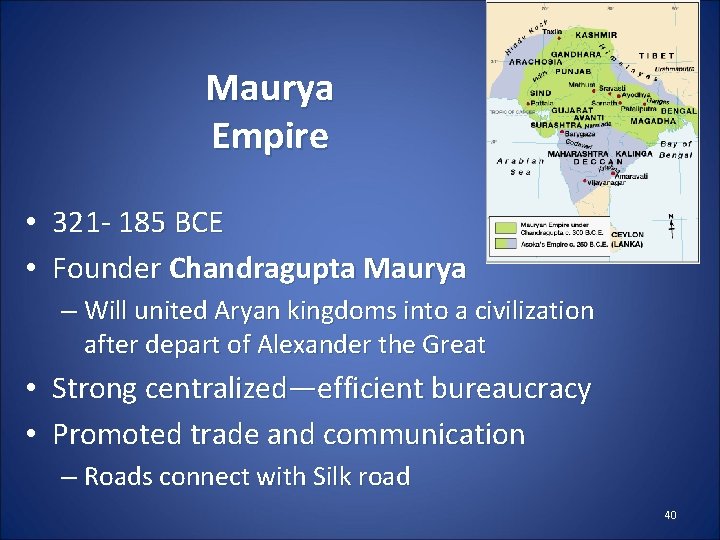
Maurya Empire • 321 - 185 BCE • Founder Chandragupta Maurya – Will united Aryan kingdoms into a civilization after depart of Alexander the Great • Strong centralized—efficient bureaucracy • Promoted trade and communication – Roads connect with Silk road 40
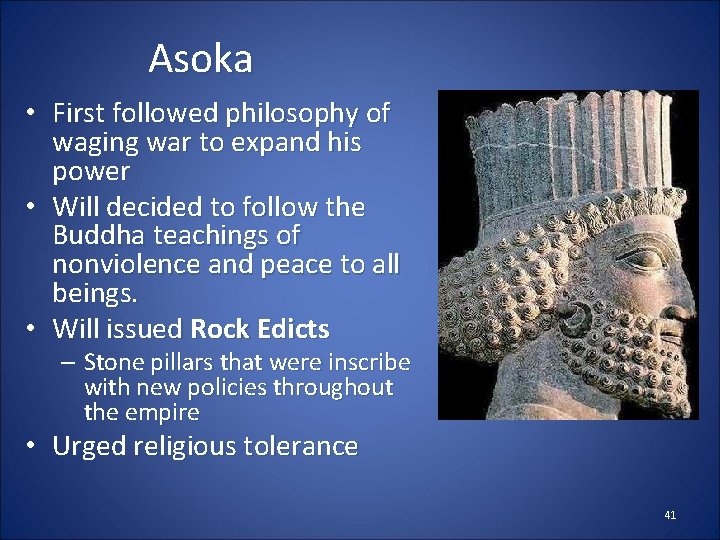
Asoka • First followed philosophy of waging war to expand his power • Will decided to follow the Buddha teachings of nonviolence and peace to all beings. • Will issued Rock Edicts – Stone pillars that were inscribe with new policies throughout the empire • Urged religious tolerance 41
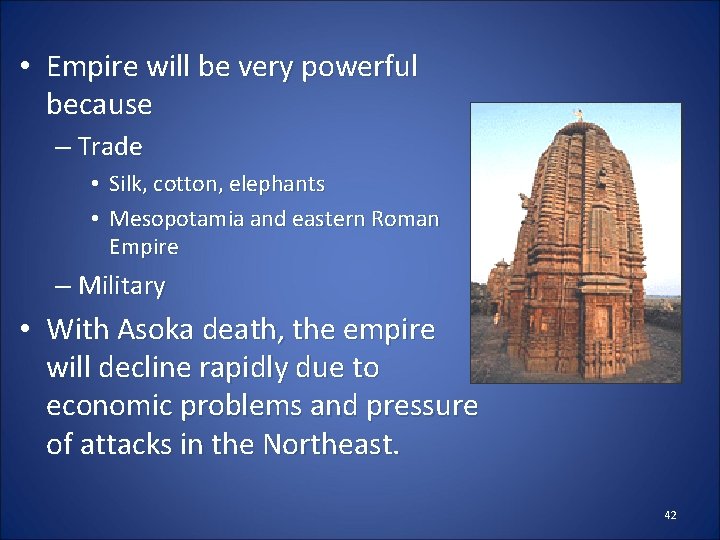
• Empire will be very powerful because – Trade • Silk, cotton, elephants • Mesopotamia and eastern Roman Empire – Military • With Asoka death, the empire will decline rapidly due to economic problems and pressure of attacks in the Northeast. 42
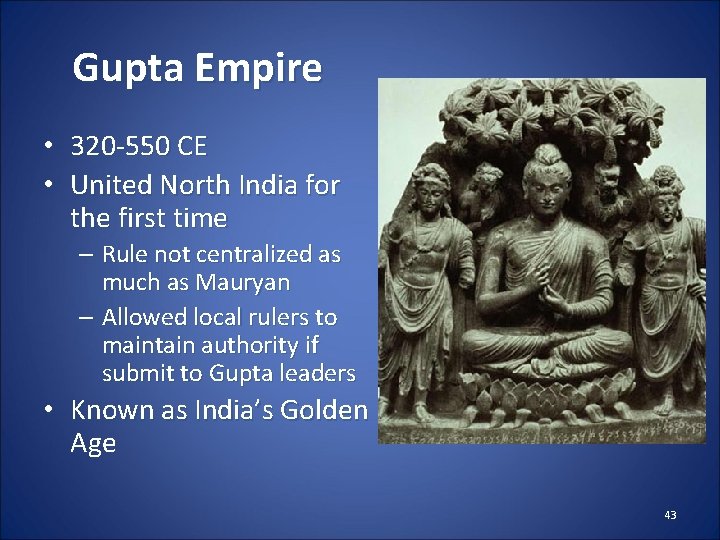
Gupta Empire • 320 -550 CE • United North India for the first time – Rule not centralized as much as Mauryan – Allowed local rulers to maintain authority if submit to Gupta leaders • Known as India’s Golden Age 43
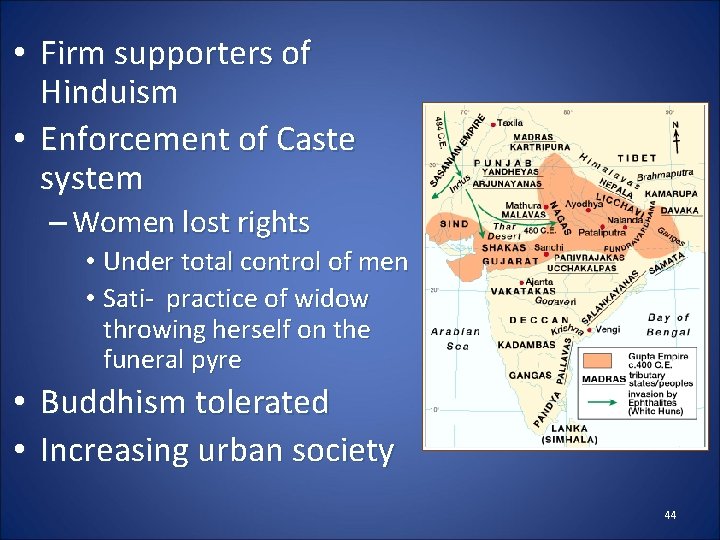
• Firm supporters of Hinduism • Enforcement of Caste system – Women lost rights • Under total control of men • Sati- practice of widow throwing herself on the funeral pyre • Buddhism tolerated • Increasing urban society 44
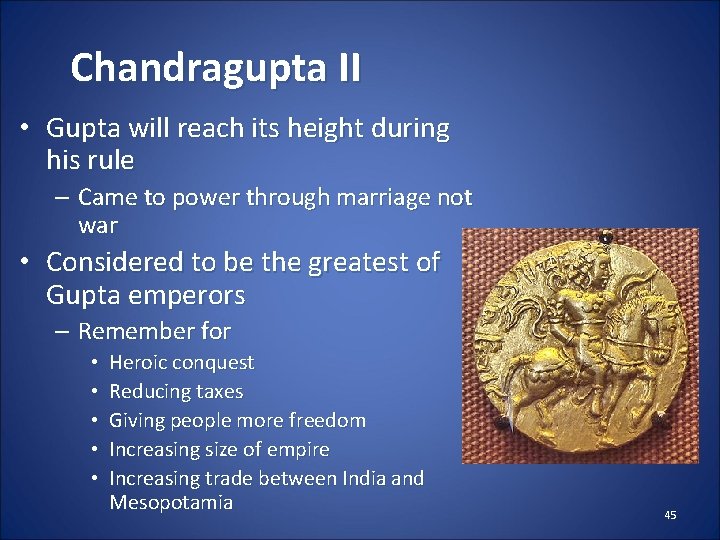
Chandragupta II • Gupta will reach its height during his rule – Came to power through marriage not war • Considered to be the greatest of Gupta emperors – Remember for • • • Heroic conquest Reducing taxes Giving people more freedom Increasing size of empire Increasing trade between India and Mesopotamia 45
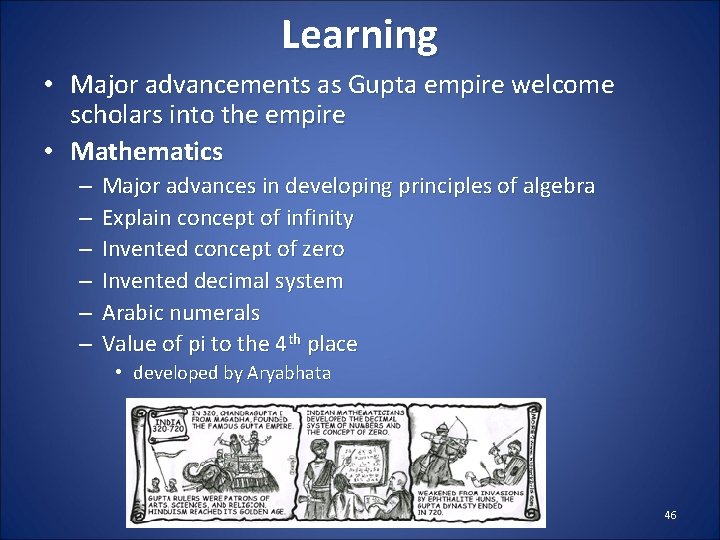
Learning • Major advancements as Gupta empire welcome scholars into the empire • Mathematics – – – Major advances in developing principles of algebra Explain concept of infinity Invented concept of zero Invented decimal system Arabic numerals Value of pi to the 4 th place • developed by Aryabhata 46
• Astronomy – Proved earth round 1, 000 years before Columbus – Calculated the length of solar year • Medicine – Set bones, performed operations, inoculation of smallpoxs and invented hundreds of medical instruments – Medical guides • Classified more than 1, 000 diseases • Describe more than 500 medical plants 47
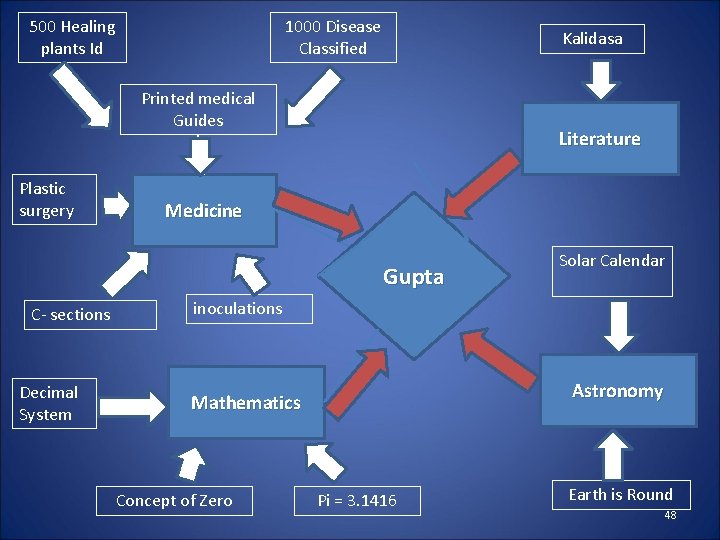
500 Healing plants Id 1000 Disease Classified Kalidasa Printed medical Guides Plastic surgery Literature Medicine Gupta C- sections Decimal System Solar Calendar inoculations Astronomy Mathematics Concept of Zero Pi = 3. 1416 Earth is Round 48
Trade • Will spread Gupta advancements with extensive trade with other civilizations – Caravan route called Silk Road • Will act as the middleman in the silk trade • Effects of trade – Rise of banking in India – Spread of culture – Spread of Hinduism and Buddhism 49
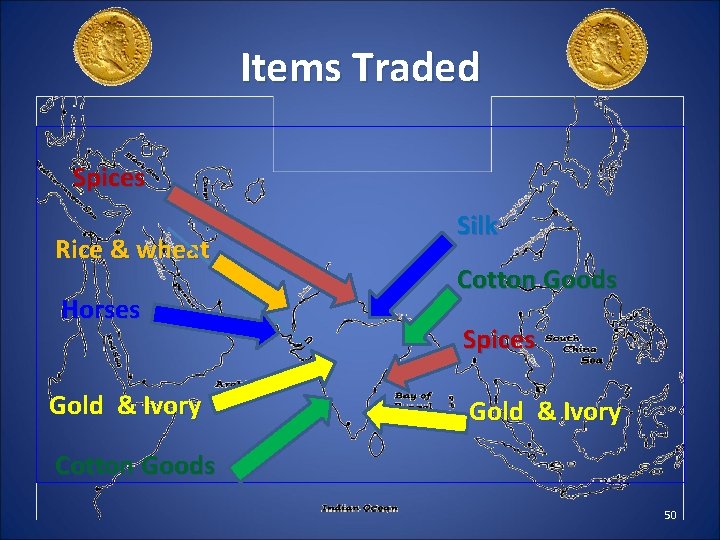
Items Traded Spices Rice & wheat Horses Gold & Ivory Silk Cotton Goods Spices Gold & Ivory Cotton Goods 50
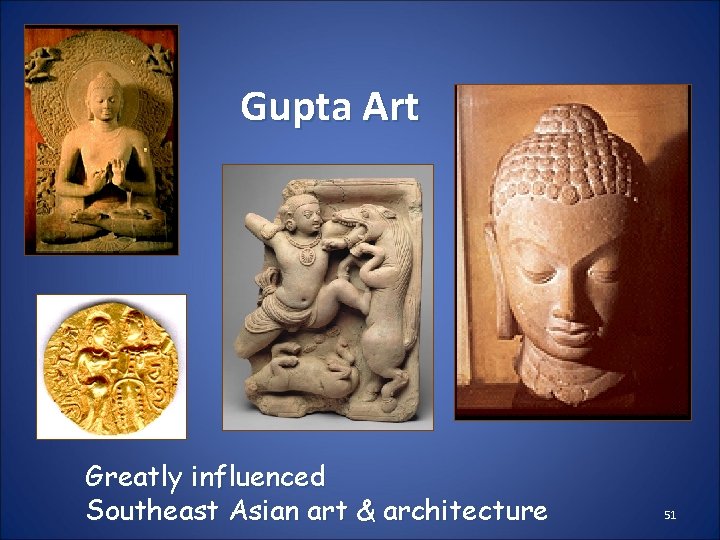
Gupta Art Greatly influenced Southeast Asian art & architecture 51
Global Connection of India • • • No civilization more open to others None more central to cultural exchanges New Civilizations – Trade influence grew – Religion, epics, art, architecture led to new civilizations • Angkor Wat/ Majapahit • Trading network – Coveted cotton textiles and bronze statuaries – Epic literature 52
- Slides: 52