
Home Based Memory Rehabilitation Programme An occupational therapy
Home Based Memory Rehabilitation Programme An occupational therapy early intervention for dementia Email : Dumf-uhb. OTreferrals-mentalhealth@nhs. net Twitter: @OTMH_DG NHS Dumfries and Galloway Mental Health Occupational Therapy Service
Home Based Memory Rehab : HBMR • • • Introduction Cognitive rehabilitation Programme outline Programme outcomes Discussion NHS Dumfries and Galloway Mental Health Occupational Therapy Service
Introduction to HBMR • Evidence based OT early intervention programme for people with dementia • First established in Belfast City hospital in 2007 (Mc. Grath & Passmore, 2009) Contact: Mary. Mc. Grath@belfasttrust. hscni. net • COT OT Evidence Factsheet for dementia NHS Dumfries and Galloway Mental Health Occupational Therapy Service

• Programme aims to help people with dementia compensate for memory difficulties affecting everyday functioning • Structure and Repetition: encourages new learned behaviours in early stages of dementia • Habits and Routines: more likely to be remembered as memory loss continues • Early intervention, post-diagnostic support, living well with dementia NHS Dumfries and Galloway Mental Health Occupational Therapy Service

Cognitive & Memory Rehabilitation • Memory Rehabilitation was originally developed as part of the Cognitive Rehabilitation approach for the treatment of younger brain-injured people. However it is equally applicable to progressive conditions such as early stage Alzheimer’s Disease (Clare et al, 2000 cited in Mc. Grath & Passmore, 2009) • Refers to rehabilitation of cognitive deficits • Memory rehabilitation taps into a ‘partially intact learning capacity’ (Bird, 2001) NHS Dumfries and Galloway Mental Health Occupational Therapy Service

Cognitive & Memory Rehabilitation • Individualised approach • Focus on improving functioning in everyday life • Person with dementia and their families work together with healthcare professional to identify personally relevant goals and devise strategies for addressing these. (Wilson, 2002) • Memory rehabilitation is part of Cognitive Rehabilitation (Wilson et al, 1997) NHS Dumfries and Galloway Mental Health Occupational Therapy Service

Memory Rehabilitation Key is to compensate for memory difficulties via: 1) Environmental Adaptation 2) Use of external memory aids 3) Use of internal memory strategies NHS Dumfries and Galloway Mental Health Occupational Therapy Service
Further Reading • Bahar-Fuchs A, Clare L, Woods B. Cognitive training and cognitive rehabilitation for mild to moderate Alzheimer’s disease and vascular dementia. Cochrane Database of Systematic Reviews 2013, Issue 6. Art. No. : CD 003260. DOI: 10. 1002/14651858. CD 003260. pub 2. NHS Dumfries and Galloway Mental Health Occupational Therapy Service
Criteria for Programme • Diagnosis of mild dementia or mild cognitive impairment • Non age specific • Insight / awareness of everyday memory difficulties : essential • ACE III >60/100 MMSE >20/30 (guideline) • Family/friend/carer support : preferable • All Memory Clinic referrals screened NHS Dumfries and Galloway Mental Health Occupational Therapy Service

Assessments • Large Allen Cognitive Level Screen (LACLS) • Checklist of Everyday Memory Problems • Modified Carer Strain Index (MCSI) (Thornton, M & Travis, S. S, 2003) • Activities of Daily Living : dependency scale • Assessment of Motor and Process Skills (AMPS) NHS Dumfries and Galloway Mental Health Occupational Therapy Service
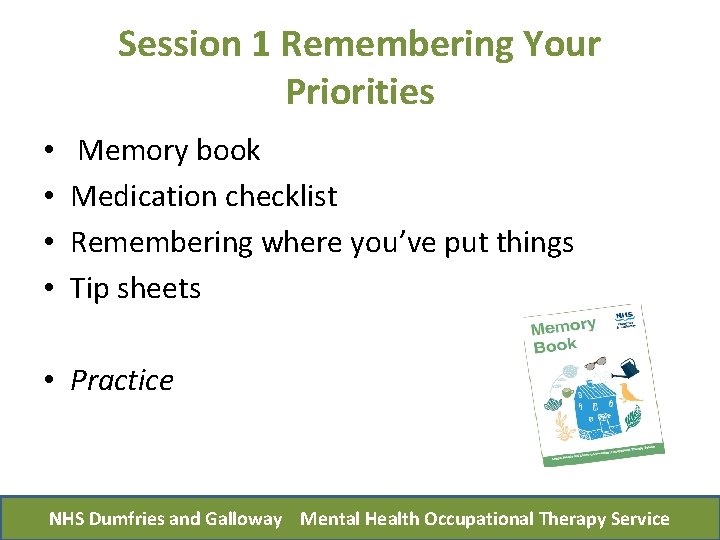
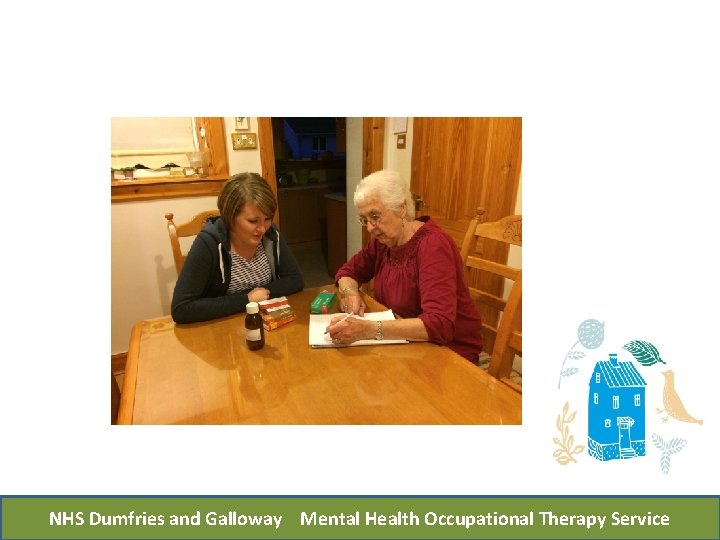
Session 1 Remembering Your Priorities • • Memory book Medication checklist Remembering where you’ve put things Tip sheets • Practice NHS Dumfries and Galloway Mental Health Occupational Therapy Service
Session 2 Remembering What People Have Told You • Review previous week and practice progress • Pocket Notebook • Telephone use: prompt card, notebook • Practice NHS Dumfries and Galloway Mental Health Occupational Therapy Service
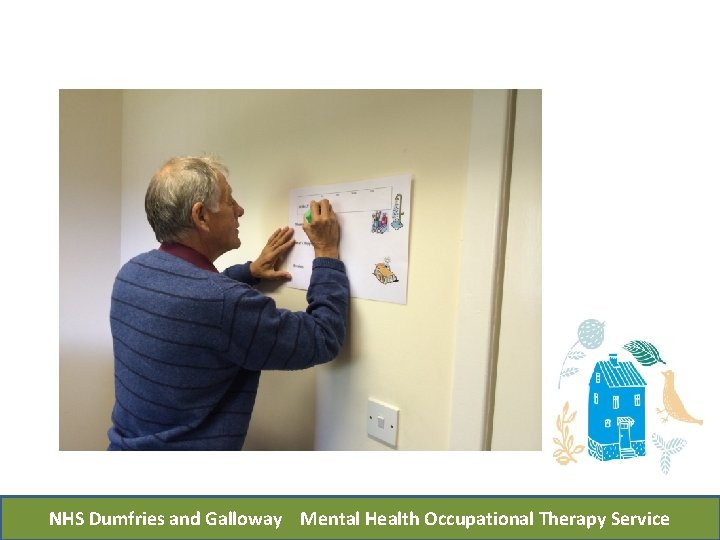
Session 3 Remembering Something You Have To Do • • Review previous weeks and practice progress Permanent reminders, checklists Calendars, memory boards Reminder notes, techniques, tips • Practice NHS Dumfries and Galloway Mental Health Occupational Therapy Service
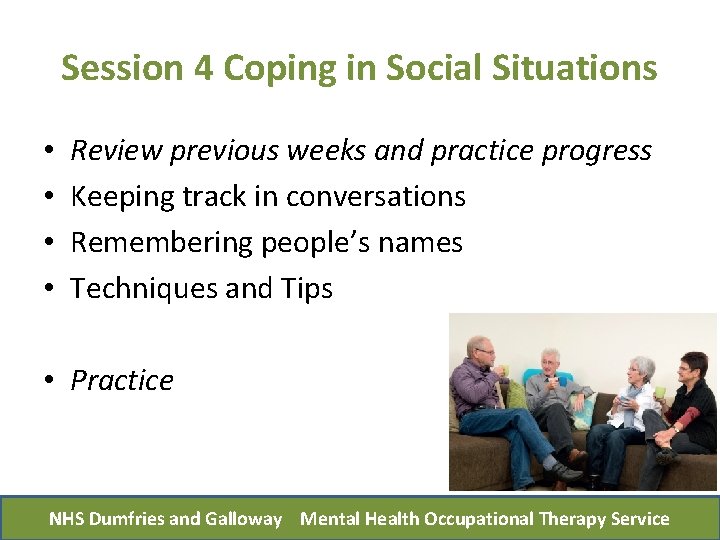
Session 4 Coping in Social Situations • • Review previous weeks and practice progress Keeping track in conversations Remembering people’s names Techniques and Tips • Practice NHS Dumfries and Galloway Mental Health Occupational Therapy Service
Session 5 Keeping Your Brain Healthy • • Review previous weeks and practice progress General advice about active brains Breathing exercises Local and online resources • Practice NHS Dumfries and Galloway Mental Health Occupational Therapy Service
Session 6 Remember Your Bearings & Driving • Review previous weeks and practice progress • Tips on driving • Tips for on foot bearings • Revision of all previous sessions • Revision of strategies in place • Practice NHS Dumfries and Galloway Mental Health Occupational Therapy Service
Reassessment • 3 months post programme completion • 1 year • 2 years • Repeat assessment package • Monitor memory strategy use NHS Dumfries and Galloway Mental Health Occupational Therapy Service
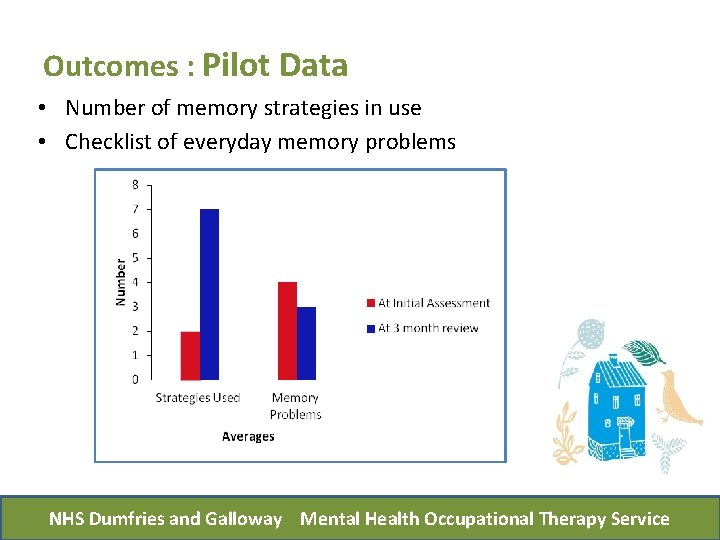
Outcomes : Pilot Data • Number of memory strategies in use • Checklist of everyday memory problems NHS Dumfries and Galloway Mental Health Occupational Therapy Service
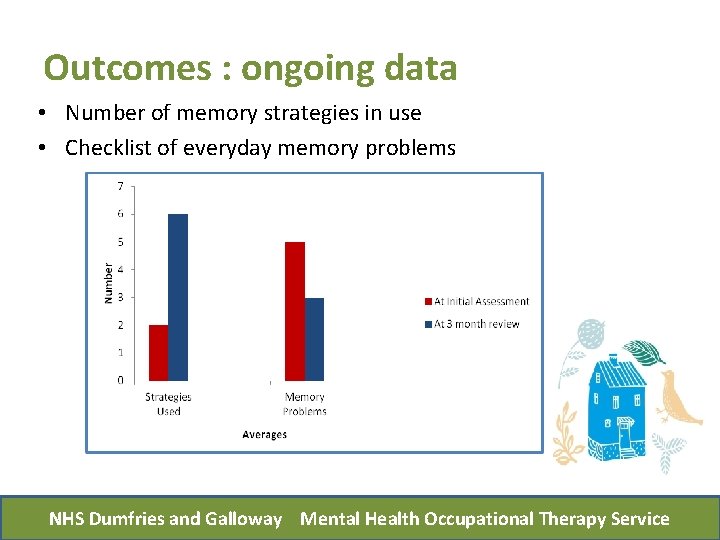
Outcomes : ongoing data • Number of memory strategies in use • Checklist of everyday memory problems NHS Dumfries and Galloway Mental Health Occupational Therapy Service
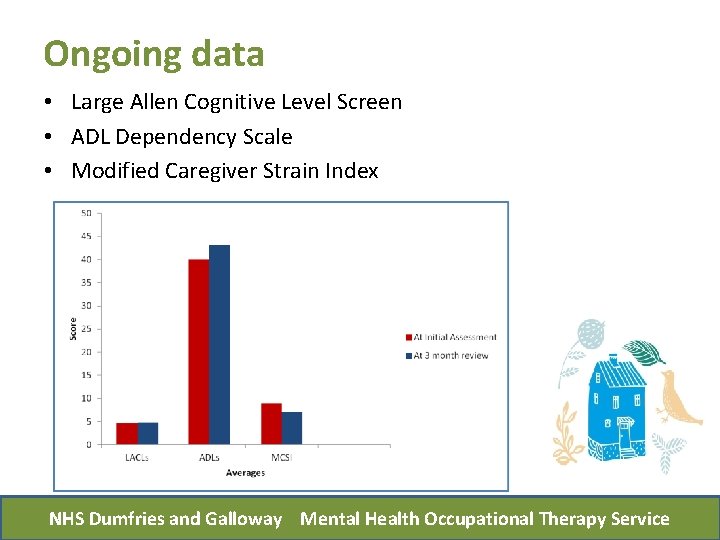
Ongoing data • Large Allen Cognitive Level Screen • ADL Dependency Scale • Modified Caregiver Strain Index NHS Dumfries and Galloway Mental Health Occupational Therapy Service
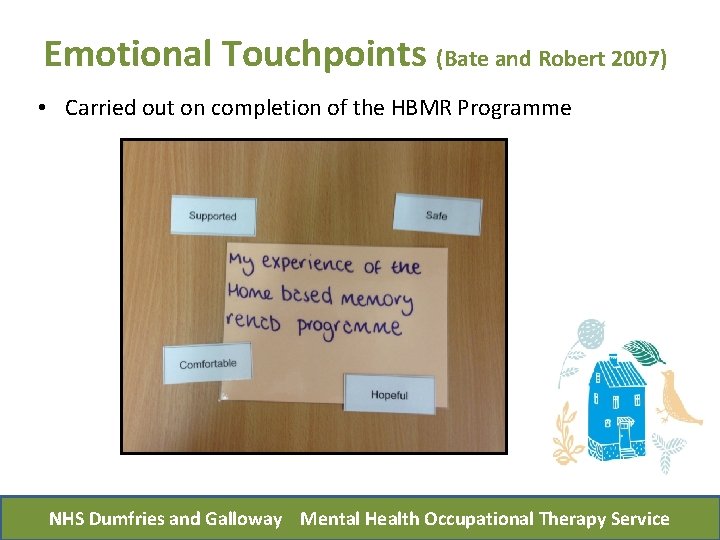
Emotional Touchpoints (Bate and Robert 2007) • Carried out on completion of the HBMR Programme NHS Dumfries and Galloway Mental Health Occupational Therapy Service
Emotional Touchpoints • “I find the strategies helpful. . I am looking for something to help with the blank bits – I found these [strategies] helped. ” • “HBMR - Realising I still have skills and I’m hopeful this will continue for some time. I know I can still be responsible for myself. If you think of the effect of all of these, then you’re going to be happy” NHS Dumfries and Galloway Mental Health Occupational Therapy Service
People’s Stories – Mr S is a 58 year old gentleman who was diagnosed with Alzheimer’s Disease, mixed type • At time of referral, main difficulties identified: - word finding at times of high stress - mild functional disorientation in kitchen AMPS and HBMR completed • EMOTIONAL TOUCHPOINTS: I felt unsure and embarrassed at first before starting the Programme, after the first visit I felt supported but did feel a bit anxious at times. I am enjoying doing the memory book, it is helping my spelling and my writing is getting better. I feel I have gained skills, the OT made me feel comfortable and I feel much better now. NHS Dumfries and Galloway Mental Health Occupational Therapy Service
NHS Dumfries and Galloway Mental Health Occupational Therapy Service
NHS Dumfries and Galloway Mental Health Occupational Therapy Service
NHS Dumfries and Galloway Mental Health Occupational Therapy Service
Next steps • Continue to promote HBMR locally and nationally • Explore potential for use of technology • Explore potential for work based memory rehabilitation • Explore potential to modify HBMR for people with a learning disability and dementia NHS Dumfries and Galloway Mental Health Occupational Therapy Service
Summary of HBMR • Positive results obtained • Demonstrate people with dementia have ability to learn and retain new strategies/ skills with support from the OT • Decreased number of reported everyday memory problems NHS Dumfries and Galloway Mental Health Occupational Therapy Service
Acknowledgement: Special thanks to: Mary Mc. Grath MPhil Dip COT SROT Specialist Occupational Therapist For sharing of information and support with implementation of HBMR in Dumfries & Galloway NHS Dumfries and Galloway Mental Health Occupational Therapy Service
References • Bate. P & Robert. G (2007) Toward more user centric OD: Lessons from the field of experience based design and a case study. Journal of Applied Behavioural Science, 43 (31) http: //jab. sagepub. com/cgi/content/abstract/43/1/41 • Bird (2001) Behavioural difficulties and cued recall of adaptive behaviour in dementia: experimental and clinical evidence. Neuropsychological Rehabilitation 2001; 11: 357– 75. • Clare L, Wilson BA, Carter G, Breen K, Gosses A, Hodges, JR (2000) Intervening with Everyday Memory Problems in Dementia of Alzheimer Type: An Errorless Learning Approach. Journal of Clinical and Experimental Neuropsychology 22(1): 132 - 146 • College of Occupational Therapists Limited. OT Evidence: OTs help those with dementia and their carers Factsheet www. COT. org. uk • Mc. Grath M and Passmore P (2009) Home-based memory rehabilitation programme for persons with mild dementia. Irish Journal of medical Science. 178 (Suppl 8), S 330 NHS Dumfries and Galloway Mental Health Occupational Therapy Service
References • Scottish Government (2013) Scotland’s National Dementia Strategy, 2013 -2016 • Thornton, M & Travis S. S (2003) Analysis of the reliability of the Modified Caregiver Strain Index. The Journal of Gerontology, Series B, Psychological Sciences and Social Sciences, 58(2) p. S 129 • Wilson BA (2002) Towards a comprehensive model of cognitive rehabilitation. Neuropsychological Rehabilitation; 12 (2): 97– 110. • Wilson BA, Hughes JC, Evie (1997) Coping with Amnesia: The Natural History of a Compensatory Memory System Neuropsychological Rehabilitation; 7: 43 - 56 NHS Dumfries and Galloway Mental Health Occupational Therapy Service
NHS Dumfries and Galloway Mental Health Occupational Therapy Service
- Slides: 32