
HOM Couplers for CERN SPL Cavities Kai Papke
- Slides: 15
HOM Couplers for CERN SPL Cavities Kai Papke Work supported by the Wolfgang-Gentner-Programme of the Bundesministerium für Bildung und Forschung (BMBF) 16 -05 -2014 SLHi. PP 2014 - CERN 1
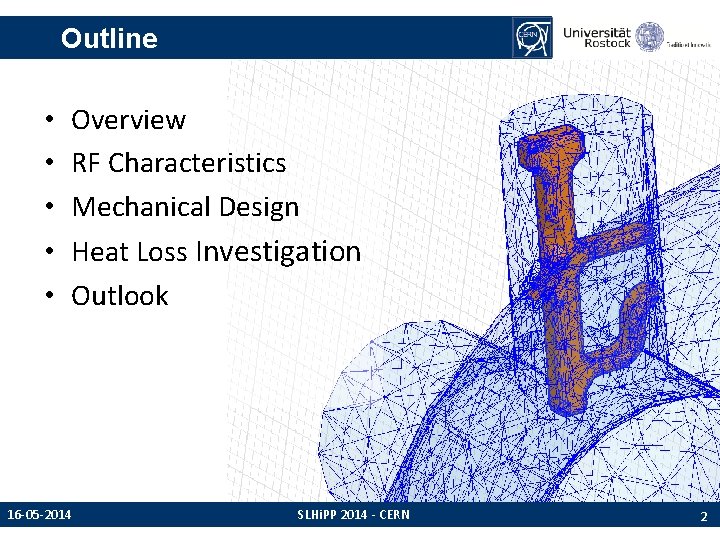
Outline • • • Overview RF Characteristics Mechanical Design Heat Loss Investigation Outlook 16 -05 -2014 SLHi. PP 2014 - CERN 2 2
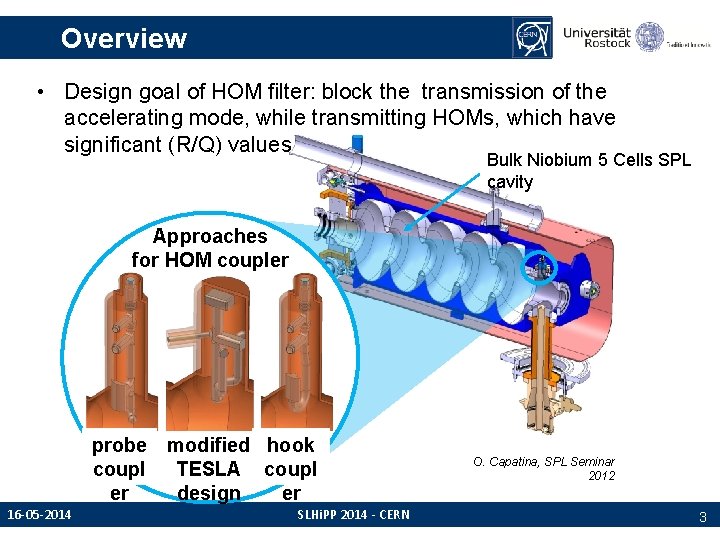
Overview • Design goal of HOM filter: block the transmission of the accelerating mode, while transmitting HOMs, which have significant (R/Q) values Bulk Niobium 5 Cells SPL cavity Approaches for HOM coupler probe coupl er 16 -05 -2014 modified hook TESLA coupl design er SLHi. PP 2014 - CERN O. Capatina, SPL Seminar 2012 3 3
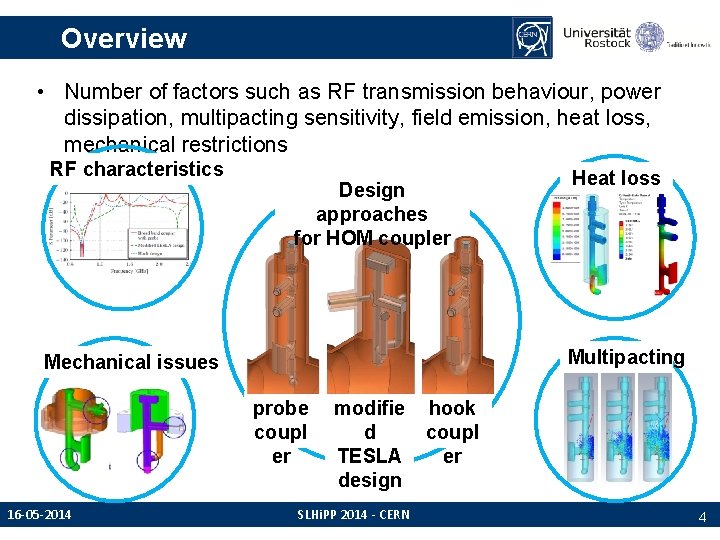
Overview • Number of factors such as RF transmission behaviour, power dissipation, multipacting sensitivity, field emission, heat loss, mechanical restrictions RF characteristics Design approaches for HOM coupler Multipacting Mechanical issues probe coupl er 16 -05 -2014 Heat loss modifie d TESLA design SLHi. PP 2014 - CERN hook coupl er 4 4
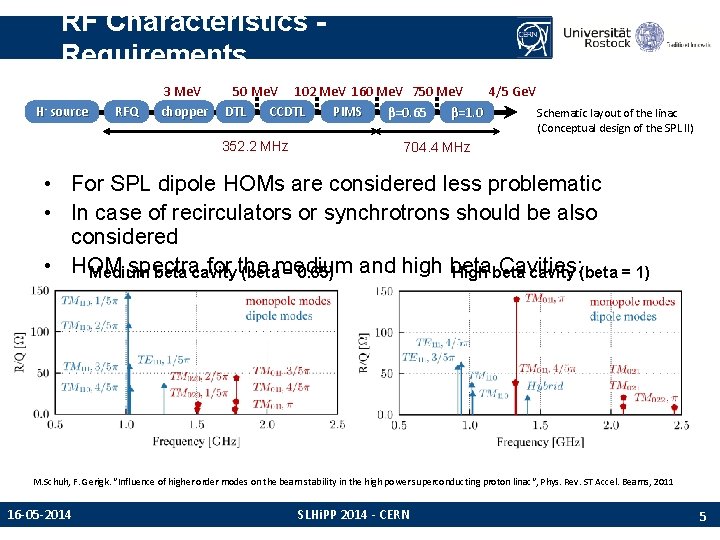
RF Characteristics Requirements H- source RFQ 3 Me. V chopper 4/5 Ge. V 50 Me. V 102 Me. V 160 Me. V 750 Me. V DTL PIMS CCDTL β=0. 65 β=1. 0 Schematic layout of the linac (Conceptual design of the SPL II) 352. 2 MHz 704. 4 MHz • For SPL dipole HOMs are considered less problematic • In case of recirculators or synchrotrons should be also considered • HOM spectra for the and high beta Cavities: Medium beta cavity (betamedium = 0. 65) High beta cavity (beta = 1) M. Schuh, F. Gerigk. “Influence of higher order modes on the beam stability in the high power superconducting proton linac“, Phys. Rev. ST Accel. Beams, 2011 16 -05 -2014 SLHi. PP 2014 - CERN 5 5
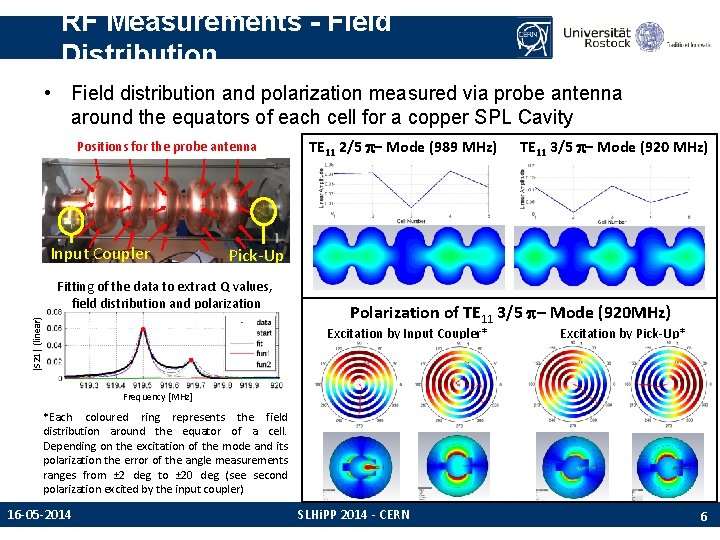
RF Measurements - Field Distribution • Field distribution and polarization measured via probe antenna around the equators of each cell for a copper SPL Cavity Positions for the probe antenna Input Coupler TE 11 2/5 – Mode (989 MHz) TE 11 3/5 – Mode (920 MHz) Pick-Up |S 21| (linear) Fitting of the data to extract Q values, field distribution and polarization Polarization of TE 11 3/5 – Mode (920 MHz) Excitation by Input Coupler* Excitation by Pick-Up* Frequency [MHz] *Each coloured ring represents the field distribution around the equator of a cell. Depending on the excitation of the mode and its polarization the error of the angle measurements ranges from ± 2 deg to ± 20 deg (see second polarization excited by the input coupler) 16 -05 -2014 SLHi. PP 2014 - CERN 6 6
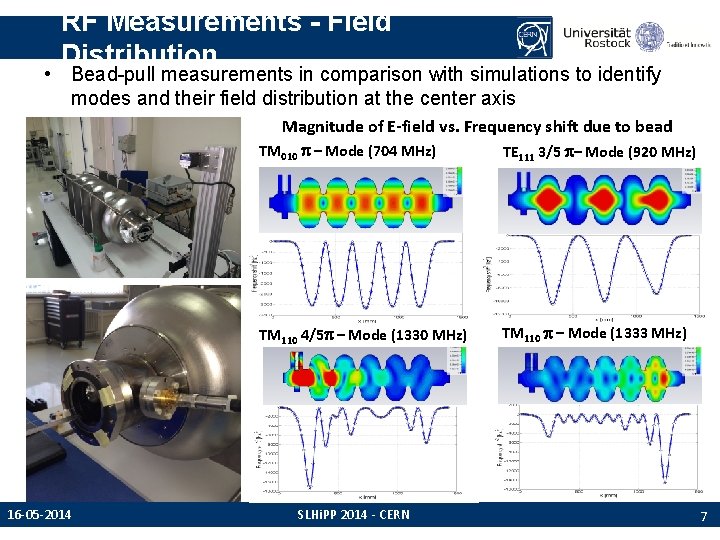
RF Measurements - Field Distribution • Bead-pull measurements in comparison with simulations to identify modes and their field distribution at the center axis Magnitude of E-field vs. Frequency shift due to bead 16 -05 -2014 TM 010 – Mode (704 MHz) TE 111 3/5 – Mode (920 MHz) TM 110 4/5 – Mode (1330 MHz) TM 110 – Mode (1333 MHz) SLHi. PP 2014 - CERN 7 7
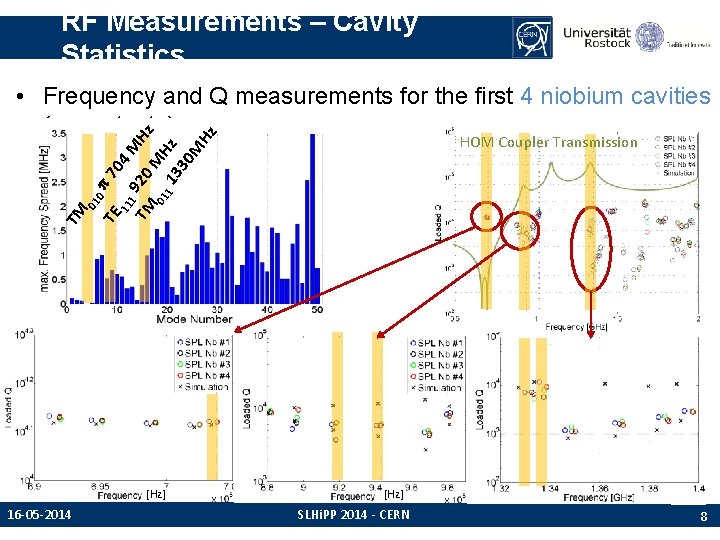
RF Measurements – Cavity Statistics 0 TE 70 4 M 11 1 9 Hz TM 20 M 01 H 1 1 33 z 0 M Hz • Frequency and Q measurements for the first 4 niobium cavities (warm tests) TM 01 HOM Coupler Transmission [Hz] 16 -05 -2014 [Hz] SLHi. PP 2014 - CERN 8 8
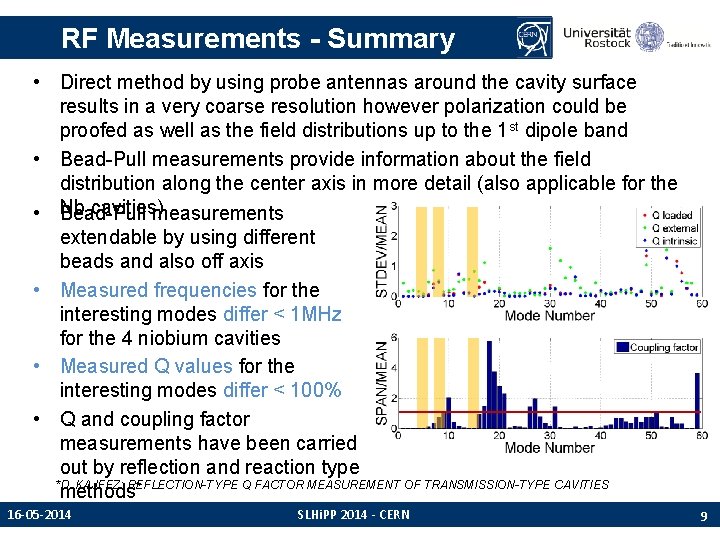
RF Measurements - Summary • Direct method by using probe antennas around the cavity surface results in a very coarse resolution however polarization could be proofed as well as the field distributions up to the 1 st dipole band • Bead-Pull measurements provide information about the field distribution along the center axis in more detail (also applicable for the Nb cavities) • Bead-Pull measurements extendable by using different beads and also off axis • Measured frequencies for the interesting modes differ < 1 MHz for the 4 niobium cavities • Measured Q values for the interesting modes differ < 100% • Q and coupling factor measurements have been carried out by reflection and reaction type *D. KAJFEZ: REFLECTION-TYPE Q FACTOR MEASUREMENT OF TRANSMISSION-TYPE CAVITIES methods* 16 -05 -2014 SLHi. PP 2014 - CERN 9 9
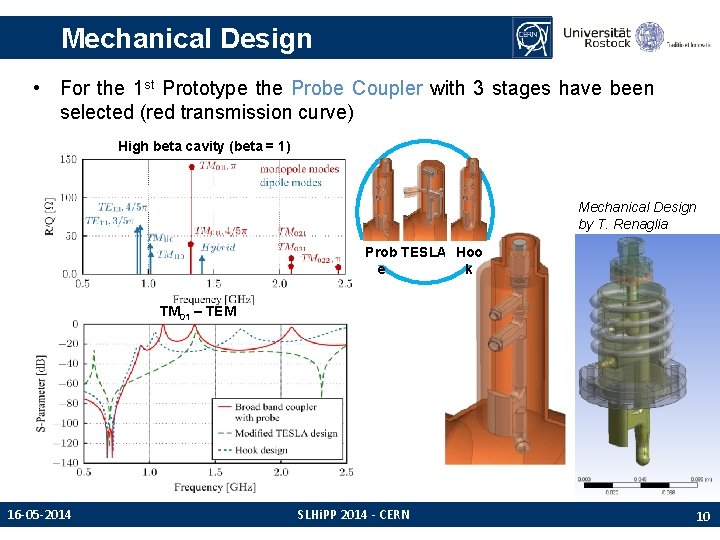
Mechanical Design • For the 1 st Prototype the Probe Coupler with 3 stages have been selected (red transmission curve) High beta cavity (beta = 1) Mechanical Design by T. Renaglia Prob TESLA Hoo e k TM 01 – TEM 16 -05 -2014 SLHi. PP 2014 - CERN 10 10
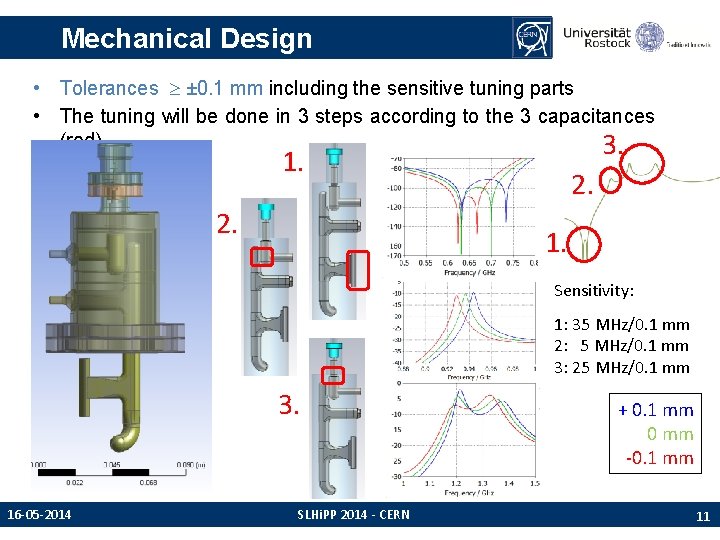
Mechanical Design • Tolerances ± 0. 1 mm including the sensitive tuning parts • The tuning will be done in 3 steps according to the 3 capacitances (red) 3. 1. 2. 1. Sensitivity: 1: 35 MHz/0. 1 mm 2: 5 MHz/0. 1 mm 3: 25 MHz/0. 1 mm 3. 16 -05 -2014 SLHi. PP 2014 - CERN + 0. 1 mm 0 mm -0. 1 mm 11 11
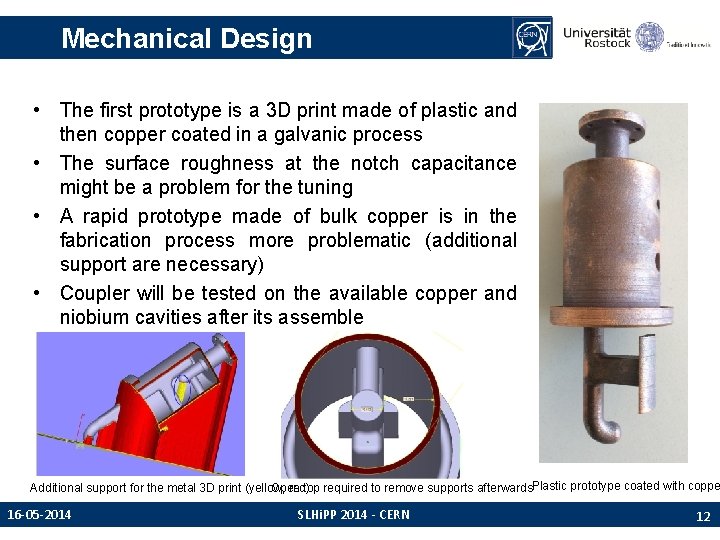
Mechanical Design • The first prototype is a 3 D print made of plastic and then copper coated in a galvanic process • The surface roughness at the notch capacitance might be a problem for the tuning • A rapid prototype made of bulk copper is in the fabrication process more problematic (additional support are necessary) • Coupler will be tested on the available copper and niobium cavities after its assemble Additional support for the metal 3 D print (yellow, red) Open top required to remove supports afterwards. Plastic prototype coated with coppe 16 -05 -2014 SLHi. PP 2014 - CERN 12 12
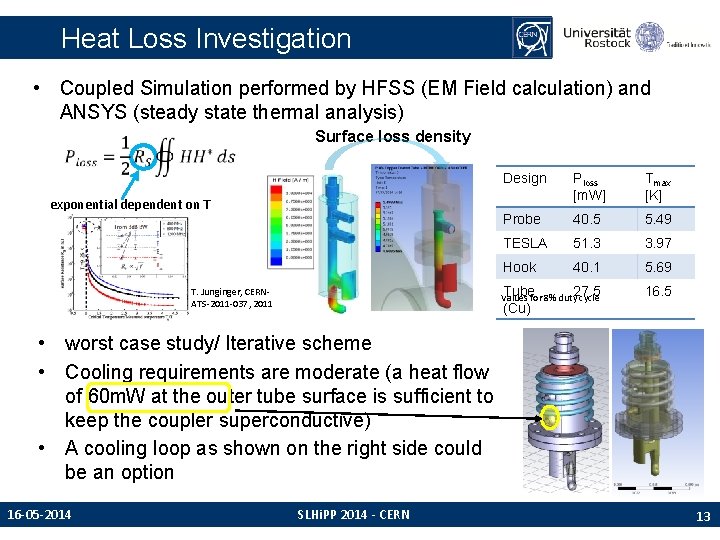
Heat Loss Investigation • Coupled Simulation performed by HFSS (EM Field calculation) and ANSYS (steady state thermal analysis) Surface loss density exponential dependent on T T. Junginger, CERNATS-2011 -037, 2011 Design Ploss [m. W] Tmax [K] Probe 40. 5 5. 49 TESLA 51. 3 3. 97 Hook 40. 1 5. 69 Tube (Cu) 27. 5 16. 5 Values for 8% duty cycle • worst case study/ Iterative scheme • Cooling requirements are moderate (a heat flow of 60 m. W at the outer tube surface is sufficient to keep the coupler superconductive) • A cooling loop as shown on the right side could be an option 16 -05 -2014 SLHi. PP 2014 - CERN 13 13
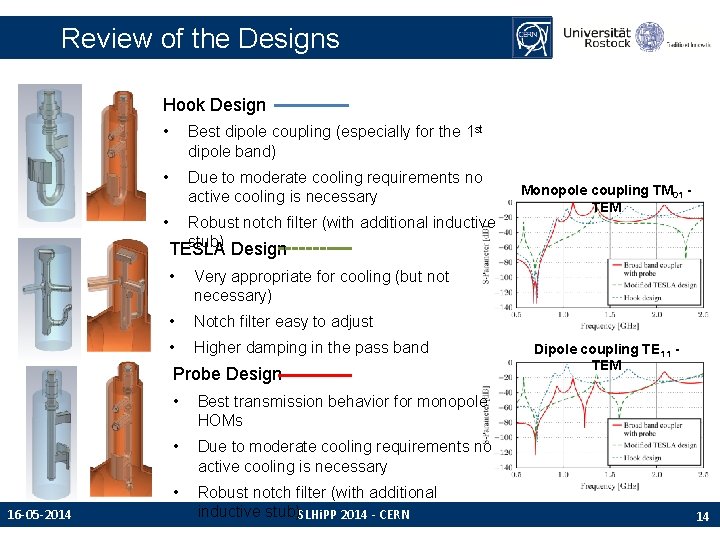
Review of the Designs Hook Design • Best dipole coupling (especially for the 1 st dipole band) • Due to moderate cooling requirements no active cooling is necessary • Robust notch filter (with additional inductive stub) Design TESLA • Very appropriate for cooling (but not necessary) • Notch filter easy to adjust • Higher damping in the pass band Probe Design 16 -05 -2014 • Best transmission behavior for monopole HOMs • Due to moderate cooling requirements no active cooling is necessary • Robust notch filter (with additional inductive stub)SLHi. PP 2014 - CERN Monopole coupling TM 01 TEM Dipole coupling TE 11 TEM 14 14
Outlook • 1 st prototype coupler will be tested on the available copper and niobium cavities after its assemble • Tuning procedure will be investigated • Frequency and Q factor sensitivity of selected HOMs will be investigated for a copper SPL high beta cavity using a tuning machine • Investigation of Multipacting barriers • Mechanical design and fabrication of a real coupler (maybe also a second rapid prototype made of bulk copper) Thank you for your attention 16 -05 -2014 SLHi. PP 2014 - CERN 15 15