
HOLT Economics Chapter 6 Market Structures These documents
- Slides: 50
HOLT: Economics Chapter 6 Market Structures “These documents are being distributed for educational discussion purposes only. They do not reflect any attempt by the North East Independent School District, its trustees, administrators, or teachers, to promote any particular viewpoints or opinions expressed in the documents over any others, nor do the viewpoints or opinions expressed in the documents necessarily reflect those of the NEISD, its trustees, administrators or teachers. ”
Sect 1: Highly Competitive Markets • Consumers benefit most from competitive markets • Competitive markets provide consumers with a range of products that are…. • …Lower priced • …Better reflect the cost of production • …Offered by multiple sellers
Competition v. Monopoly • The forces of supply and demand promote competition by encouraging producers to supply consumers with a wide selection of goods and services • Two types of highly competitive markets are…. • …Perfect competition • …Monopolistic competition
Perfect Competition • Buyers and sellers compete directly under the laws of Supply and Demand • No one buyer or seller controls demand, supply, or prices • Nothing prevents competition among buyers and sellers
4 Conditions of Perfect Competition • • Many buyers and sellers act independently Sellers offer identical products Buyers are well informed about products Sellers can enter and exit the market easily
Many Buyers and Sellers • Because there are many buyers and sellers in the market, each one has a very small share in overall purchases and sales • No single buyer has enough power to control demand, supply, or price • Each buyer or seller acts independently • This promotes competition
Identical Products • Under perfect competition products would be identical • The only distinguishing thing would be price • Is this possible?
Informed Buyers • Under perfect competition buyers would be knowledgeable about products • Sellers can compete perfectly only when buyers can make informed decisions
Easy Market Entry & Exit • For sellers to compete perfectly in a market they must be free to enter a profitable market and leave an unprofitable market • Ease of entry or exit depends on… • …start-up costs • …level of technical knowledge needed • …amount of control held by those already in the market
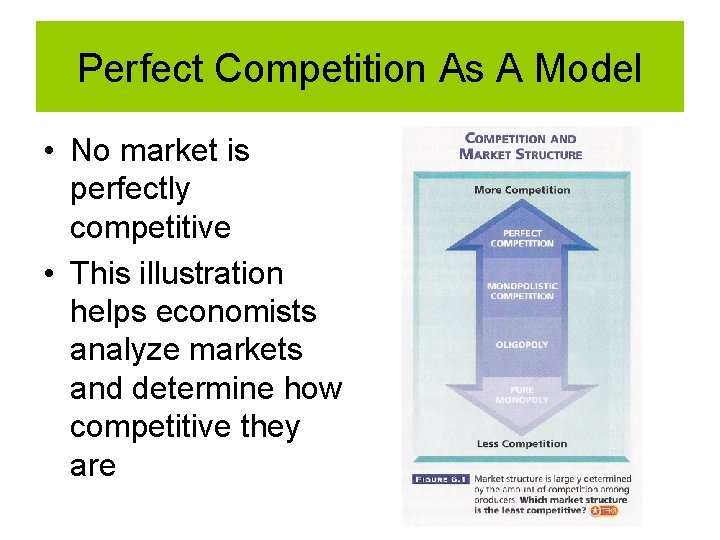
Perfect Competition As A Model • No market is perfectly competitive • This illustration helps economists analyze markets and determine how competitive they are
Close to Perfect… • Agricultural products come close… • …Thousands of independent growers • …Products are near identical (apples to apples) • …Buyers are generally well informed • …Sellers can enter and exit the market freely (cotton farmer can grow soybeans)
Monopolistic Competition • In Monopolistic Competition, sellers offer different rather than identical products • Each seller tries to get monopoly like power by selling a unique product • Since product variation is much more common than selling identical products, monopolistic competition is the more common • Must still compete based on supply and demand
Product Differentiation • Sellers in monopolistic competition try to differentiate, or point out differences between their products and those of their competitors • Whether products are really different or just seem different, sellers use product differentiation to set their product apart
Non-Price Competition • Non-Price competition is when sellers compete on a basis other than price • Emphasizing their brand name (designer v’ non-designer) • …Relies heavily on advertising • …Creates a “sense of style” • …Snob appeal
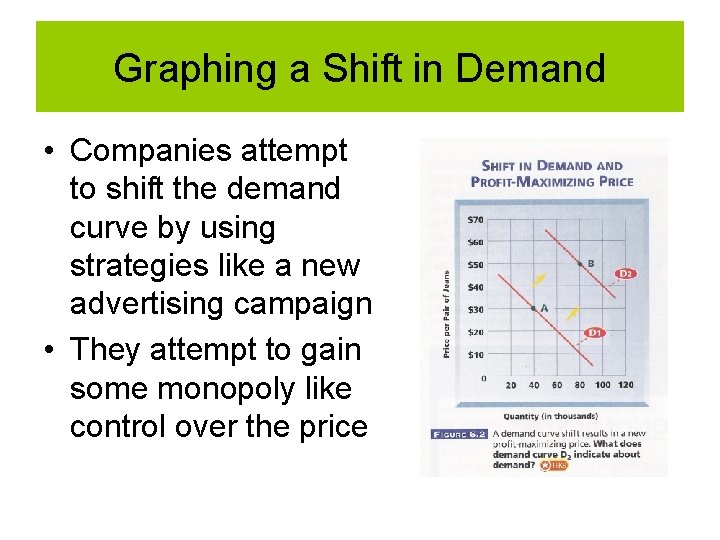
Profits • The main goal of product differentiation and non-price competition is to increase profits • This practice allows sellers to raise the price of their product • They attempt to increase demand for their product and shift the market price upward
Graphing a Shift in Demand • Companies attempt to shift the demand curve by using strategies like a new advertising campaign • They attempt to gain some monopoly like control over the price
Sect. 2: Imperfectly Competitive Markets • Not all markets are highly competitive • When competition is low it usually means fewer products and less choice is available for consumers • An imperfectly competitive structure also usually results in higher prices
Oligopolies • An oligopoly is a market structure in which a few large sellers control most of the production of a good or service • 3 conditions present in an oligopoly… • …there are only a few large sellers • …sellers offer identical or similar products • …other sellers cannot enter the market easily
Few Large Sellers • A market is considered an oligopoly when the largest three or four sellers produce most of a markets total output (70+%)
Identical or Similar Products • Because an oligopoly is dominated by a few large sellers they… • …have a lot at stake • …are less likely to take risks • …are not quick to offer new products
Difficult Market Entry • The few sellers in market can maintain their control only if other sellers cannot easily enter the market due to… • …high start up costs • …government regulations • …consumer loyalty to their products
Oligopolies at Work • The lower number of sellers that are in a market means that each seller has a larger control over prices in their market • Most use legal means to control prices • Sometimes they might use illegal strategies to control price
Non-Price Competition • Advertising is used as an attempt to develop brand loyalty • The market for breakfast cereal is an oligopoly where 3 companies dominate 80% of the market… • …Kellogg’s • …General Mills • …Post
Interdependent Pricing • Sellers in an oligopoly are price sensitive to prices their competition maintains • Interdependent pricing is being very responsive to and dependent on prices of their competitions products • They are reluctant to risk their market share by increasing their prices too far from their competition • Thus their similar products seem to be offered at similar prices (air fares)
Price Leadership • When one of the largest sellers in a market takes the lead by setting a price for its product they are exerting price leadership • If others follow their price, the market leader has in effect controlled the price of all products • If other sellers don’t follow their price they may be forced to change their price again to remain competitive
Price Wars • A price war is when sellers aggressively undercut each other’s prices in an attempt to gain market share • Price wars help consumers initially • If the price wars continue, some sellers might be forced out of business because they lose so much money • Usually when price wars end prices go up to former levels or even higher because some competition has been eliminated • …gasoline
Collusion • Collusion is when sellers secretly agree to set production levels or prices for their products • This practice is illegal and carries heavy penalties such as fines and even prison sentences for those involved
Cartels • Cartels are groups of producers who ban together and openly organize a system of price setting and market sharing… • …Oil (OPEC) • …De. Beers’ Diamond Cartel • …Cartels are illegal in the United States
Monopolies • A monopoly is a market structure where a single seller controls all production of a good or service • A monopoly generally exists when… • …there is a single seller • …no close substitute goods are available • …other sellers cannot enter the market easily
Single Seller • In San Antonio monopolies exists under licensing agreements… • …SAWS • …City Public Service
Difficult Market Entry • • High start up costs High level of technical knowledge Expensive to maintain Government restrictions
Types of Monopolies • Natural monopolies feature a single large seller that produces a good or service more efficiently • Economies of scale allow these large sellers to use their human, capital and other resources to provide a particular good or service more efficiently than if performed by several smaller sellers • Ex. Utilities (electricity, water, etc. ) • Closely regulated by governments
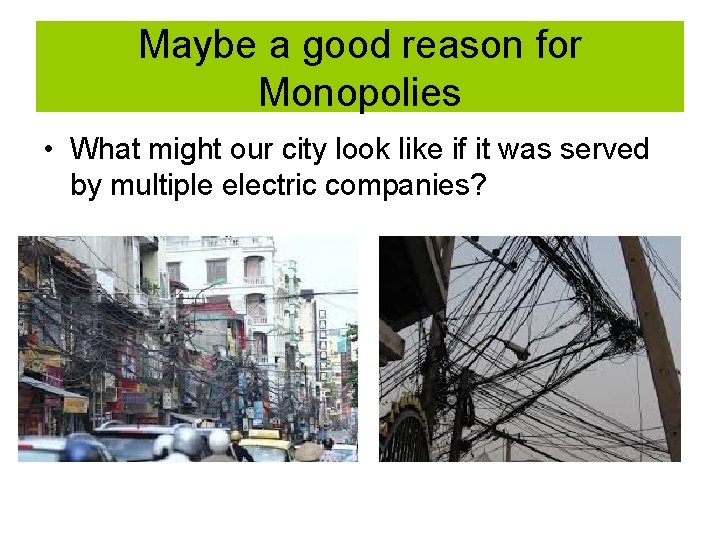
Maybe a good reason for Monopolies • What might our city look like if it was served by multiple electric companies?
Geographic Monopolies • Geographic monopolies offer limited potential profits for multiple providers because of their remote location • Ex. a general store in a remote area • In our times geographic monopolies have competition from mail order, delivery services, and the internet
Technological Monopolies (Patents) • A patent grants a company or an individual the exclusive right to produce, use, rent, and sell an invention or discovery • Patents are granted for a term of 20 years and give the patent holder a 20 year monopoly to produce the product, profit from the product • Ex. medicines
Technological Monopolies (Copyrights) • A copyright grants authors, musicians & writers, the exclusive rights to publish, duplicate, perform, and display their creative works • Copyrights today are granted for lifetime + 70 years from their time of publication
Government Monopolies • Government monopolies are any market in which a government is the sole seller of a product • The product is usually a basic necessity that cannot be provided through the normal price system… • …Water, sewer, roads, bridges • These types of monopolies provide goods and services that serve the general welfare of citizens and usually have public support
How Monopolies Set Prices • High or low, consumer demand sometimes determines the service price • Excessively high prices might make others enter the market even though start up costs are high • Government also regulate rates… • …electricity, cable TV, water
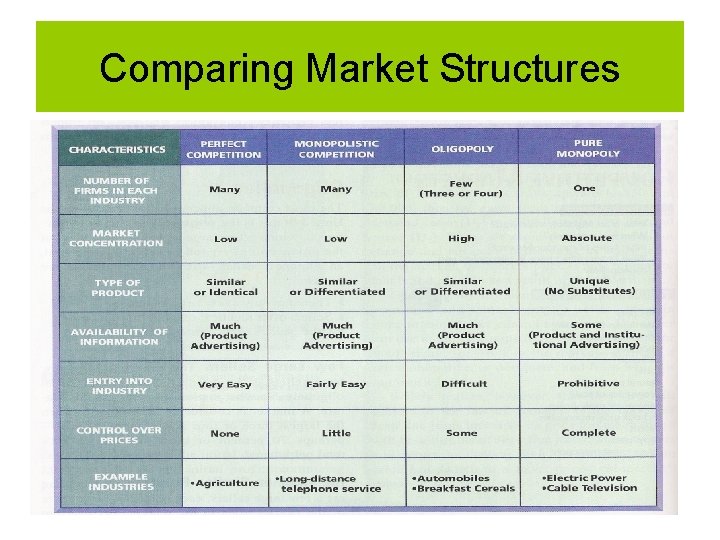
Comparing Market Structures
Sect. 3: Market Regulation • The US government has enacted several pieces of legislation designed to protect the public from actions taken by monopolies • Huge monopolies called trusts dominated US industries in the late 1800’s • Oil, steel, sugar, tobacco, meatpacking and railroads
Laissez-Faire • Most believe that businesses prosper when the government does not interfere in the marketplace • Laissez-fare is a French term meaning “let the people do as they will” • Many believed that businesses were getting too powerful and the government responded with anti-trust legislation
Antitrust Legislation • • • Antitrust Legislation was designed to… …monitor and regulate big business …prevent monopolies from forming …dismantle existing monopolies Presidents Theodore Roosevelt and William Howard Taft made “trust-busting” a priority of their administrations
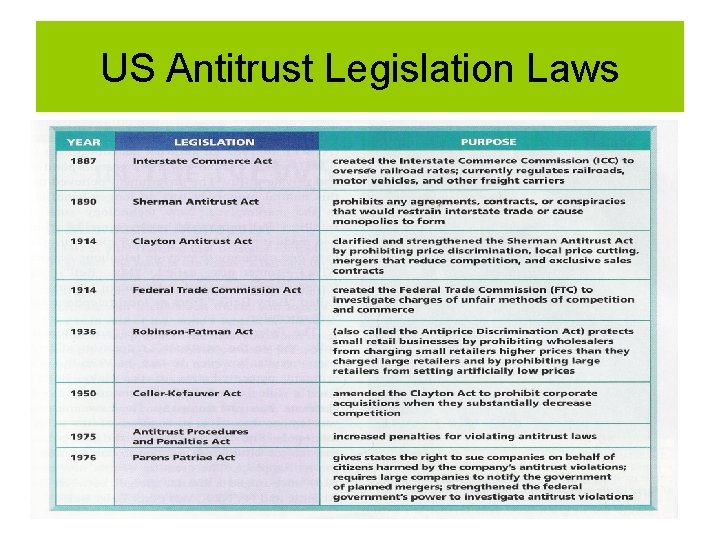
Interstate Commerce Act • Created the Interstate Commerce Commission (ICC) which oversaw the railroad freight business • Rates charged for shipping had soared causing farmers and merchants difficulty in getting their products to market • Abolished in 1995
Sherman Antitrust Act • Banned agreements and actions that were “in the restraint of trade” • Language of law was vague and resulted in numerous court actions • John D. Rockefeller and his company, Standard Oil Company, controlled almost all of the US oil industry • Using this law, the Supreme Court broke up Standard Oil Company in 1911 • The remaining company today is Exxon/Mobil
Clayton Antitrust Act • Enacted in 1914, this law prohibited price discrimination-the practice of offering different prices to different customers under the same circumstances
Federal Trade Commission Act • This 1914 act created the Federal Trade Commission (FTC) to investigate unfair methods of competition and commerce • Still in force today • Bernie Madoff
Robinson-Patman Act • This 1936 law strengthened the Clayton Antitrust Act dealing with price discrimination • The government continues today to enact antitrust legislation as the need arises
US Antitrust Legislation Laws
More Recent Antitrust Breakups • In 1982 the government broke AT&T into several smaller units • Ed Whitaker • Two of the units Pacific Telesis and SBC Communications reunited in 1996 and reclaimed the name AT&T which is much smaller than the original • AT&T was headquartered in San Antonio for several years, but moved to Dallas recently
References • Holt Economics; Texas Edition: 2003, Holt, Rinehart and Winston,