
HOLT Economics Chapter 2 Economic Systems These documents
- Slides: 40
HOLT: Economics Chapter 2 Economic Systems “These documents are being distributed for educational discussion purposes only. They do not reflect any attempt by the North East Independent School District, its trustees, administrators, or teachers, to promote any particular viewpoints or opinions expressed in the documents over any others, nor do the viewpoints or opinions expressed in the documents necessarily reflect those of the NEISD, its trustees, administrators or teachers. ”
Section 1: Types of Economics Systems • Nations, like you and I, must make choices about how to use their natural, human, capital, & entrepreneurial resources efficiently. • Nations, also must answer in some way the three basic economic questions of what, how, and for whom to produce.
Economic Systems • Nations respond to the 3 economic questions and the 4 factors of production to a large degree based on their economic systems • The four types of economic systems are: – Traditional – Command – Market – Mixed
Mixed? • Actually all economies today are some form of mixed economy • No pure traditional, command, or market economies exist • We simply classify them as the one they are closest to
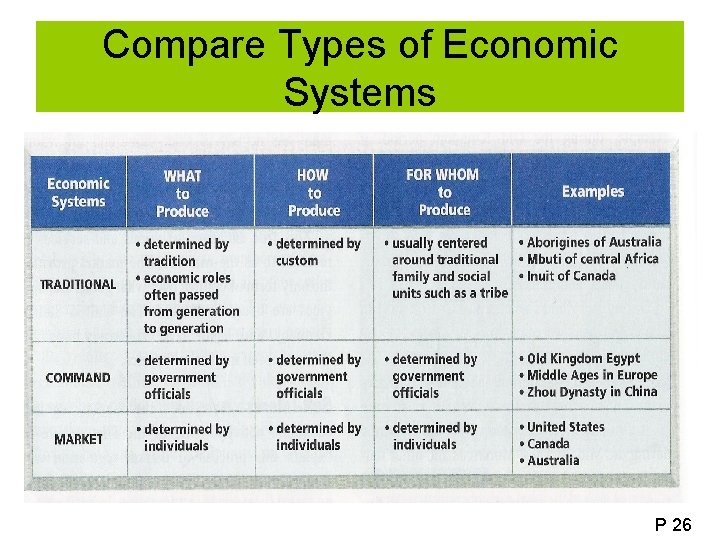
Traditional Economies • Traditional economies answer the economic questions as they have done in the past • Activities are based on rituals, habits, laws, and religious beliefs developed by their ancestors • Traditional Economies are found in less developed parts of he world
Traditions are passed down • Father to son, mother to daughter • You carry on the family traditions
Command Economies • A Command economy relies on government officials to answer the three basic economic questions • Officials or central planners have the power to decide what products will be made and how they will be produced • They also decide who receives the products once they are made
Individual Rights In Command Economies • Individuals have little or no say in making economic choices • The government maintains complete control over the factors of production • No “pure” command economies exist
Market Economies • In a pure market economy, individuals answer the three economic questions • The government has no say • Individuals are free to exchange goods and services in the market • No pure market economies exist today, but the countries of the United States, Germany, & Japan are very close
Compare Types of Economic Systems P 26
Early thoughts on Market Economies • Adam Smith, a Scottish economist and philosopher wrote “An Inquiry Into the Nature and Causes of the Wealth of Nations” in 1776 • He believed market economies were driven purely by self interests • Self-interest is the impulse that encourages people to fulfill their own needs and wants
Self-Interests • Some believed that self-interests would lead to individuals ignoring the needs of others • Smith argued that self-interest benefits all of society by helping the economy grow • He said that self-interest acts as an invisible hand that leads people to do what is best for society even if they don’t know that’s what they are doing
Limiting the Invisible Hand • Smith believed that government involvement in the economy conflicts with self-interest and limits the “invisible hand” to regulate the market
Incentives • An incentive is something that encourages you to behave in a particular way • An incentive might be in the form of a bonus for increasing production or sales • A negative incentive can also be used such as a penalty for not making production or sales quotas
Mixed Economies • A mixed economy combines elements of traditional, market, and command economic models • They are usually described by defining the economy they are most close to • Authoritarian socialism • Capitalism • Democratic socialism
Authoritarian Socialism • These economies are also referred to as communism • The government owns or controls nearly all of the factors of production • These governments engage in long-term planning and limits decision making power by individuals • North Korea, Russia & Cuba are examples of this system
Capitalism • In this economy, individuals own the factors of production and answer the basic economic questions • Individuals can decide what to produce, what career you pursue based on your own interests and skills • The United States, Canada, Mexico, Japan, and Taiwan are capitalistic
Governments Role in Capitalism • These governments have taxing and spending authority • They provide services to society such as education, social welfare programs, national defense, health & safety standards in the workplace • Private ownership and free choice are basic to capitalism
Democratic Socialism • The government owns some of the factors of production • Key industries: electrical utilities, telephones, • These are deemed to be in the “national concern” • Individuals can influence the government ownership by electing government officials • Sweden, Poland, & France are examples
Sec. 2: What is Free Enterprise? • Because of the great number of economic freedoms in the US we sometimes call our system a free enterprise system • Free Enterprise is a system where business can be conducted freely with little government intervention • Encourages investment • Prices tend to respond to competition
5 Features of US Free Enterprise • Individuals have the right to …. . • 1. Own private property and enter into contracts • 2. Make individual choices • 3. Engage in economic competition • 4. Make decisions based on self-interests • 5. Participate in the economy with limited government involvement & regulation
Private Property & Contracts • Goods owned by individuals and businesses rather than the government are considered to be private property • Individuals & businesses can…. . – – Use or dispose of property Buy as much as they can afford Sell as much as they can Enter into agreements (contracts), oral or written, to buy and sell • Contracts are legally enforceable
Individual Choice • Laborers, producers, and consumers in the United States enjoy freedom of choice – Pursue job opportunities of our choice – Make whatever (legal) goods and services they want – Buy whatever (legal) goods and services that meet our needs
Economic Rivalry • When two or more business people make the same production choices, it leads to competition • Competition is the economic rivalry that exists among business selling the same or similar products • Competition encourages producers to improve existing products and to develop new ones to attract customers
Voluntary Exchange • Producers and consumers are free to purchase and sell when the terms of the trade are acceptable to both parties • The transaction is called a voluntary exchange • Both parties gain by the exchange (they get what they want)
Limited Government Involvement • Individuals, not the government, make most decisions in a market economy • The government does have an important role…. – – Establishes health and safety laws Monitors banking practices Prohibits discrimination in the work place Provides public services like national defense, public education – Encourages economic stability by encouraging economic growth, low unemployment, & stable prices – The government has taxing authority to carry out it’s role
Economic Actors in Free Enterprise • Producers • Consumers • Government
Producers • Producers provide goods and services in the market • They combine human, natural, & capital resources to create a product or perform a service • They can satisfy the needs and wants of consumers • Benefit others by providing jobs
Consumers • Influence production by purchasing goods and services • We communicate with producers by saying “produce more” when we buy, or “stop producing this” when we don’t buy • Consumers verify to producers that they have or have not made the right decisions about what, how, and for whom they produce
Government • Government plays a limited but important role in the US free enterprise system • It oversees and regulates the decisions of the other economic actors (producers & consumers) and regulates the effects of these decisions on the economy as a whole
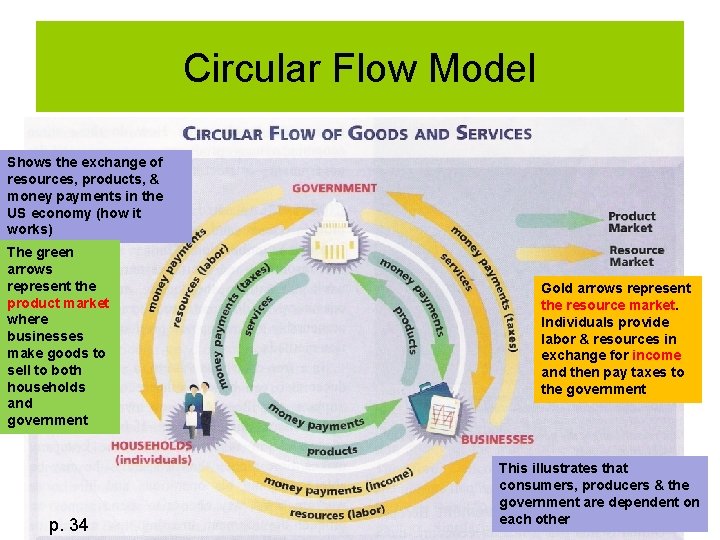
Everyone is Connected • Producers, consumers & government play different, but connected roles in a market system • Resources, products, & money payments are exchanged among economic actors in our economy
Circular Flow Model Shows the exchange of resources, products, & money payments in the US economy (how it works) The green arrows represent the product market where businesses make goods to sell to both households and government p. 34 Gold arrows represent the resource market. Individuals provide labor & resources in exchange for income and then pay taxes to the government This illustrates that consumers, producers & the government are dependent on each other
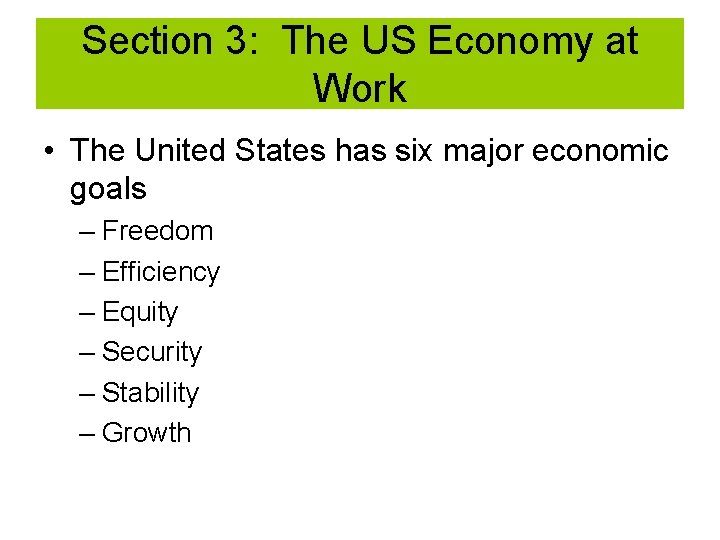
Section 3: The US Economy at Work • The United States has six major economic goals – Freedom – Efficiency – Equity – Security – Stability – Growth
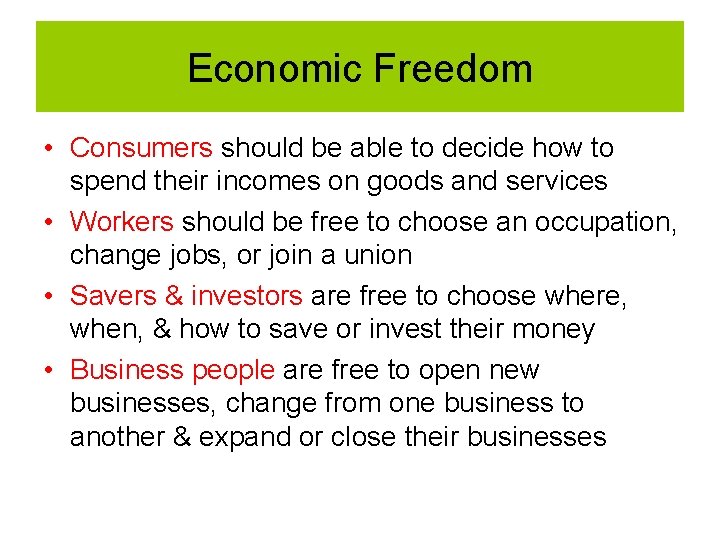
Economic Freedom • Consumers should be able to decide how to spend their incomes on goods and services • Workers should be free to choose an occupation, change jobs, or join a union • Savers & investors are free to choose where, when, & how to save or invest their money • Business people are free to open new businesses, change from one business to another & expand or close their businesses
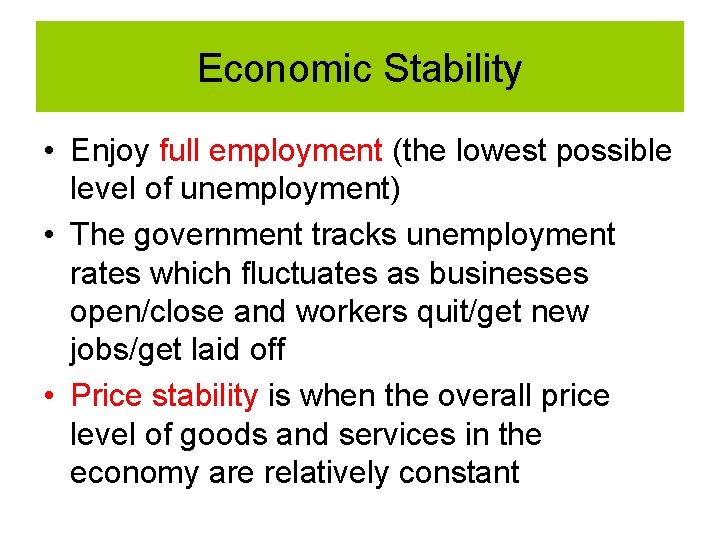
Economic Stability • Enjoy full employment (the lowest possible level of unemployment) • The government tracks unemployment rates which fluctuates as businesses open/close and workers quit/get new jobs/get laid off • Price stability is when the overall price level of goods and services in the economy are relatively constant
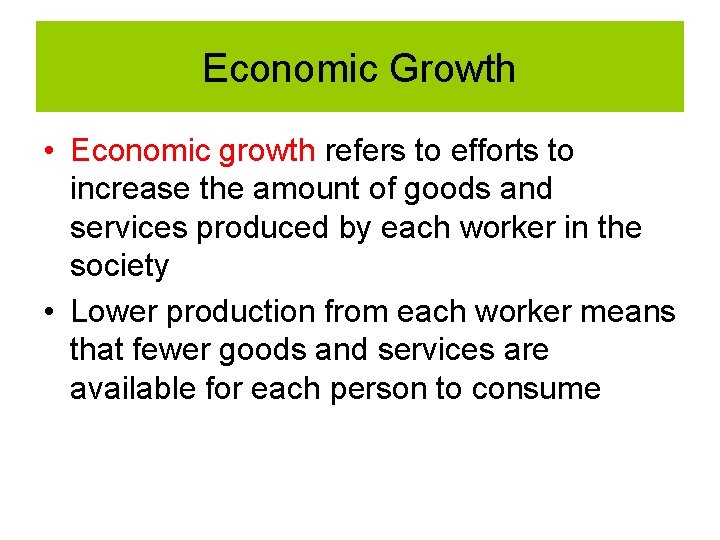
Economic Growth • Economic growth refers to efforts to increase the amount of goods and services produced by each worker in the society • Lower production from each worker means that fewer goods and services are available for each person to consume
Standard of Living • Standard of Living refers to peoples economic well-being • Economists measure a nation’s standard of living by how much an average person in that country is able to consume in a given period (one year) • Standard of living improves when production from each worker increases faster than the total population
Economic Goals and Trade-Offs • Goals, like wants must be evaluated to decide which is more important at a particular time, priorities change • Scarcity forces individuals, businesses, & governments to make choices among various needs and wants
Economic Goals and Trade-Offs • Sometimes priorities are not the same from group to group • Sometimes solutions for one group causes problems for others
References • Holt Economics; Texas Edition: 2003, Holt, Rinehart and Winston,