
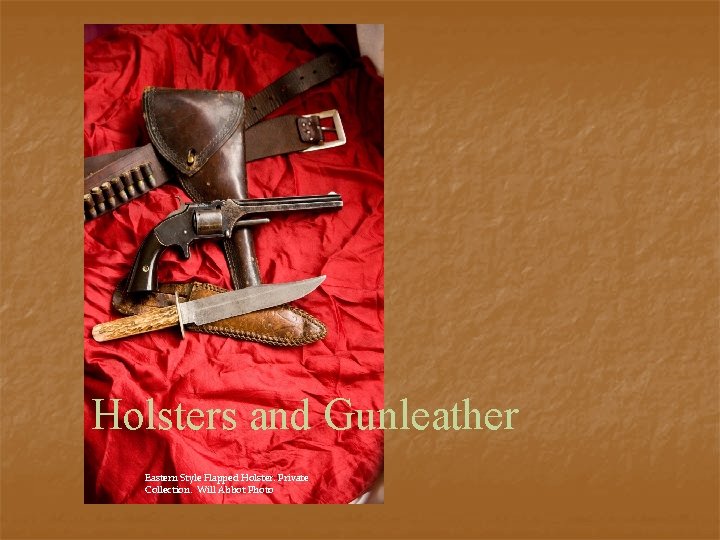
Holsters and Gunleather Eastern Style Flapped Holster Private
- Slides: 23
Holsters and Gunleather Eastern Style Flapped Holster. Private Collection. Will Abbot Photo
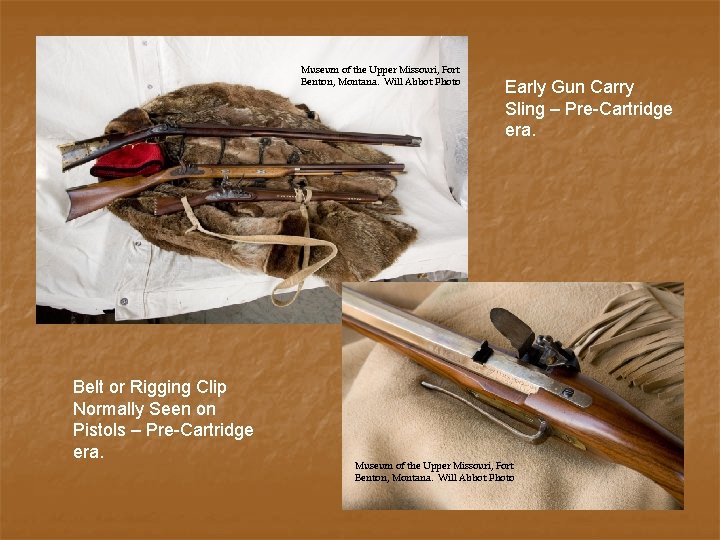
Museum of the Upper Missouri, Fort Benton, Montana. Will Abbot Photo Belt or Rigging Clip Normally Seen on Pistols – Pre-Cartridge era. Early Gun Carry Sling – Pre-Cartridge era. Museum of the Upper Missouri, Fort Benton, Montana. Will Abbot Photo
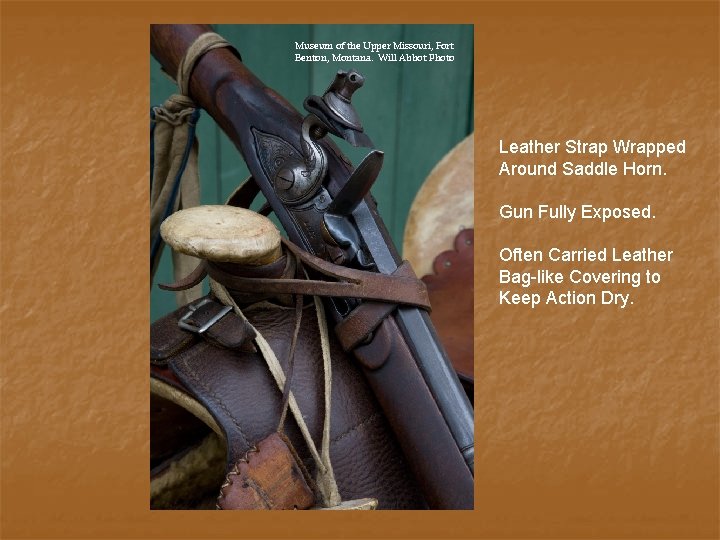
Museum of the Upper Missouri, Fort Benton, Montana. Will Abbot Photo Leather Strap Wrapped Around Saddle Horn. Gun Fully Exposed. Often Carried Leather Bag-like Covering to Keep Action Dry.
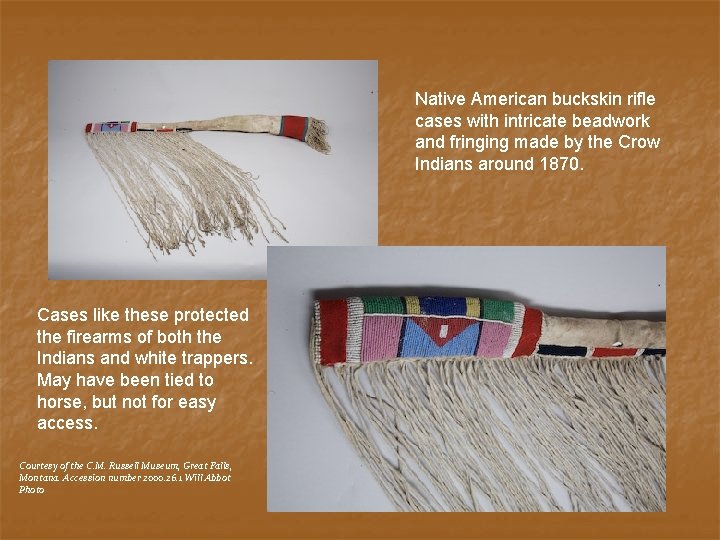
Native American buckskin rifle cases with intricate beadwork and fringing made by the Crow Indians around 1870. Cases like these protected the firearms of both the Indians and white trappers. May have been tied to horse, but not for easy access. Courtesy of the C. M. Russell Museum, Great Falls, Montana. Accession number 2000. 26. 1 Will Abbot Photo
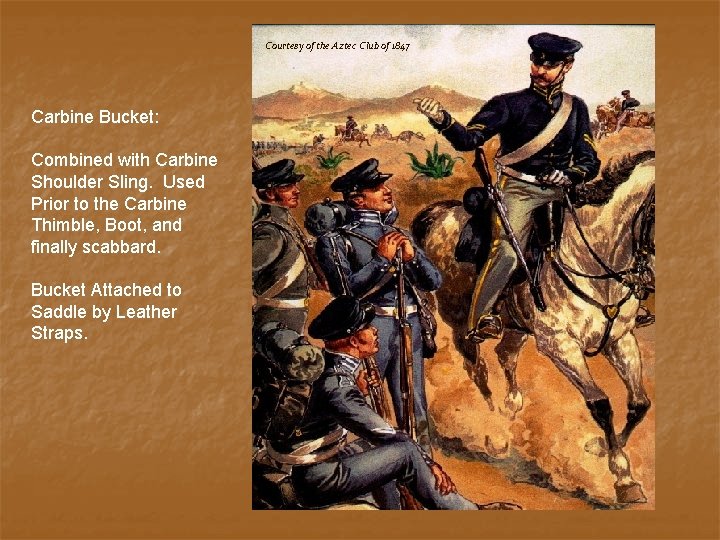
Courtesy of the Aztec Club of 1847 Carbine Bucket: Combined with Carbine Shoulder Sling. Used Prior to the Carbine Thimble, Boot, and finally scabbard. Bucket Attached to Saddle by Leather Straps.
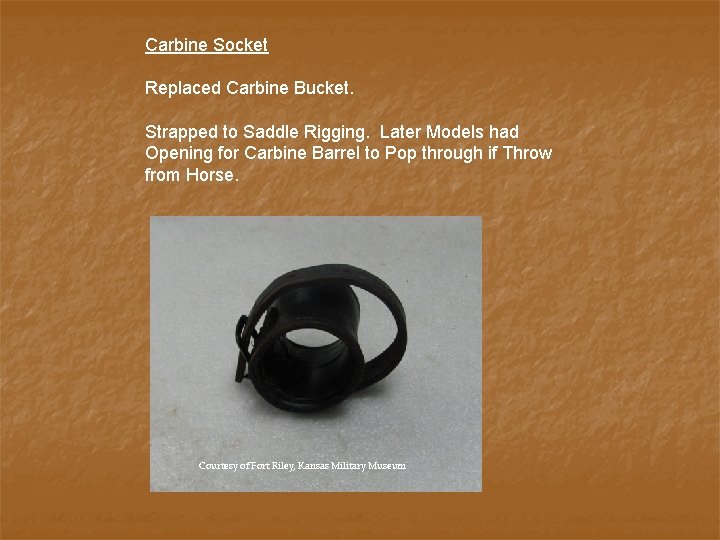
Carbine Socket Replaced Carbine Bucket. Strapped to Saddle Rigging. Later Models had Opening for Carbine Barrel to Pop through if Throw from Horse. Courtesy of Fort Riley, Kansas Military Museum
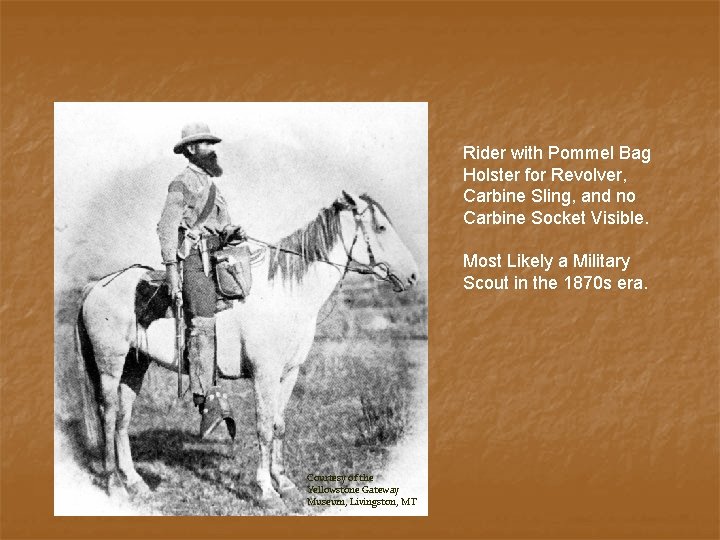
Rider with Pommel Bag Holster for Revolver, Carbine Sling, and no Carbine Socket Visible. Most Likely a Military Scout in the 1870 s era. Courtesy of the Yellowstone Gateway Museum, Livingston, MT
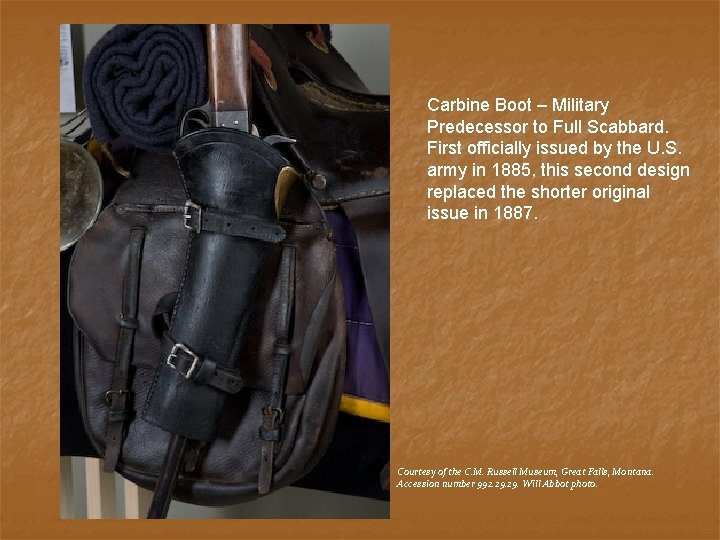
Carbine Boot – Military Predecessor to Full Scabbard. First officially issued by the U. S. army in 1885, this second design replaced the shorter original issue in 1887. Courtesy of the C. M. Russell Museum, Great Falls, Montana. Accession number 992. 29. Will Abbot photo.
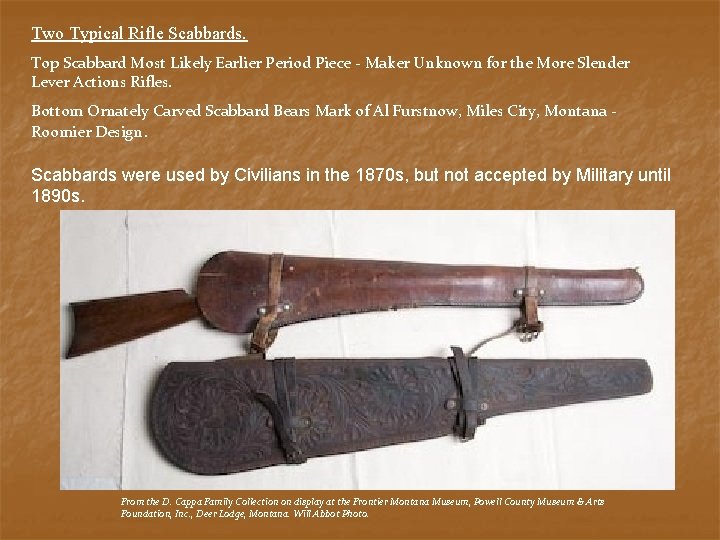
Two Typical Rifle Scabbards. Top Scabbard Most Likely Earlier Period Piece - Maker Unknown for the More Slender Lever Actions Rifles. Bottom Ornately Carved Scabbard Bears Mark of Al Furstnow, Miles City, Montana Roomier Design. Scabbards were used by Civilians in the 1870 s, but not accepted by Military until 1890 s. From the D. Cappa Family Collection on display at the Frontier Montana Museum, Powell County Museum & Arts Foundation, Inc. , Deer Lodge, Montana. Will Abbot Photo.
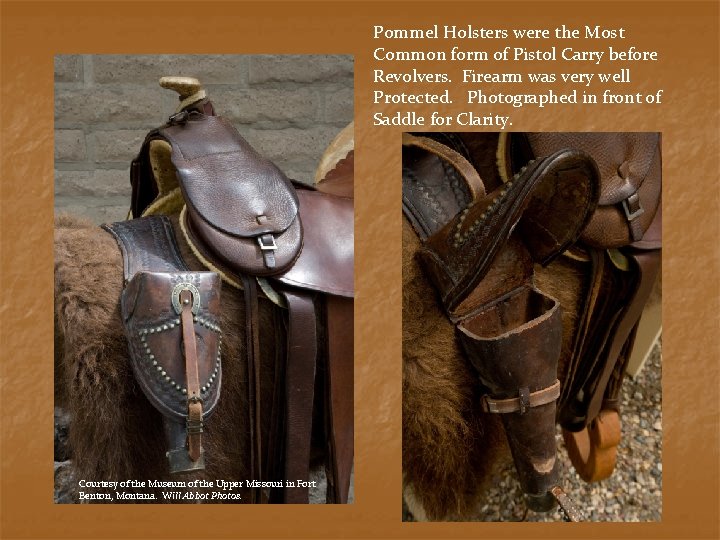
Pommel Holsters were the Most Common form of Pistol Carry before Revolvers. Firearm was very well Protected. Photographed in front of Saddle for Clarity. Courtesy of the Museum of the Upper Missouri in Fort Benton, Montana. Will Abbot Photos.
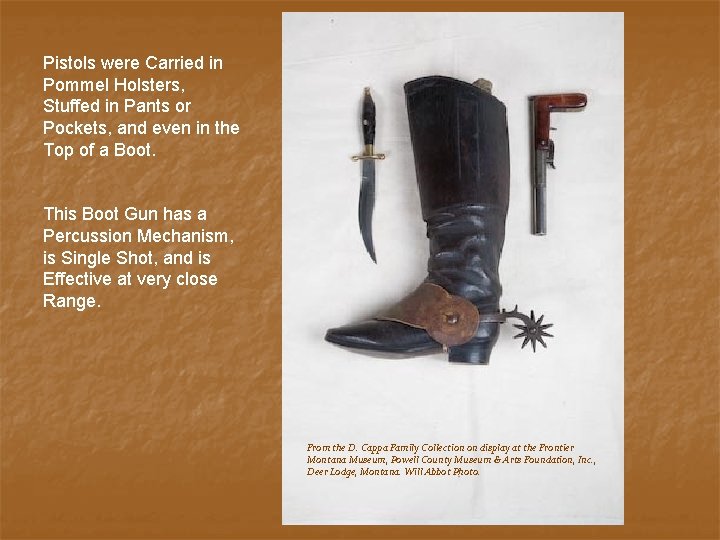
Pistols were Carried in Pommel Holsters, Stuffed in Pants or Pockets, and even in the Top of a Boot. This Boot Gun has a Percussion Mechanism, is Single Shot, and is Effective at very close Range. From the D. Cappa Family Collection on display at the Frontier Montana Museum, Powell County Museum & Arts Foundation, Inc. , Deer Lodge, Montana. Will Abbot Photo.
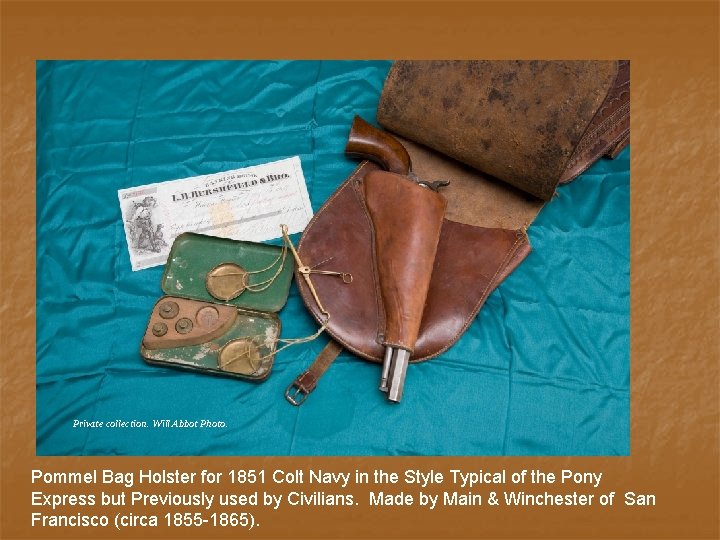
Private collection. Will Abbot Photo. Pommel Bag Holster for 1851 Colt Navy in the Style Typical of the Pony Express but Previously used by Civilians. Made by Main & Winchester of San Francisco (circa 1855 -1865).
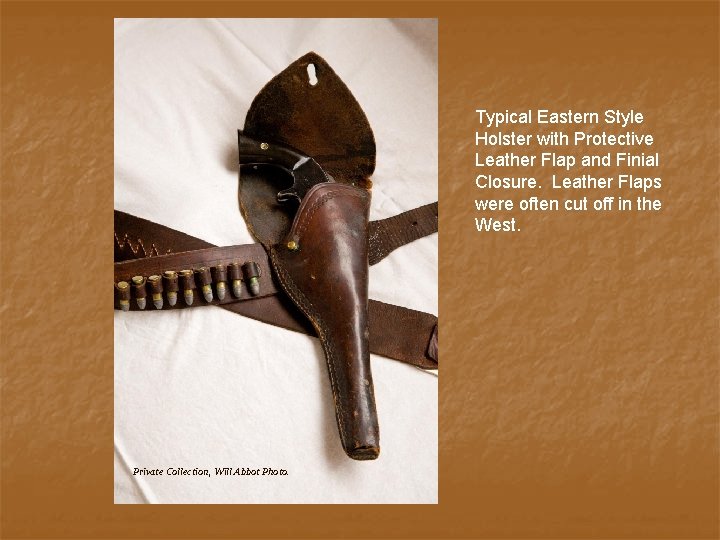
Typical Eastern Style Holster with Protective Leather Flap and Finial Closure. Leather Flaps were often cut off in the West. Private Collection, Will Abbot Photo.
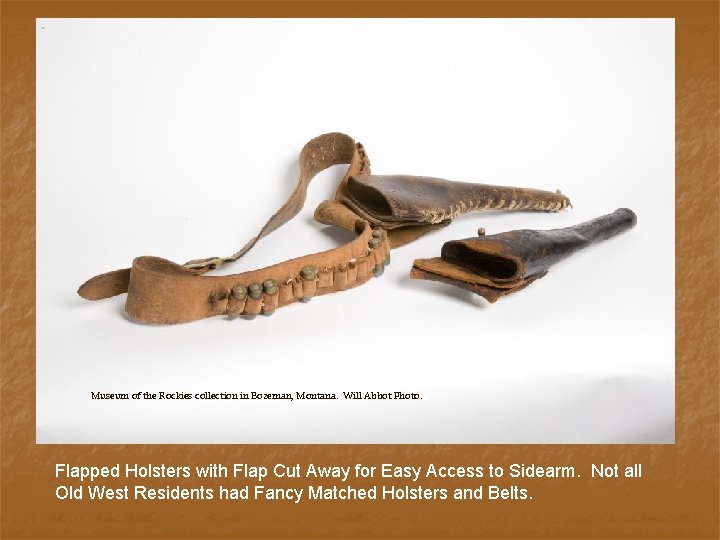
, Museum of the Rockies collection in Bozeman, Montana. Will Abbot Photo. Flapped Holsters with Flap Cut Away for Easy Access to Sidearm. Not all Old West Residents had Fancy Matched Holsters and Belts.
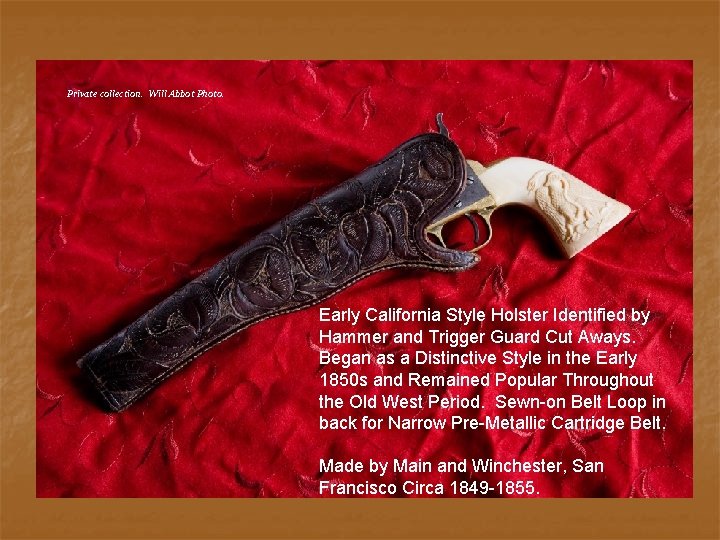
Private collection. Will Abbot Photo. Early California Style Holster Identified by Hammer and Trigger Guard Cut Aways. Began as a Distinctive Style in the Early 1850 s and Remained Popular Throughout the Old West Period. Sewn-on Belt Loop in back for Narrow Pre-Metallic Cartridge Belt. Made by Main and Winchester, San Francisco Circa 1849 -1855.
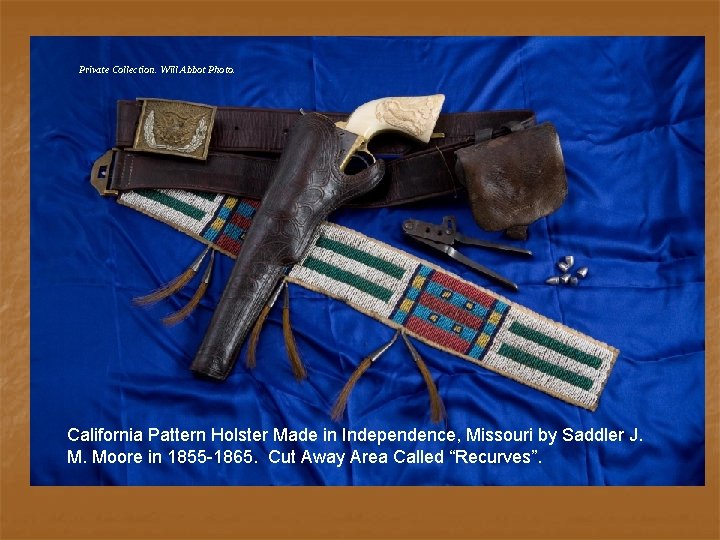
Private Collection. Will Abbot Photo. California Pattern Holster Made in Independence, Missouri by Saddler J. M. Moore in 1855 -1865. Cut Away Area Called “Recurves”.
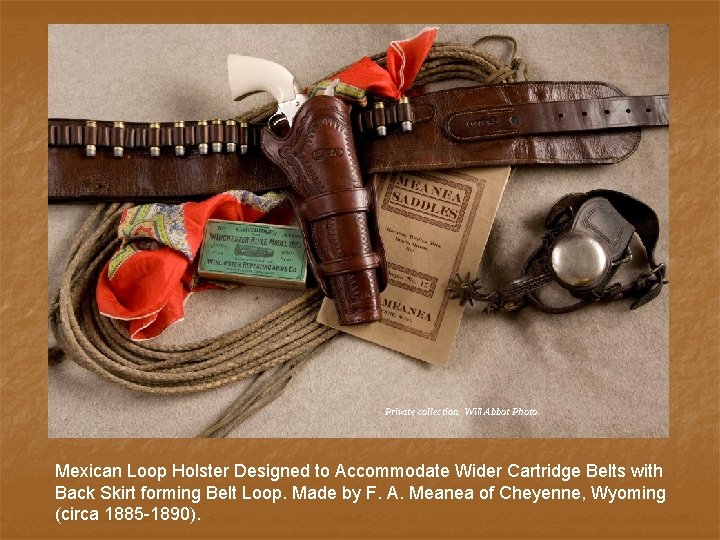
Private collection. Will Abbot Photo. Mexican Loop Holster Designed to Accommodate Wider Cartridge Belts with Back Skirt forming Belt Loop. Made by F. A. Meanea of Cheyenne, Wyoming (circa 1885 -1890).
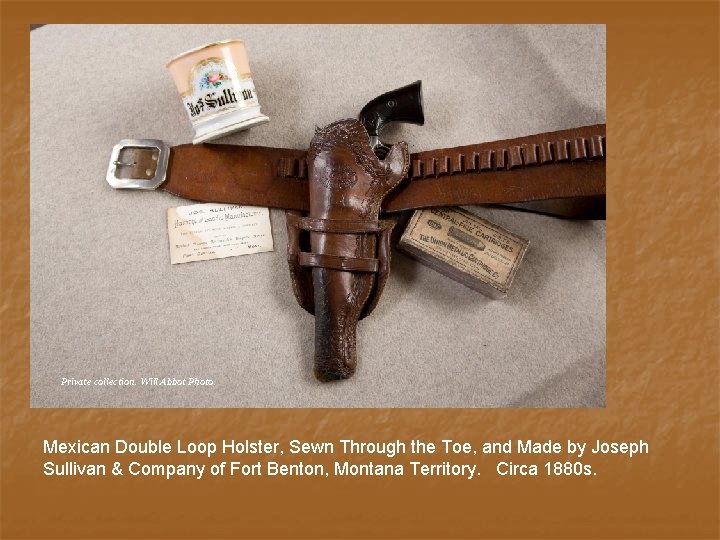
Private collection. Will Abbot Photo. Mexican Double Loop Holster, Sewn Through the Toe, and Made by Joseph Sullivan & Company of Fort Benton, Montana Territory. Circa 1880 s.
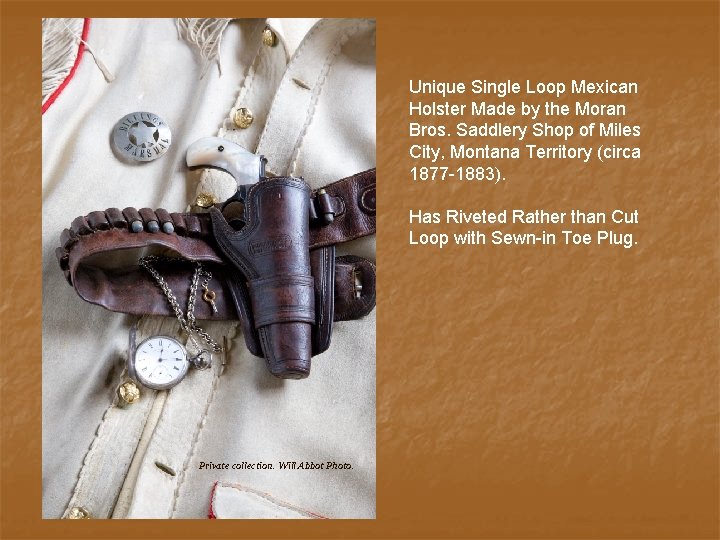
Unique Single Loop Mexican Holster Made by the Moran Bros. Saddlery Shop of Miles City, Montana Territory (circa 1877 -1883). Has Riveted Rather than Cut Loop with Sewn-in Toe Plug. Private collection. Will Abbot Photo.
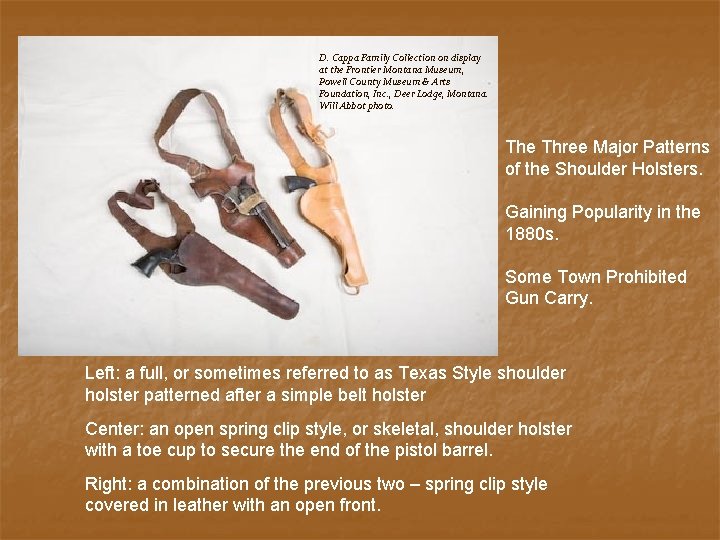
D. Cappa Family Collection on display at the Frontier Montana Museum, Powell County Museum & Arts Foundation, Inc. , Deer Lodge, Montana. Will Abbot photo. The Three Major Patterns of the Shoulder Holsters. Gaining Popularity in the 1880 s. Some Town Prohibited Gun Carry. Left: a full, or sometimes referred to as Texas Style shoulder holster patterned after a simple belt holster Center: an open spring clip style, or skeletal, shoulder holster with a toe cup to secure the end of the pistol barrel. Right: a combination of the previous two – spring clip style covered in leather with an open front.
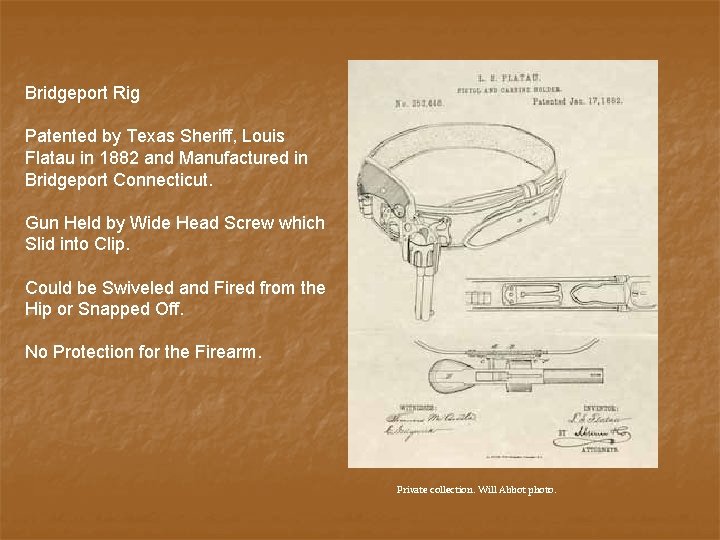
Bridgeport Rig Patented by Texas Sheriff, Louis Flatau in 1882 and Manufactured in Bridgeport Connecticut. Gun Held by Wide Head Screw which Slid into Clip. Could be Swiveled and Fired from the Hip or Snapped Off. No Protection for the Firearm. Private collection. Will Abbot photo.
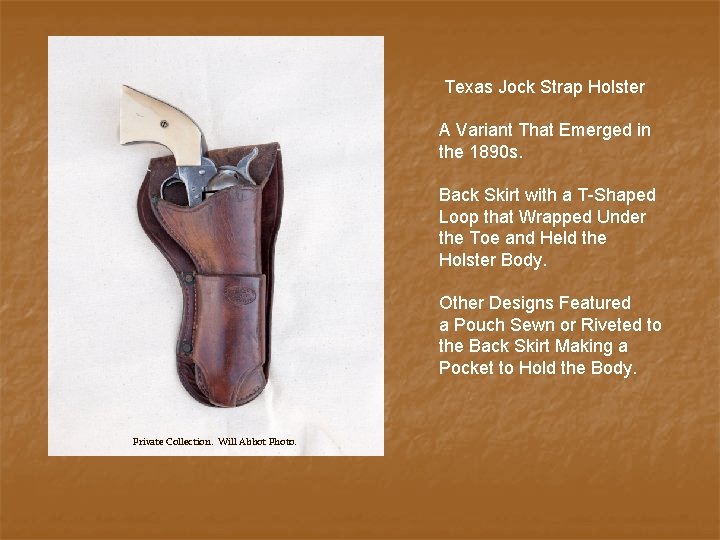
Texas Jock Strap Holster A Variant That Emerged in the 1890 s. Back Skirt with a T-Shaped Loop that Wrapped Under the Toe and Held the Holster Body. Other Designs Featured a Pouch Sewn or Riveted to the Back Skirt Making a Pocket to Hold the Body. Private Collection. Will Abbot Photo.
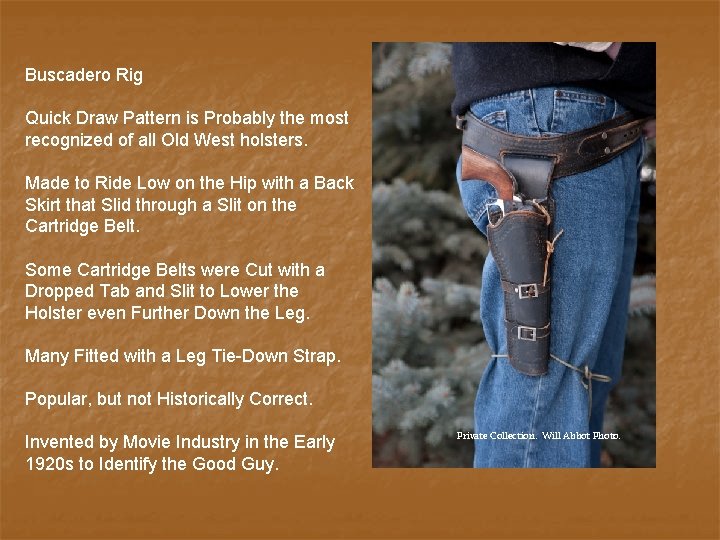
Buscadero Rig Quick Draw Pattern is Probably the most recognized of all Old West holsters. Made to Ride Low on the Hip with a Back Skirt that Slid through a Slit on the Cartridge Belt. Some Cartridge Belts were Cut with a Dropped Tab and Slit to Lower the Holster even Further Down the Leg. Many Fitted with a Leg Tie-Down Strap. Popular, but not Historically Correct. Invented by Movie Industry in the Early 1920 s to Identify the Good Guy. Private Collection. Will Abbot Photo.