
Holonic Scheduling Concepts for C 2 Organizational Design
- Slides: 13
Holonic Scheduling Concepts for C 2 Organizational Design for MHQ with MOC Chulwoo Park 1 Prof. David L. Kleinman 1, 2 Prof. Krishna R. Pattipati 1 1 Dept. of Electrical and Computer Engineering University of Connecticut 2 Dept. of Information Science Naval Postgraduate School Contact: krishna@engr. uconn. edu (860) 486 -2890 June 17 - 19, 2008 1
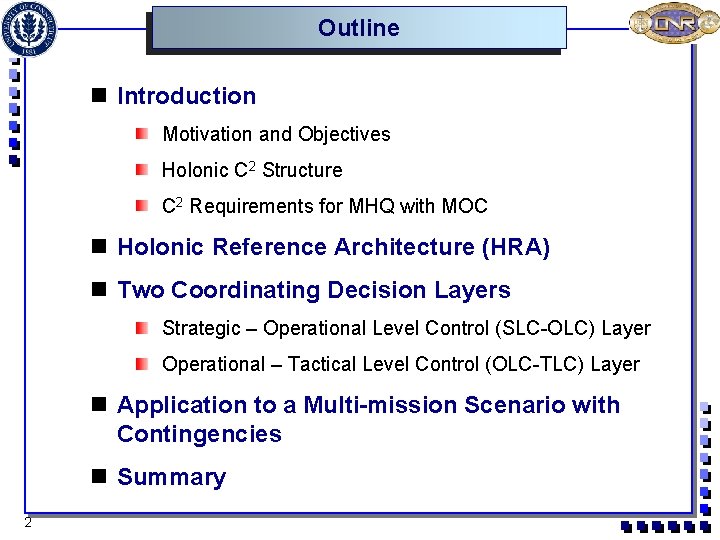
Outline n Introduction Motivation and Objectives Holonic C 2 Structure C 2 Requirements for MHQ with MOC n Holonic Reference Architecture (HRA) n Two Coordinating Decision Layers Strategic – Operational Level Control (SLC-OLC) Layer Operational – Tactical Level Control (OLC-TLC) Layer n Application to a Multi-mission Scenario with Contingencies n Summary 2
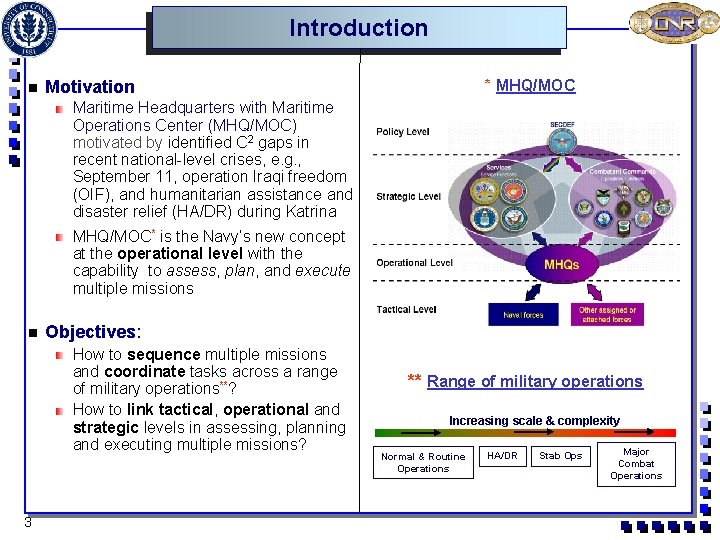
Introduction n Motivation * MHQ/MOC Maritime Headquarters with Maritime Operations Center (MHQ/MOC) motivated by identified C 2 gaps in recent national-level crises, e. g. , September 11, operation Iraqi freedom (OIF), and humanitarian assistance and disaster relief (HA/DR) during Katrina MHQ/MOC* is the Navy’s new concept at the operational level with the capability to assess, plan, and execute multiple missions n Objectives: How to sequence multiple missions and coordinate tasks across a range of military operations**? How to link tactical, operational and strategic levels in assessing, planning and executing multiple missions? 3 ** Range of military operations Increasing scale & complexity Normal & Routine Operations HA/DR Stab Ops Major Combat Operations
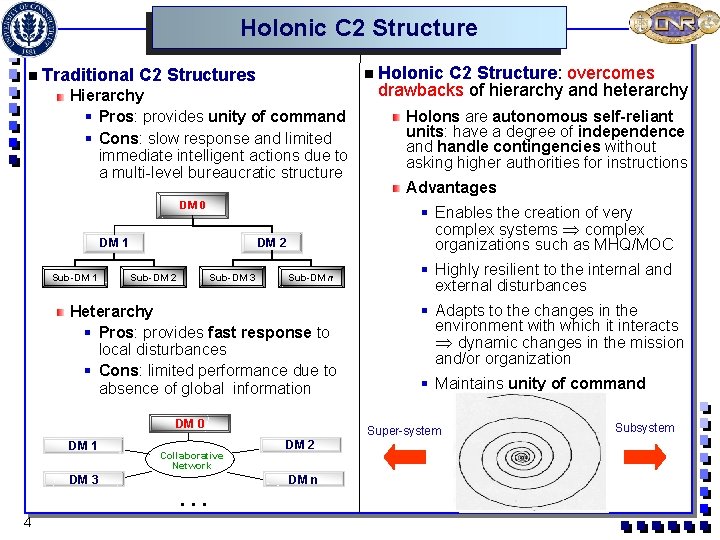
Holonic C 2 Structure n Traditional n Holonic C 2 Structures Hierarchy § Pros: provides unity of command § Cons: slow response and limited immediate intelligent actions due to a multi-level bureaucratic structure DM 0 DM 1 Sub-DM 3 Sub-DM n Heterarchy § Pros: provides fast response to local disturbances § Cons: limited performance due to absence of global information DM 0 DM 1 DM 3 4 Collaborative Network … Holons are autonomous self-reliant units: have a degree of independence and handle contingencies without asking higher authorities for instructions Advantages § Enables the creation of very complex systems complex organizations such as MHQ/MOC DM 2 Sub-DM 2 C 2 Structure: overcomes drawbacks of hierarchy and heterarchy § Highly resilient to the internal and external disturbances § Adapts to the changes in the environment with which it interacts dynamic changes in the mission and/or organization § Maintains unity of command Super-system DM 2 DM n Subsystem
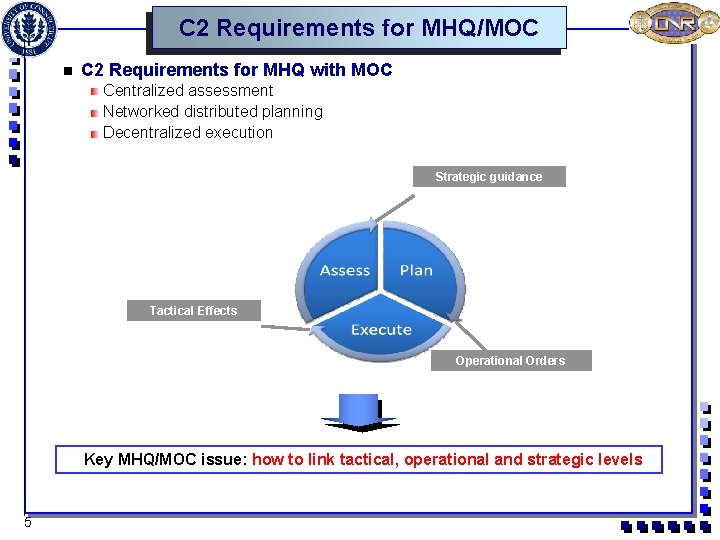
C 2 Requirements for MHQ/MOC n C 2 Requirements for MHQ with MOC Centralized assessment Networked distributed planning Decentralized execution Strategic guidance Tactical Effects Operational Orders Key MHQ/MOC issue: how to link tactical, operational and strategic levels 5
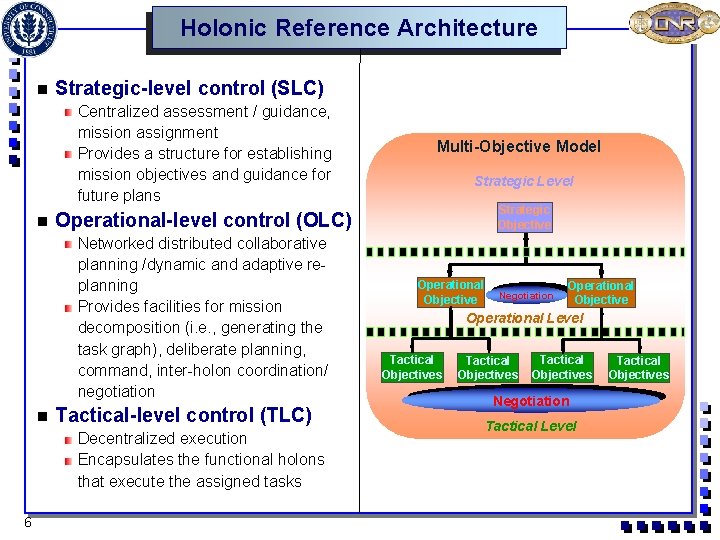
Holonic Reference Architecture n Strategic-level control (SLC) Centralized assessment / guidance, mission assignment Provides a structure for establishing mission objectives and guidance for future plans n Tactical-level control (TLC) Decentralized execution Encapsulates the functional holons that execute the assigned tasks 6 Strategic Level Strategic Objective Operational-level control (OLC) Networked distributed collaborative planning /dynamic and adaptive replanning Provides facilities for mission decomposition (i. e. , generating the task graph), deliberate planning, command, inter-holon coordination/ negotiation n Multi-Objective Model Operational Objective Negotiation Operational Objective Operational Level Tactical Objectives Negotiation Tactical Level Tactical Objectives
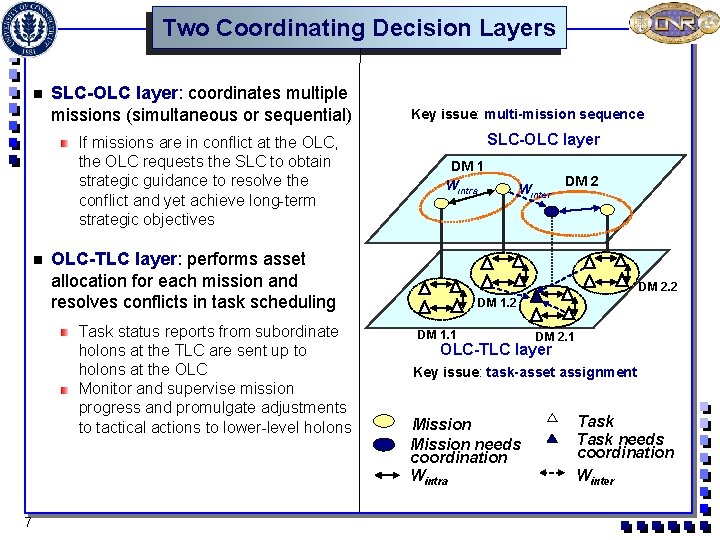
Two Coordinating Decision Layers n SLC-OLC layer: coordinates multiple missions (simultaneous or sequential) If missions are in conflict at the OLC, the OLC requests the SLC to obtain strategic guidance to resolve the conflict and yet achieve long-term strategic objectives n SLC-OLC layer DM 1 Wintra OLC-TLC layer: performs asset allocation for each mission and resolves conflicts in task scheduling Task status reports from subordinate holons at the TLC are sent up to holons at the OLC Monitor and supervise mission progress and promulgate adjustments to tactical actions to lower-level holons 7 Key issue: multi-mission sequence Winter DM 2. 2 DM 1. 1 DM 2. 1 OLC-TLC layer Key issue: task-asset assignment Mission needs coordination Wintra Task needs coordination Winter
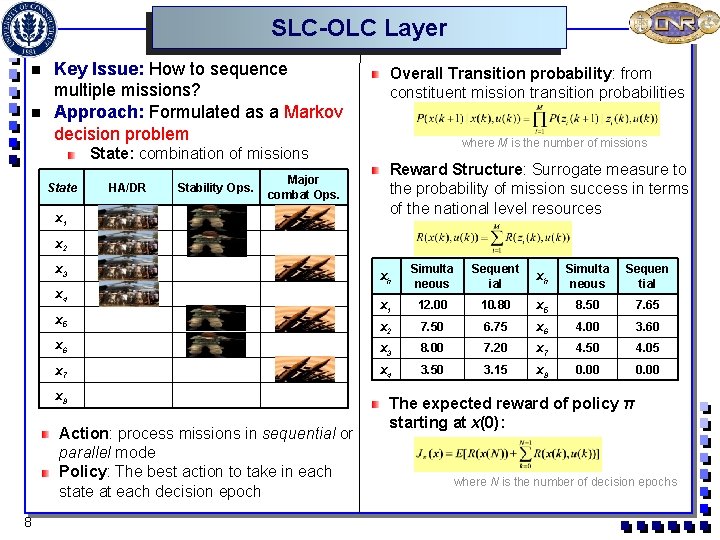
SLC-OLC Layer n n Key Issue: How to sequence multiple missions? Approach: Formulated as a Markov decision problem State: combination of missions State HA/DR Stability Ops. x 2 1 1 x 3 1 x 4 1 Major combat Ops. x 1 1 x 5 1 x 6 1 x 7 1 1 x 8 Action: process missions in sequential or parallel mode Policy: The best action to take in each state at each decision epoch 8 Overall Transition probability: from constituent mission transition probabilities where M is the number of missions Reward Structure: Surrogate measure to the probability of mission success in terms of the national level resources xh Simulta neous Sequent ial xh Simulta neous Sequen tial x 1 12. 00 10. 80 x 5 8. 50 7. 65 x 2 7. 50 6. 75 x 6 4. 00 3. 60 x 3 8. 00 7. 20 x 7 4. 50 4. 05 x 4 3. 50 3. 15 x 8 0. 00 The expected reward of policy π starting at x(0): where N is the number of decision epochs
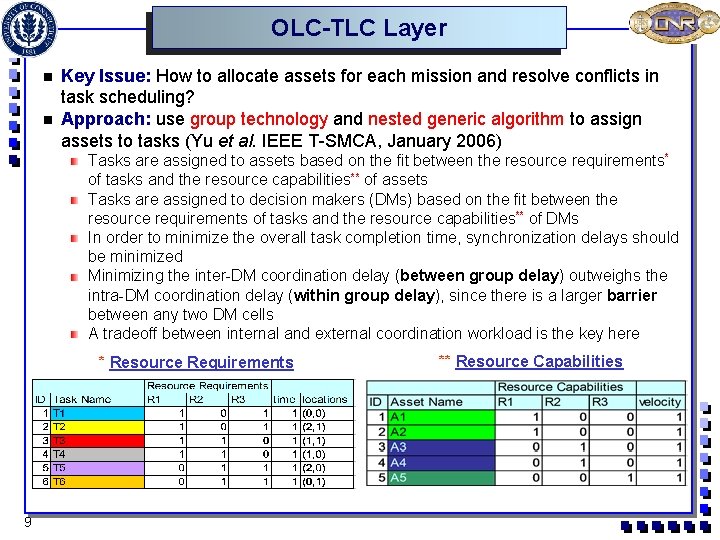
OLC-TLC Layer n n Key Issue: How to allocate assets for each mission and resolve conflicts in task scheduling? Approach: use group technology and nested generic algorithm to assign assets to tasks (Yu et al. IEEE T-SMCA, January 2006) Tasks are assigned to assets based on the fit between the resource requirements* of tasks and the resource capabilities** of assets Tasks are assigned to decision makers (DMs) based on the fit between the resource requirements of tasks and the resource capabilities** of DMs In order to minimize the overall task completion time, synchronization delays should be minimized Minimizing the inter-DM coordination delay (between group delay) outweighs the intra-DM coordination delay (within group delay), since there is a larger barrier between any two DM cells A tradeoff between internal and external coordination workload is the key here * Resource Requirements 9 ** Resource Capabilities
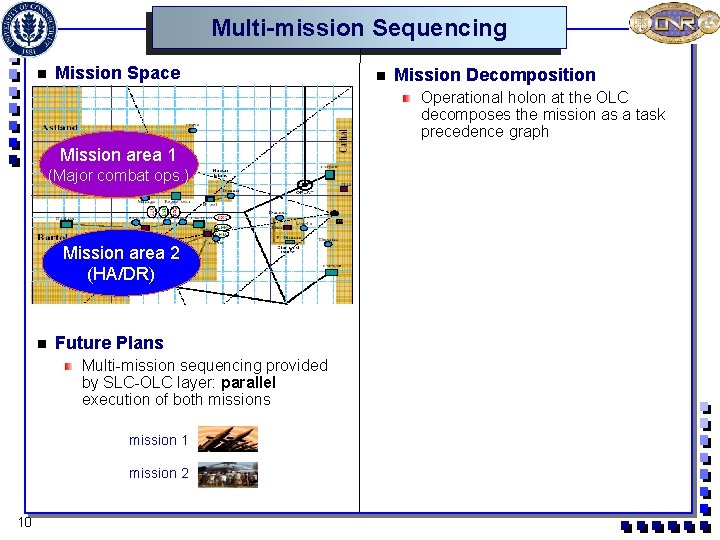
Multi-mission Sequencing n Mission Space n Mission Decomposition Operational holon at the OLC decomposes the mission as a task precedence graph Mission area 1 (Major combat ops. ) Mission area 2 (HA/DR) n Future Plans Multi-mission sequencing provided by SLC-OLC layer: parallel execution of both missions mission 1 mission 2 10
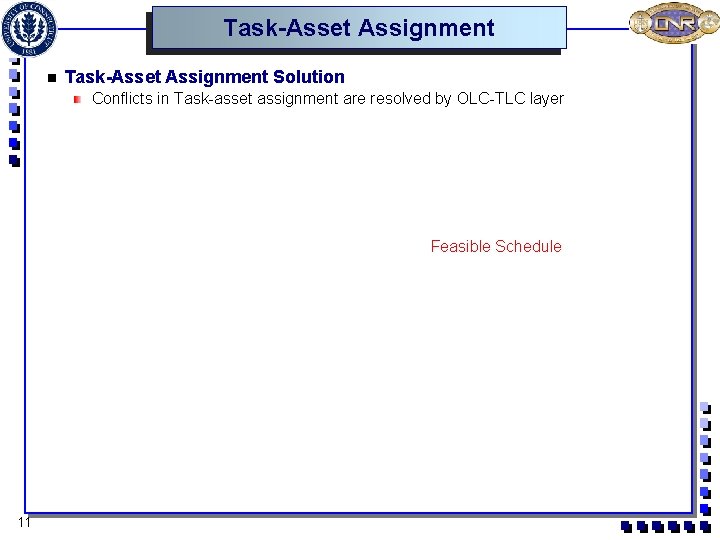
Task-Asset Assignment n Task-Asset Assignment Solution Conflicts in Task-asset assignment are resolved by OLC-TLC layer Infeasible schedule because assets 2, 10 & 12 need to travel logistics delay Feasible Schedule (mission area 1 mission area 2) 11
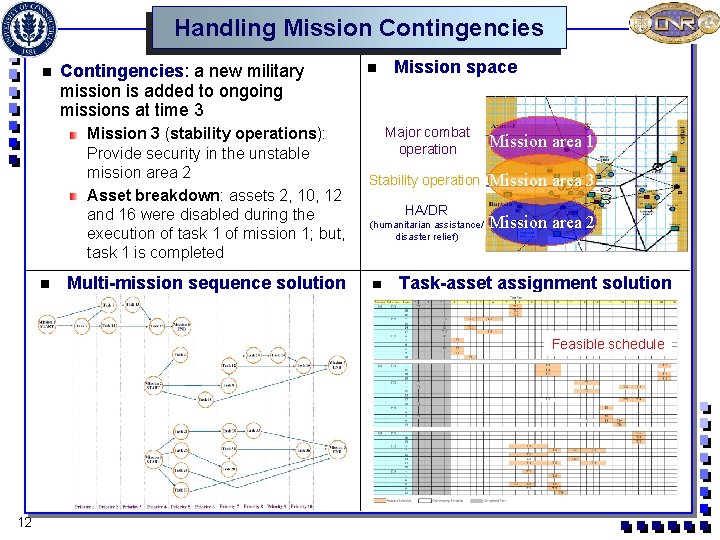
Handling Mission Contingencies: a new military mission is added to ongoing missions at time 3 Mission 3 (stability operations): Provide security in the unstable mission area 2 Asset breakdown: assets 2, 10, 12 and 16 were disabled during the execution of task 1 of mission 1; but, task 1 is completed Multi-mission sequence solution n Mission space Major combat operation Mission area 1 Stability operation Mission area 3 HA/DR (humanitarian assistance/ disaster relief) Mission area 2 Task-asset assignment solution Feasible schedule Infeasible schedule 12
Summary n We showed that the proposed C 2 holonic reference architecture (HRA) can be applied to the Navy’s new MHQ with MOC linking tactical, operational and strategic level controls Strategic Level Control (SLC): centralized assessment Operational Level Control (OLC): networked distributed planning Tactical level control (TLC): decentralized execution 13 n The C 2 HRA provides an approach to the multi-mission planning problem at the operational level n A multi-mission scenario showed that the C 2 HRA exhibits the capability to detect and recover from schedule infeasibility and to adapt to contingencies, such as the onset of new missions and asset breakdowns