
Holographic Imaging of Atomic Structure Where Is It



- Slides: 43
Holographic Imaging of Atomic Structure: Where Is It and Where Can It Go? C. S. Fadley UC Davis Physics and LBNL Materials Sciences Collaborators: S. Marchesini, N. Mannella, A. Nambu, S. Ritchey, L. Zhao-LBNL Material Sciences and UCD (experiment, theory) D. Shuh, G. Bucher--LBNL-Chemical Sciences (solid state detector) L. Fabris, N. Madden--LBNL Eng. (solid state detector) W. Stolte, A. S. Schlachter--ALS (BL 9. 3. 1) A. Thompson--ALS (BL 11. 3. 1) M. A. Van Hove, S. Omori--LBNL Materials Sciences (theory) E. Rotenberg, J. Denlinger, M. Howells, Z. Hussain, ALS (experiment) A. Szöke--LLNL (theory) S. P. Cramer, U. Bergmann--UCD and LBNL Physical Biosciences V. K. Yachandra, T. N. Earnest, LBNL Physical Biosciences M. Tegze, G. Faigel--Budapest M. Belakhovsky--Grenoble, ESRF J. Garcia de Abajo--San Sebastian (theory)
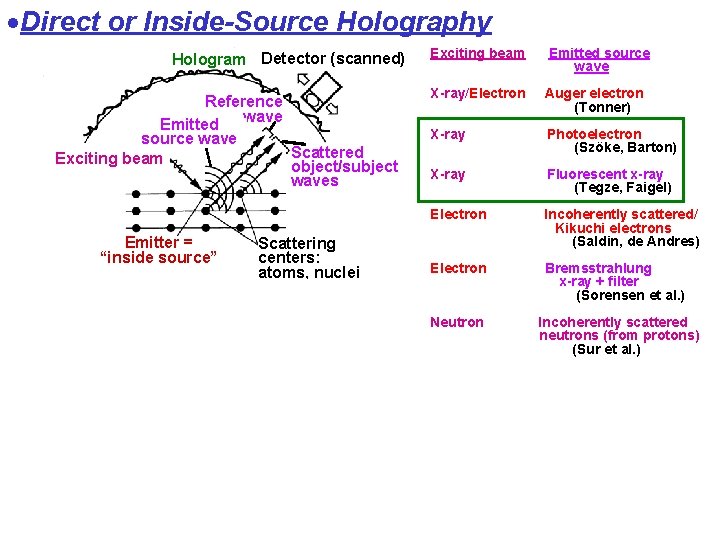
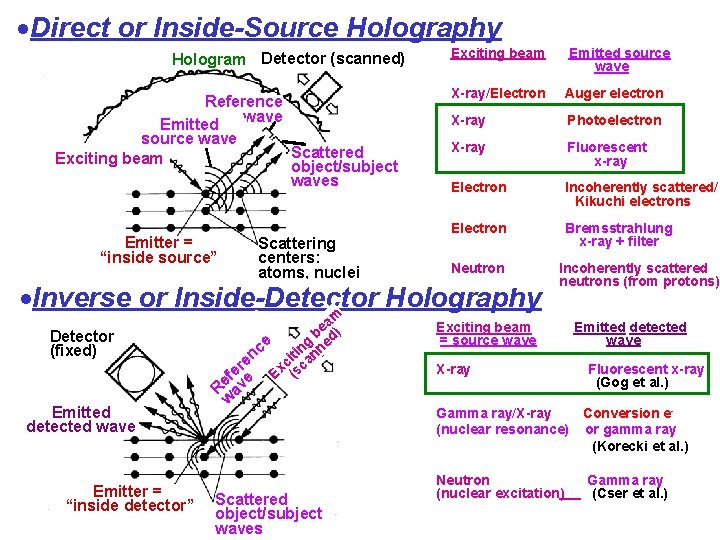
Direct or Inside-Source Holography Hologram Detector (scanned) Reference wave Emitted source wave Scattered Exciting beam object/subject waves Emitter = “inside source” Scattering centers: atoms, nuclei Exciting beam Emitted source wave X-ray/Electron Auger electron (Tonner) X-ray Photoelectron (Szöke, Barton) X-ray Fluorescent x-ray (Tegze, Faigel) Electron Incoherently scattered/ Kikuchi electrons (Saldin, de Andres) Electron Bremsstrahlung x-ray + filter (Sorensen et al. ) Inverse or Inside-Detector Holography Detector (fixed) Emitted detected wave Emitter = “inside detector” am e b d) e g e c n n i t n en xci ca r fe e E (s e R av w Neutron scattered Exciting beam. Incoherently Emitted detected neutrons (from protons) = source wave (Sur et al. ) X-ray Fluorescent x-ray Gamma ray/X-ray Conversion e(nuclear resonance) or gamma ray Neutron (nuclear excitation) Scattered object/subject waves Gamma ray
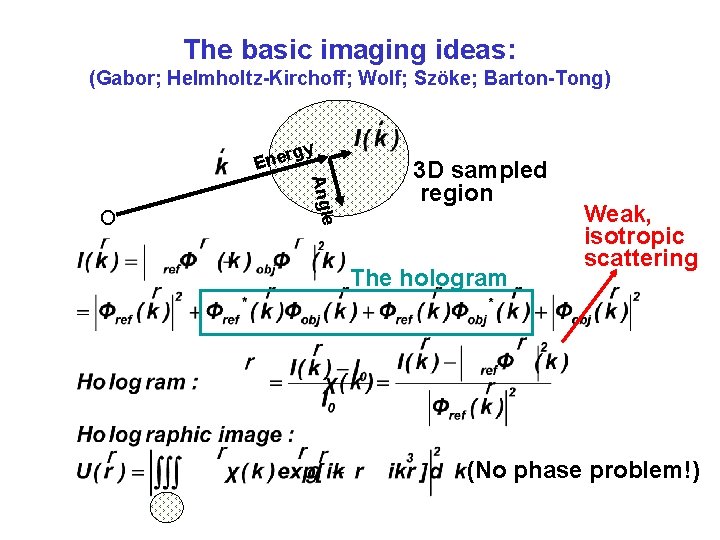
The basic imaging ideas: (Gabor; Helmholtz-Kirchoff; Wolf; Szöke; Barton-Tong) rgy e n E Angle O 3 D sampled region The hologram Weak, isotropic scattering (No phase problem!)
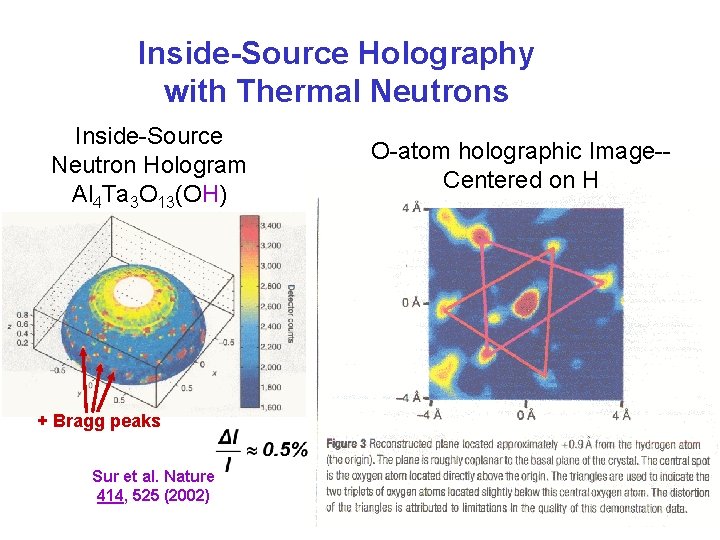
Inside-Source Holography with Thermal Neutrons Inside-Source Neutron Hologram Al 4 Ta 3 O 13(OH) + Bragg peaks Sur et al. Nature 414, 525 (2002) O-atom holographic Image-Centered on H
Direct or Inside-Source Holography Hologram Detector (scanned) Reference wave Emitted source wave Scattered Exciting beam object/subject waves Emitter = “inside source” Scattering centers: atoms, nuclei Exciting beam Emitted source wave X-ray/Electron Auger electron X-ray Photoelectron X-ray Fluorescent x-ray Electron Incoherently scattered/ Kikuchi electrons Electron Bremsstrahlung x-ray + filter Neutron Inverse or Inside-Detector Holography Detector (fixed) Emitted detected wave Emitter = “inside detector” am e b d) e g e c n n i t n en xci ca r fe e E (s e R av w Scattered object/subject waves Incoherently scattered neutrons (from protons) Exciting beam = source wave X-ray Emitted detected wave Fluorescent x-ray (Gog et al. ) Gamma ray/X-ray Conversion e(nuclear resonance) or gamma ray (Korecki et al. ) Neutron (nuclear excitation) Gamma ray (Cser et al. )
Inside-Detector Holography with Gamma Rays & Resonant Scattering Resonantly scattering nucleus Far-field gamma source e- Horizontal Emitting nucleus Hologram--Fe epitaxial film Vertical Korecki et al. PRL 79, 3518 (1997) Images
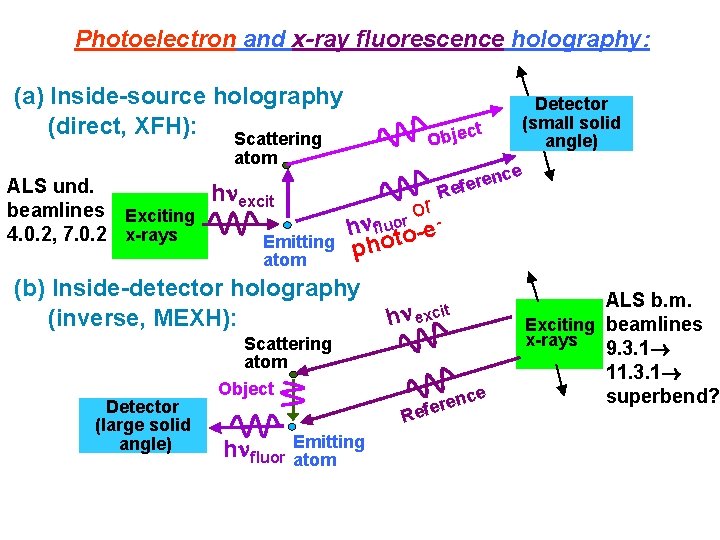
Photoelectron and x-ray fluorescence holography: (a) Inside-source holography (direct, XFH): Scattering Obje atom ALS und. beamlines Exciting 4. 0. 2, 7. 0. 2 x-rays ce ren e f e R hnexcit Emitting atom p Scattering atom Object hnfluor or -e o t o h hn fluor (b) Inside-detector holography (inverse, MEXH): Detector (large solid angle) ct Detector (small solid angle) Emitting atom hn excit nce e r e Ref ALS b. m. Exciting beamlines x-rays 9. 3. 1 11. 3. 1 superbend?
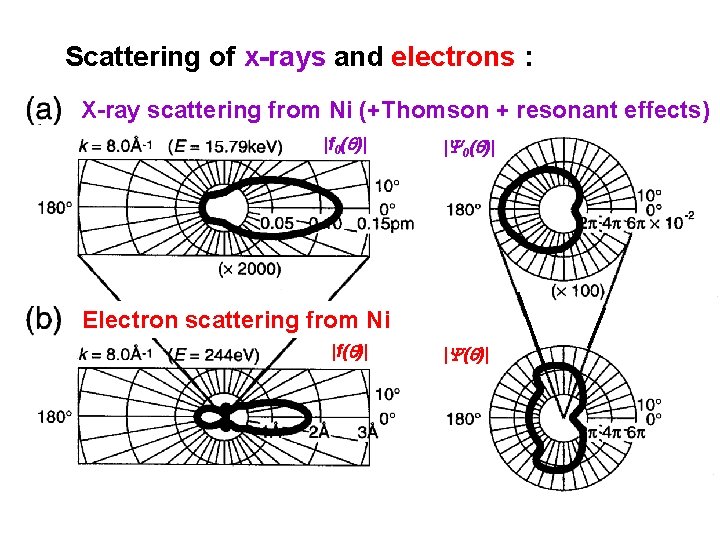
Scattering of x-rays and electrons : X-ray scattering from Ni (+Thomson + resonant effects) |f 0( )| | 0( )| Electron scattering from Ni |f( )| | ( )|
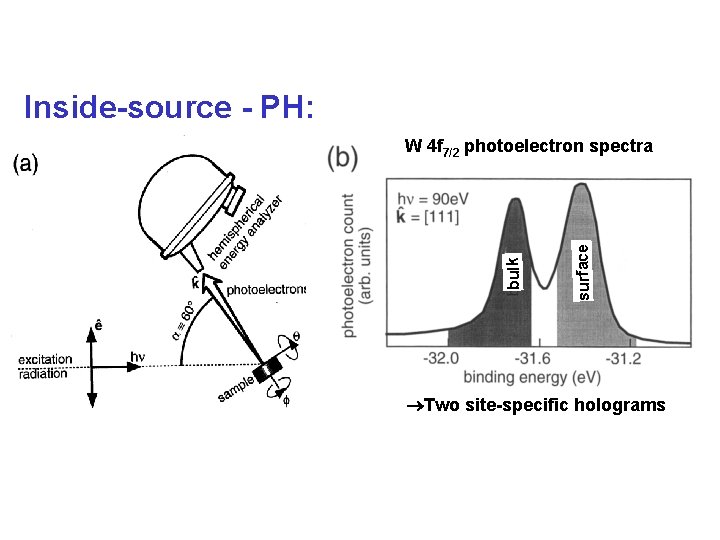
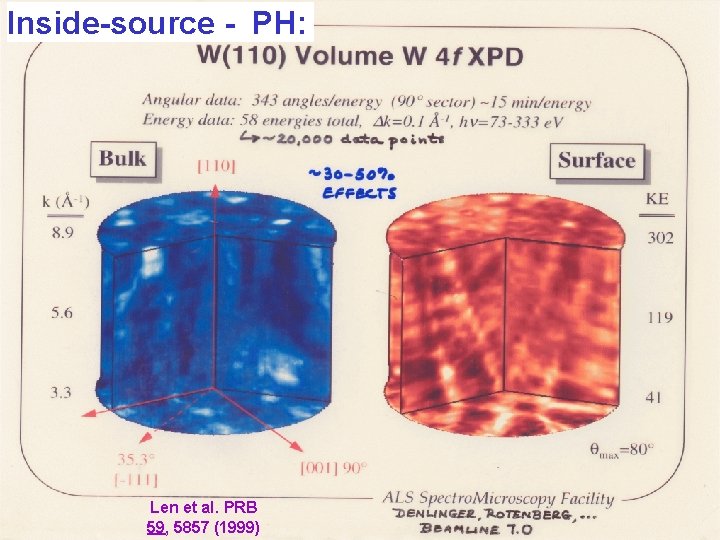
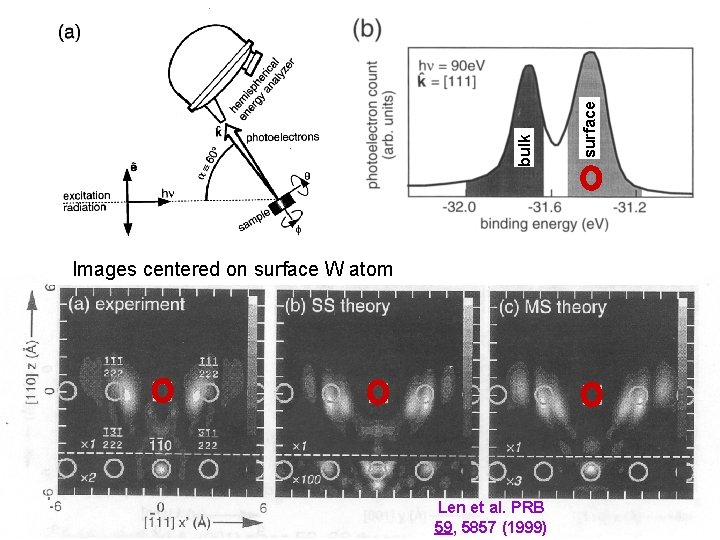
Inside-source - PH: surface bulk W 4 f 7/2 photoelectron spectra Two site-specific holograms
Inside-source - PH: Len et al. PRB 59, 5857 (1999)
Len et al. PRB 59, 5857 (1999) surface bulk Images centered on surface W atom
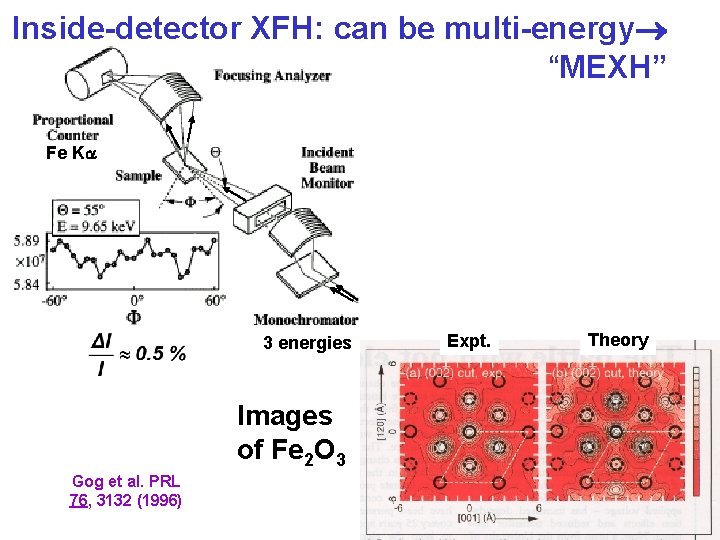
Inside-detector XFH: can be multi-energy “MEXH” Fe K 3 energies Images of Fe 2 O 3 Gog et al. PRL 76, 3132 (1996) Expt. Theory
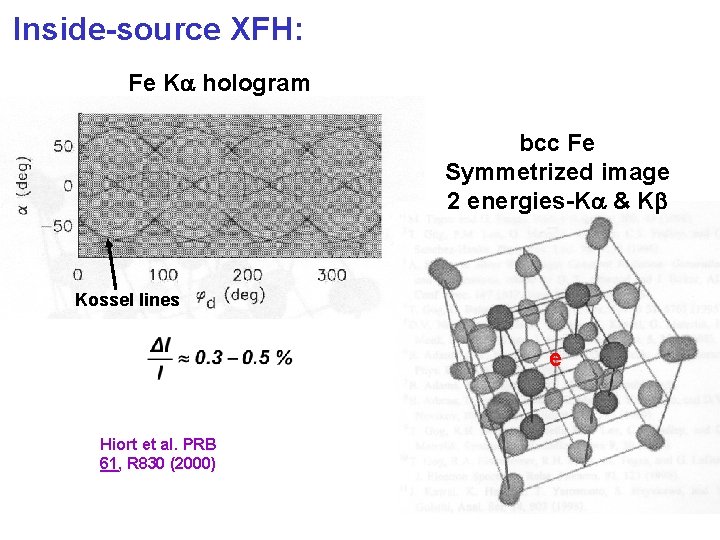
Inside-source XFH: Fe K hologram bcc Fe Symmetrized image 2 energies-K & K Kossel lines e Hiort et al. PRB 61, R 830 (2000)
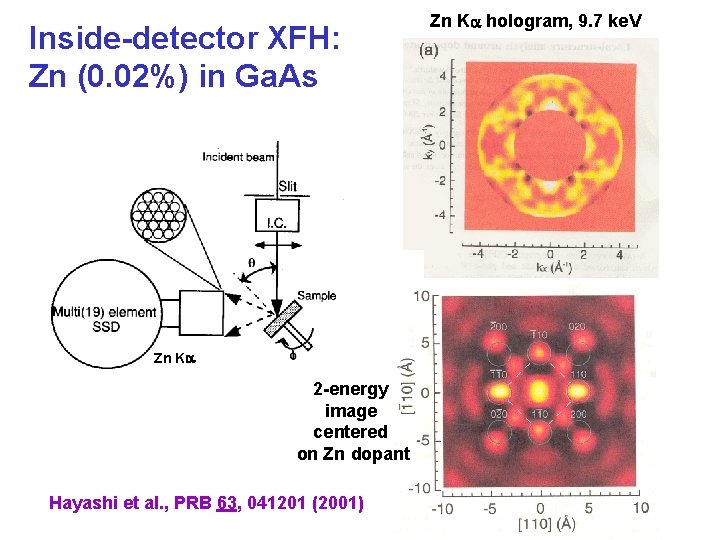
Inside-detector XFH: Zn (0. 02%) in Ga. As Zn K 2 -energy image centered on Zn dopant Hayashi et al. , PRB 63, 041201 (2001) Zn K hologram, 9. 7 ke. V
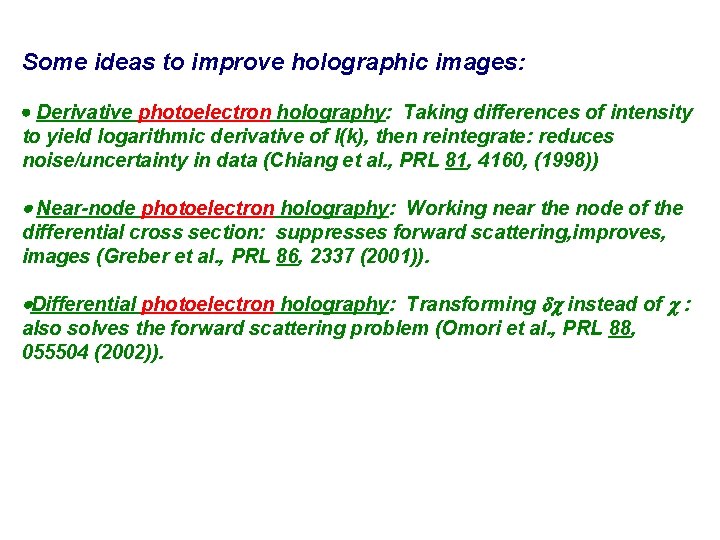
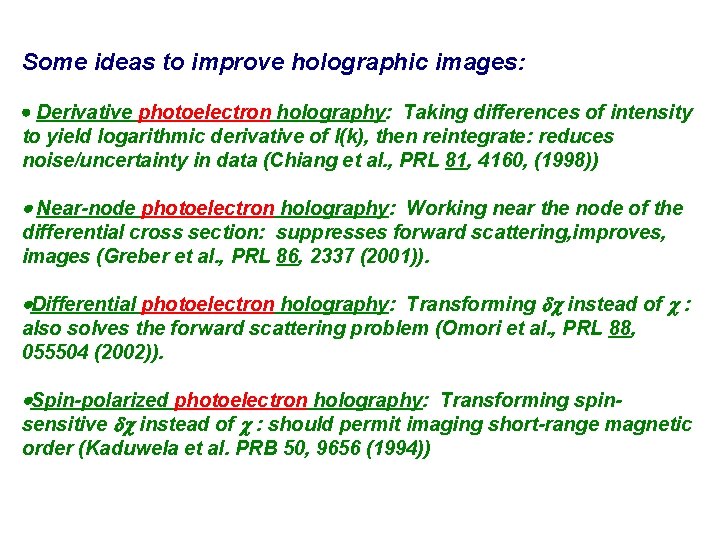
Some ideas to improve holographic images: Derivative photoelectron holography: Taking differences of intensity to yield logarithmic derivative of I(k), then reintegrate: reduces noise/uncertainty in data (Chiang et al. , PRL 81, 4160, (1998))
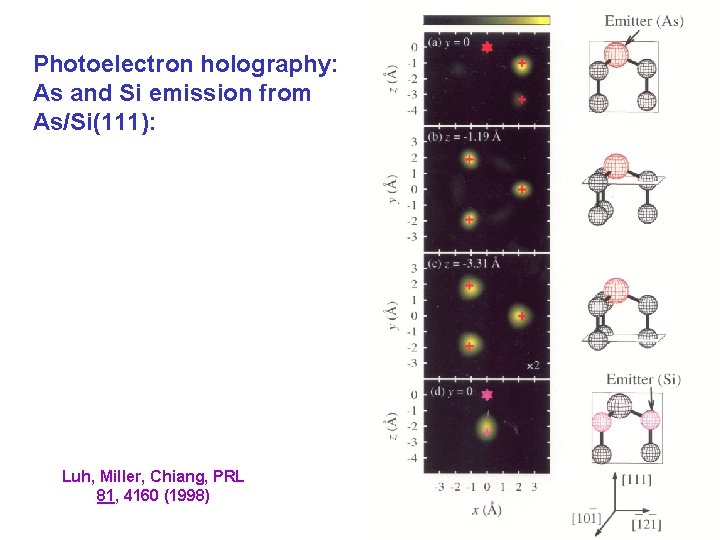
Photoelectron holography: As and Si emission from As/Si(111): Luh, Miller, Chiang, PRL 81, 4160 (1998)
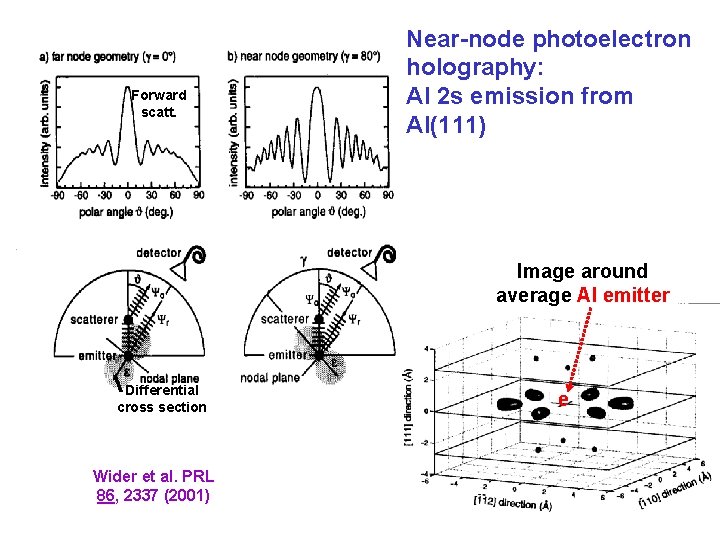
Some ideas to improve holographic images: Derivative photoelectron holography: Taking differences of intensity to yield logarithmic derivative of I(k), then reintegrate: reduces noise/uncertainty in data (Chiang et al. , PRL 81, 4160, (1998)) Near-node photoelectron holography: Working near the node of the differential cross section: suppresses forward scattering, improves, images (Greber et al. , PRL 86, 2337 (2001)).
Forward scatt. Near-node photoelectron holography: Al 2 s emission from Al(111) Image around average Al emitter Differential cross section Wider et al. PRL 86, 2337 (2001) e
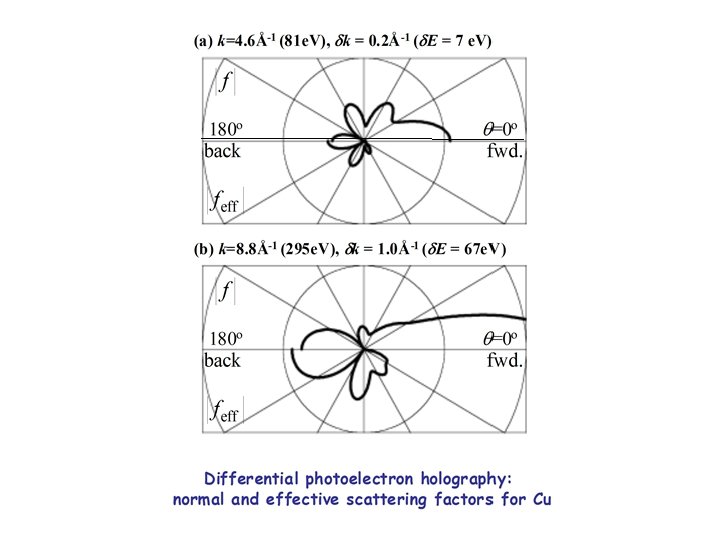
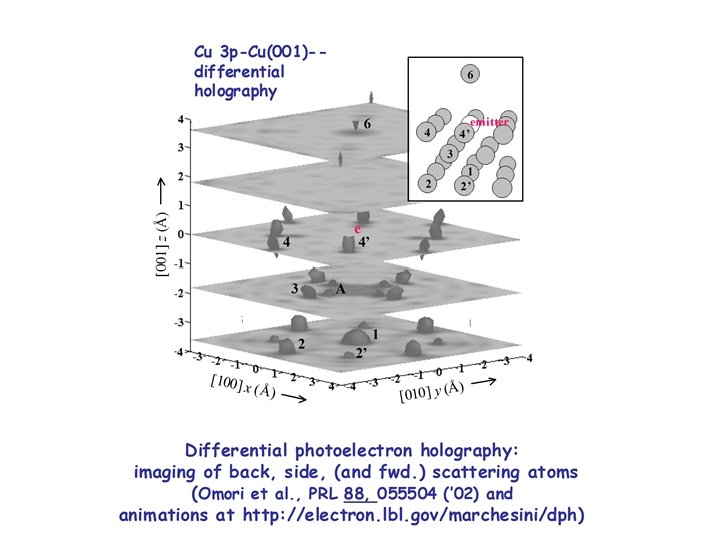
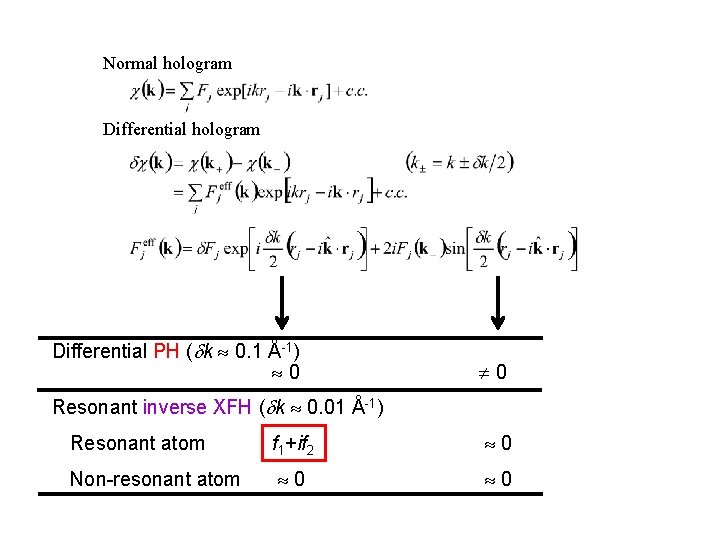
Some ideas to improve holographic images: Derivative photoelectron holography: Taking differences of intensity to yield logarithmic derivative of I(k), then reintegrate: reduces noise/uncertainty in data (Chiang et al. , PRL 81, 4160, (1998)) Near-node photoelectron holography: Working near the node of the differential cross section: suppresses forward scattering, improves, images (Greber et al. , PRL 86, 2337 (2001)). Differential photoelectron holography: Transforming instead of : also solves the forward scattering problem (Omori et al. , PRL 88, 055504 (2002)).
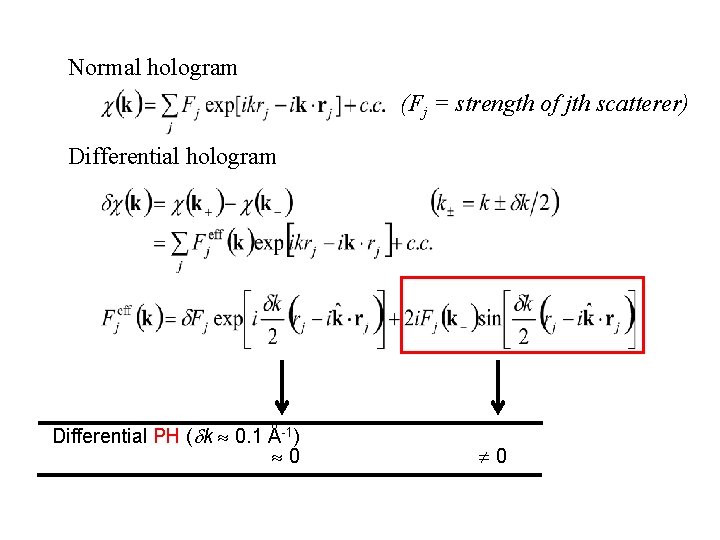
Normal hologram (Fj = strength of jth scatterer) Differential hologram Differential PH ( k 0. 1 Å-1) 0 0
Some ideas to improve holographic images: Derivative photoelectron holography: Taking differences of intensity to yield logarithmic derivative of I(k), then reintegrate: reduces noise/uncertainty in data (Chiang et al. , PRL 81, 4160, (1998)) Near-node photoelectron holography: Working near the node of the differential cross section: suppresses forward scattering, improves, images (Greber et al. , PRL 86, 2337 (2001)). Differential photoelectron holography: Transforming instead of : also solves the forward scattering problem (Omori et al. , PRL 88, 055504 (2002)). Spin-polarized photoelectron holography: Transforming spinsensitive instead of : should permit imaging short-range magnetic order (Kaduwela et al. PRB 50, 9656 (1994))
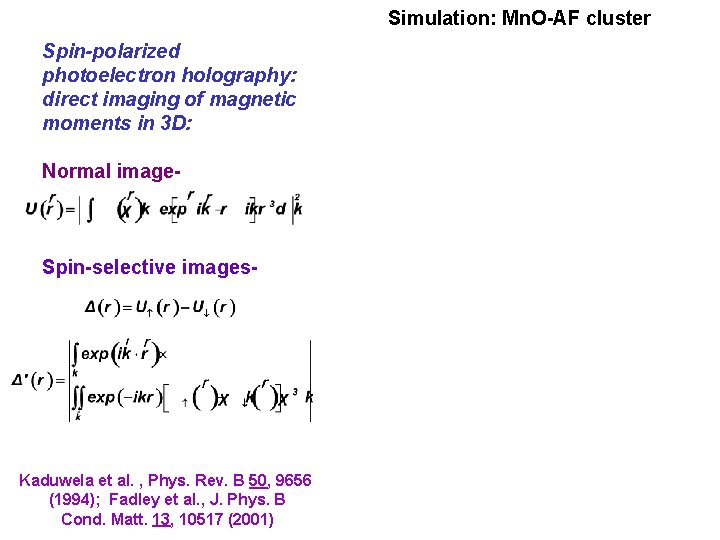
Simulation: Mn. O-AF cluster Spin-polarized photoelectron holography: direct imaging of magnetic moments in 3 D: Normal image- Spin-selective images- Kaduwela et al. , Phys. Rev. B 50, 9656 (1994); Fadley et al. , J. Phys. B Cond. Matt. 13, 10517 (2001)
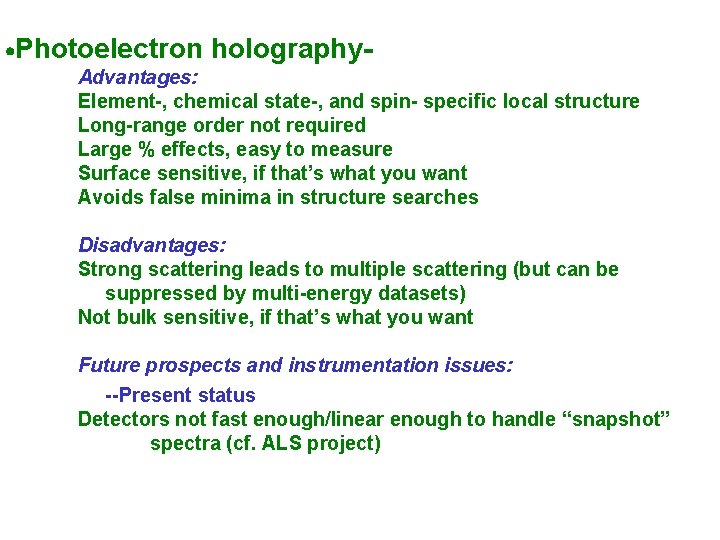
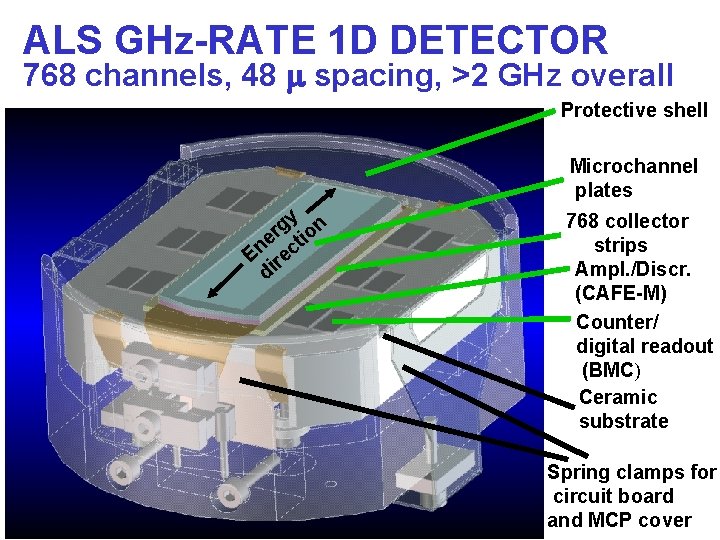
Photoelectron holography. Advantages: Element-, chemical state-, and spin- specific local structure Long-range order not required Large % effects, easy to measure Surface sensitive, if that’s what you want Avoids false minima in structure searches Disadvantages: Strong scattering leads to multiple scattering (but can be suppressed by multi-energy datasets) Not bulk sensitive, if that’s what you want Future prospects and instrumentation issues: --Present status Detectors not fast enough/linear enough to handle “snapshot” spectra (cf. ALS project)
ALS GHz-RATE 1 D DETECTOR 768 channels, 48 spacing, >2 GHz overall Protective shell Microchannel plates gy on r e cti n E ire d 768 collector strips Ampl. /Discr. (CAFE-M) Counter/ digital readout (BMC) Ceramic substrate Spring clamps for circuit board and MCP cover
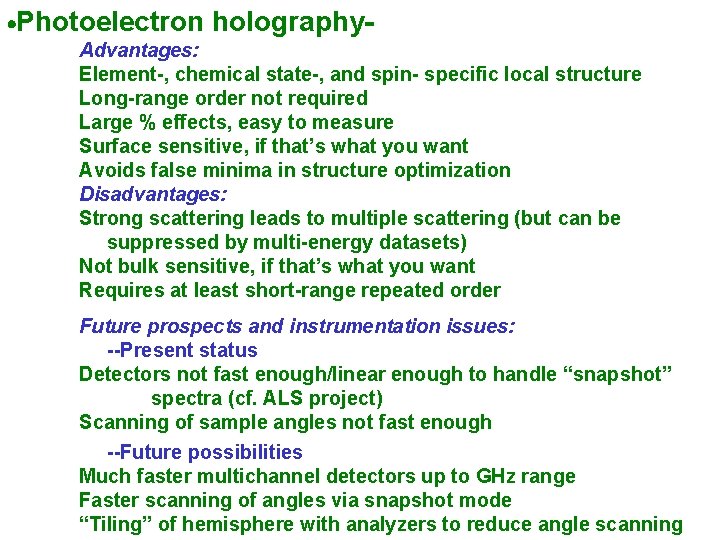
Photoelectron holography. Advantages: Element-, chemical state-, and spin- specific local structure Long-range order not required Large % effects, easy to measure Surface sensitive, if that’s what you want Avoids false minima in structure optimization Disadvantages: Strong scattering leads to multiple scattering (but can be suppressed by multi-energy datasets) Not bulk sensitive, if that’s what you want Requires at least short-range repeated order Future prospects and instrumentation issues: --Present status Detectors not fast enough/linear enough to handle “snapshot” spectra (cf. ALS project) Scanning of sample angles not fast enough --Future possibilities Much faster multichannel detectors up to GHz range Faster scanning of angles via snapshot mode “Tiling” of hemisphere with analyzers to reduce angle scanning
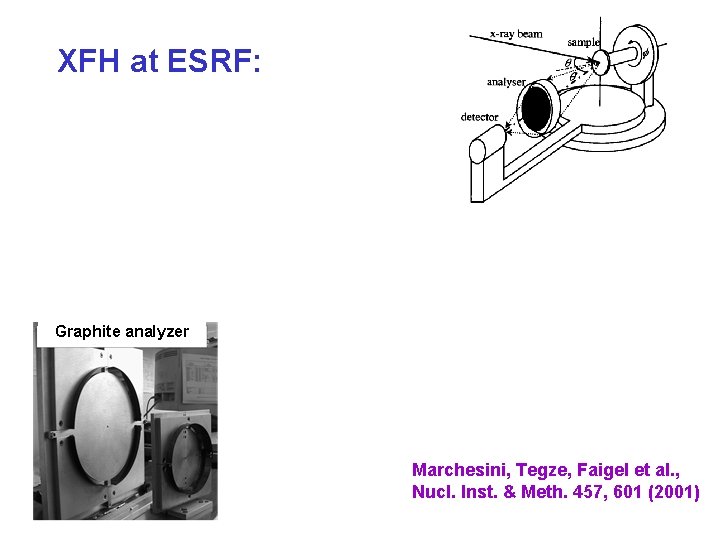
XFH at ESRF: Graphite analyzer Marchesini, Tegze, Faigel et al. , Nucl. Inst. & Meth. 457, 601 (2001)
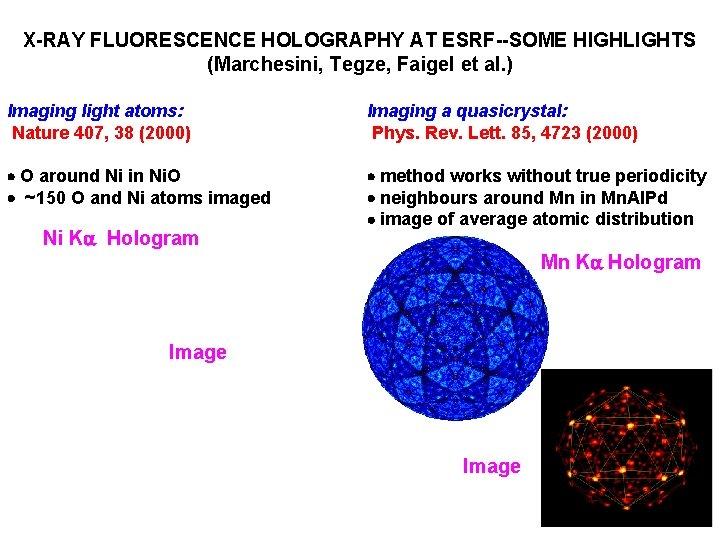
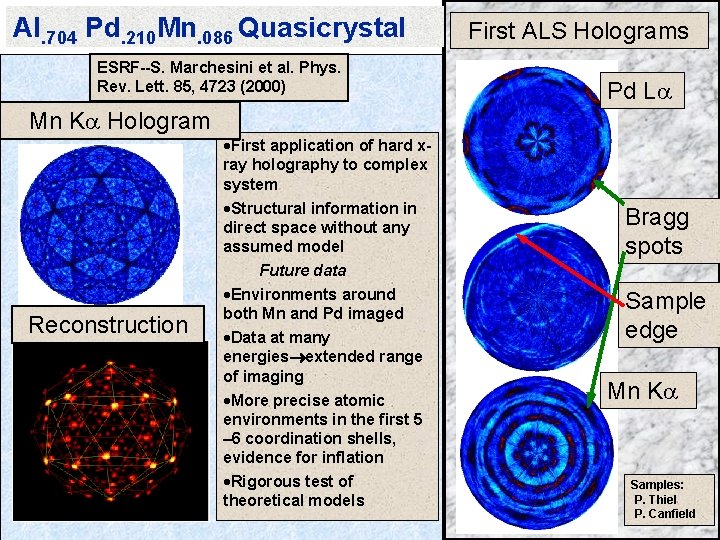
X-RAY FLUORESCENCE HOLOGRAPHY AT ESRF--SOME HIGHLIGHTS (Marchesini, Tegze, Faigel et al. ) Imaging light atoms: Nature 407, 38 (2000) Imaging a quasicrystal: Phys. Rev. Lett. 85, 4723 (2000) O around Ni in Ni. O ~150 O and Ni atoms imaged method works without true periodicity neighbours around Mn in Mn. Al. Pd image of average atomic distribution Ni K Hologram Mn K Hologram Image
Al. 704 Pd. 210 Mn. 086 Quasicrystal ESRF--S. Marchesini et al. Phys. Rev. Lett. 85, 4723 (2000) First ALS Holograms Pd La Mn Ka Hologram Reconstruction First application of hard xray holography to complex system Structural information in direct space without any assumed model Future data Environments around both Mn and Pd imaged Data at many energies extended range of imaging More precise atomic environments in the first 5 – 6 coordination shells, evidence for inflation Rigorous test of theoretical models Bragg spots Sample edge Mn Ka Samples: P. Thiel P. Canfield
X-RAY FLUORESCENCE HOLOGRAPHY AT THE ALS (a) Experimental setup: (Marchesini et al. ) Motion PC Acquisition Motion Drivers Clock j Future plans • Sample heating/coolingphase-transition studies High speed motionacquisitiond /dt = 3600 o/sec • Applications to: strongly correlated materials (CMR high-T phases), magnetic quasicrystals (RE-Mg-Zn--I. Fisher), bio-relevant crystals d /dt = Acquisition D 2 o/sec et Ge solid state det. -up to 4 MHz Monochromatic x-rays (b-e) First data (b) Expt. Mn. O (100) (c) Calc. 6 • Development of: -Resonant and dichroic XFH -More efficient pixel detectors ALS (d) Mn-atom image (scales in Å) CMR: (La, Sr)3 Mn 2 O 7 (e) Expt. 1 (a. u. ) F. T. (La, Sr) Mn -6 -6 Å 6Å 0 O
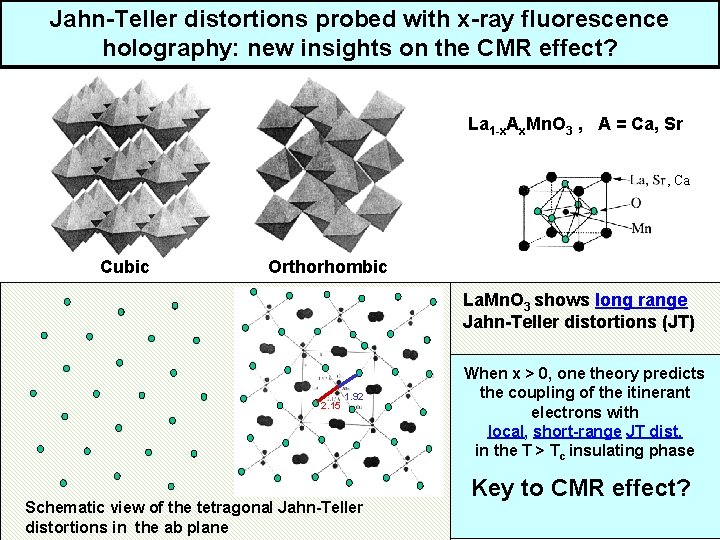
Jahn-Teller distortions probed with x-ray fluorescence holography: new insights on the CMR effect? La 1 -x. Ax. Mn. O 3 , A = Ca, Sr , Ca Cubic Orthorhombic La. Mn. O 3 shows long range Jahn-Teller distortions (JT) 2. 15 1. 92 Schematic view of the tetragonal Jahn-Teller distortions in the ab plane When x > 0, one theory predicts the coupling of the itinerant electrons with local, short-range JT dist. in the T > Tc insulating phase Key to CMR effect?
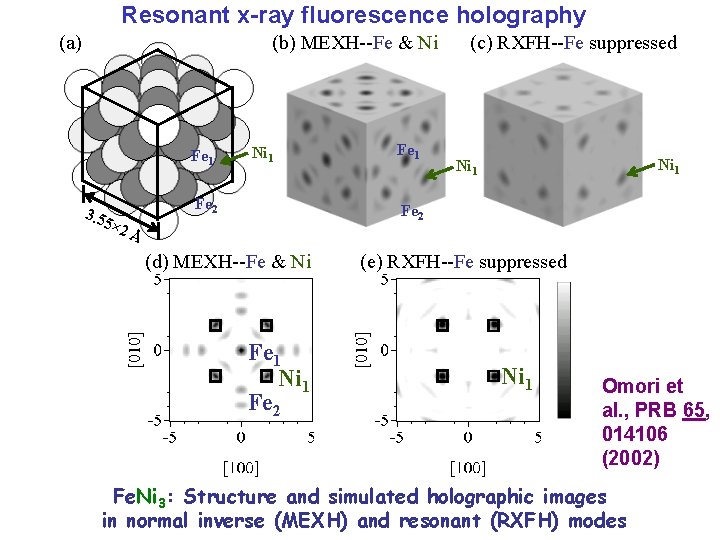
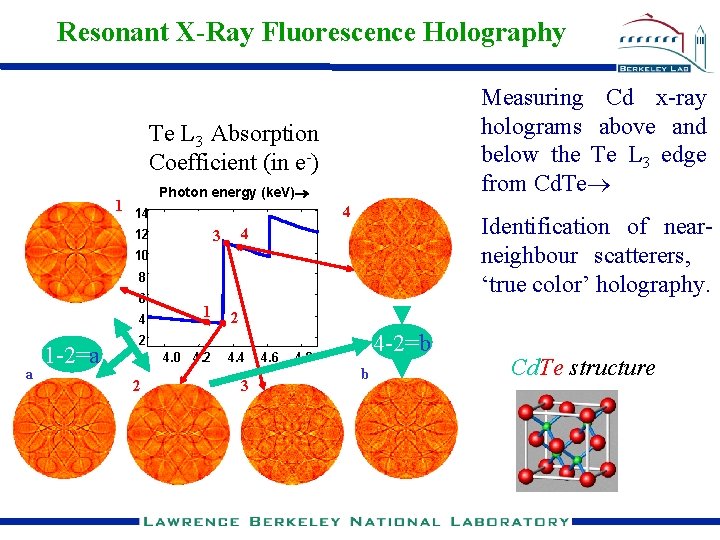
Some ideas to improve holographic images: Derivative photoelectron holography: Taking differences of intensity to yield logarithmic derivative of I(k), then reintegrate: reduces noise/uncertainty in data (Chiang et al. , PRL 81, 4160, (1998)) Near-node photoelectron holography: Working near the node of the differential cross section: suppresses forward scattering, improves, images (Greber et al. , PRL 86, 2337 (2001)). Differential photoelectron holography: Transforming instead of : also solves the forward scattering problem (Omori et al. , PRL 88, 055504 (2002)). Spin-polarized photoelectron holography: Transforming spin-sensitive instead of : should permit imaging short-range magnetic order (Kaduwela et al. PRB 50, 9656 (1994)) Resonant x-ray fluorescence holography: Taking difference holograms above and below a core-level resonance on atom A, and imaging on again, with weighting wk= +1 below resonance and -1 above resonance, and (below) and (above) calculated at three energies below, on, and above resonance, yields images in which only atom A is prominent.
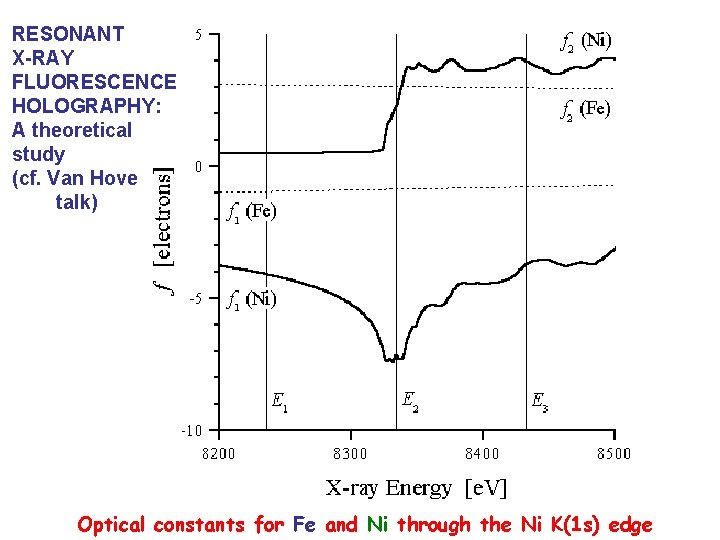
RESONANT X-RAY FLUORESCENCE HOLOGRAPHY: A theoretical study (cf. Van Hove talk) Optical constants for Fe and Ni through the Ni K(1 s) edge
Normal hologram Differential PH ( k 0. 1 Å-1) 0 0 Resonant inverse XFH ( k 0. 01 Å-1) Resonant atom f 1+if 2 0 Non-resonant atom 0 0
Resonant x-ray fluorescence holography (a) (b) MEXH--Fe & Ni Fe 1 3. 5 5× 2 Ni 1 Fe 2 Fe 1 (c) RXFH--Fe suppressed Ni 1 Fe 2 Å (d) MEXH--Fe & Ni Fe 1 Ni 1 Fe 2 (e) RXFH--Fe suppressed Ni 1 Omori et al. , PRB 65, 014106 (2002) Fe. Ni 3: Structure and simulated holographic images in normal inverse (MEXH) and resonant (RXFH) modes
Resonant X-Ray Fluorescence Holography Measuring Cd x-ray holograms above and below the Te L 3 edge from Cd. Te L 3 Absorption Coefficient (in e-) 1 14 Photon energy (ke. V) 4 Identification of nearneighbour scatterers, ‘true color’ holography. 4 3 12 10 8 6 4 a 1 -2=a 1 2 4 -2=b 2 4. 0 4. 2 2 4. 4 3 4. 6 4. 8 b Cd. Te structure
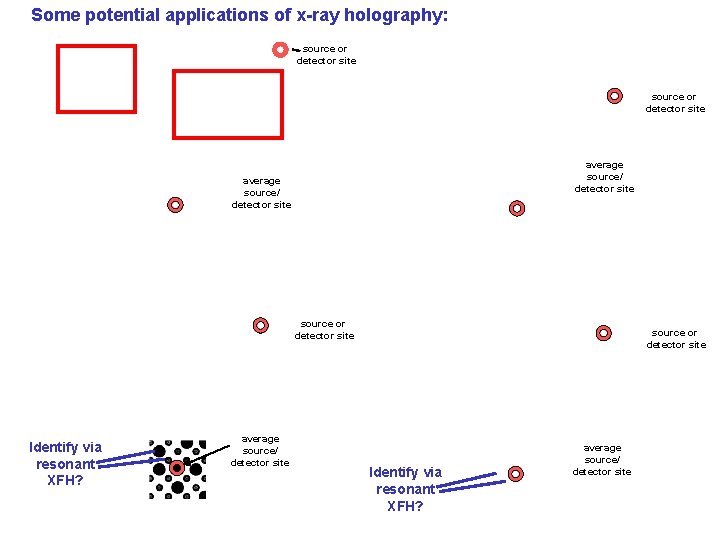
Some potential applications of x-ray holography: source or detector site average source/ detector site source or detector site Identify via resonant XFH? average source/ detector site
…and ultimately more dilute species: source or detector site Active sites in biorelevant molecules average source/ detector site source or detector site average source/ detector site
X-ray fluorescence holography Advantages: Element-specific local structure Weak scattering, better holographic imaging Long-range order not required Mosaicity up to few degrees OK Avoids false minima in structure optimization With resonance, near-neighbor identification? With CP radiation, short-range magnetic order imaging? Disadvantages: Small % effects, need approx. 109 -1010 counts in hologram Requires at least short-range repeated order
X-ray fluorescence holography Future prospects and instrumentation issues: --Present status Detector-limited--e. g. , graphite crystal plus avalanche photodiode (ESRF); Ge detectors up to 1 MHz over 4 elements (LBNL) hologram in approx. 1 -10 hours --Future possibilities "Tiling" of hemisphere with Ge detectors ala Gammasphere, Si drift diodes (HASYLAB, Materlik et al. ? , commercial sources Ketek and Photon Imaging? ) --Future “dream machine” 1 angular resolution, 100 e. V resolution for x-rays at 6 -20 ke. V, hemisphere coverage, 1 -100 GHz overall hologram in 0. 1 -10 sec, or in one LCLS pulse
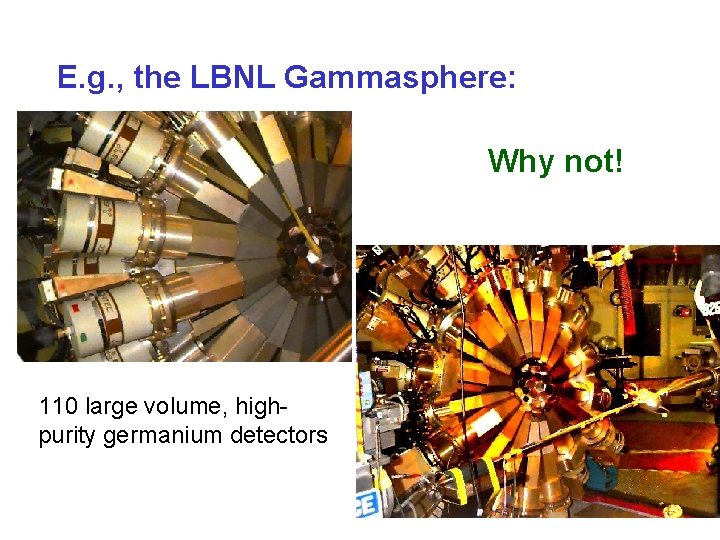
E. g. , the LBNL Gammasphere: Why not! 110 large volume, highpurity germanium detectors
The End