
Holistic goals Critical thinking and problemsolving skills Oral

Holistic goals • • Critical thinking and problem-solving skills Oral and written communication skills Interpersonal and team skills these things, In the process of learning Ability and desire lifelong students learn for more of thelearning specific “stuff” Personal responsibility we want them to know Improve affect and, theystudent retain it longer after our class is over Help students develop intellectually Help students become intentional and selfregulated learners
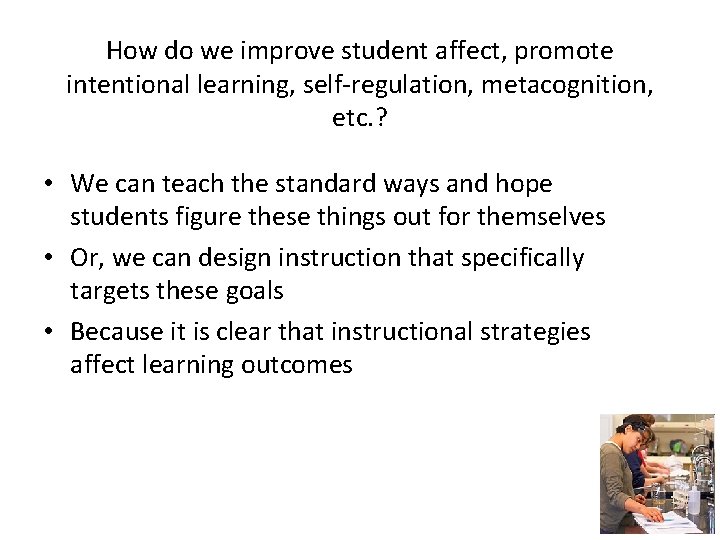
How do we improve student affect, promote intentional learning, self-regulation, metacognition, etc. ? • We can teach the standard ways and hope students figure these things out for themselves • Or, we can design instruction that specifically targets these goals • Because it is clear that instructional strategies affect learning outcomes
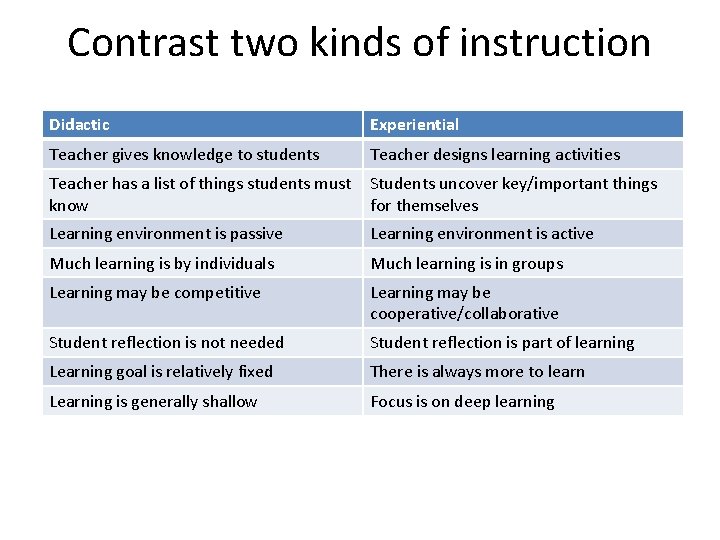
Contrast two kinds of instruction Didactic Experiential Teacher gives knowledge to students Teacher designs learning activities Teacher has a list of things students must know Students uncover key/important things for themselves Learning environment is passive Learning environment is active Much learning is by individuals Much learning is in groups Learning may be competitive Learning may be cooperative/collaborative Student reflection is not needed Student reflection is part of learning Learning goal is relatively fixed There is always more to learn Learning is generally shallow Focus is on deep learning
Many roadblocks • We are asking our students to do something new – And to do more for themselves – Duh. . . there will be resistance – So, it is essential that we tell them why • We are asking us to do something new – If we do new things, we cannot do all the old things – There is a significant time commitment – There will be “failures, ” confusion, chaos – It is absolutely essential that we share resources • Colleagues and tenure committees may not appreciate our innovations
Ideal: a co-curriculum to help students develop metacognitive skills and to become self-regulated learners • Specific instruction aimed at this goal • Specific activities aimed at this goal This is what I do, and students say it is very valuable
Almost as good: introduce any of a diverse number of activities into your more “standard” class • Key is to get students engaged in self-reflection • And for them to realize how important it is • There are many “simple” activities – – – Learning portfolios Self-reflective essays Exam wrappers Knowledge surveys Mastery Quizzes Etc. And, all students say these things are very valuable and they learn a lot from them Many question why they are not done in all their courses
- Slides: 6