
Hold Fast the Traditions Knowing when to change

- Slides: 8
Hold Fast the Traditions Knowing when to change and when to stay the same
Traditions in the church • Many hold in contempt and want to abandon all traditions … “tradition” is bad. . . “Church of Christ traditions” must go (baptism for salvation, male leadership, acappella singing, M-D-R) • “Tradition” is something that is old and bad • Many churches now have a “traditional” service and a “contemporary” service • Others hold onto the past – good or bad – and resist all change (“This is the way we’ve always done it…”)
What is tradition? • “Tradition” (Gr. paradosis) means “a teaching or practice that is passed down, handed down, delivered, orally or in writing” • Two classes of “tradition” are stated in scripture, the source being different • “Tradition” may be apostolic (1 Cor. 11: 2; 2 Thess. 2: 15; 2 Thess. 3: 6) • “Tradition” may be from men (Mt. 15: 2 -3, 6; 7: 3, 5, 8, 9, 13; Gal. 1: 14; Col. 2: 8) Mk.
Apostolic traditions • Apostolic tradition comes from God; inspiration Cor. 11: 23; 15: 3; 2 Pet. 2: 21) (1 • Apostolic tradition must be kept today (1 Cor. 11: 2; 2 Thess. 2: 15; 2 Thess. 3: 6) • Apostolic tradition forms a pattern that must be kept • Things such as the work, worship, organization of the local church; plan of salvation; are apostolic traditions that must not be changed • The pattern must not be changed (Rom. 6: 17; 2 Tim. 1: 13; Jude 3)
Human traditions • Human traditions come from man, not God; uninspired; they may need to be discarded; they may need to be changed (Mt. 15: 2 -3, 6; Mk. 7: 3, 5, 8, 9, 13; Gal. 1: 14 [comp. 1 Pet. 1: 18]; Col. 2: 8) • Some human traditions set aside the word of God • Some human traditions are made the word of God • Some human traditions violate the word of God • Some human traditions help carry out the word of God (“expediency”)
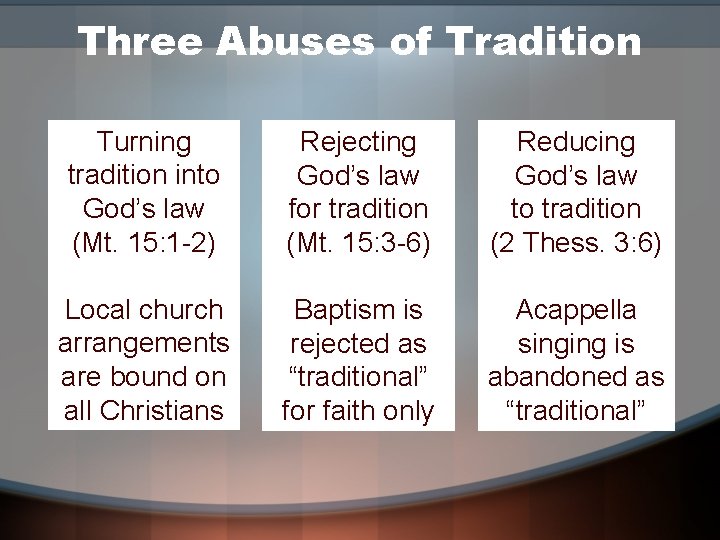
Three Abuses of Tradition Turning tradition into God’s law (Mt. 15: 1 -2) Rejecting God’s law for tradition (Mt. 15: 3 -6) Reducing God’s law to tradition (2 Thess. 3: 6) Local church arrangements are bound on all Christians Baptism is rejected as “traditional” for faith only Acappella singing is abandoned as “traditional”
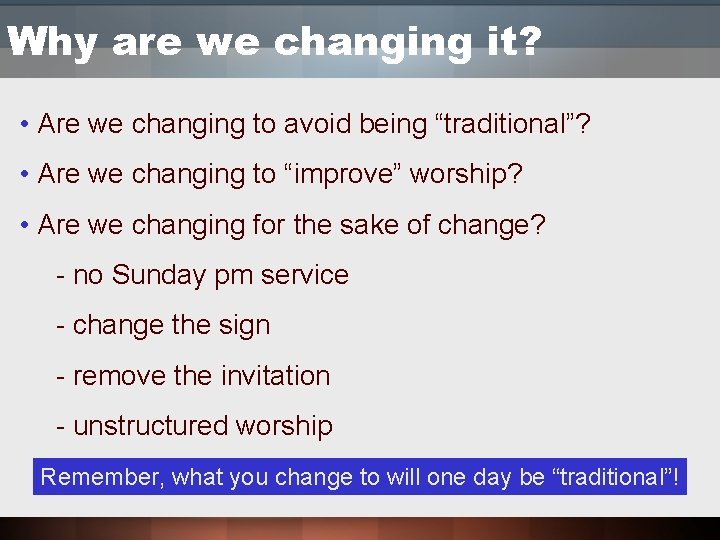
Why are we changing it? • Are we changing to avoid being “traditional”? • Are we changing to “improve” worship? • Are we changing for the sake of change? - no Sunday pm service - change the sign - remove the invitation - unstructured worship Remember, what you change to will one day be “traditional”!
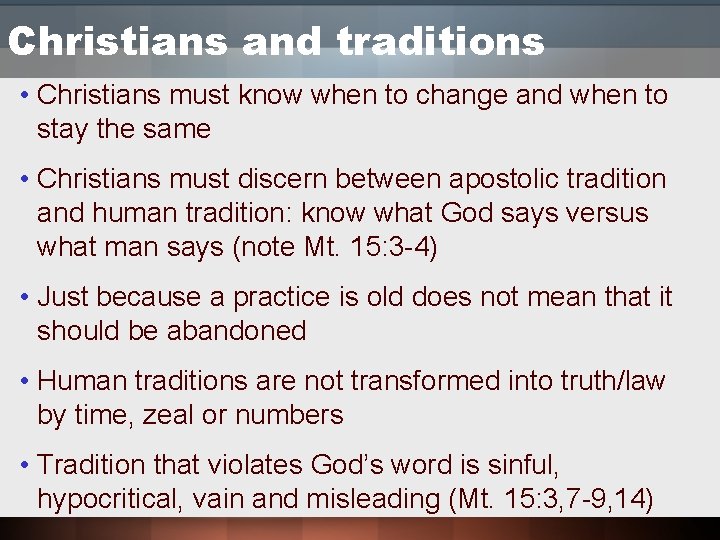
Christians and traditions • Christians must know when to change and when to stay the same • Christians must discern between apostolic tradition and human tradition: know what God says versus what man says (note Mt. 15: 3 -4) • Just because a practice is old does not mean that it should be abandoned • Human traditions are not transformed into truth/law by time, zeal or numbers • Tradition that violates God’s word is sinful, hypocritical, vain and misleading (Mt. 15: 3, 7 -9, 14)