
Hola Hoy es el 14 de agosto This
- Slides: 12
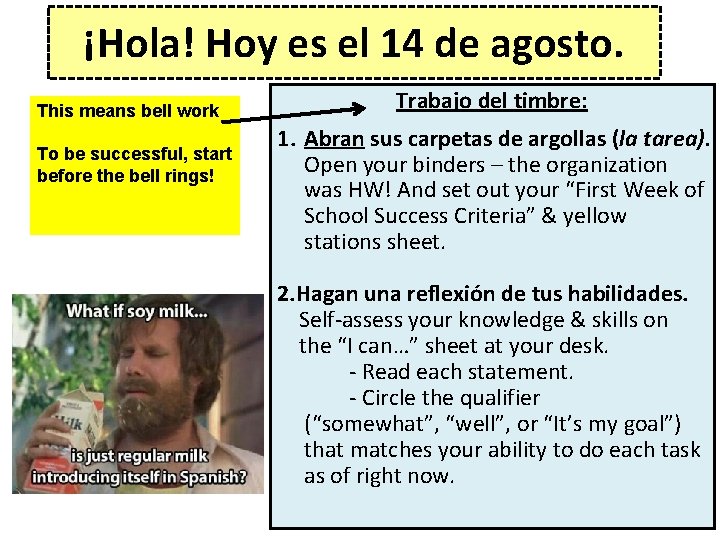
¡Hola! Hoy es el 14 de agosto. This means bell work To be successful, start before the bell rings! Trabajo del timbre: 1. Abran sus carpetas de argollas (la tarea). Open your binders – the organization was HW! And set out your “First Week of School Success Criteria” & yellow stations sheet. 2. Hagan una reflexión de tus habilidades. Self-assess your knowledge & skills on the “I can…” sheet at your desk. - Read each statement. - Circle the qualifier (“somewhat”, “well”, or “It’s my goal”) that matches your ability to do each task as of right now.
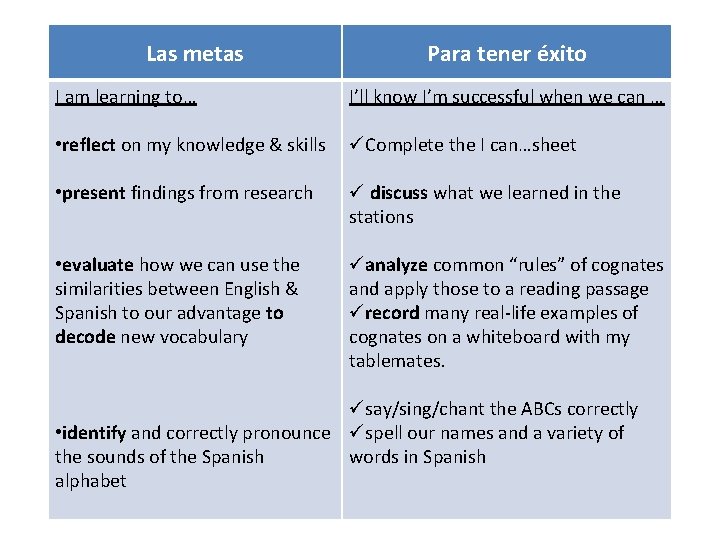
Las metas Para tener éxito I am learning to… I’ll know I’m successful when we can … • reflect on my knowledge & skills üComplete the I can…sheet • present findings from research ü discuss what we learned in the stations • evaluate how we can use the similarities between English & Spanish to our advantage to decode new vocabulary üanalyze common “rules” of cognates and apply those to a reading passage ürecord many real-life examples of cognates on a whiteboard with my tablemates. üsay/sing/chant the ABCs correctly • identify and correctly pronounce üspell our names and a variety of the sounds of the Spanish words in Spanish alphabet
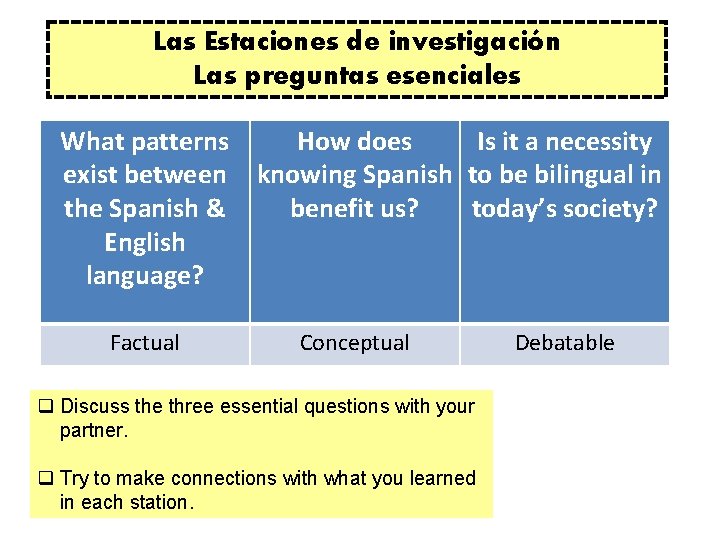
Las Estaciones de investigación Las preguntas esenciales What patterns How does Is it a necessity exist between knowing Spanish to be bilingual in the Spanish & benefit us? today’s society? English language? Factual Conceptual q Discuss the three essential questions with your partner. q Try to make connections with what you learned in each station. Debatable
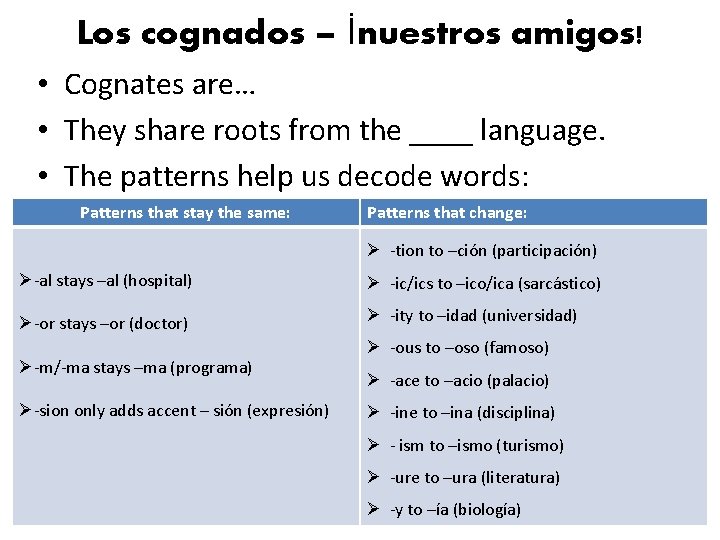
Los cognados – İnuestros amigos! • Cognates are… • They share roots from the ____ language. • The patterns help us decode words: Patterns that stay the same: Patterns that change: Ø -tion to –ción (participación) Ø-al stays –al (hospital) Ø -ic/ics to –ico/ica (sarcástico) Ø-or stays –or (doctor) Ø -ity to –idad (universidad) Ø-m/-ma stays –ma (programa) Ø-sion only adds accent – sión (expresión) Ø -ous to –oso (famoso) Ø -ace to –acio (palacio) Ø -ine to –ina (disciplina) Ø - ism to –ismo (turismo) Ø -ure to –ura (literatura) Ø -y to –ía (biología)
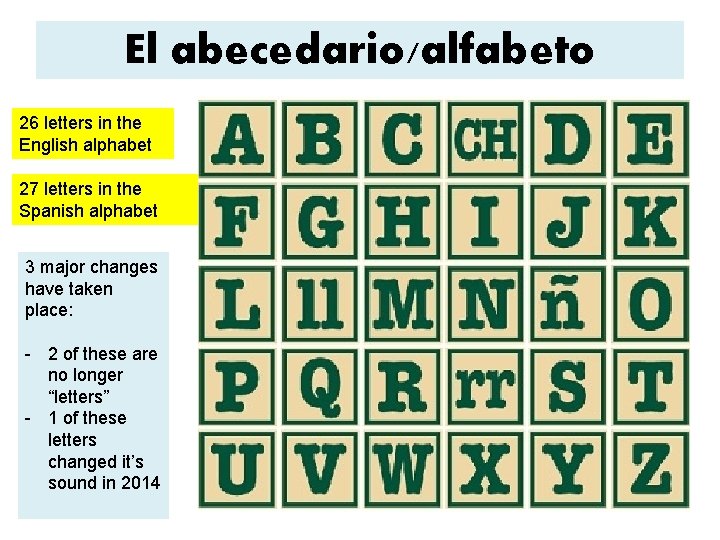
El abecedario/alfabeto 26 letters in the English alphabet 27 letters in the Spanish alphabet 3 major changes have taken place: - 2 of these are no longer “letters” - 1 of these letters changed it’s sound in 2014
Una mosca (que es una poca loca)
• Una mosca parada en la pared, Una mosca parada, una mosca parada, Una mosca parada en la pared.
• Ahora con la A • Ana masca parada an la parad, Ana masca parada, ana masca parada, Ana masca parada an la parad.
• Ahora con la E Ene mesque perede en le pered, Ene mesque perede, ene mesque perede, Ene mesque perede en le pered.
• Ahora con la i Ini misqui piridi in li pirid Ini misqui piridi, Ini misqui piridi in li pirid.
• Ahora con la O Ono mosco porodo on lo porod, Ono mosco porodo, Ono mosco porodo on lo porod.
• Ahora con la U Unu muscu purudu un lu purud, Unu muscu purudu, unu muscu purudu, Unu muscu purudu un lu purud.