
HMS Model Calibration Strategies Emily Moe P E

HMS Model Calibration Strategies Emily Moe, P. E. St. Paul District U. S. Army Corps of Engineers
Objectives • Setting Initial Model Parameters • Data Sources • Estimation Methods • Setting Calibration Goals • Calibration Metrics
Setting Initial Model Parameters • • • Loss Transform Baseflow Routing Evapotranspiration/Snowmelt

Initial Model Parameters - Loss Parameters • Regulate Infiltration • Various Methods Available • Physically-Based, Depend On: ₋ ₋ ₋ ₋ Rainfall Soil Compaction Slope Cracks Roots Vegetation Soil Moisture Litter Temperature Soil Porosity Soil Type Urban Areas & More! Source: (Top)- http: //ftp. comet. ucar. edu/memory-stick/hydro/basic_int/runoff/navmenu. php_tab_1_page_2. 1. 0. htm, (Bottom)-https: //cals. arizona. edu/extension/riparian/chapt 3/p 07. html
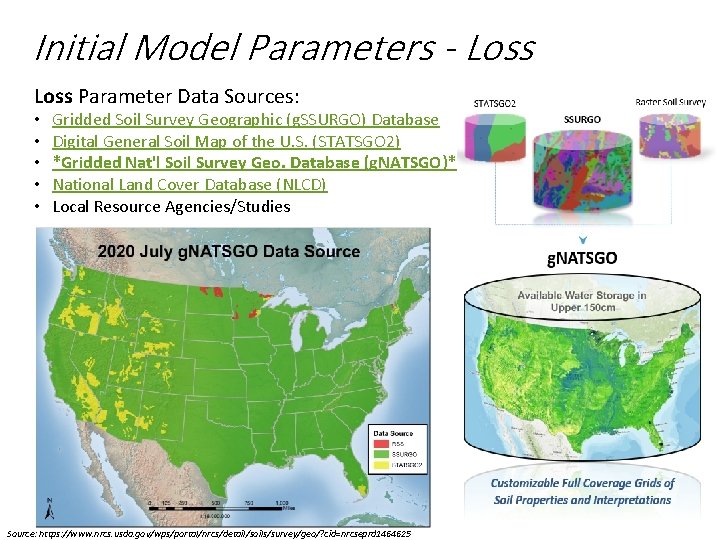
Initial Model Parameters - Loss Parameter Data Sources: • • • Gridded Soil Survey Geographic (g. SSURGO) Database Digital General Soil Map of the U. S. (STATSGO 2) *Gridded Nat'l Soil Survey Geo. Database (g. NATSGO)* National Land Cover Database (NLCD) Local Resource Agencies/Studies Source: https: //www. nrcs. usda. gov/wps/portal/nrcs/detail/soils/survey/geo/? cid=nrcseprd 1464625

Initial Model Parameters - Loss Initial Estimate Example: • Deficit and Constant Method • Initial Loss: Dependent on Antecedent Conditions • Fully Saturated? 0. 0 in • Very Dry? > 0. 0 in • Constant Loss • Hydraulic Conductivity from g. SSURGO • Maximum Deficit • g. SSURGO Available Water Storage • Impervious (%): Dependent on Land Cover/Use • NLCD Urban Imperviousness • NLCD Impervious Estimate by Type of LC • Assign each type a %-impervious value, ratio by area within subbasin Source: https: //www. nrcs. usda. gov/wps/PA_NRCSConsumption/download? cid=nrcs 142 p 2_051847&ext=pdf
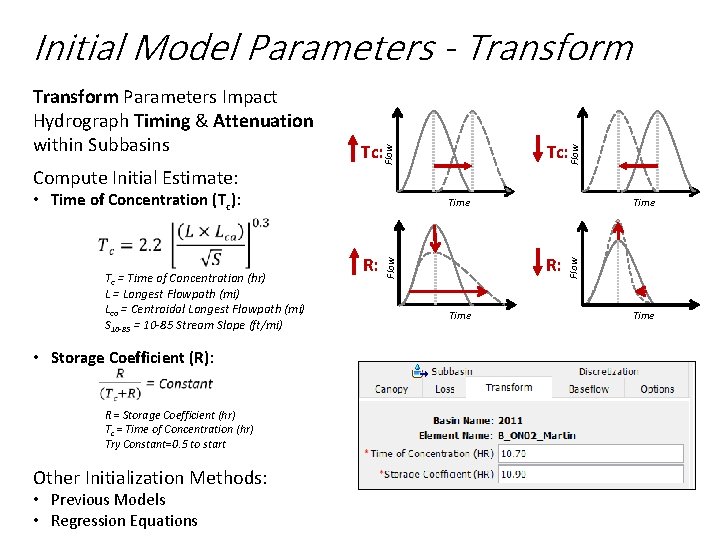
Initial Model Parameters - Transform Compute Initial Estimate: • Time of Concentration (Tc): • Storage Coefficient (R): R = Storage Coefficient (hr) Tc = Time of Concentration (hr) Try Constant=0. 5 to start Other Initialization Methods: • Previous Models • Regression Equations Time R: Time Flow Tc = Time of Concentration (hr) L = Longest Flowpath (mi) Lca = Centroidal Longest Flowpath (mi) S 10 -85 = 10 -85 Stream Slope (ft/mi) Tc: Flow Transform Parameters Impact Hydrograph Timing & Attenuation within Subbasins Time
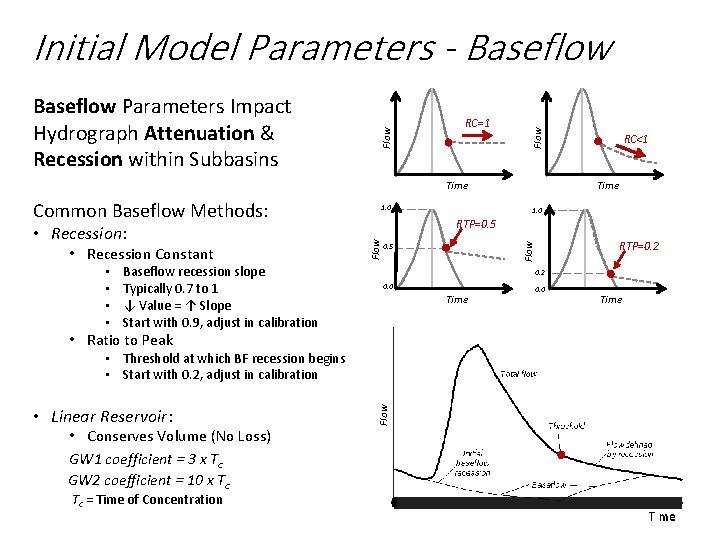
RC=1 Flow Baseflow Parameters Impact Hydrograph Attenuation & Recession within Subbasins Flow Initial Model Parameters - Baseflow Time • Recession Constant • • Baseflow recession slope Typically 0. 7 to 1 ↓ Value = ↑ Slope Start with 0. 9, adjust in calibration 0. 5 0. 0 Time Tc = Time of Concentration Flow • Threshold at which BF recession begins • Start with 0. 2, adjust in calibration • Conserves Volume (No Loss) GW 1 coefficient = 3 x Tc GW 2 coefficient = 10 x Tc RTP=0. 2 • Ratio to Peak • Linear Reservoir: 1. 0 RTP=0. 5 Flow • Recession: 1. 0 Flow Common Baseflow Methods: RC<1 0. 0 Time
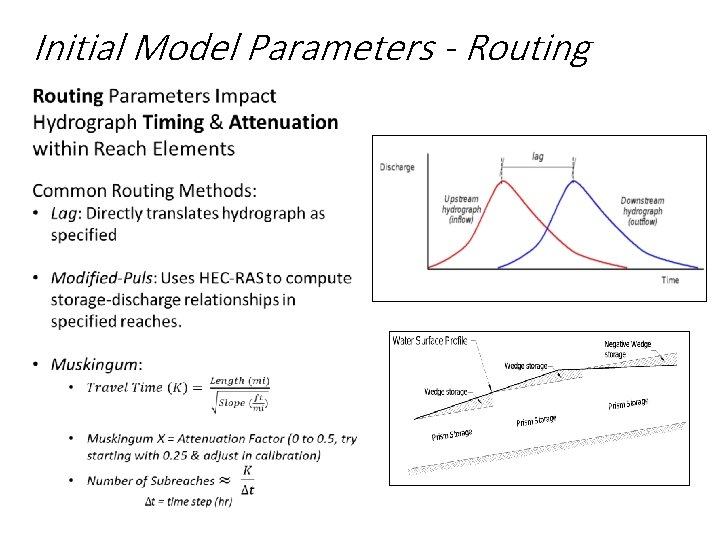
Initial Model Parameters - Routing •
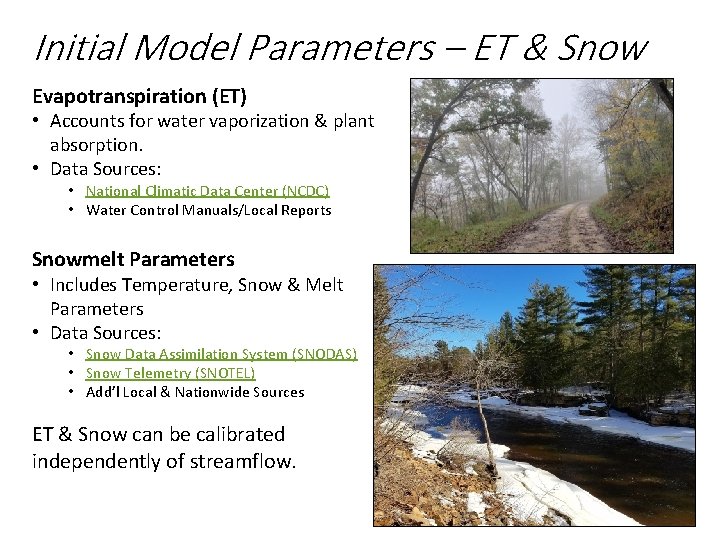
Initial Model Parameters – ET & Snow Evapotranspiration (ET) • Accounts for water vaporization & plant absorption. • Data Sources: • National Climatic Data Center (NCDC) • Water Control Manuals/Local Reports Snowmelt Parameters • Includes Temperature, Snow & Melt Parameters • Data Sources: • Snow Data Assimilation System (SNODAS) • Snow Telemetry (SNOTEL) • Add’l Local & Nationwide Sources ET & Snow can be calibrated independently of streamflow.

Setting Calibration Goals • Goals Vary by Project Objective • Goal Examples: • Quantitative Goodness-of-Fit • Statistics • Timing • Volume • Magnitude

Calibration Goals • Quantitative Goodness-of-Fit • Coefficient of Determination, Nash-Sutcliffe Efficiency, Root Mean Square Error, Percent Bias Performance Ratings for Evaluation Metrics for a daily and weekly time step Performance Rating R 2 NSE RSR PBIAS Very Good 0. 65<R 2≤ 1. 00 0. 65<������ ≤ 1. 00 0. 00<������ ≤ 0. 60 ���� < ± 15 Good 0. 55<�� 2≤ 0. 65 0. 55<������ ≤ 0. 65 0. 60<������ ≤ 0. 70 ± 15≤������� <± 20 Satisfactory 0. 40<�� 2≤ 0. 55 0. 40<������ ≤ 0. 55 0. 70<������ ≤ 0. 80 ± 20≤������� <± 30 Unsatisfactory �� 2≤ 0. 40 ������ >0. 80 ���� ≥± 30 Performance Rating Very Good Satisfactory Unsatisfactory Performance Ratings for Evaluation Metrics for a monthly time step R 2 0. 75<�� 2≤ 1. 00 0. 65<�� 2≤ 0. 75 0. 50<�� 2≤ 0. 65 �� 2≤ 0. 50 Source: Moriasi et al (2007) NSE RSR PBIAS 0. 75<������ ≤ 1. 00 0. 00<������ ≤ 0. 50 ���� < ± 10 0. 65<������ ≤ 0. 75 0. 50<������ ≤ 0. 60 ± 10≤������� <± 15 0. 50<������ ≤ 0. 65 0. 60<������ ≤ 0. 70 ± 15≤������� <± 25 ������ ≤ 0. 50 ������ >0. 70 ���� ≥± 25
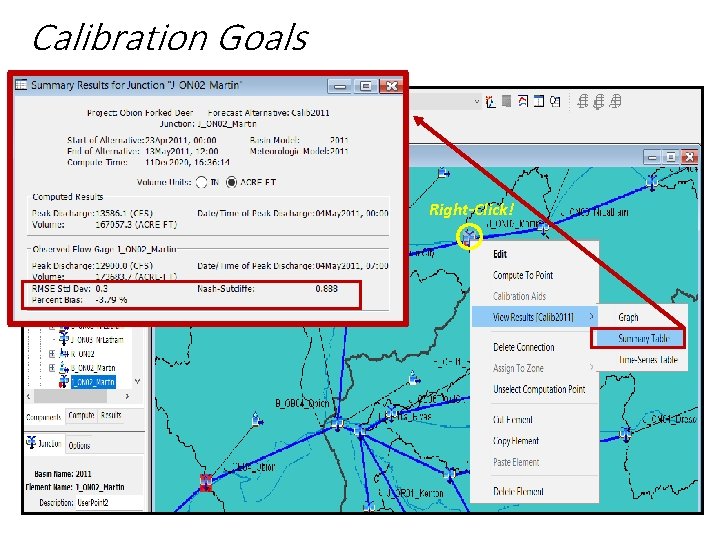
Calibration Goals Right-Click!

Calibration Goals Performance Ratings for Evaluation Metrics for a daily and weekly time step Performance Rating R 2 NSE RSR PBIAS Very Good 0. 65<R 2≤ 1. 00 0. 65<������ ≤ 1. 00 0. 00<������ ≤ 0. 60 ���� < ± 15 Good 0. 55<�� 2≤ 0. 65 0. 55<������ ≤ 0. 65 0. 60<������ ≤ 0. 70 ± 15≤������� <± 20 Satisfactory 0. 40<�� 2≤ 0. 55 0. 40<������ ≤ 0. 55 0. 70<������ ≤ 0. 80 ± 20≤������� <± 30 Unsatisfactory �� 2≤ 0. 40 ������ >0. 80 ���� ≥± 30 Source: Moriasi et al (2007)
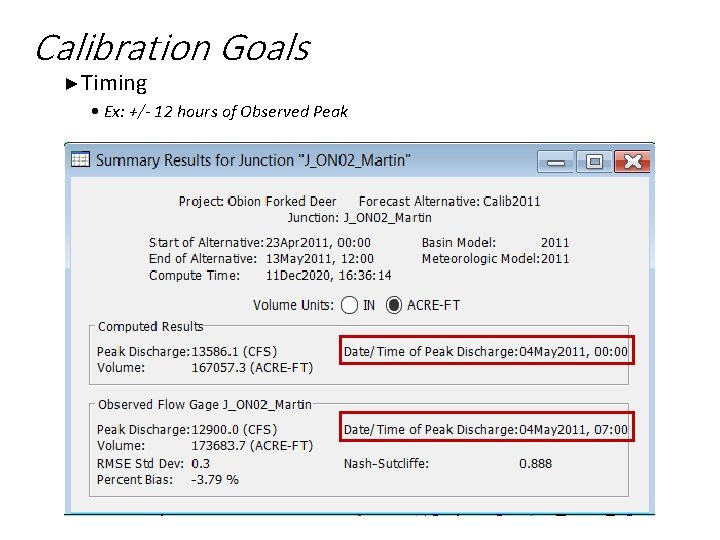
Calibration Goals ►Timing • Ex: +/- 12 hours of Observed Peak
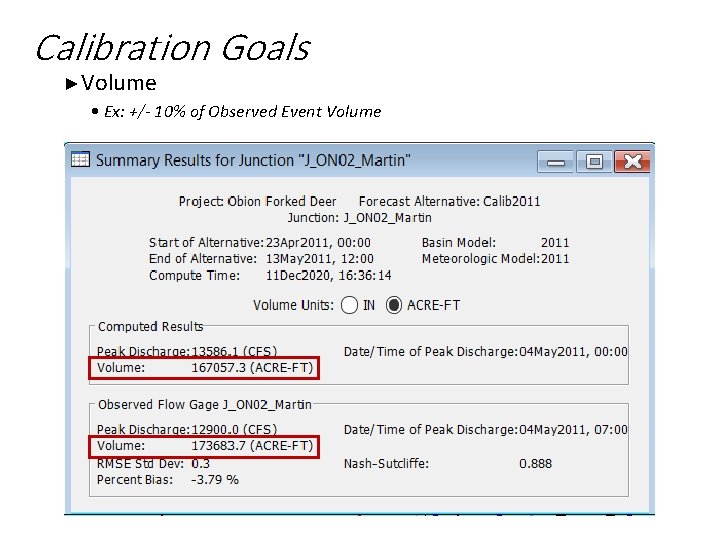
Calibration Goals ►Volume • Ex: +/- 10% of Observed Event Volume
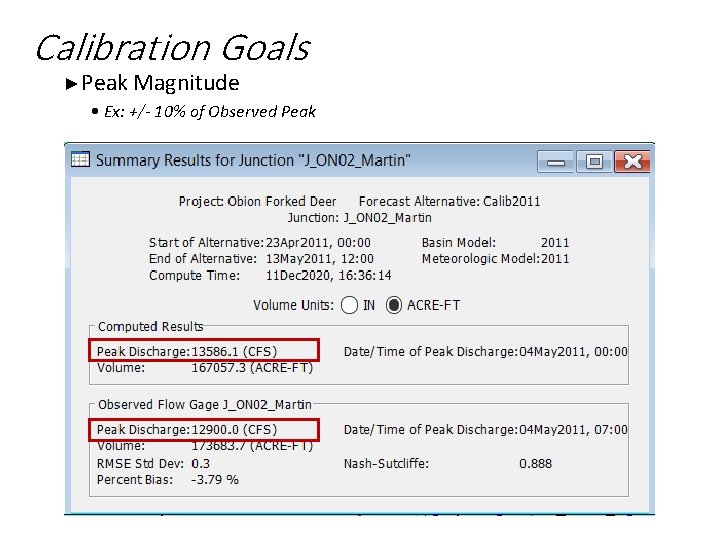
Calibration Goals ►Peak Magnitude • Ex: +/- 10% of Observed Peak
Takeaways • Setting Initial Model Parameters • “Best Guess” Starting Values • Parameters Will Evolve Throughout Calibration • Setting Calibration Goals • Quantifying Fit (vs. “Eyeball Test”) • Goals Depend on Scope of Project
References Moriasi, D. N. , J. G. Arnold, M. W. Van Liew, R. L. Bingner, R. D. Harmel, and T. L. Veith, Model evaluation guidelines for systematic quantification of accuracy in watershed simulations, Transactions of the ASABE 50 (3), 885 -900, 2007

HMS Model Calibration Strategies Emily Moe, P. E. St. Paul District U. S. Army Corps of Engineers
- Slides: 20