
HMRC Movement of Goods End of Transition period
- Slides: 26
HMRC Movement of Goods – End of Transition period November 2020 1 OFFICIAL
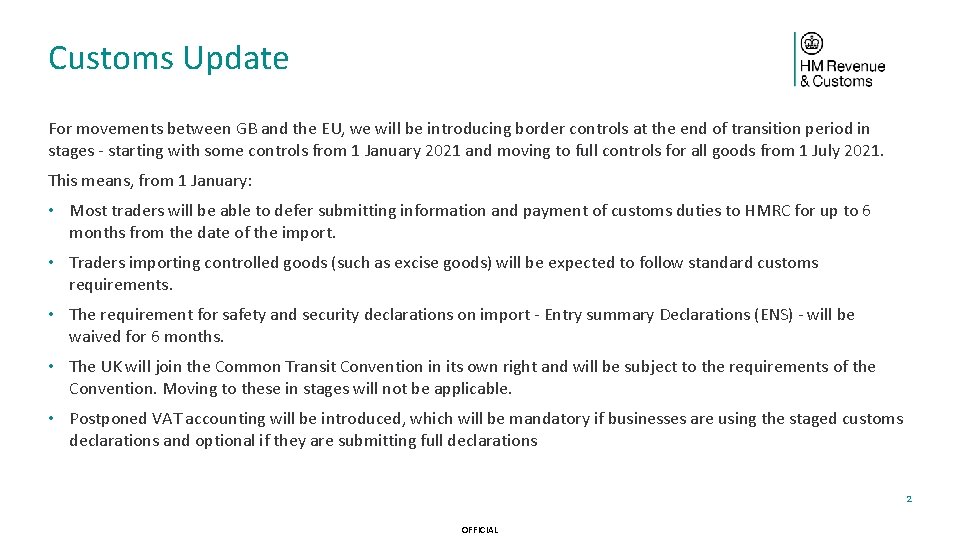
Customs Update For movements between GB and the EU, we will be introducing border controls at the end of transition period in stages - starting with some controls from 1 January 2021 and moving to full controls for all goods from 1 July 2021. This means, from 1 January: • Most traders will be able to defer submitting information and payment of customs duties to HMRC for up to 6 months from the date of the import. • Traders importing controlled goods (such as excise goods) will be expected to follow standard customs requirements. • The requirement for safety and security declarations on import - Entry summary Declarations (ENS) - will be waived for 6 months. • The UK will join the Common Transit Convention in its own right and will be subject to the requirements of the Convention. Moving to these in stages will not be applicable. • Postponed VAT accounting will be introduced, which will be mandatory if businesses are using the staged customs declarations and optional if they are submitting full declarations 2 OFFICIAL
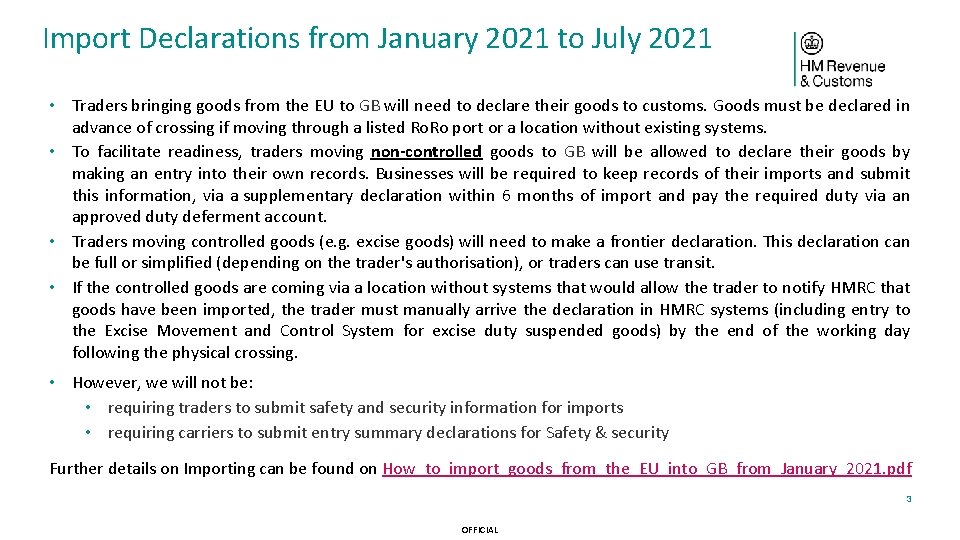
Import Declarations from January 2021 to July 2021 • Traders bringing goods from the EU to GB will need to declare their goods to customs. Goods must be declared in advance of crossing if moving through a listed Ro. Ro port or a location without existing systems. • To facilitate readiness, traders moving non-controlled goods to GB will be allowed to declare their goods by making an entry into their own records. Businesses will be required to keep records of their imports and submit this information, via a supplementary declaration within 6 months of import and pay the required duty via an approved duty deferment account. • Traders moving controlled goods (e. g. excise goods) will need to make a frontier declaration. This declaration can be full or simplified (depending on the trader's authorisation), or traders can use transit. • If the controlled goods are coming via a location without systems that would allow the trader to notify HMRC that goods have been imported, the trader must manually arrive the declaration in HMRC systems (including entry to the Excise Movement and Control System for excise duty suspended goods) by the end of the working day following the physical crossing. • However, we will not be: • requiring traders to submit safety and security information for imports • requiring carriers to submit entry summary declarations for Safety & security Further details on Importing can be found on How_to_import_goods_from_the_EU_into_GB_from_January_2021. pdf 3 OFFICIAL
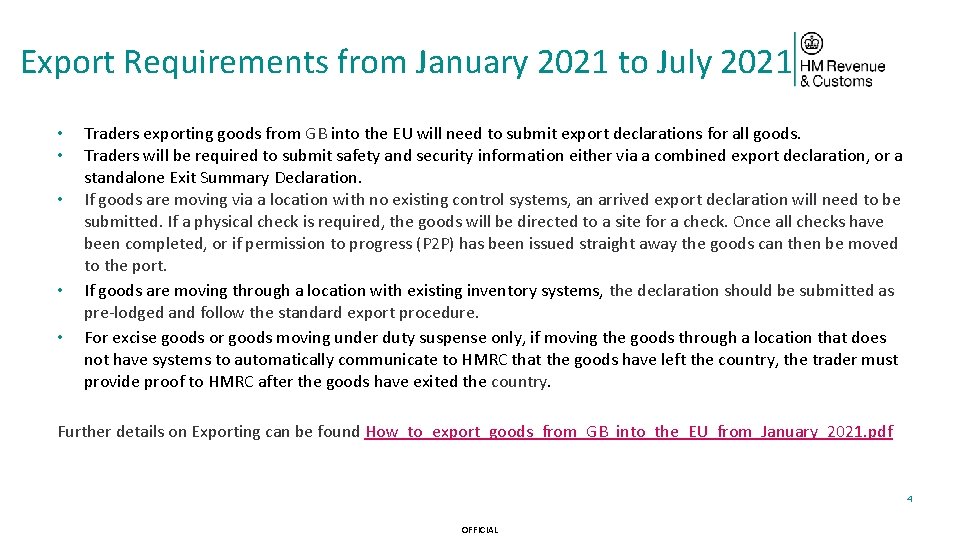
Export Requirements from January 2021 to July 2021 • • • Traders exporting goods from GB into the EU will need to submit export declarations for all goods. Traders will be required to submit safety and security information either via a combined export declaration, or a standalone Exit Summary Declaration. If goods are moving via a location with no existing control systems, an arrived export declaration will need to be submitted. If a physical check is required, the goods will be directed to a site for a check. Once all checks have been completed, or if permission to progress (P 2 P) has been issued straight away the goods can then be moved to the port. If goods are moving through a location with existing inventory systems, the declaration should be submitted as pre-lodged and follow the standard export procedure. For excise goods or goods moving under duty suspense only, if moving the goods through a location that does not have systems to automatically communicate to HMRC that the goods have left the country, the trader must provide proof to HMRC after the goods have exited the country. Further details on Exporting can be found How_to_export_goods_from_GB_into_the_EU_from_January_2021. pdf 4 OFFICIAL
Full Controls From July 2021 • Traders will have to make full customs declarations (or use Simplified procedures if they are authorised to do so) at the point of importation on all goods and pay relevant tariffs. • Full Safety and Security declarations will be required. • Border locations can either use the temporary storage model, or the newly developed pre-lodgement model (developed as an alternative where border locations may not have the space and infrastructure to operate temporary storage). • The Temporary Storage model allows goods to be stored for up to 90 days at an HMRC approved temporary storage facility, before a declaration is made and Government officials carry out any checks before goods are released from the facility. • The Pre-lodgement model ensures that all declarations are pre-lodged before they board on the EU side, this will maintain flow. • HMRC will introduce a new IT system called the Goods Vehicle Movement Service (GVMS) to support the Prelodgement model for both imports and exports and to facilitate Transit movements. Further details on customs can be found on https: //www. gov. uk/topic/business-tax/import-export 5 OFFICIAL
Customs Special Procedures • Customs Special Procedures allow businesses to benefit from full or partial relief on the payment of customs duties and VAT under specified conditions. Included within Special Procedures is Temporary Admission. • Temporary Admission is a customs procedure that allows you to import non-UK goods temporarily in to the UK and, provided you remove the goods from the UK at a later date, any import duty or import VAT is suspended. • This can be useful if temporarily importing goods such as professional equipment, samples or items for exhibition, demonstration in to the UK. • Goods can be imported under Temporary Admission for up to 24 months. This can be extended in exceptional circumstances. Some goods imported under Temporary Admission have set time limits to be discharged. • The procedure may only be used when the holder is established outside of the UK, although there are some exceptions, for example, medical, surgical or laboratory equipment. • Following the UK’s departure from the EU, we have now entered a transition period which ends on 31 December 2020. From 1 January 2021, Temporary Admission can be used for goods entering the UK from EU countries (as well as for Rest of World imports), provided the relevant conditions are met. • HMRC is also reviewing the impact of the NI Protocol on Special Procedures such as Temporary Admission Further details on Customs Special Procedures can be found at https: //www. gov. uk/guidance/pay-less-or-no-duty-ongoods-you-store-process-repair-or-temporarily-use OFFICIAL 6
Help and support • HMRC is writing to all VAT registered traders to tell them about actions they need to take – here’s a link to the monthly letters https: //www. gov. uk/government/publications/letters-to-businesses-about-new-tradearrangements-with-the-eu-from-1 -january-2021 • For more information please find links to the border operating model updated 8 October https: //www. gov. uk/government/publications/the-border-operating-model • There also some very useful step by step guides on importing and exporting https: //www. gov. uk/government/publications/how-to-import-and-export-goods-between-great-britain-and-theeu-from-1 -january-2021 • And useful one page link to guidance for traders can be found https: //www. gov. uk/guidance/help-and-support-ifyour-business-trades-with-the-eu 7 OFFICIAL
Update on the Northern Ireland Protocol | Official Sensitive | HMRC NI Engagement | OFFICIAL 8
What you need to know | Official Sensitive | HMRC NI Engagement | OFFICIAL 9
The Northern Ireland Protocol` From 1 January 2021 our trading arrangements will either be based on the Withdrawal Agreement only, or on a Free Trade Agreement concluded with the EU. The Northern Ireland Protocol has been designed as a practical solution to avoiding a hard border on the island of Ireland whatever the trading arrangements are between the UK and the EU. The staged approach that applies in GB to EU-GB movements will not apply in Northern Ireland. Under the protocol the UK Government will: • Deliver unfettered access for NI producers to the whole of the UK market; • Ensure there are no tariffs on goods remaining within the UK customs territory; • Give effect to our obligations without the need for any new customs infrastructure in Northern Ireland; and • Guarantee that NI businesses will benefit from the lower tariffs we deliver through our new Free Trade Agreements with third countries. OFFICIAL
Joint Committee agreement In December the UK Government announced that agreement has been found in the following areas, amongst others: • export declarations, • ‘at risk’ goods • A UK Trader Scheme for businesses to declare their goods not at risk What has been agreed at the Joint Committee does not alter the requirement for goods moving GB to NI to have an import declaration and an entry Safety and Security declaration. This applies even where easements have been agreed for certain supplies of agri-food products in relation to SPS requirements. The UK government’s approach is set out in a command paper published 10 December 2020. The NI Command Paper OFFICIAL
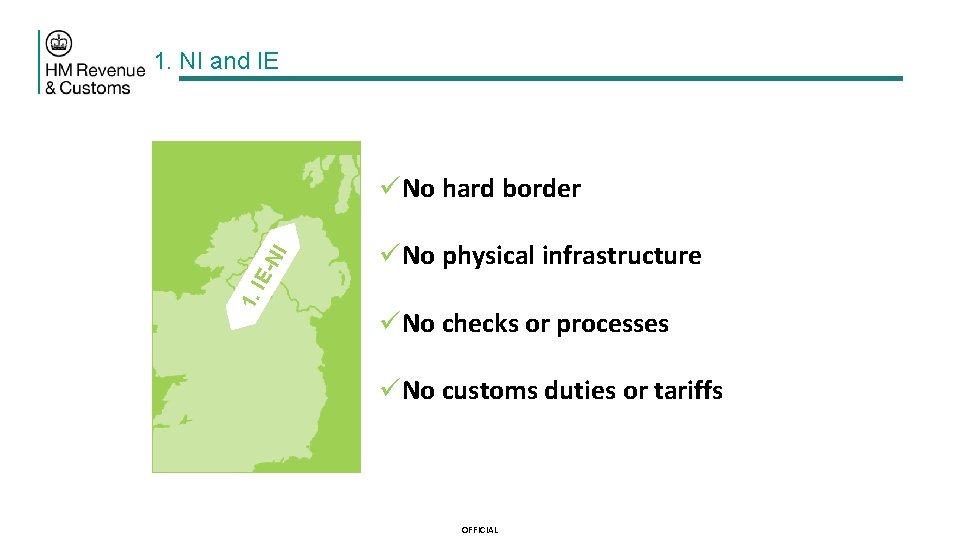
1. NI and IE 1. IE- NI üNo hard border üNo physical infrastructure üNo checks or processes üNo customs duties or tariffs OFFICIAL
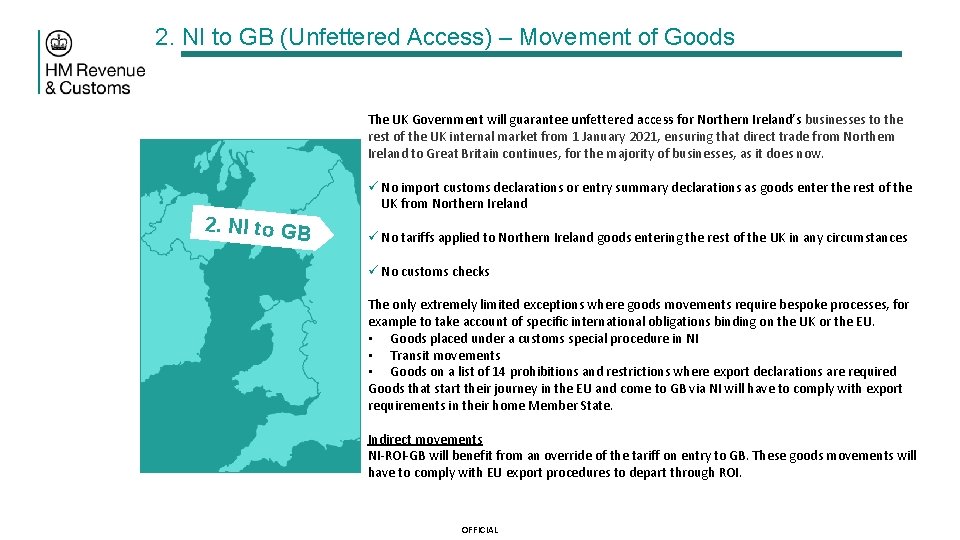
2. NI to GB (Unfettered Access) – Movement of Goods The UK Government will guarantee unfettered access for Northern Ireland’s businesses to the rest of the UK internal market from 1 January 2021, ensuring that direct trade from Northern Ireland to Great Britain continues, for the majority of businesses, as it does now. 2. NI to GB ü No import customs declarations or entry summary declarations as goods enter the rest of the UK from Northern Ireland ü No tariffs applied to Northern Ireland goods entering the rest of the UK in any circumstances ü No customs checks The only extremely limited exceptions where goods movements require bespoke processes, for example to take account of specific international obligations binding on the UK or the EU. • Goods placed under a customs special procedure in NI • Transit movements • Goods on a list of 14 prohibitions and restrictions where export declarations are required Goods that start their journey in the EU and come to GB via NI will have to comply with export requirements in their home Member State. Indirect movements NI-ROI-GB will benefit from an override of the tariff on entry to GB. These goods movements will have to comply with EU export procedures to depart through ROI. OFFICIAL
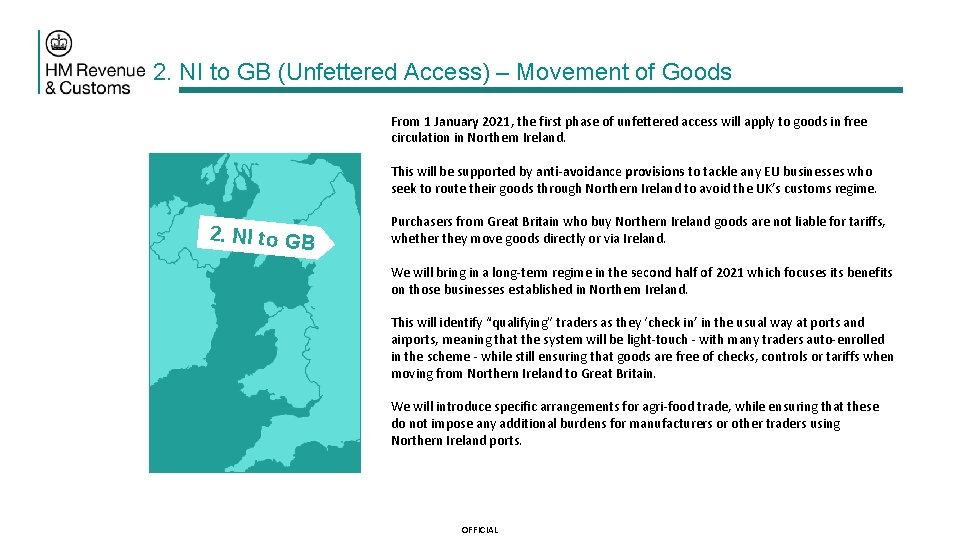
2. NI to GB (Unfettered Access) – Movement of Goods From 1 January 2021, the first phase of unfettered access will apply to goods in free circulation in Northern Ireland. This will be supported by anti-avoidance provisions to tackle any EU businesses who seek to route their goods through Northern Ireland to avoid the UK’s customs regime. 2. NI to GB Purchasers from Great Britain who buy Northern Ireland goods are not liable for tariffs, whether they move goods directly or via Ireland. We will bring in a long-term regime in the second half of 2021 which focuses its benefits on those businesses established in Northern Ireland. This will identify “qualifying” traders as they ‘check in’ in the usual way at ports and airports, meaning that the system will be light-touch - with many traders auto-enrolled in the scheme - while still ensuring that goods are free of checks, controls or tariffs when moving from Northern Ireland to Great Britain. We will introduce specific arrangements for agri-food trade, while ensuring that these do not impose any additional burdens for manufacturers or other traders using Northern Ireland ports. OFFICIAL
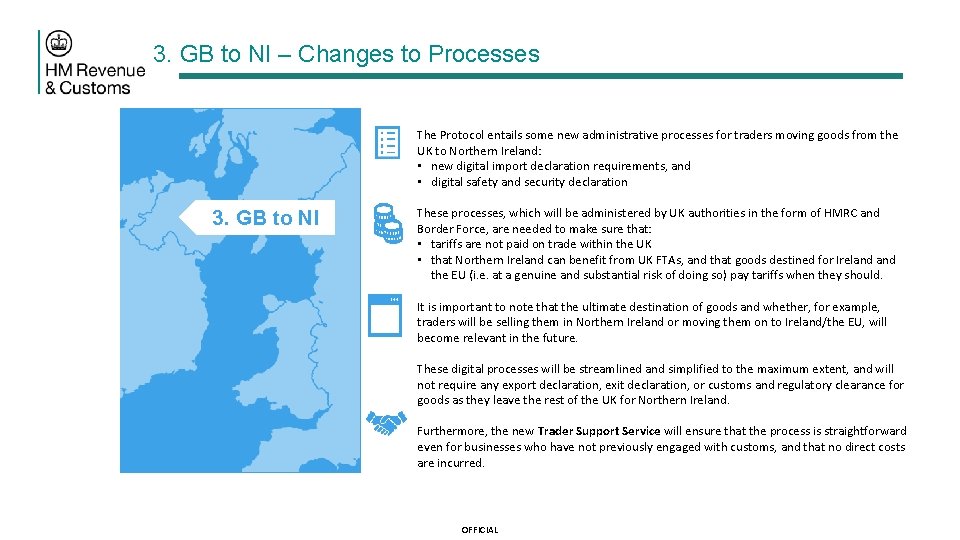
3. GB to NI – Changes to Processes The Protocol entails some new administrative processes for traders moving goods from the UK to Northern Ireland: • new digital import declaration requirements, and • digital safety and security declaration 3. GB to NI These processes, which will be administered by UK authorities in the form of HMRC and Border Force, are needed to make sure that: • tariffs are not paid on trade within the UK • that Northern Ireland can benefit from UK FTAs, and that goods destined for Ireland the EU (i. e. at a genuine and substantial risk of doing so) pay tariffs when they should. It is important to note that the ultimate destination of goods and whether, for example, traders will be selling them in Northern Ireland or moving them on to Ireland/the EU, will become relevant in the future. These digital processes will be streamlined and simplified to the maximum extent, and will not require any export declaration, exit declaration, or customs and regulatory clearance for goods as they leave the rest of the UK for Northern Ireland. Furthermore, the new Trader Support Service will ensure that the process is straightforward even for businesses who have not previously engaged with customs, and that no direct costs are incurred. OFFICIAL
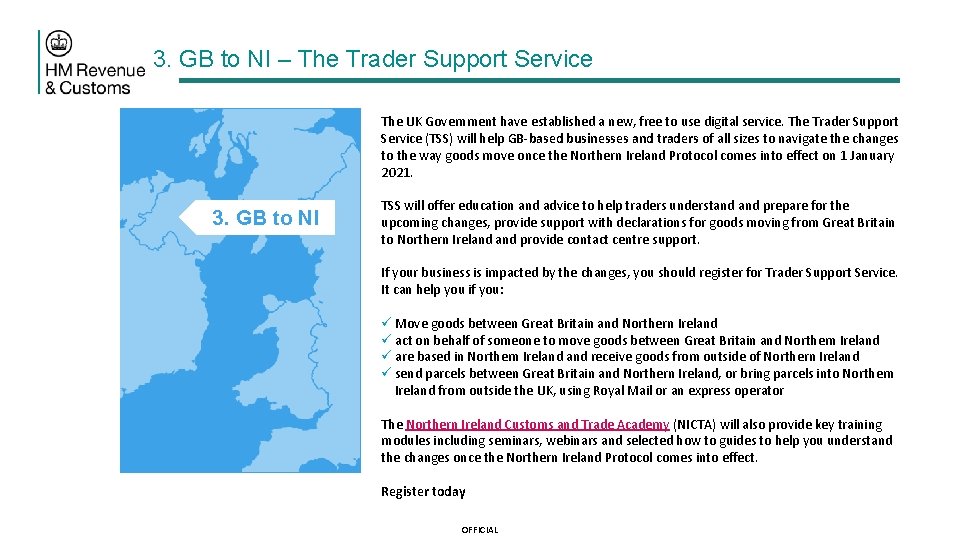
3. GB to NI – The Trader Support Service The UK Government have established a new, free to use digital service. The Trader Support Service (TSS) will help GB-based businesses and traders of all sizes to navigate the changes to the way goods move once the Northern Ireland Protocol comes into effect on 1 January 2021. 3. GB to NI TSS will offer education and advice to help traders understand prepare for the upcoming changes, provide support with declarations for goods moving from Great Britain to Northern Ireland provide contact centre support. If your business is impacted by the changes, you should register for Trader Support Service. It can help you if you: ü Move goods between Great Britain and Northern Ireland ü act on behalf of someone to move goods between Great Britain and Northern Ireland ü are based in Northern Ireland receive goods from outside of Northern Ireland ü send parcels between Great Britain and Northern Ireland, or bring parcels into Northern Ireland from outside the UK, using Royal Mail or an express operator The Northern Ireland Customs and Trade Academy (NICTA) will also provide key training modules including seminars, webinars and selected how to guides to help you understand the changes once the Northern Ireland Protocol comes into effect. Register today OFFICIAL
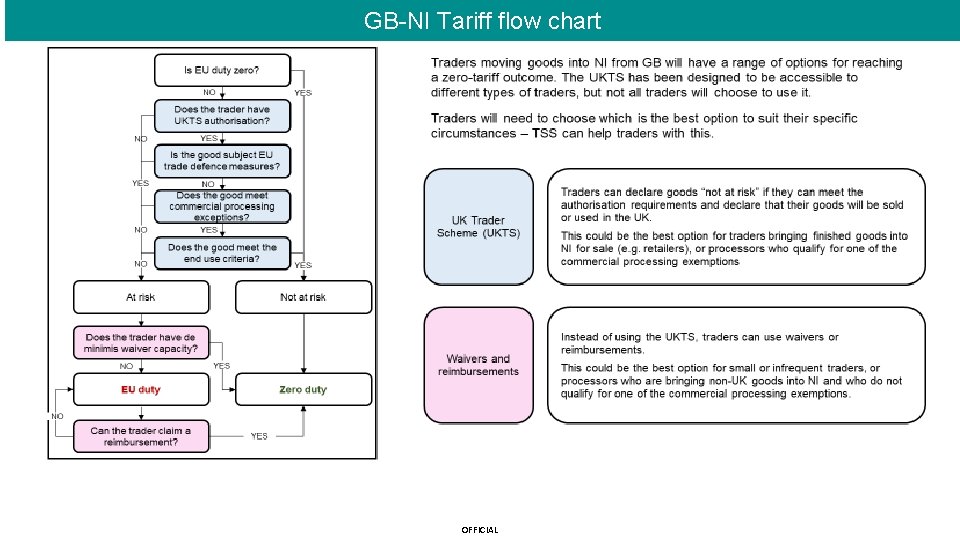
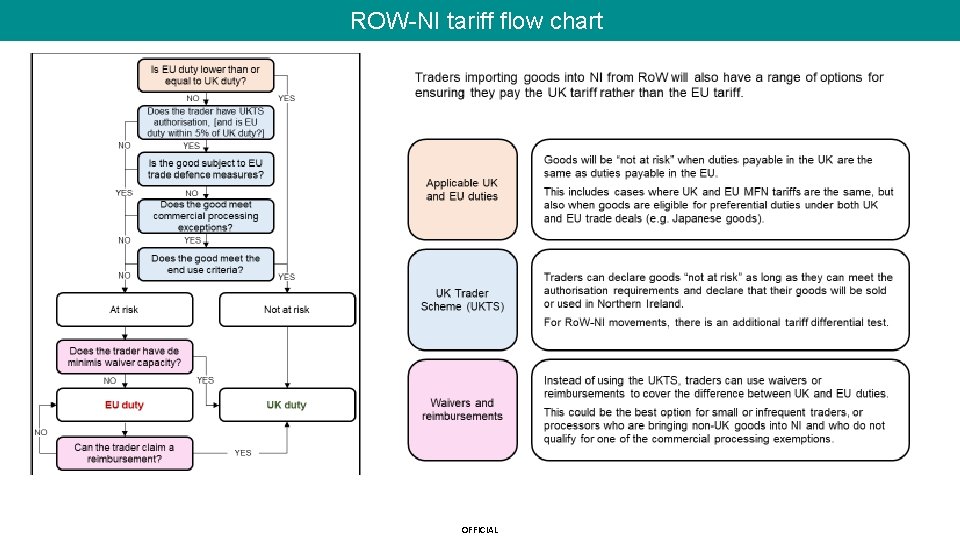
At risk goods Businesses will have a range of options to reach the right outcome on the application of tariffs for goods movements into NI. Good always at risk: • Good subject to EU trade defence measures • Good subject to commercial processing in NI and the additional processing criteria is not met • Goods from outside the UK/EU where the EU duty is more than 3% greater than the UK duty Goods automatically not at risk • Good where the UK duty is equal to or higher than the EU duty For GB-NI movements there is no UK duty so this would cover goods where the EU tariff is zero A business does not require a UK Trader Scheme authorisation to declare these goods not at risk OFFICIAL
At risk goods A business may register for the UK Trader Scheme, which will allow them to declare their goods are not at risk, where the goods meet the criteria below Good which may be declared not at risk: • Goods for sale to or final use by, end-consumers located in the UK • For example, goods for sale in retail stores • Goods for business use in NI • For example, a business purchasing stationery, or a farmer purchasing a tractor A business does not need to provide supporting evidence as part of its declaration, but must hold evidence, which may be examined by HMRC on request Examples of evidence: • Commercial receipts and invoices • Commercial contracts and purchase orders • Delivery receipts, consignment notes OFFICIAL
UK Trader Scheme To declare goods not at risk a business must be authorised to use the UK Trader Scheme Open to businesses in all sectors and of all sizes Criteria: • Established in NI, or • Established in GB and have indirect representation in NI and have a fixed place of business in NI where records are available and where goods are sold to, or provided for final use by end-consumers, and • Have no history of serious customs or tax infringements or other similar criminal offences of an economic nature, and • Have sufficient controls of their operations and record keeping to ensure they can provide evidence to support not at risk declarations OFFICIAL
Commercial processing Goods brought into NI for processing are automatically at risk, unless the business meets one of the criteria: • Small processor – businesses with an annual turnover less than £ 500, 000 pa • Approved processing sectors • Sale of food to end-consumers • Construction in NI • Final use of animal feed in NI Other than the sale of food the processing must be carried out by the business moving the goods into NI Businesses who meet these criteria must inform HMRC of this when applying for the UKTS. Once authorised they may declare goods for processing not at risk. They must keep supporting evidence. OFFICIAL
GB-NI Tariff flow chart OFFICIAL
ROW-NI tariff flow chart . OFFICIAL
What you need to do | Official Sensitive | HMRC NI Engagement | OFFICIAL 23
EORI- Requirements for movements From 1 Jan 2021 you will need an EORI number to move goods between GB (England, Scotland, Wales) and the EU. You may also need one if you move goods to or from NI. If you do not have an EORI you may incur increased costs and delays. If you move goods to or from Northern Ireland From 1 January 2021 you’ll need an EORI number that starts with XI to: • move goods between Northern Ireland GB • move goods between Northern Ireland non-EU countries • make a declaration in Northern Ireland • get a customs decision in Northern Ireland To get an EORI number that starts with XI, you must already have an EORI number that starts with GB. If you do not have one, apply for an EORI number that starts with GB as soon as possible. If you already have an EORI number that starts with GB and HMRC thinks you need one that starts with XI, they’ll automatically send you one in mid-December 2020. OFFICIAL
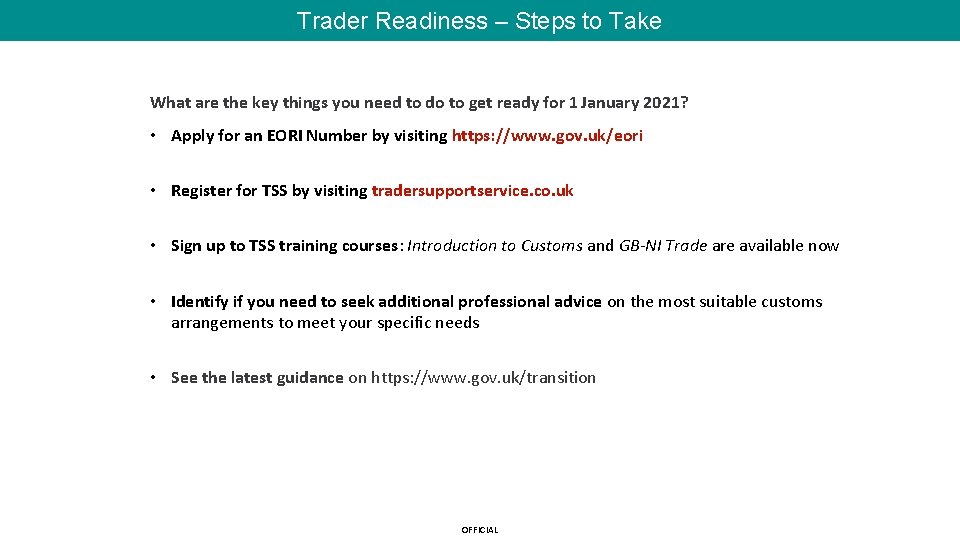
Trader Readiness – Steps to Take What are the key things you need to do to get ready for 1 January 2021? • Apply for an EORI Number by visiting https: //www. gov. uk/eori • Register for TSS by visiting tradersupportservice. co. uk • Sign up to TSS training courses: Introduction to Customs and GB-NI Trade are available now • Identify if you need to seek additional professional advice on the most suitable customs arrangements to meet your specific needs • See the latest guidance on https: //www. gov. uk/transition OFFICIAL
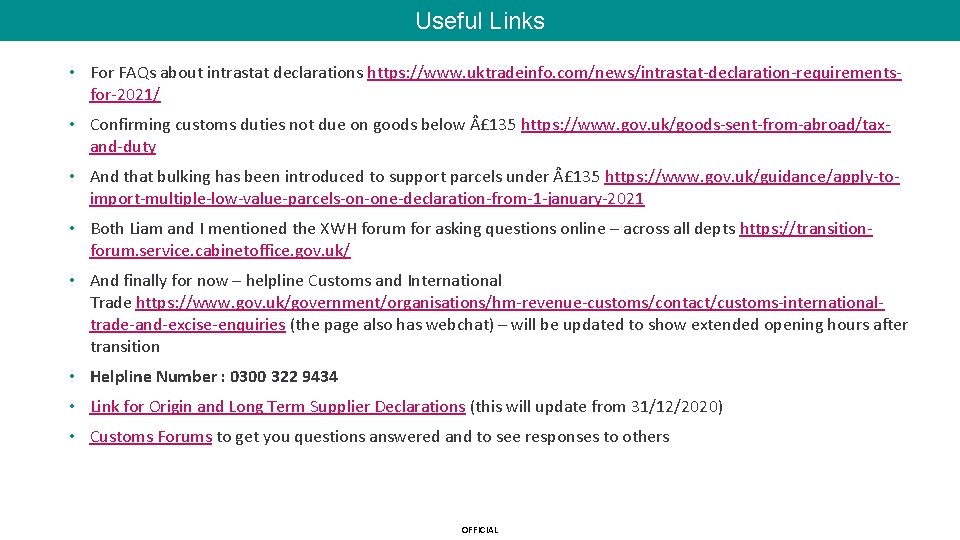
Useful Links • For FAQs about intrastat declarations https: //www. uktradeinfo. com/news/intrastat-declaration-requirementsfor-2021/ • Confirming customs duties not due on goods below £ 135 https: //www. gov. uk/goods-sent-from-abroad/taxand-duty • And that bulking has been introduced to support parcels under £ 135 https: //www. gov. uk/guidance/apply-toimport-multiple-low-value-parcels-on-one-declaration-from-1 -january-2021 • Both Liam and I mentioned the XWH forum for asking questions online – across all depts https: //transitionforum. service. cabinetoffice. gov. uk/ • And finally for now – helpline Customs and International Trade https: //www. gov. uk/government/organisations/hm-revenue-customs/contact/customs-internationaltrade-and-excise-enquiries (the page also has webchat) – will be updated to show extended opening hours after transition • Helpline Number : 0300 322 9434 • Link for Origin and Long Term Supplier Declarations (this will update from 31/12/2020) • Customs Forums to get you questions answered and to see responses to others OFFICIAL