
HMON HNMMB Development of a new Hurricane model

HMON (HNMMB): Development of a new Hurricane model for NWS/NCEP operations Avichal Mehra, EMC Hurricane and Mesoscale Teams Environmental Modeling Center NOAA / NWS / NCEP

HMON: A New Operational Hurricane Model at NCEP HMO N HMON: Hurricanes in a Multi-scale Ocean coupled Non-hydrostatic model HMON: Implements a long-term strategy at NCEP/EMC for multiple static and moving nests globally, with one- and two-way interaction and coupled to other (ocean, wave, sea ice, surge, inundation, etc. ) models using NEMS-NUOPC infrastructure. 2
Long-Term Strategies for Operational Hurricane Modeling at NCEP 1. Strategies for unified regional (meso-scale) models in the NEMS framework • Be able to meet the performance of current operational HWRF • Accommodate future development strategies including coupling to ocean, waves, land, surge and hydrology • Retain and expand community interactions fostered by HFIP • Flexible options for inner-core data assimilation • Enable future ensemble strategies and potential genesis and 7 -day intensity forecasts 2. Strategies for unified global model with multiple moveable nests • Take advantage of NGGPS/FV 3 supported development of non-hydrostatic global model in NEMS with high resolution nests for hurricanes • Leverage NMMB and GFS physics unification • Transition regional hurricane model components to global system for seamless prediction of hurricanes and severe weather 3. Strategies for serving the next-generation needs of operational tropical cyclone forecasters • Expand the products to include deterministic and probabilistic forecast guidance on genesis, rapid intensity changes, size, structure, storm-surge, rainfall, flooding and inundation and warn on forecasts 3
What is NEMS? • NEMS stands for: NOAA’s Environmental Modeling System • A shared, portable, high performance software superstructure and infrastructure • For use in operational prediction models at the National Centers for Environmental Prediction (NCEP) • Leveraging NUOPC related community developments * slide courtesy Cecelia De. Luca 4
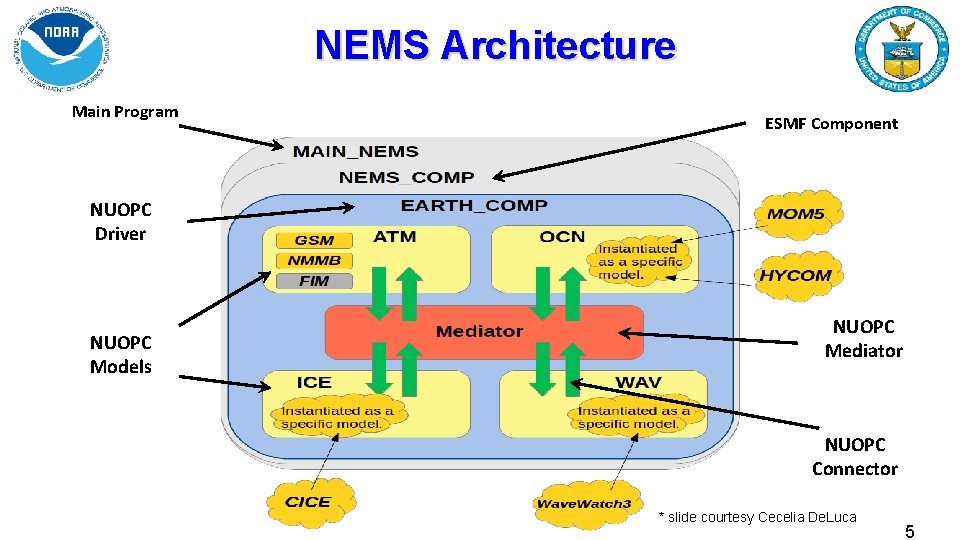
NEMS Architecture Main Program ESMF Component NUOPC Driver NUOPC Models NUOPC Mediator NUOPC Connector * slide courtesy Cecelia De. Luca 5
FY 17 HMON Configuration • Features • Current status • Flowchart • Physics options 6
HMON: Hurricanes in a Multi-scale Ocean coupled Non-hydrostatic model • HMON: Advanced Hurricane Model using NMMB (Non-hydrostatic Multi-scale Model on a B grid) dynamic core which is currently being used in NCEP’s operational NAM and SREF systems. • Shared infrastructure with unified model development in NEMS. A step closer towards NEMS/FV 3 Unified Modeling System for hurricanes • Much faster, scalable and uses CCPP style physics package • Development supported by NGGPS, HFIP and HIWPP programs • Provides high-resolution intensity forecast guidance to NHC along with HWRF (replacing the legacy GFDL hurricane model) 7
Status of HMON at EMC (March 2017) 1. HWRF physics package and storm motion algorithm have been added to NMMB dy-core. 2. HMON vortex initialization has been developed. 3. HMON restart capability has been implemented. (1) , (2), and (3) via active collaboration between EMC-HRD funded by HIWPP 4. Post and tracker scripts are working. 5. Python workflow has been built. 6. HMON ran in real-time on Theia for 2016 Hurricane season (using 1 -5) 7. Retrospectives (2014 -2016) completed using 2016 GFS. 8. Redo retrospectives using 2017 GFS (uncoupled and coupled) 8
Status of HMON at EMC (March 2017) Two options for earth-system component coupling: 1. EMC legacy coupler (leverage HWRF developments) -- operationally ready -- extensively tested, robust -- configured for 3 -way interactions (air-ocean-wave) 2. NEMS-NUOPC coupler -- unified modeling (Future) -- based on ESMF regridding/functionality/portability -- extensible to multiple-storm/component configurations -- extensible to FV 3/NEMS based configurations -- leverage other coupled systems (NWS, NRL, NASA) 9
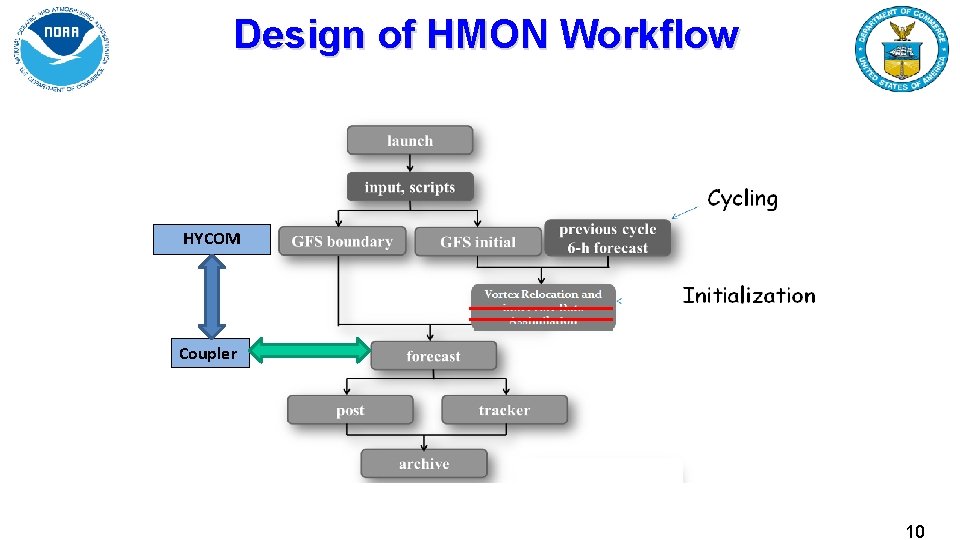
Design of HMON Workflow HYCOM Coupler 10
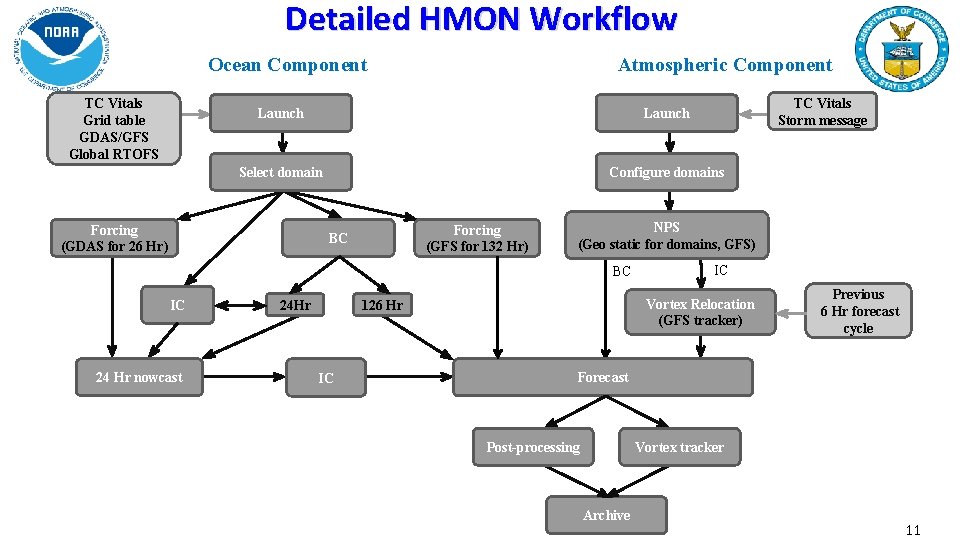
Detailed HMON Workflow Ocean Component TC Vitals Grid table GDAS/GFS Global RTOFS Atmospheric Component Launch Select domain Configure domains Forcing (GDAS for 26 Hr) Forcing (GFS for 132 Hr) BC NPS (Geo static for domains, GFS) BC IC 24 Hr nowcast TC Vitals Storm message Launch 24 Hr Vortex Relocation (GFS tracker) 126 Hr IC IC Previous 6 Hr forecast cycle Forecast Post-processing Vortex tracker Archive 11
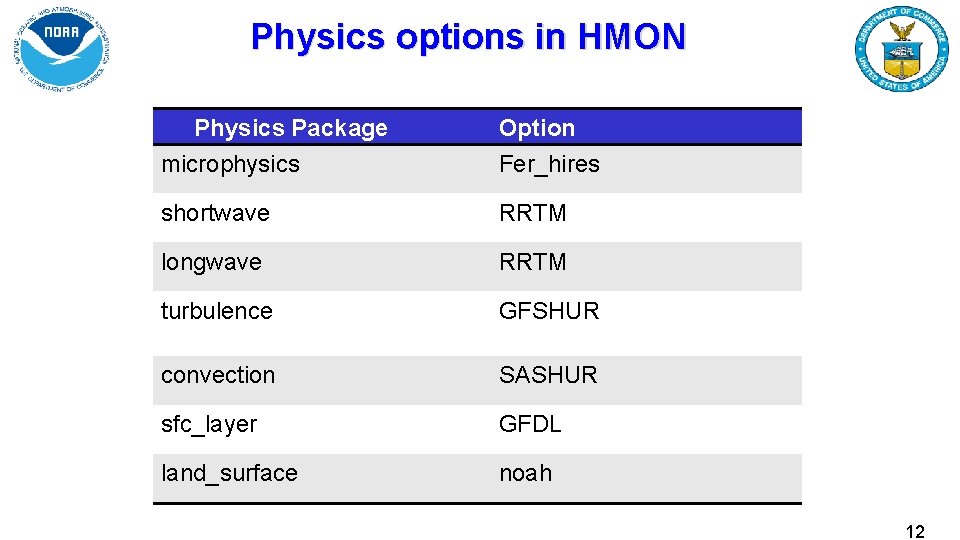
Physics options in HMON Physics Package microphysics Option Fer_hires shortwave RRTM longwave RRTM turbulence GFSHUR convection SASHUR sfc_layer GFDL land_surface noah 12

HWRF vs GFDL vs HMON HWRF GFDL HMON Dycore Non-hydrostatic, NMM-E Hydrostatic Non-hydrostatic, NMM-B Nesting 18/6/2 kms; 75°/25°/8. 3°, Full two-way moving ½. °, 1/6°, 1/18°; 75°/11°/5°, Two-way moving with bc 18/6/2 kms; 75°/12°/8°, Full two-way moving Data Self-cycled two-way HWRF En. KF Spin-up using idealized Assimilation and -GSI with inner core DA (TDR); axisymmetric vortex Initialization Vortex relocation & adjustment NDAS, NLDAS with partial cycling; Vortex relocation & adjustment Physics Updated surface (GFDL), GFSEDMF PBL, Scale-aware SAS, NOAH LSM, RRTM, Ferrier Surface (GFDL), GFS PBL(2014), SAS, GFDL LSM, RRTM, Ferrier Surface (GFDL), GFS PBL (2015), SAS, NOAH LSM, RRTM, Ferrier Coupling MPIPOM, RTOFS/GDEM Wavewatch-III MPIPOM, RTOFS/GDEM, No waves HYCOM, RTOFS/NCODA, No waves Post-processing NHC interpolation method, GFDL tracker NHC interpolation Method, NHC interpolation method, In-line tracker GFDL tracker NEMS/NUOPC No No Yes with moving nests 13
2014 -2016 Retrospective Statistics for HMON 14
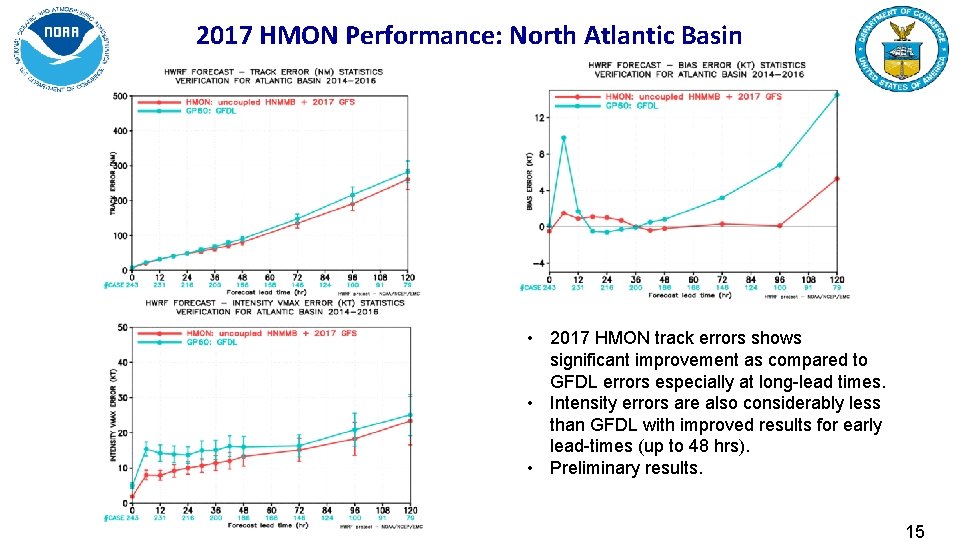
2017 HMON Performance: North Atlantic Basin • 2017 HMON track errors shows significant improvement as compared to GFDL errors especially at long-lead times. • Intensity errors are also considerably less than GFDL with improved results for early lead-times (up to 48 hrs). • Preliminary results. 15
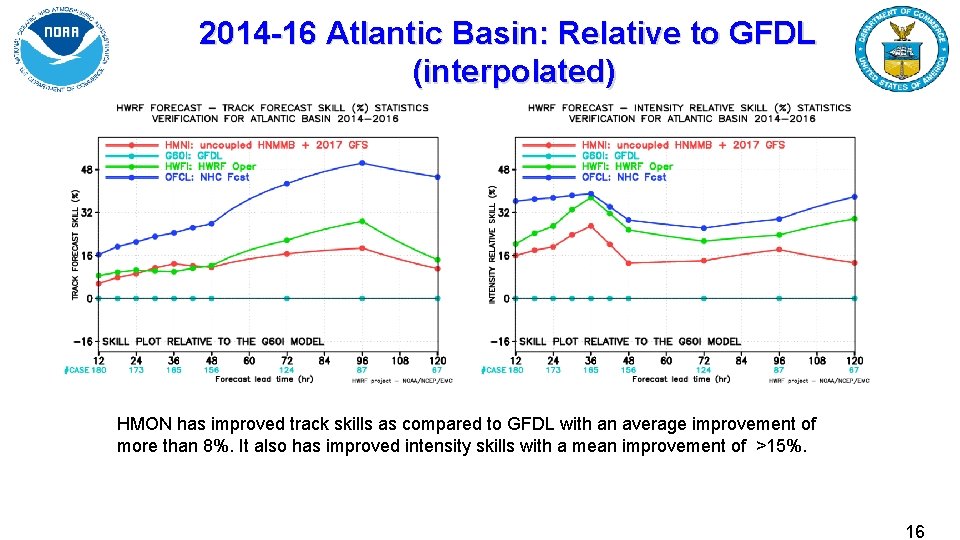
2014 -16 Atlantic Basin: Relative to GFDL (interpolated) HMON has improved track skills as compared to GFDL with an average improvement of more than 8%. It also has improved intensity skills with a mean improvement of >15%. 16
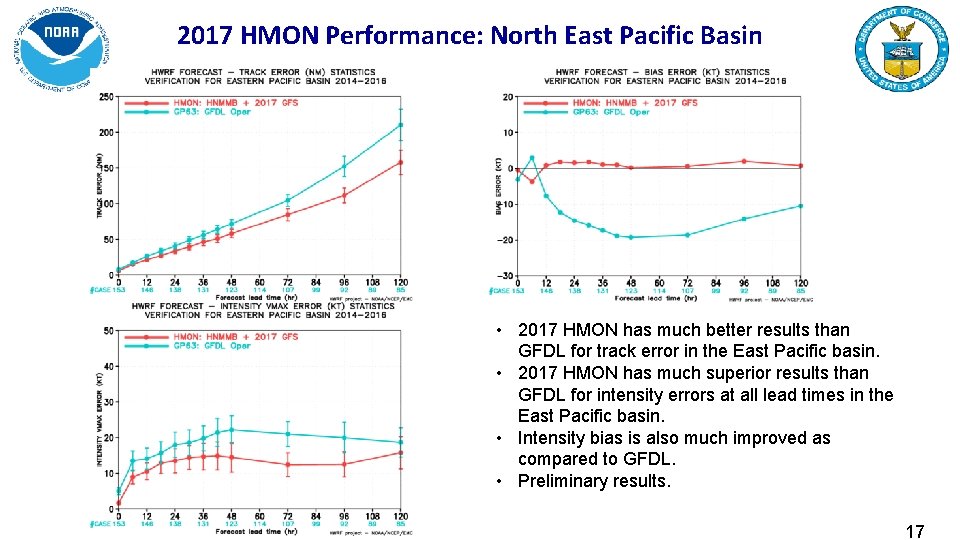
2017 HMON Performance: North East Pacific Basin • 2017 HMON has much better results than GFDL for track error in the East Pacific basin. • 2017 HMON has much superior results than GFDL for intensity errors at all lead times in the East Pacific basin. • Intensity bias is also much improved as compared to GFDL. • Preliminary results. 17
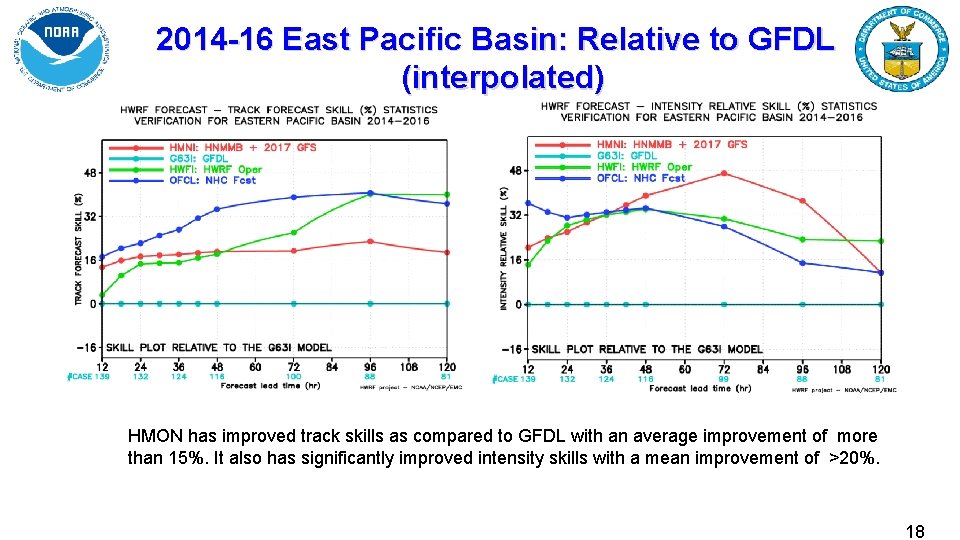
2014 -16 East Pacific Basin: Relative to GFDL (interpolated) HMON has improved track skills as compared to GFDL with an average improvement of more than 15%. It also has significantly improved intensity skills with a mean improvement of >20%. 18
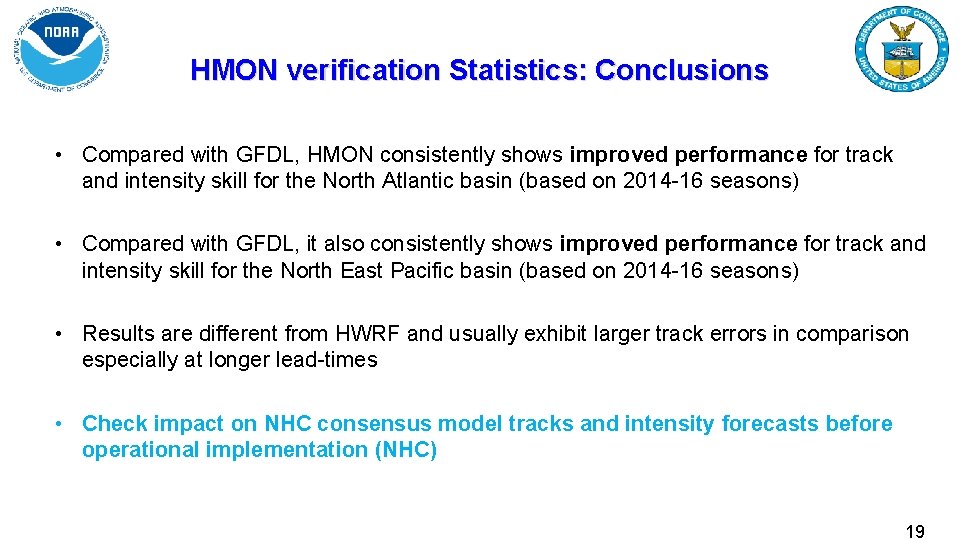
HMON verification Statistics: Conclusions • Compared with GFDL, HMON consistently shows improved performance for track and intensity skill for the North Atlantic basin (based on 2014 -16 seasons) • Compared with GFDL, it also consistently shows improved performance for track and intensity skill for the North East Pacific basin (based on 2014 -16 seasons) • Results are different from HWRF and usually exhibit larger track errors in comparison especially at longer lead-times • Check impact on NHC consensus model tracks and intensity forecasts before operational implementation (NHC) 19
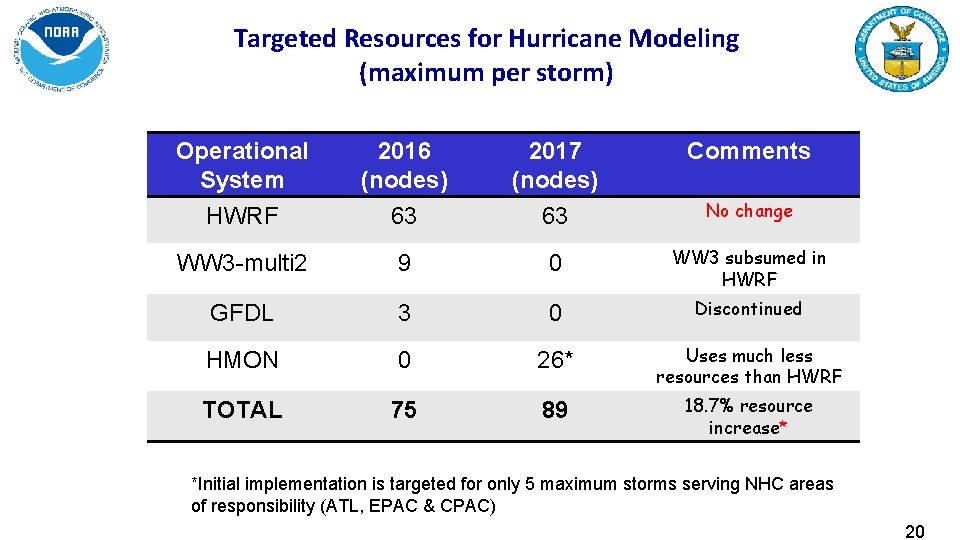
Targeted Resources for Hurricane Modeling (maximum per storm) Operational System 2016 (nodes) 2017 (nodes) Comments HWRF 63 63 No change WW 3 -multi 2 9 0 WW 3 subsumed in HWRF GFDL 3 0 Discontinued HMON 0 26* Uses much less resources than HWRF TOTAL 75 89 18. 7% resource increase* *Initial implementation is targeted for only 5 maximum storms serving NHC areas of responsibility (ATL, EPAC & CPAC) 20
HMON: Current and Future Tasks • Redo retrospectives with 2017 GFS data plus ocean coupling plus other upgrades • Data Assimilation developments (sync with HWRF) • Nesting under active development with NESII/ESRL/HRD/GFDL using NEMS/NUOPC • Extend HMON to all global Basins (incl. WPAC, NIO and SH) • Potential migration from NMMB to FV 3 -based NGGPS Dycore under NEMS 21
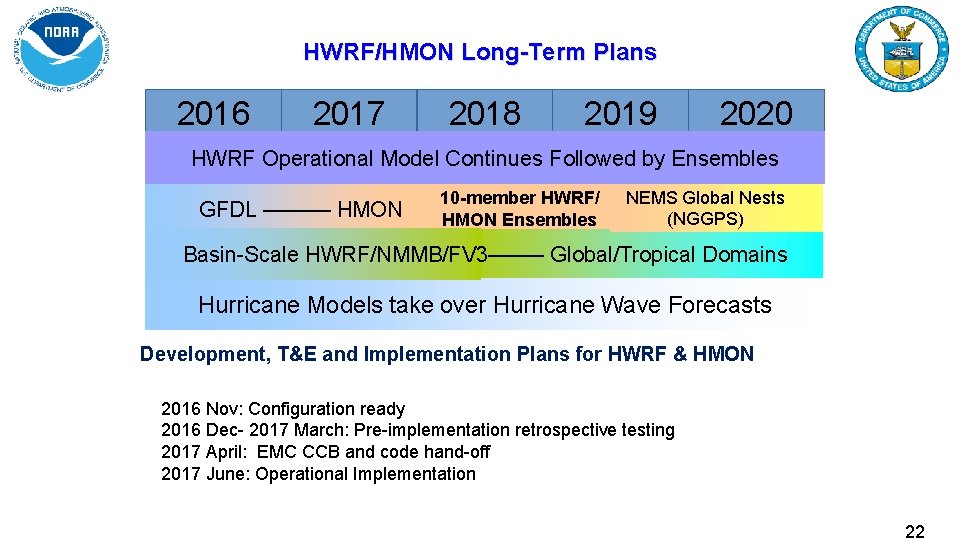
HWRF/HMON Long-Term Plans 2016 2017 2018 2019 2020 HWRF Operational Model Continues Followed by Ensembles GFDL –—–— HMON 10 -member HWRF/ HMON Ensembles NEMS Global Nests (NGGPS) Basin-Scale HWRF/NMMB/FV 3—–— Global/Tropical Domains Hurricane Models take over Hurricane Wave Forecasts Development, T&E and Implementation Plans for HWRF & HMON 2016 Nov: Configuration ready 2016 Dec- 2017 March: Pre-implementation retrospective testing 2017 April: EMC CCB and code hand-off 2017 June: Operational Implementation 22
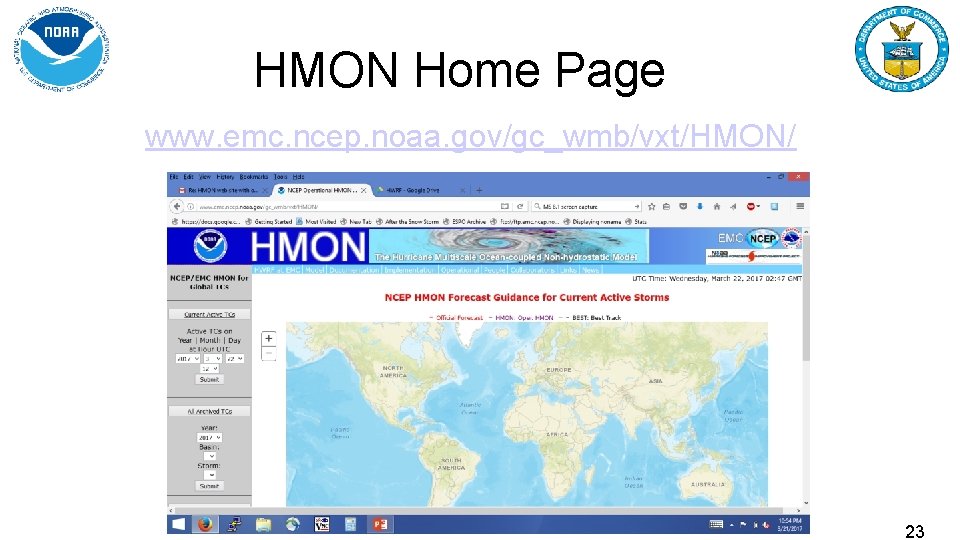
HMON Home Page www. emc. ncep. noaa. gov/gc_wmb/vxt/HMON/ 23
Thank You! 24
- Slides: 24