
HMI Investigation Overview Philip Scherrer HMI Principal Investigator
- Slides: 23
HMI Investigation Overview Philip Scherrer HMI Principal Investigator pscherrer@solar. stanford. edu This presentation available at http: //hmi. stanford. edu/Presentations SDO Science Writers Workshop – 16 Dec 2009 Investigation Overview, Scherrer, Page 1
HMI Investigation Overview – Outline • Investigation Overview • Science Objectives • How HMI works • Helioseismology – What is it? • Data Products and Objectives • Inside HMI • Data Center • Science Team • Web Links SDO Science Writers Workshop – 16 Dec 2009 Investigation Overview, Scherrer, Page 2
Investigation Overview - 1 The primary goal of the Helioseismic and Magnetic Imager (HMI) investigation is to study the origin of solar variability and to characterize and understand the Sun’s interior and the various components of magnetic activity. HMI measures of the motion of the solar photosphere to study solar oscillations and HMI measures the polarization in a spectral line to obtain all three components of the photospheric magnetic field. SDO Science Writers Workshop – 16 Dec 2009 Investigation Overview, Scherrer, Page 3
Investigation Overview - 2 The basic HMI measurements are “filtergrams” – images of the Sun’s photosphere made through a very narrow-band filter tunable to a set of six specific wavelengths across one spectral line. The raw observations must be processed into higher level data products before analysis can proceed. HMI produces data products suitable to determine the interior sources and mechanisms of solar variability and how the physical processes inside the Sun are related to surface magnetic field and activity. It also produces data products to enable estimates of the low and far coronal magnetic field for studies of variability in the extended solar atmosphere. SDO Science Writers Workshop – 16 Dec 2009 Investigation Overview, Scherrer, Page 4
Investigation Overview - 3 HMI observations will enable establishing the relationships between the internal dynamics and magnetic activity. This is a prerequisite to understanding possible physics-based solar activity forecasts. Active participation of the HMI Team in collaboration with the other SDO instrument teams and the LWS community is necessary to achieve the HMI science goals. HMI data and results will be made available to the scientific community and the public at large through data export, publications, and an Education and Public Outreach program. SDO Science Writers Workshop – 16 Dec 2009 Investigation Overview, Scherrer, Page 5
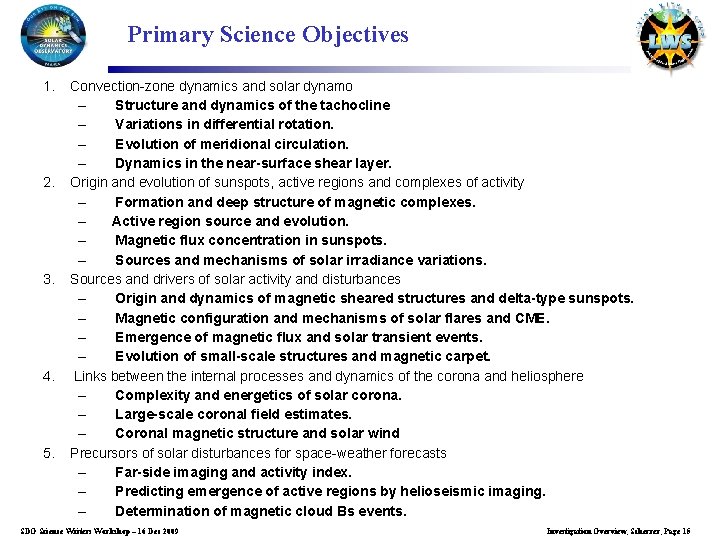
HMI Science Objectives HMI science objectives are grouped into five broad categories: • Convection-zone dynamics and the solar dynamo; How does the solar cycle work? • Origin and evolution of sunspots, active regions and complexes of activity; What drives the evolution of spots and active regions? • Sources and drivers of solar activity and disturbances; How and why is magnetic complexity expressed as activity? • Links between the internal processes and dynamics of the corona and heliosphere; What are the large scale links between the important domains? • Precursors of solar disturbances for space-weather forecasts. What are the prospects for predictions? SDO Science Writers Workshop – 16 Dec 2009 Investigation Overview, Scherrer, Page 6
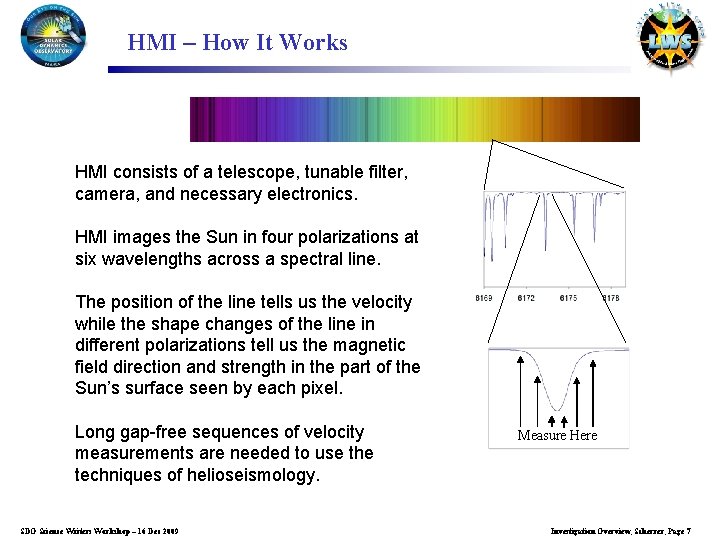
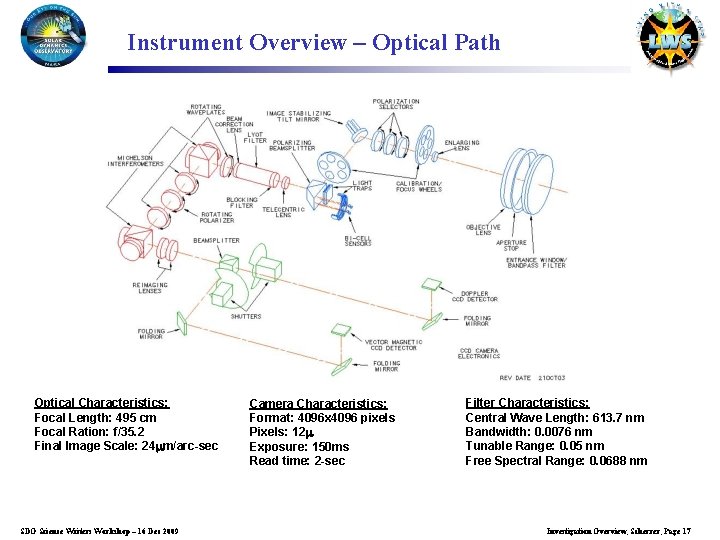
HMI – How It Works HMI consists of a telescope, tunable filter, camera, and necessary electronics. HMI images the Sun in four polarizations at six wavelengths across a spectral line. The position of the line tells us the velocity while the shape changes of the line in different polarizations tell us the magnetic field direction and strength in the part of the Sun’s surface seen by each pixel. Long gap-free sequences of velocity measurements are needed to use the techniques of helioseismology. SDO Science Writers Workshop – 16 Dec 2009 Measure Here Investigation Overview, Scherrer, Page 7
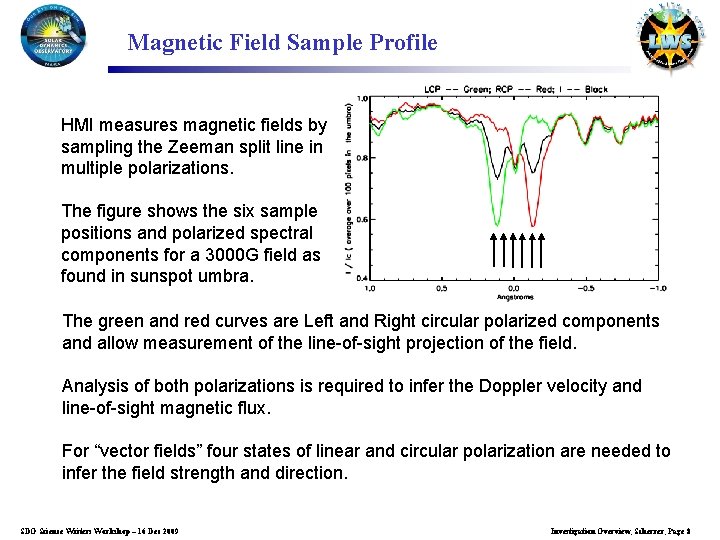
Magnetic Field Sample Profile HMI measures magnetic fields by sampling the Zeeman split line in multiple polarizations. The figure shows the six sample positions and polarized spectral components for a 3000 G field as found in sunspot umbra. The green and red curves are Left and Right circular polarized components and allow measurement of the line-of-sight projection of the field. Analysis of both polarizations is required to infer the Doppler velocity and line-of-sight magnetic flux. For “vector fields” four states of linear and circular polarization are needed to infer the field strength and direction. SDO Science Writers Workshop – 16 Dec 2009 Investigation Overview, Scherrer, Page 8
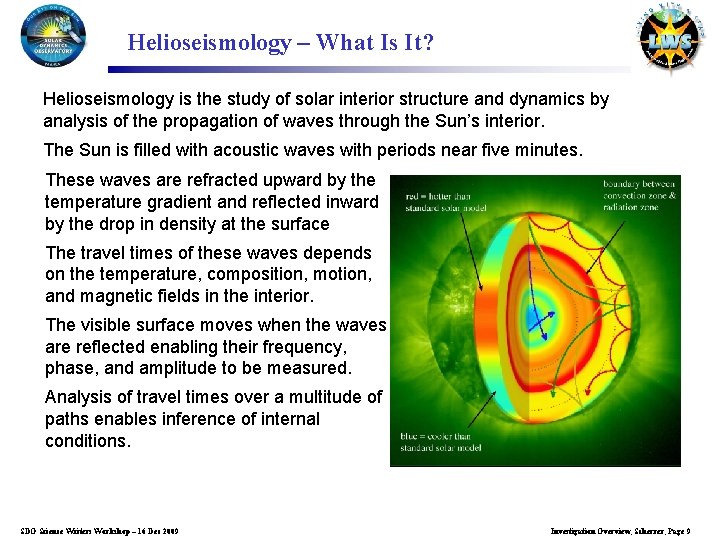
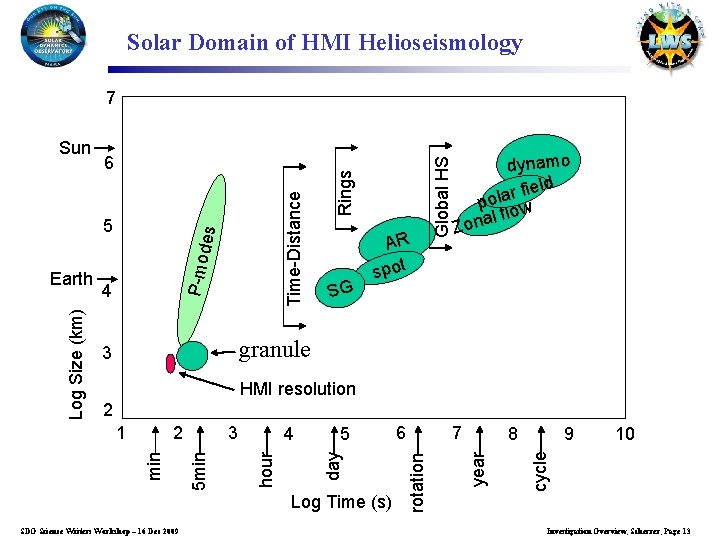
Helioseismology – What Is It? Helioseismology is the study of solar interior structure and dynamics by analysis of the propagation of waves through the Sun’s interior. The Sun is filled with acoustic waves with periods near five minutes. These waves are refracted upward by the temperature gradient and reflected inward by the drop in density at the surface The travel times of these waves depends on the temperature, composition, motion, and magnetic fields in the interior. The visible surface moves when the waves are reflected enabling their frequency, phase, and amplitude to be measured. Analysis of travel times over a multitude of paths enables inference of internal conditions. SDO Science Writers Workshop – 16 Dec 2009 Investigation Overview, Scherrer, Page 9
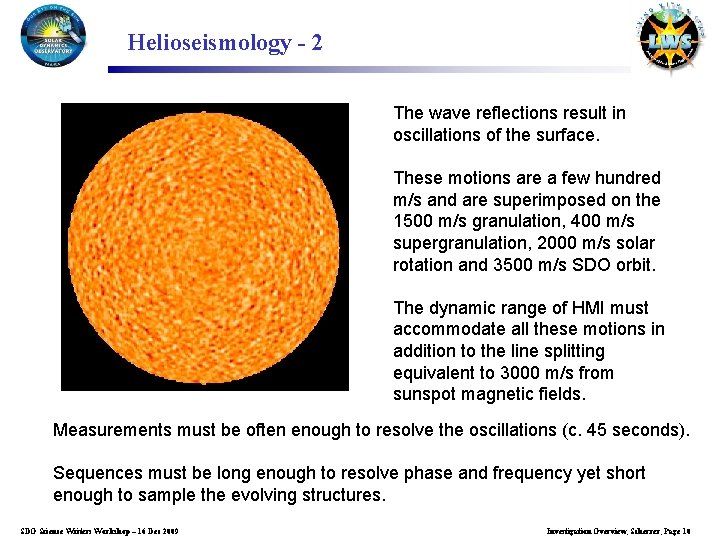
Helioseismology - 2 The wave reflections result in oscillations of the surface. These motions are a few hundred m/s and are superimposed on the 1500 m/s granulation, 400 m/s supergranulation, 2000 m/s solar rotation and 3500 m/s SDO orbit. The dynamic range of HMI must accommodate all these motions in addition to the line splitting equivalent to 3000 m/s from sunspot magnetic fields. Measurements must be often enough to resolve the oscillations (c. 45 seconds). Sequences must be long enough to resolve phase and frequency yet short enough to sample the evolving structures. SDO Science Writers Workshop – 16 Dec 2009 Investigation Overview, Scherrer, Page 10
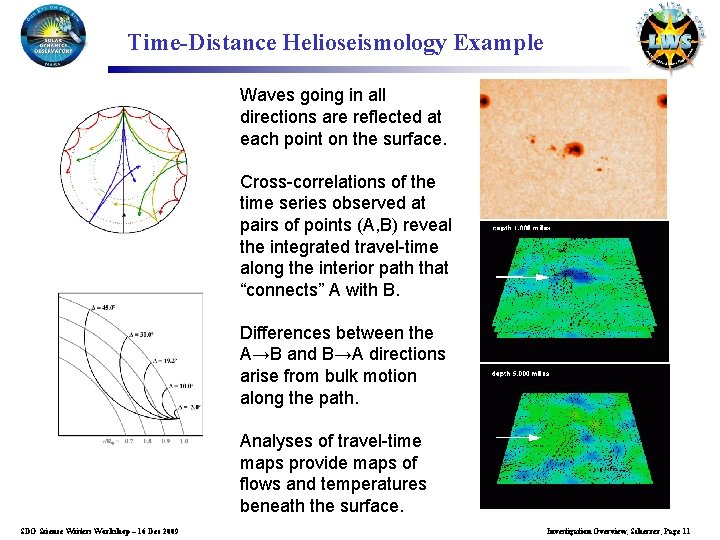
Time-Distance Helioseismology Example Waves going in all directions are reflected at each point on the surface. Cross-correlations of the time series observed at pairs of points (A, B) reveal the integrated travel-time along the interior path that “connects” A with B. Differences between the A→B and B→A directions arise from bulk motion along the path. Analyses of travel-time maps provide maps of flows and temperatures beneath the surface. SDO Science Writers Workshop – 16 Dec 2009 Investigation Overview, Scherrer, Page 11
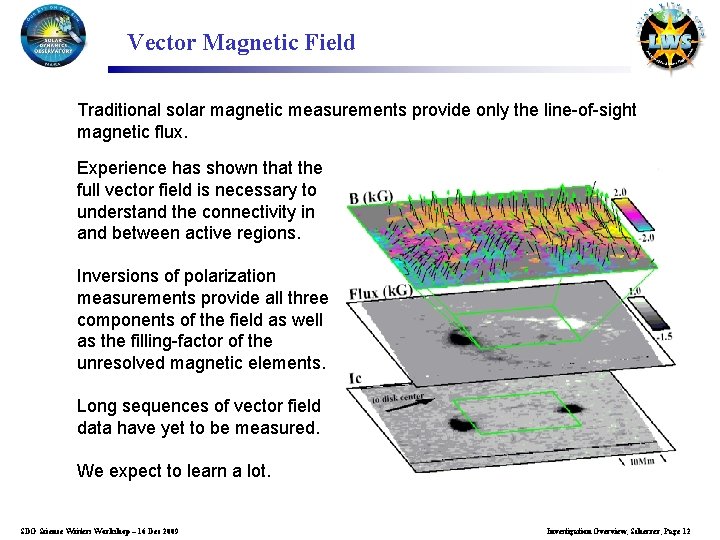
Vector Magnetic Field Traditional solar magnetic measurements provide only the line-of-sight magnetic flux. Experience has shown that the full vector field is necessary to understand the connectivity in and between active regions. Inversions of polarization measurements provide all three components of the field as well as the filling-factor of the unresolved magnetic elements. Long sequences of vector field data have yet to be measured. We expect to learn a lot. SDO Science Writers Workshop – 16 Dec 2009 Investigation Overview, Scherrer, Page 12
Solar Domain of HMI Helioseismology P-mo d 4 SG Global HS AR spot dynamo field r a l po ow l nal f Zo granule 3 HMI resolution 2 Log Time (s) SDO Science Writers Workshop – 16 Dec 2009 7 6 8 9 10 cycle 5 year 4 rotation 3 day 2 min 1 hour Log Size (km) Earth es 5 Time-Distance 6 5 min Sun Rings 7 Investigation Overview, Scherrer, Page 13
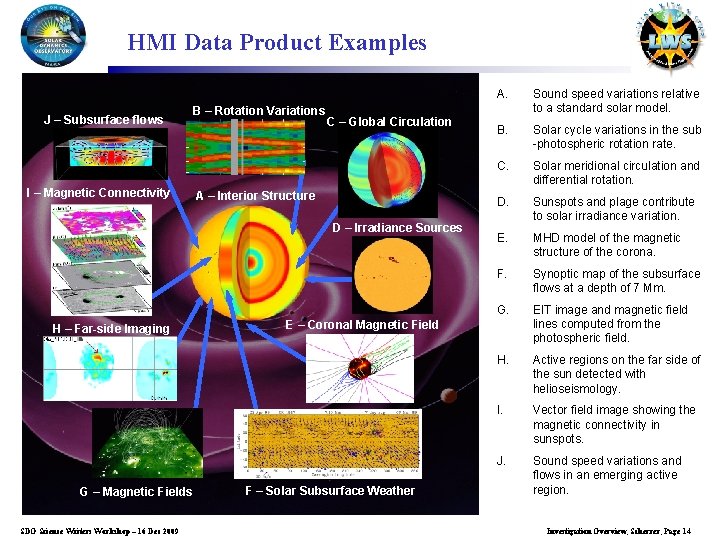
HMI Data Product Examples J – Subsurface flows I – Magnetic Connectivity B – Rotation Variations C – Global Circulation A – Interior Structure D – Irradiance Sources H – Far-side Imaging G – Magnetic Fields SDO Science Writers Workshop – 16 Dec 2009 A. Sound speed variations relative to a standard solar model. B. Solar cycle variations in the sub -photospheric rotation rate. C. Solar meridional circulation and differential rotation. D. Sunspots and plage contribute to solar irradiance variation. E. MHD model of the magnetic structure of the corona. F. Synoptic map of the subsurface flows at a depth of 7 Mm. G. EIT image and magnetic field lines computed from the photospheric field. H. Active regions on the far side of the sun detected with helioseismology. I. Vector field image showing the magnetic connectivity in sunspots. J. Sound speed variations and flows in an emerging active region. E – Coronal Magnetic Field F – Solar Subsurface Weather Investigation Overview, Scherrer, Page 14
Primary Science Objectives 1. 2. 3. 4. 5. Convection-zone dynamics and solar dynamo – Structure and dynamics of the tachocline – Variations in differential rotation. – Evolution of meridional circulation. – Dynamics in the near-surface shear layer. Origin and evolution of sunspots, active regions and complexes of activity – Formation and deep structure of magnetic complexes. – Active region source and evolution. – Magnetic flux concentration in sunspots. – Sources and mechanisms of solar irradiance variations. Sources and drivers of solar activity and disturbances – Origin and dynamics of magnetic sheared structures and delta-type sunspots. – Magnetic configuration and mechanisms of solar flares and CME. – Emergence of magnetic flux and solar transient events. – Evolution of small-scale structures and magnetic carpet. Links between the internal processes and dynamics of the corona and heliosphere – Complexity and energetics of solar corona. – Large-scale coronal field estimates. – Coronal magnetic structure and solar wind Precursors of solar disturbances for space-weather forecasts – Far-side imaging and activity index. – Predicting emergence of active regions by helioseismic imaging. – Determination of magnetic cloud Bs events. SDO Science Writers Workshop – 16 Dec 2009 Investigation Overview, Scherrer, Page 15
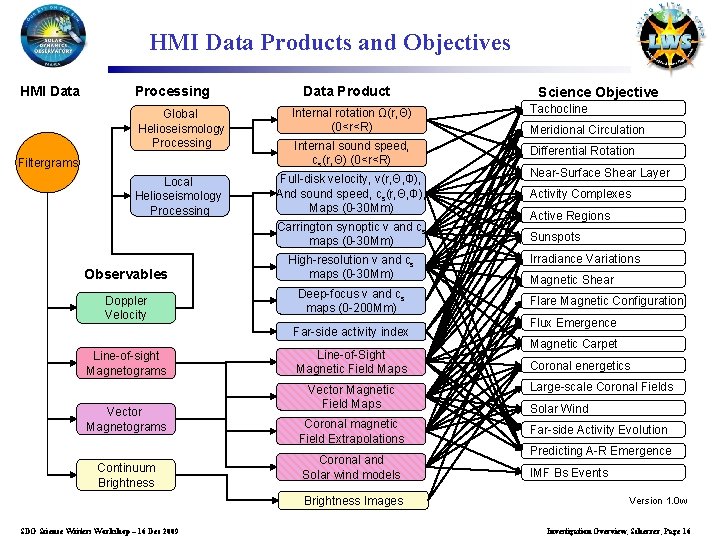
HMI Data Products and Objectives HMI Data Processing Data Product Science Objective Tachocline Global Helioseismology Processing Internal rotation Ω(r, Θ) (0<r<R) Internal sound speed, cs(r, Θ) (0<r<R) Differential Rotation Local Helioseismology Processing Full-disk velocity, v(r, Θ, Φ), And sound speed, cs(r, Θ, Φ), Maps (0 -30 Mm) Activity Complexes Filtergrams Carrington synoptic v and cs maps (0 -30 Mm) Observables Doppler Velocity High-resolution v and cs maps (0 -30 Mm) Deep-focus v and cs maps (0 -200 Mm) Far-side activity index Line-of-sight Magnetograms Vector Magnetograms Continuum Brightness Line-of-Sight Magnetic Field Maps Near-Surface Shear Layer Active Regions Sunspots Irradiance Variations Magnetic Shear Flare Magnetic Configuration Flux Emergence Magnetic Carpet Coronal energetics Vector Magnetic Field Maps Large-scale Coronal Fields Coronal magnetic Field Extrapolations Far-side Activity Evolution Coronal and Solar wind models Brightness Images SDO Science Writers Workshop – 16 Dec 2009 Meridional Circulation Solar Wind Predicting A-R Emergence IMF Bs Events Version 1. 0 w Investigation Overview, Scherrer, Page 16
Instrument Overview – Optical Path Optical Characteristics: Focal Length: 495 cm Focal Ration: f/35. 2 Final Image Scale: 24 m/arc-sec SDO Science Writers Workshop – 16 Dec 2009 Camera Characteristics: Format: 4096 x 4096 pixels Pixels: 12 Exposure: 150 ms Read time: 2 -sec Filter Characteristics: Central Wave Length: 613. 7 nm Bandwidth: 0. 0076 nm Tunable Range: 0. 05 nm Free Spectral Range: 0. 0688 nm Investigation Overview, Scherrer, Page 17
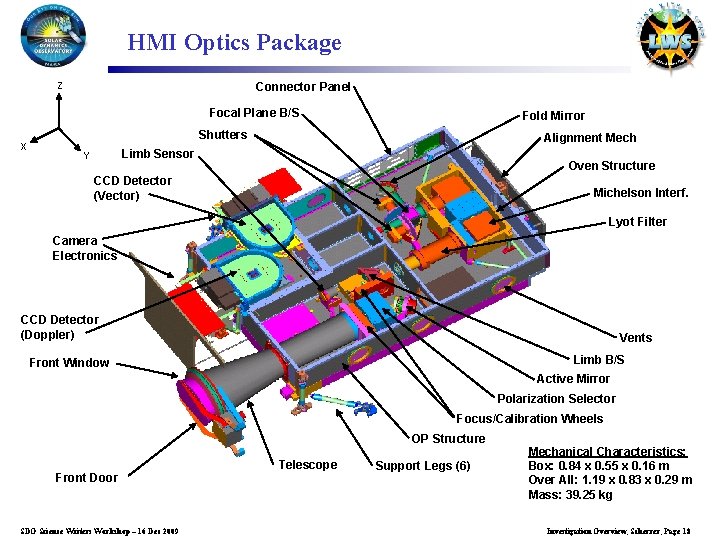
HMI Optics Package Connector Panel Z Focal Plane B/S X Fold Mirror Shutters Alignment Mech Limb Sensor Y Oven Structure CCD Detector (Vector) Michelson Interf. Lyot Filter Camera Electronics CCD Detector (Doppler) Vents Limb B/S Front Window Active Mirror Polarization Selector Focus/Calibration Wheels OP Structure Front Door SDO Science Writers Workshop – 16 Dec 2009 Telescope Support Legs (6) Mechanical Characteristics: Box: 0. 84 x 0. 55 x 0. 16 m Over All: 1. 19 x 0. 83 x 0. 29 m Mass: 39. 25 kg Investigation Overview, Scherrer, Page 18
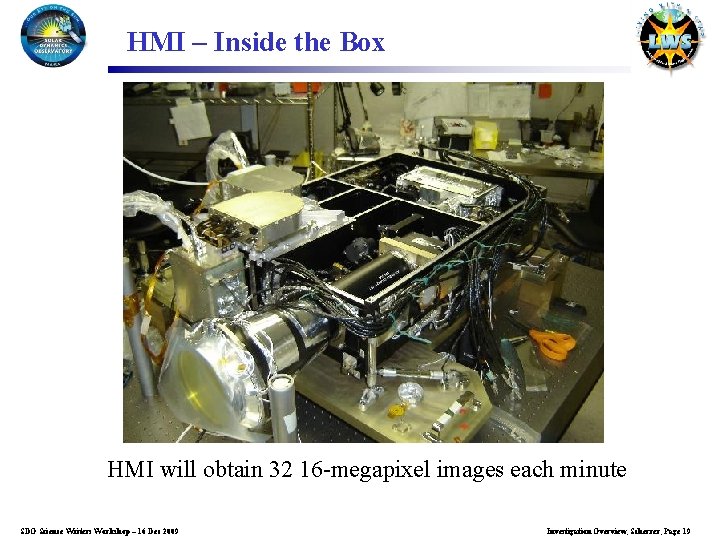
HMI – Inside the Box HMI will obtain 32 16 -megapixel images each minute SDO Science Writers Workshop – 16 Dec 2009 Investigation Overview, Scherrer, Page 19
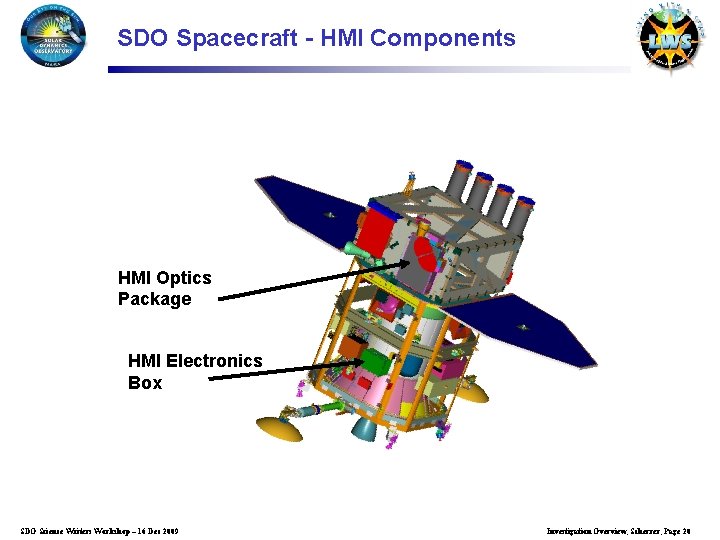
SDO Spacecraft - HMI Components HMI Optics Package HMI Electronics Box SDO Science Writers Workshop – 16 Dec 2009 Investigation Overview, Scherrer, Page 20
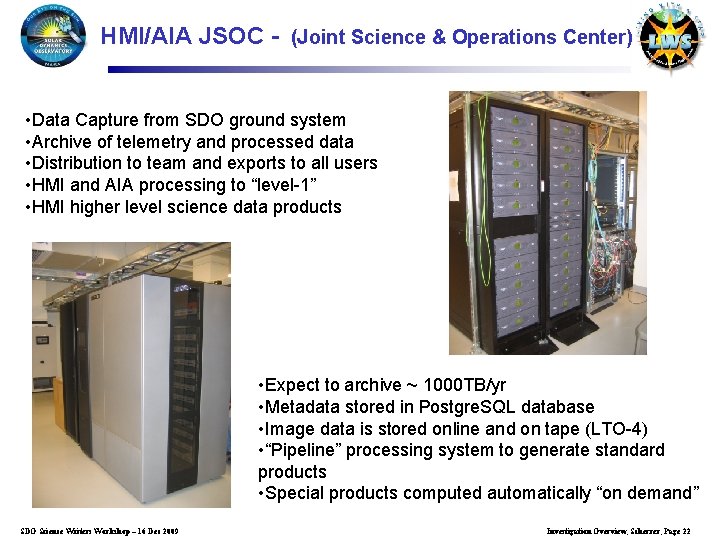
HMI/AIA JSOC - (Joint Science & Operations Center) • Data Capture from SDO ground system • Archive of telemetry and processed data • Distribution to team and exports to all users • HMI and AIA processing to “level-1” • HMI higher level science data products • Expect to archive ~ 1000 TB/yr • Metadata stored in Postgre. SQL database • Image data is stored online and on tape (LTO-4) • “Pipeline” processing system to generate standard products • Special products computed automatically “on demand” SDO Science Writers Workshop – 16 Dec 2009 Investigation Overview, Scherrer, Page 22
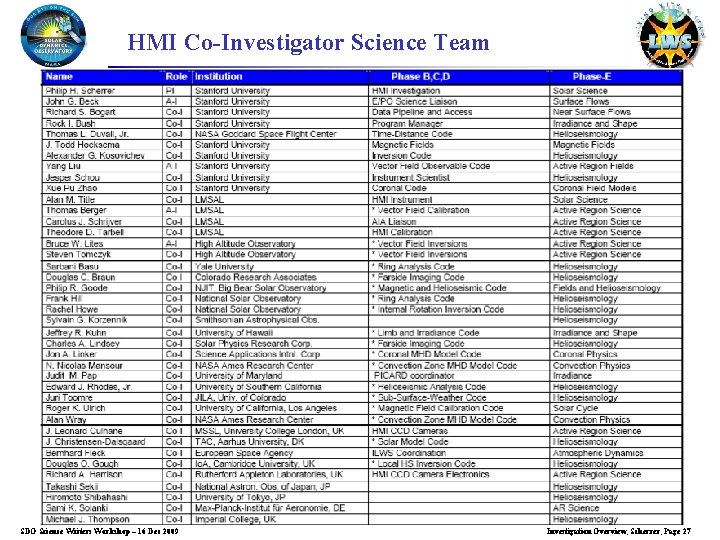
HMI Co-Investigator Science Team SDO Science Writers Workshop – 16 Dec 2009 Investigation Overview, Scherrer, Page 27
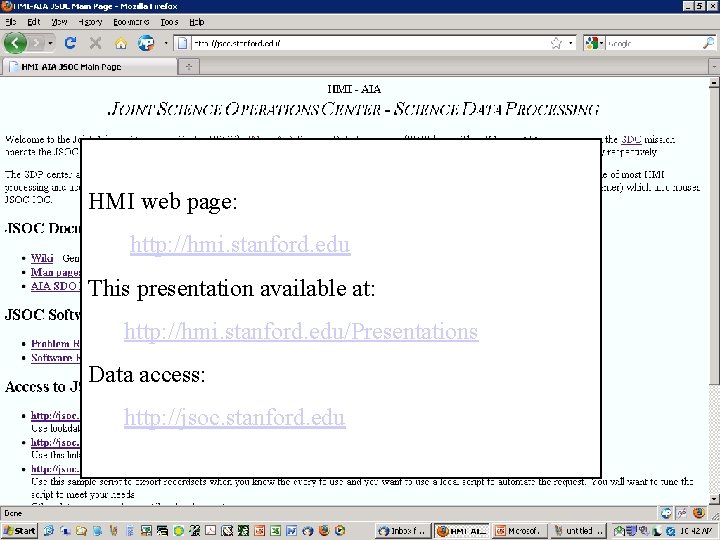
HMI web page: http: //hmi. stanford. edu This presentation available at: http: //hmi. stanford. edu/Presentations Data access: http: //jsoc. stanford. edu SDO Science Writers Workshop – 16 Dec 2009 Investigation Overview, Scherrer, Page 28