
HLA Time Management Outline l l l Basic
HLA - Time Management 陳昱豪
Outline l l l Basic Concepts of HLA Simulations Time Management 簡介 HLA 模擬時間原理
Basic Concepts of HLA Simulations l l l HLA 簡介 HLA 元件與服務 Federate的規則—TM方面 Continuous vs. Discrete Simulations Simulation Time Steps Time steps & Pseudocode

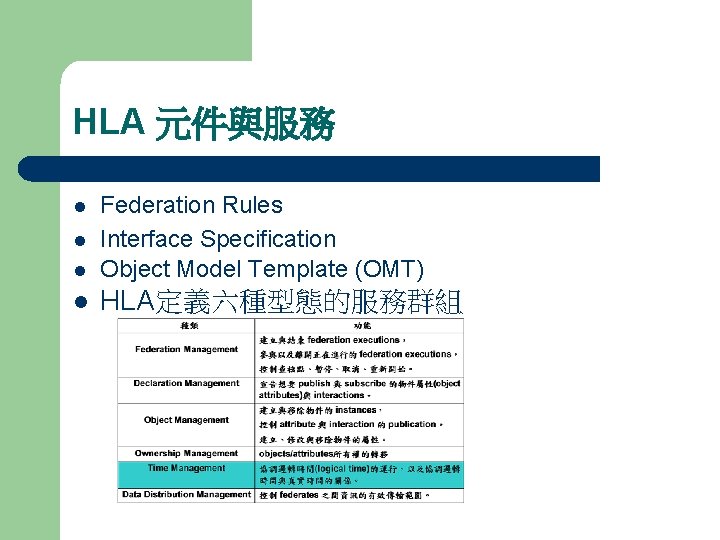
HLA 元件與服務 l Federation Rules Interface Specification Object Model Template (OMT) l HLA定義六種型態的服務群組 l l
Continuous vs. Discrete Simulations
Simulation Time Steps
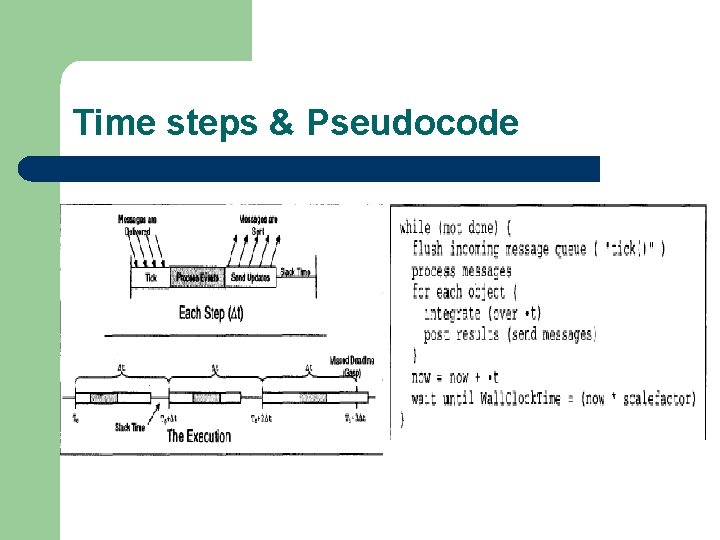
Time steps & Pseudocode
Time Management 簡介 l l Time Management目的 Time Management 是用來協調Federates之間 的Logical time Time Management的另一個觀點 Time Management設法適合滿足單一 Federation所使用的各種技術
Time Management設法適合滿足單一 Federation所使用的各種技術
HLA 模擬時間原理 l l l l Time in Distributed Simulations Supported by the HLA The Need for Time Management Time Stamps Logical Time Logical View of TM Services Time Management Mechanisms
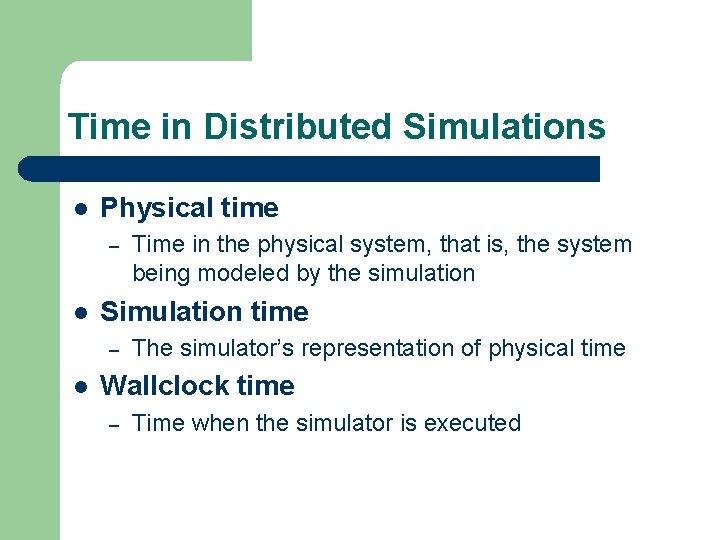
Time in Distributed Simulations l Physical time – l Simulation time – l Time in the physical system, that is, the system being modeled by the simulation The simulator’s representation of physical time Wallclock time – Time when the simulator is executed
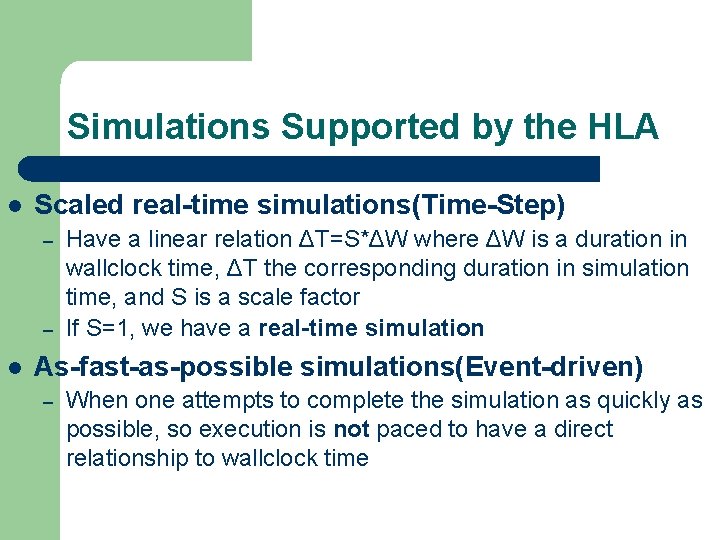
Simulations Supported by the HLA l Scaled real-time simulations(Time-Step) – – l Have a linear relation ΔT=S*ΔW where ΔW is a duration in wallclock time, ΔT the corresponding duration in simulation time, and S is a scale factor If S=1, we have a real-time simulation As-fast-as-possible simulations(Event-driven) – When one attempts to complete the simulation as quickly as possible, so execution is not paced to have a direct relationship to wallclock time
The Need for Time Management l l A simulator may incorrectly reproduce temporal aspects of the real world system being modeled Repeated executions of the simulation with the same initial state and external inputs might give entirely different results
Time Stamps l l Temporal anomalies are eliminated by assigning a time stamp (in simulation time) to each event and ensuring that events are delivered to the federate in time-stamp order (TSO) The time management services ensure a federate will not receive an event in its past, i. e. , an event with time stamp less than its current federate time
Logical Time l l l Federate time is the current simulation time of a federate Logical time is how federate time is called for federates that can send or receive TSO messages to distinguish these federates from those deriving federate time directly from wallclock time During the execution of a federation, different federates may have different logical time values
Logical View of TM Services
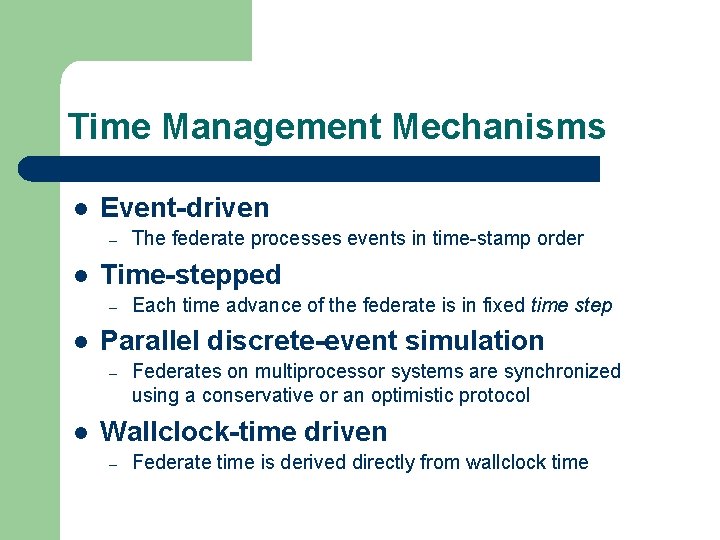
Time Management Mechanisms l Event-driven – l Time-stepped – l Each time advance of the federate is in fixed time step Parallel discrete-event simulation – l The federate processes events in time-stamp order Federates on multiprocessor systems are synchronized using a conservative or an optimistic protocol Wallclock-time driven – Federate time is derived directly from wallclock time
Thanks for listening!!
- Slides: 23