
HL 7 Da Vinci Project Community Roundtable January

HL 7 Da Vinci Project Community Roundtable January 27, 2021
Antitrust Policy ANSI neither develops standards nor conducts certification programs but instead accredits standards developers and certification bodies under programs requiring adherence to principles of openness, voluntariness, due process and non-discrimination. ANSI, therefore, brings significant, procompetitive benefits to the standards and conformity assessment community. ANSI nevertheless recognizes that it must not be a vehicle for individuals or organizations to reach unlawful agreements regarding prices, terms of sale, customers, or markets or engage in other aspects of anti-competitive behavior. ANSI’s policy, therefore, is to take all appropriate measures to comply with U. S. antitrust laws and foreign competition laws and ANSI expects the same from its members and volunteers when acting on behalf of ANSI. Approved by the ANSI Board of Directors May 22, 2014 2
Agenda Welcome and Housekeeping Session to be recorded and posted, along with slides, to Da Vinci’s video library: https: //confluence. hl 7. org/display/DVP/Da+Vinci+Video+Presentations Today’s Presentation: Learn How the HL 7 Da Vinci Guides Help with Interoperability Rules • Jocelyn Keegan, HL 7 Da Vinci Program Manager • Dr. Viet Nguyen, HL 7 Da Vinci Technical Director • Vanessa Candelora, HL 7 Da Vinci Project Management Office 3

Events Da Vinci Community Roundtable Schedule: 4 th Wednesday of each month! Details on Da Vinci’s calendar Upcoming Events: Da Vinci calendar: https: //confluence. hl 7. org/display/DVP/Da+Vinci+2021+Calendar HL 7 events calendar: https: //www. hl 7. org/events/index. cfm? showallevents&ref=nav 4
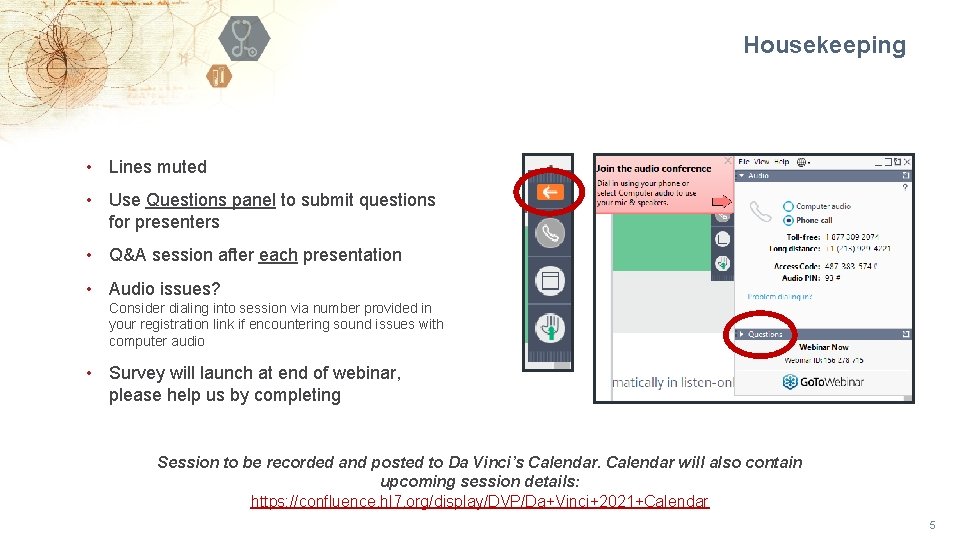
Housekeeping • Lines muted • Use Questions panel to submit questions for presenters • Q&A session after each presentation • Audio issues? Consider dialing into session via number provided in your registration link if encountering sound issues with computer audio • Survey will launch at end of webinar, please help us by completing Session to be recorded and posted to Da Vinci’s Calendar will also contain upcoming session details: https: //confluence. hl 7. org/display/DVP/Da+Vinci+2021+Calendar 5
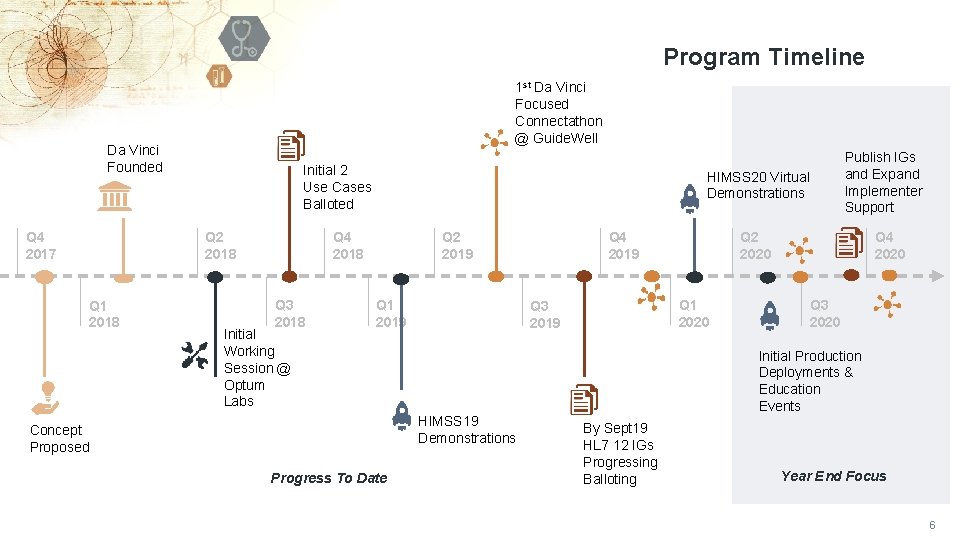
Program Timeline 1 st Da Vinci Focused Connectathon @ Guide. Well Da Vinci Founded Initial 2 Use Cases Balloted Q 2 2018 Q 4 2017 Q 1 2018 HIMSS 20 Virtual Demonstrations Q 4 2018 Q 3 2018 Initial Working Session @ Optum Labs Q 2 2019 Q 1 2019 HIMSS 19 Demonstrations Concept Proposed Progress To Date Q 2 2020 Q 4 2019 Q 1 2020 Q 3 2019 Publish IGs and Expand Implementer Support Q 4 2020 Q 3 2020 Initial Production Deployments & Education Events By Sept 19 HL 7 12 IGs Progressing Balloting Year End Focus 6
Learn How the HL 7 Da Vinci Guides Help with Interoperability Rules • Jocelyn Keegan, HL 7 Da Vinci Program Manager • Dr. Viet Nguyen, HL 7 Da Vinci Technical Director • Vanessa Candelora, HL 7 Da Vinci Project Manager 7
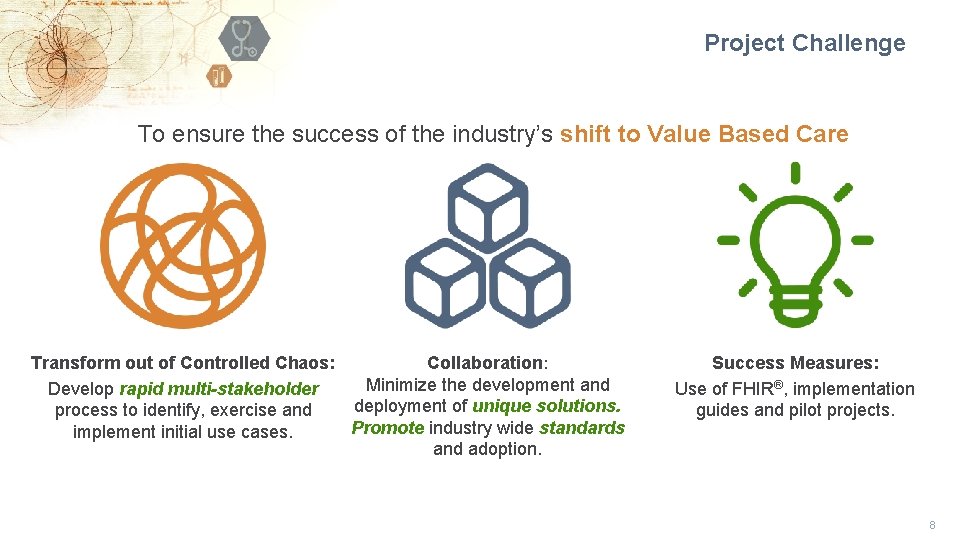
Project Challenge To ensure the success of the industry’s shift to Value Based Care Collaboration: Transform out of Controlled Chaos: Minimize the development and Develop rapid multi-stakeholder deployment of unique solutions. process to identify, exercise and Promote industry wide standards implement initial use cases. and adoption. Success Measures: Use of FHIR®, implementation guides and pilot projects. 8
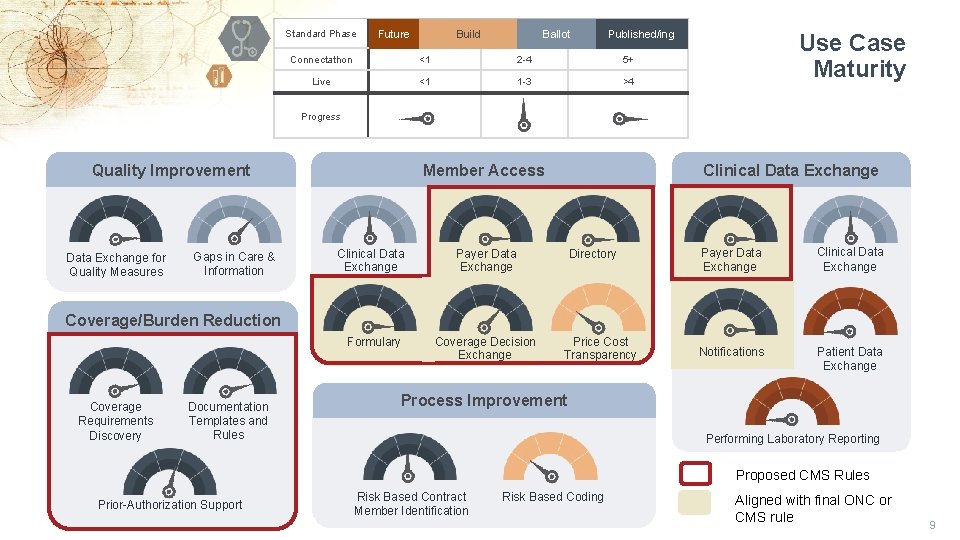
Standard Phase Future Build Ballot Published/ing Connectathon <1 2 -4 5+ Live <1 1 -3 >4 Use Case Maturity Progress Data Exchange for Quality Measures Gaps in Care & Information Clinical Data Exchange Member Access Quality Improvement Clinical Data Exchange Payer Data Exchange Directory Payer Data Exchange Clinical Data Exchange Notifications Patient Data Exchange Coverage/Burden Reduction Formulary Coverage Requirements Discovery Documentation Templates and Rules Coverage Decision Exchange Price Cost Transparency Process Improvement Performing Laboratory Reporting Proposed CMS Rules Prior-Authorization Support Risk Based Contract Member Identification Risk Based Coding Aligned with final ONC or CMS rule 9

How Da Vinci Solves Business Challenges
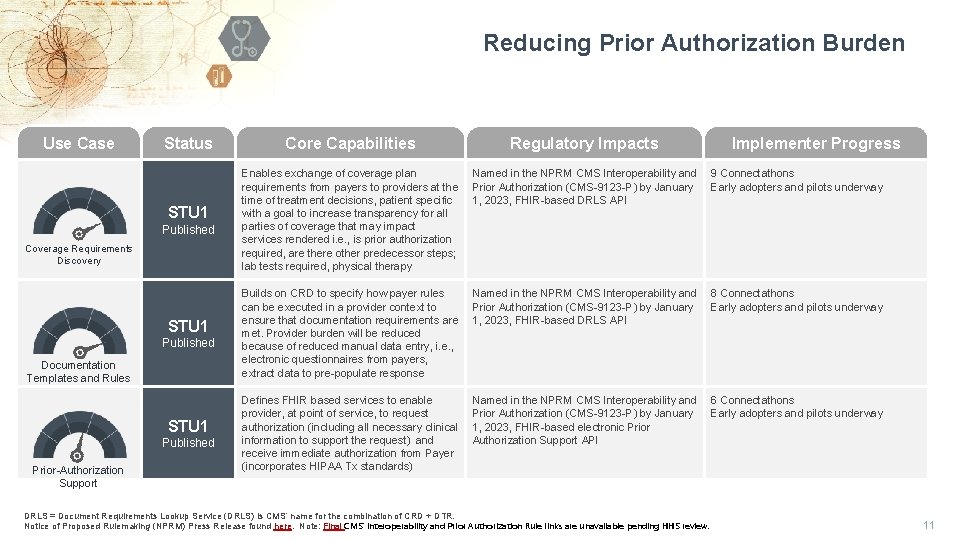
Reducing Prior Authorization Burden Use Case Status STU 1 Published Coverage Requirements Discovery STU 1 Published Documentation Templates and Rules STU 1 Published Prior-Authorization Support Core Capabilities Regulatory Impacts Enables exchange of coverage plan requirements from payers to providers at the time of treatment decisions, patient specific with a goal to increase transparency for all parties of coverage that may impact services rendered i. e. , is prior authorization required, are there other predecessor steps; lab tests required, physical therapy Named in the NPRM CMS Interoperability and Prior Authorization (CMS-9123 -P) by January 1, 2023, FHIR-based DRLS API 9 Connectathons Early adopters and pilots underway Builds on CRD to specify how payer rules can be executed in a provider context to ensure that documentation requirements are met. Provider burden will be reduced because of reduced manual data entry, i. e. , electronic questionnaires from payers, extract data to pre-populate response Named in the NPRM CMS Interoperability and Prior Authorization (CMS-9123 -P) by January 1, 2023, FHIR-based DRLS API 8 Connectathons Early adopters and pilots underway Defines FHIR based services to enable provider, at point of service, to request authorization (including all necessary clinical information to support the request) and receive immediate authorization from Payer (incorporates HIPAA Tx standards) Named in the NPRM CMS Interoperability and Prior Authorization (CMS-9123 -P) by January 1, 2023, FHIR-based electronic Prior Authorization Support API 6 Connectathons Early adopters and pilots underway DRLS = Document Requirements Lookup Service (DRLS) is CMS’ name for the combination of CRD + DTR. Notice of Proposed Rulemaking (NPRM) Press Release found here. Note: Final CMS’ Interoperability and Prior Authorization Rule links are unavailable pending HHS review. Implementer Progress 11
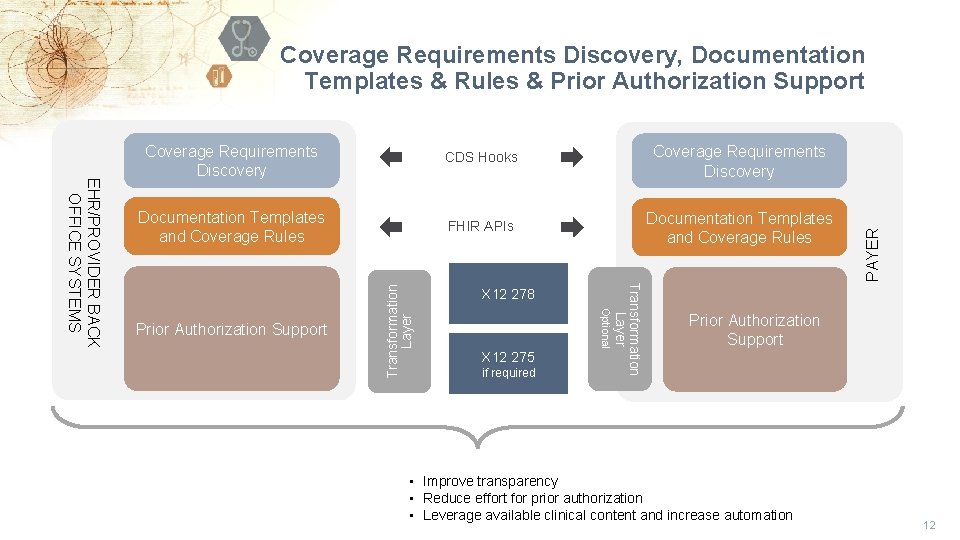
Coverage Requirements Discovery Documentation Templates and Coverage Rules FHIR APIs Documentation Templates and Coverage Rules X 12 278 X 12 275 if required Transformation Layer Prior Authorization Support Transformation Layer CDS Hooks Optional EHR/PROVIDER BACK OFFICE SYSTEMS Coverage Requirements Discovery PAYER Coverage Requirements Discovery, Documentation Templates & Rules & Prior Authorization Support • Improve transparency • Reduce effort for prior authorization • Leverage available clinical content and increase automation 12
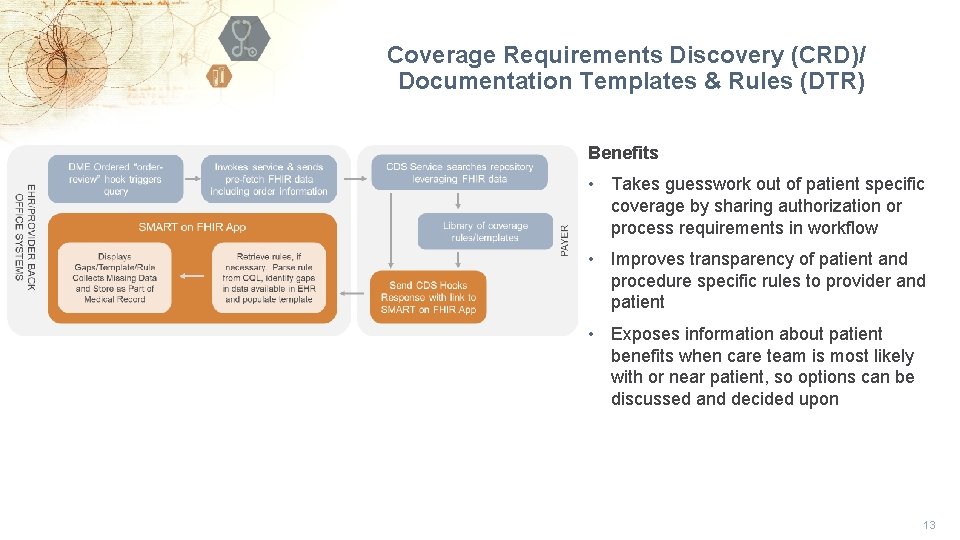
Coverage Requirements Discovery (CRD)/ Documentation Templates & Rules (DTR) Benefits • Takes guesswork out of patient specific coverage by sharing authorization or process requirements in workflow • Improves transparency of patient and procedure specific rules to provider and patient • Exposes information about patient benefits when care team is most likely with or near patient, so options can be discussed and decided upon 13
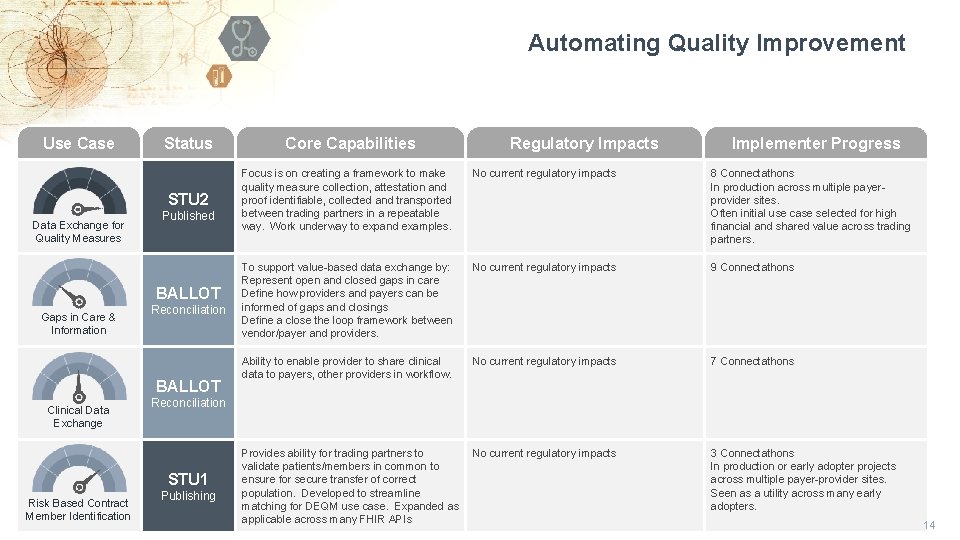
Automating Quality Improvement Use Case Data Exchange for Quality Measures Status Core Capabilities No current regulatory impacts STU 2 Focus is on creating a framework to make quality measure collection, attestation and proof identifiable, collected and transported between trading partners in a repeatable way. Work underway to expand examples. 8 Connectathons In production across multiple payerprovider sites. Often initial use case selected for high financial and shared value across trading partners. To support value-based data exchange by: Represent open and closed gaps in care Define how providers and payers can be informed of gaps and closings Define a close the loop framework between vendor/payer and providers. No current regulatory impacts 9 Connectathons Ability to enable provider to share clinical data to payers, other providers in workflow. No current regulatory impacts 7 Connectathons Provides ability for trading partners to validate patients/members in common to ensure for secure transfer of correct population. Developed to streamline matching for DEQM use case. Expanded as applicable across many FHIR APIs No current regulatory impacts 3 Connectathons In production or early adopter projects across multiple payer-provider sites. Seen as a utility across many early adopters. Published BALLOT Gaps in Care & Information Reconciliation BALLOT Clinical Data Exchange Implementer Progress Reconciliation STU 1 Risk Based Contract Member Identification Regulatory Impacts Publishing 14
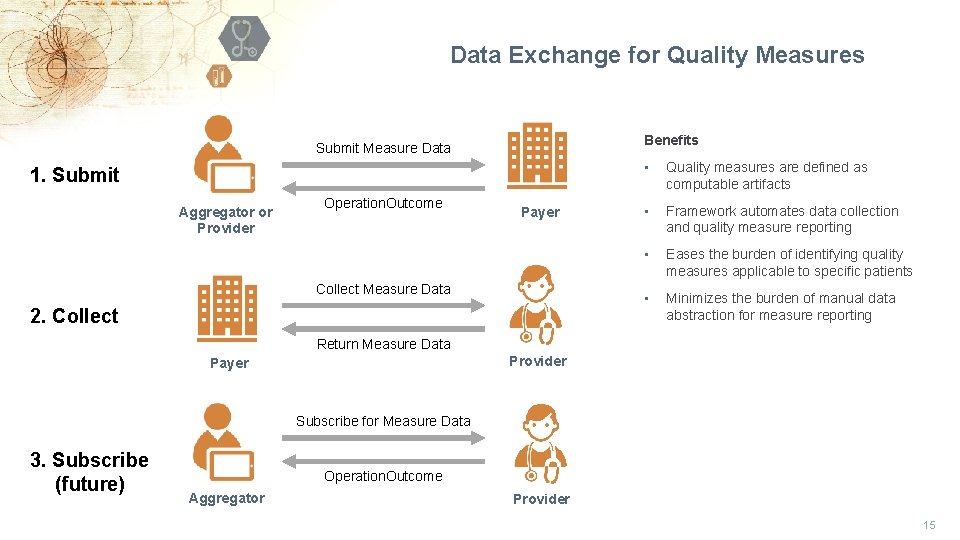
Data Exchange for Quality Measures Benefits Submit Measure Data 1. Submit Aggregator or Provider Operation. Outcome Payer Collect Measure Data 2. Collect • Quality measures are defined as computable artifacts • Framework automates data collection and quality measure reporting • Eases the burden of identifying quality measures applicable to specific patients • Minimizes the burden of manual data abstraction for measure reporting Return Measure Data Provider Payer Subscribe for Measure Data 3. Subscribe (future) Operation. Outcome Aggregator Provider 15
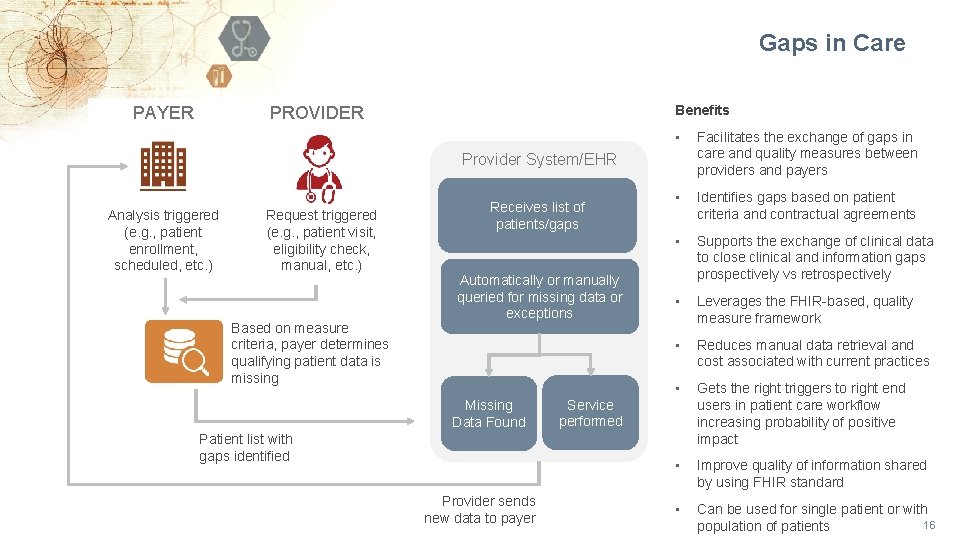
Gaps in Care PAYER Benefits PROVIDER • Facilitates the exchange of gaps in care and quality measures between providers and payers • Identifies gaps based on patient criteria and contractual agreements • Supports the exchange of clinical data to close clinical and information gaps prospectively vs retrospectively • Leverages the FHIR-based, quality measure framework • Reduces manual data retrieval and cost associated with current practices • Gets the right triggers to right end users in patient care workflow increasing probability of positive impact • Improve quality of information shared by using FHIR standard • Can be used for single patient or with 16 population of patients Provider System/EHR Analysis triggered (e. g. , patient enrollment, scheduled, etc. ) Request triggered (e. g. , patient visit, eligibility check, manual, etc. ) Based on measure criteria, payer determines qualifying patient data is missing Receives list of patients/gaps Automatically or manually queried for missing data or exceptions Missing Data Found Patient list with gaps identified Provider sends new data to payer Service performed
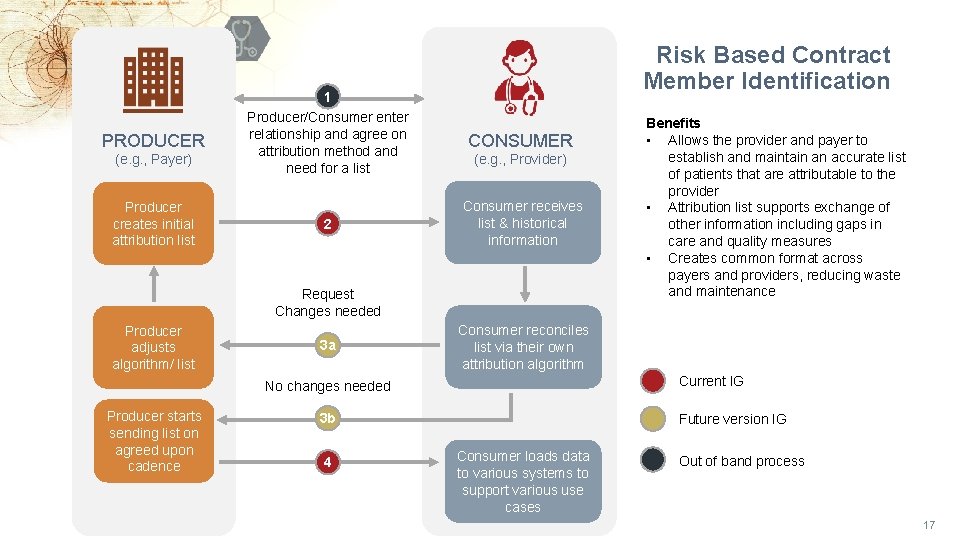
PRODUCER (e. g. , Payer) Producer creates initial attribution list 1 Producer/Consumer enter relationship and agree on attribution method and need for a list 2 Risk Based Contract Member Identification CONSUMER (e. g. , Provider) Consumer receives list & historical information Request Changes needed Producer adjusts algorithm/ list 3 a Consumer reconciles list via their own attribution algorithm Current IG No changes needed Producer starts sending list on agreed upon cadence 3 b 4 Benefits • Allows the provider and payer to establish and maintain an accurate list of patients that are attributable to the provider • Attribution list supports exchange of other information including gaps in care and quality measures • Creates common format across payers and providers, reducing waste and maintenance Future version IG Consumer loads data to various systems to support various use cases Out of band process 17
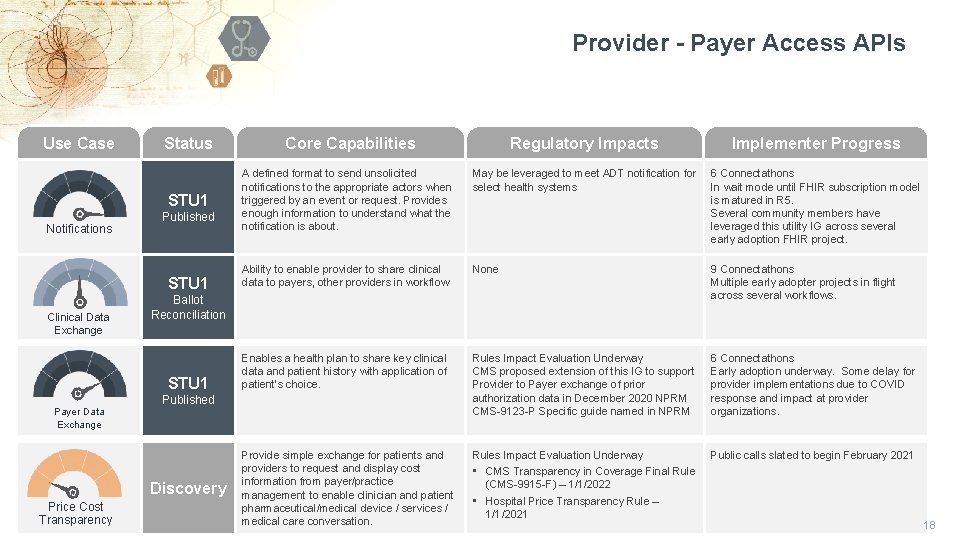
Provider - Payer Access APIs Use Case Status STU 1 Notifications Published STU 1 Clinical Data Exchange Implementer Progress A defined format to send unsolicited notifications to the appropriate actors when triggered by an event or request. Provides enough information to understand what the notification is about. May be leveraged to meet ADT notification for select health systems 6 Connectathons In wait mode until FHIR subscription model is matured in R 5. Several community members have leveraged this utility IG across several early adoption FHIR project. Ability to enable provider to share clinical data to payers, other providers in workflow None 9 Connectathons Multiple early adopter projects in flight across several workflows. Enables a health plan to share key clinical data and patient history with application of patient’s choice. Rules Impact Evaluation Underway CMS proposed extension of this IG to support Provider to Payer exchange of prior authorization data in December 2020 NPRM CMS-9123 -P Specific guide named in NPRM 6 Connectathons Early adoption underway. Some delay for provider implementations due to COVID response and impact at provider organizations. Provide simple exchange for patients and providers to request and display cost information from payer/practice management to enable clinician and patient pharmaceutical/medical device / services / medical care conversation. Rules Impact Evaluation Underway • CMS Transparency in Coverage Final Rule (CMS-9915 -F) – 1/1/2022 • Hospital Price Transparency Rule – 1/1/2021 Public calls slated to begin February 2021 Published Discovery Price Cost Transparency Regulatory Impacts Ballot Reconciliation STU 1 Payer Data Exchange Core Capabilities 18
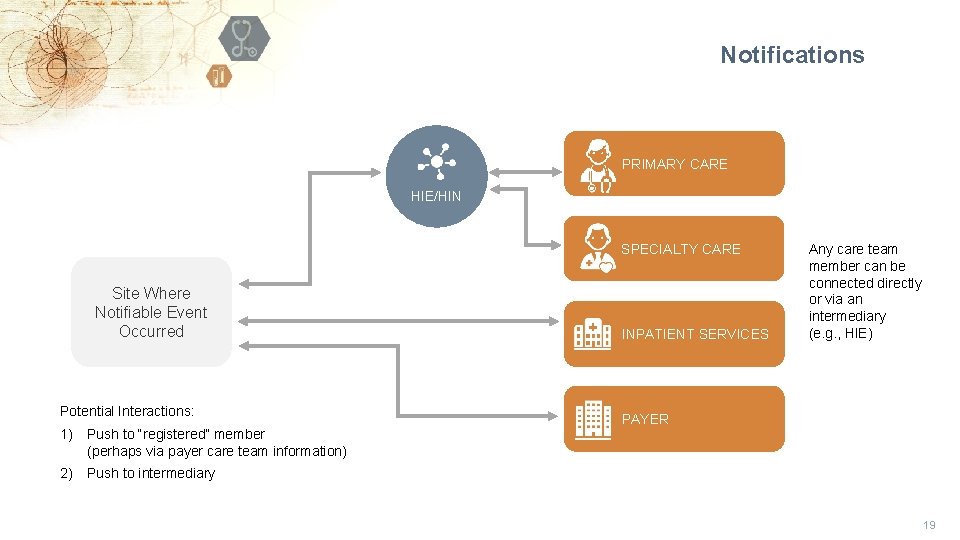
Notifications PRIMARY CARE HIE/HIN SPECIALTY CARE Site Where Notifiable Event Occurred Potential Interactions: 1) Push to “registered” member (perhaps via payer care team information) INPATIENT SERVICES Any care team member can be connected directly or via an intermediary (e. g. , HIE) PAYER 2) Push to intermediary 19
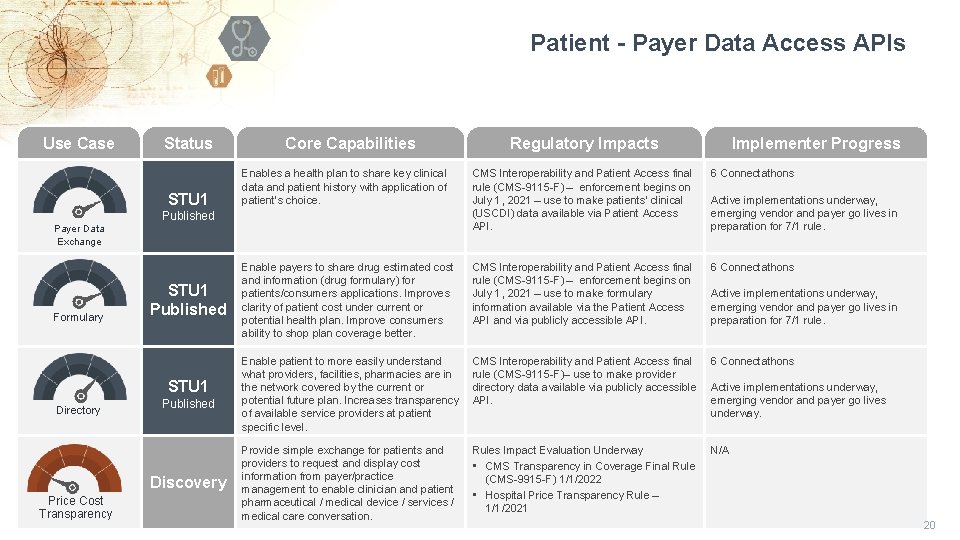
Patient - Payer Data Access APIs Use Case Status STU 1 Payer Data Exchange Formulary STU 1 Published Discovery Price Cost Transparency Regulatory Impacts Implementer Progress Enables a health plan to share key clinical data and patient history with application of patient’s choice. CMS Interoperability and Patient Access final rule (CMS-9115 -F) – enforcement begins on July 1, 2021 – use to make patients' clinical (USCDI) data available via Patient Access API. 6 Connectathons Enable payers to share drug estimated cost and information (drug formulary) for patients/consumers applications. Improves clarity of patient cost under current or potential health plan. Improve consumers ability to shop plan coverage better. CMS Interoperability and Patient Access final rule (CMS-9115 -F) – enforcement begins on July 1, 2021 – use to make formulary information available via the Patient Access API and via publicly accessible API. 6 Connectathons Enable patient to more easily understand what providers, facilities, pharmacies are in the network covered by the current or potential future plan. Increases transparency of available service providers at patient specific level. CMS Interoperability and Patient Access final rule (CMS-9115 -F)– use to make provider directory data available via publicly accessible API. 6 Connectathons Provide simple exchange for patients and providers to request and display cost information from payer/practice management to enable clinician and patient pharmaceutical / medical device / services / medical care conversation. Rules Impact Evaluation Underway • CMS Transparency in Coverage Final Rule (CMS-9915 -F) 1/1/2022 • Hospital Price Transparency Rule – 1/1/2021 N/A Published STU 1 Directory Core Capabilities Active implementations underway, emerging vendor and payer go lives in preparation for 7/1 rule. Active implementations underway, emerging vendor and payer go lives underway. 20
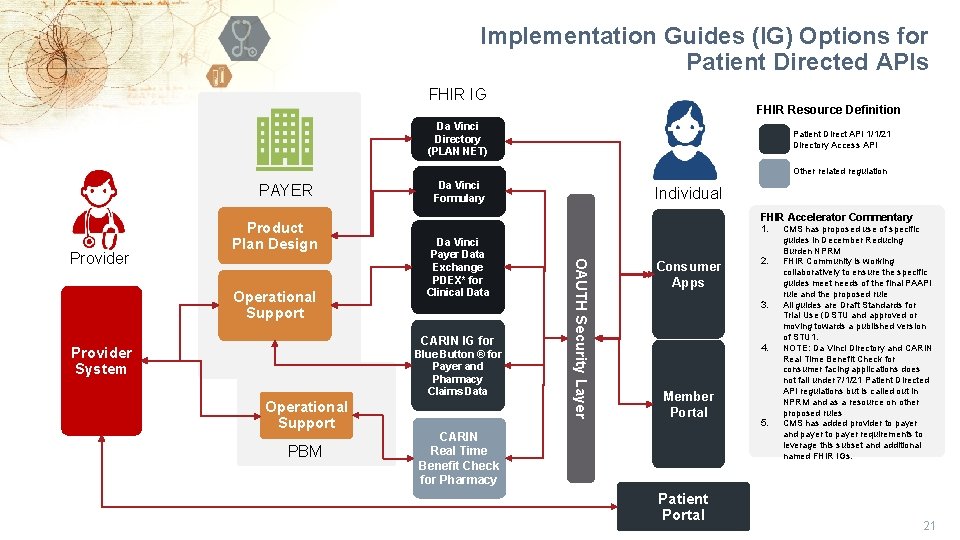
Implementation Guides (IG) Options for Patient Directed APIs FHIR IG FHIR Resource Definition Da Vinci Directory (PLAN NET) Patient Direct API 1/1/21 Directory Access API Other related regulation PAYER Operational Support FHIR Accelerator Commentary 1. Da Vinci Payer Data Exchange PDEX* for Clinical Data CARIN IG for Provider System Blue Button ® for Payer and Pharmacy Claims Data Operational PBM Support PBM Individual OAUTH Security Layer Provider Product Plan Design Da Vinci Formulary Consumer Apps 2. 3. 4. Member Portal CARIN Real Time Benefit Check for Pharmacy Patient Portal 5. CMS has proposed use of specific guides in December Reducing Burden NPRM FHIR Community is working collaboratively to ensure the specific guides meet needs of the final PAAPI rule and the proposed rule All guides are Draft Standards for Trial Use (DSTU and approved or moving towards a published version of STU 1. NOTE: Da Vinci Directory and CARIN Real Time Benefit Check for consumer facing applications does not fall under 7/1/21 Patient Directed API regulations but is called out in NPRM and as a resource on other proposed rules CMS has added provider to payer and payer to payer requirements to leverage this subset and additional named FHIR IGs. 21
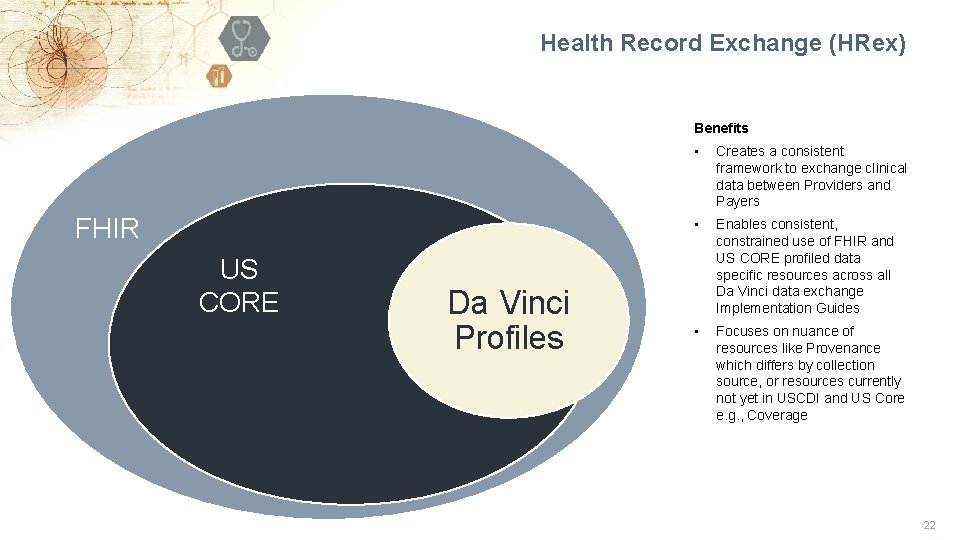
Health Record Exchange (HRex) Benefits FHIR US CORE Da Vinci Profiles • Creates a consistent framework to exchange clinical data between Providers and Payers • Enables consistent, constrained use of FHIR and US CORE profiled data specific resources across all Da Vinci data exchange Implementation Guides • Focuses on nuance of resources like Provenance which differs by collection source, or resources currently not yet in USCDI and US Core e. g. , Coverage 22
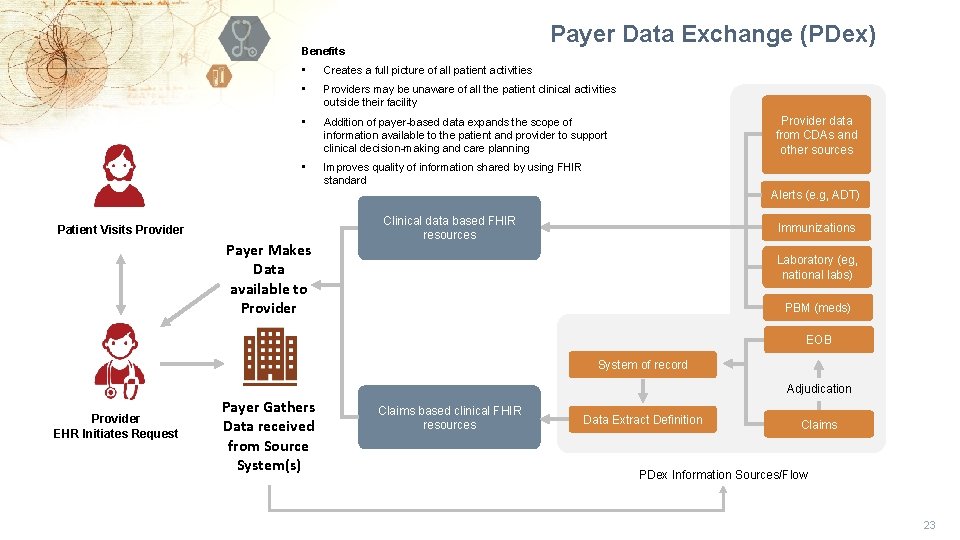
Payer Data Exchange (PDex) Benefits • Creates a full picture of all patient activities • Providers may be unaware of all the patient clinical activities outside their facility • Addition of payer-based data expands the scope of information available to the patient and provider to support clinical decision-making and care planning • Improves quality of information shared by using FHIR standard Provider data from CDAs and other sources Alerts (e. g, ADT) Patient Visits Provider Payer Makes Data available to Provider Clinical data based FHIR resources Immunizations Laboratory (eg, national labs) PBM (meds) EOB System of record Adjudication Provider EHR Initiates Request Payer Gathers Data received from Source System(s) Claims based clinical FHIR resources Data Extract Definition Claims PDex Information Sources/Flow 23
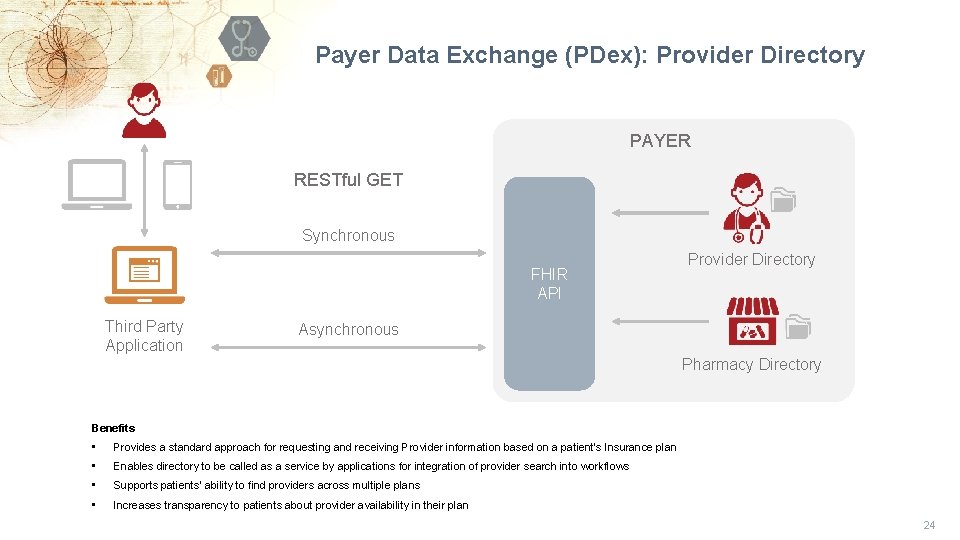
Payer Data Exchange (PDex): Provider Directory PAYER RESTful GET Synchronous FHIR API Third Party Application Provider Directory Asynchronous Pharmacy Directory Benefits • Provides a standard approach for requesting and receiving Provider information based on a patient's Insurance plan • Enables directory to be called as a service by applications for integration of provider search into workflows • Supports patients’ ability to find providers across multiple plans • Increases transparency to patients about provider availability in their plan 24
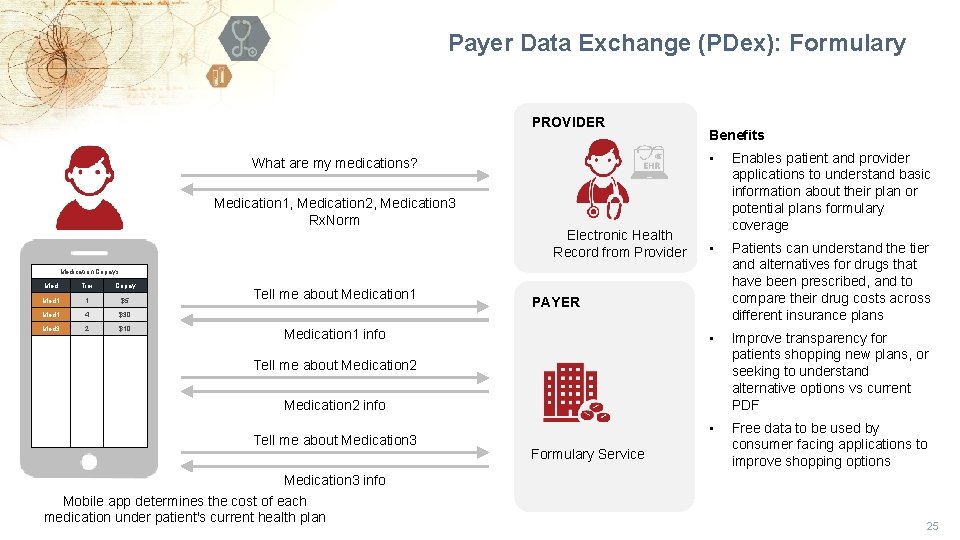
Payer Data Exchange (PDex): Formulary PROVIDER What are my medications? Medication 1, Medication 2, Medication 3 Rx. Norm Electronic Health Record from Provider Benefits • Enables patient and provider applications to understand basic information about their plan or potential plans formulary coverage • Patients can understand the tier and alternatives for drugs that have been prescribed, and to compare their drug costs across different insurance plans • Improve transparency for patients shopping new plans, or seeking to understand alternative options vs current PDF • Free data to be used by consumer facing applications to improve shopping options Medication Copays Med Tier Copay Med 1 1 $5 Med 1 4 $30 Med 3 2 $10 Tell me about Medication 1 PAYER Medication 1 info Tell me about Medication 2 info Tell me about Medication 3 info Mobile app determines the cost of each medication under patient's current health plan Formulary Service 25
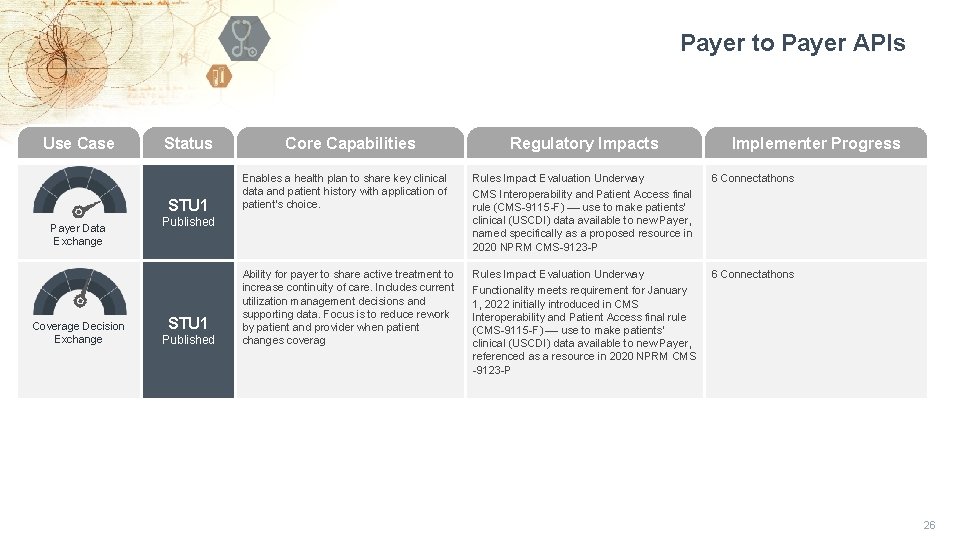
Payer to Payer APIs Use Case Status STU 1 Payer Data Exchange Coverage Decision Exchange Core Capabilities Published Implementer Progress Enables a health plan to share key clinical data and patient history with application of patient’s choice. Rules Impact Evaluation Underway CMS Interoperability and Patient Access final rule (CMS-9115 -F) –– use to make patients' clinical (USCDI) data available to new Payer, named specifically as a proposed resource in 2020 NPRM CMS-9123 -P 6 Connectathons Ability for payer to share active treatment to increase continuity of care. Includes current utilization management decisions and supporting data. Focus is to reduce rework by patient and provider when patient changes coverag Rules Impact Evaluation Underway Functionality meets requirement for January 1, 2022 initially introduced in CMS Interoperability and Patient Access final rule (CMS-9115 -F) –– use to make patients' clinical (USCDI) data available to new Payer, referenced as a resource in 2020 NPRM CMS -9123 -P 6 Connectathons Published STU 1 Regulatory Impacts 26
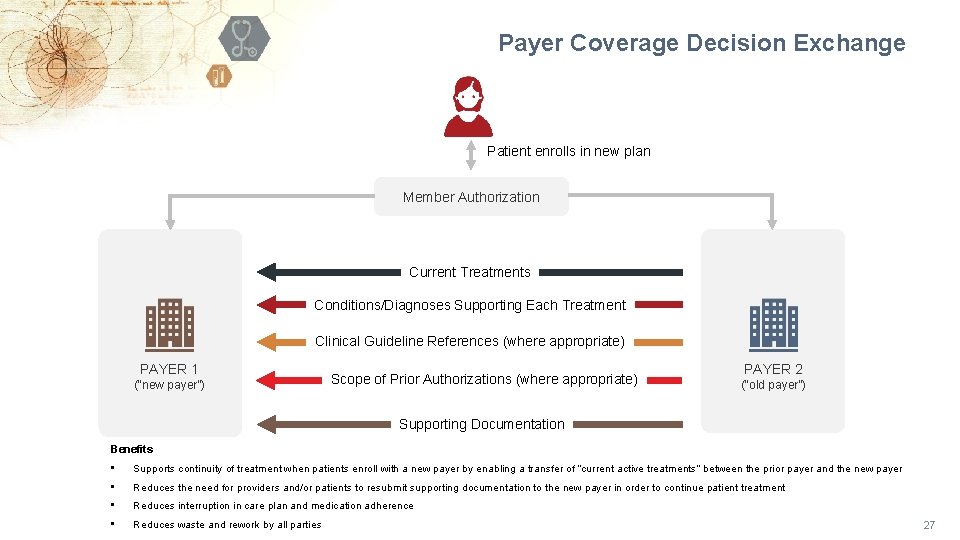
Payer Coverage Decision Exchange Patient enrolls in new plan Member Authorization Current Treatments Conditions/Diagnoses Supporting Each Treatment Clinical Guideline References (where appropriate) PAYER 1 (“new payer”) Scope of Prior Authorizations (where appropriate) PAYER 2 (“old payer”) Supporting Documentation Benefits • Supports continuity of treatment when patients enroll with a new payer by enabling a transfer of “current active treatments” between the prior payer and the new payer • Reduces the need for providers and/or patients to resubmit supporting documentation to the new payer in order to continue patient treatment • Reduces interruption in care plan and medication adherence • Reduces waste and rework by all parties 27
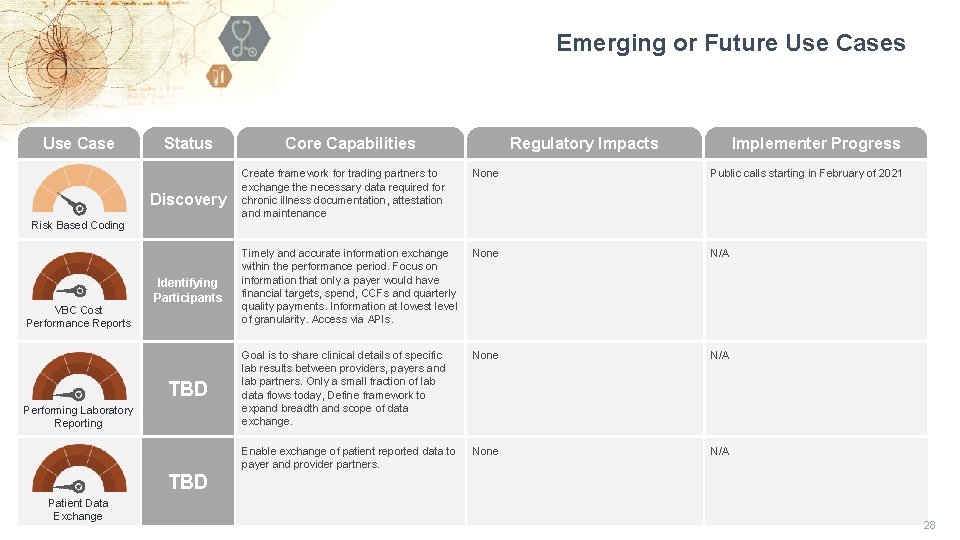
Emerging or Future Use Cases Use Case Status Discovery Risk Based Coding VBC Cost Performance Reports Identifying Participants TBD Performing Laboratory Reporting Core Capabilities Regulatory Impacts Implementer Progress Create framework for trading partners to exchange the necessary data required for chronic illness documentation, attestation and maintenance None Public calls starting in February of 2021 Timely and accurate information exchange within the performance period. Focus on information that only a payer would have financial targets, spend, CCFs and quarterly quality payments. Information at lowest level of granularity. Access via APIs. None N/A Goal is to share clinical details of specific lab results between providers, payers and lab partners. Only a small fraction of lab data flows today, Define framework to expand breadth and scope of data exchange. None N/A Enable exchange of patient reported data to payer and provider partners. None N/A TBD Patient Data Exchange 28

Join the Da Vinci Community 29
Implementer Resources 30
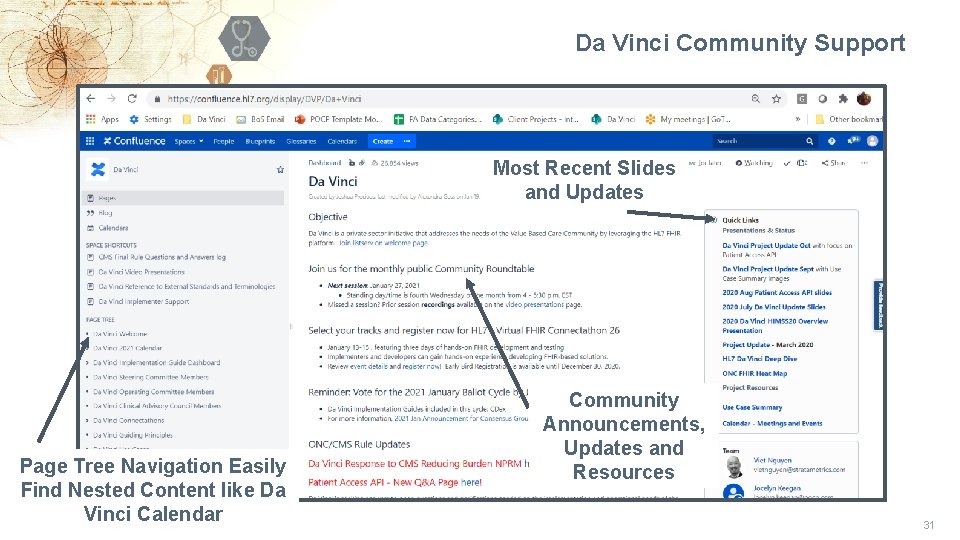
Da Vinci Community Support Most Recent Slides and Updates Page Tree Navigation Easily Find Nested Content like Da Vinci Calendar Community Announcements, Updates and Resources 31
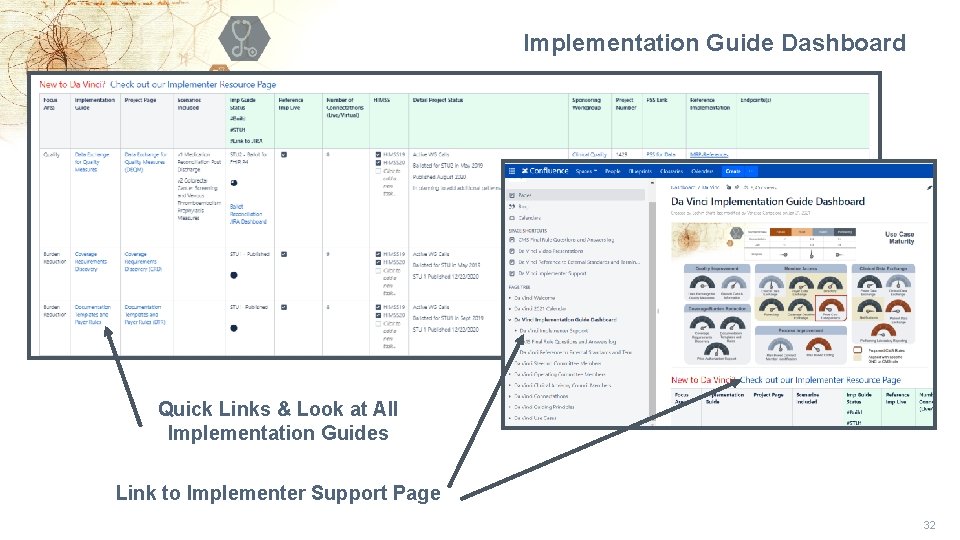
Implementation Guide Dashboard Quick Links & Look at All Implementation Guides Link to Implementer Support Page 32
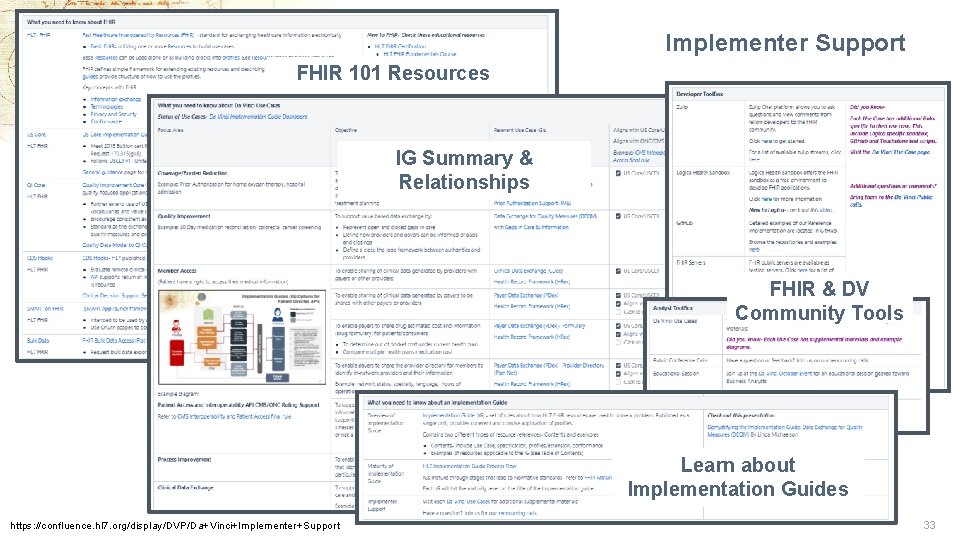
Implementer Support FHIR 101 Resources IG Summary & Relationships FHIR & DV Community Tools Learn about Implementation Guides https: //confluence. hl 7. org/display/DVP/Da+Vinci+Implementer+Support 33
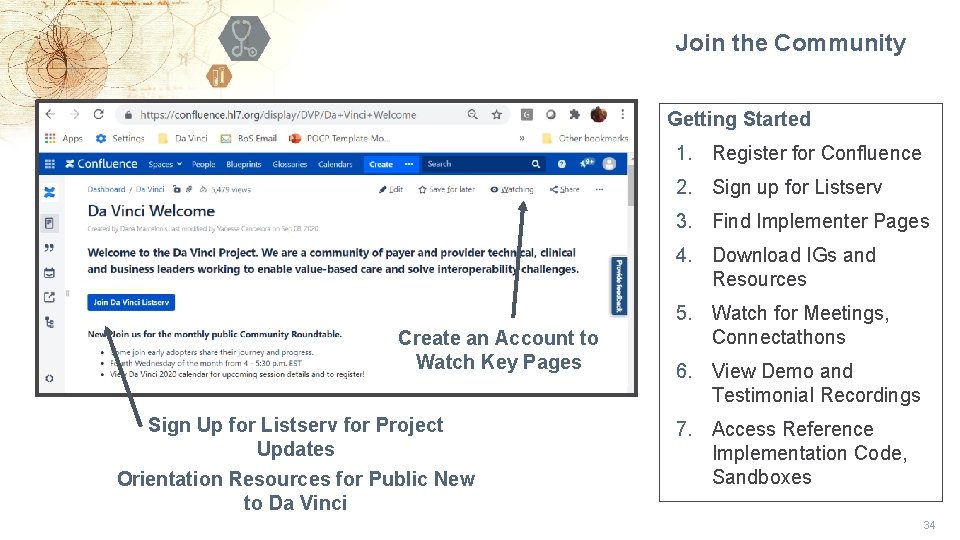
Join the Community Getting Started 1. Register for Confluence 2. Sign up for Listserv 3. Find Implementer Pages 4. Download IGs and Resources Create an Account to Watch Key Pages Sign Up for Listserv for Project Updates Orientation Resources for Public New to Da Vinci 5. Watch for Meetings, Connectathons 6. View Demo and Testimonial Recordings 7. Access Reference Implementation Code, Sandboxes 34

Membership Support
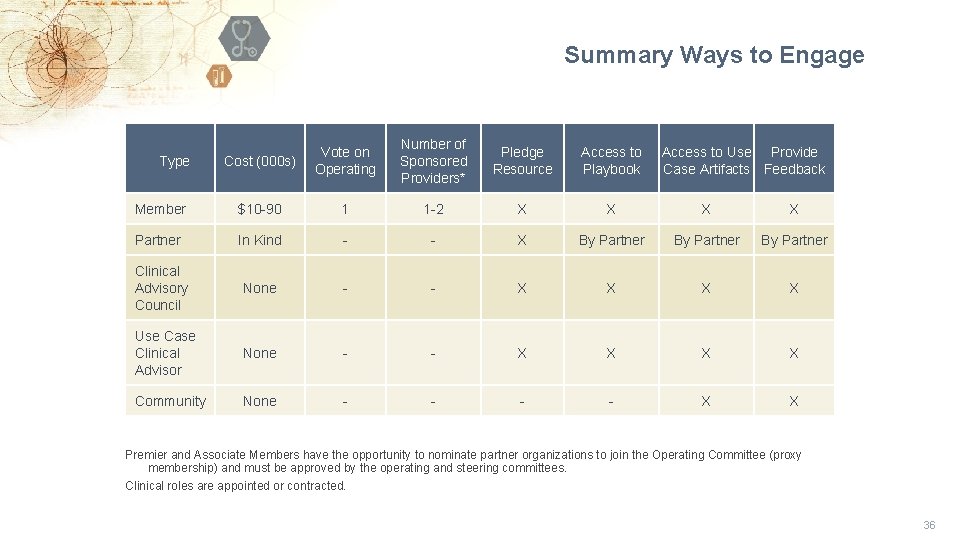
Summary Ways to Engage Cost (000 s) Vote on Operating Number of Sponsored Providers* Pledge Resource Access to Playbook Member $10 -90 1 1 -2 X X Partner In Kind - - X By Partner Clinical Advisory Council None - - X X Use Case Clinical Advisor None - - X X Community None - - X X Type Access to Use Provide Case Artifacts Feedback Premier and Associate Members have the opportunity to nominate partner organizations to join the Operating Committee (proxy membership) and must be approved by the operating and steering committees. Clinical roles are appointed or contracted. 3636
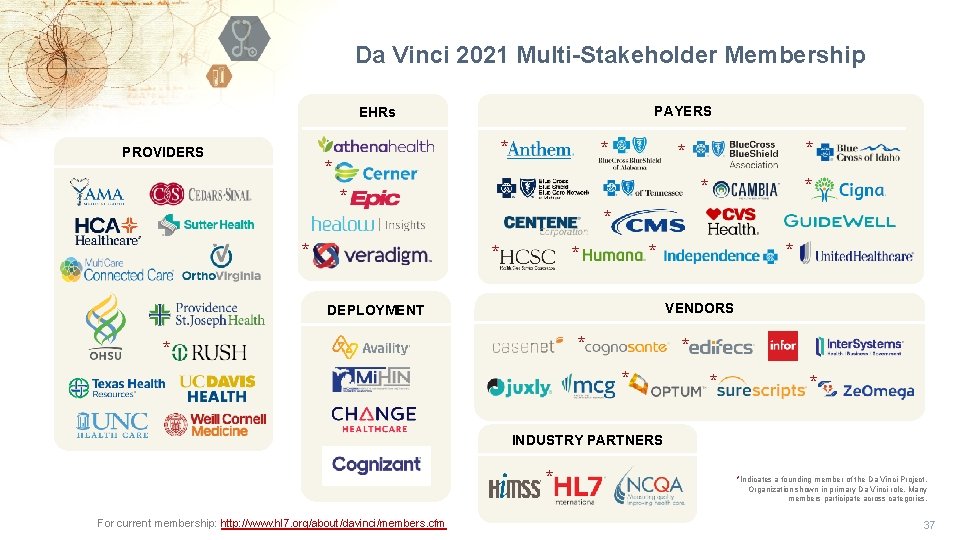
Da Vinci 2021 Multi-Stakeholder Membership PAYERS EHRs PROVIDERS * * * * VENDORS DEPLOYMENT * * * INDUSTRY PARTNERS * For current membership: http: //www. hl 7. org/about/davinci/members. cfm *Indicates a founding member of the Da Vinci Project. Organization shown in primary Da Vinci role, Many members participate across categories. 37
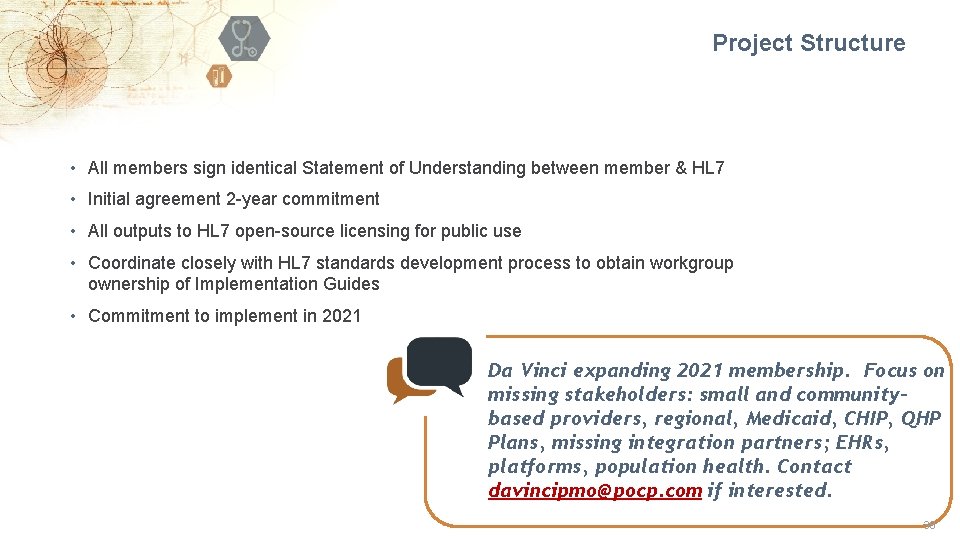
Project Structure • All members sign identical Statement of Understanding between member & HL 7 • Initial agreement 2 -year commitment • All outputs to HL 7 open-source licensing for public use • Coordinate closely with HL 7 standards development process to obtain workgroup ownership of Implementation Guides • Commitment to implement in 2021 Da Vinci expanding 2021 membership. Focus on missing stakeholders: small and communitybased providers, regional, Medicaid, CHIP, QHP Plans, missing integration partners; EHRs, platforms, population health. Contact davincipmo@pocp. com if interested. 38
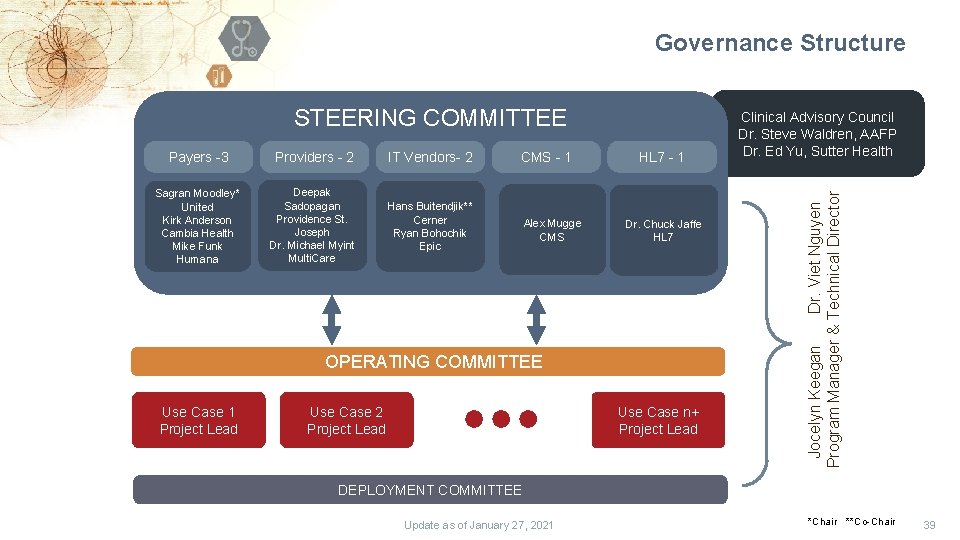
Governance Structure Payers -3 Providers - 2 IT Vendors- 2 CMS - 1 Sagran Moodley* United Kirk Anderson Cambia Health Mike Funk Humana Deepak Sadopagan Providence St. Joseph Dr. Michael Myint Multi. Care Hans Buitendjik** Cerner Ryan Bohochik Epic Alex Mugge CMS HL 7 - 1 Dr. Chuck Jaffe HL 7 OPERATING COMMITTEE Use Case 1 Project Lead Use Case 2 Project Lead Use Case n+ Project Lead Clinical Advisory Council Dr. Steve Waldren, AAFP Dr. Ed Yu, Sutter Health Jocelyn Keegan Dr. Viet Nguyen Program Manager & Technical Director STEERING COMMITTEE DEPLOYMENT COMMITTEE Update as of January 27, 2021 *Chair **Co-Chair 39
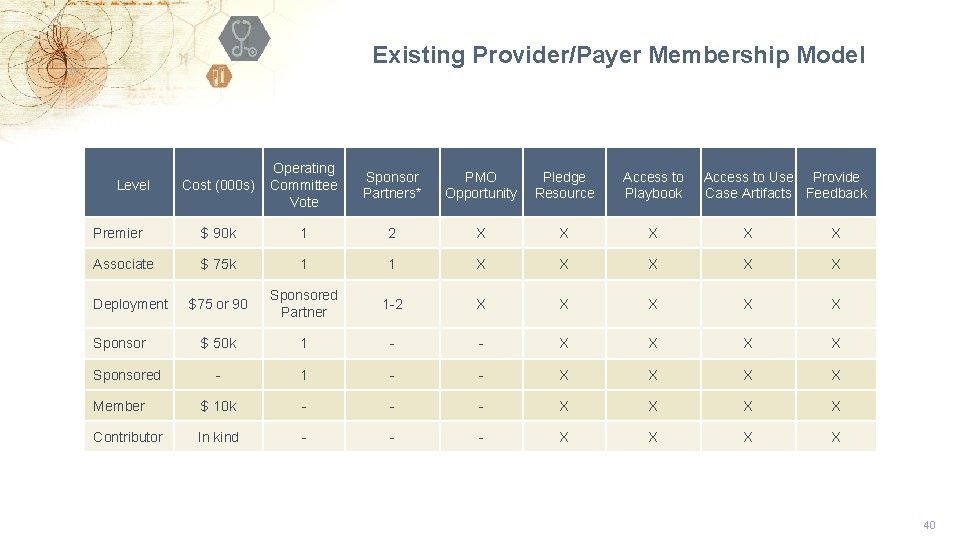
Existing Provider/Payer Membership Model Cost (000 s) Operating Committee Vote Sponsor Partners* PMO Opportunity Pledge Resource Access to Playbook Premier $ 90 k 1 2 X X X Associate $ 75 k 1 1 X X X $75 or 90 Sponsored Partner 1 -2 X X X $ 50 k 1 - - X X - 1 - - X X $ 10 k - - - X X Level Deployment Sponsored Member Access to Use Provide Case Artifacts Feedback * Premier and Associate Members have the opportunity to nominate partner organizations to join the Contributor In kind (proxy -membership) - and must be - approved. Xby the operating X X X Operating Committee and steering committees. 4040
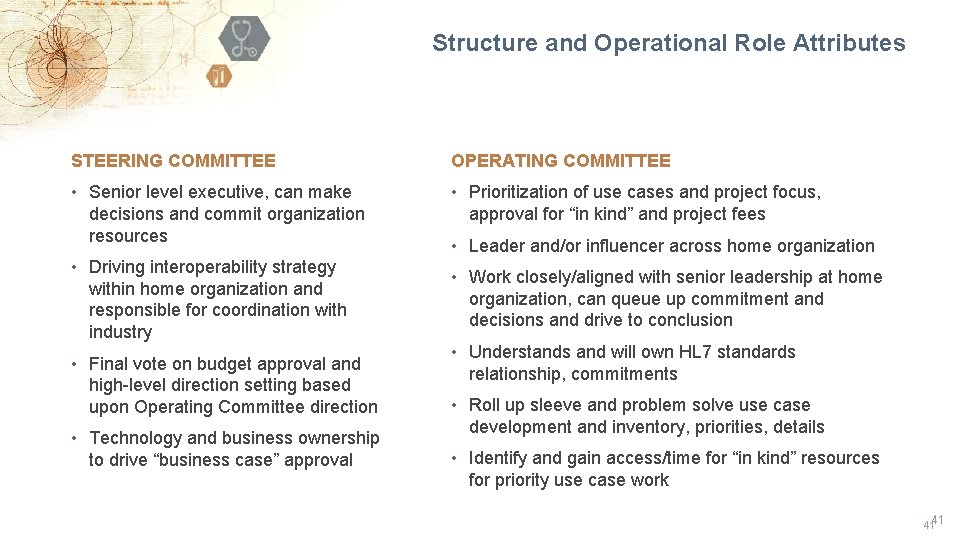
Structure and Operational Role Attributes STEERING COMMITTEE OPERATING COMMITTEE • Senior level executive, can make decisions and commit organization resources • Prioritization of use cases and project focus, approval for “in kind” and project fees • Driving interoperability strategy within home organization and responsible for coordination with industry • Final vote on budget approval and high-level direction setting based upon Operating Committee direction • Technology and business ownership to drive “business case” approval • Leader and/or influencer across home organization • Work closely/aligned with senior leadership at home organization, can queue up commitment and decisions and drive to conclusion • Understands and will own HL 7 standards relationship, commitments • Roll up sleeve and problem solve use case development and inventory, priorities, details • Identify and gain access/time for “in kind” resources for priority use case work 4141
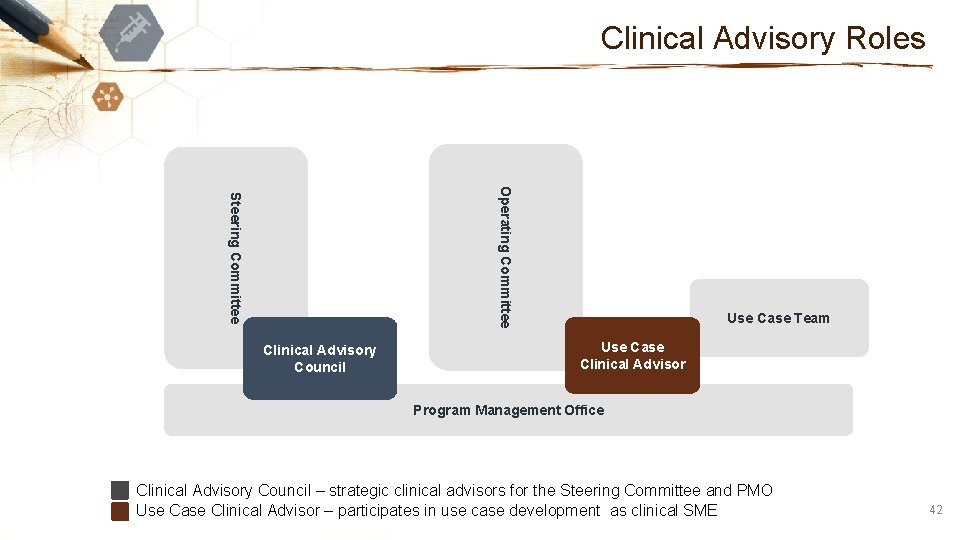
Clinical Advisory Roles Operating Committee Steering Committee Clinical Advisory Council Use Case Team Use Case Clinical Advisor Program Management Office Clinical Advisory Council – strategic clinical advisors for the Steering Committee and PMO Use Case Clinical Advisor – participates in use case development as clinical SME 42
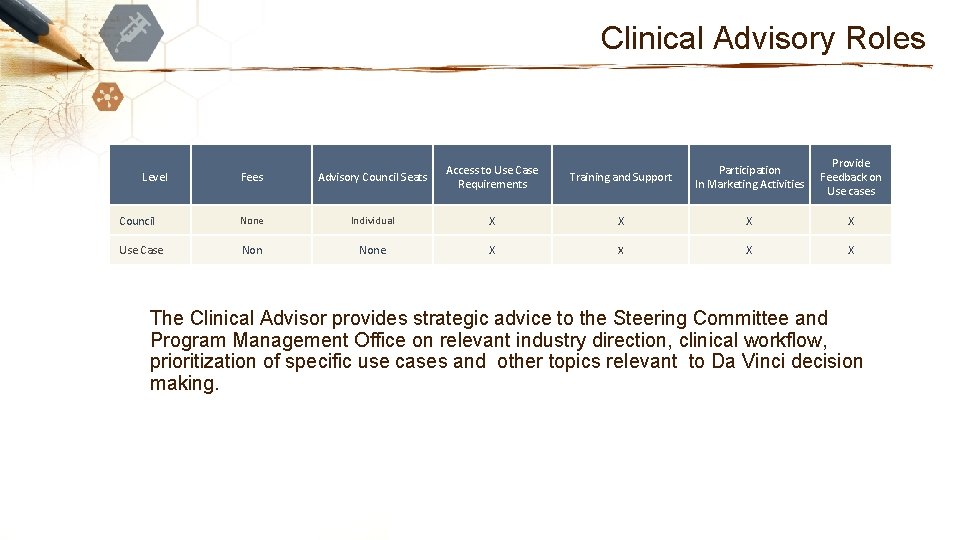
Clinical Advisory Roles Training and Support Participation In Marketing Activities Provide Feedback on Use cases Fees Advisory Council Seats Access to Use Case Requirements Council None Individual X X Use Case None X X Level The Clinical Advisor provides strategic advice to the Steering Committee and Program Management Office on relevant industry direction, clinical workflow, prioritization of specific use cases and other topics relevant to Da Vinci decision making.
Da Vinci Program Manager: Jocelyn Keegan, Point of Care Partners jocelyn. keegan@pocp. com Da Vinci Technical Lead: Dr. Viet Nguyen, Stratametrics LLC vietnguyen@stratametrics. com Da Vinci Project Manager: Vanessa Candelora, Point of Care Partners vanessa. candelora@pocp. com
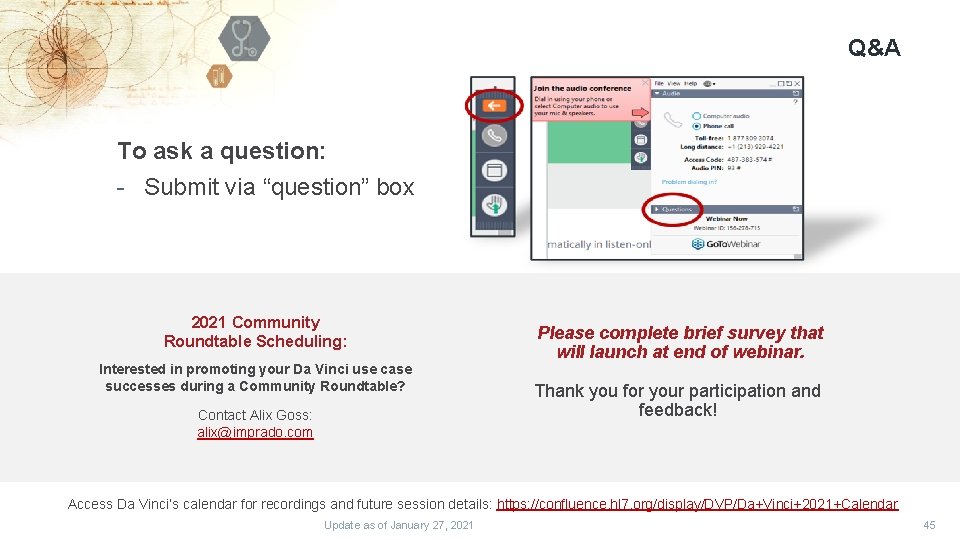
Q&A To ask a question: - Submit via “question” box 2021 Community Roundtable Scheduling: Interested in promoting your Da Vinci use case successes during a Community Roundtable? Contact Alix Goss: alix@imprado. com Please complete brief survey that will launch at end of webinar. Thank you for your participation and feedback! Access Da Vinci’s calendar for recordings and future session details: https: //confluence. hl 7. org/display/DVP/Da+Vinci+2021+Calendar Update as of January 27, 2021 45
Da Vinci Program Support for Member Onboarding, Training and Use Case Implementations: Alix Goss, Imprado alix@imprado. com
- Slides: 46