
HL 7 Clinical Document Architecture An Introduction Toolkit
- Slides: 17
HL 7 Clinical Document Architecture An Introduction Toolkit for Planning an EHR-based Surveillance Program | www. phii. org/EHRtoolkit
Presentation Outline • • • Brief description of HL 7 Brief history of CDA Description of Document Paradigm CDA levels CDA components Examples Disclaimer: This presentation is not a comprehensive training in the HL 7 standard. The HL 7 organization offers many training courses that provide more in-depth training. Toolkit for Planning an EHR-based Surveillance Program | www. phii. org/EHRtoolkit
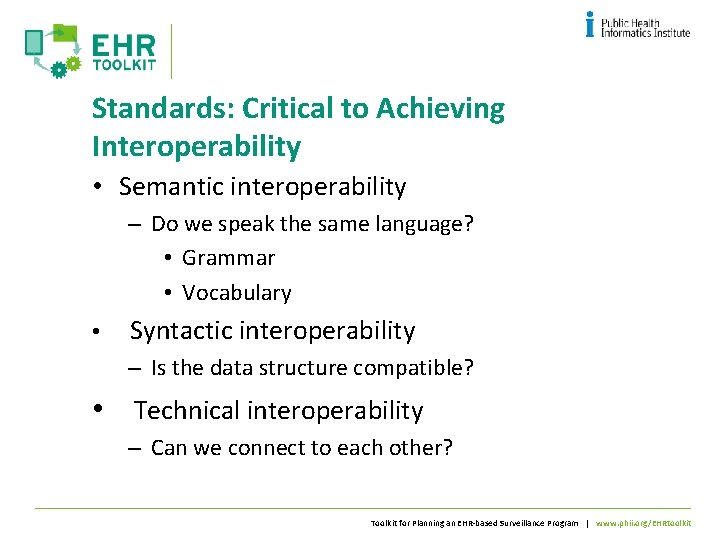
Standards: Critical to Achieving Interoperability • Semantic interoperability – Do we speak the same language? • Grammar • Vocabulary • Syntactic interoperability – Is the data structure compatible? • Technical interoperability – Can we connect to each other? Toolkit for Planning an EHR-based Surveillance Program | www. phii. org/EHRtoolkit
Organizational History of HL 7 • Founded as an international standards development organization in 1987 to promote communication between hospital data systems • Stated a goal of creating a platform independent method of moving data between different systems • Developed grammar for messaging and a standardized vocabulary Toolkit for Planning an EHR-based Surveillance Program | www. phii. org/EHRtoolkit
HL 7: The Primary Standard for Communicating Health Data • • ANSI standard for clinical interoperability The standards continue to evolve and are widely adopted Meaningful Use has identified a number of HL 7 standards to support sharing data between systems HL 7 website: http: //www. hl 7. org/ Toolkit for Planning an EHR-based Surveillance Program | www. phii. org/EHRtoolkit
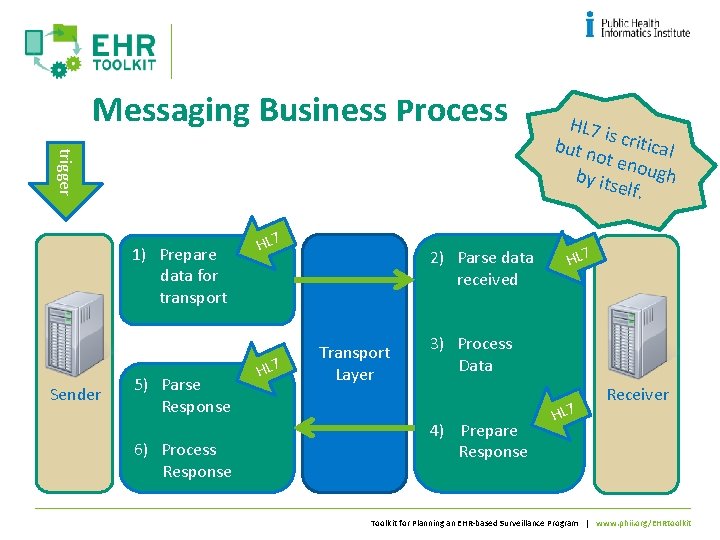
Messaging Business Process trigger 1) Prepare data for transport Sender 5) Parse Response 6) Process Response HL 7 2) Parse data received Transport Layer HL 7 i s but n critical ot en by its ough elf. HL 7 3) Process Data 4) Prepare Response HL 7 Receiver Toolkit for Planning an EHR-based Surveillance Program | www. phii. org/EHRtoolkit
HL 7 Versions • • HL 7 Version 2. x messaging HL 7 Version 3 messaging HL 7 Clinical Document Architecture (CDA) HL 7 Fast Healthcare Interoperability Resources (FHIR) Toolkit for Planning an EHR-based Surveillance Program | www. phii. org/EHRtoolkit
Clinical Document Architecture - CDA • • • An electronic equivalent of a paper document Has an author/attester Represents a point in time view of data Persists as an artifact over time Supports simple to very complex document types Toolkit for Planning an EHR-based Surveillance Program | www. phii. org/EHRtoolkit
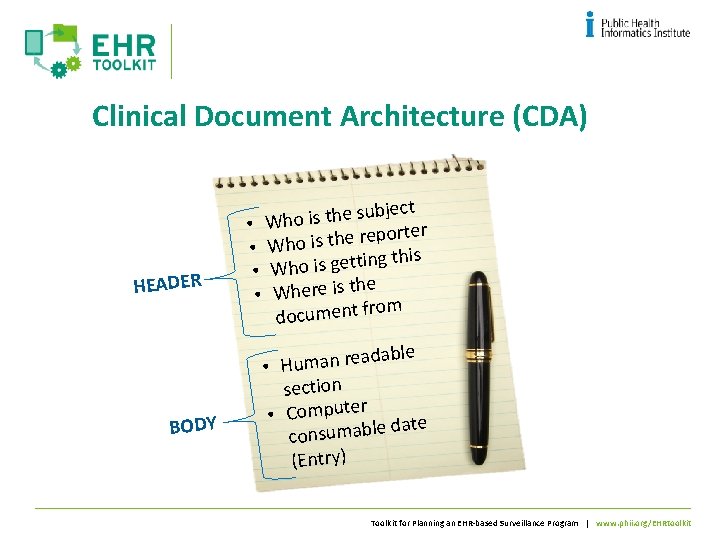
Clinical Document Architecture (CDA) HEADER BODY ubject s e h t is o h • W rter o p e r e h t is • Who ing this t t e g is o h • W the • Where is rom document f adable e r n a m u H • section • Computer date consumable (Entry) Toolkit for Planning an EHR-based Surveillance Program | www. phii. org/EHRtoolkit
CDA - Structured Body The CDA body is composed of a Narrative block and an Entry block • Narrative block. A text section that a browser can render so that it is readable by a human • Entry block. The data formatted in a way that facilitates computer consumption of the structured data and represents the same information as the data in the Narrative block Toolkit for Planning an EHR-based Surveillance Program | www. phii. org/EHRtoolkit
Profiles Constrain the HL 7 Base Standard • Base standard is designed to meet many needs from many countries • To be useful, the standard must be constrained to meet a specific need in a specific realm Toolkit for Planning an EHR-based Surveillance Program | www. phii. org/EHRtoolkit
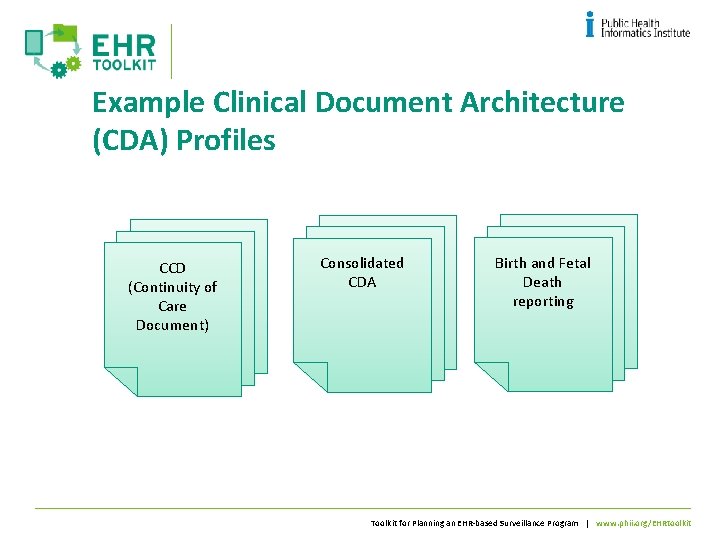
CDA Profiles Building Blocks • Profiles are built from components – Patient – Medication List – Immunization Record • Profiles specify which components must be included and which may be included Toolkit for Planning an EHR-based Surveillance Program | www. phii. org/EHRtoolkit
Example Clinical Document Architecture (CDA) Profiles CCD (Continuity of Care Document) Consolidated CDA Birth and Fetal Death reporting Toolkit for Planning an EHR-based Surveillance Program | www. phii. org/EHRtoolkit
CDA Public Health Examples • • Consolidated CDA (Continuity of Care Document) Cancer reporting Vital records fetal birth and death Quality Reporting Document Architecture (QRDA) Toolkit for Planning an EHR-based Surveillance Program | www. phii. org/EHRtoolkit
When to Use CDA Documents • The focus is on persistence of the artifact • Need tight control over authenticated content • When human readability across platforms is desirable Toolkit for Planning an EHR-based Surveillance Program | www. phii. org/EHRtoolkit
When to Avoid Using CDA Documents • Need for workflow – Decision support – Request - response • Data are dynamic – Want view of data now, not when authored – Multiple contributors over time • Data from disparate systems need to be integrated Toolkit for Planning an EHR-based Surveillance Program | www. phii. org/EHRtoolkit
Additional Resources • • • HL 7 (hl 7. org) has a variety of materials including tutorials where you can get the specifics for each of its standards. HL 7’s website is at: http: //www. hl 7. org/ CDC’s Vocabulary Access and Distribution Systems (PHIN VADS) can be found at https: //phinvads. cdc. gov/ Toolkit for Planning an EHR-based Surveillance Program | www. phii. org/EHRtoolkit