
HIV1 Rapid Test for Recent Infection Sedia Asante



- Slides: 20
HIV-1 Rapid Test for Recent Infection: Sedia Asante HIV-1 Rapid Recency Assay PERFORMING SEDIA ASANTE: TESTING ALGORITHM International Laboratory Branch Division of Global HIV/AIDS & Tuberculosis Centers for Disease Control and Prevention
2 Learning Objectives • At the end of this module, you will be able to: • Define HIV diagnosis testing algorithms • Define HIV recent infection testing algorithm • Define HIV status and HIV recent/long-term status using an algorithm
3 Content Overview • To determine HIV status • Testing strategies • Testing algorithms • To determine recent infection • Interpreting test results of Asante® HIV-1 Rapid Recency Assay
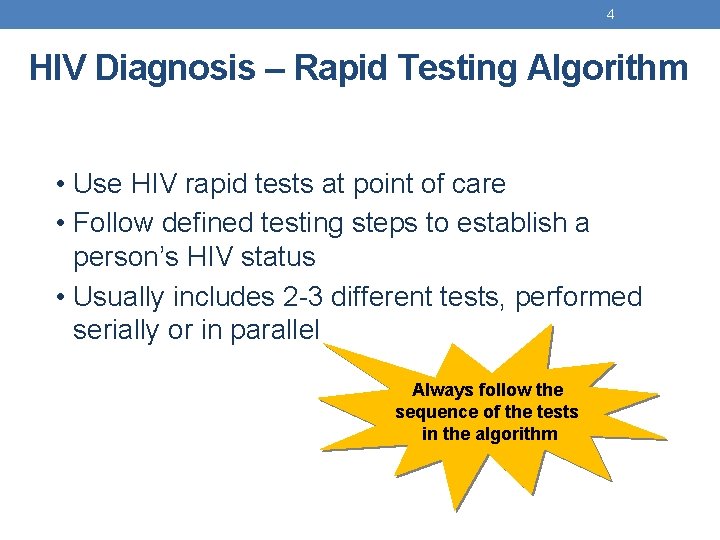
4 HIV Diagnosis – Rapid Testing Algorithm • Use HIV rapid tests at point of care • Follow defined testing steps to establish a person’s HIV status • Usually includes 2 -3 different tests, performed serially or in parallel Always follow the sequence of the tests in the algorithm
5 HIV Diagnosis – HIV Status • Positive HIV diagnosis is based on reactive result of two or more different tests • When the first two tests are discordant, a third test or repeat testing must be performed as per country algorithm • The result of the third test or repeat testing determines the algorithm result
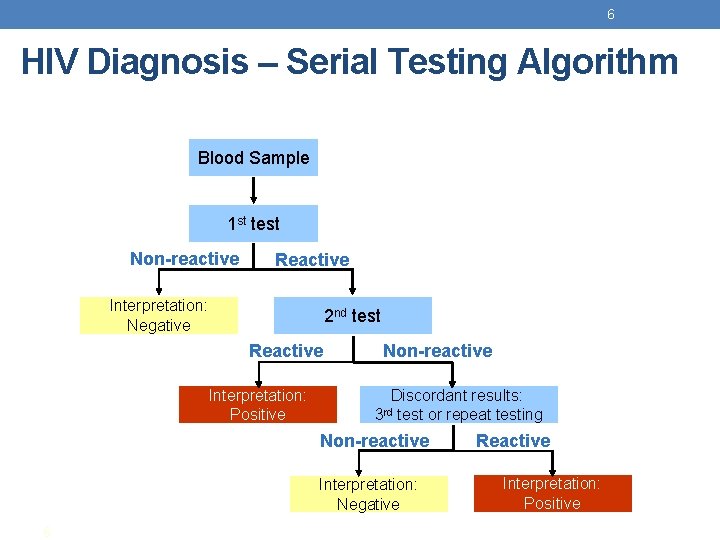
6 HIV Diagnosis – Serial Testing Algorithm Blood Sample 1 st test Non-reactive Reactive Interpretation: Negative 2 nd test Reactive Interpretation: Positive Non-reactive Discordant results: test or repeat testing 3 rd Non-reactive Interpretation: Negative 6 Reactive Interpretation: Positive
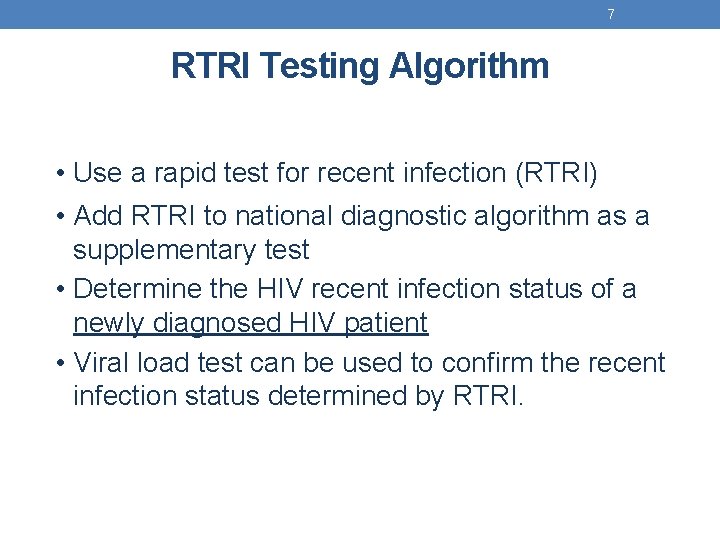
7 RTRI Testing Algorithm • Use a rapid test for recent infection (RTRI) • Add RTRI to national diagnostic algorithm as a supplementary test • Determine the HIV recent infection status of a newly diagnosed HIV patient • Viral load test can be used to confirm the recent infection status determined by RTRI.
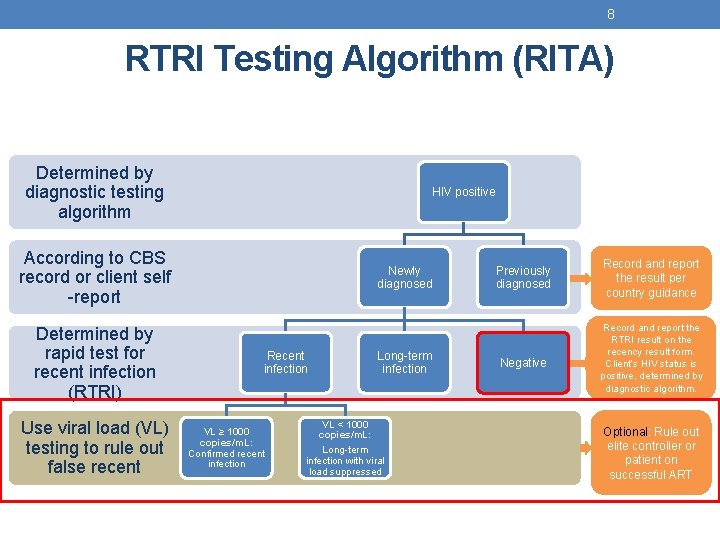
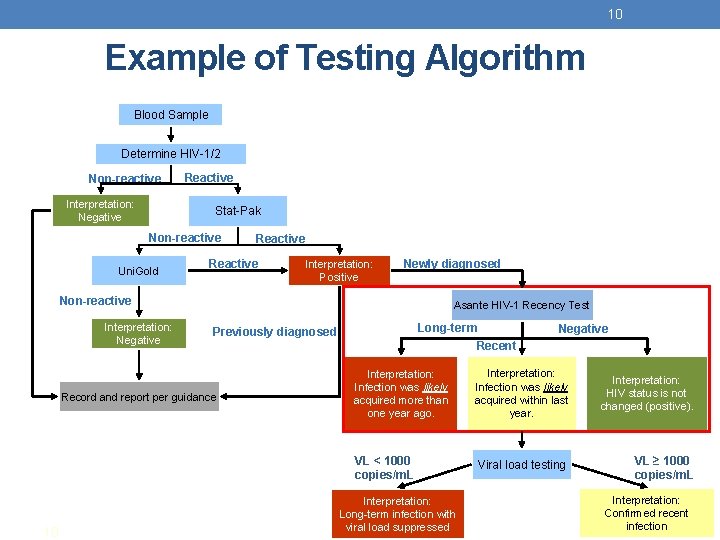
8 RTRI Testing Algorithm (RITA) Determined by diagnostic testing algorithm HIV positive According to CBS record or client self -report Determined by rapid test for recent infection (RTRI) Use viral load (VL) testing to rule out false recent Newly diagnosed Recent infection VL ≥ 1000 copies/m. L: Confirmed recent infection Long-term infection VL < 1000 copies/m. L: Long-term infection with viral load suppressed Previously diagnosed Record and report the result per country guidance Negative Record and report the RTRI result on the recency result form. Client’s HIV status is positive, determined by diagnostic algorithm. Optional: Rule out elite controller or patient on successful ART
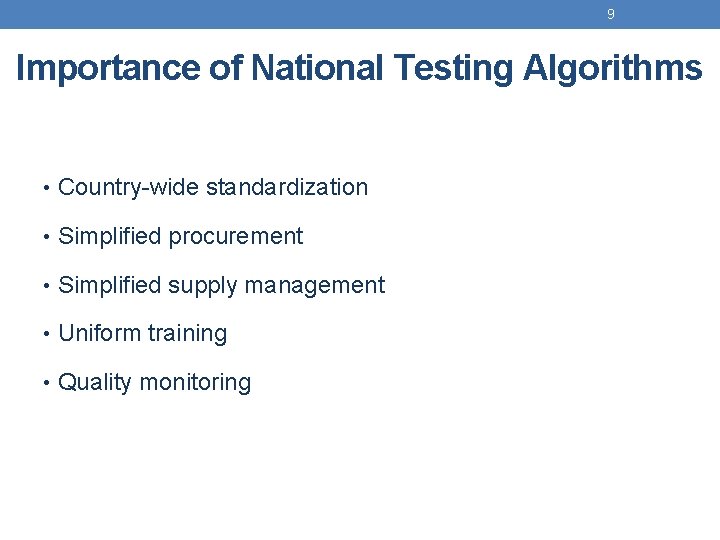
9 Importance of National Testing Algorithms • Country-wide standardization • Simplified procurement • Simplified supply management • Uniform training • Quality monitoring
10 Example of Testing Algorithm Blood Sample Determine HIV-1/2 Non-reactive Interpretation: Negative Reactive Stat-Pak Non-reactive Uni. Gold Reactive Interpretation: Positive Newly diagnosed Non-reactive Interpretation: Negative Asante HIV-1 Recency Test Record and report per guidance 10 Long-term Recent Previously diagnosed Negative Interpretation: Infection was likely acquired more than one year ago. Interpretation: Infection was likely acquired within last year. Interpretation: HIV status is not changed (positive). VL < 1000 copies/m. L Viral load testing VL ≥ 1000 copies/m. L Interpretation: Long-term infection with viral load suppressed Interpretation: Confirmed recent infection
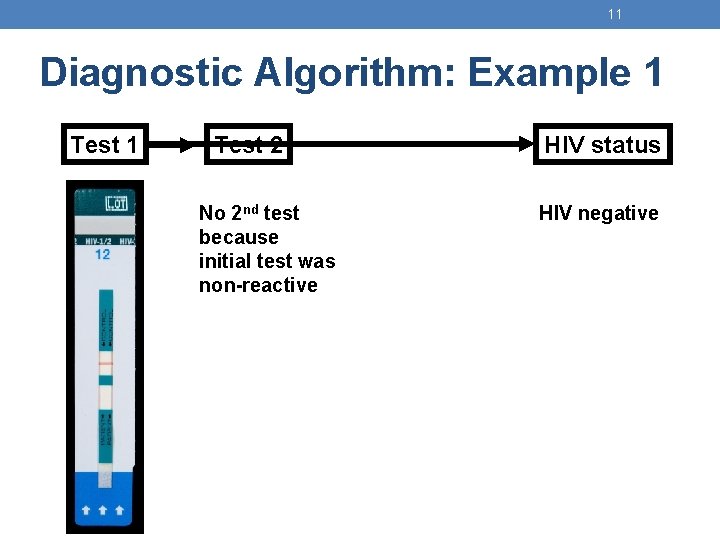
11 Diagnostic Algorithm: Example 1 Test 2 No 2 nd test because initial test was non-reactive HIV status HIV negative
12 Diagnostic Algorithm: Example 2 Test 1 Test 2 HIV status HIV positive
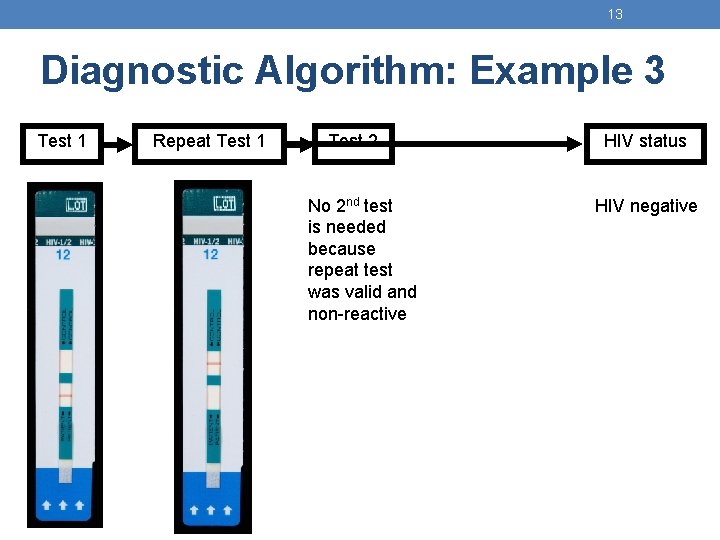
13 Diagnostic Algorithm: Example 3 Test 1 Repeat Test 1 Test 2 No 2 nd test is needed because repeat test was valid and non-reactive HIV status HIV negative
14 Diagnostic Algorithm: Example 4 Test 1 Test 2 Test 3 HIV status HIV Positive
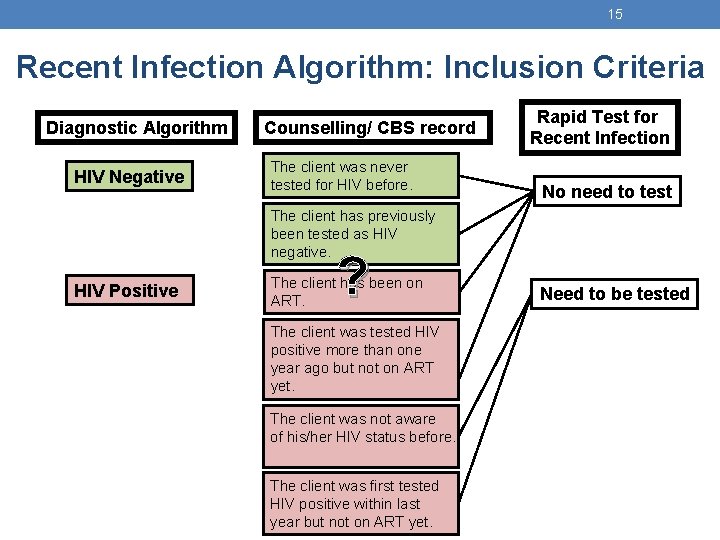
15 Recent Infection Algorithm: Inclusion Criteria Diagnostic Algorithm HIV Negative Counselling/ CBS record The client was never tested for HIV before. Rapid Test for Recent Infection No need to test The client has previously been tested as HIV negative. HIV Positive ? The client has been on ART. The client was tested HIV positive more than one year ago but not on ART yet. The client was not aware of his/her HIV status before. The client was first tested HIV positive within last year but not on ART yet. Need to be tested
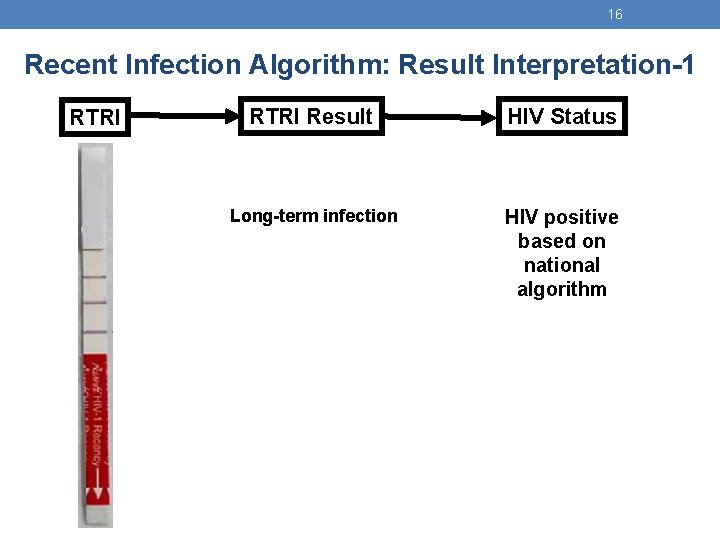
16 Recent Infection Algorithm: Result Interpretation-1 RTRI Result HIV Status Long-term infection HIV positive based on national algorithm
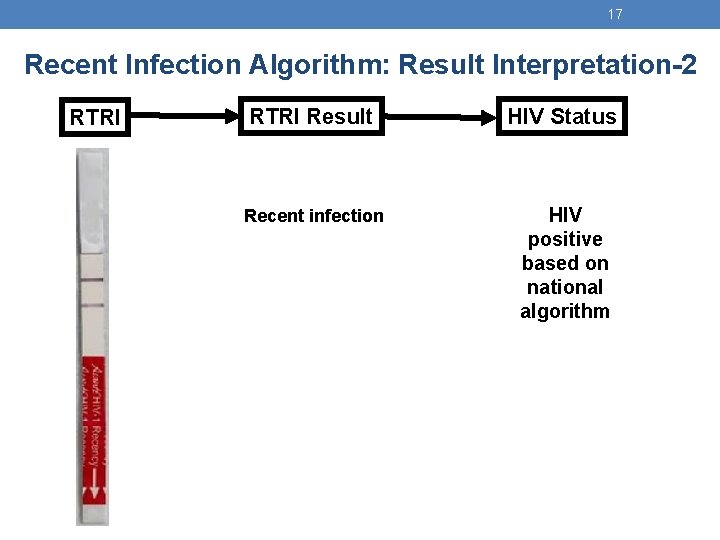
17 Recent Infection Algorithm: Result Interpretation-2 RTRI Result HIV Status Recent infection HIV positive based on national algorithm
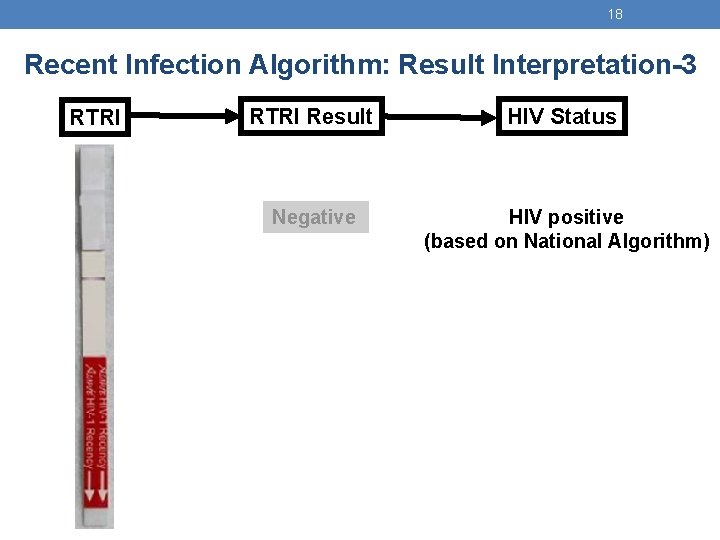
18 Recent Infection Algorithm: Result Interpretation-3 RTRI Result HIV Status Negative HIV positive (based on National Algorithm)
19 Review • When can HIV be diagnosed with a single test? • What is the diagnostic algorithm? • What is the recent infection testing algorithm? • What is the HIV status if RTRI result is negative?
Thank You