
Hittites Who Were the Hittites Ancient Anatolian people

- Slides: 42
Hittites
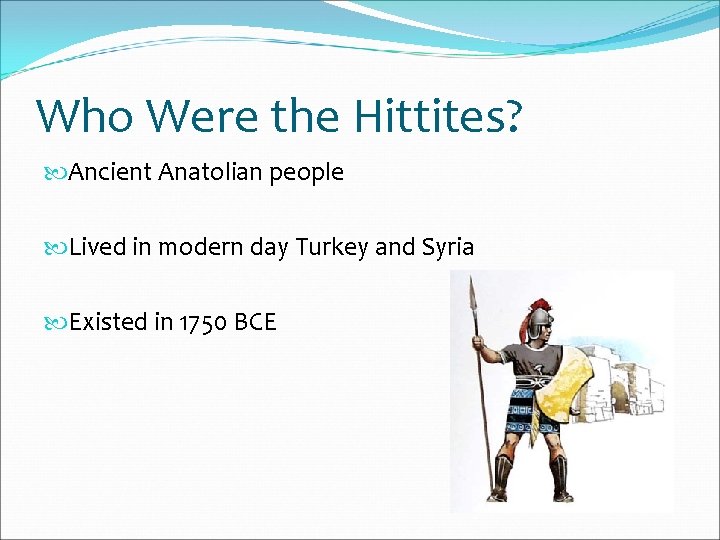
Who Were the Hittites? Ancient Anatolian people Lived in modern day Turkey and Syria Existed in 1750 BCE
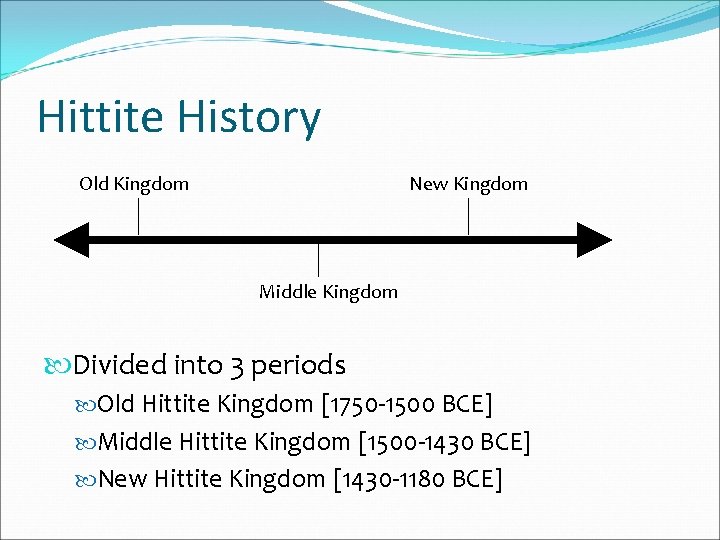
Hittite History Old Kingdom New Kingdom Middle Kingdom Divided into 3 periods Old Hittite Kingdom [1750 -1500 BCE] Middle Hittite Kingdom [1500 -1430 BCE] New Hittite Kingdom [1430 -1180 BCE]
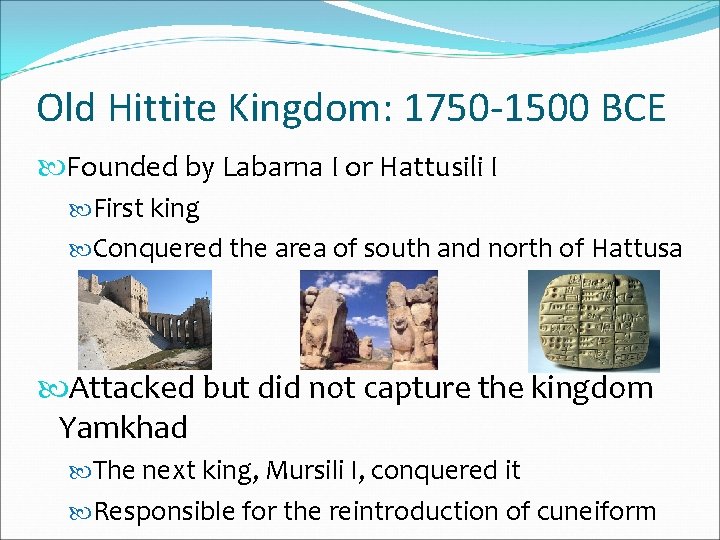
Old Hittite Kingdom: 1750 -1500 BCE Founded by Labarna I or Hattusili I First king Conquered the area of south and north of Hattusa Attacked but did not capture the kingdom Yamkhad The next king, Mursili I, conquered it Responsible for the reintroduction of cuneiform
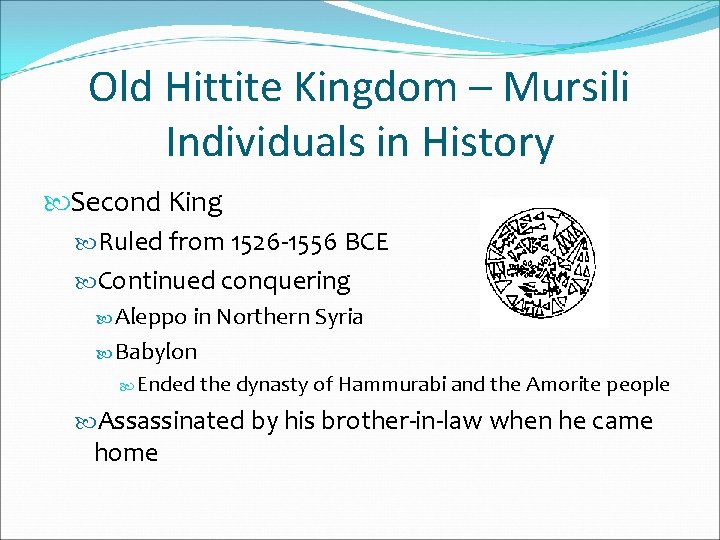
Old Hittite Kingdom – Mursili Individuals in History Second King Ruled from 1526 -1556 BCE Continued conquering Aleppo in Northern Syria Babylon Ended the dynasty of Hammurabi and the Amorite people Assassinated by his brother-in-law when he came home
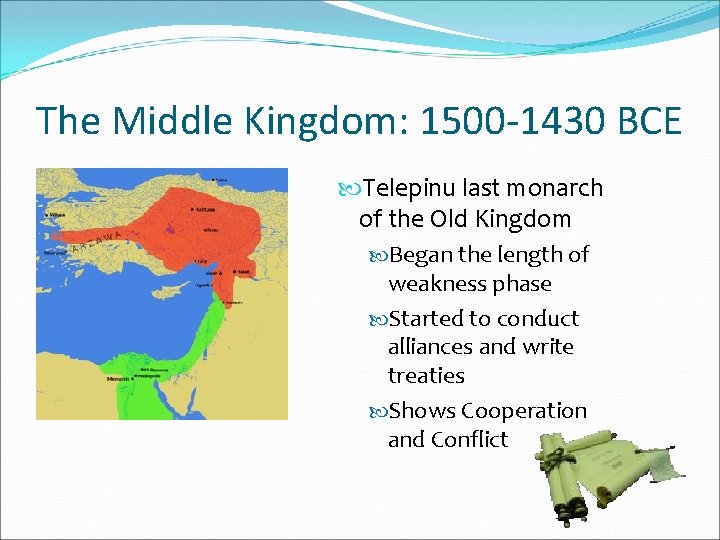
The Middle Kingdom: 1500 -1430 BCE Telepinu last monarch of the Old Kingdom Began the length of weakness phase Started to conduct alliances and write treaties Shows Cooperation and Conflict
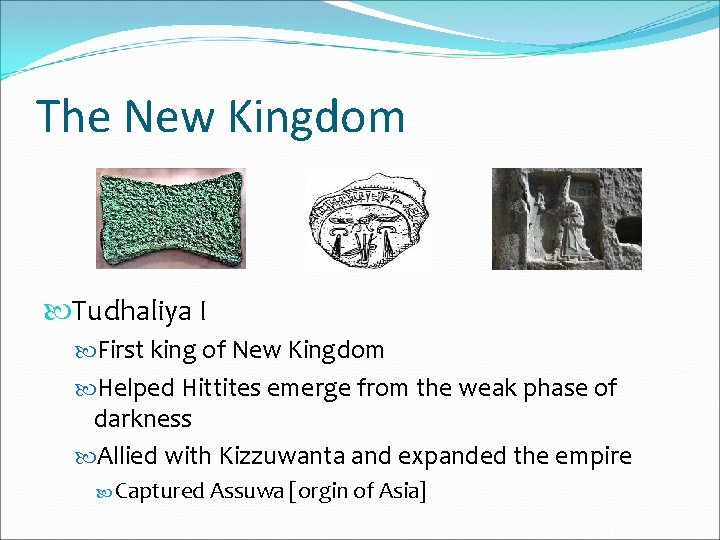
The New Kingdom Tudhaliya I First king of New Kingdom Helped Hittites emerge from the weak phase of darkness Allied with Kizzuwanta and expanded the empire Captured Assuwa [orgin of Asia]
The Rise of Democratic Ideas Significantly updated the law they took from the Old Bablyonians Differences: 1. More merciful 2. No death penaly for minor crimes 3. More fines than death 4. Gave more power to the king Basically everything on the Hittite territory belonged to the king [Monarchy]
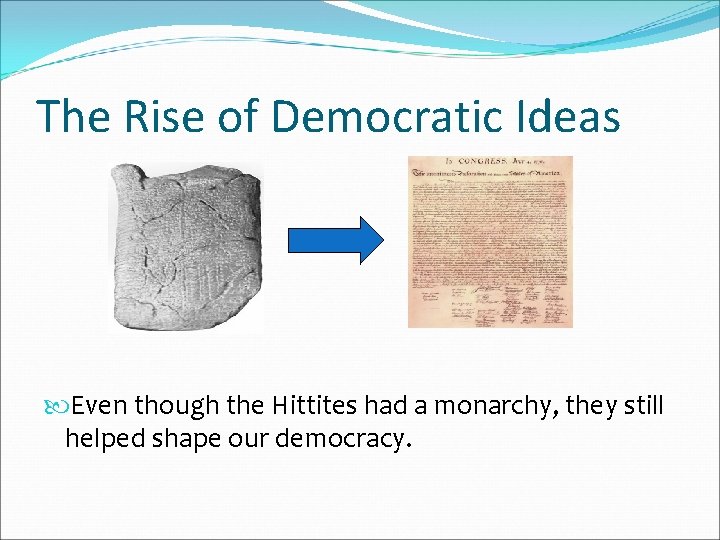
The Rise of Democratic Ideas Even though the Hittites had a monarchy, they still helped shape our democracy.
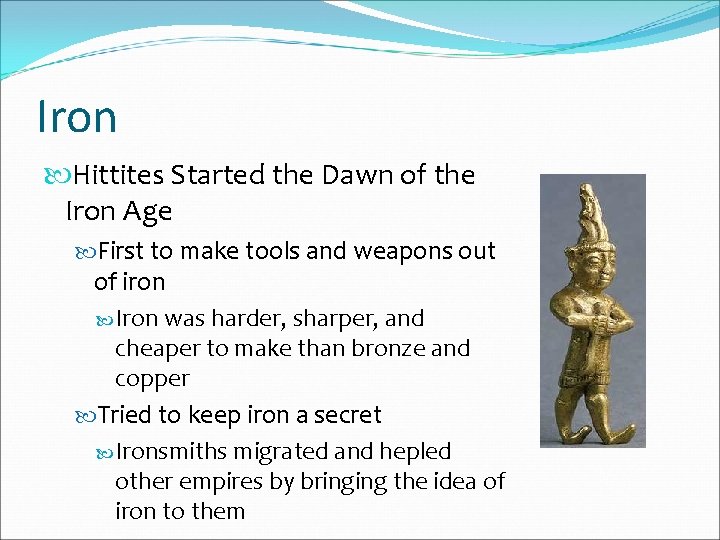
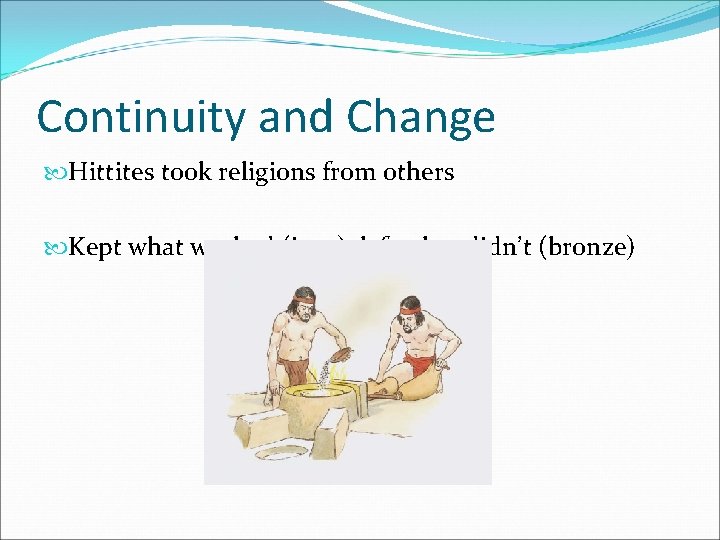
Iron Hittites Started the Dawn of the Iron Age First to make tools and weapons out of iron Iron was harder, sharper, and cheaper to make than bronze and copper Tried to keep iron a secret Ironsmiths migrated and hepled other empires by bringing the idea of iron to them
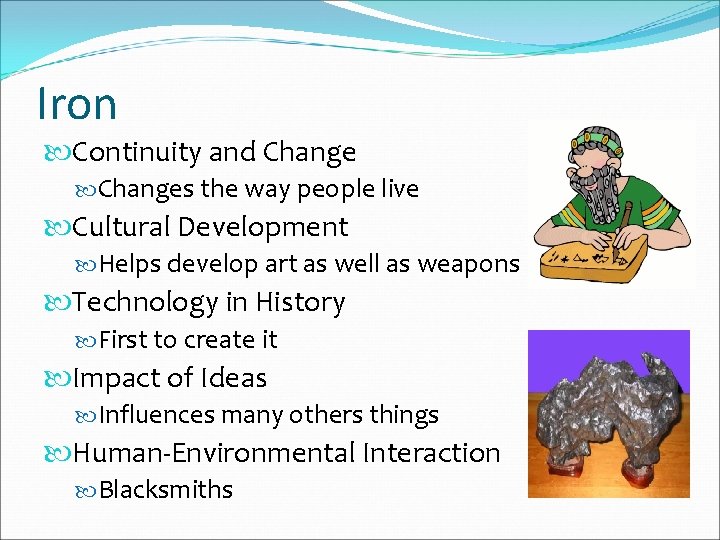
Iron Continuity and Changes the way people live Cultural Development Helps develop art as well as weapons Technology in History First to create it Impact of Ideas Influences many others things Human-Environmental Interaction Blacksmiths
Religion Polytheism Adopted mostly the same gods of the Sumerian people and Old Babylonians Whenever they conquered a group of people they adopt their gods they believed in to their religion
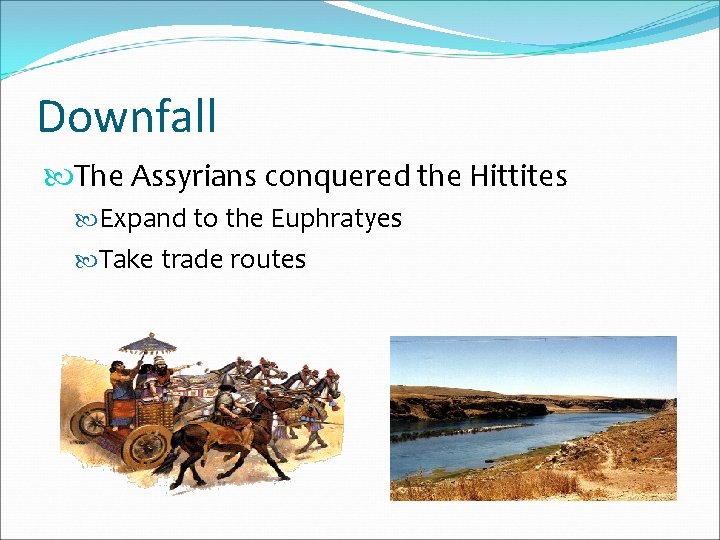
Downfall The Assyrians conquered the Hittites Expand to the Euphratyes Take trade routes
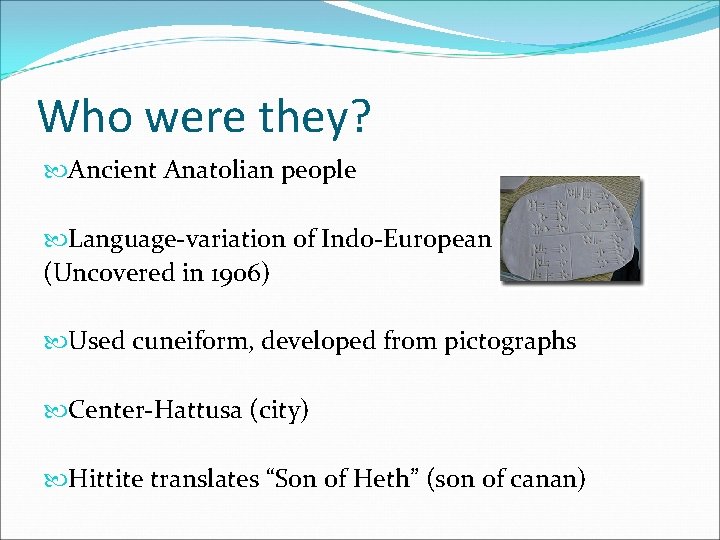
Who were they? Ancient Anatolian people Language-variation of Indo-European (Uncovered in 1906) Used cuneiform, developed from pictographs Center-Hattusa (city) Hittite translates “Son of Heth” (son of canan)
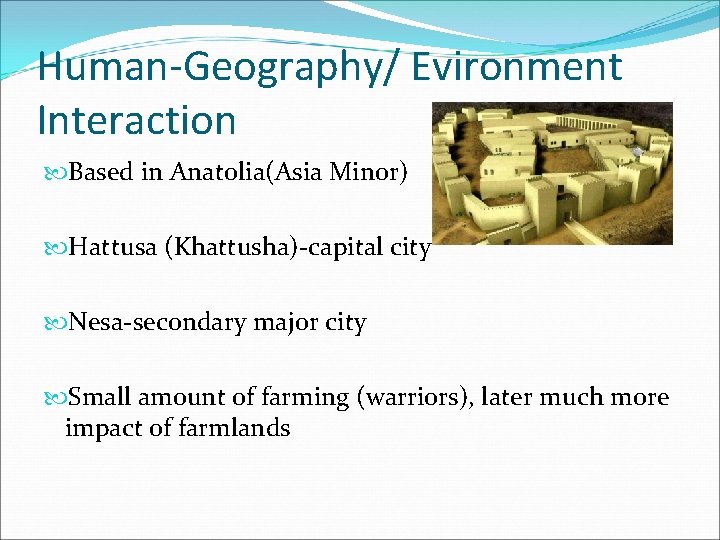
Human-Geography/ Evironment Interaction Based in Anatolia(Asia Minor) Hattusa (Khattusha)-capital city Nesa-secondary major city Small amount of farming (warriors), later much more impact of farmlands
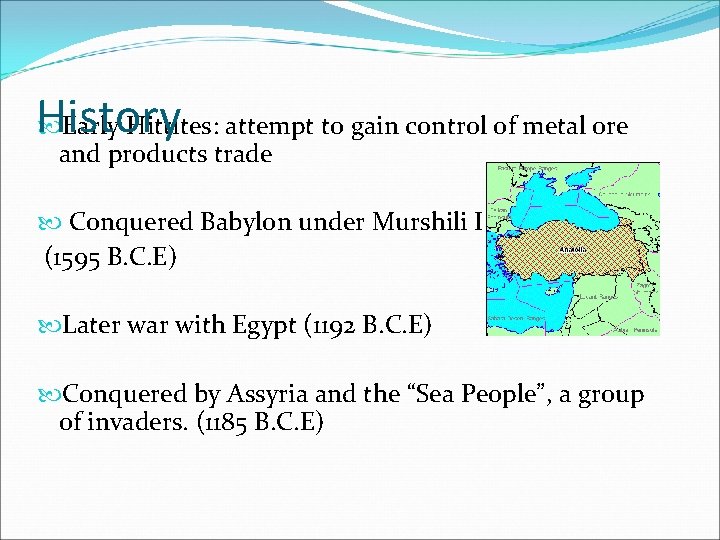
History Early Hittites: attempt to gain control of metal ore and products trade Conquered Babylon under Murshili I (1595 B. C. E) Later war with Egypt (1192 B. C. E) Conquered by Assyria and the “Sea People”, a group of invaders. (1185 B. C. E)
Economy and Trade Skilled metal workers Grains, vegetables, and fruits Grapes-wine Varied craftspeople Most craftsmen “controlled” by temple
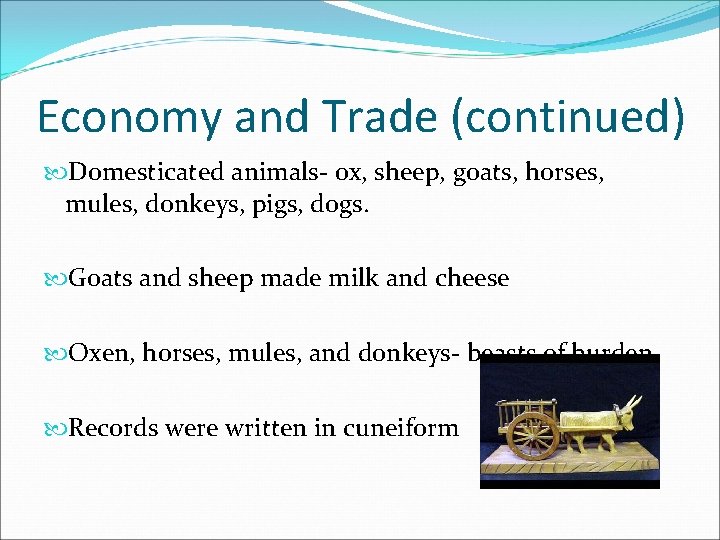
Economy and Trade (continued) Domesticated animals- ox, sheep, goats, horses, mules, donkeys, pigs, dogs. Goats and sheep made milk and cheese Oxen, horses, mules, and donkeys- beasts of burden Records were written in cuneiform
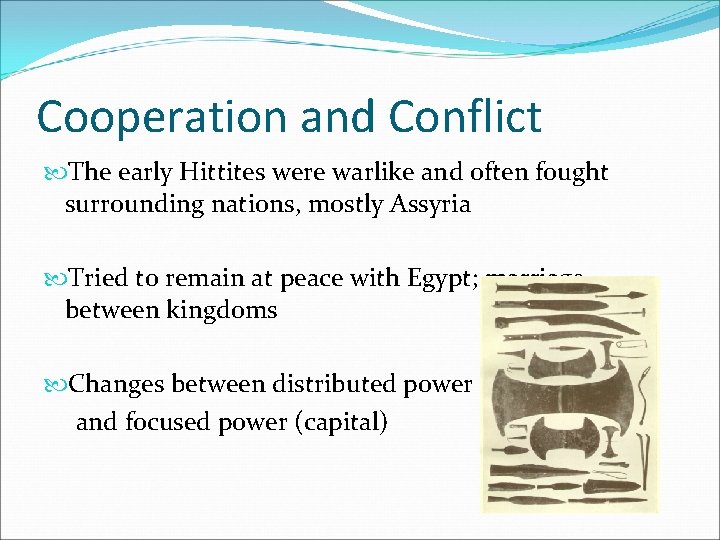
Cooperation and Conflict The early Hittites were warlike and often fought surrounding nations, mostly Assyria Tried to remain at peace with Egypt; marriage between kingdoms Changes between distributed power and focused power (capital)
Rulers and Leadership Hereditary kings- dominant hereditary monarchy Passed from father to ANY son, not always 1 st son Chief priest, acting in place of gods Commander of military Notable Kings: Labarna I-founder Mursili I-sacked Babylon Tudhaliya III-killed when father died Suppiliuma II-fall of capital Founders of first constitutional monarchy
Laws 200 paragraphs of laws; nearly as detailed as Hammurabi’s code Defined all crimes 2 versions of the code were found
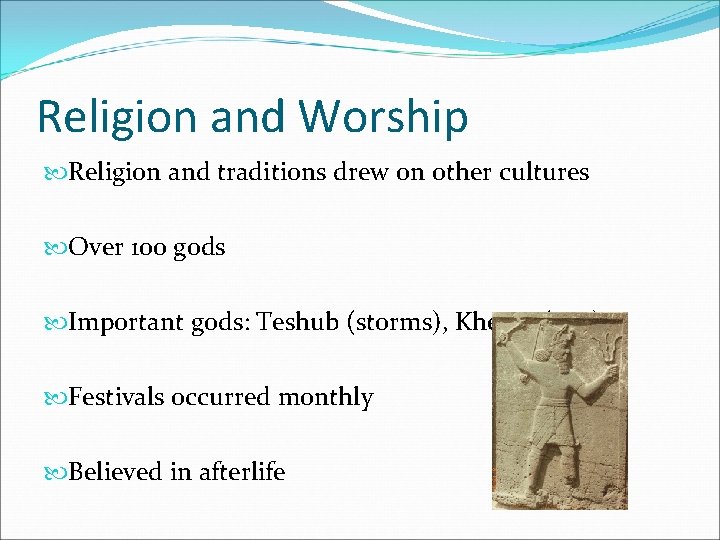
Religion and Worship Religion and traditions drew on other cultures Over 100 gods Important gods: Teshub (storms), Khepat (sun) Festivals occurred monthly Believed in afterlife
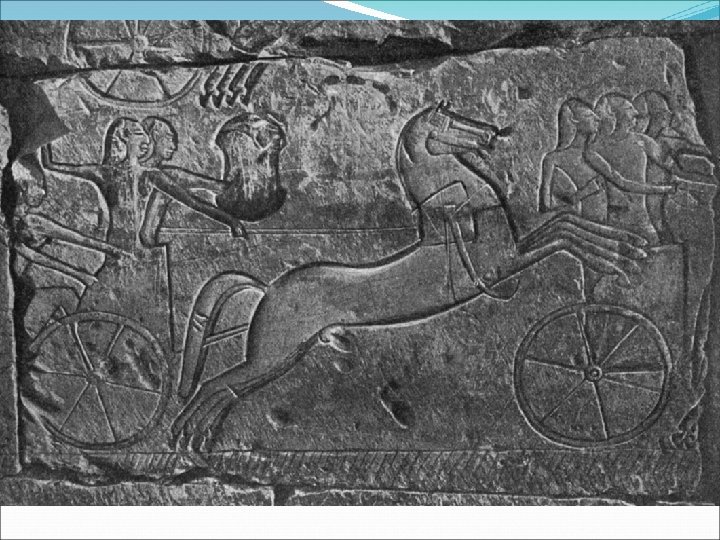
Technology Hittites made many innovations in the field of metal working Many people were craftsmen and worked as potters, textile makers, and many other jobs Increased chariot effectiveness
Continuity and Change Hittites took religions from others Kept what worked (iron), left what didn’t (bronze)
Ideas Controlled the market of metal ore and refinement trade Large time use of chariots in wars and travel Sacking of Babylon, leaving it open for invaders for about 100 years Conquered most of Anatolia
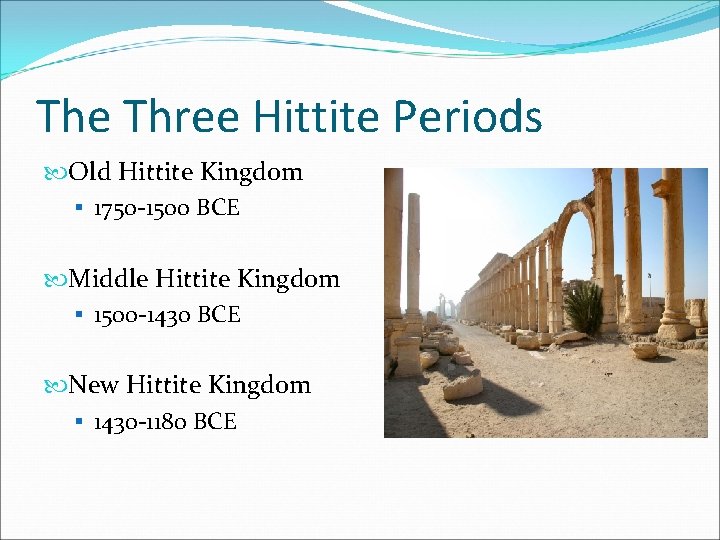
The Three Hittite Periods Old Hittite Kingdom § 1750 -1500 BCE Middle Hittite Kingdom § 1500 -1430 BCE New Hittite Kingdom § 1430 -1180 BCE
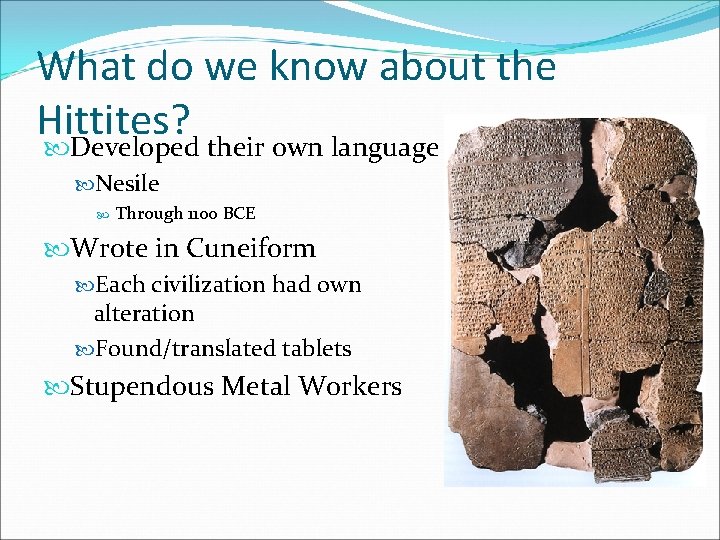
What do we know about the Hittites? Developed their own language Nesile Through 1100 BCE Wrote in Cuneiform Each civilization had own alteration Found/translated tablets Stupendous Metal Workers
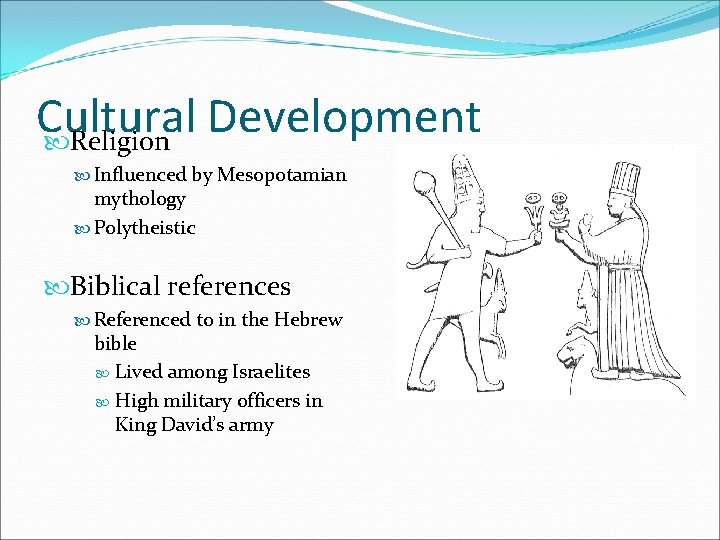
Cultural Development Religion Influenced by Mesopotamian mythology Polytheistic Biblical references Referenced to in the Hebrew bible Lived among Israelites High military officers in King David’s army
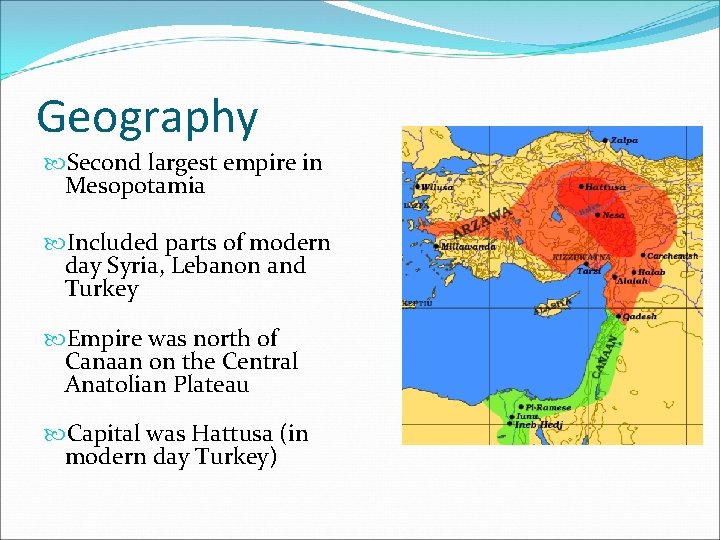
Geography Second largest empire in Mesopotamia Included parts of modern day Syria, Lebanon and Turkey Empire was north of Canaan on the Central Anatolian Plateau Capital was Hattusa (in modern day Turkey)
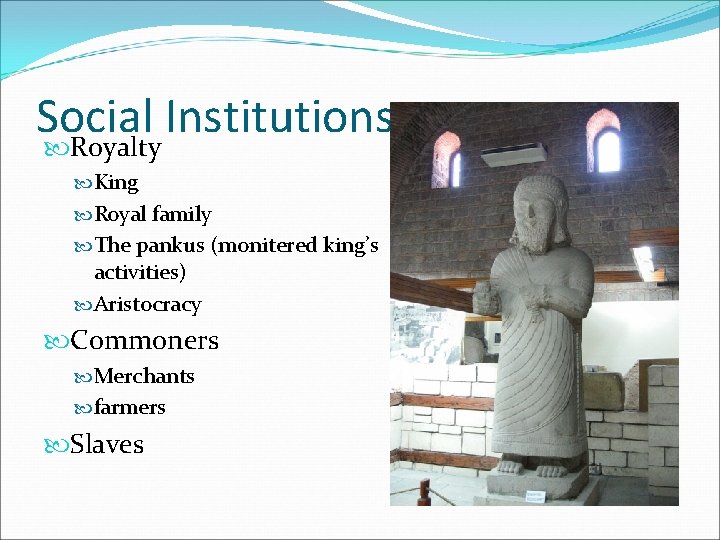
Social Institutions Royalty King Royal family The pankus (monitered king’s activities) Aristocracy Commoners Merchants farmers Slaves
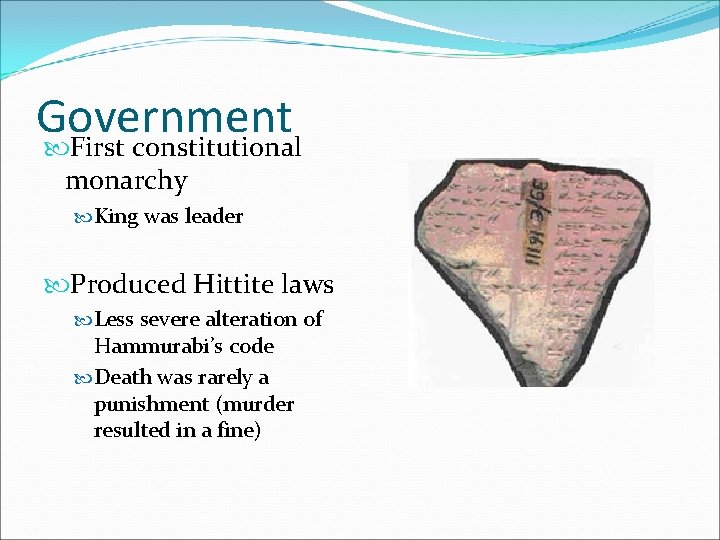
Government First constitutional monarchy King was leader Produced Hittite laws Less severe alteration of Hammurabi’s code Death was rarely a punishment (murder resulted in a fine)
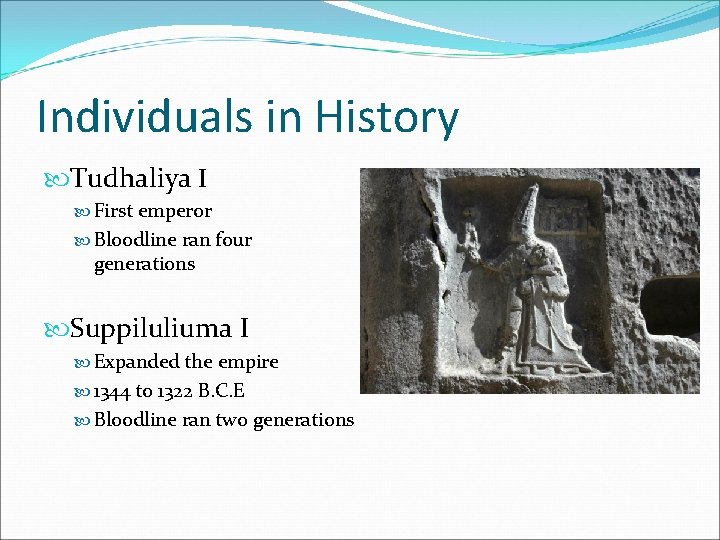
Individuals in History Tudhaliya I First emperor Bloodline ran four generations Suppiluliuma I Expanded the empire 1344 to 1322 B. C. E Bloodline ran two generations
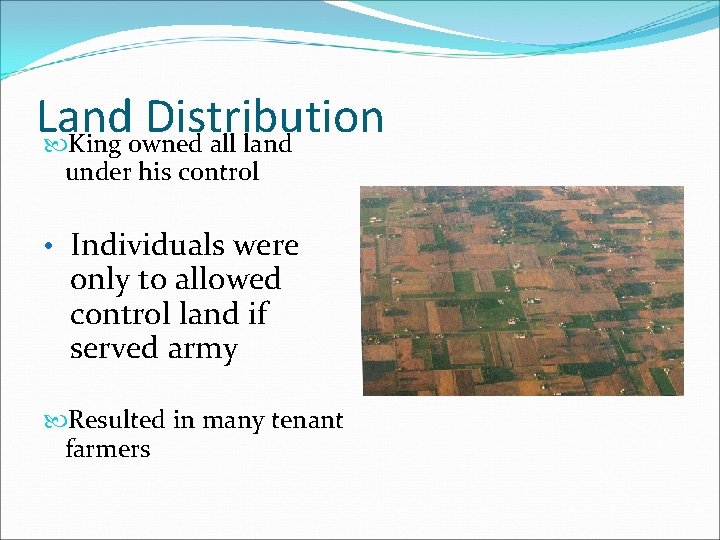
Land Distribution King owned all land under his control • Individuals were only to allowed control land if served army Resulted in many tenant farmers
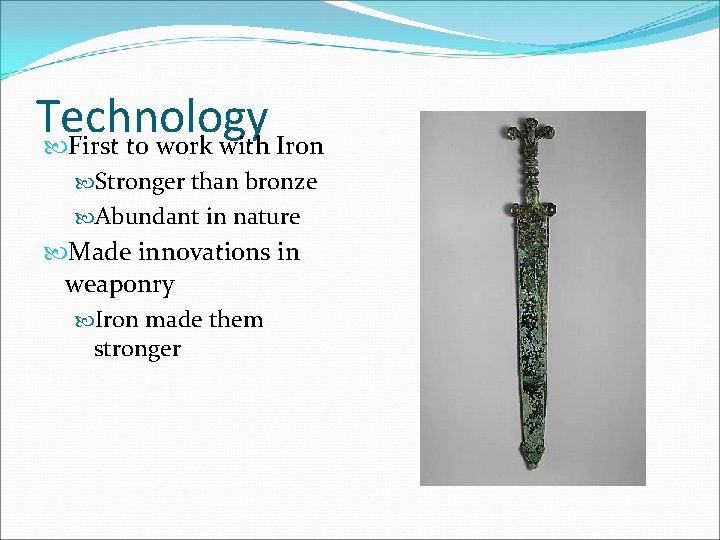
Technology First to work with Iron Stronger than bronze Abundant in nature Made innovations in weaponry Iron made them stronger
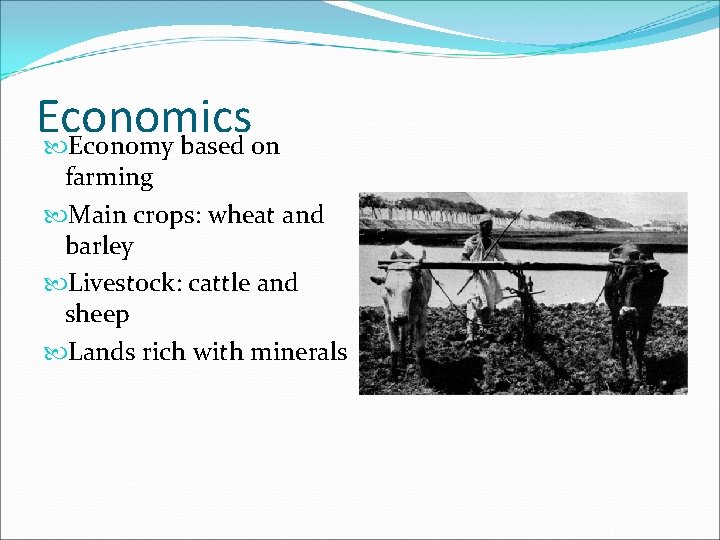
Economics Economy based on farming Main crops: wheat and barley Livestock: cattle and sheep Lands rich with minerals
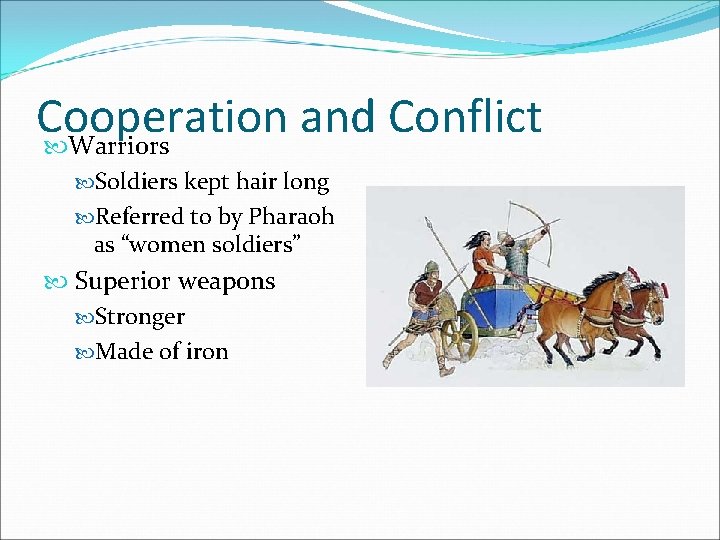
Cooperation and Conflict Warriors Soldiers kept hair long Referred to by Pharaoh as “women soldiers” Superior weapons Stronger Made of iron
Bibliography “Hittites. ” Wikipedia: The Free Encyclopedia. 16 November 2008 <http: //en. wikipedia. org/wiki/Hittites> “The Hittites. ” World Civilizations. 16 November 2008 <http: //www. wsu. edu/~dee/MESO/HITTITES. HTM> “List of Hittite Kings. ” Wikipedia: The Free Encyclopedia. 16 November 2008 <http: //en. wikipedia. org/wiki/List_of_Hittite_kings>
Bibliography (cont. ) “Hittites. ” Looklex Encyclopedia. 16 November 2008 <http: //lexicorient. com/e. o/hittites. htm> “History of the Hittites. ” Wikipedia: The Free Encyclopedia. 16 November 2008. <http: //en. wikipedia. org/wiki/Hittite_empire> Jantzen, Steven L. and Kreiger, Larry S. and Neil, Kenneth. World History: Perspectives on the Past. Lexington, Massachusetts and Toranto, Ontario: D. C. Heath and Company, 1992.
Bibliography Wallenfels, The Ancient Near East Volume II. Charles Scribner’s Sons, San Francisco; publishing year 2000 Wikipedia. org, Hittites. http: //en. wikipedia. org/wiki/Hittites November 13, 2008;
Bibliography <en. wikipedia. org/wiki/Hittites> www. wsu. edu/~dee/MESO/HITTITES. HTM <www. crystalinks. com/hittites. html>