
Hitlers rise to power By Harvey Brown Start
Hitler’s rise to power By Harvey Brown Start Book
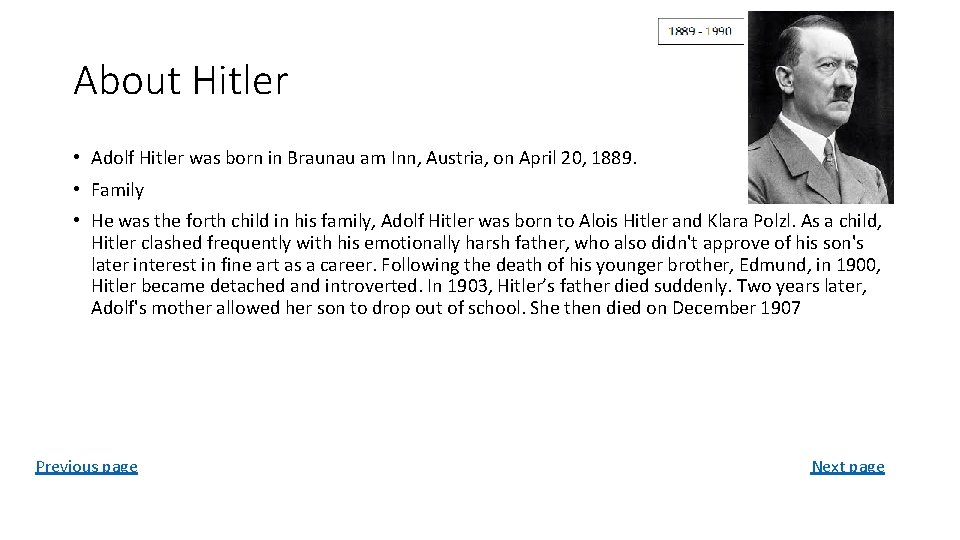
About Hitler • Adolf Hitler was born in Braunau am Inn, Austria, on April 20, 1889. • Family • He was the forth child in his family, Adolf Hitler was born to Alois Hitler and Klara Polzl. As a child, Hitler clashed frequently with his emotionally harsh father, who also didn't approve of his son's later interest in fine art as a career. Following the death of his younger brother, Edmund, in 1900, Hitler became detached and introverted. In 1903, Hitler’s father died suddenly. Two years later, Adolf's mother allowed her son to drop out of school. She then died on December 1907 Previous page Next page
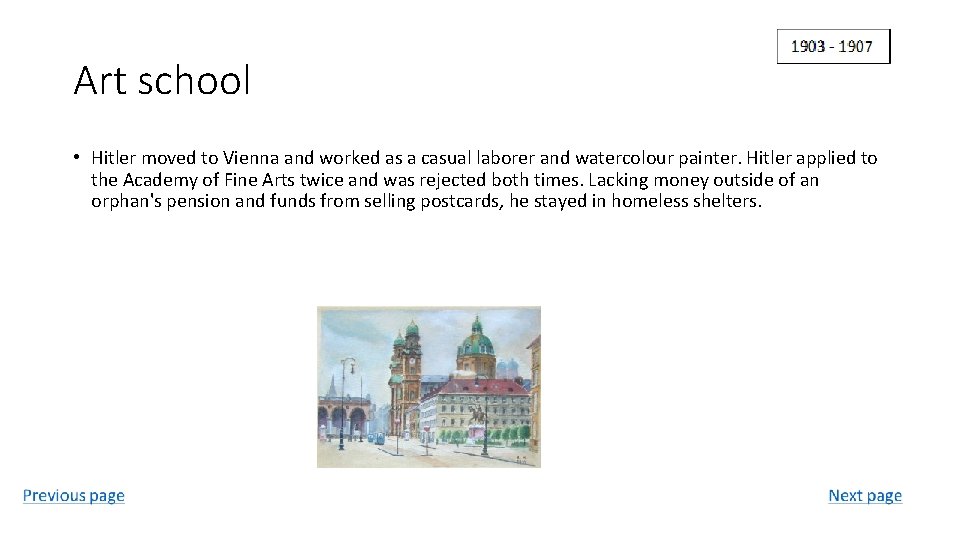
Art school • Hitler moved to Vienna and worked as a casual laborer and watercolour painter. Hitler applied to the Academy of Fine Arts twice and was rejected both times. Lacking money outside of an orphan's pension and funds from selling postcards, he stayed in homeless shelters.
Why Hitler hated Jews • Hitler’s time in Vienna shaped him. Between 1908 and 1913 the young Hitler was unsuccessfully to set himself up as an artist there. The city had a large Jewish community just before the First World War (1914 -1918) nearly 9% of the two million residents were Jewish but the social climate was openly antisemitic. With an outspoken anti-Jewish mayor (Karl Lueger) and many anti-Jewish newspapers and magazines there was no restriction on antisemitism, and Hitler was strongly influenced by this. Many nationalists and conservatives believed that Germany had not lost the war on the battlefield but due to betrayal from within, by a ‘stab in the back’. Socialists, communists and particularly Jews were blamed, even though more than 100, 000 German and Austrian Jews had served in the war and 12, 000 had been killed. This strongly influenced him to start putting the blame and influenced his hatred for the Jewish race.
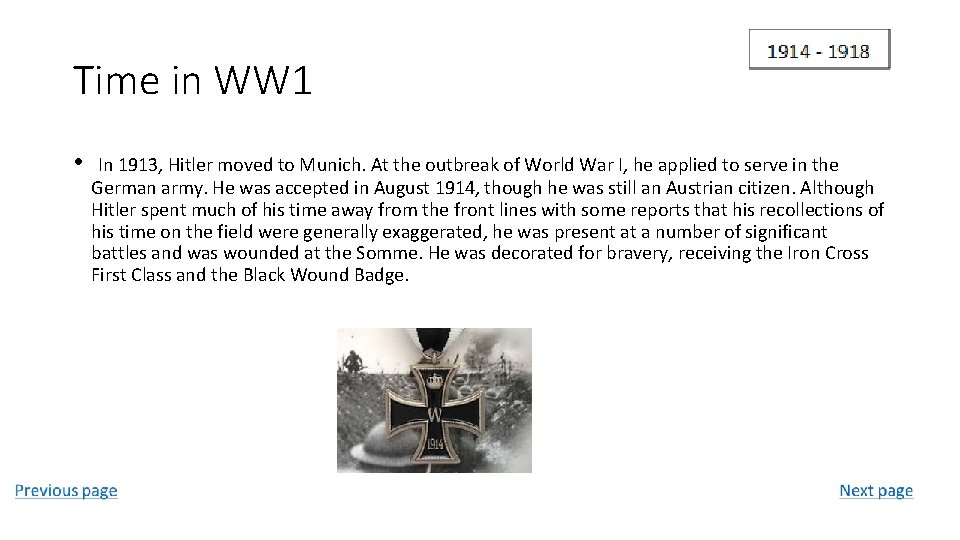
Time in WW 1 • In 1913, Hitler moved to Munich. At the outbreak of World War I, he applied to serve in the German army. He was accepted in August 1914, though he was still an Austrian citizen. Although Hitler spent much of his time away from the front lines with some reports that his recollections of his time on the field were generally exaggerated, he was present at a number of significant battles and was wounded at the Somme. He was decorated for bravery, receiving the Iron Cross First Class and the Black Wound Badge.
Treaty of Versailles • Germany was made to pay heavily for the war. the Treaty of Versailles (1919) set out that Germany had to give up large areas of land pay painfully high reparations to the allied victors. Politically and economically the country had been in deep crisis for years. Hitler and his party were so fiercely opposed to the new Weimar Republic, as it was called, that in 1923 they tried to seize power. The coup failed and Hitler was sentenced to five years in prison.

Joining the German workers party • After World War I, Hitler returned to Munich and continued to work for the German military. As an intelligence officer, he monitored the activities of the German Workers’ Party and adopted many of the anti -Semitic, nationalist and anti-Marxist ideas of party founder Anton Drexler

Nazi Party • In September 1919, Hitler joined the DAP, which changed its name to the National sozialist ische Deutsche Arbeiter partei often abbreviated to Nazi. Hitler personally designed the Nazi party banner, appropriating the swastika symbol and placing it in a white circle on a red background. He soon gained notoriety for his vitriolic speeches against the Treaty of Versailles, rival politicians, Marxists and Jews. In 1921, Hitler replaced Drexler as the Nazi party chairman.
Manipulation in speeches • After WW 1, Hitler joined a new extreme rightwing party, the National Socialist German Workers’ Party (NSDAP), quickly becoming its strongman because he could inspire people with his speeches. He noticed that propaganda against Jews and Bolsheviks (often mentioned together) struck a chord with audiences and voters. He claimed Jews were not only responsible for the unfair German defeat but were also blocking Germany’s recovery. As the German people felt betrayed with their loss in WW 1 they needed someone or something to blame so when Hitler came along with the solution and something to blame the German people took that and Hitler used this to get a massive following of people.
Mein Kampf • Hitler only served 10 months of his jail sentence, during which time he wrote Mein Kampf (My Struggle). The book is full of anti-Jewish passages and theories about the superiority of the German (Germanic) race. Hitler expresses his support for race theories and more “Lebensraum” (living space) for the German people. The German race had to strive for mastery in Europe or face annihilation. Therefore, people with disabilities, or with divergent sexual orientation or of a different race had to be removed from the population. According to this racial doctrine, Jews were an inferior race that was poisoning Germany and so did not belong in the community.
Becoming Chancellor • In 1928, the Nazis had only 12 seats in the Reichstag; by July 1932 they had 230 seats and were the largest party. The government was in chaos. President Hindenburg dismissed Brüning in 1932. His replacement - Papen - lasted six months, and the next chancellor Schleicher - only lasted two months. Hindenburg had to use Article 48 to pass almost every law. In January 1933, Hindenburg and Papen came up with a plan to get the Nazis on their side by offering to make Hitler vice chancellor. He refused and demanded to be made chancellor. They agreed, thinking they could control him. In January 1933, Hitler became chancellor, and immediately set about making himself absolute ruler of Germany using Article 48. Back to the start
- Slides: 11